The economics notes for UPSC Vajiram and Ravi come in two distinct forms, and buying the wrong one wastes money: the Vajiram Economics Optional Notes 2025-2026 is a printed set of 5 booklets built strictly for Mains Optional Paper I & II, while GS-Economy coverage (for Prelims + GS Mains Paper III) is folded into full study-material sets, not sold as a Vajiram economics-only pack. This page routes both intents — grab the printed Optional set below if Economics is your optional, or pick the GS Economy alternative if you only need Prelims and GS marks — and tells you plainly where each one stops being enough.
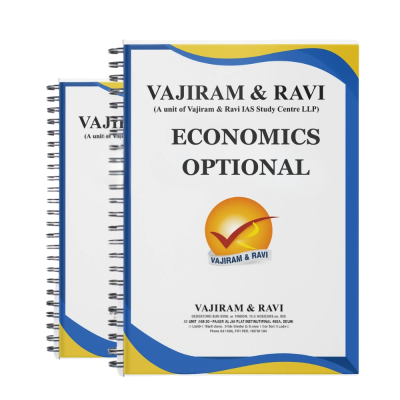
Vajiram Economics Notes 2025-2026 UPSC Economics Optional Booklets Set of 5

Vision IAS UPSC CSE 2026–27 Complete GS Notes | Prelims + Mains | 57 Booklets + Freebies
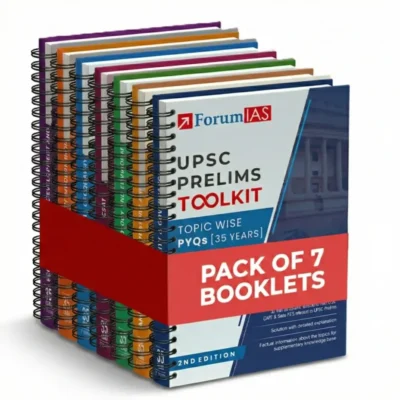
Forum IAS UPSC Prelims Toolkit: Topic Wise PYQ (1992-2025) – Ultimate Pack of 7 Booklets (2nd Edition)
Vajiram Prelims Test Series for 2026 - UPSC GS Prelims Test Series

Vision IAS Prelims Test Series 2026 | UPSC Prelims GS Tests in English Medium
Vision IAS Mains Test Series 2026 | UPSC GS Test Series
What the economics notes for UPSC Vajiram and Ravi actually cover
The Optional booklet set of 5 maps the entire CSE Economics syllabus, split the way UPSC splits it. Paper I covers pure theory: consumer and producer behaviour, market structures, welfare economics and general equilibrium (Micro); national income, IS-LM, inflation, employment and open-economy models (Macro); balance of payments, exchange-rate regimes, trade theory and WTO (International); and taxation, public debt, deficit financing and fiscal federalism (Public Finance). Paper II is Indian Economy — planning to NITI Aayog, agriculture, industry, money & banking, and the growth-and-development debates that examiners love to set as 20-markers. Each booklet uses numbered points, labelled diagrams, step-by-step derivations and comparative tables, so a single topic — say, the difference between cost-push and demand-pull inflation with the AS-AD diagram — sits on one or two facing pages you can revise in a single sitting.
If instead you only need Prelims + GS Mains economy — National Income (GDP/GVA/GNI), RBI and monetary-policy tools (repo, CRR, SLR, LAF), fiscal policy and the Union Budget, GST and direct-tax reform, capital markets and SEBI, external sector, NITI Aayog, and the inflation-indices set (CPI/WPI) — the Optional set is genuinely overkill. Its Micro and Public Finance theory will not be tested at that depth in GS, and you will spend weeks on derivations that earn zero Prelims marks. Use a GS notes set instead, such as the Vision IAS 2026-27 GS Notes (57 booklets), where the economy portion is written for application and current-affairs linkage rather than graduate theory.
Optional set vs GS Economy: which do you need?
| Factor | Vajiram Economics Optional (5 booklets) | GS Economy notes (within full set) |
|---|---|---|
| Best for | Economics as Mains Optional (Papers I & II, 500 marks) | Prelims + GS Mains Paper III |
| Depth | Graduate-level theory, diagrams, derivations | Application & current-affairs oriented |
| Syllabus | Micro, Macro, Intl, Public Finance, Indian Economy | Money/Banking, Budget, GST, NITI, inflation |
| Booklets | 5 | Part of 27-57 booklet set |
| Answer-writing | Optional-specific model structure with diagrams | GS-style pointwise, keyword-driven |
| Weekly hours to master | High — theory needs practice, not just reading | Moderate — layer onto NCERT + current affairs |
Rule of thumb: choose Economics Optional only if you have a commerce or economics background, or you actively enjoy working through models and derivations. Its scoring ceiling is high — 300+/500 in good years, and Paper II overlaps directly with GS Paper III, so preparation compounds. But the learning curve is steep, and the two papers reward mathematical comfort that humanities students often underestimate. Do not buy the Optional set until you have firmly confirmed Economics as your optional; these booklets will not lift your GS scores on their own, and switching optionals after buying is the most common wasted purchase in this segment.
Pricing & value
The printed Vajiram Optional set typically sells around the ₹1,249 mark against an MRP near ₹1,899 — a fraction of a full Economics Optional coaching course, which runs ₹40,000 and above, while carrying the same classroom-derived content you would sit through live. That is the core value case: you are buying the distilled class output without the fee, the travel and the fixed timetable. The trade-off is that printed notes lag by one exam cycle, so you must layer in the latest Economic Survey and Budget figures yourself (covered in the next section). For value, do not stack the Optional set against a second notes set — you will duplicate theory; pair it with a test series so you are converting reading into marks.
| Product | Role | Indicative price band |
|---|---|---|
| Vajiram Economics Optional Notes (5) | Core Optional theory | ₹1,000-1,400 |
| Vajiram Prelims Test Series 2026 | GS Prelims practice | Test-series band |
| Forum IAS Prelims Toolkit (PYQ 1992-2025) | Economy PYQ mastery | 7-booklet band |
Read the table as a kit, not a menu: the Optional notes build theory, the toolkit converts three decades of PYQs into pattern recognition, and the Prelims test series exposes gaps under time pressure. Buying all three still costs a fraction of one coaching course, and each covers a different failure mode — weak concepts, weak recall, weak exam temperament.
How to use the economics notes for UPSC Vajiram and Ravi
For the Optional, the method matters more than the reading. Work one booklet at a time and, after each chapter, reproduce every diagram from memory before moving on — Micro and Public Finance reward diagram accuracy most, and examiners routinely allot marks to a correctly labelled curve even when the prose is thin. Convert derivations into a one-line trigger you can recall in the hall rather than re-deriving from scratch. For Paper II, treat the printed Indian Economy sections as a skeleton and overwrite the data annually: plug in the latest Economic Survey growth figures, the current fiscal-deficit and Budget allocations, and the newest RBI policy stance, because a 2025-26 answer quoting stale numbers signals to the examiner that you have not updated.
For GS economy, the notes play a supporting role. Anchor first on NCERT (Class 11-12 macro and Indian economic development), then layer monthly current affairs, then drill the Forum IAS PYQ toolkit — economy is consistently 15-20 Prelims questions a year, and the toolkit’s 1992-2025 coverage exposes which sub-topics repeat (banking, external sector and government schemes dominate). Whichever track you are on, validate learning through the Vision IAS Mains Test Series to build answer-writing speed; theory that you cannot deploy inside the 7-8 minutes a 15-marker allows is theory you effectively do not have.
Are the Vajiram economics notes good — and who should buy which
| You are… | Buy this |
|---|---|
| Taking Economics Optional | Vajiram Economics Optional 5-booklet set (top pick) |
| Only need GS/Prelims economy | Vision IAS full GS notes set |
| Weak on economy MCQs | Forum IAS Prelims Toolkit + Vajiram Prelims Test Series |
| Revising before Mains | Notes + Vision IAS Mains Test Series |
| From a non-economics stream | Optional set + a standard theory textbook (Ahuja/Jhingan) |
Honest verdict: for structure and diagrams the Vajiram Optional notes are among the cleaner printed sets on the market — comparable to Sriram’s for Indian Economy but noticeably stronger on Paper I theory, which is exactly where most optional candidates lose marks. They work as a standalone Optional resource for aspirants with prior exposure to economics. A fresh non-economics student, however, should treat them as a summary layer and pair them with a standard textbook (Ahuja for Micro, Jhingan for growth and development) for the full derivations the booklets compress. In short: strong notes, but their sufficiency depends on the background you bring to them — match the purchase to your starting point using the table above, not to a generic recommendation.
Frequently Asked Questions
Are Vajiram and Ravi economics notes good for UPSC?
Yes — the Optional 5-booklet set is well-structured with numbered points, comparative tables and labelled diagrams, and is widely used by Economics Optional aspirants. Freshers to economics should pair it with a standard theory textbook for derivations.
How many booklets are in the Vajiram economics optional notes?
The Vajiram Economics Optional set contains 5 printed booklets covering Paper I (Micro, Macro, International, Public Finance) and Paper II (Indian Economy — Growth & Development).
Can I download the Vajiram economics notes PDF for free?
Unofficial PDFs float around on file-sharing sites, but they are usually outdated and incomplete. For the current 2025-26 printed set with the latest data, order the physical booklets from the product listing above.
Are these notes for Economics Optional or GS Economy?
The 5-booklet set is for Economics as a Mains Optional subject. If you only need Prelims and GS Mains economy, choose a full GS study-material set such as the Vision IAS GS notes instead.
Is economics a good optional subject for UPSC?
It has a high scoring ceiling and strong overlap with GS Paper III, but demands quantitative comfort. It suits commerce/economics graduates; humanities students without a background often find the theory demanding.