Buy IMS mathematics notes at Competer — printed and delivered with Cash on Delivery across India. Shop the full range below at the best price.
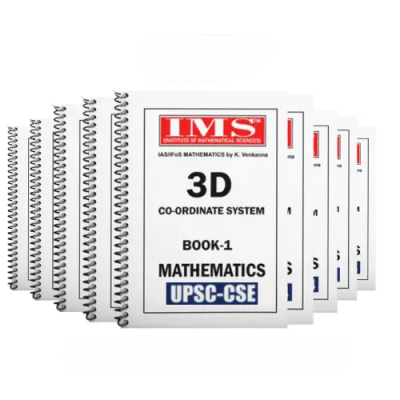
What the IMS Mathematics notes cover
The IMS Mathematics notes are a structured set of printed study material prepared for candidates taking the Mathematics optional in the UPSC Civil Services Mains examination. They walk through the full optional syllabus across both papers, so you work from one consistent source rather than stitching together scattered references. Paper I areas such as Linear Algebra, Calculus, Analytic Geometry, Ordinary Differential Equations, Dynamics and Statics, and Vector Analysis are covered alongside Paper II topics like Algebra, Real Analysis, Complex Analysis, Linear Programming, Partial Differential Equations, Numerical Analysis, and Mechanics and Fluid Dynamics.
Each unit typically moves from core definitions and theorems to worked examples and solved problems, which helps you see how concepts translate into the step-by-step answers the examiner expects. For a formula-heavy optional like Mathematics, having the derivations, standard results and representative question types in one place saves revision time and keeps your presentation uniform.
How to choose the right IMS Mathematics notes for you
Before you buy, match the material to where you stand in your preparation. If you are starting the optional fresh, look for notes that build each topic from first principles. If you have already finished a coaching cycle, prioritise sets that are strong on solved problems and previous-year patterns for quick revision. Check that both papers are fully represented, that the latest syllabus weightings are reflected, and that the handwriting or print is legible enough for long study sessions. Also consider the page volume against your available months — a very large set needs a realistic reading plan.
IMS Mathematics notes compared with other study routes
It helps to see how printed optional notes sit next to the common alternatives candidates weigh up.
| Study route | Best for | Effort to assemble | Revision speed |
|---|---|---|---|
| IMS Mathematics notes | Covering the full optional syllabus from one organised source | Low — ready to study on delivery | Fast — topic-wise structure |
| Standard textbooks | Deep theory and rigorous proofs | High — multiple books to track | Slow — dense and spread out |
| Self-made notes | Personalised recall of your weak areas | Very high — months of writing | Fast once complete |
| Online lectures | Understanding tricky concepts visually | Medium — note-taking required | Slow for last-minute review |
Many aspirants use a blend: notes as the spine of preparation, textbooks for the few topics they want to go deeper on, and lectures only where a concept refuses to click.
Who should buy these notes
These notes suit candidates who have already chosen Mathematics as their optional and want a syllabus-aligned base to study and revise from. They are a natural fit for working professionals and students short on time, for repeaters who want to tighten their answer presentation, and for self-study aspirants who are not attending a full classroom programme. Candidates with a mathematics or engineering background will move through them quickly, while those returning to the subject after a gap get a guided path back into the fundamentals. If you are still undecided about your optional, settle that choice first before investing in a full set.
How to use the notes effectively
Treat the notes as an active workbook, not a reading book. Read a topic, then immediately redo the worked examples on paper without looking, since Mathematics rewards practice over recognition. Keep a running list of standard results and formulas for daily revision. Attempt previous-year questions topic by topic as you finish each unit, and time yourself to build the speed Mains demands. Mark the sub-topics you find weak and schedule a second pass over them. In the final weeks, lean on the summarised results and solved problems for rapid, repeated revision rather than re-reading full derivations.
Buying and delivery
Ordering from Competer is straightforward: select the Mathematics optional set from the cards above, add it to your cart, and complete checkout with your delivery address. The material is printed and dispatched to your doorstep across India, so you do not have to arrange any printing yourself. Delivery timelines and any available shipping options are shown during checkout, and you can reach out through the site if you need help confirming which set matches your requirement before placing the order.
Frequently Asked Questions
Do the IMS Mathematics notes cover both optional papers?
Yes. The material is organised to span the Paper I and Paper II topics of the UPSC Mathematics optional syllabus so you can prepare both papers from one set.
Are these notes suitable for self-study without coaching?
They are structured topic-wise with worked examples, which makes them usable for self-study. Pairing them with disciplined problem practice and previous-year questions gives the best results.
How are the notes delivered?
The notes are printed and shipped to your address in India. You place the order through the product cards above and the material is dispatched to you directly.
Is a mathematics background necessary to use them?
A background helps you move faster, but the notes build topics from their fundamentals, so motivated candidates from other streams can follow them with consistent effort.
How should I revise from these notes before the exam?
Use the summarised results and solved problems for quick repeated revision, keep a formula sheet for daily review, and re-attempt previous-year questions under timed conditions.