Deciding between Shubhra Ranjan handwritten vs printed notes comes down to one trade-off: the scanned classroom handwritten booklets (Set of 11, full PSIR syllabus) give you a topper-grade, annotated, answer-writing-ready copy at a lower price, while machine-printed booklets give cleaner readability and durability for fast revision. For most PSIR optional aspirants we recommend the Shubhra Ranjan PSIR Class Notes 2025-26 handwritten set of 11; the printed format suits revision-year aspirants who already know the optional and only skim. Both cover the identical Paper 1 and Paper 2 syllabus — the difference is format, price and how the content reads, not what it contains.
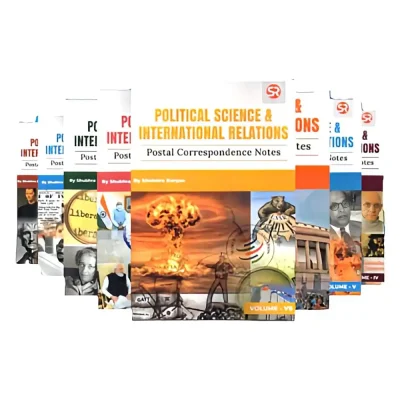
Shubhra Ranjan PSIR Class Notes 2025-26 Handwritten Booklets Set of 11
Shubhra Ranjan Handwritten Notes 2026 | PSIR Optional | 11 Booklets
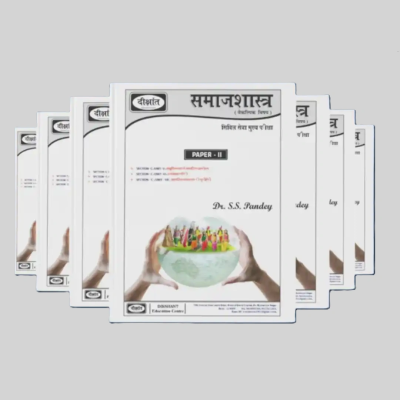
SS Pandey Sociology Handwritten Notes 2024-2025 (UPSC Optional, 9 Booklets)
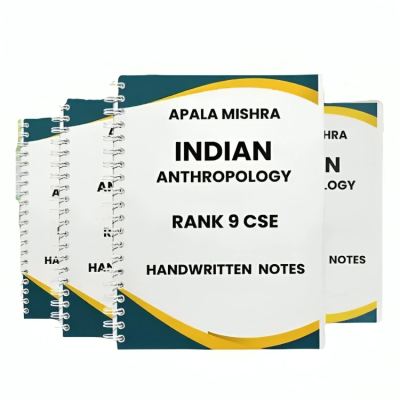
Apala Mishra Anthropology Handwritten Notes for 2024-2025 Printed Booklets Set of 4
Vajiram Public Administration Handwritten Booklets 2025-26 Set of 6
What you are actually comparing
Shubhra Ranjan handwritten notes are scanned classroom booklets — Madam’s lectures captured in her exact teaching sequence, with the margin notes, thinker names, diagram cues and answer-framing keywords kept intact on the page. Printed notes are the same content reset in clean machine type: book-quality, uniform line spacing, no handwriting to decode. The PSIR optional runs to roughly 11 booklets across both papers. Paper 1 covers Political Theory (liberalism, Marxism, theories of the state, justice, rights, democracy) and Indian Government & Politics (Constitution, federalism, party system, social movements). Paper 2 covers Comparative Politics and International Relations (approaches to comparison, globalisation, India’s foreign policy, the UN and regional groupings). Neither format auto-updates current affairs or fast-moving IR, so you supplement both the same way regardless of which you buy.
The decision is rarely about which format is “better” in the abstract — it is about which one matches your stage. A first-attempt aspirant learning the optional from scratch needs the classroom voice and the framing cues. A revision-year aspirant on their third reading needs speed and a page they can scan in seconds. The sections below break down exactly where each format earns its price.
Shubhra Ranjan handwritten vs printed notes: side-by-side
| Factor | Handwritten (Set of 11) | Printed booklets |
|---|---|---|
| Readability | High-resolution scans of legible classroom hand; denser on theory-heavy pages | Uniform machine type — fastest to skim, no handwriting to decode |
| Price band | Lower — usually the cheaper entry point for the full syllabus | Higher — combos commonly Rs 4,497-6,999 |
| Revision speed | Slower per skim; built for the first deep, sequential read | Faster for repeated rounds; easy to flick to a sub-topic |
| Answer-writing value | High — preserves Madam’s framing, keywords and the order she builds an argument | Moderate — same content, but margin cues and emphasis are flattened into body text |
| Durability | Scan-printed pages; spiral-bind or laminate covers to survive a full prep cycle | Book-quality binding; withstands daily handling across two attempts |
| Annotation space | Already annotated by Madam; less white space for your own notes | Cleaner margins to add your current-affairs links and examples |
| Current-affairs currency | Not updated — needs a monthly supplement | Not updated — needs a monthly supplement |
Pricing & value verdict
Handwritten sets undercut printed combos because they are direct scans rather than typeset, professionally bound books. Printed PSIR combos commonly sit in the Rs 4,497-6,999 band depending on whether you take a single paper or the full optional; the handwritten Shubhra Ranjan Handwritten Notes 2026 (11 booklets) is usually the lower-cost route to the same syllabus. On price-per-value the handwritten set wins decisively for a first reading: you pay less and you get the answer-writing cues that a typeset version strips out. Those cues — which keyword to lead an answer with, which thinker to cite for which sub-question, where Madam draws a comparison diagram — are exactly what a PSIR scorer rewards, and they are hard to reconstruct from clean print alone.
The printed premium is justified in one scenario: you have already read PSIR once, you retain the framework, and you now revise in three to four fast rounds before Mains. At that point you are not learning — you are refreshing — and the time you save skimming clean type across forty-five days of revision outweighs the higher sticker price. If you are still building the framework, paying more for skimmability you cannot yet use is the weaker spend.
Who should buy which
| Your profile | Best pick |
|---|---|
| First attempt, self-study, learning the optional from scratch | Handwritten Set of 11 — mirrors the classroom sequence and retains framing cues |
| Revision year, retains the framework, multiple fast rounds | Printed booklets — cleaner, faster skim |
| Budget-tight, wants the full syllabus at lowest cost | Handwritten Set of 11 — lowest entry price for both papers |
| Wants both retention and clean revision | Hybrid: handwritten to learn, printed to revise the final rounds |
| Struggles to read others’ handwriting | Printed booklets — removes the legibility risk entirely |
Do not buy the handwritten set if scanned cursive genuinely slows you down, or if you are six weeks from the exam and only skimming — the denser theory pages will cost you time you do not have. Equally, do not over-buy: the handwritten Set of 11 is complete on its own, and a hybrid is a comfort upgrade, not a requirement. Sociology optional aspirants under Upendra Sir should note this PSIR set will not help them at all; pick a subject-matched handwritten option such as the SS Pandey Sociology Handwritten Notes (9 booklets) instead. Matching the notes to your actual optional matters far more than the handwritten-versus-printed question itself.
How to actually use each format
For the handwritten set, read it the way it was taught — front to back, in Madam’s sequence — rather than jumping to topics. The booklets build arguments cumulatively, so Political Theory underpins how Comparative Politics is framed later. On your first pass, do not highlight everything; instead, copy the margin keywords into a one-page index per booklet so your revision later is keyword-driven. The handwritten cues are most valuable when you practise answers immediately: read a sub-topic, then write a 150-word answer using the exact keywords Madam flagged, and your introductions and value-additions will start to sound like a topper’s script.
For the printed set, the workflow is the reverse — use it as a revision spine. Because the margins are clean, mark your own current-affairs hooks beside each static topic: a recent Supreme Court judgment next to federalism, a foreign-policy development next to the IR chapters. By Mains you will have a printed booklet that is half static content and half your own linked examples, which is the most exam-ready state any note set can reach. This margin-annotation advantage is the quiet reason serious revisers pay the printed premium.
The supplement plan both formats need
Neither format updates itself, and PSIR Paper 2 in particular goes stale fastest because International Relations turns on current events. Whichever you buy, build a fixed top-up routine: a monthly current-affairs magazine for the dynamic portion, plus a running IR tracker for India’s bilateral and multilateral developments through the prep year. Pair the static booklets with the previous five years of PSIR question papers so you can see which static topics keep returning and weight your revision accordingly. The notes give you the framework; the supplements keep it from aging out before you sit the exam. Aspirants who treat the booklets as a finished product rather than a spine to update are the ones who find their answers reading a year out of date.
Buying tips & honest downsides
Three things to check before paying. First, confirm the edition — insist on 2025-26 or 2026 so the recent syllabus reorganisation is reflected; an older edition can leave gaps in the reshuffled Paper 1 theory section. Second, accept the handwritten downside upfront: scan quality is high but theory-dense pages run tighter, so this format rewards deep reading and punishes last-minute skimming. Third, plan the current-affairs and IR top-up before you buy, not after — a note set you cannot keep current is a half-purchase. For a sense of what fully typeset, book-quality print looks like across an optional, compare the Apala Mishra Anthropology printed booklets (Set of 4); and GS-heavy aspirants who want governance depth alongside PSIR often add the Vajiram Public Administration handwritten booklets (Set of 6) to cover the administrative-theory overlap. The honest bottom line: the handwritten Set of 11 is the higher-value pick for the majority of aspirants, the printed set earns its premium only in the revision year, and a hybrid is a worthwhile upgrade only once your budget and your prep stage both support it.
Frequently Asked Questions
Are Shubhra Ranjan handwritten notes better than printed notes for UPSC?
For a first deep reading, yes — the handwritten Set of 11 keeps Madam’s answer-writing cues and classroom sequence, which aids retention and makes your answers read sharper. For fast multi-round revision, printed booklets are easier to skim. Choose by stage, not by hype.
What is the difference between Shubhra Ranjan printed and handwritten notes?
Handwritten notes are scanned classroom booklets with margin annotations and framing keywords; printed notes are the same syllabus reset in clean machine type, more durable and uniform. Content scope is identical across both papers; format, price, readability and annotation space differ.
How many booklets are in Shubhra Ranjan PSIR notes?
The PSIR optional spans roughly 11 booklets across Paper 1 and Paper 2 — covering Political Theory, Indian Government & Politics, Comparative Politics and International Relations.
Are handwritten notes enough for PSIR optional or do I need printed notes too?
The handwritten Set of 11 covers the full syllabus and is sufficient on its own. Many aspirants add the printed set as a hybrid — handwritten to learn, printed to revise — but it is an optional upgrade, not a requirement.
Are Shubhra Ranjan notes updated with current affairs and recent syllabus?
The core notes follow the latest 2025-26 syllabus, but neither format auto-updates current affairs or fresh IR developments. Supplement both with a monthly current-affairs source and an IR tracker before Mains.