Which is the best Mains test series for IAS? For most GS aspirants the honest answer is the Vision IAS Mains Test Series 2026 for question standard, model-answer quality and the largest ranking pool, with Rau’s IAS the pick when 24–48 hour copy evaluation matters more to you than brand. But the genuinely correct choice is a function of four variables specific to you: your Mains date, your optional subject, your current answer-writing level, and your budget. This page gives you a five-point scoring checklist, an institute-by-institute breakdown, two decision tables, and the answer-writing material that decides whether any Mains test series for IAS actually converts effort into marks.
Vision IAS Mains Test Series 2026 | UPSC GS Test Series

Vision IAS Prelims Test Series 2026 | UPSC Prelims GS Tests in English Medium
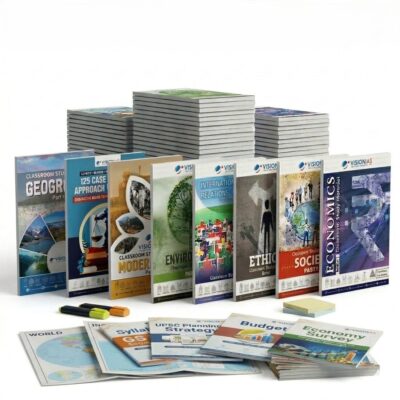
Vision IAS UPSC CSE 2026–27 Complete GS Notes | Prelims + Mains | 57 Booklets + Freebies
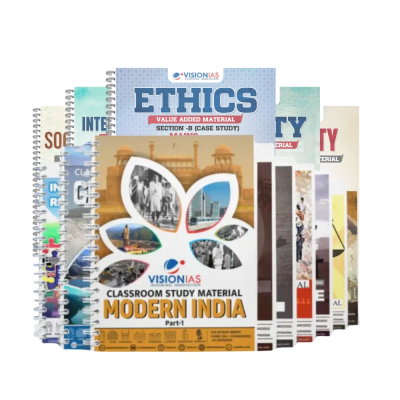
Vision IAS GS 2026-27 Booklets with Value Added Materials - 56 Booklets
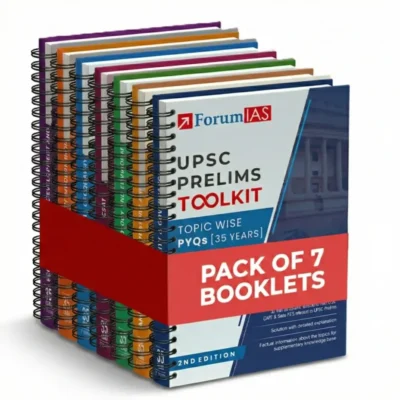
Forum IAS UPSC Prelims Toolkit: Topic Wise PYQ (1992-2025) – Ultimate Pack of 7 Booklets (2nd Edition)

Vision IAS Current Affairs Magazine January 2026 | English Medium Edition
How to judge which is the best Mains test series for IAS
Skip the brand war. Score every option on five measurable things, and the shortlist writes itself.
1. Evaluation turnaround — the single biggest differentiator. A test series exists to run a write–review–rewrite loop, and a slow checker breaks that loop. Rau’s IAS returns evaluated copies in 24–48 hours; Next IAS in roughly 72–96 hours; Vision IAS in about 4–7 days; and Insights IAS can take around 6 working days at peak load. If your copy comes back a week later, you have already written two more tests and forgotten your own reasoning, so the feedback lands on cold ground. When you are writing 20–25 tests in a compressed window, a 2-day return versus a 7-day return is the difference between fixing a structural weakness in three attempts and dragging it across the whole programme.
2. Test count and composition. A complete GS programme should give you 8–12 sectional or thematic tests (GS-I society and history, GS-II polity and IR, GS-III economy and environment, GS-IV ethics) plus 8–10 full-length 250-mark, 3-hour papers that rehearse the real endurance problem. Insist on separate Essay tests and dedicated GS-IV case-study papers, because both are scored on skills you cannot rehearse inside a normal GS sectional. A programme that bundles ethics into general GS and skips essays entirely is underbuilt, however cheap it looks.
3. Feedback depth. A number out of 250 teaches you nothing. What moves your score is a mix of four things: micro comments in the margin flagging exactly where an argument thins out, a macro note on structure and introduction–body–conclusion balance, model answers written inside the real 150-word and 250-word limits, and score-pulling keywords or diagrams you failed to deploy. Ask to see a sample evaluated copy before you pay. If the sample shows only ticks and a total, the evaluation is decorative.
4. PYQ alignment and current-affairs linkage. UPSC Mains rewards unpredictability, so a good paper reverse-engineers the last five to ten years of Previous Year Questions for pattern and difficulty, then layers current-affairs hooks on top so a static-syllabus question still demands a 2025–26 example. Ask how often the question bank is refreshed. A series recycling 2021 papers with no current-affairs overlay is training you for an exam that no longer exists.
5. Schedule format. A fixed calendar forces discipline and puts you in a synchronised peer group that makes percentile ranking meaningful. Attempt-anytime suits repeaters and working professionals revising on their own clock but strips out the ranking signal. Neither is better in the abstract — pick the one that matches how you actually behave under no supervision.
Comparing the main options for UPSC Mains
No single institute wins on every axis, and pretending otherwise is how aspirants overpay. Here is where each one earns its place. Vision IAS leads on question standard and the sheer size of its peer group, which makes its percentile ranking the most trustworthy calibration of where you actually stand nationally; its model answers are tight and exam-realistic. Insights IAS is the depth pick — topper-angle feedback and richly sourced model answers — but its copy return is the slowest of the majors, so it rewards aspirants who write ahead of schedule and can wait. Rau’s IAS is built around evaluation speed and a mentor call, so it is the natural home for repeaters who need to iterate fast on a known weakness. Next IAS gives you micro-plus-macro comments at the lowest entry price, making it the value play for a first, exploratory Mains cycle. ForumIAS through its MGP (Mains Guidance Programme) blends peer review with mentor oversight and sits mid-market on both price and turnaround.
| Institute | GS + FLT tests | Evaluation time | Feedback depth | Indicative price |
|---|---|---|---|---|
| Vision IAS | ~24 (sectional + 8–10 FLT) | ~4–7 days | Model answers + margin notes | ₹18,000–₹32,000 |
| Insights IAS | ~30+ | ~6 working days | Detailed, topper-angle | ₹15,000–₹28,000 |
| Rau’s IAS | ~20 | 24–48 hours | Personalised, mentor call | ₹25,000–₹50,000 |
| Next IAS | ~18–22 | 72–96 hours | Micro + macro comments | ₹8,000–₹20,000 |
| ForumIAS | ~20 (MGP) | ~3–5 days | Peer-review + mentor | ₹12,000–₹30,000 |
Read the table as a trade-off map, not a leaderboard. Rau’s buys you the fastest loop but at the top of the price band; Next IAS buys you the lowest price but a slower, lighter loop; Vision and Insights buy you the biggest ranking pool and the deepest model answers respectively. Decide which axis is your actual bottleneck this cycle, then pay for that axis and refuse to pay a premium for the ones that do not bind you.
Essay and Ethics — the tests most aspirants under-buy
GS ranking gets all the attention, but Essay (250 marks) and Ethics/GS-IV (250 marks) together carry 500 marks and are where scores swing hardest, because both reward a repeatable technique rather than raw content. A serious Mains test series should give you at least 4–6 full essays evaluated on structure, sub-theme balance and philosophical anchoring, not just prose quality, plus 6–8 GS-IV papers heavy on case studies where the evaluator marks your stakeholder identification, the ethical dilemma you named, and whether your resolution stayed practical. When you compare programmes, price the Essay and Ethics component separately in your head. A GS-only package that looks cheaper often is not, once you add the standalone Essay-plus-Ethics module you will inevitably buy to cover the gap.
Pricing, value and free alternatives
Expect ₹8,000–₹20,000 for a test-only GS package and ₹25,000–₹50,000 for test-plus-discussion classes with GS, Essay and Ethics bundled. The premium tier buys you live discussion, mentor calls and often offline peer pressure; the test-only tier buys you papers and evaluation and nothing else. If ₹15k-plus is out of reach, a workable free route exists: write PYQ-based answers on a self-schedule and self-evaluate against a published model-answer set. It is genuinely cheaper, but you lose the two things you cannot manufacture alone — the national ranking and an outside eye that catches the mistakes you have gone blind to.
Either path only pays off if your notes are already Mains-ready, because a test series checks how well you deploy content, it does not supply the content. This is where most of the enrolment fee gets wasted: aspirants sit tests they have no material to answer well, then blame the series. Pair the programme with the Vision IAS 2026–27 Complete GS Notes (57 booklets, Prelims + Mains) or the Vision IAS GS 2026-27 Booklets with Value Added Material so you have structured, examiner-ready answer content for every sectional, and feed the Vision IAS Current Affairs Magazine (January 2026) into your answers so every static question carries a fresh, dated example — exactly the current-affairs linkage that pulls an answer from the 6-mark band into the 9-mark band.
Who should buy which — and who should skip it
| Your situation | Best fit | Why |
|---|---|---|
| Fresher, first Mains attempt | Vision or Insights full GS + Essay | Large peer group, ranking calibration |
| Repeater, weak on copy speed | Rau’s IAS | 24–48 hr feedback for tight rewrite loops |
| Tight budget (< ₹12k) | Next IAS / ForumIAS MGP | Lowest entry price, still mentored |
| Working professional | Attempt-anytime series | No fixed calendar pressure |
| Answer-writing basics not built | None yet | Fix notes + daily writing first |
The bottom row is the one aspirants ignore and regret. Do NOT buy a premium ₹40k-plus programme if you have not yet finished the syllabus once and cannot write a structured 250-word answer in eight minutes — you will burn through tests you cannot attempt seriously, and a wasted evaluated copy is worse than no copy because it trains you to normalise weak answers. Build the base first: drill the pattern of the exam with the Forum IAS Topic-Wise PYQ Toolkit (1992–2025) so you know what UPSC actually asks and how it repeats, get one clean GS notes set into your memory, write a structured answer a day for a month, then enrol. A test series is an amplifier — it multiplies whatever you already have, including zero.
Buying tips and evaluation red flags
Start your Mains test series roughly 8–10 months before the exam. For CSE 2026 Mains, that means enrolling by late 2025 or early 2026, which leaves room to complete 20–25 evaluated tests without cramming five papers into the final fortnight. Aim for 20–25 seriously written and fully reviewed tests, not 40 unrevised ones — the review is the product, and an unread evaluated copy is money set on fire.
Walk away when you see any of these red flags: evaluation that routinely stretches beyond a week (the loop is dead); generic one-line remarks with no keyword or structural feedback (the evaluator is a rubber stamp); model answers that blow past the 150 or 250-word limit (they are teaching you a length you can never write in the hall); or a question bank of repeated papers with no current-affairs refresh (you are rehearsing last year’s exam). On the online-versus-offline question, treat quality as a wash — offline adds peer pressure and same-day doubt-clearing, online adds attempt-anytime flexibility and recorded discussion videos you can replay. Pick by your own discipline, not by prestige. And if you are still in the Prelims-to-Mains bridge with your qualification not yet secure, do not spend on Mains at all until Prelims is locked — protect the gate first with the Vision IAS Prelims Test Series 2026, then commit to a Mains programme.
One last calibration on the optional subject: a GS Mains test series does not cover your optional, which carries 500 marks of its own. If your optional is shaky, a subject-specific optional test series or a strong optional mentor will move your rank more than upgrading from a ₹20k GS series to a ₹40k one. Diagnose your weakest 250 marks honestly, then spend where the marks are, not where the marketing is.
Frequently Asked Questions
Which test series is best for UPSC Mains?
For question standard and peer ranking, Vision IAS is the common top pick; for the fastest 24–48 hour copy evaluation, Rau’s IAS leads. The best choice depends on your Mains date, optional and budget — use the five criteria above to self-select.
When should I start the Mains test series for IAS?
Roughly 8–10 months before Mains, and only after you have finished the syllabus once. For CSE 2026 that means enrolling around late 2025 to early 2026 so you can complete 20–25 evaluated tests.
How many tests should I write for UPSC Mains?
Aim for 20–25 seriously written and evaluated tests — a mix of 10–14 sectional/thematic papers and 8–10 full-length 250-mark tests, plus separate Essay and Ethics tests. Quality of review beats raw quantity.
Is Vision IAS or Insights IAS better for Mains test series?
Vision IAS scores higher on question standard and a larger ranking pool; Insights IAS offers deeper, topper-angle feedback but a slower ~6-working-day return. Freshers who want calibration lean Vision; content-depth seekers lean Insights.
Are UPSC Mains test series worth it?
Yes, if you use the feedback — a test series forces answer-writing under time pressure and gives an outside evaluation you can’t self-generate. It is not worth it if your notes and basic answer structure aren’t ready, or if you won’t attempt the tests seriously.