Buy Manikant Singh history notes at Competer — printed and delivered with Cash on Delivery across India. Shop the full range below at the best price.
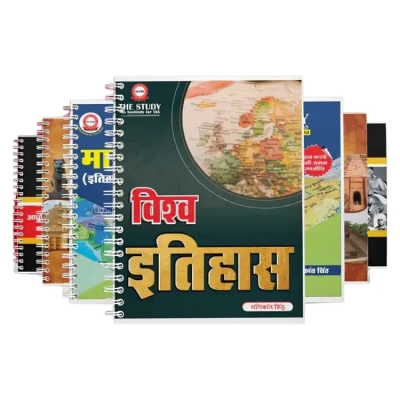
The manikant singh history notes are among the most trusted printed study resources for aspirants preparing History as an optional subject and for the General Studies History portions of the UPSC Civil Services Examination. On this page you can order the complete set of these classroom-tested notes, printed and delivered to your doorstep so that you can focus on revision rather than running to the photocopy shop.
What the manikant singh history notes cover
These notes are built around the full UPSC History syllabus and are structured to work for both the optional paper and the GS requirement. The coverage typically spans Ancient India, Medieval India, Modern India, World History, Art and Culture, and historiography. The material is organised topic-wise so that each theme flows logically, with cause-and-effect linkages, dates, dynasties, movements and personalities laid out in a way that mirrors how questions are framed in Mains answer writing.
For History optional candidates, Paper I and Paper II content is handled in depth, including map-based questions, archaeological sources and interpretation-based debates. For GS aspirants, the emphasis shifts to high-yield areas such as the freedom struggle, socio-religious reform movements, and post-independence consolidation, which recur frequently in Prelims and GS Paper I.
How to choose the right set of notes
Start by deciding whether you need the full History optional package or only the GS History segments. Optional aspirants should pick the comprehensive multi-booklet set, while GS-only candidates can often manage with the Modern India and Art and Culture portions. Next, check that the edition you buy is aligned with the current syllabus and recent question trends. Consider the print quality, binding and legibility, since you will be revising these pages many times before the examination. Finally, match the notes to your own base level: a beginner benefits from the detailed version, whereas a repeater may prefer a tighter revision-focused set.
Comparison: History optional notes versus GS History notes
| Aspect | History Optional Notes | GS History Notes |
|---|---|---|
| Target paper | Optional Paper I & II | Prelims & GS Paper I |
| Depth of coverage | Very detailed, analytical | Concise, fact-focused |
| World History | Covered in full | Limited, selective |
| Art & Culture | Integrated with themes | Standalone high-yield unit |
| Ideal for | History optional aspirants | Candidates with other optionals |
| Revision time | Longer, multiple booklets | Shorter, compact |
Who should buy the manikant singh history notes
These notes suit a wide range of aspirants. If you have chosen History as your optional subject, the complete set gives you a structured spine for the entire preparation. If your optional is something else but you want to strengthen the GS History score, the GS-oriented booklets offer dependable coverage without overwhelming you. Working professionals and distance learners who cannot attend regular coaching also find the printed notes helpful, as they replicate a classroom sequence in self-study form. Repeaters who already know the syllabus can use them purely for fast, reliable revision.
How to use these notes effectively
Treat the notes as a core text rather than a one-time read. Begin with a first pass to understand the chronology and major themes, marking the areas that feel weak. In the second pass, link each topic to previous years’ questions and practise writing structured answers using the points provided. Make short margin annotations for last-minute recall, and use the map and timeline sections for quick visual revision. For Prelims, convert the factual portions into one-liners and test yourself regularly. Pair the notes with current affairs for the modern and post-independence segments, since examiners often connect historical themes to contemporary relevance.
Buying and delivery
Ordering is straightforward: select the set that matches your requirement from the cards above, add it to your cart and complete the checkout. The notes are printed and dispatched to your shipping address across India, with order tracking so that you know when to expect delivery. If you are unsure which combination fits your strategy, choose the complete set for optional preparation or the GS-focused booklets if History is not your optional. Keep an eye on the listed edition details before placing the order so that you receive material aligned with the latest pattern.
Frequently Asked Questions
Are these notes suitable for both History optional and GS?
Yes. The complete set is designed for History optional preparation, while specific booklets such as Modern India and Art and Culture serve the GS History requirement well.
Do the notes cover the entire UPSC History syllabus?
The optional set spans Ancient, Medieval, Modern and World History along with Art and Culture, matching the prescribed syllabus for Papers I and II.
Can a beginner start History preparation with these notes?
Yes. The topic-wise structure and logical sequencing make them beginner-friendly, though beginners should pair them with standard reference reading for deeper context.
Will the notes be printed and delivered to my address?
Yes. Your selected set is printed and shipped to your delivery address across India, with tracking available after dispatch.
Should GS aspirants buy the full optional set?
Not necessarily. If History is not your optional, the GS-focused booklets are usually sufficient and save you revision time.