Public Administration Optional Syllabus 2026: Paper 1 & 2 + PDF
Complete public administration optional syllabus for UPSC 2026: full Paper 1 & 2 topics, PDF, booklist, PYQ trends, strategy and Hindi guidance.

The public administration optional syllabus for UPSC has two papers of 250 marks each (500 total): Paper 1 covers Administrative Theory (12 topics) and Paper 2 covers Indian Administration (14 topics) — 26 topics in all. Each paper has 8 questions in a two-section format and you attempt 5 (Q1 and Q5 compulsory). Because the syllabus is short, static and overlaps heavily with GS Paper II, GS Paper IV (Ethics) and the Essay, Public Administration remains one of the most time-efficient, scoring optionals for candidates who write differentiated, example-backed answers.
This guide gives you the complete topic-wise syllabus for both papers, how to build a PDF from the official notification, the recommended booklist, a thinker-to-topic map, PYQ weightage trends, a comparison with rival optionals, a 120-day study plan, Hindi-medium guidance, and an honest 2026 verdict on whether Public Administration is still worth it. Bookmark it — it is built to be your single planning page for the entire optional.
Public Administration Optional at a Glance: Exam Pattern
Before you download the syllabus, understand the exam structure. Public Administration (often shortened to “Pub Ad”) is a single-subject optional split across two Mains papers. Both are descriptive, and both reward structured, keyword-driven answers backed by thinkers, committees and real administrative examples.
| Parameter | Details |
|---|---|
| Paper 1 | Administrative Theory — 250 marks |
| Paper 2 | Indian Administration — 250 marks |
| Total marks | 500 (both papers combined) |
| Questions per paper | 8 questions in 2 sections (A & B) |
| Questions to attempt | 5 — Q1 and Q5 compulsory, then 3 more (at least 1 from each section) |
| Duration per paper | 3 hours |
| Medium | English or Hindi (and other Schedule VIII languages) |
| Nature | Descriptive / theory + application |
Because the syllabus is short and self-contained, most aspirants can cover it in roughly 4–5 months of focused study, leaving more time for GS and answer-writing practice than lengthier optionals like History or Geography demand.
Why Choose Public Administration Optional for UPSC
The public administration optional syllabus UPSC aspirants pick is famous for three reasons — it is compact, it is scoring, and it recycles a lot of what you already study for General Studies. Here is the concrete case:
- Short, static syllabus: Compared with optionals that run into hundreds of pages, Pub Ad’s core theory can be mapped onto a few standard books, making revision fast before Mains.
- Heavy GS overlap: Topics such as governance, civil services, accountability, RTI, e-governance, local government and administrative reforms appear almost verbatim in GS Paper II, while ethics thinkers and concepts feed GS Paper IV.
- Essay and interview value: Governance vocabulary — citizen charter, good governance, cooperative federalism, SDGs, welfare delivery — elevates your Essay and Personality Test answers.
- Real-world relevance: If you aim to become an administrator, the subject literally teaches how the Indian state is organised and run, which keeps motivation high.
Aspirants planning to buy structured notes often pair the optional with a syllabus-mapped booklet like the GS Score Latest Syllabus Booklet 2026-27 so the UPSC-notified wording is always in front of them while making notes.
Public Administration Optional Syllabus Paper 1 and Paper 2: Structure
The public administration optional syllabus paper 1 and paper 2 divide neatly: Paper 1 is conceptual and global (Administrative Theory), while Paper 2 is applied and India-specific (Indian Administration). You must master Paper 1’s thinkers to score in Paper 2’s application questions, so treat the two papers as one integrated course rather than silos.
| Paper | Focus | No. of Topics | Core Skill Tested |
|---|---|---|---|
| Paper 1 | Administrative Theory (concepts, thinkers, models) | 12 | Theoretical clarity + thinker quotes |
| Paper 2 | Indian Administration (institutions, reforms, current issues) | 14 | Application + current-affairs linkage |
Full Public Administration Optional Syllabus — Paper 1 (Administrative Theory)
Paper 1 has 12 topics. Below is the complete topic-wise breakdown as notified by UPSC, with the key sub-areas you must prepare under each.
| # | Topic | Key Sub-Topics to Prepare |
|---|---|---|
| 1 | Introduction | Meaning, scope and significance of Public Administration; Wilson’s vision; comparison of public & private administration; New Public Administration; New Public Management (NPM); Good Governance; changing role of the state. |
| 2 | Administrative Thought | Scientific Management (Taylor); Classical Theory (Fayol, Urwick, Gulick); Bureaucratic model (Weber & critiques); Ideas of Mary Parker Follett; Human Relations (Elton Mayo); Chester Barnard; Simon’s decision-making; Riggs; participative management (McGregor, Likert, Argyris). |
| 3 | Administrative Behaviour | Process & techniques of decision-making; theories of motivation (Maslow, Herzberg, McClelland); leadership theories (traditional & modern); communication; morale. |
| 4 | Organisations | Theories — systems, contingency; structure & forms — ministries, departments, corporations, companies, boards, commissions; ad hoc & advisory bodies; headquarters & field relationships; regulatory authorities; public-private partnerships. |
| 5 | Accountability & Control | Legislative, executive and judicial control over administration; citizen and administration; role of media, interest groups, voluntary organisations; civil society; citizens’ charters; RTI; social audit. |
| 6 | Administrative Law | Meaning, scope & significance; Dicey on Administrative Law; delegated legislation; administrative tribunals. |
| 7 | Comparative Public Administration | Historical & sociological factors affecting administrative systems; administration & politics in different countries; current status of Comparative Public Administration; ecology and administration; Riggsian models and critique. |
| 8 | Development Dynamics | Concept of development; changing profile of development administration; anti-development thesis; bureaucracy and development; strong state versus market debate; impact of liberalisation on administration in developing countries; women and development (self-help groups). |
| 9 | Personnel Administration | Importance of human resource development; recruitment, training, career advancement, position classification, discipline, performance appraisal, promotion, pay & service conditions; employer-employee relations, grievance redressal; code of conduct; administrative ethics. |
| 10 | Public Policy | Models of policy-making and their critique; processes of conceptualisation, planning, implementation, monitoring, evaluation and review and their limitations; state theories and public policy formulation. |
| 11 | Techniques of Administrative Improvement | Organisation & Methods (O&M), work study & work management; e-governance and information technology; management aid tools like network analysis, MIS, PERT, CPM. |
| 12 | Financial Administration | Monetary and fiscal policies; public borrowings & public debt; budgets — types & forms; budgetary process; financial accountability; accounts & audit. |
How many topics are there in Public Administration optional Paper 1?
Paper 1 has 12 broad topics, ranging from Introduction and Administrative Thought to Financial Administration. Every topic is theory-heavy, so a single standard book plus a thinker chart is usually enough to cover it end to end.
Full Public Administration Optional Syllabus — Paper 2 (Indian Administration)
Paper 2 has 14 topics. It is the applied paper: you connect Paper 1 theory to India’s constitutional framework, institutions, reforms and live governance debates. This is where current affairs and committee reports earn marks.
| # | Topic | Key Sub-Topics to Prepare |
|---|---|---|
| 1 | Evolution of Indian Administration | Kautilya’s Arthashastra; Mughal administration; legacy of British rule — civil service, local government, centralisation vs decentralisation, salient features of the 1919 & 1935 Acts. |
| 2 | Philosophical & Constitutional Framework of Government | Salient features & value premises; constitutionalism; political culture; bureaucracy and democracy; bureaucracy and development. |
| 3 | Public Sector Undertakings (PSUs) | Public sector in Indian economy; forms of PSUs — departmental undertakings, public corporations, companies; autonomy, accountability & control; impact of liberalisation & privatisation. |
| 4 | Union Government & Administration | Executive, Parliament, Judiciary — structure, functions, work processes; recent trends; intra-governmental relations; Cabinet Secretariat; PMO; Central Secretariat; ministries & departments; boards, commissions; attached & subordinate offices. |
| 5 | Plans & Priorities | Machinery of planning; role, composition & functions of the Planning Commission and the NITI Aayog; indicative planning; process of plan formulation at Union & State levels; constitutional amendments (1992) and decentralised planning for economic development & social justice. |
| 6 | State Government & Administration | Union-State administrative, legislative & financial relations; role of the Finance Commission; Governor; Chief Minister; Council of Ministers; Chief Secretary; State Secretariat; Directorates. |
| 7 | District Administration since Independence | Changing role of the Collector; Union-State-local relations; decentralisation & Panchayati Raj; district administration and democratic decentralisation. |
| 8 | Civil Services | Constitutional position; structure, recruitment, training & capacity-building; good governance initiatives; Code of Conduct & discipline; staff associations; political rights; grievance redressal; civil service neutrality; civil service activism. |
| 9 | Financial Management | Budget as a political instrument; parliamentary control of public expenditure; role of finance ministry in monetary & fiscal area; accounting techniques; audit; role of Controller General of Accounts & Comptroller and Auditor General. |
| 10 | Administrative Reforms since Independence | Major concerns; important committees & commissions; reforms in financial management & human resource development; problems of implementation. |
| 11 | Rural Development | Institutions & agencies since Independence; rural development programmes — foci & strategies; decentralisation & Panchayati Raj; 73rd Amendment. |
| 12 | Urban Local Government | Municipal governance — main features, structures, finance & problem areas; 74th Constitutional Amendment; global-local debate; new localism; development dynamics, politics & administration with reference to urban local government. |
| 13 | Law & Order Administration | British legacy; National Police Commission; investigative agencies; role of Central & State agencies including para-military forces in maintenance of law & order and countering insurgency & terrorism; criminalisation of politics & administration; police-public relations; reforms in police. |
| 14 | Significant Issues in Indian Administration | Values in public service; regulatory Commissions; National Human Rights Commission; problems of administration in coalition regimes; citizen-administration interface; corruption & administration; disaster management. |
How many topics are there in Public Administration optional Paper 2?
Paper 2 has 14 broad topics, from the Evolution of Indian Administration to Significant Issues in Indian Administration. Because Paper 2 is dynamic, you must continuously update it with committee reports, Supreme Court judgments and current governance news.
Download the Public Administration Optional Syllabus PDF (2026)
You should always prepare from the UPSC public administration optional syllabus 2026 PDF as notified in the official Civil Services Examination notification, because coaching summaries occasionally paraphrase the wording. To build your own downloadable copy: open the latest UPSC CSE notification on upsc.gov.in, go to the optional subjects section, and save the Public Administration pages (Paper 1 and Paper 2) as a PDF — the exact 12 + 14 topics above match that notification. Print that PDF and paste it inside the cover of your notes register as a master checklist.
For aspirants who prefer a ready, exam-formatted booklet rather than compiling pages themselves, the GS Score Latest Syllabus Booklet 2026-27 reproduces the complete UPSC syllabus (GS plus optional wording) in a printed format you can annotate and carry.
Recommended Public Administration Optional Booklist and Strategy
A tight public administration optional booklist and strategy beats hoarding twenty books. The subject is standardised, so 6–8 sources plus one good note-set are enough. Here is the proven list.
| Book / Source | Author / Publisher | Best For |
|---|---|---|
| New Horizons of Public Administration | Mohit Bhattacharya | Paper 1 core theory & thinkers |
| Administrative Thinkers | Prasad & Prasad (D. Ravindra Prasad) | Thinker-wise coverage for Paper 1 |
| Public Administration: Concepts and Theories | Rumki Basu | Conceptual depth & alternate angles |
| Indian Administration | Fadia & Fadia / B.L. Fadia | Paper 2 institutions & reforms |
| Indian Administration | Maheshwari (S.R. Maheshwari) | Paper 2 historical evolution |
| Indian Polity | M. Laxmikanth | Constitutional framework (Paper 2 + GS-II) |
| ARC Reports (esp. 2nd ARC) | Government of India | Administrative reforms, governance, ethics |
| IGNOU BA/MA Public Administration material | IGNOU (eGyanKosh, free) | Simple explanations & value addition |
Which books should I read for Public Administration optional?
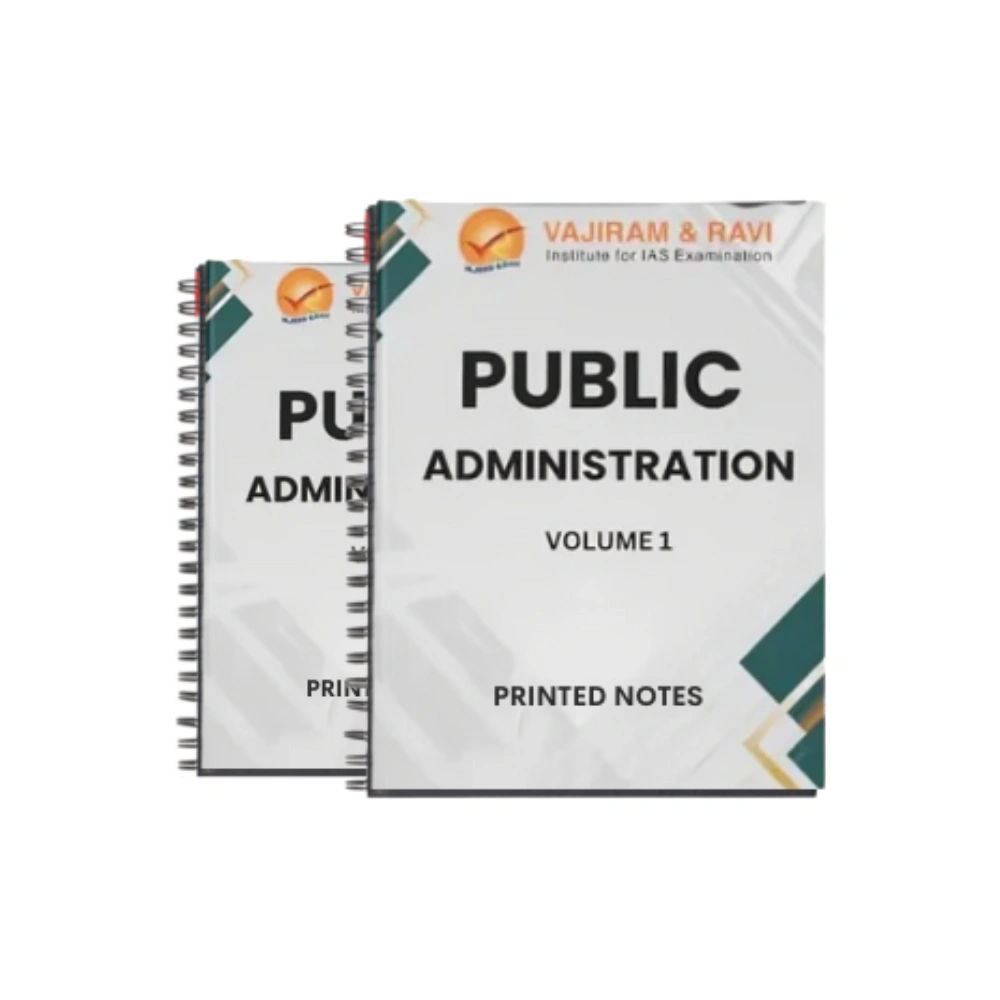
Start with Mohit Bhattacharya and Prasad & Prasad for Paper 1 theory, and Fadia/Maheshwari plus Laxmikanth for Paper 2. Add the 2nd ARC reports and IGNOU material for value addition, and use one consolidated printed note-set to revise fast. The Vajiram Public Administration Notes 2025-26 (Set of 3) work well as that single revision spine, keeping both papers’ theory and application in one syllabus-mapped place.
Note-making, current affairs and answer-writing
- Notes: Make one register per paper, sub-divided into the 12 and 14 topics above. Reserve blank space under each Paper 2 topic to paste current examples.
- Current affairs: Feed Paper 2 with governance news — new commissions, CAG reports, police reforms, disaster events, e-governance schemes. A monthly compilation such as the Vision IAS Current Affairs Magazine January 2026 helps you mine ready-to-quote examples.
- Answer writing: Every answer should carry a thinker or committee, a diagram/flowchart where possible, and a contemporary Indian example. This is what separates 120+ scores from average ones.
- Essay & GS synergy: Reuse governance vocabulary in the Essay paper — good governance, citizen charter, cooperative federalism and welfare delivery all double-count.
Thinker-to-Topic Mapping (The High-Value Angle Competitors Skip)
Most pages dump the syllabus but never tell you which thinker maps to which syllabus keyword. This chart lets you attach the right authority to the right question — the single fastest way to raise answer quality in Paper 1.
| Syllabus Keyword | Map to Thinker / Theory | Typical Question Hook |
|---|---|---|
| Scientific Management | F.W. Taylor | Efficiency, time-motion, critiques of “one best way” |
| Principles / POSDCORB | Gulick & Urwick | Classical structure, span of control |
| Bureaucracy | Max Weber | Ideal type, rationality, dysfunctions |
| Human Relations | Elton Mayo | Hawthorne, informal groups, morale |
| Decision-making | Herbert Simon | Bounded rationality, fact-value dichotomy |
| Ecology of administration | Fred Riggs | Prismatic-Sala model, developing societies |
| Motivation | Maslow, Herzberg, McClelland | Need hierarchy, hygiene factors |
| Leadership / participation | McGregor, Likert, Argyris | Theory X-Y, System 4, maturity-immaturity |
| Informal organisation & authority | Chester Barnard | Acceptance theory of authority |
| Conflict & integration | Mary Parker Follett | Constructive conflict, power-with |
PYQ Trend Analysis and Topic-Wise Weightage
Listing public administration optional previous year question papers is not enough — you need to know which sub-topics repeat most so you can prioritise. Based on the pattern of recent Mains papers, weightage clusters around a predictable core. Use the table below to allocate revision effort.
| Paper | High-Weightage / Repeating Areas | Priority |
|---|---|---|
| Paper 1 | Administrative Thought (Taylor, Weber, Simon, Riggs), New Public Management & Good Governance, Public Policy, Accountability & Control | Very High |
| Paper 1 | Personnel Administration, Financial Administration, Development Dynamics | High |
| Paper 1 | Administrative Law, Comparative Public Administration | Moderate |
| Paper 2 | Civil Services, Administrative Reforms (2nd ARC), Union & State administration, Local Government (73rd/74th) | Very High |
| Paper 2 | Significant Issues (corruption, disaster management, regulatory bodies), Financial Management (CAG) | High |
| Paper 2 | Evolution of Indian Administration, PSUs, Law & Order | Moderate |
To practise these trends, download year-wise Pub Ad Paper 1 and Paper 2 PDFs from upsc.gov.in (previous year question papers section) and solve one full paper every fortnight in the final phase. For broader UPSC PYQ practice across GS, aspirants also use topic-wise PYQ packs like the Forum IAS Prelims Toolkit (Topic-Wise PYQ 1992-2025) to build the habit of pattern-reading.
Paper 1 ↔ Paper 2 and Pub Ad ↔ GS Overlap (Made Concrete)
The overlap benefit is usually stated vaguely. Here is exactly which topics double-count, so you can study once and answer twice.
| Pub Ad Topic | Overlaps With | What You Save |
|---|---|---|
| Accountability, RTI, Citizen Charter, Social Audit | GS-II (Governance) | Transparency & accountability answers ready-made |
| Civil Services, Reforms, e-Governance | GS-II (Governance) | Reform + capacity-building content shared |
| Local Government (73rd/74th) | GS-II (Devolution) | Panchayati Raj & municipal answers shared |
| Administrative Ethics, Code of Conduct, Values in public service | GS-IV (Ethics) | Integrity, neutrality, work culture directly reused |
| Good Governance, Welfare Delivery, Cooperative Federalism | Essay Paper | Ready governance vocabulary & examples |
| Financial Administration, Budget, CAG | GS-III (Economy/Budgeting) | Fiscal accountability concepts shared |
Does Public Administration optional overlap with the General Studies syllabus?
Yes — significantly. Governance, civil services, local government, accountability and reforms overlap with GS Paper II; ethics concepts and code of conduct overlap with GS Paper IV; and governance vocabulary strengthens the Essay. Realistically, a good chunk of your Pub Ad preparation directly upgrades your GS answers, which is a core reason the optional stays popular.
Public Administration vs Other Popular Optionals (Quick Comparison)
Most aspirants deciding on Pub Ad are really comparing it against Sociology, PSIR (Political Science & International Relations), Geography or Anthropology. The comparison below is directional — based on syllabus length, GS overlap and typical preparation load — to help you decide, not a guarantee of marks.
| Optional | Syllabus Load | GS Overlap | Best Suited For |
|---|---|---|---|
| Public Administration | Short, static | Very high (GS-II, GS-IV, Essay) | Governance-minded aspirants who write example-rich answers |
| Sociology | Short, concept-based | Moderate (GS-I society, Essay) | Beginners wanting a light, intuitive optional |
| PSIR | Moderate-heavy, dynamic | High (GS-II polity & IR) | Aspirants strong in polity and international relations |
| Geography | Long, diagram-heavy | Moderate (GS-I & GS-III) | Science-background aspirants comfortable with maps/diagrams |
| Anthropology | Short, factual | Low-moderate | Aspirants preferring a scientific, static, low-current-affairs optional |
The honest takeaway: Pub Ad wins on GS overlap and revision speed, but it is a crowded optional, so your edge comes from answer quality, not from the subject being “easy.”
Is Public Administration Worth It in 2026? An Honest Verdict
Here is the candid part most pages avoid. In the past decade, Public Administration’s results have fluctuated and, in some years, the optional was seen as harder to score in than during its high-success phase of the 2000s, partly because of over-crowding — a large number of aspirants choose it, which can compress the scoring band and make examiners stricter on generic answers.
That does not make it a bad choice. It means the way to win has shifted from “cover the syllabus” to “differentiate every answer.” You still score well if you:
- Quote thinkers and committees precisely instead of writing generic points.
- Add current, India-specific examples to every Paper 2 answer.
- Use diagrams, flowcharts and crisp introductions/conclusions.
- Practise full-length papers and get them evaluated.
Choose Pub Ad if you have a background or genuine interest in governance and administration, and if the GS-II/GS-IV overlap fits your profile. Avoid it if you cannot commit to disciplined answer-writing, because in a crowded optional, average answers get average marks.
Is Public Administration a good/scoring optional for UPSC?
It can be highly scoring for candidates who write differentiated, example-rich answers, and it remains one of the most GS-friendly optionals. Its recent trend is more competitive than a decade ago, so treat it as scoring-for-the-prepared rather than automatically easy.
What is the success rate of Public Administration optional in UPSC?
The success rate varies year to year and UPSC does not publish a guaranteed figure per optional; historically it has sat in the low-to-moderate band, similar to other popular optionals. What matters more than the aggregate rate is your individual answer quality — well-prepared candidates with Pub Ad have crossed 260–300/500, which shows the ceiling is high for strong writers even when the overall rate looks average.
Public Administration Optional Syllabus in Hindi (हिंदी माध्यम)
Demand for the public administration optional syllabus in Hindi is strong, yet most English pages ignore it. Pub Ad is very Hindi-medium friendly because standard texts are available in translation and terminology is consistent. Practical guidance:
- Books: Use Hindi editions of Fadia & Fadia (भारतीय प्रशासन) and Laxmikanth (भारतीय राज्यव्यवस्था); for theory, rely on IGNOU’s Hindi study material (लोक प्रशासन) available free on eGyanKosh.
- Terminology: Keep an English-Hindi glossary of key terms (e.g., accountability = जवाबदेही, decentralisation = विकेंद्रीकरण) so you can read English committee reports and write in Hindi confidently.
- Current affairs: Use a Hindi monthly such as the Vision IAS Current Affairs Magazine (Hindi Medium) to feed Paper 2 with governance examples in your writing language.
- Answer writing: Practise in Hindi from day one — do not prepare in English and translate in the exam hall.
120-Day Study Plan for the Public Administration Optional
A realistic, time-bound schedule tied to each syllabus unit prevents the common trap of over-reading Paper 1 and neglecting Paper 2. Adjust the pace for a 90-day sprint by compressing revision.
| Phase | Days | Focus | Outcome |
|---|---|---|---|
| Phase 1 | Day 1–35 | Paper 1 topics 1–12 (theory + thinkers) with note-making | Core theory foundation ready |
| Phase 2 | Day 36–70 | Paper 2 topics 1–14 + link each to Paper 1 theory & current examples | Applied paper mapped to theory |
| Phase 3 | Day 71–95 | 2nd ARC, PYQ solving, thinker chart mastery, diagrams | Value addition + PYQ trend command |
| Phase 4 | Day 96–115 | Full-length answer writing (both papers), evaluated tests | Exam-temperament & speed |
| Phase 5 | Day 116–120 | Rapid revision from consolidated notes + syllabus checklist tick-off | Confident, revision-ready |
How much time does it take to complete the Public Administration optional syllabus?
Most aspirants complete the full syllabus in about 4–5 months of focused study (roughly 120 days), including note-making and one round of revision. A well-prepared repeater can compress the first read to 8–10 weeks and spend the rest on answer-writing.
Is the Public Administration optional syllabus hard to complete?
The syllabus itself is not hard to complete — it is short and static. The difficulty lies in scoring: because so many candidates cover the same content, you must write differentiated, example-backed answers. So it is easy to finish but demanding to top.
Toppers, Marks and Difficulty Snapshot
Public Administration has a long history of producing top ranks, and many successful candidates have scored strongly in the optional. While specific names and marks change every cycle, the durable takeaway is that Pub Ad’s 260–300/500 ceiling is achievable for disciplined writers. Track the latest UPSC toppers’ interviews and marksheets on official and coaching platforms each year, and reverse-engineer their answer structures rather than just noting their ranks.
| Difficulty Factor | Rating | Why |
|---|---|---|
| Syllabus length | Low | Short, static, self-contained |
| Conceptual difficulty | Moderate | Thinkers & models need clarity |
| Scoring difficulty | Moderate-High | Crowded optional, strict on generic answers |
| GS overlap benefit | High | Saves time on GS-II/IV & Essay |
| Resource availability | High | Standard books & notes widely available |
Common Mistakes to Avoid
- Treating Paper 2 as static: It is dynamic — without current examples, Paper 2 answers stay average.
- Ignoring thinkers: A Paper 1 answer without a named thinker or model is a capped-marks answer.
- Over-collecting books: Reading ten sources once beats reading two sources thrice — pick a tight list and revise.
- Skipping answer writing: In a crowded optional, unpractised writing is the biggest score-killer.
- Not maintaining a syllabus checklist: Without a printed topic-tracker, aspirants leave sub-topics half-prepared.
Fix the last point immediately: print the 12 + 14 topic tables above and tick each sub-topic as you finish its first read, revision and PYQ practice.
Frequently Asked Questions
What is the syllabus of Public Administration optional in UPSC?
The Public Administration optional syllabus has two papers of 250 marks each. Paper 1 (Administrative Theory) covers 12 topics from Introduction and Administrative Thought to Financial Administration, while Paper 2 (Indian Administration) covers 14 topics from the Evolution of Indian Administration to Significant Issues in Indian Administration. Each paper has 8 questions in two sections, and you attempt 5.
How many topics are there in Public Administration optional Paper 1 and Paper 2?
Paper 1 has 12 broad topics and Paper 2 has 14 broad topics, for a combined 26 topics across both papers. Paper 1 is conceptual and thinker-based, while Paper 2 is applied, institution-based and current-affairs driven.
Is Public Administration a good and scoring optional for UPSC?
Yes, for candidates who write differentiated, example-rich answers and value its heavy overlap with GS Paper II, GS Paper IV and the Essay. Its recent trend is more competitive than a decade ago, so it rewards disciplined answer-writing rather than mere syllabus completion.
Which books should I read for Public Administration optional?
Use Mohit Bhattacharya and Prasad & Prasad for Paper 1 theory; Fadia/Maheshwari and Laxmikanth for Paper 2; the 2nd ARC reports and IGNOU material for value addition; and one consolidated printed note-set for fast revision. A tight 6–8 source list beats collecting dozens of books.
How much time does it take to complete the Public Administration optional syllabus?
About 4–5 months (roughly 120 days) of focused study for a first read plus note-making and one revision. Repeaters can finish the first read in 8–10 weeks and devote the remaining time to answer-writing and PYQ practice.
Is the Public Administration optional syllabus available in Hindi?
Yes. Standard books like Fadia & Fadia and Laxmikanth have Hindi editions, IGNOU offers free Hindi study material, and Hindi current-affairs magazines supply Paper 2 examples. Hindi-medium aspirants should prepare and practise answers in Hindi from the start rather than translating in the exam.
Can I complete the Public Administration optional syllabus without coaching?
Yes. The syllabus is short, standardised and fully covered by publicly available books, 2nd ARC reports and free IGNOU material, so self-study works well. Coaching or a printed note-set mainly saves time on consolidation and answer-structure; the decisive factor is regular, evaluated answer-writing rather than the source of your notes.
Which is better for UPSC: Public Administration or Sociology optional?
Both have short syllabi and Essay value, but Public Administration offers heavier GS overlap (GS-II governance and GS-IV ethics), while Sociology is often seen as more intuitive for beginners. Choose Pub Ad if you enjoy governance, institutions and administrative theory; choose Sociology if you prefer society-focused concepts and a lighter current-affairs load.
Recommended Study Material
Continue Reading
UPTET Syllabus 2026: Paper 1 & 2 Subject-Wise + PDF (Hindi)
The UPTET syllabus is divided into two papers — Paper 1 for candidates who want to teach Classes…
UPPCS Syllabus 2026: Prelims, Mains (8 Papers) + PDF Download
Quick answer: The UPPCS syllabus for 2026 spans three stages run by the Uttar Pradesh Public Service Commission…

UGC NET Commerce Syllabus 2026: Units, Weightage + PDF
Quick answer: The UGC NET Commerce syllabus (Subject Code 08) has two parts — a common Paper 1…