Buy Shubhra Ranjan psir notes at Competer — printed and delivered with Cash on Delivery across India. Shop the full range below at the best price.
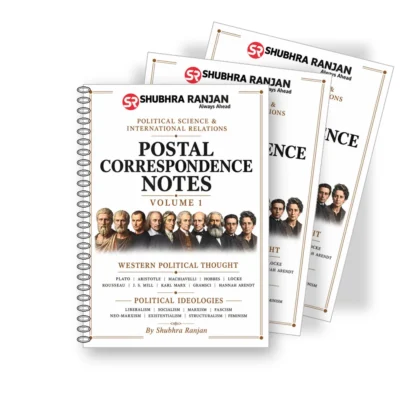
Shubhra Ranjan PSIR Handwritten Notes 2026 English Medium | Complete Political Science and IR Class Notes for UPSC CSE Mains | Set of 5 Booklets Covering Paper 1, Polity, International Relations | Printed Study Material by Shubhra Ranjan
Shubhra Ranjan PSIR Class Notes 2025-26 Handwritten Booklets Set of 11
Shubhra Ranjan Handwritten Notes 2026 | PSIR Optional | 11 Booklets
Shubhra Ranjan Notes 2026 | PSIR Optional | English Medium | Set of 4 Booklets
Shubhra Ranjan PSIR Handwritten Notes 2025-2026 Hindi Set of 4 Booklets
Shubhra Ranjan PSIR Notes 2025-26 Hindi Edition 7 Booklets Printed
Shubhra Ranjan PSIR Optional Material 2025-26 | 4 Printed Booklets in English
Shubhra ranjan psir notes are among the most trusted printed study resources for aspirants preparing Political Science & International Relations as their UPSC optional, and this page brings the complete set to your doorstep in clean, exam-ready print. If you have decided to take PSIR for the Mains optional, structured classroom-grade notes can save you months of self-compilation and help you revise faster in the final run-up to the exam.
What the Shubhra Ranjan PSIR notes cover
The notes map directly to the UPSC PSIR optional syllabus across both papers. Paper I covers Political Theory, Indian Government & Politics, and the major thinkers from Plato and Aristotle to Gandhi, Marx and Gramsci. Paper II covers Comparative Politics, International Relations theory, India and the World, and contemporary global issues such as the UN, regional groupings, globalisation and India’s foreign policy. Each section is broken into topic-wise units with definitions, debates, thinker positions, diagrams and ready-to-use answer points, so you can move from understanding a concept to writing a structured 15-mark answer.
How to choose the right set for you
Before buying, match the material to your preparation stage. Beginners usually need the full Paper I and Paper II sets to build conceptual depth from scratch. Repeat aspirants who already have a base often prefer focused current-affairs and IR update material layered on top of their existing foundation. Check that the set covers both static theory and dynamic IR portions, that the handwriting or typeset is legible, and that the volume split suits your revision rhythm. If you are short on time before Mains, prioritise concise thinker summaries and value-addition points over exhaustive reading.
Comparison: full set vs. focused modules
| Factor | Full PSIR set (Paper I + II) | Focused / topic modules |
|---|---|---|
| Best for | Fresh aspirants building the optional from zero | Repeaters strengthening weak areas |
| Coverage | Complete syllabus, both papers | Selected units or IR current affairs |
| Revision load | Higher, needs an early start | Lighter, quick to finish |
| Answer practice | End-to-end, all themes | Targeted, around chosen topics |
| Ideal timeline | 8–12 months before Mains | 2–4 months before Mains |
Who should buy these notes
These notes suit candidates who have chosen PSIR as their UPSC optional and want a coaching-aligned structure without attending full classroom batches. They work well for working professionals and remote aspirants who cannot relocate for offline coaching, for self-study candidates who need a reliable backbone instead of scattered PDFs, and for repeaters who want to consolidate a strong optional score. If you are still comparing optionals, PSIR’s overlap with GS Paper II, essay and interview makes these notes doubly useful.
How to use the notes effectively
Read each unit once for understanding, then make a second pass to underline thinker positions, keywords and inter-linkages. Convert dense sections into one-page mind maps for quick revision. Pair the static theory with daily IR current affairs so your Paper II answers stay contemporary. Most importantly, write answers from day one — pick previous-year questions, draft them using the points in the notes, and self-evaluate against the model structure. Three to four full revisions before Mains usually give the best recall under exam pressure.
Buying & delivery
Choose your set from the cards above, add it to the cart and place the order with your delivery address. Competer prints and ships the material across India, so you receive a neatly bound physical copy you can annotate and revise from offline. Review the volume list and shipping timeline on the product card before checkout, and reach out to support if you need help picking between the full set and focused modules for your timeline.
Frequently Asked Questions
Are the Shubhra Ranjan PSIR notes aligned to the current UPSC syllabus?
Yes. The notes are organised topic-wise to follow the UPSC PSIR optional syllabus for both Paper I and Paper II, covering political theory, Indian politics, comparative politics and international relations.
Do I need both papers or can I buy one?
If you are starting the optional fresh, the complete Paper I and Paper II set is recommended. If you only need to strengthen specific areas, focused modules let you target those topics without buying everything.
Are these notes enough without separate coaching?
Many self-study aspirants use these notes as their primary backbone. To score well you should pair them with regular answer writing and daily IR current affairs, since the optional rewards practice and updated examples.
Will I get a printed copy or a digital file?
Competer prints and delivers physical study material to your address across India, so you receive a bound copy you can revise from and annotate offline.
How should a repeater use these notes?
Repeaters should focus on weak units, revise thinker positions and inter-linkages, and layer fresh IR current affairs over the static theory, aiming for multiple quick revisions before Mains.