Anthropology Optional Syllabus 2026: Paper 1 & 2 + PDF
Anthropology optional syllabus for UPSC 2026: full Paper 1 & 2 topics, marks, PYQ weightage, booklist, strategy and a free syllabus PDF download.


The anthropology optional syllabus for UPSC CSE Mains is divided into two papers of 250 marks each, totalling 500 marks. Paper I covers physical/biological anthropology, prehistoric archaeology, social-cultural anthropology and anthropological theory; Paper II covers Indian anthropology — the evolution of Indian society, tribal communities, and their problems and development. Each paper is a 3-hour descriptive exam with Section A and Section B, where Question 1 and Question 5 are compulsory. Below you get the full topic-by-topic official syllabus (reproduced from the UPSC Civil Services Examination notification), PYQ weightage, a standard booklist, topper strategy, a printable checklist, and a free PDF download.
Anthropology Optional Syllabus UPSC: Quick Overview
Anthropology is one of the most popular and scoring optionals in the UPSC Civil Services Examination, chosen every year by aspirants from engineering, medical, arts and commerce backgrounds alike. It is a compact, logical subject with a static syllabus, heavy overlap with General Studies (society, art & culture, tribal governance, science), and strong diagram-based answer writing that fetches marks quickly. The anthropology optional syllabus UPSC is examined across two written papers in Mains, and there is no anthropology component in the Prelims.
| Component | Details |
|---|---|
| Number of papers | 2 (Paper I & Paper II) |
| Marks per paper | 250 marks |
| Total marks | 500 marks |
| Duration per paper | 3 hours each |
| Sections in each paper | Section A & Section B |
| Compulsory questions | Q1 (Section A) & Q5 (Section B) |
| Medium | English or Hindi (any listed language) |
| Nature | Descriptive / diagram-based |
The topic list below is reproduced from the official UPSC CSE optional-subject syllabus so you can revise from the exact wording UPSC uses to frame questions. Where we add interpretation — PYQ weightage, diagram mapping, timelines — it is clearly labelled as indicative guidance, not part of the notification.
Anthropology Optional Exam Pattern & Question Structure
Both Paper I and Paper II follow an identical pattern. Each paper has 8 questions split into two sections of 4 questions each. You must attempt 5 questions in total: Question 1 (from Section A) and Question 5 (from Section B) are compulsory, and out of the remaining six you choose any three, ensuring at least one from each section. Each question carries 250/5 = an effective weight of roughly 50 marks, usually broken into sub-parts of 10, 15 and 20 marks. Answer writing rewards a definition–diagram–example–conclusion structure, precise anthropological terminology, and relevant thinker/scholar names.
| Feature | Paper I | Paper II |
|---|---|---|
| Focus | General / theoretical anthropology (physical, archaeological, social-cultural) | Indian anthropology (Indian society & tribes) |
| Marks | 250 | 250 |
| Static vs dynamic | Almost fully static | Static core + current affairs (tribal news, schemes) |
| Diagram intensity | Very high (skulls, evolution, kinship) | Moderate (maps, flowcharts, tables) |
| Overlap with GS | GS-1 (society), GS-3 (science) | GS-1 (society), GS-2 (governance, schemes) |
Anthropology Optional Syllabus Paper 1 (Topic-by-Topic)
Paper I is the theoretical foundation of the subject and is nearly 100% static. Here is the official, verbatim-style anthropology optional syllabus paper 1 and paper 2 reproduction, sub-point numbered for clean copy-paste and revision.
1. Meaning, Scope and Development of Anthropology
1.1 Meaning, scope and development of Anthropology. 1.2 Relationships with other disciplines: Social Sciences, Behavioural Sciences, Life Sciences, Medical Sciences, Earth Sciences and Humanities. 1.3 Main branches of Anthropology, their scope and relevance: (a) Social-cultural Anthropology, (b) Biological Anthropology, (c) Archaeological Anthropology, (d) Linguistic Anthropology. 1.4 Human Evolution and emergence of Man: Biological and Cultural factors; theories of Organic Evolution (Pre-Darwinian, Darwinian and Post-Darwinian); Synthetic theory of evolution; brief outline of terms and concepts — Doctrine of Uniformitarianism, Lamarckism, Neo-Lamarckism, Darwinism, Neo-Darwinism, Mutation theory, Isolation, Natural Selection, Sexual Selection, Genetic Drift, Gene flow. 1.5 Characteristics of Primates; Evolutionary Trend and Primate Taxonomy; Primate Adaptations (Arboreal and Terrestrial); Primate Behaviour; Tertiary and Quaternary fossil primates; Living Major Primates; comparative anatomy of Man and Apes; skeletal changes due to erect posture and its implications.
2. Human Evolution & Phylogenetic Status
2.1 Phylogenetic status, characteristics and geographical distribution of Plio-Pleistocene hominids in South and East Africa — Australopithecines. 2.2 Homo erectus: Africa (Paranthropus), Europe (Homo erectus heidelbergensis), Asia (Homo erectus javanicus, Homo erectus pekinensis). 2.3 Neanderthal Man — La-Chapelle-aux-Saints (Classical type) and Mt. Carmel (Progressive type). 2.4 Rhodesian Man. 2.5 Homo sapiens — Cromagnon, Grimaldi and Chancelede.
3. Prehistoric Archaeology
3.1 Chronology: Relative and Absolute Dating methods. 3.2 Cultural Evolution — broad outlines of Prehistoric cultures: (a) Palaeolithic, (b) Mesolithic, (c) Neolithic, (d) Chalcolithic, (e) Copper-Bronze age, (f) Iron age.
4. The Nature of Culture, Society & Marriage
4.1 The Nature of Culture: concept and characteristics of culture and civilization; Ethnocentrism vis-à-vis cultural Relativism. 4.2 The Nature of Society: concept of Society; Society and Culture; Social Institutions; Social groups; and Social stratification. 4.3 Marriage: definition and universality; laws of marriage (endogamy, exogamy, hypergamy, hypogamy, incest taboo); type of marriage (monogamy, polygamy, polyandry, group marriage); functions of marriage; marriage regulations (preferential, prescriptive and proscriptive); marriage payments (bride wealth and dowry).
5. Family, Kinship, Economic & Political Organization
5.1 Family: definition and universality; family, household and domestic groups; functions of family; types of family (from the perspectives of structure, blood relation, marriage, residence and succession); Impact of urbanization, industrialization and feminist movements on family. 5.2 Kinship: consanguinity and affinity; principles and types of descent (Unilineal, Double, Bilineal and Cognatic); forms of descent groups (lineage, clan, phratry, moiety and kindred); Kinship terminology (descriptive and classificatory); Descent, Filiation and Complementary Filiation; Descent and Alliance. 5.3 Economic organization: meaning, scope and relevance of economic anthropology; Formalist and Substantivist debate; principles governing production, distribution and exchange (reciprocity, redistribution and market) in communities subsisting on hunting and gathering, fishing, swiddening, pastoralism, horticulture and agriculture; globalization and indigenous economic systems. 5.4 Political organization and Social Control: band, tribe, chiefdom, kingdom and state; concepts of power, authority and legitimacy; social control, law and justice in simple societies.
6. Religion, Anthropological Theories & Culture-Personality
6.1 Religion: anthropological approaches to the study of religion (evolutionary, psychological and functional); monotheism and polytheism; sacred and profane; myths and rituals; forms of religion in tribal and peasant societies (animism, animatism, fetishism, naturism and totemism); religion, magic and science distinguished; magico-religious functionaries (priest, shaman, medicine man, sorcerer and witch). 6.2 Anthropological theories: (a) Classical evolutionism (Tylor, Morgan, Frazer), (b) Historical particularism (Boas); Diffusionism (British, German and American), (c) Functionalism (Malinowski); Structural-functionalism (Radcliffe-Brown), (d) Structuralism (Levi-Strauss, E. Leach), (e) Culture and personality (Benedict, Mead, Linton, Kardiner and Cora du Bois), (f) Neo-evolutionism (Childe, White, Steward, Sahlins and Service), (g) Cultural materialism (Harris), (h) Symbolic and interpretive theories (Turner, Schneider and Geertz), (i) Cognitive theories (Tyler, Conklin), (j) Post-modernism in anthropology.
7. Culture, Language, Communication & Research Methods
7.1 Culture, Language and Communication: nature, origin and characteristics of language; verbal and non-verbal communication; social contexts of language use. 7.2 Research methods in anthropology: fieldwork tradition in anthropology; distinction between technique, method and methodology; tools of data collection — observation, interview, schedules, questionnaire, case study, genealogy, life-history, oral history, secondary sources of information, participatory methods; analysis, interpretation and presentation of data.
8. Human Genetics, Race & Applied Physical Anthropology
8.1 Human Genetics: methods and application — methods for study of genetic principles in man (family study, twin study, foster child, cytogenetic method, chromosomal and karyotype analysis); mendelian genetics in man; concept of genetic polymorphism and selection; Mendelian population; Hardy-Weinberg law; causes and changes which bring down allele frequency and its attainment of equilibrium; chromosomes and chromosomal aberrations in man, methodology; numerical and structural aberrations (disorders); sex chromosomal aberrations — Klinefelter (XXY), Turner (XO), Super female (XXX); intersex and other syndromic disorders; autosomal aberrations — Down syndrome, Patau, Edward and Cri-du-chat syndromes; genetic imprints in human disease; genetic screening, genetic counselling, human DNA profiling, gene mapping and genome study; race and racism, biological basis of morphological variation of non-metric and metric characters; racial criteria, racial traits in respect of morphological characters; classification of human races; the concept of race, racism, ethnic groups and racial and social prejudice. 8.2 Concept of human growth and development; ecological anthropology; epidemiological anthropology; anthropology and human physical variations. 8.3 Applications of Anthropology: Anthropology of sports, Nutritional anthropology, Anthropology in designing of defence and other equipments, Forensic Anthropology, Methods and principles of personal identification and reconstruction, Applied human genetics — Paternity diagnosis, genetic counselling and eugenics, DNA technology in diseases and medicine, serogenetics and cytogenetics in reproductive biology.
Anthropology Optional Syllabus Paper 2 (Topic-by-Topic)
Paper II is Indian anthropology and blends a static core with dynamic current affairs on tribal issues, welfare schemes and constitutional debates. It is the higher-scoring paper for well-prepared candidates because answers can be enriched with recent reports, committees and government schemes.
1. Evolution of Indian Culture and Civilization
1.1 Evolution of the Indian Culture and Civilization — Prehistoric (Palaeolithic, Mesolithic, Neolithic and Neolithic-Chalcolithic), Protohistoric (Indus Civilization): Pre-Harappan, Harappan and post-Harappan cultures; contributions of tribal cultures to Indian civilization. 1.2 Palaeo-Anthropological evidences from India with special reference to Siwaliks and Narmada basin (Ramapithecus, Sivapithecus and Narmada Man). 1.3 Ethno-archaeology in India: concept of ethno-archaeology; survivals and parallels among the hunting, foraging, fishing, pastoral and peasant communities including arts and crafts producing communities.
2. Demographic & Ethnic Profile of India
2.1 Demographic profile of India — ethnic and linguistic elements in the Indian population and their distribution. Indian population — factors influencing its structure and growth. 2.2 The structure and nature of traditional Indian social system — Varnashram, Purushartha, Karma, Rina and Rebirth. 2.3 Caste system in India — structure and characteristics, Varna and caste, theories of origin of caste system, dominant caste, caste mobility, future of caste system, Jajmani system, tribe-caste continuum. 2.4 Sacred Complex and Nature-Man-Spirit Complex. 2.5 Impact of Buddhism, Jainism, Islam and Christianity on Indian society.
3. Indian Village, Linguistic & Religious Communities
3.1 Indian Village — significance of village study in India; Indian village as a social system; traditional and changing patterns of settlement and inter-caste relations; agrarian relations in Indian villages; impact of globalization on Indian villages. 3.2 Linguistic and religious minorities and their social, political and economic status. 3.3 Indigenous and exogenous processes of socio-cultural change in Indian society — Sanskritization, Westernization, Modernization; inter-play of little and great traditions; panchayati raj and social change; media and social change.
4. Tribal Communities of India
4.1 Tribal situation in India — bio-genetic variability, linguistic and socio-economic characteristics of tribal populations and their distribution. 4.2 Problems of the tribal Communities — land alienation, poverty, indebtedness, low literacy, poor educational facilities, unemployment, underemployment, health and nutrition. 4.3 Developmental projects and their impact on tribal displacement and problems of rehabilitation. Development of forest policy and tribals. Impact of urbanization and industrialization on tribal populations.
5. Problems of Tribal, Scheduled Caste & OBC Communities
5.1 Problems of exploitation and deprivation of Scheduled Castes, Scheduled Tribes and Other Backward Classes. Constitutional safeguards for Scheduled Tribes and Scheduled Castes. 5.2 Social change and contemporary tribal societies: impact of modern democratic institutions, development programmes and welfare measures on tribals and weaker sections. 5.3 The concept of ethnicity; Ethnic conflicts and political developments; unrest among tribal communities; regionalism and demand for autonomy; pseudo-tribalism; social change among the tribes during colonial and post-Independent India.
6. Tribal Development, PVTGs & Applied Anthropology
6.1 Impact of Hinduism, Buddhism, Christianity, Islam and other religions on tribal societies. 6.2 Tribe and nation state — a comparative study of tribal communities in India and other countries. 6.3 History of administration of tribal areas, tribal policies, plans, programmes of tribal development and their implementation. The concept of PTGs (Primitive Tribal Groups)/PVTGs (Particularly Vulnerable Tribal Groups), their distribution, special programmes for their development. Role of N.G.O.s in tribal development. 6.4 Role of anthropology in tribal and rural development. Contributions of anthropology to the understanding of regionalism, communalism and ethnic and political movements.
Paper 1 vs Paper 2: What Is the Difference?
A question aspirants ask constantly is how the two papers differ, because it decides how you split study time. In short, Paper I is the global, theoretical half of anthropology — how humans evolved, how societies and cultures are structured, and the schools of thought that explain them. Paper II applies that lens to India — its civilization, caste and village systems, and above all its tribal communities and their development. Paper I barely changes year to year and is diagram-heavy; Paper II layers current affairs (schemes, committees, court rulings, PVTG news) on a static core, which is why it can be the higher-scoring paper for a well-read candidate.
PYQ Trend & Marks Weightage (Which Topics Are Asked Most)
One gap most syllabus pages miss is mapping the syllabus to Previous Year Questions. Based on the last several years of UPSC Mains anthropology papers, certain sub-topics repeat almost every year and deserve heavier preparation. The shares below are our indicative estimates from published question papers, not official UPSC figures — treat them as a prioritisation aid for revision.
| Paper | High-weightage topic cluster | Approx. share of questions |
|---|---|---|
| Paper I | Anthropological theories (evolutionism, functionalism, structuralism) | 18-22% |
| Paper I | Kinship, marriage & family | 14-18% |
| Paper I | Human evolution, fossils & primates | 12-15% |
| Paper I | Human genetics, race & Hardy-Weinberg | 10-14% |
| Paper I | Economic & political organization | 8-12% |
| Paper I | Research methods & religion | 10-12% |
| Paper II | Tribal problems, development & PVTGs | 20-25% |
| Paper II | Caste system, village studies & social change | 15-18% |
| Paper II | Constitutional safeguards & tribal policy | 12-15% |
| Paper II | Evolution of Indian culture & ethno-archaeology | 10-14% |
Practical takeaway: theory (Paper I) and tribal development plus current affairs (Paper II) are the two engines of a 300+ score. Anchor daily revision around these clusters, and keep a running current-affairs note for tribal news — a good monthly compilation such as the Vision IAS Current Affairs Magazine January 2026 makes Paper II answers stand out.
High-Yield Diagrams Mapped to Syllabus Topics
Anthropology is a diagram-driven optional, and toppers consistently attribute their marks jump to well-labelled figures. A relevant diagram in almost every answer can lift a script by 30-50 marks. Here is a list of high-yield diagrams mapped to the syllabus topics they belong to.
| Diagram | Syllabus topic (Paper) |
|---|---|
| Comparative skulls (ape vs. hominid) | Human evolution, comparative anatomy (Paper I) |
| Evolutionary tree of primates / hominids | Primate taxonomy & fossil hominids (Paper I) |
| Kinship symbols & descent charts | Kinship, descent groups (Paper I) |
| Hardy-Weinberg equilibrium graph | Human genetics, Mendelian population (Paper I) |
| Karyotype / chromosomal aberration charts | Down, Turner, Klinefelter syndromes (Paper I) |
| Erect posture skeletal changes | Bipedalism & anatomy (Paper I) |
| Tribe-caste continuum flowchart | Caste system (Paper II) |
| Tribal distribution map of India | Tribal situation in India (Paper II) |
| Nature-Man-Spirit complex diagram | Sacred complex (Paper II) |
Why Choose Anthropology as Your UPSC Optional
Anthropology consistently ranks among the top scoring optionals, and its appeal cuts across academic backgrounds. Here is the compact, logical case for choosing it.
- Compact & static syllabus: The anthropology optional syllabus UPSC is short compared with sociology, PSIR or history, and Paper I barely changes year to year.
- Scoring & scientific: Genetics, evolution, physical anthropology and diagrams allow objective, high-marks answers — the subject blends the precision of science with the width of humanities.
- GS overlap: Society, art & culture, tribal governance, PVTGs, welfare schemes and science-tech topics overlap with GS Paper 1, 2 and 3, plus essay.
- Beginner-friendly: No prior background is needed; NCERTs and one or two standard books build the base.
- Diagram advantage: Well-labelled diagrams make answers evaluator-friendly and time-efficient.
- Coaching optional, not mandatory: Because the syllabus is finite and book-driven, many candidates prepare it through self-study with a standard booklist and one set of structured notes.
Anthropology vs Sociology vs Geography vs PSIR
If you are still choosing, this comparison of the four most popular optionals helps you decide based on syllabus length, GS overlap and scoring nature.
| Parameter | Anthropology | Sociology | Geography | PSIR |
|---|---|---|---|---|
| Syllabus length | Short-medium | Short | Medium-long | Long |
| Scoring nature | High & objective | High | Medium-high | Medium |
| Diagram/map advantage | Very high (diagrams) | Low | Very high (maps) | Low |
| GS overlap | GS 1, 2, 3, Essay | GS 1, Essay | GS 1, 3 | GS 2, Essay |
| Current affairs load | Low-moderate | Moderate | Low | Very high |
| Best suited for | All backgrounds | All backgrounds | Analytical/visual learners | Polity enthusiasts |
For candidates comparing options, our detailed guides on the SS Pandey Sociology Notes and PSIR material help you weigh the trade-offs before committing to a two-year subject.
Standard Booklist for Anthropology Optional
A focused anthropology optional booklist and strategy beats reading ten books superficially. Stick to this standard list, one source per topic, and revise repeatedly.
| Topic area | Recommended book / source |
|---|---|
| Foundation | NCERTs — Sociology (Class 11 & 12), Indian Society |
| Physical Anthropology | Physical Anthropology — P. Nath |
| Social-Cultural Anthropology | An Introduction to Social Anthropology — D.N. Majumdar & T.N. Madan; Anthropology Simplified / Vivek Bhasme |
| Anthropological Theories | Anthropological Theories — Makhan Jha; Vivek Bhasme notes |
| Indian Anthropology (Paper II) | Indian Anthropology — Nadeem Hasnain |
| Tribal India (Paper II) | Tribal India — Nadeem Hasnain |
| Cross-cultural / theory reference | Anthropology — Ember & Ember |
| Coaching notes | Brain Tree / Vaid’s ICS structured notes |
| Current affairs (Paper II) | Monthly magazine + tribal news compilation |
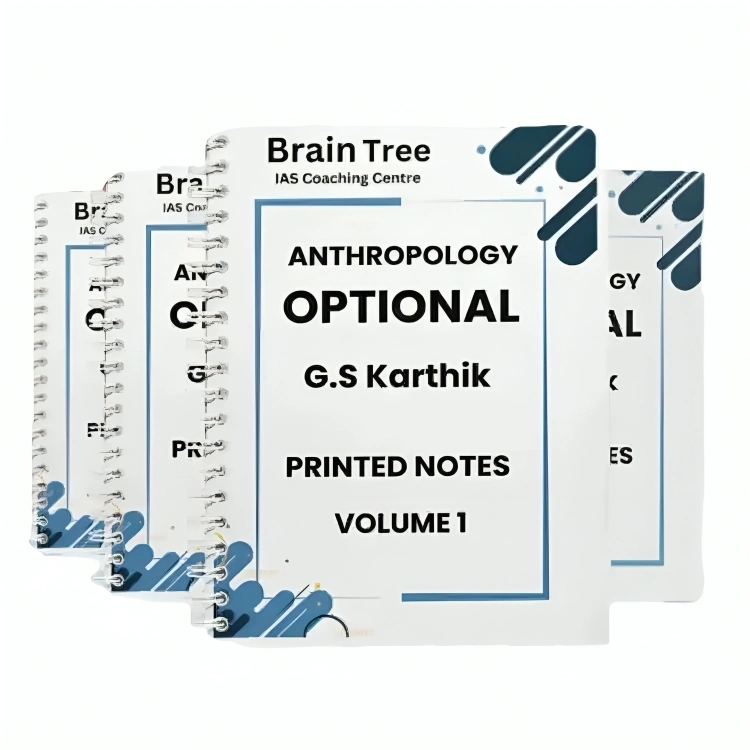
Many aspirants pair a standard textbook with a well-organised coaching handout to save time on note-making. The Brain Tree Anthropology Optional Notes are a widely used, exam-oriented set that covers both papers in a revision-friendly format.
Preparation Strategy & Topper Tips
Toppers who scored 300+ in anthropology broadly follow the same playbook. Adopt these habits early.
- Answer structure: Follow definition → diagram → thinker/example → conclusion. This templated structure works for almost every 10/15/20-mark question.
- Diagrams in every answer: Practise 40-50 core diagrams (see the table above) until you can draw them in under a minute.
- PYQ analysis first: Solve the last 10 years of papers before finishing the syllabus — it reveals repeated themes and framing.
- Short notes & flashcards: Condense each topic into one page; anthropology rewards precise terminology and scholar names.
- Current affairs for Paper II: Maintain a tribal-issues file (schemes, committees, reports, court judgments, PVTG news). Feed it monthly from a reliable magazine.
- Answer writing practice: Write at least 2-3 answers daily and join a test series in the final months.
- Link theory to India: In Paper II, always ground theoretical concepts in Indian tribal/village examples.
How Long Does It Take to Finish the Syllabus?
With focused study, the anthropology optional syllabus can be completed in 4-5 months, and revised again before Mains. Here is a realistic timeline.
| Phase | Duration | Focus |
|---|---|---|
| Phase 1 | 6-7 weeks | Paper I static — evolution, genetics, social-cultural, theories |
| Phase 2 | 5-6 weeks | Paper II — Indian society, tribes, development, current affairs |
| Phase 3 | 3-4 weeks | PYQ solving, diagrams, answer writing |
| Phase 4 | Ongoing | Test series + 2-3 full revisions |
Yes, a dedicated aspirant can complete anthropology in about 4 months of serious study — but budget extra weeks for revision and answer-writing, which is where the actual marks are won.
Anthropology Optional Syllabus in Hindi (Hindi-Medium Guidance)
The anthropology optional syllabus in Hindi (मानवशास्त्र वैकल्पिक विषय) is fully available, and UPSC allows you to write the optional in Hindi. Hindi-medium aspirants can rely on Nadeem Hasnain’s Hindi editions (मानव विज्ञान / भारतीय मानवशास्त्र), Drishti-style Hindi source material, and Hindi coaching notes. Terminology in physical anthropology and genetics is best noted in both English and Hindi to avoid confusion in the exam. Hindi-medium candidates preparing GS alongside often use the Drishti IAS Hindi Study Material for GS and pair it with a dedicated Hindi anthropology source for the optional.
Printable One-Page Syllabus Checklist / Tracker
Use this tick-box tracker to monitor topic-wise coverage across both papers. Mark each as Not Started, In Progress or Revised.
| Paper | Topic | Status |
|---|---|---|
| I | Meaning, scope, branches | ☐ |
| I | Human evolution & primates | ☐ |
| I | Fossil hominids | ☐ |
| I | Prehistoric archaeology | ☐ |
| I | Marriage, family, kinship | ☐ |
| I | Economic & political organization | ☐ |
| I | Religion & theories | ☐ |
| I | Language & research methods | ☐ |
| I | Human genetics, race, applied | ☐ |
| II | Evolution of Indian culture | ☐ |
| II | Demographic profile & caste | ☐ |
| II | Village studies & social change | ☐ |
| II | Tribal communities & problems | ☐ |
| II | Constitutional safeguards | ☐ |
| II | Tribal development & PVTGs | ☐ |
Download the UPSC Anthropology Optional Syllabus PDF
You can save this complete anthropology syllabus for UPSC PDF download by using your browser’s Print → Save as PDF option on this page, which captures the full verbatim Paper I and Paper II topic list plus the checklist above. On desktop press Ctrl+P (or Cmd+P on Mac), choose “Save as PDF” as the destination, and set the layout to portrait for a clean printout. For an officially printed, consolidated syllabus booklet covering all subjects, the GS Score Latest Syllabus Booklet 2026-27 is a handy reference to keep on your desk. The UPSC anthropology optional syllabus 2026 remains unchanged from the current official notification, so this reproduction is valid for the 2026 and 2027 cycles.
Success Data: Why Aspirants Trust Anthropology
Anthropology has produced a steady stream of top rankers over the years. Publicly shared toppers’ mark sheets suggest well-prepared candidates often score in the 280-330 range out of 500 — among the higher optional bands, though individual results vary and no optional guarantees a score. Its appeal is otherwise structural: a syllabus meaningfully shorter than history or PSIR, a near-100% static Paper I, and strong Essay/GS synergy. Every year a visible share of successful candidates in the final list carry anthropology, and it remains a frequent choice among working professionals and non-humanities graduates precisely because it can be built from scratch in a few months.
Frequently Asked Questions
What is the anthropology optional syllabus for UPSC?
The anthropology optional syllabus for UPSC consists of two Mains papers of 250 marks each (500 total). Paper I covers physical/biological anthropology, prehistoric archaeology, social-cultural anthropology and anthropological theory, while Paper II covers Indian anthropology — evolution of Indian society, caste and village studies, tribal communities, constitutional safeguards, PVTGs and tribal development.
Is anthropology a good optional subject for UPSC?
Yes. Anthropology is widely regarded as a scoring, compact and logical optional with a largely static syllabus, strong diagram-based answers, and useful overlap with GS Papers 1, 2, 3 and the Essay. It suits candidates from all academic backgrounds and can be completed relatively quickly, making it one of the most popular optionals.
Can I complete the anthropology optional syllabus in 4 months?
Yes, a dedicated aspirant studying consistently can cover the anthropology optional syllabus in about 4 months, with roughly 6-7 weeks on Paper I, 5-6 weeks on Paper II, and the remainder on PYQs, diagrams and answer writing. However, you should reserve additional time for at least two full revisions and regular answer-writing practice before Mains.
How many papers are there in anthropology optional and how many marks?
There are two papers in the anthropology optional — Paper I and Paper II — each worth 250 marks, for a total of 500 marks. Both are 3-hour descriptive papers with Sections A and B, where Question 1 and Question 5 are compulsory. There is no anthropology component in the Prelims.
What is the difference between Paper 1 and Paper 2 in anthropology optional?
Paper I is general/theoretical anthropology — physical and biological anthropology, prehistoric archaeology, social-cultural concepts and anthropological theories — and is almost entirely static and diagram-heavy. Paper II is Indian anthropology — Indian civilization, caste and village studies, tribal communities, constitutional safeguards and tribal development — with a static core plus current affairs on tribal issues and schemes.
Which books should I read for anthropology optional?
Start with relevant NCERTs, then use P. Nath for physical anthropology, Majumdar & Madan and Vivek Bhasme’s Anthropology Simplified for social-cultural topics, Nadeem Hasnain’s Indian Anthropology and Tribal India for Paper II, and Ember & Ember as a reference. A structured coaching note set such as Brain Tree helps consolidate both papers for revision.
Is anthropology optional suitable for non-science / humanities students?
Absolutely. Anthropology requires no prior science background; concepts in evolution, genetics and physical anthropology are self-contained and can be learned from standard books and NCERTs. Humanities and arts students perform very well in it, and its blend of scientific precision with social-cultural breadth makes it accessible and scoring for every background.
Where can I download the UPSC anthropology optional syllabus PDF?
You can create the PDF directly from this page using your browser’s Print → Save as PDF option (Ctrl+P or Cmd+P), which saves the full verbatim Paper I and Paper II topic list along with the checklist. If you prefer a printed, consolidated syllabus booklet across all subjects, the GS Score Latest Syllabus Booklet 2026-27 available on Competer is a convenient desk reference.
Is the anthropology optional syllabus available in Hindi?
Yes. The anthropology optional syllabus is fully available in Hindi (मानवशास्त्र), and UPSC permits candidates to write the optional in Hindi. Hindi-medium aspirants commonly use Nadeem Hasnain’s Hindi editions and Hindi coaching notes, and it helps to record technical terms in physical anthropology and genetics in both Hindi and English to avoid confusion in the exam.
Recommended Study Material
Continue Reading

CGPSC Syllabus 2026: Prelims, Mains Pattern + PDF Download
The cgpsc syllabus for 2026 covers a three-stage State Service Examination conducted by the Chhattisgarh Public Service Commission:…
CGPSC Syllabus 2025: Prelims, Mains, Exam Pattern + PDF Download
The CGPSC syllabus for the Chhattisgarh State Service Examination (SSE) spans three stages: Prelims — two objective papers…
KVS Syllabus 2025-26: PRT, TGT, PGT Pattern + PDF
The kvs syllabus for the 2025-26 recruitment cycle follows a two-tier structure: a Tier-1 screening test of 100…