UPSC Prelims Syllabus 2026: GS & CSAT Topics, Pattern + PDF
Complete UPSC Prelims syllabus 2026 — GS Paper 1 & CSAT topic-by-topic, exam pattern, marks, negative marking, weightage, study-material map and free syllabus PDF download.


Short answer: the upsc prelims syllabus has two papers — General Studies Paper I (100 questions, 200 marks) covering current events, history, geography, polity, economy, environment and general science, and the CSAT Paper II (80 questions, 200 marks) testing comprehension, reasoning, decision-making and basic numeracy. Both papers are objective (MCQ), each lasts 2 hours, and carry negative marking of one-third. CSAT is only qualifying at 33% (66.67 marks), while your GS Paper I score decides the Prelims cut-off.
This guide breaks down the complete UPSC Prelims (Civil Services Examination) syllabus topic-by-topic for the 2026 cycle, maps each syllabus head to the exact study material and NCERTs you should read, adds recent-year weightage so you prioritise correctly, and gives you a clean, one-click upsc prelims syllabus pdf download. Whether you are a first-timer or a repeater, use this as your master checklist.
Last reviewed for the 2026 cycle against the official syllabus published by UPSC in the Civil Services Examination notification. Always cross-check final numbers and dates on upsc.gov.in, as this page reflects the long-standing notified pattern.
UPSC Prelims Syllabus 2026 at a Glance
The upsc prelims syllabus 2026 is the first of three stages — Prelims, Mains and Interview — in the Civil Services Examination. The Preliminary stage is purely a screening test: its marks do not count towards the final merit list, but you must clear it to qualify for the Mains. In one line: two objective papers, 400 marks on paper, but only GS Paper I counts for the cut-off and CSAT must merely be cleared at 33%.
- GS Paper I: 100 questions, 200 marks, 2 hours — decides your Prelims cut-off.
- CSAT (GS Paper II): 80 questions, 200 marks, 2 hours — qualifying only, needs 33%.
- Negative marking: one-third of the marks for each wrong answer in both papers.
- Stability: the official syllabus text has not changed for over a decade — only current affairs move.
UPSC Prelims Exam Pattern and Marks (2026)
Before the upsc prelims syllabus 2026 topics, fix the structure in your head. The upsc prelims exam pattern and marks are summarised below.
| Feature | GS Paper I | CSAT (GS Paper II) |
|---|---|---|
| Nature | Merit (decides cut-off) | Qualifying (33% needed) |
| Total marks | 200 | 200 |
| Number of questions | 100 | 80 |
| Marks per question | 2 | 2.5 |
| Duration | 2 hours (9:30–11:30 AM) | 2 hours (2:30–4:30 PM) |
| Negative marking | −1/3 (0.66) per wrong answer | −1/3 (0.83) per wrong answer |
| Medium | English & Hindi | English & Hindi |
| Qualifying bar | UPSC cut-off (varies yearly) | 66.67 marks (33%) |
Blind persons and candidates with benchmark disability as per rules get 20 minutes of compensatory time per paper. Note: decision-making questions in CSAT usually carry no negative marking, but UPSC does not pre-mark them, so treat every CSAT question as negatively marked unless stated.
Is CSAT Qualifying? The 33% Rule Explained
Yes — the CSAT (Civil Services Aptitude Test) is purely qualifying. You need a minimum of 33%, i.e. 66.67 out of 200 marks, to have your GS Paper I evaluated for the cut-off. If you clear 33% in CSAT but fall below the GS cut-off, you are out; if you top GS but miss 33% in CSAT, you are also out. After the 2023–24 toughening (heavy reasoning and dense comprehension passages), CSAT has eliminated many candidates who treated it casually. Do not. Aim to solve at least 20–25 CSAT questions confidently to stay safe.
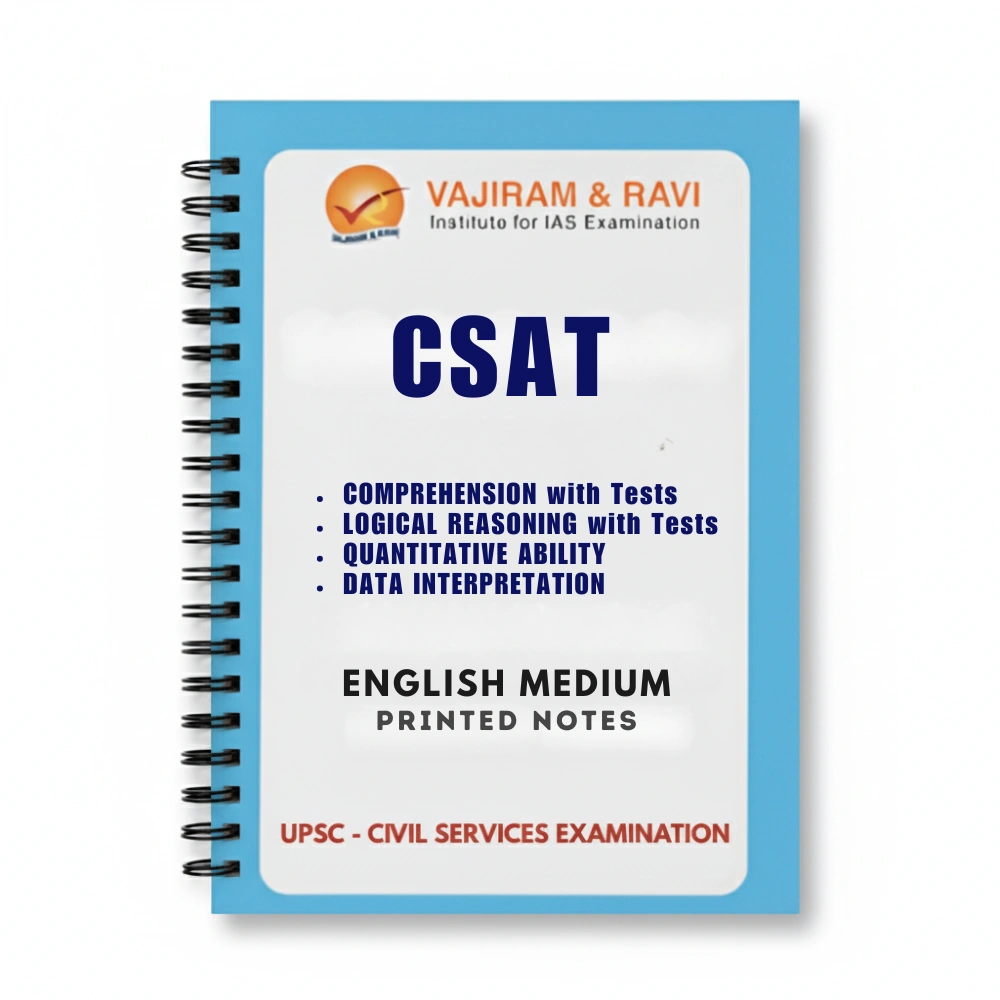
A structured Vajiram CSAT complete booklet set with practice questions plus a graded CSAT test series is the fastest way to de-risk this paper.
UPSC Prelims GS Paper 1 Syllabus (Topic-by-Topic)
The upsc prelims gs paper 1 syllabus is officially listed by UPSC in seven broad heads. Here is each head with its sub-topics.
| # | Syllabus Head | What It Covers |
|---|---|---|
| 1 | Current events of national & international importance | Government schemes, reports/indices, summits, awards, defence, appointments, bilateral relations |
| 2 | History of India & Indian National Movement | Ancient, Medieval, Modern India; Art & Culture; freedom struggle 1857–1947 |
| 3 | Indian & World Geography | Physical, social, economic geography of India and the world |
| 4 | Indian Polity & Governance | Constitution, political system, Panchayati Raj, public policy, rights issues |
| 5 | Economic & Social Development | Sustainable development, poverty, inclusion, demographics, social sector initiatives |
| 6 | Environmental Ecology, Biodiversity & Climate Change | General issues — no subject specialisation required |
| 7 | General Science | Everyday science, biology, physics, chemistry, science & technology developments |
History & Indian National Movement
Split into three blocks plus Art & Culture:
- Ancient India: Indus Valley, Vedic age, Mahajanapadas, Mauryas, Guptas, Sangam age.
- Medieval India: Delhi Sultanate, Vijayanagara, Mughals, Bhakti–Sufi movements, Marathas.
- Modern India: British expansion, 1857 revolt, socio-religious reforms, Congress, Gandhian phase, revolutionary movements, Partition and Independence.
- Art & Culture: architecture, painting, dance, music, literature, religion, festivals.
Indian & World Geography
- Physical: geomorphology, climatology, oceanography, geography of India (relief, drainage, climate, soils).
- Human & Economic: population, agriculture, minerals, industries, transport.
- World: continents, important lines, straits, world physical features, mapping.
Indian Polity & Governance
Highest-yield static area. Cover Constitution (features, Preamble, FRs, DPSPs, FDs), Union & State executive, Parliament & legislatures, judiciary, centre-state relations, constitutional & statutory bodies, Panchayati Raj, RTI, and governance/rights issues.
Economic & Social Development
Basics of macroeconomics, national income, money & banking, inflation, fiscal & monetary policy, budget, planning, poverty & unemployment, inclusive growth, government schemes and social-sector data.
Environment, Ecology & General Science
Ecology basics, biodiversity, protected areas, climate change conventions, pollution, conservation efforts — heavily linked to current affairs. General Science leans on everyday-application biology, basic physics/chemistry and science-tech in the news.
UPSC CSAT Syllabus (GS Paper II)
The upsc csat syllabus tests aptitude at roughly Class X level for numeracy and reasoning. The seven official components are below.
| Component | Scope | Approx. Weight |
|---|---|---|
| Comprehension | English & bilingual passages, inference, assumptions | High (25–30 Qs) |
| Interpersonal & communication skills | Clubbed within comprehension passages | Low |
| Logical reasoning & analytical ability | Syllogism, statements, seating, blood relations, directions | High (15–20 Qs) |
| Decision-making & problem-solving | Situational/ethical judgement | Low (usually no negative marking) |
| General mental ability | Series, coding-decoding, puzzles, clocks, calendars | Medium |
| Basic numeracy | Numbers, percentages, ratio, time-speed, P&L (Class X) | Medium |
| Data interpretation | Tables, graphs, pie charts, data sufficiency (Class X) | Medium (5–10 Qs) |
Note: English-language comprehension passages in CSAT are not translated into Hindi; all other sections are bilingual.
Subject-Wise Weightage & Trend Analysis
Top pages list topics but rarely tell you where the marks actually come from. Below is an indicative distribution of GS Paper I questions across recent UPSC Prelims papers — use it to prioritise, not to skip. Exact counts vary year to year; treat these as planning ranges, not guarantees.
| Subject | Approx. Questions (per year) | Priority |
|---|---|---|
| Polity & Governance | 12–18 | High-yield |
| Economy | 14–20 | High-yield |
| Environment & Ecology | 12–18 | High-yield |
| Current Affairs (integrated) | 15–25 | High-yield |
| History (Ancient/Medieval/Modern) | 12–17 | Medium |
| Art & Culture | 3–6 | Medium |
| Geography | 10–15 | Medium |
| Science & Technology | 7–12 | Medium |
The clear takeaway: Polity, Economy, Environment and Current Affairs together account for over half the paper. Lock these first. For current-affairs coverage, a disciplined monthly habit with the Vision IAS Current Affairs magazine (January 2026) keeps you from drowning in newspapers.
Syllabus-to-Study-Material Map (NCERTs + Standard Books)
This is the gap most syllabus pages miss — matching every head to what to read. Start with NCERTs, then move to a standard source per subject.
| Syllabus Head | NCERT Base | Standard / Advanced Source |
|---|---|---|
| Polity | Class IX–XII Political Science | Laxmikanth; GS booklets |
| Modern History | Class XII (Themes III) | Spectrum; GS notes |
| Ancient/Medieval & Culture | Class XI (Themes I & II) | Nitin Singhania (Culture) |
| Geography | Class VI–XII Geography | G.C. Leong; atlas |
| Economy | Class XI–XII Economics | Ramesh Singh / GS economy notes |
| Environment | Class XII Biology (ecology units) | Shankar IAS Environment |
| Science | Class VI–X Science | Current affairs + GS notes |
| Current Affairs | — | Monthly magazine + daily notes |
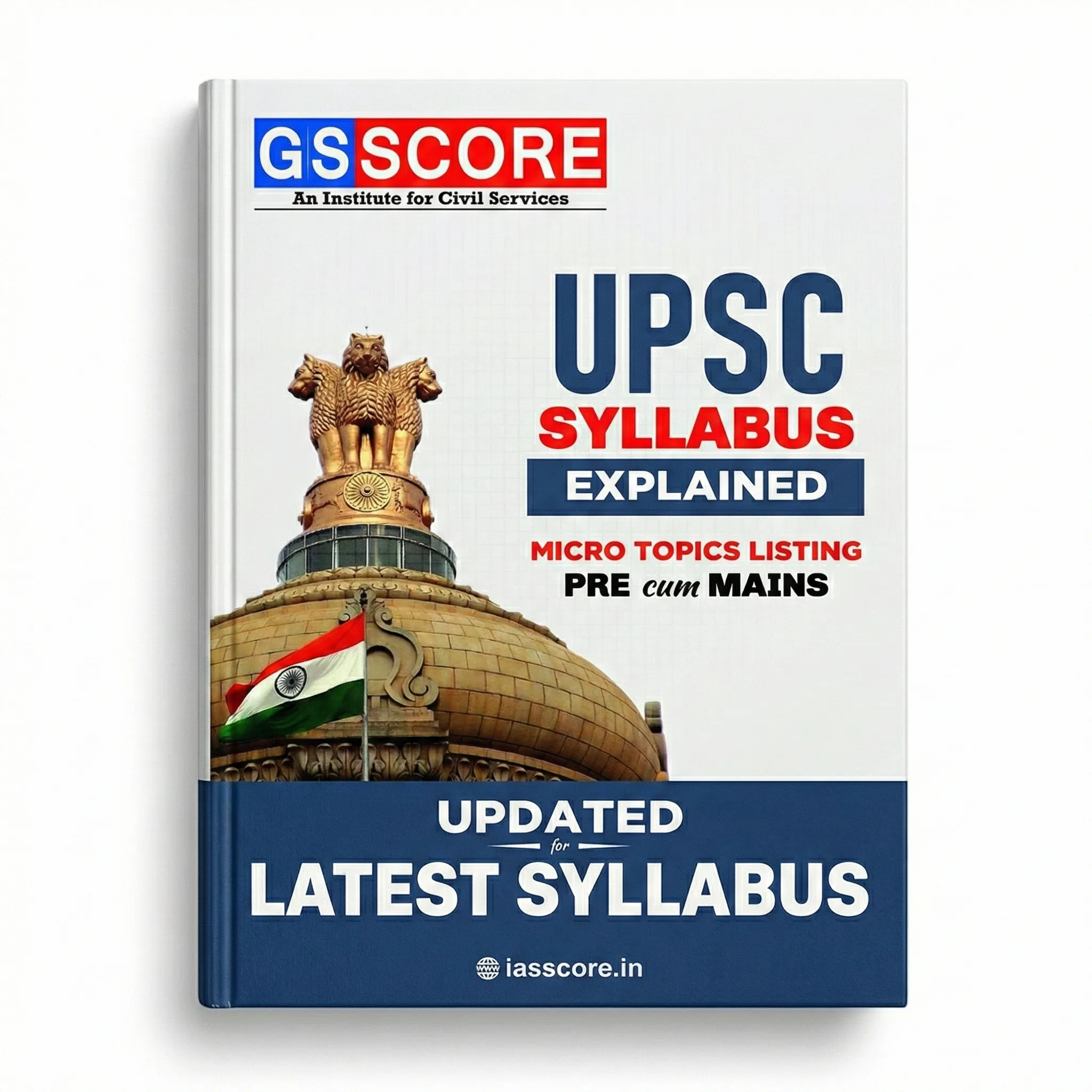
If you want this entire map pre-made as structured, syllabus-aligned booklets, the Vision IAS GS 2026-27 booklets (56 booklets with value-added material) cover every head above in Prelims-ready form, saving you the effort of stitching sources together. For an exact official-syllabus reference to annotate, the GS Score Latest Syllabus Booklet 2026-27 is a compact ready-reckoner.
Are NCERTs Enough to Cover the UPSC Prelims Syllabus?
NCERTs build an essential conceptual base and still reward you with a handful of direct questions each year — but on their own they are not enough to clear Prelims. They give you the language and fundamentals of each subject; they do not give you the depth in Polity, the current-affairs linkage in Environment, or the applied economy coverage that UPSC now tests. The working formula is: NCERT for the base, one standard source per subject for depth, current affairs for linkage, and PYQ/mock practice for calibration. Skip any one leg and the syllabus has a hole in it. First-timers should finish core NCERTs in the first 6–8 weeks, then stop re-reading them and shift to standard sources and revision.
Previous-Year Questions (PYQ) Tagged to the Syllabus
UPSC repeats concepts, not questions. Tagging 20–30 years of PYQs against each syllabus head tells you how a topic is actually asked — static fact, applied concept or current-linkage. This single habit raises your accuracy more than reading one extra book. A topic-wise PYQ compilation such as the Forum IAS UPSC Prelims Toolkit (Topic-Wise PYQ 1992–2025) lets you drill each syllabus line against decades of real questions.
Prelims vs Mains Syllabus: Key Difference
Aspirants constantly confuse the two. The Prelims syllabus is broad, objective and screening; the Mains syllabus is deep, analytical and descriptive and actually counts for the final merit.
| Aspect | Prelims | Mains |
|---|---|---|
| Format | Objective MCQ | Descriptive (written) |
| Papers | 2 (GS + CSAT) | 9 (incl. Essay, 4 GS, Optional, 2 language) |
| Counts in merit? | No (screening only) | Yes |
| Depth | Factual breadth | Analytical depth, opinion |
| Syllabus detail | Short, broad heads | Elaborate, sub-topic listed |
Smart aspirants prepare the overlapping static portions (Polity, Economy, History, Geography) together for both stages, then separate the Prelims-only facts (environment species, schemes, index ranks) and Mains-only analysis closer to each exam. For the descriptive stage, see our dedicated Prelims + Mains complete GS notes set.
High-Yield vs Low-Yield Areas
- High-yield (cover 100%): Polity, Economy, Environment, Current Affairs, Modern History.
- Medium-yield (cover selectively): Geography, Science & Tech, Ancient/Medieval History.
- Low-yield (optimise effort): very niche Art & Culture, obscure physical geography. Do not over-invest here.
And for CSAT: comprehension + reasoning are your highest-return areas. Numeracy/DI need daily 30-minute practice if your maths is rusty.
6-Month & 1-Year Study Plan Tied to the Syllabus
A syllabus is only useful with a timeline. Here is a compressed 6-month roadmap (scale each phase up for a 1-year plan).
| Phase | Duration | Focus |
|---|---|---|
| 1. Foundation | Month 1–2 | NCERTs + Polity, Modern History, Geography |
| 2. Core static | Month 3–4 | Economy, Environment, Science; start CSAT |
| 3. Current affairs | Throughout | Monthly magazine + daily notes; revision 1 |
| 4. Testing | Month 5 | Full-length mock tests, PYQ analysis |
| 5. Revision | Month 6 | Revision 2–3 + rapid CSAT practice |
Testing is non-negotiable in the last 8–10 weeks. A graded mock programme like the Vision IAS Prelims Test Series 2026 trains elimination, time management and that crucial attempt-count calibration under negative marking.
Can the UPSC Prelims Syllabus Be Completed in 3 Months?
Honestly, it depends on your starting point. A 3-month Prelims sprint is realistic only for repeaters or graduates of relevant backgrounds who already have a static base and mainly need revision, current affairs and heavy test practice. For a genuine first-timer starting from zero, three months is enough to cover the syllabus once but rarely enough to revise it the two-to-three times that clearing the cut-off demands. If you have exactly three months, do not try to read everything — instead:
- Weeks 1–6: finish only high-yield subjects (Polity, Economy, Environment, Modern History) from one source each, plus last 12 months of current affairs.
- Weeks 7–9: add Geography, Science and selective Art & Culture; begin daily CSAT practice.
- Weeks 10–12: full-length mocks every 2–3 days, PYQ analysis, and two rapid revisions of high-yield notes.
In short: completable, but only with ruthless prioritisation and daily testing — not by chasing 100% coverage.
Printable Syllabus Checklist / Tracker
Convert the syllabus into a tick-off tracker so nothing slips. A simple structure:
| Subject | Read 1st Time | Revision 1 | Revision 2 | PYQ Done |
|---|---|---|---|---|
| Polity | ☐ | ☐ | ☐ | ☐ |
| Economy | ☐ | ☐ | ☐ | ☐ |
| History & Culture | ☐ | ☐ | ☐ | ☐ |
| Geography | ☐ | ☐ | ☐ | ☐ |
| Environment | ☐ | ☐ | ☐ | ☐ |
| Science & Tech | ☐ | ☐ | ☐ | ☐ |
| Current Affairs | ☐ | ☐ | ☐ | ☐ |
| CSAT | ☐ | ☐ | ☐ | ☐ |
Print this and target three full revisions of every high-yield subject before exam day.
Key Dates & Syllabus PDF Download (2026 Cycle)
As per UPSC’s annual calendar, the Civil Services (Preliminary) Examination 2026 notification is expected around 14 January 2026, with the Prelims exam scheduled for 24 May 2026 (always confirm the final dates on upsc.gov.in). The ias prelims syllabus itself is notified as part of this notification and has remained stable for years.
upsc prelims syllabus pdf download: The official, authoritative copy of the complete GS Paper I + CSAT syllabus is published inside the UPSC Prelims notification PDF on upsc.gov.in — download that and keep it on your study table. For a printed, annotation-ready version you can mark up with “where to study each line” notes, a copy such as the GS Score Latest Syllabus Booklet 2026-27 doubles as your master reference. And is the UPSC Prelims syllabus the same every year? Broadly yes — only current affairs change; the structure and heads do not.
Common Mistakes Aspirants Make
- Ignoring CSAT until it is too late — then failing the 33% bar.
- Reading new sources instead of revising the same source 3 times.
- Collecting material but never solving PYQs or mock tests.
- Over-preparing low-yield topics and under-preparing Economy/Environment.
- Attempting too many questions and losing marks to negative marking.
Frequently Asked Questions
What is the syllabus for UPSC Prelims?
UPSC Prelims has two papers. GS Paper I covers current events, history and the national movement, Indian and world geography, polity and governance, economic and social development, environment and ecology, and general science. CSAT (Paper II) covers comprehension, reasoning, decision-making, general mental ability, basic numeracy and data interpretation at Class X level.
Is UPSC Prelims syllabus same every year?
Yes, the structure and topics stay the same every year — UPSC has not changed the official Prelims syllabus for over a decade. Only the current-affairs component changes with the news cycle, so your static preparation remains valid across attempts.
How many papers are there in UPSC Prelims and what are the marks?
There are two papers, each of 200 marks and 2 hours. GS Paper I has 100 questions and CSAT has 80 questions, giving a total of 400 marks for the Prelims stage.
Is there negative marking in UPSC Prelims?
Yes. One-third of the marks assigned to a question (roughly 0.66 in GS and 0.83 in CSAT) is deducted for every wrong answer. Unattempted questions carry no penalty, and CSAT decision-making questions usually have no negative marking.
Is CSAT qualifying in UPSC Prelims and how many marks are needed?
CSAT is only qualifying. You need a minimum of 33%, i.e. 66.67 out of 200 marks, to qualify. Your CSAT score beyond 33% does not add to the cut-off — only GS Paper I decides the Prelims merit.
Are NCERTs enough to cover the UPSC Prelims syllabus?
NCERTs build an essential base but are not sufficient alone. You need NCERTs plus a standard source per subject (such as Laxmikanth for Polity or Shankar IAS for Environment), regular current affairs, and PYQ/test practice to fully cover the Prelims syllabus.
What is the difference between UPSC Prelims and Mains syllabus?
The Prelims syllabus is broad, objective (MCQ) and only a screening test that does not count towards the final merit. The Mains syllabus is deeper, descriptive and listed in detailed sub-topics across nine papers, and it does count towards your rank. Static subjects like Polity, Economy, History and Geography overlap, so prepare them together and separate the Prelims-only facts and Mains-only analysis nearer each exam.
Can the UPSC Prelims syllabus be completed in 3 months?
It can, but mainly for repeaters or candidates with a strong existing base who need revision and test practice rather than first-time learning. A complete beginner can cover the syllabus once in three months but will struggle to revise it two or three times. The workable approach is to prioritise high-yield subjects (Polity, Economy, Environment, Current Affairs, Modern History), finish one source each, and switch to daily mocks and PYQ analysis in the final weeks rather than aiming for 100% coverage.
Recommended Study Material

Continue Reading

Best Books for UPSC 2026: Subject & Stage-Wise List
The best books for UPSC are the NCERTs (Class 6–12) for foundation, followed by a tight set of…

CTET Syllabus 2026: Paper 1 & 2 Topics, Pattern + PDF
The CTET syllabus is set by the Central Board of Secondary Education (CBSE) and is split across two…
Best Study Material for IIT-JEE 2026: FIITJEE, Resonance, Aakash & More Compared
Best Study Material for IIT-JEE: An Honest Buying Guide (2026) Choosing the best study material for IIT JEE…