CAPF Syllabus 2026: Paper 1 & 2, Pattern, PST/PET + PDF
Complete CAPF syllabus 2026 for UPSC Assistant Commandant: Paper 1 & 2 topics, exam pattern, marks, PST/PET, medical standards, books & PDF download.

The CAPF syllabus for the UPSC Assistant Commandant (AC) 2026 exam has two written papers: Paper 1 — General Ability & Intelligence (250 marks, objective MCQs) and Paper 2 — General Studies, Essay & Comprehension (200 marks, descriptive). These are followed by the Physical Standard Test (PST), Physical Efficiency Test (PET), a medical exam, and a 150-mark interview. The written stage carries 450 marks and the Personality Test 150 marks, for a total of 600 marks. That is the short answer; everything below is the complete, subject-wise breakdown.
This guide gives you the full 2026 capf paper 1 and paper 2 syllabus, the exam pattern and marking scheme, physical and medical standards, cut-off trends, a topic-wise weightage analysis, a study plan, and where to get the syllabus PDF. Conducted by the Union Public Service Commission (UPSC), the CAPF AC exam recruits Assistant Commandants for the BSF, CRPF, CISF, ITBP and SSB. Because Paper 1 overlaps heavily with UPSC CSE Prelims General Studies, many aspirants prepare for both together — we map every topic to its weightage and to specific study material so you can plan from day one.
Note: syllabus topics are stable year to year, but marks, dates and physical standards should always be cross-checked against the official UPSC notification (upsc.gov.in) for the 2026 cycle before you finalise your plan.
CAPF AC 2026 Exam: Quick Overview
Before the detailed upsc capf ac syllabus 2026, here is the exam at a glance. The notification is typically released in April and the written exam held in August.
| Particular | Detail |
|---|---|
| Exam Name | UPSC CAPF Assistant Commandant (AC) Examination 2026 |
| Conducting Body | Union Public Service Commission (UPSC) |
| Posts | Assistant Commandant (Group A) in BSF, CRPF, CISF, ITBP, SSB |
| Written Exam Marks | 450 (Paper 1: 250 + Paper 2: 200) |
| Interview / Personality Test | 150 marks |
| Total Marks | 600 |
| Mode (Paper 1) | Offline OMR — objective MCQs |
| Mode (Paper 2) | Offline — descriptive (pen & paper) |
| Negative Marking | Yes — 1/3 (0.33) in Paper 1 only |
| Age Limit | 20–25 years (relaxation per category) |
| Selection Stages | Written → PST/PET → Medical → Interview |
CAPF AC 2026 Eligibility: Who Can Apply
Syllabus mastery is wasted if you are not eligible, so confirm these basics first. The capf assistant commandant syllabus journey is open only to candidates who meet the age, education and nationality criteria below.
| Criterion | Requirement |
|---|---|
| Nationality | Indian citizen (or as specified in the UPSC notification) |
| Age | 20–25 years as on the cut-off date; age relaxation for OBC (3 yrs), SC/ST (5 yrs) and other eligible categories |
| Education | Bachelor’s degree from a recognised university (any stream) |
| Physical | Must meet PST/PET and medical standards (detailed below) |
| Gender | Open to male and female candidates |
Always verify the exact cut-off date for age and the list of eligible categories in the official 2026 notification, as these are fixed afresh each cycle.
CAPF AC Exam Pattern 2026
The capf ac exam pattern has two written papers taken on the same day. Both are compulsory. Paper 1 is objective and tests general awareness and reasoning; Paper 2 is descriptive and tests writing, analysis and comprehension (the essay component may be attempted in Hindi or English).
| Paper | Subject | Type | Questions | Marks | Duration | Negative Marking |
|---|---|---|---|---|---|---|
| Paper 1 | General Ability & Intelligence | Objective (MCQ) | 125 | 250 | 2 hours (10 AM–12 PM) | 0.33 per wrong answer |
| Paper 2 | General Studies, Essay & Comprehension | Descriptive | — | 200 | 3 hours (2 PM–5 PM) | No |
Key marking facts: Each Paper 1 question carries 2 marks; a wrong answer deducts 0.33 marks (one-third). You must clear a UPSC-decided cut-off in Paper 1 before Paper 2 is evaluated. Paper 2 must be answered in Hindi or English only (the comprehension/précis Part B is English-only). A minimum qualifying mark (commonly 25%) in each written paper is required to proceed to the next stage.
CAPF Paper 1 Syllabus: General Ability & Intelligence
Paper 1 is the scoring, high-overlap paper, carrying 250 marks across six broad areas. The Paper 1 portion of the capf paper 1 and paper 2 syllabus closely mirrors UPSC Prelims GS Paper 1, which is why dual aspirants find it efficient to study once and sit for both.
| Section | Key Topics | Approx. Weightage |
|---|---|---|
| General Mental Ability | Logical reasoning, quantitative aptitude (up to 10th standard), data interpretation, series, analogies | 15–20% |
| General Science | Physics, Chemistry, Biology basics; science in everyday life; space, ICT, defence & biotech developments | 15–18% |
| Current Events of National & International Importance | Culture, music, arts, sports, governance, polity, economy, science-tech, awards, summits, defence news | 20–25% |
| Indian Polity & Economy | Constitution, political system, Panchayati Raj, economic & social development, sustainable development, poverty, demographics | 15–18% |
| History of India | Ancient, medieval, modern India; social, economic & political aspects; freedom struggle | 12–15% |
| Indian & World Geography | Physical, social & economic geography of India and the world; climate, resources, agriculture | 12–15% |
Current affairs is the single heaviest slice of Paper 1, so a disciplined monthly current-affairs routine is non-negotiable. Pairing a static GS base with a current-affairs magazine keeps you aligned with the exam’s national-and-international focus.
CAPF Paper 2 Syllabus: General Studies, Essay & Comprehension
Paper 2 is descriptive and split into two parts. Part A rewards structured, opinionated essay writing; Part B tests precise English comprehension and language skills. This is where most candidates lose marks, because they revise static facts but never practise answer-writing.
| Part | Component | Topics / Skills Tested | Indicative Marks |
|---|---|---|---|
| Part A | Essay Questions | Modern Indian history & freedom struggle; geography; polity & economy; knowledge of security & human rights issues; analytical ability (written in Hindi or English) | ~80 |
| Part B | Comprehension, Précis Writing, Developing Counter-Arguments, Simple Grammar & Language Testing | Reading comprehension passages, précis, other communication/language skills (English only) | ~120 |
How to prepare for the descriptive Paper 2
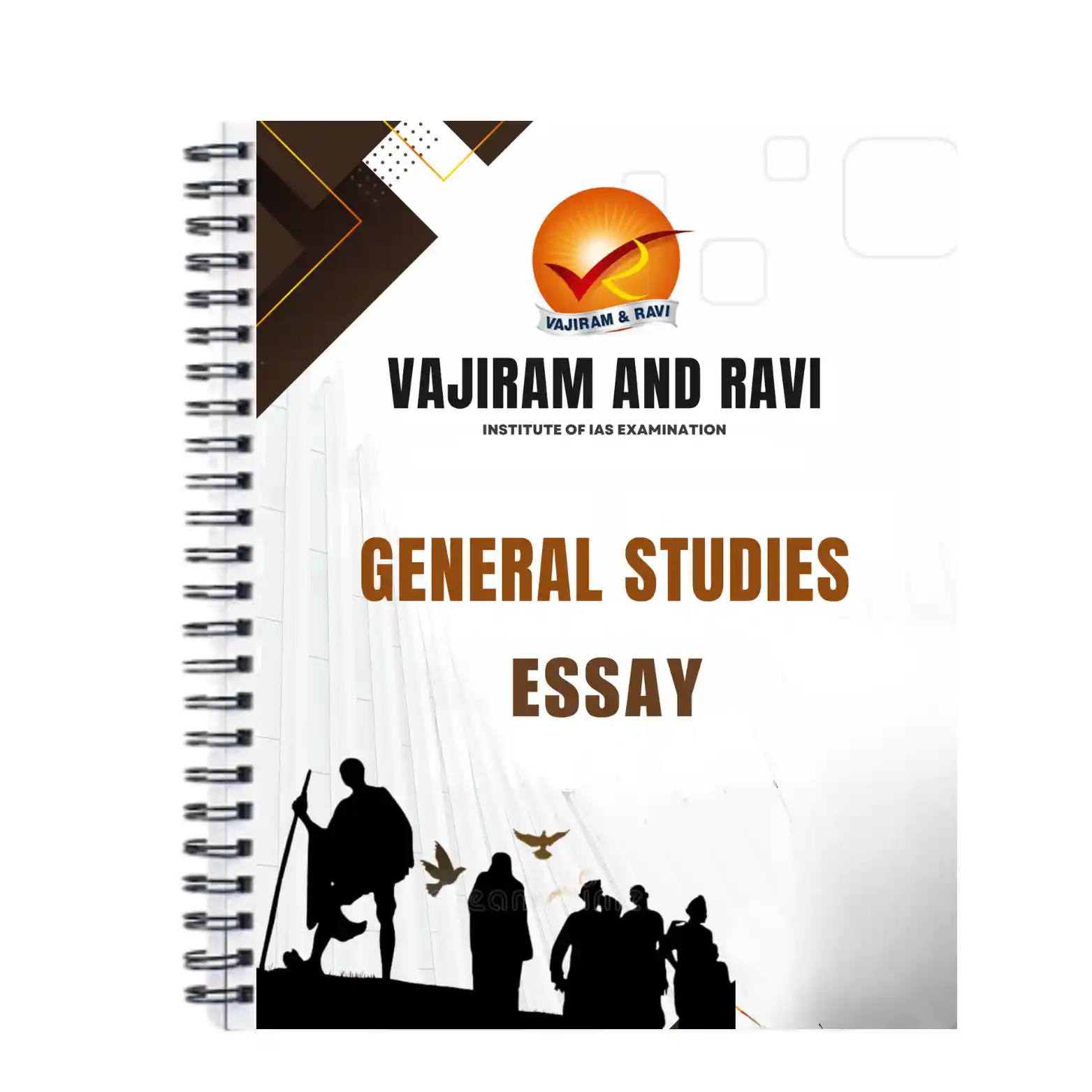
Treat Paper 2 like UPSC Mains in miniature. Write at least two full essays and one précis every week under a timer. For Part A, build a stock of examples on security, human rights and governance; for Part B, practise summarising 300-word passages into one-third length without losing meaning. A dedicated essay notes booklet gives you ready structures, quotes and model introductions you can adapt on exam day.
CAPF AC Selection Process 2026: All Stages
Clearing the written exam is only the first gate. The full selection journey runs through sequential stages, and you must clear each to advance.
| Stage | What It Involves | Nature |
|---|---|---|
| 1. Written Examination | Paper 1 (250) + Paper 2 (200) = 450 marks | Merit-ranking |
| 2. Physical Standard Test (PST) | Height, chest and weight verification | Qualifying |
| 3. Physical Efficiency Test (PET) | Race, long jump, shot put | Qualifying |
| 4. Medical Standards Test (MST) | Vision, general fitness, physical soundness | Qualifying |
| 5. Interview / Personality Test | 150 marks before the UPSC board | Merit-ranking |
The final merit list is prepared from written marks (450) plus the Personality Test (150). PST, PET and medical are strictly qualifying — you either pass or you are out — so train for them in parallel with your studies.
CAPF Physical Standard Test (PST) 2026
The capf physical standards (pst) and pet are a common reason strong written performers get eliminated. PST checks height, chest and weight. Relaxations apply for ST candidates and candidates from specified hilly/tribal areas.
| Parameter | Male | Female |
|---|---|---|
| Height (General) | 165 cm | 157 cm |
| Height (ST / hill areas) | 162.5 cm | 154 cm |
| Chest (unexpanded) | 81 cm | Not applicable |
| Chest (minimum expansion) | 5 cm | Not applicable |
| Weight | Proportionate to height & age | Proportionate to height & age |
CAPF Physical Efficiency Test (PET) 2026
The PET follows PST and is also qualifying. There is no relaxation in PET timings/distances across categories, so begin fitness training early. Standards differ for male and female candidates.
| Event | Male | Female |
|---|---|---|
| 100 metres race | 16 seconds | 18 seconds |
| 800 metres race | 3 minutes 45 seconds | 4 minutes 45 seconds |
| Long jump | 3.5 metres (3 chances) | 3.0 metres (3 chances) |
| Shot put (7.26 kg) | 4.5 metres | Not applicable |
CAPF Medical Standards 2026
After PET, shortlisted candidates face the Medical Standards Test. Eyesight requirements are among the most common disqualifiers, so get your vision checked before applying.
| Medical Parameter | Requirement |
|---|---|
| Distant vision (better eye, corrected) | 6/6 or 6/9 |
| Distant vision (worse eye, corrected) | 6/12 or 6/9 |
| Near vision | N6 (better eye), N9 (worse eye) |
| Colour vision / squint | No colour blindness; no squint |
| General fitness | No knock knee, flat foot, varicose vein; sound mental & bodily health |
Is the CAPF Syllabus the Same as UPSC CSE Prelims?
This is the most-asked dual-aspirant question. The answer is partly yes. CAPF Paper 1 (General Ability & Intelligence) and UPSC Prelims GS Paper 1 share the same static spine — Polity, History, Geography, Economy, General Science and Current Affairs. That means one strong GS foundation serves both exams.
| Area | CAPF Paper 1 | UPSC CSE Prelims GS |
|---|---|---|
| Polity, History, Geography, Economy | Yes — core | Yes — core |
| General Science & Current Affairs | Yes | Yes |
| General Mental Ability / Reasoning | Within Paper 1 | In CSAT (Paper 2) |
| Environment & Ecology depth | Lighter | Heavier |
| Descriptive Essay & Comprehension | Yes (Paper 2) | No (Mains stage) |
| Negative marking | 0.33 | 0.33 |
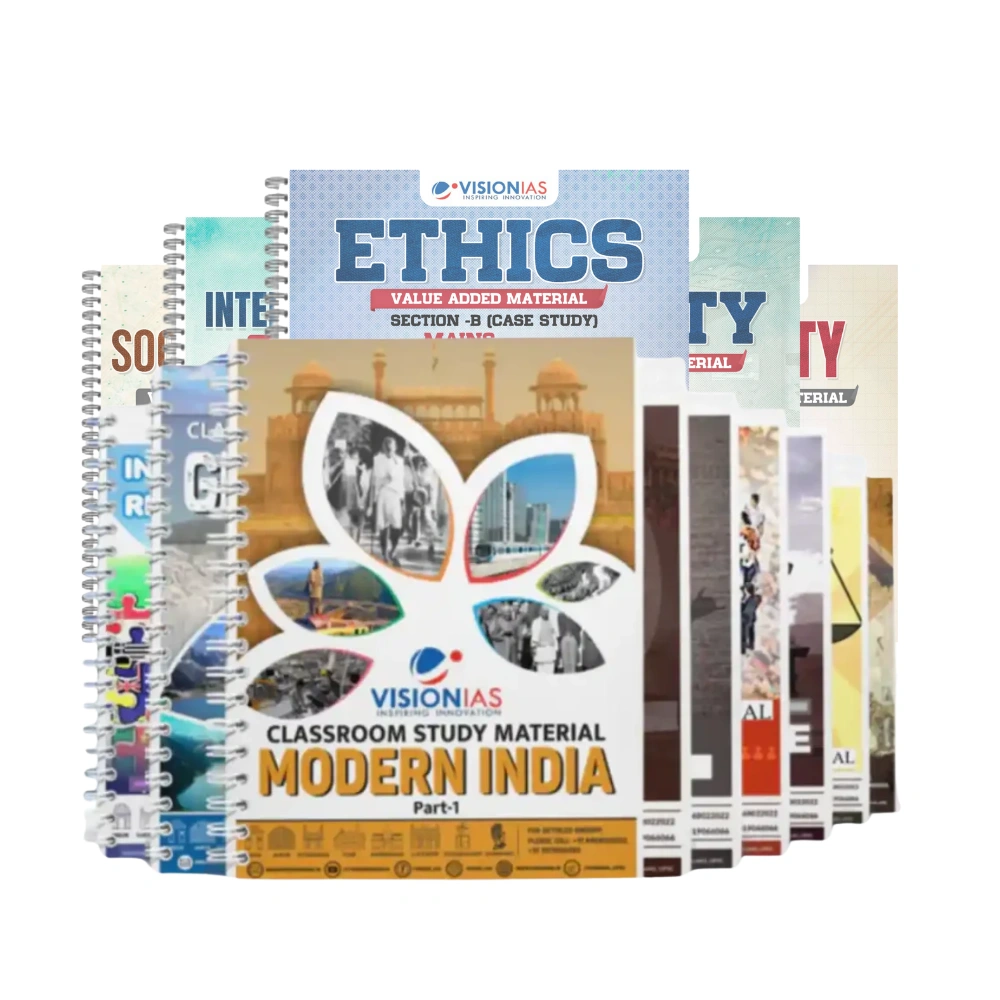
The practical takeaway: study a single GS source, then add CAPF-specific descriptive practice for Paper 2. A comprehensive printed GS set like the Vision IAS GS 2026-27 booklets covers the static syllabus for both exams in one go, saving you from buying duplicate material.
Subject-Wise Books & Study Material Mapped to the CAPF Syllabus
Most ranking pages list the syllabus but never tell you what to read for each topic. Here is a topic-to-resource map built from the catalogue, so you can cover every section with the right material instead of guessing.
| Syllabus Area | What to Study | Recommended Material |
|---|---|---|
| Polity, History, Geography, Economy, Science (static) | Full NCERT-to-advanced static base for Paper 1 | Vision IAS GS 2026-27 (56 booklets) |
| Current Events (national & international) | Monthly current affairs — the heaviest Paper 1 slice | Vision IAS Current Affairs Magazine (Jan 2026) |
| PYQ trend & topic weightage | Topic-wise previous-year questions to spot repeats | Forum IAS Prelims Toolkit — PYQ 1992–2025 |
| Paper 2 Essay (Part A) | Model essays, structures, security & human rights content | Vajiram Essay Notes (GS) |
| General Mental Ability | Reasoning & quantitative aptitude up to class 10 | Practice sets + CSAT-style aptitude material |
| Latest syllabus reference | Clean, printed UPSC syllabus for quick revision | GS Score Latest Syllabus Booklet 2026-27 |
Topic-Wise Weightage & Previous-Year Trend Analysis
Analysing recent Paper 1 papers shows a clear pattern: Current Affairs, Polity and General Science together account for roughly half the paper. Smart candidates allocate time by weightage rather than reading every subject equally.
| Priority | Subject | Trend (recent papers) | Study Time Share |
|---|---|---|---|
| High | Current Events | 25–30 questions; mix of static + dynamic | 30% |
| High | Indian Polity & Economy | 18–22 questions; Constitution-heavy | 20% |
| Medium | General Science | 18–20 questions; application-based | 18% |
| Medium | History of India | 15–18 questions; modern India dominant | 15% |
| Medium | Geography | 12–15 questions; India + physical geography | 12% |
| Low–Medium | General Mental Ability | 8–12 questions; scoring & quick | 5% |
CAPF AC Cut-Off & Qualifying Marks: What to Target
Many aspirants ask how much they need to score. There are two layers: a minimum qualifying mark in each paper, and a final merit cut-off that varies by category and vacancies each year. Treat the figures below as recent-trend guidance, not guarantees — the UPSC publishes the exact cut-offs after each cycle.
| Benchmark | Indicative Level | Notes |
|---|---|---|
| Minimum qualifying (each written paper) | ~25% | Fall below in either paper and you are out, regardless of total |
| Written cut-off to reach interview (General) | Varies yearly (often ~45–55% of 450) | Depends on paper difficulty and vacancies |
| Final merit (written + interview) | Category- and year-dependent | Strong interview marks can lift borderline candidates |
The lesson: do not aim merely to “qualify.” Because the final list is drawn from 600 marks, build a buffer in the high-weightage Paper 1 sections and do not treat the 150-mark interview as an afterthought.
CAPF AC 2026 Preparation Strategy & Timeline
A disciplined 6–8 month plan comfortably covers the capf assistant commandant syllabus. Study Paper 1 static subjects first, layer current affairs continuously, and start Paper 2 answer-writing from month three.
| Phase | Duration | Focus |
|---|---|---|
| Foundation | Months 1–3 | Complete static GS (Polity, History, Geography, Economy, Science); start daily current affairs |
| Application | Months 4–5 | PYQ practice, weekly essay & précis writing, General Mental Ability drills |
| Consolidation | Month 6 | Full-length mocks for both papers, revision of high-weightage topics |
| Parallel (all months) | Ongoing | PST/PET fitness — running, long jump, shot put practice |
Common mistakes to avoid
- Ignoring Paper 2 until the last month — descriptive writing needs months of practice.
- Neglecting physical training; many written-qualified candidates fail PET.
- Guessing blindly in Paper 1 despite 0.33 negative marking.
- Relying only on online notes without a consolidated, revisable printed source.
- Skipping previous-year papers, which reveal repeated themes every cycle.
CAPF Syllabus 2026 PDF Download
You can complete an upsc capf syllabus pdf download directly from the exam notification on the UPSC website (upsc.gov.in) each cycle — the official PDF lists the Paper 1 and Paper 2 syllabus, the pattern, and the physical and medical standards. For a cleaner, exam-ready reference you can annotate and revise from, a printed syllabus booklet such as the GS Score Latest Syllabus Booklet 2026-27 lays out the full UPSC syllabus in a structured format you can carry. Keep the topic-wise weightage table above as your personal checklist and tick off each area as you complete it.
Frequently Asked Questions
What is the syllabus of CAPF?
The CAPF AC syllabus has two written papers. Paper 1 (General Ability & Intelligence, 250 marks) covers General Mental Ability, General Science, Current Events, Indian Polity & Economy, History of India, and Indian & World Geography. Paper 2 (200 marks) is descriptive, with Part A essays and Part B comprehension, précis, counter-arguments and grammar.
Is the CAPF syllabus same as UPSC CSE Prelims?
Largely yes for the static portion. CAPF Paper 1 and UPSC Prelims GS share Polity, History, Geography, Economy, Science and Current Affairs. The differences are CAPF’s descriptive Paper 2 and UPSC’s separate CSAT paper, so one GS foundation can serve both exams with some targeted additions.
How many papers are there in the CAPF AC exam?
There are two written papers. Paper 1 is objective (125 MCQs, 250 marks, 2 hours) and Paper 2 is descriptive (200 marks, 3 hours). Both are compulsory and held on the same day, followed by PST/PET, medical and a 150-mark interview.
Is there negative marking in CAPF Paper 1?
Yes. Paper 1 carries a negative marking of one-third (0.33) marks for every wrong answer. Each question is worth 2 marks, so a wrong attempt costs you roughly 0.66 marks in net terms. Paper 2, being descriptive, has no negative marking.
What is the exam pattern and total marks for UPSC CAPF AC?
The written stage has Paper 1 (250 marks, objective) and Paper 2 (200 marks, descriptive), totalling 450 marks. Adding the 150-mark Personality Test/interview gives a grand total of 600 marks. PST, PET and the medical test are qualifying-only and do not add to the merit score.
What are the physical standards (PST/PET) for CAPF Assistant Commandant?
PST requires a minimum height of 165 cm for men and 157 cm for women (relaxed for ST/hill candidates), with an 81 cm male chest (5 cm expansion). PET includes a 100 m race (16s men/18s women), 800 m race (3:45 men/4:45 women), long jump (3.5 m men/3.0 m women) and shot put (4.5 m, men only).
Which subjects are included in CAPF Paper 1 and Paper 2?
Paper 1 includes General Mental Ability, General Science, Current Events of national and international importance, Indian Polity & Economy, History of India, and Indian & World Geography. Paper 2 includes essay writing on history, geography, polity, economy and security/human-rights topics (Part A) plus comprehension, précis, counter-arguments and grammar (Part B).
Can I prepare for CAPF AC and UPSC Prelims together?
Yes, and many aspirants do. The static spine of CAPF Paper 1 and UPSC Prelims GS is nearly identical, so one GS base covers both. Add CAPF-specific essay and comprehension practice for Paper 2, and brush up reasoning/aptitude, which CAPF places inside Paper 1 rather than a separate CSAT paper.
Which books are best for CAPF AC preparation?
A complete static GS set like the Vision IAS GS 2026-27 booklets covers Paper 1, a monthly current-affairs magazine handles the high-weightage current events, topic-wise PYQ toolkits reveal repeat trends, and an essay notes booklet prepares you for the descriptive Paper 2. Combining these four covers the entire CAPF syllabus efficiently.
Recommended Study Material


Continue Reading

KVS Syllabus 2025: PRT, TGT, PGT Pattern + PDF
The KVS syllabus for 2025 is built around a two-tier selection process: Tier 1 is a screening test…

Best Sociology Optional Notes for UPSC 2026: Faculty-Wise Comparison
Sociology Optional Notes for UPSC: An Honest Buying Guide (2026) Choosing the right sociology optional notes can quietly…
UKPSC Syllabus 2026: Prelims, Mains, Exam Pattern + PDF (Hindi & English)
The UKPSC syllabus for the Uttarakhand Combined State Civil Services (Upper PCS) exam is a three-stage syllabus spread…