CGPSC Syllabus 2025: Prelims, Mains, Exam Pattern + PDF Download
Complete CGPSC syllabus 2025 for Prelims & Mains — full exam pattern, topic-wise breakdown, paper-wise weightage, negative marking, Hindi notes and official syllabus PDF download.

The CGPSC syllabus for the Chhattisgarh State Service Examination (SSE) spans three stages: Prelims — two objective papers of 200 marks each; Mains — seven descriptive papers of 200 marks each (1,400 marks); and a Personality Test (interview) of 150 marks. Prelims screens candidates through a General Studies paper and an Aptitude (CSAT-style) paper with 1/3 negative marking, while Mains covers Language, Essay and five General Studies papers, after which the interview decides the final merit. This guide reproduces the notification-matched topic list for every paper, adds paper-wise weightage and a Chhattisgarh-focused strategy, and points you to the official cgpsc syllabus pdf download so you can plan your preparation in one sitting.
CGPSC Syllabus 2025: Quick Facts
Before the detail, here is the cgpsc syllabus 2025 in one snapshot so you can orient your prep immediately.
| Detail | At a Glance |
|---|---|
| Conducting body | Chhattisgarh Public Service Commission (CGPSC) |
| Exam name | State Service Examination (SSE) |
| Stages | Prelims → Mains → Interview (Personality Test) |
| Prelims papers | 2 objective papers (400 marks) |
| Mains papers | 7 descriptive papers (1,400 marks) |
| Interview | 150 marks |
| Final merit | Mains + Interview = 1,550 marks |
| Medium | Bilingual (Hindi & English) |
| Negative marking | Yes, 1/3 in Prelims only |
What is the Syllabus of CGPSC?
The Chhattisgarh Public Service Commission (CGPSC) conducts the State Service Examination to recruit for posts such as Deputy Collector, DSP, Chhattisgarh Accounts Service, Excise Sub-Inspector, Naib Tehsildar and other Class-1 and Class-2 gazetted roles. The selection process has three stages, and the cgpsc syllabus stays close to the UPSC template while adding a heavy layer of Chhattisgarh-specific general knowledge — the real differentiator in this exam.
| Stage | Nature | Papers | Total Marks | Purpose |
|---|---|---|---|---|
| Prelims | Objective (MCQ) | 2 papers | 400 | Screening / qualifying |
| Mains | Descriptive (written) | 7 papers | 1400 | Merit ranking |
| Interview | Personality Test | — | 150 | Merit ranking |
| Final Merit | Mains + Interview | — | 1550 | Final selection |
Marks scored in Prelims are not added to the final tally — Prelims only qualifies you for Mains. The final rank is built from Mains (1,400) plus the Personality Test (150), a total of 1,550 marks. Because CGPSC periodically fine-tunes paper groupings, treat this guide as a study-ready map and always cross-verify against the latest official notification before you finalise your booklist.
CGPSC Exam Pattern 2025 (Prelims & Mains)
Understanding the cgpsc exam pattern before touching the syllabus saves months of misdirected effort. Prelims is a one-day, two-session objective test; Mains is a multi-day descriptive marathon. Here is the complete pattern.
CGPSC Prelims Exam Pattern
| Paper | Subject | Questions | Marks | Duration | Negative Marking |
|---|---|---|---|---|---|
| Paper I | General Studies | 100 | 200 | 2 hours | 1/3 (0.67 mark) |
| Paper II | Aptitude Test (CSAT) | 100 | 200 | 2 hours | 1/3 (0.67 mark) |
Each Prelims question carries 2 marks. For every wrong answer, one-third of the marks (about 0.67) is deducted. Paper II (Aptitude) is qualifying in nature — you must score at least 33% — while the merit for entering Mains is decided by your Paper I score.
CGPSC Mains Exam Pattern
| Paper | Subject | Marks | Duration |
|---|---|---|---|
| Paper I | Language (Hindi, Chhattisgarhi & English) | 200 | 3 hours |
| Paper II | Essay (Nibandh) | 200 | 3 hours |
| Paper III | General Studies-I (History & Constitution) | 200 | 3 hours |
| Paper IV | General Studies-II (Science, Technology & Environment) | 200 | 3 hours |
| Paper V | General Studies-III (Economy, Geography) | 200 | 3 hours |
| Paper VI | General Studies-IV (Mathematics & Reasoning) | 200 | 3 hours |
| Paper VII | General Studies-V (Philosophy, Sociology, Public Administration) | 200 | 3 hours |
All seven Mains papers are descriptive and carry 200 marks each for a total of 1,400 marks, each with a three-hour window. Aspirants sometimes see slightly different GS groupings in older notifications — always cross-check the latest official notification, but the seven-paper, 1,400-mark structure has been stable.
Who Can Apply? Eligibility & Attempts (Quick Note)
Eligibility isn’t part of the syllabus, but it shapes your timeline, so keep it in view: candidates generally need a bachelor’s degree from a recognised university, and age limits (with relaxations for reserved categories and Chhattisgarh domicile) plus the number of permitted attempts are specified afresh in each year’s notification. Confirm the exact age band, relaxation and attempt limit from the current advertisement before you commit a preparation cycle.
CGPSC Prelims Syllabus 2025: Paper I (General Studies)
The cgpsc prelims syllabus Paper I blends national General Studies with a dense Chhattisgarh component. Below is the full topic-by-topic breakdown as it appears in the official notification.
National / General Studies Portion
- History of India: Ancient, medieval and modern India; the Indian freedom struggle and national movement; socio-religious reform movements.
- Indian Polity & Constitution: Making of the Constitution, salient features, Fundamental Rights and Duties, Directive Principles, Union and State legislature, executive and judiciary, Panchayati Raj, constitutional bodies.
- Indian Economy: Planning, national income, banking, budgeting, agriculture, industry, poverty, unemployment, economic reforms and government schemes.
- Geography of India: Physical, social and economic geography; rivers, monsoon, natural resources, agriculture, minerals and industries.
- General Science & Technology: Everyday science, physics, chemistry, biology fundamentals, IT, space, defence and recent scientific developments.
- Environment & Ecology: Biodiversity, ecosystems, climate change, pollution, conservation and environmental legislation.
- Current Affairs: National and international events, sports, awards, appointments and important schemes of the last 12–18 months.
Chhattisgarh-Specific Portion (the CGPSC Differentiator)
Roughly a third to nearly half of Paper I revolves around Chhattisgarh. This is where selections are won or lost, since national GS is common with other exams. Cover:
- History of Chhattisgarh: Ancient and medieval CG, the Kalchuri and Maratha rule, contribution to the freedom struggle, tribal revolts and the movement for statehood.
- Geography of Chhattisgarh: Physiography, rivers (Mahanadi, Indravati, Shivnath), climate, forests, soil, minerals, crops and agro-climatic zones.
- Culture of Chhattisgarh: Tribes, dialects, festivals, folk dances (Panthi, Raut Nacha, Karma), folk music, fairs, art, literature and archaeological sites.
- Chhattisgarh Polity & Administration: State administrative structure, districts and divisions, local self-government, Panchayati Raj institutions, and the PESA Act.
- Chhattisgarh Economy: Agriculture, forest produce (tendu, mahua), industries, power, mineral wealth and state government schemes and welfare programmes.
- Chhattisgarh Current Affairs: State budget, policies, appointments, sports persons, awards and recent developments.
CGPSC Prelims Syllabus: Paper II (Aptitude / CSAT)
Paper II is the aptitude test, similar to UPSC CSAT. It is qualifying (33%), but candidates who ignore it risk failing to clear the cut-off. The topics are:
- Comprehension: Reading passages and answering inference-based questions.
- Interpersonal skills including communication skills.
- Logical reasoning and analytical ability.
- Decision making and problem solving.
- General mental ability.
- Basic numeracy (numbers and their relations, orders of magnitude) and data interpretation (charts, graphs, tables) of Class 10 level.
- Hindi language comprehension of Class 10 level (tested without English translation).
| Section | Approx. Weight | Difficulty |
|---|---|---|
| Comprehension | High | Moderate |
| Reasoning & Analytical Ability | High | Moderate |
| Basic Numeracy & Data Interpretation | Medium | Class 10 |
| Decision Making | Low–Medium | Easy |
CGPSC Mains Syllabus 2025: Paper-Wise Breakdown
The cgpsc mains syllabus is where depth matters. Seven descriptive papers demand structured answers, so map each paper to a clear source set. Below is the paper-wise scope.
Paper I — Language (Hindi, Chhattisgarhi & English)
Tests grammar, comprehension, precis writing, letter/report writing, translation and vocabulary across Hindi, Chhattisgarhi and English. A high-scoring paper if grammar fundamentals are strong.
Paper II — Essay (Nibandh)
Long and short essays on national, state, social, economic, political and current-affairs themes. Practice structured, balanced essays with a Chhattisgarh angle where relevant.
Paper III — General Studies-I: History & Constitution
- History of India and the Indian national movement.
- History and culture of Chhattisgarh.
- Indian Constitution, polity, governance and Panchayati Raj.
- Chhattisgarh state administration and local government.
Paper IV — General Studies-II: Science, Technology & Environment
- General science, biotechnology, space and IT.
- Environment, biodiversity and climate change.
- Chhattisgarh’s biodiversity, forests and environmental issues.
- Health, nutrition and disease.
Paper V — General Studies-III: Economy & Geography
- Indian and Chhattisgarh economy, planning and budgeting.
- Physical, economic and social geography of India and Chhattisgarh.
- Agriculture, industry, natural resources and infrastructure.
- Government schemes and inclusive growth.
Paper VI — General Studies-IV: Mathematics & Reasoning
- Arithmetic, algebra, geometry and statistics.
- Logical reasoning and analytical ability.
- Data interpretation and mental aptitude.
Paper VII — General Studies-V: Philosophy, Sociology & Public Administration
- Indian philosophy, ethics and values.
- Sociology, social issues and social justice.
- Public administration and governance.
- Chhattisgarh society, tribes and welfare.
CGPSC Prelims vs Mains Syllabus: Key Differences
Aspirants often ask how the two stages differ. The subject universe overlaps heavily, but the demand changes completely.
| Parameter | Prelims | Mains |
|---|---|---|
| Format | Objective MCQs | Descriptive answers |
| Papers | 2 (GS + Aptitude) | 7 (Language, Essay, GS I–V) |
| Total marks | 400 | 1400 |
| Counts for merit? | No (qualifying) | Yes |
| Skill tested | Recognition, speed, accuracy | Writing, structure, depth, analysis |
| Negative marking | Yes (1/3) | No |
In short: Prelims rewards broad recall and elimination skill; Mains rewards written articulation and answer structure. Build your notes once, then revise them differently for each stage — one-line factual triggers for Prelims, and structured, example-backed points for Mains.
Paper-Wise Weightage & High-Yield Topics
Trends from previous years show where marks concentrate. Prioritise these before chasing rare topics. Treat the percentages below as indicative planning ranges, not fixed quotas.
| Segment | Indicative Weight in Prelims Paper I | High-Yield Focus |
|---|---|---|
| Chhattisgarh GK (history, geography, culture, polity, economy) | 35–45% | CG schemes, tribes, rivers, statehood movement |
| Indian Polity & Constitution | 12–15% | Panchayati Raj, Fundamental Rights, constitutional bodies |
| Indian & CG Economy | 10–14% | Schemes, agriculture, budget, forest economy |
| Geography (India + CG) | 10–12% | Rivers, minerals, agro-climatic zones |
| History (India + CG) | 10–12% | Freedom struggle, tribal revolts |
| Science, Tech & Environment | 8–10% | Everyday science, biodiversity |
| Current Affairs | 8–10% | State + national last 12 months |
The single biggest takeaway: Chhattisgarh-specific GK is the largest and most predictable block. Master it thoroughly and you build an unassailable lead over candidates who only prepare generic UPSC-style GS.
A Note on Cut-Offs
CGPSC does not publish a fixed passing percentage — cut-offs shift every year with vacancies, difficulty and category. Rather than chase a target number, aim to maximise the high-weightage CG block and secure the CSAT qualifying threshold; that combination clears the Prelims screen far more reliably than gambling on volatile national-GS trivia.
CGPSC Syllabus in Hindi (सिलेबस)
Most CGPSC aspirants prepare in Hindi, and the exam itself is bilingual, so studying the cgpsc syllabus in hindi is both natural and strategic. Here is the Prelims Paper I structure in Hindi for quick reference:
| विषय (Subject) | मुख्य टॉपिक |
|---|---|
| इतिहास | भारत एवं छत्तीसगढ़ का इतिहास, स्वतंत्रता संग्राम |
| भूगोल | भारत एवं छत्तीसगढ़ का भूगोल, नदियाँ, खनिज |
| राजव्यवस्था | संविधान, पंचायती राज, छत्तीसगढ़ प्रशासन |
| अर्थव्यवस्था | भारतीय एवं छत्तीसगढ़ अर्थव्यवस्था, योजनाएँ |
| विज्ञान एवं पर्यावरण | सामान्य विज्ञान, तकनीकी, पर्यावरण |
| समसामयिकी | राष्ट्रीय एवं छत्तीसगढ़ करेंट अफेयर्स |
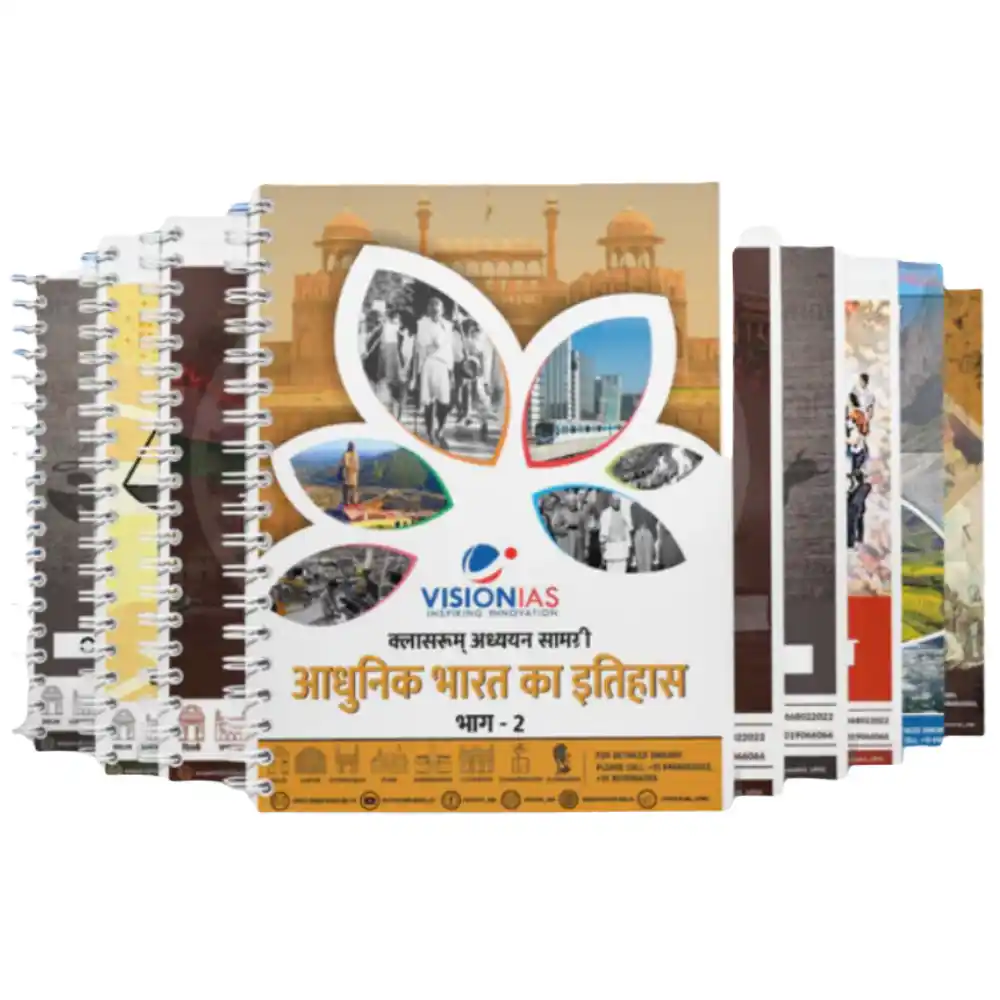
Because the syllabus is common with UPSC and BPSC at the conceptual level, structured Hindi-medium GS notes carry over beautifully. Aspirants building their foundation in Hindi often start with a full GS set such as the Vision IAS Hindi Study Material or the compact Drishti IAS Hindi Study Material (18 booklets), then layer Chhattisgarh-specific books on top.
CGPSC Syllabus PDF Download
You can get the official cgpsc syllabus pdf download directly from the Commission and cross-verify it with the topic lists above. Follow these steps:
- Visit the official CGPSC portal at psc.cg.gov.in.
- Open the Syllabus or Advertisement/Notification section for the State Service Examination.
- Download the Prelims and Mains syllabus PDF (available in both Hindi and English).
- Read it alongside the latest official notification to confirm any year-specific changes to paper grouping or marks.
Save the PDF, print it, and paste it on your study wall — ticking off topics as you finish them is the simplest way to guarantee full coverage without gaps.
Recommended Books & Study Material Mapped to the Syllabus
Because CGPSC GS overlaps substantially with UPSC and other state PCS exams, well-structured GS notes cover the national portion efficiently; you then add dedicated Chhattisgarh GK sources for the state block.
| Syllabus Area | Suggested Study Material |
|---|---|
| Polity & Constitution | Focused polity notes such as Vajiram Polity Notes |
| Indian Economy | Vision IAS Economics Notes |
| Full GS (Hindi medium) | Vision IAS Hindi Study Material / Drishti IAS Hindi Study Material |
| State PCS orientation & answer style | Drishti BPSC Books (Hindi, 24 booklets) |
| Current Affairs | Vision IAS Current Affairs Magazine (Hindi) |
| Chhattisgarh GK | Dedicated CG-specific GK guides (state-focused publishers) |
The Drishti BPSC set is particularly useful for CGPSC aspirants because it is built for a state PCS pattern in Hindi medium, closely mirroring the descriptive answer style that CGPSC Mains rewards.
CGPSC Preparation Strategy & Timeline
A syllabus is only useful if it drives a plan. Here is a realistic 10–12 month roadmap anchored to the CGPSC syllabus.
| Phase | Duration | Focus |
|---|---|---|
| Foundation | Months 1–4 | NCERTs + national GS + start Chhattisgarh GK |
| Depth | Months 5–7 | Complete CG-specific portion, current affairs, answer writing |
| Prelims Sprint | Months 8–9 | MCQ practice, mock tests, CSAT drills, revision |
| Mains Push | Months 10–12 | Descriptive practice, essay, language, test series |
Section-Wise Tips
- Chhattisgarh GK: Make one consolidated register of tribes, festivals, rivers, schemes and statehood milestones — revise it weekly.
- Current Affairs: Track both state and national news; a monthly magazine keeps this systematic rather than scattered.
- CSAT (Paper II): Solve 15–20 comprehension and reasoning questions daily; never leave it for the last month.
- Mains answer writing: Start early — write at least 2–3 answers a day from Month 5, and get essays reviewed.
Common Mistakes CGPSC Aspirants Make
- Under-preparing Chhattisgarh GK — it is the highest-weightage, most predictable block, yet many treat it as an afterthought.
- Ignoring CSAT — a qualifying paper failed is an exam failed, regardless of GS score.
- No answer-writing practice — Mains is descriptive; recognition-based prep does not translate to written marks.
- Chasing too many sources — one solid GS set revised repeatedly beats ten half-read books.
- Neglecting current affairs — both Prelims and Mains draw heavily from the last 12–18 months.
- Skipping the official notification — paper groupings, marks and eligibility can be revised year to year; verify before you buy books or lock a timeline.
Frequently Asked Questions
What is the syllabus of CGPSC?
The CGPSC syllabus covers three stages: Prelims (General Studies + an Aptitude/CSAT paper), Mains (Language, Essay and five General Studies papers spanning history, polity, economy, geography, science, environment, maths, reasoning, sociology and philosophy) and an Interview. A large portion, especially in Prelims Paper I, focuses on Chhattisgarh-specific history, geography, culture, polity and economy.
How many papers are there in CGPSC Prelims and Mains?
CGPSC Prelims has 2 objective papers — Paper I (General Studies) and Paper II (Aptitude/CSAT), each of 200 marks. CGPSC Mains has 7 descriptive papers — Language, Essay and General Studies I to V — each of 200 marks, totalling 1,400 marks.
Is there negative marking in CGPSC Prelims?
Yes. CGPSC Prelims has negative marking of one-third (1/3), meaning about 0.67 mark is deducted for each wrong answer since every question carries 2 marks. There is no negative marking in the descriptive Mains papers.
How many marks is the CGPSC interview?
The CGPSC Interview, also called the Personality Test, carries 150 marks. The final merit list is prepared by combining Mains (1,400 marks) and the Interview (150 marks), for a grand total of 1,550 marks.
What is the difference between CGPSC Prelims and Mains syllabus?
The subjects overlap heavily, but the format and demand differ. Prelims is objective (MCQ) across 2 papers (400 marks), is only qualifying, has 1/3 negative marking, and rewards fast recognition and elimination. Mains is descriptive across 7 papers (1,400 marks), counts fully towards merit, has no negative marking, and rewards structured writing, depth and analysis. Build one set of notes but revise it as one-line triggers for Prelims and as structured, example-backed points for Mains.
Which subjects are included in CGPSC Mains General Studies papers?
The five General Studies papers cover: GS-I — History (India and Chhattisgarh) and Constitution/polity; GS-II — Science, Technology and Environment; GS-III — Economy and Geography (India and Chhattisgarh); GS-IV — Mathematics and Reasoning; and GS-V — Philosophy, Sociology and Public Administration, including Chhattisgarh society and welfare. These are in addition to the Language and Essay papers.
Is CGPSC exam conducted in Hindi or English?
CGPSC is a bilingual exam — question papers are available in both Hindi and English, and most aspirants prepare and answer in Hindi. The Mains Language paper specifically tests Hindi, Chhattisgarhi and English.
How can I download the CGPSC syllabus PDF?
Visit the official CGPSC website (psc.cg.gov.in), open the Syllabus or Notification section for the State Service Examination, and download the Prelims and Mains syllabus PDF, available in both Hindi and English. Always cross-check it with the latest official notification for any year-specific changes.
Does the CGPSC syllabus change every year?
The core structure — two Prelims papers and seven Mains papers with a heavy Chhattisgarh GK weightage — has stayed broadly stable. However, the Commission can revise paper groupings, marks or eligibility details in a given year’s notification, so treat any guide as a study map and confirm specifics against the current official advertisement before finalising your plan.
Recommended Study Material
Continue Reading
SSC Stenographer Syllabus 2025: Grade C & D Pattern + PDF
The ssc stenographer syllabus covers three CBT sections — General Intelligence & Reasoning (50 marks), General Awareness (50…

KVS Syllabus 2025: PRT, TGT, PGT Pattern + PDF
The KVS syllabus for 2025 is built around a two-tier selection process: Tier 1 is a screening test…
SSC CGL Preparation 2026: Plan, Books & Timetable
Short answer: winning ssc cgl preparation in 2026 comes down to five disciplined habits — master the Tier…