SSC Stenographer Syllabus 2025: Grade C & D Pattern + PDF
Complete SSC Stenographer syllabus 2025 — Grade C & D CBT exam pattern, section-wise topics, skill test speed rules, weightage chart, study plan & PDF download.

The ssc stenographer syllabus covers three CBT sections — General Intelligence & Reasoning (50 marks), General Awareness (50 marks) and English Language & Comprehension (100 marks) — for a total of 200 questions worth 200 marks in 2 hours, followed by a qualifying stenography skill test (dictation + transcription). Grade C and Grade D share the exact same written syllabus; they differ only in dictation speed — Grade C requires 100 words per minute (wpm) and Grade D requires 80 wpm. There is 0.25 negative marking per wrong answer in the CBT.
This guide gives you the complete, section-wise SSC Stenographer Grade C & D syllabus, the exam pattern table, skill-test rules by language, a topic-wise weightage chart (which most pages miss), a 60/90-day study plan, book recommendations, and a syllabus PDF download link so you can plan your preparation end to end. All figures below follow the scheme published in the official SSC Stenographer notification on ssc.gov.in.
SSC Stenographer Syllabus 2025: Quick Facts
If you want the essentials at a glance before the detailed breakdown, here is the SSC Stenographer syllabus and exam snapshot in one box:
| Item | Details |
|---|---|
| Exam Stages | Stage 1 — CBT (merit) · Stage 2 — Skill Test (qualifying) |
| CBT Sections | Reasoning (50), General Awareness (50), English (100) |
| Total Marks / Questions | 200 marks / 200 questions |
| Duration | 2 hours (2 hr 40 min with scribe) |
| Negative Marking | 0.25 per wrong answer |
| Medium | Bilingual (English & Hindi); English section in English only |
| Skill Test Speed | Grade C — 100 wpm · Grade D — 80 wpm |
| Interview | None |
SSC Stenographer 2025: Exam Overview & Selection Process
The Staff Selection Commission (SSC) conducts the Stenographer Grade C and Grade D examination to recruit stenographers for various Ministries, Departments and Organisations of the Government of India. The selection process has two stages, and you must clear both:
- Stage 1 — Computer Based Test (CBT): An objective online paper of 200 marks that decides your merit ranking.
- Stage 2 — Skill Test (Stenography): A qualifying dictation-and-transcription test that checks your shorthand speed and accuracy.
Only candidates who clear the CBT cut-off are called for the skill test. The final merit is prepared on the basis of CBT marks, while the skill test is qualifying in nature — meaning you must pass it, but its marks are not added to your rank. Document verification is the final step before appointment. There is no interview stage in the SSC Stenographer selection process.
SSC Stenographer Exam Pattern 2025 (CBT)
The SSC Stenographer exam pattern for the Computer Based Test is identical for Grade C and Grade D. The paper has 200 objective (multiple-choice) questions across three parts, each carrying one mark, with a total duration of 2 hours (2 hours 40 minutes for candidates eligible for a scribe).
| Part | Subject | No. of Questions | Maximum Marks |
|---|---|---|---|
| I | General Intelligence & Reasoning | 50 | 50 |
| II | General Awareness | 50 | 50 |
| III | English Language & Comprehension | 100 | 100 |
| Total | 200 | 200 | |
Key rules of the CBT you must remember:
- The questions are set in both English and Hindi (except the English Language section).
- Negative marking of 0.25 mark applies for every wrong answer, so blind guessing hurts your score.
- There is no sectional timing — you can move between the three parts freely within the 2 hours.
- The full 2 hours is a single common window for all three parts; budget your time so the 100-mark English section is never rushed at the end.
- When the exam is held in multiple shifts, SSC applies marks normalization to adjust for shift-wise difficulty, and the normalized score is used for merit.
Is there negative marking in the SSC Stenographer exam?
Yes. For each wrong answer in the CBT, 0.25 marks are deducted. Unattempted questions carry no penalty. Because English alone is worth 100 of the 200 marks, a smart strategy is to attempt only the questions you are confident about and skip the ones where you are torn between two options.
SSC Stenographer Section-Wise Weightage Chart (Priority Guide)
Most syllabus pages simply list topics. Here is what they miss — an approximate weightage/priority chart based on the pattern of previous-year SSC Stenographer papers, so you know where the marks actually come from and what to revise first. Treat the counts as indicative ranges (SSC does not publish official topic weightage) and use them to prioritise high-yield topics.
| Section | High-Weightage Topics | Approx. Questions | Priority |
|---|---|---|---|
| Reasoning (50) | Analogy, Series, Coding-Decoding, Classification | 18–22 | Very High |
| Reasoning (50) | Blood Relations, Direction, Venn Diagram, Non-Verbal | 12–16 | High |
| General Awareness (50) | Static GK (History, Polity, Geography) | 18–24 | Very High |
| General Awareness (50) | Current Affairs (last 6–8 months) | 10–14 | High |
| English (100) | Reading Comprehension & Cloze Test | 20–25 | Very High |
| English (100) | Grammar, Error Spotting, Sentence Improvement | 25–30 | Very High |
| English (100) | Vocabulary (Synonyms, Antonyms, Idioms, One-word) | 20–25 | High |
Takeaway: English carries half the paper and is the most scoring section for well-prepared candidates. Within it, grammar and vocabulary together decide 45+ marks, so they deserve daily practice. For General Awareness, static GK repeats more reliably than current affairs — build a strong static base first.
SSC Stenographer Grade C and D Syllabus: General Intelligence & Reasoning
This 50-mark section tests both verbal and non-verbal reasoning. Questions are designed to check your ability to observe patterns, draw analogies and reason logically. The SSC Stenographer Grade C and D syllabus for reasoning includes:
| Topic Group | Topics Covered |
|---|---|
| Analogy & Classification | Semantic, symbolic and figural analogy; odd-one-out classification |
| Series | Number series, alphabet series, figural/semantic series, missing terms |
| Coding-Decoding | Letter/number coding, symbol coding, conditional coding |
| Logical Reasoning | Blood relations, direction & distance, syllogism, statement-conclusion |
| Diagrams | Venn diagrams, seating arrangement, puzzles, ordering |
| Non-Verbal | Figure completion, embedded figures, paper folding/cutting, mirror images |
| Others | Space visualisation, problem-solving, decision-making, arithmetical reasoning |
Section tip: Reasoning is scoring and less time-consuming than English. Aim to finish it in about 25–30 minutes and use daily 20-question drills on analogy, series and coding to build speed.
SSC Stenographer Syllabus: General Awareness
The General Awareness section (50 marks) checks your awareness of the environment around you and its application to society, plus current events. Roughly two-thirds is static GK and one-third is current affairs. The topics are:
| Subject | Key Topics |
|---|---|
| History | Ancient, Medieval & Modern India, freedom movement, important dates |
| Geography | Indian & world geography, rivers, mountains, climate, agriculture |
| Polity & Constitution | Fundamental Rights, Directive Principles, Parliament, amendments, panchayati raj |
| Economy | Basics of economics, budget, banking, GDP, government schemes |
| Science & Technology | Physics, Chemistry, Biology basics, space & defence, everyday science |
| Current Affairs | National & international events, awards, sports, appointments, books & authors |
| Static GK | Important days, capitals & currencies, dance forms, national parks |
For current affairs, cover the last 6–8 months before the exam. A monthly current-affairs magazine is the most efficient way to consolidate this — our Vision IAS Current Affairs Magazine (January 2026) compiles national, international, economy and awards news in one place, which works well even for SSC-level GA. For solving repeated static-GK patterns, practising previous-year questions from the Forum IAS Topic-Wise PYQ Toolkit sharpens your recall of high-frequency facts.
SSC Stenographer Syllabus: English Language & Comprehension
At 100 marks, English is the single largest and most decisive section. It tests grammar, vocabulary and comprehension. Because a stenographer’s core job is accurate transcription in English (or Hindi), the exam weights this section heavily. The syllabus covers:
| Category | Topics |
|---|---|
| Comprehension | Reading comprehension passages, cloze test |
| Grammar | Error spotting, sentence improvement, active/passive voice, direct/indirect speech, fill in the blanks |
| Sentence Structure | Para jumbles (sentence rearrangement), sentence completion |
| Vocabulary | Synonyms & antonyms, one-word substitution, idioms & phrases, spellings, homonyms |
Section tip: Build vocabulary daily (10–15 new words + roots), and master the 8–10 recurring grammar rules (subject-verb agreement, tenses, prepositions, articles). Reading comprehension is highly scoring if you practise skimming for the answer rather than reading every line.
Which subjects are included in the SSC Stenographer exam?
Three subjects are included in the CBT: General Intelligence & Reasoning, General Awareness, and English Language & Comprehension. The skill test is not a subject but a practical stenography (shorthand) test in English or Hindi.
SSC Stenographer Skill Test Details (Grade C & D)
The skill test is where the SSC Stenographer exam differs most from other SSC exams. Candidates who qualify the CBT are given a passage dictated at a fixed speed for 10 minutes, which they take down in shorthand and then transcribe on a computer. The dictation speed decides Grade C vs Grade D.
| Grade | Dictation Speed | Dictation Time | Language | Transcription Time |
|---|---|---|---|---|
| Grade C | 100 wpm | 10 minutes | English | 40 minutes |
| Grade C | 100 wpm | 10 minutes | Hindi | 55 minutes |
| Grade D | 80 wpm | 10 minutes | English | 50 minutes |
| Grade D | 80 wpm | 10 minutes | Hindi | 65 minutes |
The transcription is done on a computer. SSC applies a permissible-mistakes limit (a percentage of errors) to decide pass/fail; exceeding the error threshold means disqualification even if your speed is good. This is why accuracy matters as much as raw speed. Eligible candidates with disabilities (such as VH/OH categories, as specified in the notification) are given a slower dictation speed and extra transcription time as a relaxation — always confirm the exact relaxation in the current notification.
Is the SSC Stenographer skill test qualifying in nature?
Yes. The skill test is only qualifying — you must pass it, but its marks do not add to your final merit. Your rank is decided entirely by CBT marks. However, failing the skill test removes you from selection regardless of your CBT score, so it cannot be treated as an afterthought.
How to Build Shorthand Speed for the Skill Test
Speed is built in stages, not overnight. A practical progression:
- Foundation (Weeks 1–4): Master all shorthand outlines and phrases; aim for clean, readable strokes at 40–50 wpm.
- Speed building (Weeks 5–10): Take daily 10-minute dictations, increasing by 5–10 wpm each week until you cross 80 wpm (Grade D) or 100 wpm (Grade C).
- Transcription practice (Weeks 8–12): Practise typing your shorthand notes back within the official transcription time. Time yourself and count errors to stay under the mistake limit.
- Mock dictations: Simulate exam conditions — 10-minute dictation followed immediately by transcription on a computer — at least thrice a week in the final month.
SSC Stenographer Grade C vs Grade D: Full Comparison
The written syllabus is identical for both grades — the differences are in the posts, pay level, department and skill-test speed. Here is the side-by-side comparison most pages leave incomplete.
| Parameter | Stenographer Grade C | Stenographer Grade D |
|---|---|---|
| Dictation Speed | 100 wpm | 80 wpm |
| Pay Level | Level 6 (₹35,400–1,12,400) | Level 4 (₹25,500–81,100) |
| Typical Posts | Central Ministries/Departments (senior steno posts) | Subordinate offices & attached departments |
| CBT Syllabus | Same (Reasoning + GA + English) | Same (Reasoning + GA + English) |
| CBT Pattern | 200 marks, 2 hours | 200 marks, 2 hours |
| Skill Test | Harder (faster dictation) | Comparatively easier |
What is the difference between SSC Stenographer Grade C and Grade D?
The main difference is dictation speed and seniority. Grade C requires 100 wpm shorthand and offers a higher pay level (Level 6) in central ministries, while Grade D requires 80 wpm at Level 4 in subordinate offices. Both have the exact same CBT syllabus and exam pattern.
SSC Stenographer Minimum Qualifying Marks (CBT)
To be considered for the skill test, you must score at least the category-wise minimum qualifying marks in the CBT. These cut-offs are fixed by SSC each cycle:
| Category | Minimum Qualifying Marks |
|---|---|
| General / UR | 30% |
| OBC / EWS | 25% |
| All Other Categories (SC/ST/PwD/ESM) | 20% |
These are the minimum marks needed to be eligible; the actual cut-off for selection is usually much higher and depends on vacancies, category and difficulty of the paper.
60/90-Day SSC Stenographer Study Plan
Here is a practical study plan mapped to the syllabus. Adjust the pace based on whether you are targeting 60 or 90 days.
| Phase | Duration | Focus |
|---|---|---|
| Phase 1 — Base Building | Weeks 1–4 | English grammar rules + static GK (History, Polity, Geography); start shorthand outlines |
| Phase 2 — Application | Weeks 5–8 | Reasoning topic-wise practice; vocabulary building; current affairs; shorthand speed to 60–80 wpm |
| Phase 3 — Speed & Mocks | Weeks 9–11 | Full-length CBT mocks; time management; dictation + transcription practice |
| Phase 4 — Revision | Week 12 | Revise weightage-heavy topics, PYQs, error log; final skill-test simulation |
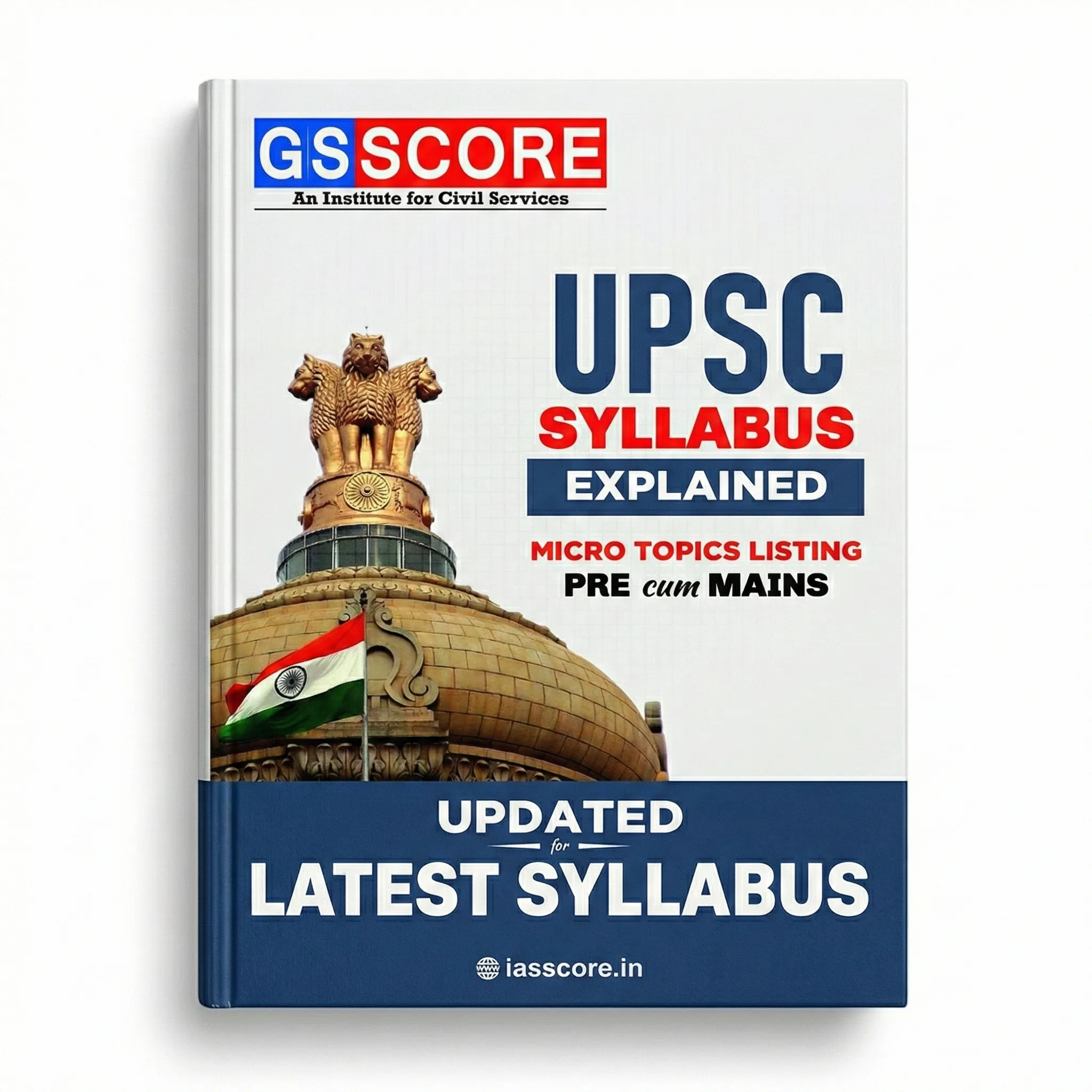
Daily routine that works: 1 hour reasoning, 1 hour English (grammar + vocab), 45 minutes GA/current affairs, and 1–1.5 hours dedicated shorthand practice. Keep an error log for every mock and revise it weekly. If you are still finalising your foundation, the concise GS Score Syllabus Booklet is a handy way to keep the full topic map in front of you while planning revisions.
Best Books for SSC Stenographer 2025
Choose focused books over bulky ones. A working booklist:
| Section | Recommended Resource Type |
|---|---|
| Reasoning | A verbal & non-verbal reasoning practice book with topic-wise chapters |
| General Awareness | A static GK compendium + a monthly current-affairs magazine |
| English | An objective English grammar & comprehension book + vocabulary builder |
| Shorthand | Standard Pitman/shorthand manual + dictation practice sets |
| Practice | Previous-year papers & sectional mock tests |
For the General Awareness edge, pairing a static GK book with a reliable current-affairs source such as the Vision IAS Current Affairs Magazine keeps you updated without over-reading. For repeated-question mastery, working through PYQs from a toolkit like the Forum IAS Prelims PYQ Toolkit trains you to recognise SSC’s favourite static-GK and reasoning patterns.
SSC Stenographer Syllabus PDF Download
You can download the complete SSC Stenographer Grade C & D syllabus and exam pattern from the official SSC notification PDF released on the SSC website (ssc.gov.in) each cycle. The official PDF contains the exact section-wise topics, the CBT scheme and the skill-test rules used above. Bookmark this page and save the official notification PDF so you always have the authentic, latest version alongside the weightage chart and study plan given here.
SSC Stenographer Syllabus in Hindi (हिंदी)
For Hindi-medium aspirants, the CBT is bilingual — General Intelligence & Reasoning and General Awareness questions appear in both Hindi and English, so you can attempt them comfortably in Hindi. Only the English Language & Comprehension section is in English. The skill-test dictation is also available in Hindi (with a longer transcription time — 55 minutes for Grade C and 65 minutes for Grade D), so candidates choosing Hindi shorthand follow the same syllabus with Hindi transcription. Hindi-medium current-affairs preparation can be supported with a Hindi edition magazine to keep GA coverage consistent.
Is the SSC Stenographer Syllabus Changing in 2025?
As per the pattern followed in recent cycles, the SSC Stenographer syllabus 2025 and exam pattern remain the same as the previous year — three CBT sections of 200 marks plus a qualifying skill test at 100/80 wpm. SSC has not announced a structural change to the section split, negative marking or skill-test speeds. The one thing to watch each cycle is the exact number of vacancies, dates and any category-wise relaxation, all of which are confirmed only in the official notification. Always cross-check the current-year PDF before finalising your strategy.
Common Mistakes & Negative-Marking Strategy
Avoid these frequent errors that cost aspirants their selection:
- Ignoring the skill test until late: Speed takes months to build — start shorthand from day one.
- Over-guessing in the CBT: With 0.25 negative marking, wild guesses can drag your net score below the cut-off. Attempt only reasonably sure questions.
- Neglecting English: It is 100 of 200 marks. Weak English caps your rank no matter how strong your GA is.
- Poor time allocation: Since there is no sectional timing, students over-spend on reasoning and rush English. Fix a personal time budget in mocks.
- Chasing every current affair: Static GK repeats more; balance the two rather than only reading news.
Frequently Asked Questions
What is the syllabus of SSC Stenographer?
The SSC Stenographer syllabus has three CBT sections — General Intelligence & Reasoning (50 marks), General Awareness (50 marks) and English Language & Comprehension (100 marks) — totalling 200 marks, plus a qualifying stenography skill test involving 10-minute dictation and computer transcription.
What is the exam pattern for SSC Stenographer 2025?
The SSC Stenographer 2025 CBT has 200 objective questions worth 200 marks in 2 hours, split as Reasoning 50, General Awareness 50 and English 100, with 0.25 negative marking per wrong answer. Qualifying candidates then take a skill test.
What is the typing/dictation speed required for SSC Stenographer?
The dictation speed is 100 words per minute for Grade C and 80 words per minute for Grade D, dictated for 10 minutes. Candidates then transcribe the passage on a computer within the allotted time (40/50 minutes in English, 55/65 minutes in Hindi).
How many questions are asked in the SSC Stenographer CBT?
A total of 200 questions are asked in the SSC Stenographer CBT — 50 from Reasoning, 50 from General Awareness and 100 from English Language & Comprehension — each carrying one mark, with 0.25 deducted for every wrong answer.
Is the SSC Stenographer skill test qualifying in nature?
Yes, the skill test is qualifying only. You must pass it to be selected, but its marks are not added to your final merit; ranking is based entirely on your CBT score.
Which subjects are included in the SSC Stenographer exam?
The CBT includes three subjects — General Intelligence & Reasoning, General Awareness, and English Language & Comprehension. The stenography skill test in English or Hindi is a separate practical, qualifying stage.
Is there an interview in the SSC Stenographer selection process?
No. There is no interview. Selection is based on the CBT merit, a qualifying stenography skill test, and document verification. Your final rank comes only from your CBT marks.
Where can I download the SSC Stenographer syllabus PDF?
The complete syllabus and exam pattern are published in the official SSC Stenographer notification PDF on ssc.gov.in for each recruitment cycle. It lists the section-wise topics, CBT scheme and skill-test rules exactly as summarised in this guide.
Recommended Study Material


Continue Reading
UPSC Syllabus 2026: Prelims, Mains, Optional Subjects + PDF Download
The UPSC syllabus for the Civil Services Examination (CSE) 2026 is spread across three stages — the Preliminary…
UPSC Ethics Syllabus 2026: GS Paper 4 Topics + PDF
The upsc ethics syllabus is the official prescribed content for General Studies Paper 4 — titled Ethics, Integrity…
UGC NET Syllabus 2025: Paper 1 & 2 Units, Weightage + PDF Download
The UGC NET syllabus has two parts: Paper 1, a common teaching and research aptitude paper (10 units,…