UPSC Ethics Syllabus 2026: GS Paper 4 Topics + PDF
Complete upsc ethics syllabus for GS Paper 4 (Ethics, Integrity & Aptitude) — 4 topics, 250-mark pattern, weightage, books, PDF download and prep strategy.

The upsc ethics syllabus is the official prescribed content for General Studies Paper 4 — titled Ethics, Integrity and Aptitude — a 250-mark, 3-hour Mains paper split into four broad topics plus Probity in Governance. It tests your ethical competence through theory questions (Section A, ~125 marks) and case studies (Section B, ~125 marks), and unlike optional papers, the syllabus is short, fixed year after year, and highly scoring when prepared with keyword-level clarity.
This guide breaks the entire GS Paper 4 syllabus into a topic-by-topic map, links each syllabus term to what UPSC has actually asked, shows weightage trends, clears up confusing terms (Ethics vs Integrity vs Probity, Attitude vs Aptitude), and gives you a downloadable PDF, a booklist, and a preparation plan.
UPSC Ethics Syllabus at a Glance (GS Paper 4)
Ethics, Integrity and Aptitude is one of the four General Studies papers in the UPSC Civil Services Mains examination. The paper was introduced in 2013 to test not what a candidate knows, but how a candidate thinks and behaves as a future administrator. Here is the snapshot every aspirant searches for.
| Parameter | Detail |
|---|---|
| Paper name | General Studies Paper 4 — Ethics, Integrity & Aptitude |
| Stage | Mains (Written) — Mains only, not Prelims |
| Total marks | 250 |
| Duration | 3 hours |
| Nature | Descriptive / Subjective (no MCQs) |
| Sections | Section A — Theory (~125 marks); Section B — Case Studies (~125 marks) |
| Question pattern | ~12–14 questions; 10-mark & 20-mark questions |
| Medium | English or any Eighth Schedule language |
| Counts towards | Final merit (all 4 GS papers + 2 optional + Essay) |
Because the upsc gs paper 4 syllabus is compact and repeats every year, a well-drilled aspirant can build a scoring engine of thinkers, quotes, values and case-study frameworks that fits almost any question the examiner frames.
The Official Ethics, Integrity and Aptitude Syllabus (Full Text, Simplified)
UPSC divides the ethics integrity and aptitude syllabus into a preamble and eight thematic clusters. Below is the complete official syllabus, restated cluster by cluster so you can see exactly what each line demands.
| # | Syllabus Block | What It Covers |
|---|---|---|
| 1 | Ethics & Human Interface | Essence, determinants and consequences of ethics in human actions; dimensions of ethics; ethics in private and public relationships; human values; role of family, society and educational institutions in inculcating values |
| 2 | Attitude | Content, structure, function; influence and relation with thought and behaviour; moral and political attitudes; social influence and persuasion |
| 3 | Aptitude & Foundational Values for Civil Service | Integrity, impartiality and non-partisanship, objectivity, dedication to public service, empathy, tolerance and compassion towards the weaker sections |
| 4 | Emotional Intelligence | Concepts, and their utilities and application in administration and governance |
| 5 | Contributions of Moral Thinkers & Philosophers | Contributions of moral thinkers and philosophers from India and the world |
| 6 | Public / Civil Service Values & Ethics in Public Administration | Status and problems; ethical concerns and dilemmas in government and private institutions; laws, rules, regulations and conscience as sources of ethical guidance; accountability and ethical governance; strengthening of ethical and moral values in governance; ethical issues in international relations and funding; corporate governance |
| 7 | Probity in Governance | Concept of public service; philosophical basis of governance and probity; information sharing and transparency in government, Right to Information, codes of ethics, codes of conduct, citizen’s charters, work culture, quality of service delivery, utilization of public funds, challenges of corruption |
| 8 | Case Studies | Case studies on the above issues (Section B) |
Everything the examiner asks flows from these eight blocks. The trick to a high score is not memorising the syllabus but mapping each keyword to answers, examples and thinkers — which is what the rest of this guide does.
Topic 1 & 2: Ethics & Human Interface + Attitude
Ethics and Human Interface — the foundation
This block asks you to define ethics and trace its essence, determinants and consequences in human action. Expect definitional questions (“What do you understand by essence of ethics?”), dimensions of ethics (normative, applied, meta-ethics, descriptive), and the difference between ethics in private versus public relationships. UPSC frequently pairs this with human values and the role of family, society and educational institutions.
Attitude — the psychology of behaviour
The Attitude block borrows from social psychology: the ABC structure (Affective, Behavioural, Cognitive components), functions of attitude, and how attitude links to thought and behaviour. Moral and political attitudes, persuasion, and social influence (conformity, obedience, propaganda) are recurring themes. This is where NCERT Psychology (Class 11–12) pays off directly.
| Syllabus Term | What UPSC Has Asked (PYQ Theme) |
|---|---|
| Essence of ethics | Meaning of ethical living; “conscience as the ultimate court of appeal” |
| Dimensions of ethics | Difference between ethics and morality; applied vs normative ethics |
| Human values / role of family | How institutions inculcate values; values you imbibed from parents |
| Attitude — structure & function | Positive attitude, moral attitude; changing negative public attitudes |
| Persuasion & social influence | Role of persuasion in behaviour change; ethical advertising |
Topic 3 & 4: Foundational Values + Emotional Intelligence
Aptitude and foundational values for civil service
This is the single most examined cluster. The syllabus lists the core civil-service values — integrity, impartiality, non-partisanship, objectivity, dedication to public service, empathy, tolerance and compassion towards weaker sections. Every value needs a definition, a real-world administrator example (T.N. Seshan for integrity and non-partisanship, Armstrong Pame for dedication), and a link to governance outcomes.
Emotional intelligence in administration
Emotional Intelligence (EI) covers Goleman’s five components — self-awareness, self-regulation, motivation, empathy and social skills — and their utility in administration: managing stress, handling public grievances, defusing communal tension, leading teams. UPSC almost always asks EI applied to a governance scenario, not as textbook theory.
| Foundational Value | Meaning in One Line | Model Example |
|---|---|---|
| Integrity | Consistency of thought, word and deed | T.N. Seshan (Election Commission reforms) |
| Impartiality / Non-partisanship | Serving all governments and citizens equally | Neutral civil servant across regimes |
| Objectivity | Decisions on evidence, not bias | Merit-based recruitment |
| Dedication to public service | Going beyond duty for citizens | Armstrong Pame (“Miracle Man” road) |
| Empathy & compassion | Feeling and acting for weaker sections | Welfare delivery to marginalised groups |
| Emotional Intelligence | Managing self and others’ emotions | Crisis and grievance handling by a DM |
Topic 5: Contributions of Moral Thinkers and Philosophers
The gs 4 ethics syllabus topics reserve one full block for moral thinkers and philosophers from India and the world. You do not need every philosopher — you need a working toolkit of 12–15 whose ideas you can deploy as quotes, frameworks or tie-breakers in ethical dilemmas.
| Thinker | Core Idea | Where to Use It |
|---|---|---|
| Mahatma Gandhi | Means over ends; Talisman; Seven Social Sins | Ends-vs-means dilemmas; probity |
| Immanuel Kant | Categorical imperative; duty-based ethics | Rule-following, honesty questions |
| Aristotle | Virtue ethics; the Golden Mean | Character, moderation, leadership |
| J.S. Mill / Bentham | Utilitarianism — greatest good | Policy trade-offs, resource allocation |
| Kautilya (Chanakya) | Statecraft, welfare of the ruled | Governance, public administration |
| Thiruvalluvar | Thirukkural — virtue and conduct | Indian ethical thought, integrity |
| B.R. Ambedkar | Social justice, constitutional morality | Equality, weaker-section empathy |
| Swami Vivekananda | Service as worship; strength | Dedication, self-development |
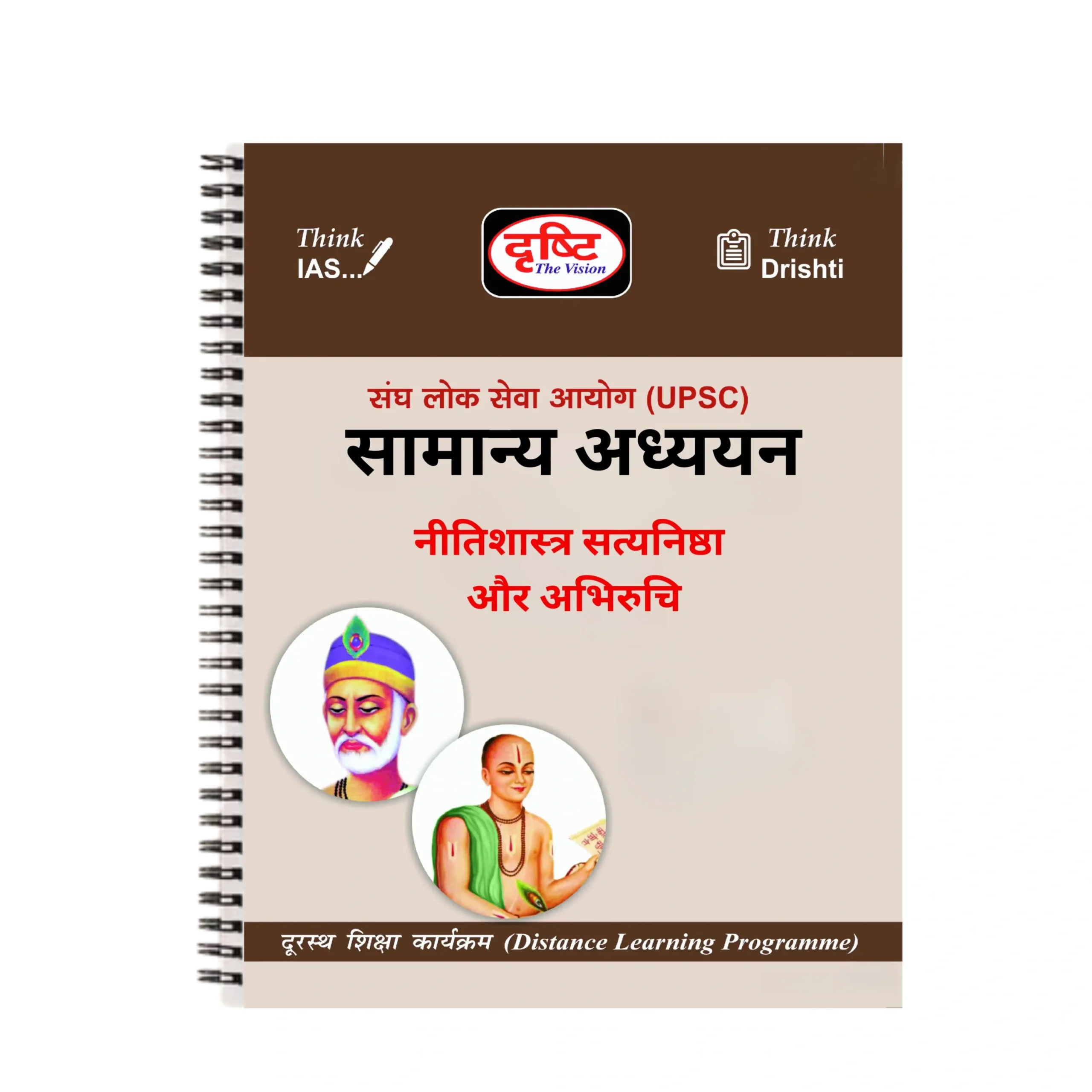
A dedicated Drishti IAS Ethics Notes booklet compiles thinker-wise quotes and value definitions in one place, which saves weeks of scattered note-making when you are building this toolkit.
Topic 6 & 7: Public Service Values, Ethics in Administration & Probity in Governance
Ethics in public administration
This block moves from personal ethics to institutional ethics: the status and problems of public-service values, ethical dilemmas in government and private institutions, and the sources of ethical guidance — laws, rules, regulations and conscience. It also brings in accountability, ethical governance, strengthening moral values in governance, corporate governance, and ethical issues in international relations and funding.
Probity in governance
Probity is uprightness in public life. The syllabus explicitly lists the concept of public service, the philosophical basis of governance and probity, and a cluster of governance instruments you must know cold: Right to Information (RTI), transparency, Citizen’s Charter, Code of Ethics vs Code of Conduct, work culture, quality of service delivery, utilization of public funds, and the challenges of corruption.
| Probity Instrument | What It Means | Governance Value Served |
|---|---|---|
| Right to Information (RTI) | Citizen’s legal right to government information | Transparency, accountability |
| Citizen’s Charter | Public promise of service standards & timelines | Responsiveness, service delivery |
| Code of Conduct | Enforceable list of do’s and don’ts | Discipline, compliance |
| Code of Ethics | Aspirational values guiding judgement | Integrity, self-regulation |
| Utilisation of public funds | Efficient, honest use of taxpayer money | Probity, anti-corruption |
| Work culture | Ethos and attitude within an organisation | Productivity, ethical climate |
Code of Ethics vs Code of Conduct is a favourite exam trap: a Code of Conduct is specific, rule-based and enforceable (what you must/must not do), while a Code of Ethics is broad, value-based and aspirational (the principles that should guide judgement). Knowing this one-line distinction wins easy marks.
UPSC Ethics Exam Pattern & Marks (Section A + Section B)
GS Paper 4 carries 250 marks over 3 hours and is neatly split into two sections. Section A is theory; Section B is case studies. Understanding the split is essential because the two halves need completely different preparation.
| Section | Type | Approx. Marks | Question Style |
|---|---|---|---|
| Section A | Theory / concept-based | ~125 | 10 & 20-mark questions on syllabus terms, thinkers, values |
| Section B | Case studies | ~125 | 6 case studies of ~20 marks; situational dilemmas |
| Total | Descriptive | 250 | ~12–14 questions, 3 hours |
Is GS Paper 4 subjective or objective? It is fully subjective/descriptive — there are no multiple-choice questions. Answers are written in your own words and evaluated on clarity, ethical reasoning, examples and structure. There is negative marking neither here nor anywhere in Mains.
Section B Explained: The Case Study Framework (125 Marks)
The upsc ethics case study syllabus is simply “case studies on the above issues” — but it carries half the paper’s marks and is where aspirants gain or lose the most. Each case study places you (usually as a bureaucrat) in a dilemma and asks you to identify stakeholders, list options, and choose a defensible course of action.
Use a repeatable framework so you never freeze in the exam hall:
- Identify the core ethical dilemma in one line.
- List stakeholders and what each stands to gain or lose.
- Lay out 3–4 options with honest merits and demerits.
- Evaluate options against values (integrity, public interest, law, compassion).
- Decide and justify the most ethical, practical option — and address the fallout.
| Case-Study Step | Marks It Protects | Common Mistake |
|---|---|---|
| Stating the dilemma | Framing marks | Retelling the story instead of analysing |
| Stakeholder mapping | Depth marks | Listing only two obvious parties |
| Options with merits/demerits | Balance marks | Presenting only your preferred option |
| Value-based justification | Ethics marks | Choosing without linking to a value |
| Practical, legal decision | Feasibility marks | An idealistic answer that ignores rules |
Practising 40–50 case studies under time pressure — ideally through a graded Mains test series — is the fastest way to convert this 125-mark section into a strength.
Topic-Wise Weightage & Trends in GS Paper 4
Marks are not spread evenly across the syllabus. Foundational values, emotional intelligence and probity dominate, while pure attitude theory is lighter. The table below shows an indicative distribution based on recent years so you can prioritise revision.
| Syllabus Area | Indicative Weightage | Priority |
|---|---|---|
| Foundational values & aptitude | High | Must-master |
| Probity in governance (RTI, transparency, corruption) | High | Must-master |
| Emotional intelligence | Medium-High | Important |
| Ethics & human interface | Medium | Important |
| Moral thinkers & philosophers | Medium | Build a toolkit |
| Ethics in public administration / corporate governance | Medium | Important |
| Attitude (pure theory) | Low-Medium | Cover once, revise fast |
The strategic takeaway: master values, EI and probity because they appear in both Section A theory and Section B case studies, giving you the highest return on study time.
Confusing Ethics Terms Decoded (Beginner Glossary)
Beginners lose marks by mixing up look-alike terms. Here is the clean glossary that most top-ranking pages skip.
What is the difference between Ethics, Integrity and Aptitude?
Ethics is the broad set of moral principles distinguishing right from wrong. Integrity is one specific virtue — the consistency between your values and your actions, especially when no one is watching. Aptitude is the natural or acquired ability and disposition to perform a role well — in this paper, the temperament and foundational values suited to public service.
What is the difference between Attitude and Aptitude?
Attitude is a settled way of thinking or feeling about something (a mindset). Aptitude is a capability or talent to do a task. You can have a positive attitude towards public service and also the aptitude (skills, values) to deliver it — the syllabus wants both.
| Term | One-Line Meaning | Keyword |
|---|---|---|
| Ethics | Principles of right and wrong | Morality |
| Integrity | Values consistent with actions | Honesty |
| Probity | Uprightness in public office | Uprightness |
| Attitude | Settled mindset / feeling | Mindset |
| Aptitude | Ability & disposition for a role | Capability |
| Normative ethics | What one ought to do (rules) | Prescriptive |
| Applied ethics | Ethics applied to real issues | Practical |
Best Books for UPSC Ethics + Downloadable Syllabus PDF
Which is the best book for UPSC Ethics? There is no single answer, but a lean combination works better than piling up sources. Start with the official syllabus, add one standard reference, one value/quote compendium, and NCERT Psychology for the Attitude and EI blocks.
| Book / Source | Best For |
|---|---|
| Lexicon for Ethics (Niraj Kumar) | Complete syllabus coverage, keyword-wise |
| Ethics, Integrity & Aptitude (Subba Rao & P.N. Roy Chowdhury) | Detailed theory and answer material |
| NCERT Psychology (Class 11 & 12) | Attitude, Emotional Intelligence basics |
| Ethics in Governance (Patrick Sheeran / 2nd ARC Reports) | Probity, corruption, governance reform |
| 2nd ARC Report — “Ethics in Governance” | Official probity and reform framework |
For a compact, exam-ready set, the Drishti IAS Ethics Notes distil the whole GS 4 syllabus into printed booklets, and the GS Score Latest Syllabus Booklet 2026-27 gives you the entire UPSC syllabus — including the exact Ethics wording — in one printed reference you can annotate.
UPSC Ethics syllabus PDF download
Looking for an upsc ethics syllabus pdf download? The official GS Paper 4 syllabus is published verbatim inside the UPSC Civil Services notification each year, and the full syllabus text above reproduces it. Many aspirants prefer a printed one-page revision chart pinned above the desk; the syllabus booklet linked above serves exactly that purpose without hunting for scattered PDFs.
How to Prepare the UPSC Ethics Syllabus (Strategy & Timeline)
How many days does it take to complete Ethics for UPSC? With focused effort, the upsc mains ethics syllabus 2026 can be covered in 30–45 days for the first reading, followed by continuous answer practice. It is the most compressible of the four GS papers because the syllabus is fixed.
| Phase | Duration | Focus |
|---|---|---|
| Foundation | Days 1–15 | Read syllabus term-by-term; make keyword + definition notes |
| Depth | Days 16–30 | Thinkers, values, EI, probity instruments; collect examples & quotes |
| Application | Days 31–45 | Section A answers + case-study framework practice |
| Continuous | Till Mains | Weekly test-series answers, revision of one-page chart |
Answer-writing tips that fetch marks
- Open every answer with a crisp definition of the syllabus keyword.
- Support each point with an example — real administrators (T.N. Seshan, Gandhi, Armstrong Pame), or a relatable everyday instance.
- Deploy one relevant quote or thinker per answer, not a dump of ten.
- Use diagrams and flowcharts for structure (ABC of attitude, EI components).
- In case studies, always take a clear, ethical and legally feasible stand.
Because Ethics rewards examples and current context, keeping a running note of governance stories from a complete GS notes set and your daily current affairs makes your answers stand out. The same illustrative skill helps in the Essay paper — an Essay notes booklet and Ethics preparation reinforce each other.
Common Mistakes Aspirants Make in GS Paper 4
Even scoring candidates leak marks here. Avoid these traps:
- Treating Ethics as GK — it tests reasoning and values, not facts.
- Ignoring Section B until the last month, despite it being 125 marks.
- Preachy, one-sided answers — the examiner wants balance, not sermons.
- No examples — abstract answers score low; anchor every value in a real instance.
- Over-quoting philosophers without applying their idea to the question.
- Idealistic case-study decisions that ignore rules, feasibility and consequences.
Frequently Asked Questions
What is the syllabus of Ethics in UPSC?
The UPSC Ethics syllabus (GS Paper 4) covers eight blocks: Ethics & Human Interface, Attitude, Aptitude & Foundational Values, Emotional Intelligence, Contributions of Moral Thinkers & Philosophers, Ethics in Public Administration, Probity in Governance, and Case Studies. It is a 250-mark Mains paper split into theory (Section A) and case studies (Section B).
Is GS Paper 4 (Ethics) subjective or objective?
GS Paper 4 is fully subjective and descriptive. There are no multiple-choice questions and no negative marking. You write answers in your own words, and they are evaluated on ethical reasoning, structure, examples and clarity across roughly 12–14 questions in 3 hours.
How many marks is the UPSC Ethics paper?
The Ethics paper carries 250 marks, split roughly as 125 marks for Section A (theory) and 125 marks for Section B (case studies). It is one of the four General Studies papers that count towards the final Mains merit.
Which is the best book for UPSC Ethics?
A lean combination works best: Lexicon for Ethics (Niraj Kumar) or Subba Rao & P.N. Roy Chowdhury for theory, NCERT Psychology for Attitude and Emotional Intelligence, and the 2nd ARC “Ethics in Governance” report for probity. Printed compilations like Drishti IAS Ethics Notes bundle these into one exam-ready set.
Is Ethics part of UPSC Prelims or only Mains?
Ethics is asked only in UPSC Mains, as General Studies Paper 4. It does not appear in Prelims. The syllabus is also fixed and repeats every year, so notes made once remain valid across attempts.
What is the difference between Attitude and Aptitude in the Ethics syllabus?
Attitude is a settled mindset or way of feeling towards something, while Aptitude is the ability and disposition to perform a role — here, the foundational values suited to public service. The syllabus tests both: the right mindset and the right competence for a civil servant.
Recommended Study Material
Continue Reading

SSC CGL Preparation 2026: Strategy, Study Plan & Books
SSC CGL preparation in 2026 comes down to three things done consistently: master the exam pattern and topic-wise…
RRB NTPC Syllabus 2025: CBT 1 & CBT 2 Subjects, Pattern + PDF
The rrb ntpc syllabus covers three sections in both CBT 1 and CBT 2 — Mathematics, General Intelligence…
UGC NET Political Science Syllabus 2026: Unit-Wise + PDF
In short: the ugc net political science syllabus has two papers — Paper 1 (General Aptitude, 50 questions…