Sociology Optional Syllabus 2026: Paper 1 & 2 + PDF
Complete sociology optional syllabus for UPSC Mains 2026-27: full Paper 1 & 2 units, exam pattern, PDF-ready checklist, booklist, PYQ heat-map and strategy.

The sociology optional syllabus for UPSC Mains has two papers of 250 marks each (500 marks total): Paper I – Fundamentals of Sociology and Paper II – Indian Society: Structure and Change. It is one of the shortest, most static and most popular of the UPSC optionals, needs no prior academic background, and overlaps heavily with GS Paper I, GS Paper II and the Essay paper. This guide gives you the complete, copy-paste-friendly official syllabus (unit by unit), the exam pattern, a one-page downloadable checklist, topic-wise PYQ weightage, the standard booklist and a tested preparation strategy — everything in clean text, no screenshots.
Unlike most pages that bury the syllabus inside images, this is the full UPSC wording for the current 2026 / 2027 cycle in plain text so you can print it, paste it into a tracker, or feed it to an AI tool. The UPSC notification has kept this syllabus unchanged for years, so the Paper I and Paper II units below are what you will face in 2026 and 2027 alike — plus the gaps every other page misses: a thinker-to-unit map, a PYQ heat-map, and a revision checklist.
Sociology Optional at a Glance (UPSC 2026)
Before the full sociology optional syllabus UPSC aspirants need, here is the snapshot. Sociology is consistently among the top three most-chosen optionals, has one of the highest candidate counts in Mains, and is favoured by engineers, doctors and humanities graduates alike because the base concepts can be built from scratch in 4–5 months.
| Parameter | Detail |
|---|---|
| Papers | 2 (Paper I & Paper II) |
| Marks per paper | 250 |
| Total marks | 500 |
| Duration per paper | 3 hours |
| Medium | English / Hindi (and other scheduled languages) |
| Background needed | None — beginner friendly |
| Syllabus length | Short & largely static |
| Completion time | ~4–5 months (first reading) |
| Best overlap | GS Paper I (society), GS Paper II (governance), Essay, Ethics |
Sociology Optional Exam Pattern & Marks Weightage
Each paper is 250 marks and carries 8 questions divided into two sections (A and B). You must answer five questions in all. Question 1 and Question 5 are compulsory; from the remaining six you choose any three, taking at least one from each section. Questions typically carry 10, 15 or 20 marks and are often split into sub-parts (a, b, c). There is no negative marking in Mains, but answers are evaluated on sociological precision — content without concepts or thinkers scores poorly.
| Component | Paper I | Paper II |
|---|---|---|
| Total marks | 250 | 250 |
| Total questions | 8 | 8 |
| Sections | A & B | A & B |
| Questions to attempt | 5 | 5 |
| Compulsory questions | Q1 & Q5 | Q1 & Q5 |
| Choice | Any 3 of remaining 6 (≥1 per section) | Any 3 of remaining 6 (≥1 per section) |
| Marks per question | ~50 (split into 10/15/20 parts) | ~50 (split into 10/15/20 parts) |
Sociology Optional Syllabus Paper 1 and Paper 2 — Full Structure
The sociology optional syllabus paper 1 and paper 2 split is simple: Paper I is purely theoretical (concepts and Western thinkers), Paper II applies that lens to India. The two are deeply interlinked — you should always connect an Indian phenomenon in Paper II back to a Paper I concept. Paper I has 10 units; Paper II has two broad parts (A: Introducing Indian Society; B: Social Structure / Change & Development) spread across 15 thematic units.
Paper I: Fundamentals of Sociology (Full Unit-Wise Syllabus)
This is the official, topic-by-topic Paper I syllabus. Treat each numbered unit as one revision block.
| Unit | Topic | Sub-topics |
|---|---|---|
| 1 | Sociology – The Discipline | Modernity & social changes in Europe and the emergence of sociology; scope of the subject and comparison with other social sciences; sociology and common sense. |
| 2 | Sociology as Science | Science, scientific method and critique; major theoretical strands of research methodology; positivism and its critique; fact, value and objectivity; non-positivist methodologies. |
| 3 | Research Methods & Analysis | Qualitative and quantitative methods; techniques of data collection; variables, sampling, hypothesis, reliability and validity. |
| 4 | Sociological Thinkers | Karl Marx – historical materialism, mode of production, alienation, class struggle; Emile Durkheim – division of labour, social fact, suicide, religion & society; Max Weber – social action, ideal types, authority, bureaucracy, Protestant ethic; Talcott Parsons – social system, pattern variables; Robert K. Merton – latent & manifest functions, conformity & deviance, reference group; G.H. Mead – self & identity. |
| 5 | Stratification & Mobility | Concepts of equality, inequality, hierarchy, exclusion, poverty and deprivation; theories of social stratification – structural functionalist, Marxist and Weberian; dimensions – social stratification of class, status groups, gender, ethnicity and race; social mobility – open and closed systems, types of mobility, sources and causes. |
| 6 | Works & Economic Life | Social organisation of work in different types of society – slave society, feudal society, industrial/capitalist society; formal and informal organisation of work; labour and society. |
| 7 | Politics & Society | Sociological theories of power; power elite, bureaucracy, pressure groups and political parties; nation, state, citizenship, democracy, civil society, ideology; protest, agitation, social movements, collective action, revolution. |
| 8 | Religion & Society | Sociological theories of religion; types – animism, monism, pluralism, sects, cults; religion in modern society – religion & science, secularisation, religious revivalism, fundamentalism. |
| 9 | Systems of Kinship | Family, household, marriage; types and forms of family; lineage and descent; patriarchy and sexual division of labour; contemporary trends. |
| 10 | Social Change in Modern Society | Sociological theories of social change; development and dependency; agents of social change; education and social change; science, technology and social change. |
Paper II: Indian Society – Structure & Change (Full Unit-Wise Syllabus)
Paper II maps the Paper I toolkit onto India. It is divided into two parts.
Part A: Introducing Indian Society
| Unit | Topic | Sub-topics |
|---|---|---|
| i | Perspectives on the Study of Indian Society | Indology (G.S. Ghurye); structural functionalism (M.N. Srinivas); Marxist sociology (A.R. Desai). |
| ii | Impact of Colonial Rule on Indian Society | Social background of Indian nationalism; modernisation of Indian tradition; protests & movements during the colonial period; social reforms. |
Part B: Social Structure
| Unit | Topic | Sub-topics |
|---|---|---|
| i | Rural & Agrarian Social Structure | The idea of Indian village and village studies; agrarian social structure – evolution of the land tenure system, land reforms. |
| ii | Caste System | Perspectives on the study of caste – G.S. Ghurye, M.N. Srinivas, Louis Dumont, Andre Beteille; features of the caste system; untouchability – forms and perspectives. |
| iii | Tribal Communities in India | Definitional problems; geographical spread; colonial policies and tribes; issues of integration and autonomy. |
| iv | Social Classes in India | Agrarian class structure; industrial class structure; middle classes in India. |
| v | Systems of Kinship in India | Lineage and descent; types of kinship systems; family and marriage; household dimensions; patriarchy, entitlements and sexual division of labour. |
| vi | Religion & Society | Religious communities in India; problems of religious minorities. |
Part B (cont.): Social Changes in India
| Unit | Topic | Sub-topics |
|---|---|---|
| i | Visions of Social Change in India | Idea of development planning and mixed economy; constitution, law and social change; education and social change. |
| ii | Rural & Agrarian Transformation | Programmes of rural development, community development programme, cooperatives, poverty alleviation schemes; green revolution and social change; changing modes of production in Indian agriculture; problems of rural labour, bondage, migration. |
| iii | Industrialisation & Urbanisation in India | Evolution of the modern industry in India; growth of the urban settlements; working class – structure, growth, class mobilisation; informal sector, child labour; slums and deprivation in urban areas. |
| iv | Politics & Society | Nation, democracy and citizenship; political parties, pressure groups, social and political elite; regionalism and decentralisation of power; secularisation. |
| v | Social Movements in Modern India | Peasants and farmers movements; women’s movement; backward classes & Dalit movements; environmental movements; ethnicity and identity movements. |
| vi | Population Dynamics | Population size, growth, composition and distribution; components of population growth – birth, death, migration; population policy and family planning; emerging issues – ageing, sex ratios, child and infant mortality, reproductive health. |
| vii | Challenges of Social Transformation | Crisis of development – displacement, environmental problems and sustainability; poverty, deprivation and inequalities; violence against women; caste conflicts; ethnic conflicts, communalism, religious revivalism; illiteracy and disparities in education. |
Sociology Optional Syllabus PDF Download & One-Page Checklist
Most top-ranking pages lock the syllabus inside images, making it impossible to copy or print. The two tables below give you a clean, sociology optional syllabus PDF download-ready checklist you can paste into Notion, Excel or a print sheet and tick off during revision. Copy everything from the Paper I and Paper II tables above into a single document, then use this tracker to monitor coverage across three readings.
| Revision block | Reading 1 | Reading 2 | Reading 3 | PYQs done |
|---|---|---|---|---|
| P1 – Discipline, Science & Methods (U1–3) | ☐ | ☐ | ☐ | ☐ |
| P1 – Thinkers (U4) | ☐ | ☐ | ☐ | ☐ |
| P1 – Stratification, Work, Politics (U5–7) | ☐ | ☐ | ☐ | ☐ |
| P1 – Religion, Kinship, Change (U8–10) | ☐ | ☐ | ☐ | ☐ |
| P2 – Perspectives & Colonial Impact | ☐ | ☐ | ☐ | ☐ |
| P2 – Caste, Tribe, Class, Kinship, Religion | ☐ | ☐ | ☐ | ☐ |
| P2 – Rural/Agrarian & Industrial change | ☐ | ☐ | ☐ | ☐ |
| P2 – Movements, Population, Transformation | ☐ | ☐ | ☐ | ☐ |
If you would rather not compile it yourself, a ready printed syllabus reference such as the GS Score Latest Syllabus Booklet 2026-27 keeps the exact UPSC wording on your desk alongside your optional notes.
Topic-Wise PYQ Weightage (The Heat-Map Nobody Else Gives You)
Aspirants constantly ask which syllabus units are worth the most marks. Based on patterns across recent UPSC Mains papers, here is an indicative heat-map so you know where to invest revision time. This is a study aid, not an official weightage.
| Syllabus area | Paper | Typical demand | Priority |
|---|---|---|---|
| Thinkers (Marx, Weber, Durkheim) | I | Asked almost every year, often compulsory Q1 | Very High |
| Research methods & objectivity | I | 1–2 questions, high-scoring if precise | High |
| Stratification & mobility | I | Regular, links to Indian caste/class | High |
| Religion, kinship, social change | I | Rotational, 1 question each | Medium |
| Caste & Indian thinkers (Srinivas, Ghurye, Beteille) | II | Asked every year | Very High |
| Social movements & agrarian change | II | Highly current-affairs linked | High |
| Population dynamics & transformation challenges | II | Essay-overlapping, data-driven | High |
| Tribes, minorities, politics & society | II | Rotational | Medium |
Thinker-to-Unit Map (Western + Indian Thinkers)
A mistake weak answers make is quoting the wrong thinker for a topic. Use this map to anchor every answer to the correct sociologist — and remember that Indian thinkers (Ghurye, Srinivas, Desai, Beteille) are concentrated in Paper II but can be used to enrich Paper I answers too.
| Thinker | Key syllabus units | Signature ideas |
|---|---|---|
| Karl Marx | P1 Thinkers, Stratification, Work, Change | Historical materialism, alienation, class conflict |
| Emile Durkheim | P1 Thinkers, Religion, Work | Social fact, division of labour, anomie, suicide |
| Max Weber | P1 Thinkers, Politics, Religion | Social action, authority, bureaucracy, Protestant ethic |
| Talcott Parsons / R.K. Merton | P1 Thinkers, Stratification | Social system, pattern variables; latent/manifest functions |
| G.H. Mead | P1 Thinkers | Self, identity, symbolic interactionism |
| G.S. Ghurye | P2 Perspectives, Caste, Tribe | Indology, caste features, tribes as “backward Hindus” |
| M.N. Srinivas | P2 Perspectives, Caste, Village | Sanskritisation, Westernisation, dominant caste |
| A.R. Desai | P2 Perspectives, Nationalism, Movements | Marxist reading of Indian nationalism |
| Andre Beteille / Louis Dumont | P2 Caste, Class | Caste-class-power; Homo Hierarchicus, purity-pollution |
Why Choose Sociology Optional for UPSC
Sociology’s popularity is not accidental. Here are the concrete reasons aspirants pick it, with the honest trade-offs.
Is Sociology a good optional for UPSC?
Yes, for most candidates it is a strong, safe choice. The syllabus is short and largely static (it rarely changes year to year), concepts are intuitive, and the subject is language-friendly for both English and Hindi medium. It consistently produces a healthy number of selections every year across engineering, medical, law and arts backgrounds. The trade-off is competition: because so many aspirants pick it, average answers no longer stand out — marks come from precise theory, named thinkers and good answer presentation.
Is the sociology optional syllabus short, and which is the shortest optional?
Sociology is widely regarded as one of the shortest and most completable optionals — a first reading takes about 4–5 months. Along with Public Administration and Political Science, it is routinely listed among the shortest, most scoring optionals, though sociology is usually the most beginner-friendly of the three because it needs no prior degree in the subject.
Does the sociology optional overlap with GS and Essay?
Heavily — and this is its biggest hidden advantage. Concrete overlaps include:
- GS Paper I: Indian society, role of women, population, urbanisation, globalisation’s effect on society, social empowerment, communalism, regionalism and secularism — almost entirely Paper II of sociology.
- GS Paper II: welfare schemes, vulnerable sections, governance, civil society and pressure groups — map to the politics & society units.
- Essay: topics on development, inequality, women, education and social change are tailor-made for a sociology aspirant.
- Ethics (GS IV): concepts like socialisation, attitude, and social influence are directly borrowed.
In effect, studying the sociology optional syllabus 2026 or 2027 cycle also covers roughly 20–25% of your GS Mains preparation.
| Advantage | Trade-off to plan for |
|---|---|
| Short, static syllabus | High competition means answers must stand out |
| No background needed | Needs precise theory, not vague “general knowledge” |
| Strong GS/Essay overlap | Paper II demands current-affairs updating |
| Scoring with good answer writing | Diagrams, thinkers and sociological vocabulary are a must |
Sociology Optional Booklist (UPSC Standard Sources)
The UPSC sociology optional booklist is compact. Build Paper I on theory classics and Paper II on Indian-society texts, then layer notes on top. Over-collecting books is the most common beginner error — pick one source per topic and revise it repeatedly.
| Paper / Topic | Recommended source |
|---|---|
| Foundation (both papers) | NCERT Sociology (Class XI & XII) |
| Paper I – core theory | Haralambos & Holborn – Sociology: Themes and Perspectives |
| Paper I – thinkers & theory | George Ritzer – Sociological Theory |
| Paper I – concepts | Anthony Giddens – Sociology |
| Paper II – Indian society | Nagla – Indian Sociological Thought |
| Paper II – modernisation/change | Yogendra Singh – Modernisation of Indian Tradition |
| Paper II – social background | A.R. Desai – Social Background of Indian Nationalism |
| Paper II – caste/village | M.N. Srinivas – Social Change in Modern India |
| Consolidation | Topic-wise printed optional notes + IGNOU BA/MA material |
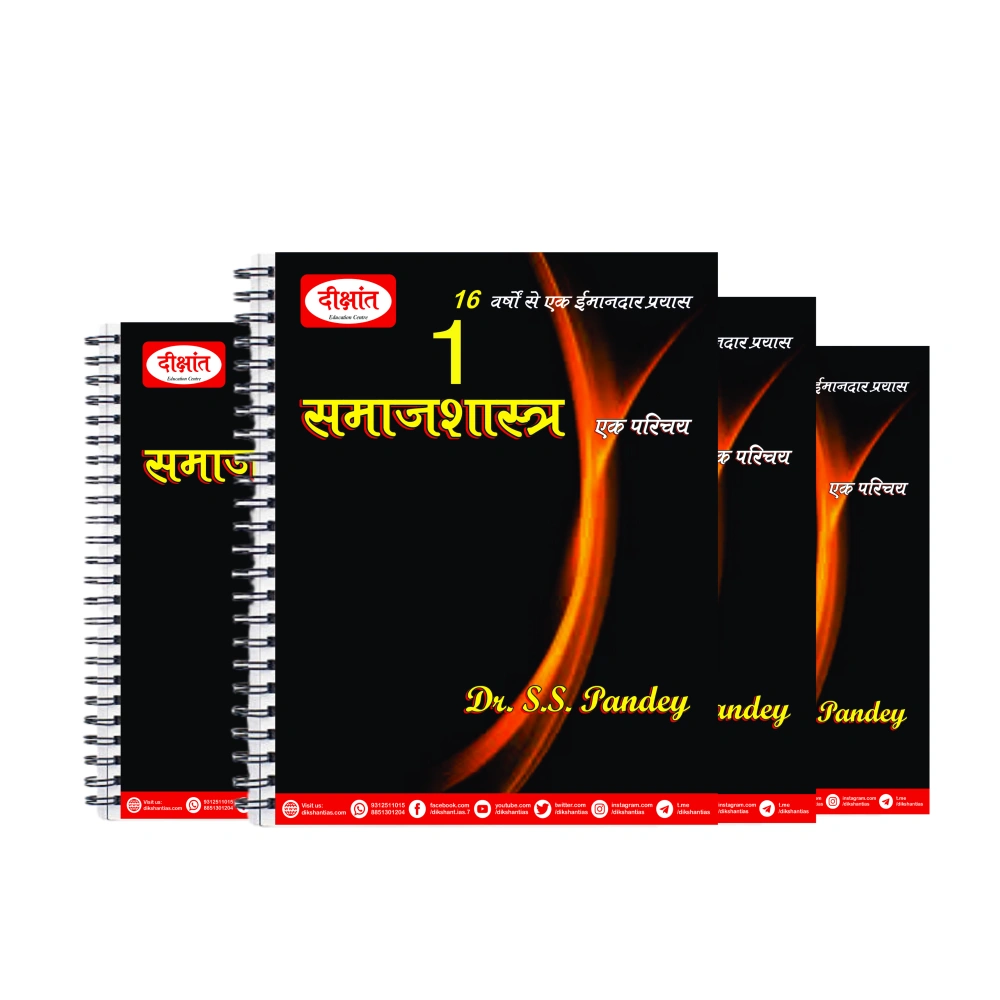
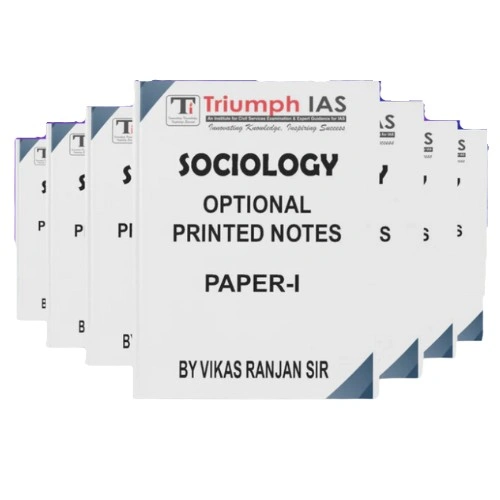
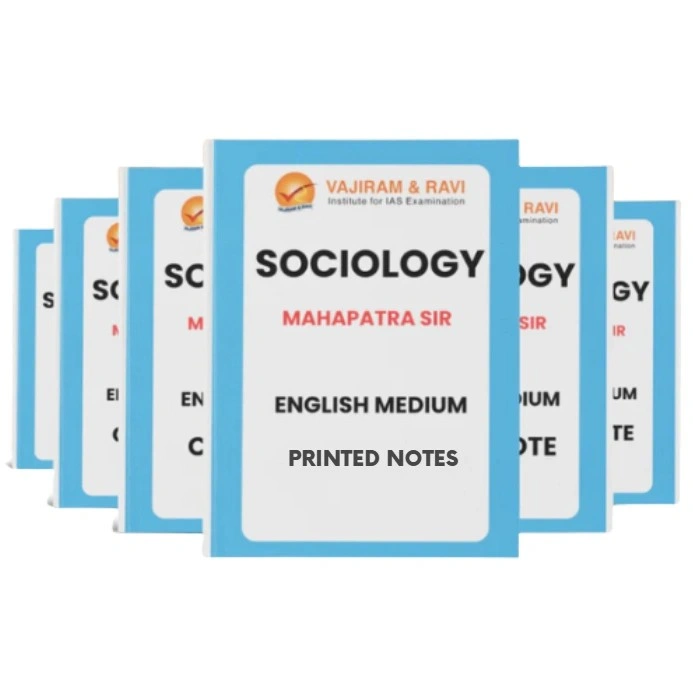
Standard textbooks are dense, so most aspirants consolidate with a structured notes set. Ready-made printed modules such as the SS Pandey Sociology Notes (25 modules, 4 booklets), the Vikash Ranjan (Triumph IAS) Sociology Notes — 7 booklets and the Mahapatra Sir Sociology Notes — 6 booklets cover both papers unit-wise, so you read theory and ready answer-frames side by side instead of compiling from scratch.
Sociology Optional Preparation Strategy
A clean sociology optional preparation strategy rests on four pillars: interlinking the two papers, updating Paper II with current affairs, disciplined answer writing, and relentless PYQ practice.
How long does it take to complete the sociology optional syllabus?
A disciplined aspirant completes the first reading in about 4–5 months at 3–4 hours a day, including note-making. Revision thereafter takes 15–20 days per full cycle, which is why sociology is considered time-efficient and comfortably fits alongside GS preparation.
Phase-wise plan
| Phase | Duration | Focus |
|---|---|---|
| Phase 1 | Weeks 1–3 | NCERTs + Paper I Units 1–4 (discipline, science, methods, thinkers) |
| Phase 2 | Weeks 4–9 | Paper I Units 5–10; start thinker-to-topic linkage |
| Phase 3 | Weeks 10–16 | Full Paper II; map each India topic to a Paper I concept |
| Phase 4 | Weeks 17–20 | Current affairs for Paper II + daily answer writing |
| Phase 5 | Ongoing | PYQ solving, revision cycles, test series |
Answer-writing and current-affairs tips
- Always name a thinker. Even a one-line reference (Weber on bureaucracy, Srinivas on Sanskritisation) lifts an answer.
- Interlink the papers. Answer a caste question (Paper II) using a stratification theory (Paper I).
- Feed Paper II with news. Farmer protests, women’s safety, migration, ageing, communal tension — connect each to the relevant syllabus unit. A monthly magazine helps here; see our Vision IAS Current Affairs for society-focused coverage.
- Use diagrams and flowcharts for processes like socialisation, mobility and the demographic transition.
- Solve 10+ years of PYQs and reuse the same examples across topics to save time.
Common Mistakes to Avoid
- Collecting too many books instead of revising one source multiple times.
- Treating Paper II as static — it demands fresh data and events every year.
- Ignoring Indian thinkers (Ghurye, Srinivas, Desai, Beteille), who are frequently asked.
- Writing descriptive, non-sociological answers without concepts or thinkers.
- Skipping answer writing until the end — it is a skill that needs months to build.
- Not mapping PYQs to units, so revision stays unfocused.
Frequently Asked Questions
What is the syllabus of Sociology optional for UPSC?
The sociology optional syllabus has two papers of 250 marks each. Paper I (Fundamentals of Sociology) covers the discipline, scientific method, research methods, thinkers (Marx, Durkheim, Weber, Parsons, Merton, Mead), stratification and mobility, work, politics, religion, kinship and social change across 10 units. Paper II (Indian Society) covers perspectives on Indian society, colonial impact, caste, tribes, classes, kinship, religion, rural/agrarian and industrial change, social movements, population dynamics and challenges of transformation.
Is Sociology a good optional for UPSC?
Yes. It has a short, static and beginner-friendly syllabus, is language-neutral, overlaps heavily with GS Paper I, GS Paper II, Essay and Ethics, and produces a consistent number of selections every year, making it one of the safest and most popular optionals.
Is the sociology optional syllabus short, and which is the shortest optional?
Sociology is widely regarded as one of the shortest and most completable optionals — a first reading takes about 4–5 months. Along with Public Administration and Political Science, it is routinely listed among the shortest, most scoring optionals, though sociology is usually the most beginner-friendly of the three.
How many papers are there in Sociology optional and what are the marks?
There are two papers — Paper I and Paper II — of 250 marks each, totalling 500 marks. Each paper is 3 hours long, has 8 questions in two sections, and requires you to answer five questions (Q1 and Q5 compulsory).
Which books are best for Sociology optional UPSC?
Start with NCERT Sociology, then use Haralambos (Themes and Perspectives) and Ritzer for Paper I theory, and Nagla, Yogendra Singh, A.R. Desai and M.N. Srinivas for Paper II. Consolidate with structured printed notes such as SS Pandey, Vikash Ranjan or Mahapatra Sir sociology modules for ready, unit-wise coverage of both papers.
Can a beginner or non-background student take Sociology optional?
Absolutely. Sociology requires no prior academic background — concepts are intuitive and can be built from the NCERTs upward. Engineers, doctors and other non-humanities graduates regularly clear UPSC with sociology, provided they practise sociological answer writing and keep Paper II updated with current affairs.
How long does it take to complete the Sociology optional syllabus?
A focused aspirant finishes the first reading in about 4–5 months at 3–4 hours a day, including note-making. Each later revision cycle takes only 15–20 days, so the subject is time-efficient enough to run in parallel with GS and Essay preparation.
Does Sociology optional overlap with GS and Essay papers?
Yes, substantially. Paper II mirrors large parts of GS Paper I (Indian society, women, population, urbanisation, communalism, secularism) and GS Paper II (welfare schemes, vulnerable sections, civil society), while Ethics borrows socialisation and attitude concepts and the Essay paper rewards sociological framing. In practice sociology covers roughly 20–25% of GS Mains, which is a major reason aspirants choose it.
Is the sociology optional syllabus available as a PDF download?
Yes — the Paper I and Paper II tables in this guide are in plain, copy-paste text, so you can paste them into a document and save or print them as your own sociology optional syllabus PDF. You can also pair them with a printed syllabus booklet to keep the exact UPSC wording on your desk during revision.
Recommended Study Material
Continue Reading

JEE Main Exam Pattern 2026: Marks, Sections & Marking Scheme
The JEE Main exam pattern for 2026 keeps Paper 1 (B.Tech) at 75 questions worth 300 marks, split…
SSC MTS Syllabus 2026: Subject-Wise Topics, Exam Pattern + PDF
The SSC MTS syllabus for 2026 covers four subjects at the 10th-standard level — Numerical & Mathematical Ability,…

Best Current Affairs Magazine for UPSC 2026: Ranked, Priced & Compared
The best current affairs magazine for UPSC in 2026 is the Vision IAS Monthly Current Affairs Magazine —…