IBPS RRB Syllabus 2026: Clerk, PO, Scale I, II & III + PDF
Complete IBPS RRB syllabus 2026 — subject-wise topics, exam pattern (Prelims + Mains), section weightage, PYQ trends, a 12-week plan & PDF download for Clerk, PO, Scale I, II & III.

The IBPS RRB syllabus covers five core subjects — Reasoning, Quantitative/Numerical Ability, General Awareness, English or Hindi Language, and Computer Knowledge — split across a two-stage selection process of Prelims (80 questions, 80 marks, 45 minutes) and Mains (200 questions, 200 marks, 120 minutes). Office Assistant (Clerk) and Officer Scale I share almost the same topic list, while Officer Scale II and III add a Financial Awareness and Professional Knowledge section. There is negative marking of 0.25 marks per wrong answer, and the exam is available in both English and Hindi.
This guide gives you the complete, post-wise, subject-wise IBPS RRB syllabus for 2026, the full exam pattern for every post, observed previous-year weightage so you know what to prioritise, a ready week-by-week study plan, a Hindi-medium resource section, and a printable syllabus PDF — everything you need in one place to plan your preparation and clear the cut-off.
Last reviewed for the 2026 recruitment cycle. The subjects, section structure and negative-marking rules below have been stable across recent IBPS RRB notifications; always confirm exact question counts, dates and post-wise details against the official IBPS notification at ibps.in before you finalise your plan, as marks distribution can be revised year to year.
IBPS RRB Syllabus 2026: Posts and Structure at a Glance
IBPS conducts the Common Recruitment Process for Regional Rural Banks (RRBs) — also called Gramin Banks — once a year to fill four categories of posts. Understanding which post you are targeting decides which parts of the IBPS RRB syllabus apply to you, because the Officer Scale II and III papers add subjects that Clerk and Scale I candidates never see.
| Post | Common Name | Selection Stages | Interview |
|---|---|---|---|
| Office Assistant (Multipurpose) | RRB Clerk | Prelims + Mains | No |
| Officer Scale I | RRB PO | Prelims + Mains + Interview | Yes |
| Officer Scale II (General Banking Officer) | RRB Scale II GBO | Single Online Exam + Interview | Yes |
| Officer Scale II (Specialist Officer) | RRB Scale II SO | Single Online Exam + Interview | Yes |
| Officer Scale III | RRB Senior Manager | Single Online Exam + Interview | Yes |
The key takeaway: the ibps rrb clerk syllabus 2026 and ibps rrb po syllabus 2026 are almost identical in topics — the difference is the exam pattern and the interview stage. Officer Scale II and III replace some General English/GA weightage with heavy Financial Awareness and, for specialists, a Professional Knowledge paper.
IBPS RRB Selection Process: How Many Stages?
A frequent People-Also-Ask query is how many stages the IBPS RRB selection process has. The answer depends on the post:
- Office Assistant (Clerk): Two stages — Preliminary Exam and Main Exam. There is no interview. Final merit is based only on the Mains score.
- Officer Scale I (PO): Three stages — Prelims, Mains and Interview. Prelims is only qualifying; the final merit list combines Mains and Interview in an 80:20 ratio.
- Officer Scale II & III: Two stages — a single online examination followed by an interview. There is no separate prelims.
Across every post the online tests carry negative marking of 0.25 marks for each wrong answer, and candidates must clear both an overall cut-off and sectional cut-offs to move ahead. Language proficiency in the official/regional language of the RRB is also checked at the document verification stage.
IBPS RRB Exam Pattern 2026: Prelims and Mains
Before diving into topics, lock in the ibps rrb exam pattern prelims and mains — it dictates how much time you can spend per question and where the marks sit.
IBPS RRB Office Assistant (Clerk) Prelims Pattern
| Section | Questions | Marks | Duration |
|---|---|---|---|
| Reasoning Ability | 40 | 40 | 45 minutes (composite) |
| Numerical Ability | 40 | 40 | |
| Total | 80 | 80 |
IBPS RRB Officer Scale I (PO) Prelims Pattern
| Section | Questions | Marks | Duration |
|---|---|---|---|
| Reasoning Ability | 40 | 40 | 45 minutes (composite) |
| Quantitative Aptitude | 40 | 40 | |
| Total | 80 | 80 |
IBPS RRB Mains Pattern (Clerk and Officer Scale I)
The Mains is where the syllabus widens to five sections. Both Office Assistant and Officer Scale I share the same 200-question, 200-mark, 120-minute structure, with only minor marks differences.
| Section | Clerk Qs / Marks | Officer Scale I Qs / Marks |
|---|---|---|
| Reasoning | 40 / 50 | 40 / 50 |
| Numerical / Quantitative Aptitude | 40 / 50 | 40 / 50 |
| General Awareness | 40 / 40 | 40 / 40 |
| English OR Hindi Language | 40 / 40 | 40 / 40 |
| Computer Knowledge | 40 / 20 | 40 / 20 |
| Total | 200 / 200 | 200 / 200 |
In the Mains, candidates choose either the English Language OR the Hindi Language paper — you do not attempt both. The composite time is 120 minutes with no separate sectional timing, so time management across five sections is critical.
IBPS RRB Officer Scale II and III Syllabus and Pattern
This is the section most competitor pages leave thin or skip entirely — yet it is exactly what senior-post aspirants search for. There is indeed an Officer Scale II and III syllabus in IBPS RRB, and it is delivered through a single online exam (no prelims) plus interview. If you searched specifically for the ibps rrb officer scale 2 and 3 syllabus, this is the part to bookmark.
Officer Scale II General Banking Officer & Officer Scale III Pattern
| Section | Questions | Marks |
|---|---|---|
| Reasoning | 40 | 50 |
| Quantitative Aptitude & Data Interpretation | 40 | 50 |
| Financial Awareness | 40 | 40 |
| English OR Hindi Language | 40 | 40 |
| Computer Knowledge | 40 | 20 |
| Total | 200 | 200 |
The single exam runs for 120 minutes. Officer Scale III (Senior Manager) uses this exact pattern, only with a tougher difficulty level and greater emphasis on managerial and financial reasoning.
Officer Scale II Specialist Officer Pattern
Specialist Officers (IT, CA, Law, Treasury Manager, Marketing, Agricultural Officer, etc.) add a dedicated Professional Knowledge paper tied to their discipline.
| Section | Questions | Marks |
|---|---|---|
| Professional Knowledge | 40 | 40 |
| Reasoning | 40 | 40 |
| Financial Awareness | 40 | 40 |
| Quantitative Aptitude & DI | 40 | 50 |
| English OR Hindi Language | 20 | 20 |
| Computer Knowledge | 20 | 10 |
| Total | 200 | 200 |
The Financial and Professional Knowledge portion for Scale II and III typically covers: monetary policy, RBI functions and tools (repo/reverse repo, CRR, SLR), BASEL I/II/III norms, capital adequacy, NPAs and their classification, risk management (credit, market, operational risk), priority-sector lending, banking regulations, financial inclusion, and recent RBI circulars. Specialist candidates must additionally master their subject stream (e.g. IT Officers face DBMS, networking and programming questions; Law Officers face banking law, negotiable instruments and SARFAESI).
Subject-Wise IBPS RRB Syllabus with Priority Tagging
Now the heart of the ibps rrb officer scale 1 syllabus and Clerk syllabus — the exact topics per subject. We have added a priority tag (High / Medium / Low) based on how frequently each topic has appeared in recent papers, so beginners know what to attack first. Treat the per-topic question counts as typical ranges observed across recent shifts, not a fixed official quota.
Reasoning Ability — Topics & Weightage
| Topic | Priority | Approx. Qs (Prelims) |
|---|---|---|
| Puzzles (box, floor, scheduling) | High | 10-12 |
| Seating Arrangement (linear, circular) | High | 8-10 |
| Syllogism | High | 3-5 |
| Inequalities (coded & direct) | High | 3-5 |
| Coding-Decoding | Medium | 3-5 |
| Blood Relations | Medium | 2-3 |
| Direction Sense | Medium | 2-3 |
| Order & Ranking, Alphanumeric Series | Medium | 2-4 |
| Data Sufficiency, Statement-Assumption | Low | 0-3 |
Puzzles and seating arrangement alone can account for 18-22 out of 40 marks — mastering these two categories is the single highest-leverage move in the entire reasoning section.
Quantitative / Numerical Ability — Topics & Weightage
| Topic | Priority | Approx. Qs (Prelims) |
|---|---|---|
| Simplification & Approximation | High | 10-15 |
| Number Series (missing/wrong) | High | 5 |
| Data Interpretation (tables, bar, pie, caselet) | High | 10-15 |
| Quadratic Equations | Medium | 5 |
| Arithmetic Word Problems* | High | 8-10 |
| Profit & Loss, SI & CI, Time & Work | Medium | Part of arithmetic |
| Mensuration, Ratio, Averages, Ages, Partnership | Medium | Part of arithmetic |
| Probability, Permutation & Combination | Low | 1-2 |
*Arithmetic word problems bundle profit & loss, simple/compound interest, time-speed-distance, time & work, mixtures, boats & streams, and pipes & cisterns. In the Mains, Data Interpretation dominates and can decide your Quant score.
General Awareness — What to Study
General Awareness is a Mains-only section for Clerk and Scale I, and it is the most scoring section per minute because there is no calculation. The ibps rrb syllabus for GA is roughly 60-70% current affairs of the last 4-6 months and 30-40% static banking knowledge:
- Current Affairs (High): national & international news, awards, appointments, sports, summits, books & authors, obituaries, government schemes.
- Banking & Financial Awareness (High): RBI structure and functions, types of banks & accounts, NABARD, SEBI, monetary policy rates, financial abbreviations, banking history, RRB-specific facts.
- Static GK (Medium): capitals, currencies, national parks, important days, dams, stadiums, first-in-India.
- Government Schemes (High): PMJDY, Mudra, PM-KISAN, Atal Pension Yojana, Stand-Up India, financial-inclusion schemes.
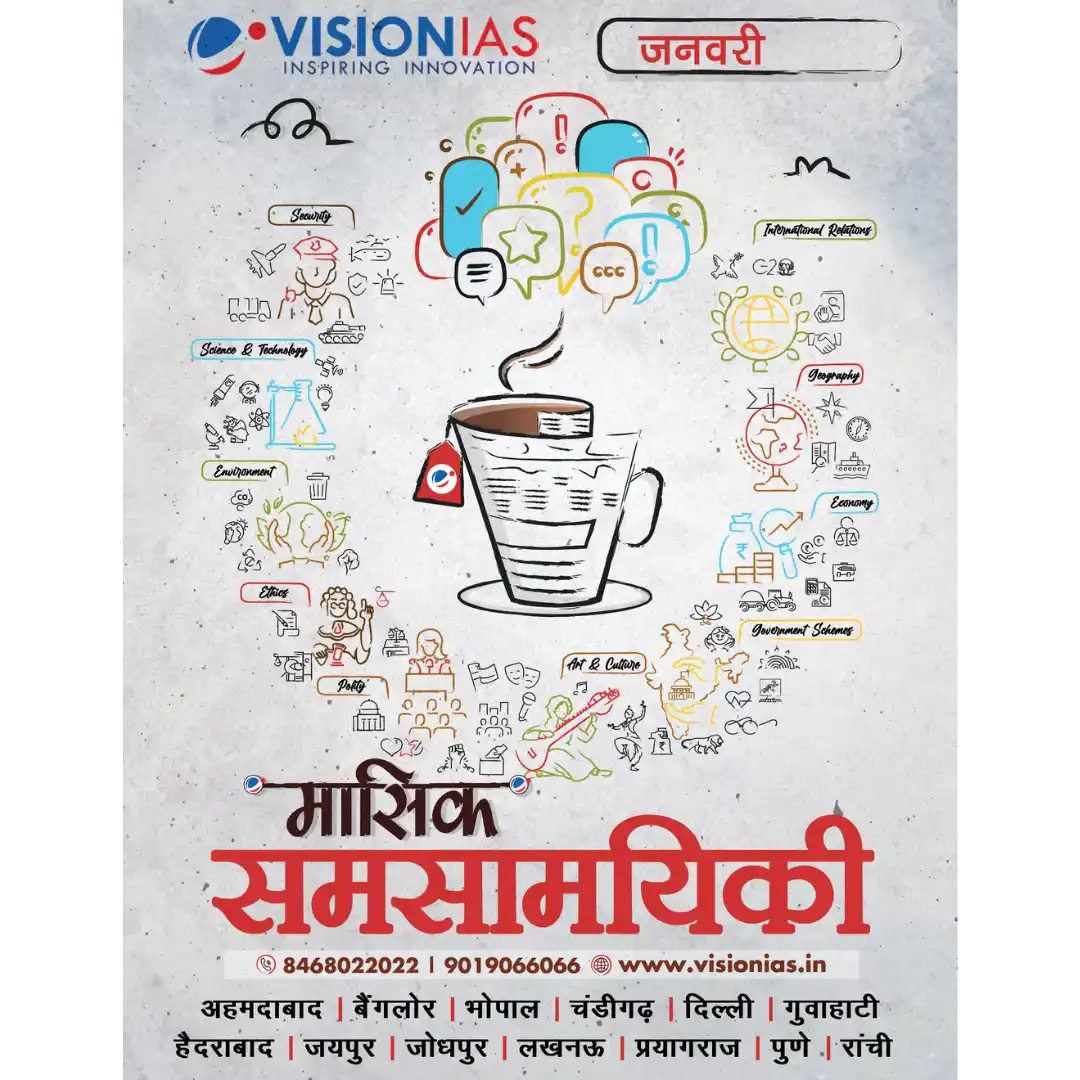
Keeping a monthly current-affairs digest is the smartest way to cover this. A structured monthly compilation like the Vision IAS Current Affairs Magazine (January 2026, English) gives you the banking, economy and scheme updates in one revision-friendly place, and the Hindi-medium edition serves Hindi-medium aspirants equally well.
English / Hindi Language — Topics
You attempt only one language paper. The English section tests:
- Reading Comprehension (High) — often based on economy/banking passages.
- Error Spotting & Sentence Correction (High).
- Cloze Test & Fillers (Medium).
- Para Jumbles & Sentence Rearrangement (Medium).
- Word Swap, Word Usage, Idioms & Phrases, Phrasal Verbs (Medium).
The Hindi (हिंदी) Language paper mirrors this with: gadyansh (comprehension), vyakaran (grammar) — sangya, sarvanam, kaal, sandhi, samas, upsarg-pratyay; ashuddhi shodhan (error correction); riktha sthan ki purti (fillers); vaakya kram vyavastha (rearrangement); and paryayvachi/vilom shabd (synonyms & antonyms). Hindi-medium candidates should note that only the language paper differs — Reasoning, Quant, GA and Computer questions appear in both English and Hindi on screen.
Computer Knowledge — Topics
Computer Knowledge is a Mains section worth 20 marks for Clerk and Scale I. It is highly scoring because the syllabus is fixed and static:
- Computer Fundamentals & Generations of Computers.
- Hardware, Software, Input/Output devices, Memory (RAM/ROM, primary/secondary).
- MS Office — Word, Excel, PowerPoint shortcuts and features.
- Operating Systems & File Management.
- Networking — LAN/WAN/MAN, topologies, protocols.
- Internet, Email, Browsers, Search Engines.
- Database (DBMS) basics.
- Computer & Cyber Security — viruses, malware, firewalls, phishing.
- Abbreviations & History of Computers.
Which Subjects Are Asked in IBPS RRB Prelims vs Mains?
A common point of confusion is that the Prelims and Mains do not test the same subjects. Here is the clean split for Clerk and Officer Scale I:
| Stage | Subjects Tested |
|---|---|
| Prelims | Reasoning Ability + Numerical/Quantitative Ability only (2 subjects) |
| Mains | Reasoning + Numerical/Quantitative + General Awareness + English OR Hindi + Computer Knowledge (5 subjects) |
So General Awareness, Language and Computer Knowledge are never tested in Prelims for Clerk and Scale I — they appear only in the Mains. For Officer Scale II and III there is no Prelims at all; every subject is tested in the single online exam.
Clerk vs PO Syllabus: What Actually Differs?
Candidates constantly ask about the difference between IBPS RRB PO and Clerk syllabus. In terms of topics, they are nearly identical — the divergence is in structure and expectation:
| Parameter | Office Assistant (Clerk) | Officer Scale I (PO) |
|---|---|---|
| Topics covered | Same 5 subjects | Same 5 subjects |
| Difficulty level | Easy to Moderate | Moderate to Difficult |
| Interview | No | Yes (100 marks) |
| Final merit basis | Mains only | Mains (80%) + Interview (20%) |
| DI & puzzle complexity | Lower | Higher (more variables) |
Practically, a PO aspirant should aim for faster solving speed and tougher Data Interpretation, while a Clerk aspirant should focus on accuracy and clearing sectional cut-offs comfortably.
Previous-Year Trend Analysis: Where the Marks Really Are
Most syllabus pages list topics but never tell you how many questions each actually generated. Based on patterns observed in recent IBPS RRB papers, here is where marks tend to concentrate — use it to allocate study hours intelligently. These shares are approximate and vary by shift, so treat them as a prioritisation guide rather than a guarantee.
| Section | Highest-yield topics | Share of section marks |
|---|---|---|
| Reasoning | Puzzles + Seating Arrangement | ~50% |
| Quant (Prelims) | Simplification + Number Series | ~40% |
| Quant (Mains) | Data Interpretation | ~35-40% |
| General Awareness | Current Affairs (last 6 months) | ~60-65% |
| English | Reading Comprehension + Error Spotting | ~45% |
| Computer | Fundamentals + MS Office + Networking | ~55% |
The lesson: roughly half of every section is decided by two or three topic clusters. Solving topic-wise previous-year question material trains you to recognise these recurring patterns faster than any theory book — PYQ-driven revision is consistently one of the biggest score multipliers for banking aspirants.
IBPS RRB Study Plan 2026: Week-by-Week Timetable
Another gap on competitor pages: they say “give X months” but never hand you a concrete plan. For most working or college-going aspirants, 3 to 4 months of focused study is enough to complete the IBPS RRB syllabus. Here is a printable 12-week plan you can follow.
| Weeks | Focus | Daily Targets |
|---|---|---|
| 1-3 | Foundation: Simplification, Number Series, Syllogism, Inequalities, basic seating | 2 hrs Quant + 2 hrs Reasoning + 30 min CA |
| 4-6 | Core: Puzzles, DI, Arithmetic word problems, Coding-Decoding | Sectional tests every alternate day |
| 7-8 | Mains subjects: GA, English/Hindi, Computer Knowledge | 1 GA + 1 Computer topic daily + RC practice |
| 9-10 | Prelims full mocks + error analysis | 1 full mock/day + 90 min analysis |
| 11-12 | Mains mocks, speed drills, revision of notes | Mains mock alternate days + CA revision |
Golden rule: from Week 4 onward, analysis of each mock matters more than the mock itself. Log every wrong answer, tag it to a syllabus topic, and revisit that topic the same week.
Hindi-Medium Aspirants: Complete Coverage
IBPS RRB is one of the most Hindi-friendly banking exams — a big advantage that most English-first guides overlook. On screen, every Reasoning, Quantitative, General Awareness and Computer question appears in both Hindi and English. You only pick a side for the Language paper (English OR Hindi). Hindi-medium candidates should therefore:
- Choose the Hindi (हिंदी भाषा) paper and master vyakaran thoroughly — it is high-scoring and predictable.
- Study current affairs from a Hindi compilation such as the Vision IAS Current Affairs Magazine (Hindi Medium) so banking and economy terms stay in your comfort language.
- Practise numerical and reasoning questions in Hindi-medium mock tests to get used to the on-screen Hindi phrasing.
Best Books and Preparation Resources
Pairing the syllabus with the right resources is what converts a plan into a selection. A balanced IBPS RRB resource set includes:
- Reasoning: a puzzle-and-seating-focused practice book with graded difficulty.
- Quantitative Aptitude: a book strong on Data Interpretation and arithmetic shortcuts.
- General Awareness: a monthly current-affairs magazine plus a static banking-awareness capsule.
- English/Hindi: grammar rules book + daily editorial/RC practice.
- Mock Tests: a full-length test series simulating the composite timing.
For the current-affairs and banking-awareness backbone that GA relies on, a monthly digest like the Vision IAS Current Affairs Magazine keeps you updated without drowning in daily news, and topic-wise previous-year question compilations sharpen pattern recognition across reasoning and quant.
IBPS RRB Syllabus PDF Download
For offline, ad-free, printable revision, save the complete subject-wise IBPS RRB syllabus and exam pattern covered above as a PDF: use your browser’s Print → Save as PDF option on this page to generate a clean, printable copy of the full ibps rrb syllabus pdf download, or bookmark this guide for the official pattern tables. For the authoritative, post-specific syllabus annexure, also download the detailed advertisement PDF attached to the official IBPS RRB notification at ibps.in when it is released. Keep the priority-tagged topic tables and the 12-week study plan pinned near your study desk — a syllabus you can see every day is a syllabus you actually finish.
Common Mistakes to Avoid
- Ignoring sectional cut-offs: a brilliant Quant score cannot compensate for a failed English section — you must clear every section.
- Skipping Computer Knowledge: it is 20 easy marks in the Mains; do not leave it for the last day.
- Over-preparing static GK: current affairs of the last 6 months dominate GA — weight your effort accordingly.
- No mock analysis: giving mocks without logging errors wastes their biggest benefit.
- Neglecting speed: Prelims gives you barely 33 seconds per question — accuracy plus speed both matter.
Frequently Asked Questions
What is the syllabus of IBPS RRB 2026?
The IBPS RRB 2026 syllabus covers five subjects: Reasoning Ability, Quantitative/Numerical Ability, General Awareness, English or Hindi Language, and Computer Knowledge. Prelims tests only Reasoning and Numerical Ability, while Mains adds General Awareness, Language and Computer Knowledge. Officer Scale II and III also include Financial Awareness and, for specialists, a Professional Knowledge paper.
What is the difference between IBPS RRB PO and Clerk syllabus?
The topics are nearly identical for both posts. The differences are structural: Officer Scale I (PO) has an interview stage and its final merit combines Mains and Interview in an 80:20 ratio, while Office Assistant (Clerk) has no interview and merit is based on Mains alone. PO papers also carry higher difficulty, especially in Data Interpretation and puzzles.
Is there Officer Scale II and III syllabus in IBPS RRB?
Yes. Officer Scale II and III are recruited through a single online exam plus interview. Their syllabus adds a Financial Awareness section (RBI, monetary policy, BASEL, NPAs, risk management) to Reasoning, Quantitative Aptitude with DI, Language and Computer Knowledge. Officer Scale II Specialist Officers additionally attempt a Professional Knowledge paper based on their discipline.
Is IBPS RRB exam in Hindi or English?
The IBPS RRB exam is available in both Hindi and English. All Reasoning, Quantitative, General Awareness and Computer questions appear on screen in both languages. Candidates choose either the English OR the Hindi Language paper for that specific section, making it very accessible for Hindi-medium aspirants.
Is there negative marking in IBPS RRB exam?
Yes, there is negative marking of 0.25 marks for every wrong answer in all objective online tests across Prelims, Mains and single-level exams. There is no penalty for questions left unanswered, so intelligent guessing and avoiding blind attempts is an important scoring strategy.
How many stages are there in IBPS RRB selection process?
It depends on the post. Office Assistant (Clerk) has two stages — Prelims and Mains, with no interview. Officer Scale I (PO) has three stages — Prelims, Mains and Interview. Officer Scale II and III have two stages — a single online exam followed by an interview, with no separate Prelims.
Which subjects are asked in IBPS RRB Prelims and Mains?
For Clerk and Officer Scale I, the Prelims tests only two subjects — Reasoning Ability and Numerical/Quantitative Ability. The Mains tests five subjects — Reasoning, Numerical/Quantitative Ability, General Awareness, English or Hindi Language, and Computer Knowledge. For Officer Scale II and III there is no Prelims; all subjects are tested together in the single online exam.
How much time is needed to complete the IBPS RRB syllabus?
Most aspirants can complete the IBPS RRB syllabus in 3 to 4 months of focused daily study of 4-6 hours. Beginners may need 5-6 months, while candidates already preparing for other bank exams can be exam-ready in 6-8 weeks by focusing on mocks, current affairs and high-weightage topics like puzzles and Data Interpretation.
Recommended Study Material


Continue Reading
SSC MTS Syllabus 2025: Subject-Wise Topics, Pattern & PDF
The SSC MTS syllabus for the Computer-Based Examination (Paper-I) covers four subjects — Numerical & Mathematical Ability, Reasoning…
Vision IAS vs Drishti IAS: Which Is Best for UPSC 2026?
Vision IAS and Drishti IAS are the two most widely used coaching study materials for UPSC CSE preparation…

UGC NET Political Science Syllabus 2026: Units, Weightage, Books & PDF
The UGC NET Political Science syllabus is divided into two papers: Paper 1 (Teaching & Research Aptitude, common…