SSC MTS Syllabus 2025: Subject-Wise Topics, Pattern & PDF
Complete SSC MTS syllabus 2025 — subject-wise Paper 1 topics, exam pattern, marking scheme, weightage, Havaldar PET/PST & PDF download to plan your prep.

The SSC MTS syllabus for the Computer-Based Examination (Paper-I) covers four subjects — Numerical & Mathematical Ability, Reasoning Ability & Problem Solving, General Awareness, and English Language & Comprehension — tested across two timed sessions totalling 90 questions and 270 marks in 90 minutes. Session-I (Maths + Reasoning, 40 questions, 120 marks) has no negative marking, while Session-II (English + General Awareness, 50 questions, 150 marks) deducts 1 mark per wrong answer. Every topic is set at Class-10 (matriculation) level, so no degree-level knowledge is needed. This guide gives you the exact subject-wise SSC MTS syllabus 2025, the revised exam pattern, topic-wise weightage, a printable one-page syllabus-at-a-glance table, Havaldar PET/PST standards, qualifying marks, and a PDF-download checklist so a Class-10-level aspirant can plan preparation with zero confusion.
SSC MTS Syllabus 2025 at a Glance (Quick Answer)
If you only have a minute, these are the numbers every aspirant must memorise before reading the detailed SSC MTS syllabus subject wise below:
- Subjects: 4 (Maths, Reasoning, General Awareness, English)
- Total questions / marks: 90 questions / 270 marks
- Duration: 90 minutes (45 minutes per session)
- Marks per question: 3
- Negative marking: None in Session-I; −1 per wrong answer in Session-II
- Level: Class 10 (Matriculation)
- Qualifying marks: 30% (UR), 25% (OBC/EWS), 20% (SC/ST/PwBD/ESM)
SSC MTS Syllabus 2025 & Exam Overview
The Multi Tasking (Non-Technical) Staff and Havaldar (CBIC & CBN) examination is conducted by the Staff Selection Commission (SSC) to recruit Group-C non-gazetted, non-ministerial employees for various Central Government departments. Before we break down the SSC MTS syllabus subject wise, here is the complete overview every aspirant should bookmark.
| Particular | Details |
|---|---|
| Conducting Body | Staff Selection Commission (SSC) |
| Post Name | Multi Tasking Staff (MTS) & Havaldar (CBIC / CBN) |
| Category | Group-C, Non-Gazetted, Non-Ministerial |
| Exam Mode | Online / Computer-Based Examination (CBE) |
| Exam Level | Class 10 (Matriculation) standard |
| Selection Process | Paper-I (CBE) → PET/PST (Havaldar only) → Document Verification |
| Paper-I Structure | 2 Sessions, 90 Questions, 270 Marks, 90 Minutes |
| Negative Marking | None in Session-I; −1 mark in Session-II |
| Language | 15 languages (Hindi, English + 13 regional) |
| Official Website | ssc.gov.in |
Because SSC MTS is a Class-10-level exam, a candidate with strong matriculation fundamentals can crack it in a few focused months. If your basics are shaky, a foundational Class 10 revision set such as the Aakash Class 10 study material can rebuild your maths and English core before you attempt full-length mocks.
SSC MTS Exam Pattern 2025 (Revised)
The SSC MTS exam pattern is the single most important thing to internalise before touching the syllabus, because the two-session, differential-marking structure changes how you should attempt the paper. Paper-I is a single computer-based test split into two separate, back-to-back sessions. There is no Paper-II or descriptive paper in the current pattern.
| Session | Subjects | Questions | Marks | Duration | Negative Marking |
|---|---|---|---|---|---|
| Session-I | Numerical & Mathematical Ability | 20 | 60 | 45 minutes | No |
| Session-I | Reasoning Ability & Problem Solving | 20 | 60 | ||
| Session-II | General Awareness | 25 | 75 | 45 minutes | Yes (−1) |
| Session-II | English Language & Comprehension | 25 | 75 | ||
| Total | 90 | 270 | 90 minutes | — | |
SSC MTS Marking Scheme 2025
Each question in both sessions carries 3 marks. The crucial difference lies in the penalty:
- Session-I (Maths + Reasoning): No negative marking. Attempt every single question — there is zero risk in guessing.
- Session-II (English + General Awareness): 1 mark is deducted for each wrong answer. Attempt only where you are reasonably confident; avoid blind guessing.
Important Points About the SSC MTS Paper Pattern
- It is mandatory to attempt both sessions; failing to appear in either session leads to disqualification.
- Session-I and Session-II are conducted on the same day, one after the other, with a fixed time allotted to each.
- The computer will automatically move from Session-I to Session-II after 45 minutes — you cannot carry leftover time forward.
- Persons with Benchmark Disabilities (PwBD) eligible for a scribe get 60 minutes per session instead of 45.
Is There Negative Marking in SSC MTS 2025?
Yes — but only partly. This is one of the most searched SSC MTS questions and the answer is nuanced. Session-I (Numerical Ability and Reasoning) has no negative marking, so you should leave no question unattempted there. Session-II (General Awareness and English) applies a penalty of 1 mark per incorrect response. This asymmetry is deliberate and should shape your strategy: be aggressive in the first half and selective in the second. A silly wrong guess in GA can wipe out the gain from a correct answer, so accuracy matters more than volume in Session-II.
SSC MTS Passing Marks & Qualifying Marks by Category
To be considered for the merit list, candidates must first clear the minimum qualifying marks. These are category-wise cut-offs set by the Commission, and they are distinct from the actual expected cut-off (which is usually much higher).
| Category | Minimum Qualifying Marks |
|---|---|
| UR (Unreserved / General) | 30% |
| OBC / EWS | 25% |
| SC / ST / PwBD / ESM (Others) | 20% |
Qualifying Marks vs. Expected Cut-Off — Don’t Confuse Them
Clearing the qualifying percentage above only makes you eligible to be counted; it does not guarantee selection. The real selection cut-off is decided by competition, vacancies, and normalised scores, and typically ranges far above the qualifying floor — often 130–170 out of 270 depending on state and category. Treat the qualifying marks as the entry gate and aim for 200+ to sit comfortably above the expected cut-off.
SSC MTS Syllabus 2025: Subject-Wise Topics (Paper 1)
Now to the core — the detailed SSC MTS Paper 1 syllabus. There are four subjects. Session-I tests aptitude (Maths + Reasoning) and Session-II tests knowledge and language (GA + English). Below is the complete topic list for each, as notified by SSC.
1. Numerical & Mathematical Ability (20 Questions / 60 Marks)
This section checks arithmetic and basic mathematical fundamentals at Class-10 level. Topics include:
- Integers and Whole Numbers, LCM and HCF
- Decimals and Fractions, Relationship between numbers
- Fundamental Arithmetical Operations, BODMAS
- Percentage, Ratio and Proportion
- Work and Time, Direct and Inverse Proportions
- Profit and Loss, Discount, Simple and Compound Interest
- Average, Mixture and Alligation
- Time and Distance, Speed, Trains and Boats
- Area and Perimeter of Basic Geometric Figures, Mensuration
- Distance and Angle, Basic Geometry, Trigonometry (basic)
- Data Interpretation — Bar Graph, Pie Chart, Line Graph, Tables
2. Reasoning Ability & Problem Solving (20 Questions / 60 Marks)
This non-verbal and verbal reasoning section rewards practice and pattern recognition. Topics include:
- Analogies (numeric, verbal, figural)
- Similarities and Differences
- Space Visualisation, Spatial Orientation
- Problem Solving, Analysis and Judgement
- Decision Making, Visual Memory, Discrimination
- Observation, Relationship Concepts (Blood Relations)
- Coding and Decoding, Series (Number, Alphabet, Figure)
- Directions, Order and Ranking
- Non-Verbal Series, Figure Classification
- Arithmetical Number Series, Statement–Conclusion
3. General Awareness (25 Questions / 75 Marks)
This section tests awareness of the environment and its application to society, plus static GK and current affairs. Topics include:
- Current Affairs (national & international, sports, awards, appointments)
- Indian History and Freedom Struggle
- Geography (India and World)
- Indian Polity and Constitution
- Economy (basic concepts, budget, schemes)
- General Science (Physics, Chemistry, Biology — Class-10 level)
- Static GK — books, authors, important dates, capitals, currencies
- Culture, Art, and Indian heritage
4. English Language & Comprehension (25 Questions / 75 Marks)
This section evaluates basic understanding of English, grammar, and vocabulary. Topics include:
- Spot the Error, Sentence Correction
- Fill in the Blanks
- Synonyms and Antonyms
- Spelling / Detecting Misspelt Words
- Idioms and Phrases
- One-Word Substitution
- Improvement of Sentences
- Active / Passive Voice
- Direct / Indirect Narration
- Cloze Passage and Comprehension Passage
SSC MTS Syllabus at a Glance (Printable One-Page Table)
Most competing pages force endless scrolling. Here is the entire SSC MTS syllabus, pattern, and weightage condensed into a single printable table — screenshot it or build the PDF checklist described below.
| Section | Session | Q / Marks | Key Topics | Weightage Priority |
|---|---|---|---|---|
| Numerical & Mathematical Ability | I | 20 / 60 | Percentage, Ratio, Profit-Loss, SI-CI, Time-Work, Averages, DI | High (no negative) |
| Reasoning & Problem Solving | I | 20 / 60 | Series, Coding-Decoding, Analogy, Blood Relations, Directions | High (scoring) |
| General Awareness | II | 25 / 75 | Current Affairs, Polity, History, Geography, Science, Static GK | Medium-High |
| English Language | II | 25 / 75 | Grammar, Vocabulary, Comprehension, Error Spotting, Cloze | Medium |
SSC MTS Topic-Wise Weightage: What to Study First
Generic weightage lists are everywhere, but few pages tell you honestly what to prioritise. Based on the trend of previous-year SSC MTS papers, here is a high-ROI vs. low-ROI breakdown for each subject.
| Subject | High-Scoring Topics (study first) | Low-ROI Topics (do later / skip if short on time) |
|---|---|---|
| Maths | Percentage, Ratio & Proportion, Profit-Loss, Averages, Number System, Simplification | Advanced trigonometry, complex mensuration |
| Reasoning | Series, Coding-Decoding, Analogy, Blood Relations, Non-Verbal Figures | Complex puzzle sets, syllogism variations |
| General Awareness | Static GK, Polity, Current Affairs (last 6 months), Science basics | Deep economic theory, obscure history dates |
| English | Synonyms/Antonyms, One-Word Substitution, Error Spotting, Fill in the Blanks | Complex idioms, rare vocabulary |
Which Subject Has the Highest Weightage in SSC MTS?
General Awareness and English each carry 25 questions (75 marks), the highest per-subject count, while Maths and Reasoning carry 20 each. But because Session-I (Maths + Reasoning) has no negative marking, it is effectively the highest-value, lowest-risk scoring zone. A smart aspirant maxes out Session-I first, then uses accurate, selective attempts to bank GA and English marks in Session-II.
SSC MTS Havaldar Syllabus: PET / PST & Selection Process
The written syllabus is identical for MTS and Havaldar posts, but Havaldar candidates (recruited by CBIC and CBN) must additionally clear a Physical Efficiency Test (PET) and Physical Standard Test (PST). This full end-to-end stage is where many competing pages fall short — here is the complete detail.
SSC Havaldar Physical Efficiency Test (PET)
| Category | Walking | Cycling |
|---|---|---|
| Male | 1600 metres in 15 minutes | 8 km in 30 minutes |
| Female | 1 km in 20 minutes | 3 km in 25 minutes |
SSC Havaldar Physical Standard Test (PST)
| Standard | Male | Female |
|---|---|---|
| Height | 157.5 cm | 152 cm |
| Chest | 81 cm (unexpanded), min 5 cm expansion | Not applicable |
| Weight | As per height & age (medical norms) | 48 kg (approx.) |
SSC Height Relaxation Rules
Height is relaxed by 5 cm for candidates belonging to Scheduled Tribes, Garhwalis, Assamese, Kumaonis, Gorkhas, and certain hill-area categories. Chest measurement is similarly relaxed for eligible categories. Candidates should verify their specific relaxation entitlement in the official notification before the PST.
Document Verification (DV)
After PET/PST (or directly after the CBE for MTS posts), shortlisted candidates undergo Document Verification. Original certificates — matriculation proof, category/caste certificate, identity proof, and photographs — must be produced. Failure to produce valid documents leads to cancellation of candidature. This makes the complete Havaldar selection flow: Paper-I (CBE) → PET/PST → Document Verification.
Difference Between SSC MTS and Havaldar Syllabus
The academic syllabus and Paper-I pattern are exactly the same for both. The only difference is the additional physical stage: MTS posts require just the CBE and DV, whereas Havaldar posts add the mandatory PET and PST between them. If you are physically fit and want a uniformed customs/excise role, opt for Havaldar; otherwise the MTS route skips the physical test entirely.
SSC MTS Language of Examination
To make the exam accessible across India, SSC conducts the objective paper in 15 languages. Candidates can choose their preferred medium for questions in the Reasoning and Numerical sections. The available languages are Hindi, English, Assamese, Bengali, Gujarati, Kannada, Konkani, Malayalam, Manipuri, Marathi, Odia, Punjabi, Tamil, Telugu, and Urdu. The English Language section is, naturally, in English only.
SSC MTS Syllabus PDF Download
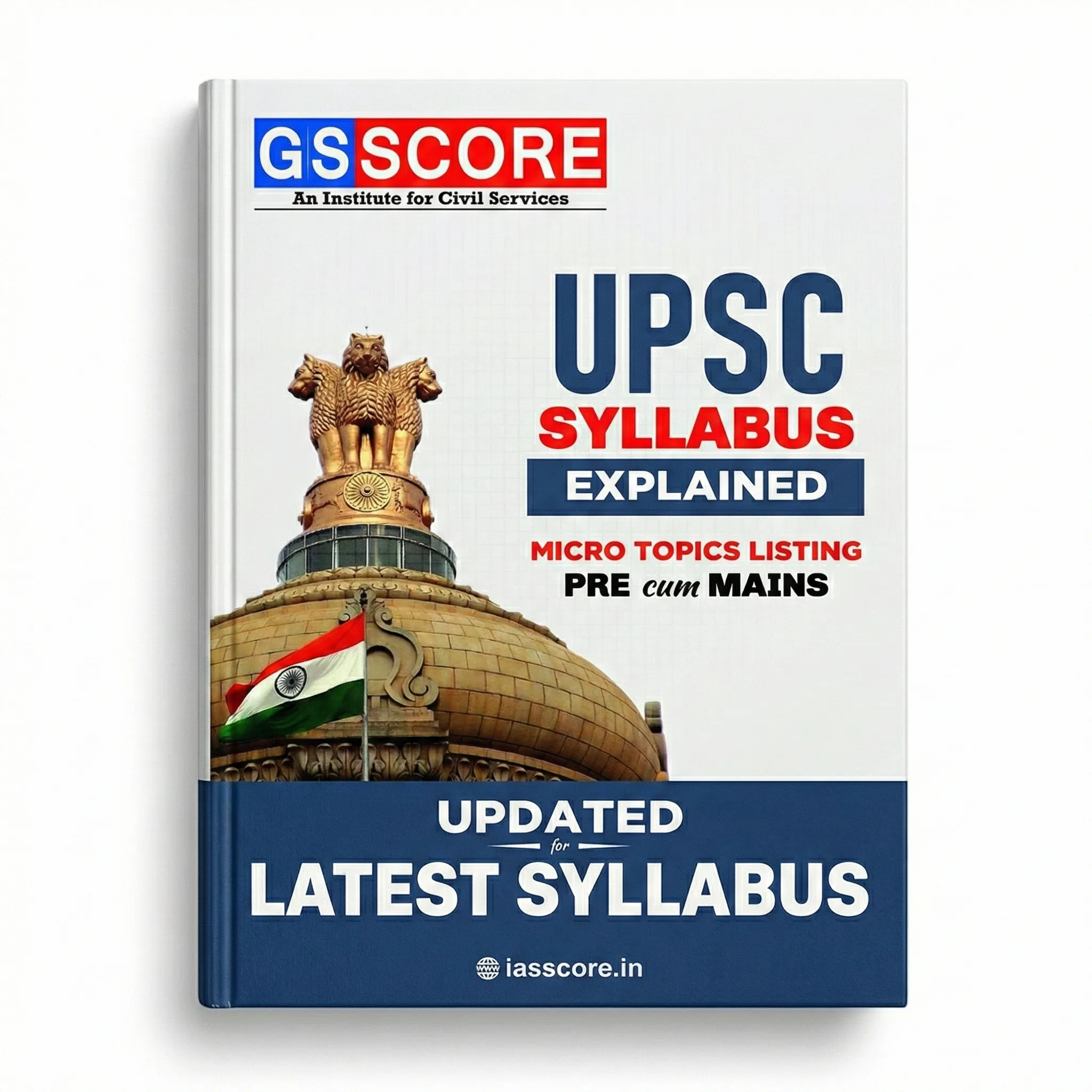
You can download the official SSC MTS syllabus PDF directly from the notification hosted on ssc.gov.in under the relevant recruitment year. We also recommend building your own annotated, tick-able topic checklist from the "syllabus at a glance" table above — print it, mark each topic Green (strong), Yellow (revise), or Red (weak), and update it weekly. This personal checklist is more actionable than a raw PDF and keeps your revision honest. For a broader understanding of how competitive-exam syllabi are structured and revised, the GS Score latest syllabus booklet is a handy reference companion.
SSC MTS Preparation Tips: Section-Wise Micro-Guides
Knowing the syllabus is half the battle; attacking each section correctly is the other half. Here are practical, section-wise strategies.
How to Prepare Numerical & Mathematical Ability
Master arithmetic fundamentals first — percentages, ratios, and averages appear in profit-loss, interest, and DI questions too, so they compound. Learn tables up to 20, squares up to 30, and cubes up to 15 by heart to save precious seconds. Since Session-I has no negative marking, practise speed with timed 20-question sets and attempt everything on exam day.
How to Prepare Reasoning & Problem Solving
Reasoning is the most improvable section because it rewards pattern familiarity over knowledge. Do 30–40 mixed questions daily covering series, coding-decoding, and analogies. Non-verbal figure questions are quick, high-accuracy scorers — do them first in the exam to bank easy marks.
How to Prepare General Awareness (Static vs Current Affairs)
Split GA into two tracks. For static GK (Polity, History, Geography, Science), rely on a consolidated GK book and revise repeatedly. For current affairs, focus strictly on the last 4–6 months before the exam — national events, sports, awards, and government schemes. Do not over-invest here; a fixed 30 minutes daily of current-affairs reading is enough. Since Session-II has negative marking, only attempt GA questions you are confident about.
How to Prepare English Language & Comprehension
Build vocabulary through daily word lists (synonyms, antonyms, one-word substitutions) and revise the top 200 idioms. Grammar rules for error spotting and sentence improvement are finite — learn them once, apply forever. Practise one comprehension passage daily to build reading speed. Again, guess selectively in this negatively-marked session.
SSC MTS Study Plan: Month-by-Month Timeline
A clear, syllabus-mapped timeline separates toppers from droppers. Here is a realistic 3-month plan you can compress or extend.
| Phase | Focus | Target |
|---|---|---|
| Month 1 | Build fundamentals — Maths (arithmetic), Reasoning basics, English grammar rules, start static GK | Complete 60% of syllabus concepts |
| Month 2 | Advanced practice — DI, tough reasoning, comprehension, current affairs, sectional tests | Finish full syllabus + 15 sectional tests |
| Month 3 | Full-length mocks, revision, weak-area repair, current affairs consolidation | 20+ full mocks, revise checklist twice |
Anchor every study block to the syllabus checklist so nothing is missed. The habit of consistent daily current-affairs reading, common to all major competitive exams, pays off here too — the same discipline that UPSC aspirants build with monthly magazines applies directly to the SSC MTS GA section.
Common Mistakes SSC MTS Aspirants Make
- Ignoring the no-negative-marking edge in Session-I — leaving Maths/Reasoning questions blank wastes free marks.
- Blind guessing in Session-II — negative marking in GA/English can silently drain your score.
- Over-preparing static GK and neglecting timed practice for aptitude.
- Confusing qualifying marks with the real cut-off and aiming too low.
- Skipping full-length mocks, so the two-session time management feels unfamiliar on exam day.
- Havaldar aspirants neglecting physical fitness until the last minute — PET/PST needs weeks of preparation.
Is SSC MTS Exam Easy or Difficult?
SSC MTS is rated easy to moderate in difficulty because the entire syllabus is pegged at Class-10 (matriculation) level. There are no advanced or degree-level concepts. What makes it competitive is not the difficulty of individual questions but the sheer number of applicants against limited vacancies. This means accuracy, speed, and smart session-wise strategy — not deep subject mastery — decide selection. With a disciplined 3-month plan and consistent mock practice, an average aspirant can comfortably clear it.
Recommended Study Material for SSC MTS Preparation
Since the exam is Class-10 based, your foundation matters more than fancy books. Strengthen matriculation-level maths, science, and English with a solid Class 10 resource like the Aakash Class 10 study material, then layer subject-specific practice sets and previous-year papers on top. Pair concept-building with a syllabus-tracking approach — the structured booklet format used by resources such as the GS Score syllabus booklet shows how disciplined topic-by-topic coverage keeps preparation gap-free. Consistent mock testing remains the single highest-impact habit for SSC MTS success.
Frequently Asked Questions
What is the syllabus of SSC MTS?
The SSC MTS syllabus covers four subjects in Paper-I: Numerical & Mathematical Ability, Reasoning Ability & Problem Solving, General Awareness, and English Language & Comprehension. All topics are at Class-10 (matriculation) level and are tested across two computer-based sessions totalling 90 questions and 270 marks.
How many subjects are there in SSC MTS?
There are four subjects in SSC MTS Paper-I. Session-I contains Numerical & Mathematical Ability and Reasoning Ability & Problem Solving, while Session-II contains General Awareness and English Language & Comprehension.
Is there negative marking in SSC MTS 2025?
Negative marking applies only in Session-II (General Awareness and English), where 1 mark is deducted for each wrong answer. Session-I (Maths and Reasoning) has no negative marking, so you should attempt every question there.
What are the total marks and number of questions in SSC MTS?
SSC MTS Paper-I has 90 questions worth 270 marks in total, with a combined duration of 90 minutes (45 minutes per session). Session-I carries 40 questions/120 marks and Session-II carries 50 questions/150 marks. Each question is worth 3 marks.
What is the passing mark for SSC MTS?
The minimum qualifying marks are 30% for UR/General, 25% for OBC/EWS, and 20% for SC/ST/PwBD/ESM candidates. These qualifying marks only make you eligible for consideration; the actual selection cut-off is usually much higher and depends on vacancies and competition.
Which subject has the highest weightage in SSC MTS?
General Awareness and English each carry the most questions (25 each, 75 marks each), while Maths and Reasoning carry 20 each. However, Session-I (Maths + Reasoning) has no negative marking, making it the highest-value, lowest-risk scoring zone, so prioritise maximising it first.
Is the SSC MTS exam easy or difficult?
SSC MTS is considered easy to moderate because the whole syllabus is at Class-10 level with no advanced concepts. The real challenge is the high competition for limited vacancies, so speed, accuracy, and smart session strategy matter more than deep subject knowledge.
What is the difference between SSC MTS and Havaldar syllabus?
The written syllabus and Paper-I pattern are identical for both posts. The only difference is that Havaldar candidates must additionally clear a Physical Efficiency Test (PET) and Physical Standard Test (PST), followed by Document Verification, whereas MTS posts do not require any physical test.
Recommended Study Material
![AAKASH [2024 Ed.] Latest Study Material for Class 10](https://competer.in/wp-content/uploads/2025/03/WhatsAppImage2024-05-07at6.43.29PM.jpg)
Continue Reading
PSIR Optional Syllabus 2026: Paper 1 & 2 + PDF
The psir optional syllabus for UPSC Mains is divided into two papers of 250 marks each (500 marks…
Anthropology Optional Syllabus 2026: Paper 1 & 2 + PDF
The anthropology optional syllabus for UPSC CSE Mains is divided into two papers of 250 marks each, totalling…
Best Sociology Optional Notes for UPSC 2026: Faculty-Wise Comparison
Sociology Optional Notes for UPSC: An Honest Buying Guide (2026) Choosing the right sociology optional notes can quietly…