CTET Paper 2 Syllabus 2026: Subject-Wise Topics + PDF
Complete CTET Paper 2 syllabus 2026: subject-wise topics for CDP, languages, Maths & Science and Social Studies, plus exam pattern, weightage and free PDF.

The CTET Paper 2 syllabus covers five sections for aspiring Classes 6–8 teachers: Child Development & Pedagogy (30 questions), Language I (30), Language II (30), and either Mathematics & Science (60) or Social Studies/Social Science (60). The paper carries 150 questions for 150 marks in 2.5 hours, follows an MCQ format, and has no negative marking. This guide breaks down every section topic-wise, maps it to NCERT Classes 6–8, adds previous-year weightage, answers the most-asked questions, and points you to the free subject-wise PDF so you can plan your preparation today.
CTET Paper 2 Syllabus 2026: Quick Overview
CTET (Central Teacher Eligibility Test) is conducted by CBSE to certify candidates for teaching posts in Central Government schools such as KVS (Kendriya Vidyalaya Sangathan), NVS (Navodaya Vidyalaya Samiti), Central Tibetan Schools, and many state and private schools that accept the CTET certificate. CTET Paper 2 is meant for candidates who want to teach Classes 6 to 8 (elementary/upper primary level). If you want to teach Classes 1–5, you appear for Paper 1; those who wish to teach both levels write both papers.
The Paper 2 syllabus is built around the National Curriculum Framework and the NCERT curriculum for the upper-primary stage, with a strong pedagogy component in every section. Roughly 40% of the questions in each subject test how you teach a concept (pedagogy), not just the concept itself — a point most aspirants underestimate.
| Feature | CTET Paper 2 Detail (2026) |
|---|---|
| Conducting body | Central Board of Secondary Education (CBSE) |
| Eligibility to teach | Classes 6 to 8 (upper primary) |
| Total questions | 150 MCQs |
| Total marks | 150 |
| Duration | 2 hours 30 minutes (150 minutes) |
| Mode | Offline (OMR) / CBT as notified |
| Negative marking | None |
| Marks per question | 1 mark each |
| Qualifying marks | 60% (90/150); relaxation for reserved categories |
| Certificate validity | Lifetime |
CTET Paper 2 Exam Pattern & Marks Distribution
Understanding the CTET Paper 2 exam pattern is the first step before you touch the syllabus. The 150 marks are divided across five sections. Four sections are compulsory for everyone; the fifth is a choice between two subject groups based on the subject you intend to teach.
| Section | Subject | Questions | Marks |
|---|---|---|---|
| I | Child Development & Pedagogy (compulsory) | 30 | 30 |
| II | Language I (medium of instruction) | 30 | 30 |
| III | Language II (different from Language I) | 30 | 30 |
| IV (a) | Mathematics & Science (for Maths/Science teachers) | 60 | 60 |
| IV (b) | Social Studies/Social Science (for Social Studies teachers) | 60 | 60 |
| Total | 150 | 150 | |
You attempt either Mathematics & Science or Social Studies — never both. A language, arts, or physical-education teacher may attempt whichever of the two subject groups they prefer, but must choose only one. Because there is no negative marking, you should attempt all 150 questions; a blank answer and a wrong answer both score zero, so an educated guess can only help you.
CTET Paper 2 Syllabus Subject-Wise: Section-by-Section
Here is the complete CTET Paper 2 syllabus, subject-wise, exactly as prescribed by CBSE. Each of the five sections is detailed below with content topics and its embedded pedagogy component.
Section I: Child Development & Pedagogy Syllabus (30 Marks)
The CTET Paper 2 Child Development and Pedagogy syllabus focuses on the 11–14 year age group (the developmental stage of Classes 6–8 learners). It is the highest-scoring compulsory section per hour of study because the topics are limited and repeat heavily. It is split into three parts:
- Child Development (about 15 questions): Concept of development and its relationship with learning; principles of child development; influence of heredity and environment; socialization processes (society, teacher, peers); Piaget, Kohlberg and Vygotsky — constructs and critical perspectives; concepts of child-centred and progressive education; intelligence — construct and its critique, multi-dimensional intelligence; language and thought; gender roles and gender bias; individual differences among learners; assessment for learning vs assessment of learning, School-Based Assessment, Continuous and Comprehensive Evaluation.
- Inclusive Education (about 5 questions): Addressing learners from diverse backgrounds including disadvantaged and deprived groups; addressing needs of children with learning difficulties and impairment; addressing the talented, creative and specially-abled learners.
- Learning and Pedagogy (about 10 questions): How children think and learn; why and how children fail to achieve success; basic processes of teaching and learning; children as problem-solvers and scientific investigators; alternative conceptions of learning; cognition and emotions; motivation and learning; factors contributing to learning (personal and environmental).
Section II & III: Language I and Language II Syllabus (30 + 30 Marks)
Language I tests your proficiency in the medium of instruction you choose, while Language II tests a second, different language. Both are 30 marks but structured differently.
- Language I — Comprehension & Pedagogy: Two unseen passages (one prose/literary and one discursive/scientific/narrative) with questions on comprehension, inference, grammar and verbal ability; plus Pedagogy of Language Development — learning and acquisition, principles of language teaching, role of listening and speaking, function of language, critical perspective on grammar, challenges of teaching language in a diverse classroom, language skills, evaluating language comprehension and proficiency, teaching-learning materials, remedial teaching.
- Language II — Comprehension & Pedagogy: Two unseen passages (may be prose or poetry) for comprehension, grammar and verbal ability, plus the same Language Development Pedagogy topics as above.
Language I emphasises the medium of instruction and proficiency; Language II emphasises the elements of the language and its pedagogy. You must pick two different languages from the CBSE list.
| Language Codes (choose Language I & II) |
|---|
| English, Hindi, Sanskrit, Urdu |
| Assamese, Bengali, Gujarati, Kannada, Malayalam |
| Marathi, Manipuri, Nepali, Oriya, Punjabi |
| Tamil, Telugu, Tibetan, Bodo, Garo |
| Khasi, Mizo, Sindhi (and other notified languages) |
Section IV(a): Mathematics & Science Syllabus (60 Marks)
For Mathematics and Science teachers, this 60-mark section is split as Mathematics (30 marks) and Science (30 marks). Roughly 20 marks in each half are content and 10 are pedagogy. This is the CTET Paper 2 Maths and Science syllabus in full:
Mathematics content: Number System (knowing our numbers, playing with numbers, whole numbers, negative numbers and integers, fractions); Algebra (introduction to algebra, ratio and proportion); Geometry (basic geometrical ideas 2-D, understanding elementary shapes 2-D and 3-D, symmetry, construction using ruler and compass); Mensuration; Data Handling.
Mathematics pedagogy: Nature of mathematics/logical thinking; place of mathematics in the curriculum; language of mathematics; community mathematics; evaluation through formal and informal methods; problems of teaching; error analysis and related aspects of learning and teaching; diagnostic and remedial teaching.
Science content: Food (sources, components, cleaning); Materials (materials of daily use, separation of substances); The World of the Living; Moving Things, People and Ideas; How Things Work (electric current and circuits, magnets); Natural Phenomena; Natural Resources.
Science pedagogy: Nature and structure of science; natural science aims and objectives; understanding and appreciating science; approaches/integrated approach to teaching science; observation and experiments; innovation; text material/aids; evaluation — cognitive/psychomotor/affective; problems; remedial teaching.
Section IV(b): Social Studies/Social Science Syllabus (60 Marks)
The CTET Paper 2 Social Science syllabus carries 60 marks. Of these, about 40 questions are content (History, Geography, Social & Political Life) and 20 questions are pedagogy of Social Science — the well-known 40:20 ratio. The complete topic list:
- History (about 20 questions): When, Where and How; The Earliest Societies; The First Farmers and Herders; The First Cities; Early States; New Ideas; The First Empire; Contacts with Distant Lands; Political Developments; Culture and Science; New Kings and Kingdoms; Sultans of Delhi; Architecture; Creation of an Empire; Social Change; Regional Cultures; The Establishment of Company Power; Rural Life and Society; Colonialism and Tribal Societies; The Revolt of 1857–58; Women and Reform; Challenging the Caste System; The Nationalist Movement; India After Independence.
- Geography (about 10 questions): Geography as a social study and as a science; Planet Earth in the Solar System; Globe; Environment in its totality; Air, Water, Human Environment (settlement, transport, communication); Resources (types — natural and human); Agriculture.
- Social & Political Life (about 10 questions): Diversity; Government (local, state and central); Democracy; State Government; Understanding Media; Unpacking Gender; The Constitution; Parliamentary Government; The Judiciary; Social Justice and the Marginalised.
- Pedagogy of Social Science (about 20 questions): Concept and nature of Social Science/Social Studies; class-room processes, activities and discourse; developing critical thinking; enquiry/empirical evidence; problems of teaching Social Science; sources — primary and secondary; projects work; evaluation.
CTET Paper 2 Syllabus Mapped to NCERT Classes 6–8
Most competitor guides list topics but never tell you which NCERT chapter to open. This mapping table is the fastest way to convert the syllabus into a reading list — almost the entire content is drawn from Classes 6, 7 and 8 NCERT textbooks.
| Section | Primary NCERT Source (Classes 6–8) | Key Chapters/Books |
|---|---|---|
| Mathematics | Maths, Classes 6–8 | Integers, Fractions & Decimals, Algebra, Ratio & Proportion, Mensuration, Data Handling, Symmetry, Practical Geometry |
| Science | Science, Classes 6–8 | Food & Nutrition, Separation of Substances, Motion & Time, Electric Current, Light, Natural Phenomena, Natural Resources |
| History | “Our Pasts” I, II, III | Earliest societies to India After Independence |
| Geography | “The Earth Our Habitat” & “Our Environment” | Solar System, Globe, Air/Water, Resources, Agriculture |
| Civics | “Social & Political Life” I, II, III | Diversity, Government, Democracy, Constitution, Judiciary, Media, Gender |
| Languages | NCERT language readers, grammar books | Comprehension, grammar, language pedagogy |
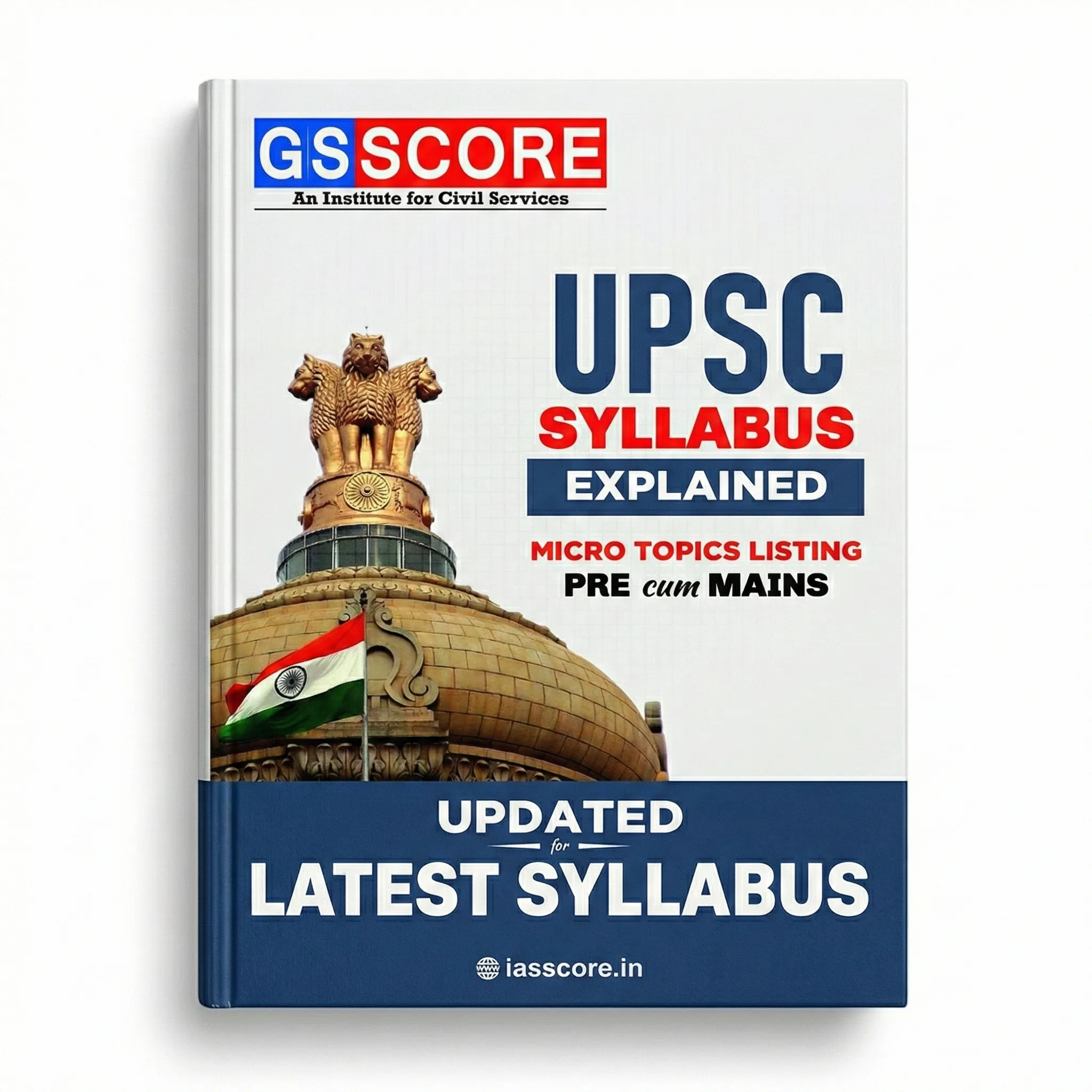
Read the NCERTs first for content, then layer pedagogy on top. If you want a single, current syllabus reference to keep beside your NCERTs, our GS Score Latest Syllabus Booklet is a handy way to see the full breakdown printed and organised.
Maths & Science vs Social Studies: Which Should You Choose?
This is the single biggest decision in CTET Paper 2, and most guides skip it. Your choice of Section IV must match the subject you are eligible and want to teach — it is not a free pick if you are being recruited for a specific post. Here is honest, background-based guidance.
| Your Graduation Background | Recommended Section IV | Why |
|---|---|---|
| B.Sc / B.Tech / Maths or Science graduate | Mathematics & Science | Content overlaps your degree; scoring is faster |
| B.A (History/Pol Sci/Geography/Economics) | Social Studies | Descriptive, memory-friendly, aligns with your subjects |
| B.Com / Commerce | Social Studies | Comfort with civics, economics-linked geography |
| B.A in languages / general | Social Studies (usually) | Less computation; conceptual reading suits you |
Key point for recruitment: KVS/NVS and state posts advertise subject-specific vacancies (PGT/TGT Maths, Science, Social Science). Choose the Section IV that matches the vacancy you plan to apply for, otherwise your CTET subject may not align with the teaching post. When in doubt, pick the group closest to your graduation subject — it minimises new learning and maximises your accuracy.
CTET Paper 2 Previous-Year Weightage & High-Return Topics
Prioritising by weightage is how toppers save 4–6 weeks. Based on recent CTET papers, here is where the marks concentrate so you know what to study first.
| Section | High-Weightage Areas | Approx. Repeat Value |
|---|---|---|
| Child Development & Pedagogy | Piaget/Vygotsky/Kohlberg, inclusive education, CCE & assessment, motivation | Very high — theories repeat yearly |
| Language I & II | Comprehension passages, language acquisition vs learning, grammar | High — 12–15 marks from passages alone |
| Mathematics | Number system, mensuration, data handling; error analysis pedagogy | High |
| Science | Natural phenomena, moving things, food & materials | Medium–high |
| Social Science — History | Ancient/medieval kingdoms, national movement | High (20/60) |
| Social Science — Pedagogy | Sources, project work, critical thinking, evaluation | High (20/60) |
The clear takeaway: pedagogy inside every subject is where the exam is decided. Around 40% of Section IV and 100% of the CDP paper is pedagogy. Aspirants who master content but ignore “how to teach” questions routinely miss the 90-mark cut-off. Solving topic-wise previous-year questions is the fastest route to spotting these patterns — the discipline of PYQ-based prep in resources like the Forum IAS Topic-Wise PYQ Toolkit shows exactly how repeat-analysis sharpens accuracy in any competitive exam.
CTET Paper 1 vs Paper 2 Syllabus: Key Differences
A common People-Also-Ask query is how the two papers differ. The structure (150 marks, 5 sections, CDP + two languages) is identical, but the level and subject content differ.
| Aspect | CTET Paper 1 | CTET Paper 2 |
|---|---|---|
| Teaching level | Classes 1–5 (primary) | Classes 6–8 (upper primary) |
| CDP age focus | 6–11 years | 11–14 years |
| Section IV | Mathematics (30) + EVS (30) — both compulsory | Maths & Science (60) OR Social Studies (60) — choice |
| Content depth | Class 1–5 NCERT level | Class 6–8 NCERT level (higher) |
| Best for | Primary teachers | Subject/TGT-level teachers |
CTET Paper 2 Qualifying Marks by Category
Clearing CTET Paper 2 is pass/fail against a fixed cut-off — there is no percentile or normalisation. You need 60% overall, and CBSE gives documented relaxation to reserved categories. The table below shows the widely applied thresholds; the marks required are on the full 150-mark paper, not per section.
| Category | Qualifying % | Marks (out of 150) |
|---|---|---|
| General / Unreserved | 60% | 90 |
| SC / ST | ~55% (as relaxed by CBSE) | ~82 |
| OBC (NCL) | ~55% (as relaxed by CBSE) | ~82 |
| PwD / Differently-abled | ~55% (as relaxed by CBSE) | ~82 |
Two things aspirants often miss: there is no separate sectional cut-off — only your aggregate matters — and the certificate is now valid for a lifetime, so a single qualifying attempt keeps you eligible for future recruitment cycles. State governments and recruiting bodies may add their own relaxation, so always confirm the exact percentage in the official notification you are applying against.
CTET Paper 2 Preparation Strategy, Timetable & Best Books
With the syllabus mapped, here is a practical 90-day study plan and the resources that fit each section.
| Phase | Weeks | Focus |
|---|---|---|
| Foundation | 1–4 | Read NCERT Classes 6–8 for your Section IV; start CDP theories |
| Pedagogy build-up | 5–8 | Finish CDP, subject pedagogy, both language pedagogy; daily comprehension |
| Practice | 9–11 | Topic-wise PYQs, sectional tests, weightage revision |
| Full mocks | 12–13 | 2–3 full 150-mark mocks weekly, error log, final revision |
Which book is best for CTET Paper 2 preparation?
Start with NCERT Classes 6–8 for content — they are non-negotiable and cover 80% of Section IV directly. Add a standard CDP guide (many aspirants use Arihant, Disha or Wiley’s CTET series), a language grammar reference for your chosen languages, and a large bank of previous-year papers. General awareness and current-affairs reading also helps in language passages and Social Science; keeping up with a monthly digest such as the Vision IAS Current Affairs Magazine builds the reading stamina and background knowledge that comprehension and civics questions reward.
Common mistakes to avoid
- Ignoring pedagogy and over-studying content — pedagogy decides the cut-off.
- Choosing Language II carelessly — pick a language you are genuinely comfortable reading.
- Skipping NCERT and jumping to guidebooks — questions are NCERT-rooted.
- Not timing mocks — 150 questions in 150 minutes needs a steady 1-minute pace.
- Leaving questions blank — there is no negative marking, so attempt all 150.
CTET Paper 2 vs State TETs & NEP-Aligned Updates
Many states run their own TET (UPTET, REET, HTET, MPTET, etc.). The subject structure is broadly similar — CDP, languages and subject groups — but CTET is valid across Central schools nationwide, while a state TET is generally valid within that state. The CTET syllabus is aligned with the NCF and the NEP 2020 emphasis on competency-based, child-centred learning; expect more application, case-let and pedagogy-heavy questions rather than rote recall. Always confirm the exact section structure from the latest official CBSE notification before you finalise your plan, as CBSE periodically refines the assessment style.
CTET Paper 2 Syllabus 2026 PDF Download
The official, current CTET Paper 2 syllabus is published in the CBSE CTET Information Bulletin on the official portal ctet.nic.in. To get the free CTET Paper 2 syllabus 2026 PDF download, open the latest information bulletin on ctet.nic.in and go to the syllabus annexure, which lists all five sections subject-wise exactly as detailed above. We recommend downloading it directly from ctet.nic.in so you always have the most current, un-gated version rather than an outdated third-party copy. Print it, keep it beside your NCERTs, and tick off each topic as you finish it.
Frequently Asked Questions
What is the syllabus of CTET Paper 2?
The CTET Paper 2 syllabus has five sections: Child Development & Pedagogy (30 marks), Language I (30), Language II (30), and either Mathematics & Science (60) or Social Studies/Social Science (60). Every subject includes a large pedagogy component based on the NCERT Classes 6–8 curriculum.
How many subjects are there in CTET Paper 2?
There are effectively four scoring areas: Child Development & Pedagogy, two languages, and one subject group (Maths & Science or Social Studies). Since the fifth section is a choice, a candidate studies four sections in total for 150 marks.
Is Maths and Science compulsory in CTET Paper 2?
No. Mathematics & Science is compulsory only for those who intend to teach Maths/Science. Candidates teaching Social Studies choose the Social Studies/Social Science section instead. You attempt only one of the two 60-mark groups.
How many questions come from each section in CTET Paper 2?
Child Development & Pedagogy has 30 questions, Language I has 30, Language II has 30, and the chosen subject group (Maths & Science or Social Studies) has 60 — a total of 150 questions for 150 marks.
What is the difference between CTET Paper 1 and Paper 2 syllabus?
Both papers share the same structure — 150 marks, CDP, two languages and a subject section. The difference is level and content: Paper 1 targets Classes 1–5 with CDP focused on ages 6–11 and a compulsory Mathematics + EVS section, while Paper 2 targets Classes 6–8 with CDP focused on ages 11–14 and a choice between Maths & Science or Social Studies. Paper 2 content is drawn from the higher Class 6–8 NCERT level.
Is there negative marking in CTET Paper 2?
No, there is no negative marking in CTET Paper 2. Each correct answer earns 1 mark and wrong answers carry no penalty, so you should attempt all 150 questions.
What are the qualifying marks for CTET Paper 2?
General category candidates must score at least 60% (90 out of 150). Reserved categories (SC/ST/OBC/PwD) receive relaxation as per CBSE norms, typically around 55% (about 82 marks). There is no sectional cut-off, and the CTET certificate is valid for a lifetime.
Which book is best for CTET Paper 2 preparation?
No single book is enough. Build content from NCERT Classes 6–8 for your subject section, add a well-reviewed CDP and pedagogy guide (Arihant, Disha or Wiley are popular), keep a grammar reference for both your languages, and practise from a large topic-wise previous-year question bank. Pair this with regular current-affairs reading to strengthen comprehension and Social Science.
Recommended Study Material


Continue Reading
SSC Selection Post Syllabus 2026: Phase 14 Pattern + PDF
The ssc selection post syllabus covers four sections — General Intelligence, General Awareness, Quantitative Aptitude and English Language…
UPSC Previous Year Question Papers (2014-2024): PDF Free Download with Answers
UPSC previous year question papers are the single most reliable resource for cracking the Civil Services Examination —…
Best Sociology Optional Books for UPSC 2026: Paper-Wise Topper Booklist
The best sociology optional books for UPSC are a short, curated set: Haralambos & Holborn and Giddens' Sociology…