Best Sociology Optional Books for UPSC 2026: Paper 1 & 2
The best sociology optional books for UPSC in 2026 — Paper 1 & Paper 2 booklist, NCERTs, Nitin Sangwan, toppers' picks, tables & a beginner buy-first list.

The best sociology optional books for UPSC are the two NCERTs (Class 11 Introducing Sociology and Class 12 Indian Society) for the foundation, Haralambos & Holborn plus Anthony Giddens and Francis Abraham for Paper 1 theory, and M.N. Srinivas, A.R. Desai and Yogendra Singh for Paper 2 Indian society — all consolidated by Essential Sociology by Nitin Sangwan. You do not need all fifteen titles; a serious aspirant should buy 4–5 core books first, master them through repeated revision, and use the rest only as reference.
Sociology is one of the most popular optionals in the UPSC Civil Services Examination because its syllabus is short, overlaps with GS Paper 1 and Essay, and rewards conceptual clarity over rote memory. But the biggest mistake aspirants make is buying a fifteen-book “library” and finishing none of it. This guide gives you a curated, paper-wise sociology optional booklist for UPSC Paper 1 and Paper 2, maps every book to its syllabus unit, tells you exactly which 4–5 books a beginner should buy first, and shows where current affairs and answer-writing fit in.
Why Sociology Optional and How These Books Fit
Sociology optional carries 500 marks (two papers of 250 marks each) in UPSC Mains. Paper 1 is the “Fundamentals of Sociology” — Western thinkers, concepts and research methods — while Paper 2 is “Indian Society: Structure and Change.” The reading strategy differs sharply between the two: Paper 1 demands you understand thinkers like Marx, Weber and Durkheim in their own words, whereas Paper 2 rewards familiarity with Indian sociologists and the ability to link classical concepts to contemporary events.
That is why a smart sociology optional books for UPSC by toppers list is never a flat dump of titles. It is layered: NCERT foundation first, then one primary book per topic, one supplementary book for depth, and a consolidated ready-reference to tie it together. The sections below build exactly that layered library.
Sociology Optional NCERT Books for UPSC: The Foundation
Before touching any advanced text, build your base with NCERTs. These are free, syllabus-aligned, written in plain language, and they seed the vocabulary you will use for the next two years. Read them once cover to cover, make short notes, and only then move to standard books.
| NCERT Book | Class | Best For | Paper Link |
|---|---|---|---|
| Introducing Sociology | Class 11 | Basic concepts, terms, sociology as a discipline | Paper 1 |
| Understanding Society | Class 11 | Social institutions, structure, methods | Paper 1 & 2 |
| Indian Society | Class 12 | Demography, caste, kinship, communalism | Paper 2 |
| Social Change and Development in India | Class 12 | Rural/urban change, globalisation, movements | Paper 2 |
These four sociology optional NCERT books for UPSC cover roughly 20–25% of the vocabulary you need for Paper 2 directly, and they make the heavier theory books far easier to digest. Aspirants who skip NCERTs and jump straight to Haralambos routinely find the terminology overwhelming.
Best Books for Sociology Optional UPSC Paper 1 (Theory & Thinkers)
Paper 1 is theory-heavy. Your goal here is conceptual mastery of the founding thinkers and the major perspectives — functionalism, conflict theory, symbolic interactionism — plus research methods. The following are the standard reference books for Paper 1.
| Book | Author | Use It For | Tag |
|---|---|---|---|
| Sociology: Themes and Perspectives | Haralambos & Holborn | All-round perspectives, most topics | Must-read |
| Introduction to Sociology | Anthony Giddens | Modernity, contemporary concepts | Must-read |
| Sociological Thought | Francis Abraham | Marx, Weber, Durkheim, Parsons | Must-read |
| Sociological Theory | George Ritzer | Deep thinker analysis, advanced | Supplementary |
| Oxford Dictionary of Sociology | John Scott | Precise definitions, quick reference | Reference |
| An Introduction to Political Theory | O.P. Gauba | Power, state, ideology (for thinkers) | Optional |
Which Book Is Best for Sociology Paper 1?
If you buy only one, buy Haralambos & Holborn’s Themes and Perspectives — it covers the widest range of Paper 1 topics with balanced perspectives. Pair it with Francis Abraham’s Sociological Thought for the founding thinkers, and use Giddens for modernity and contemporary debates. Ritzer is excellent but dense; treat it as a supplement for topics where you want extra depth on a specific theorist rather than a first read.
Source-Wise Mapping: Paper 1 Topics to Books
This is the mapping most booklists never give you — exactly which book to open for which syllabus unit.
| Paper 1 Syllabus Unit | Primary Book | Supplement |
|---|---|---|
| Sociology as a discipline; science & methods | Haralambos + NCERT Cl.11 | Ritzer |
| Karl Marx (class, alienation) | Francis Abraham | Ritzer |
| Max Weber (bureaucracy, authority) | Francis Abraham | Ritzer |
| Emile Durkheim (division of labour, religion) | Francis Abraham | Haralambos |
| Talcott Parsons & Merton (functionalism) | Ritzer / Abraham | Haralambos |
| Work, economy, politics, religion | Haralambos | Giddens |
| Social stratification & mobility | Haralambos | Giddens |
Best Books for Sociology Optional UPSC Paper 2 (Indian Society)
Paper 2 is about India — its social structure, change, movements and contemporary challenges. Here Indian sociologists dominate, and the ability to connect concepts to current affairs is what separates a 130+ score from an average one. These are the essential Paper 2 standard reference books.
| Book | Author | Use It For | Tag |
|---|---|---|---|
| Social Change in Modern India | M.N. Srinivas | Sanskritisation, Westernisation, dominant caste | Must-read |
| Social Background of Indian Nationalism | A.R. Desai | Nationalism, Marxist reading of India | Must-read |
| Modernization of Indian Tradition | Yogendra Singh | Theory of change in India | Must-read |
| Indian Society / Caste | Nadeem Hasnain / Ram Ahuja | Caste, tribe, kinship, structure | Supplementary |
| Social Movements in India | Ghanshyam Shah | Peasant, dalit, tribal, women’s movements | Must-read |
| Rural Sociology in India | Doshi & Jain | Agrarian structure, land reforms | Supplementary |
| Selected essays | Veena Das | Contemporary Indian sociology | Reference |
Source-Wise Mapping: Paper 2 Topics to Books
| Paper 2 Syllabus Unit | Primary Book | Supplement |
|---|---|---|
| Caste system & changes | M.N. Srinivas | Nadeem Hasnain |
| Agrarian structure & land reforms | Doshi & Jain | A.R. Desai |
| Kinship, family, marriage | Nadeem Hasnain | NCERT Cl.12 |
| Tribal communities | Nadeem Hasnain | Ghanshyam Shah |
| Social movements (dalit, peasant, women) | Ghanshyam Shah | Current affairs |
| Modernisation & westernisation | Yogendra Singh | M.N. Srinivas |
| Rural & urban transformation | Social Change & Development NCERT | Doshi & Jain |
Is Nitin Sangwan’s Essential Sociology Enough for UPSC?
Essential Sociology by Nitin Sangwan is the single most recommended consolidated book for sociology optional, because it covers both Paper 1 and Paper 2 in one place, in exam-oriented language, with diagrams and answer-friendly structuring. It is essential Sociology Nitin Sangwan for UPSC in the truest sense — many toppers use it as their spine and the standard books only for depth.
Is it enough on its own? Almost, but not quite. Use it as your primary revision and answer-writing resource, but read Haralambos, Francis Abraham and M.N. Srinivas at least once for the depth and original arguments that fetch marks in the actual exam. Think of Sangwan as the trunk and the standard books as the branches. Relying only on a consolidated book without ever touching a thinker’s original argument is the most common reason answers stay generic and score 110–120 instead of 140+.
The Beginner Booklist: Which 4–5 Books to Buy First
This is the gap almost every top-ranking page misses. A fresher does not need fifteen books on day one — that only guarantees paralysis. Here is the exact best sociology optional book for beginners sequence, in the order you should buy and read.
| Order | Book | Why First | Approx. Time |
|---|---|---|---|
| 1 | NCERT Cl.11 & 12 (all four) | Foundation vocabulary | 2–3 weeks |
| 2 | Nitin Sangwan – Essential Sociology | Whole syllabus overview, both papers | 4–5 weeks |
| 3 | Haralambos – Themes & Perspectives | Paper 1 theory depth | 4–6 weeks |
| 4 | Francis Abraham – Sociological Thought | Founding thinkers | 3 weeks |
| 5 | M.N. Srinivas – Social Change in Modern India | Paper 2 Indian society core | 2–3 weeks |
Master these five, add Yogendra Singh, A.R. Desai and Ghanshyam Shah in the second reading, and treat Ritzer, John Scott’s dictionary and Veena Das as pure reference. Beginners who follow this sequence typically finish the first full pass in 3–4 months, leaving ample time for revision and answer writing.
How Many Books Should You Read for Sociology Optional?
The honest answer: 5–6 books read four times beat 15 books read once. Limit yourself to one primary and one supplementary book per topic. The core principle of scoring in sociology is depth of understanding and repeated revision, not the number of sources. Aspirants who chase every recommended title rarely complete even the syllabus, let alone revise it.
| Preparation Stage | Books to Use | Focus |
|---|---|---|
| Foundation (Month 1) | NCERTs + Sangwan | Concepts, vocabulary |
| Core (Months 2–4) | Haralambos, Abraham, Srinivas, Y. Singh | Depth, thinkers |
| Enrichment (Months 5–6) | Desai, G. Shah, Ram Ahuja + current affairs | Case studies, links |
| Revision + Answers | Sangwan + own notes + PYQs | Writing, recall |
Printed Notes vs Books, PDF vs Hardcopy, and Where to Buy
Standard textbooks build understanding, but structured printed notes save enormous time during revision and answer writing — they are already organised syllabus-wise, with diagrams, thinker quotes and answer frameworks. Most toppers use a blend: standard books for the first read, and consolidated printed notes for the second read onwards.
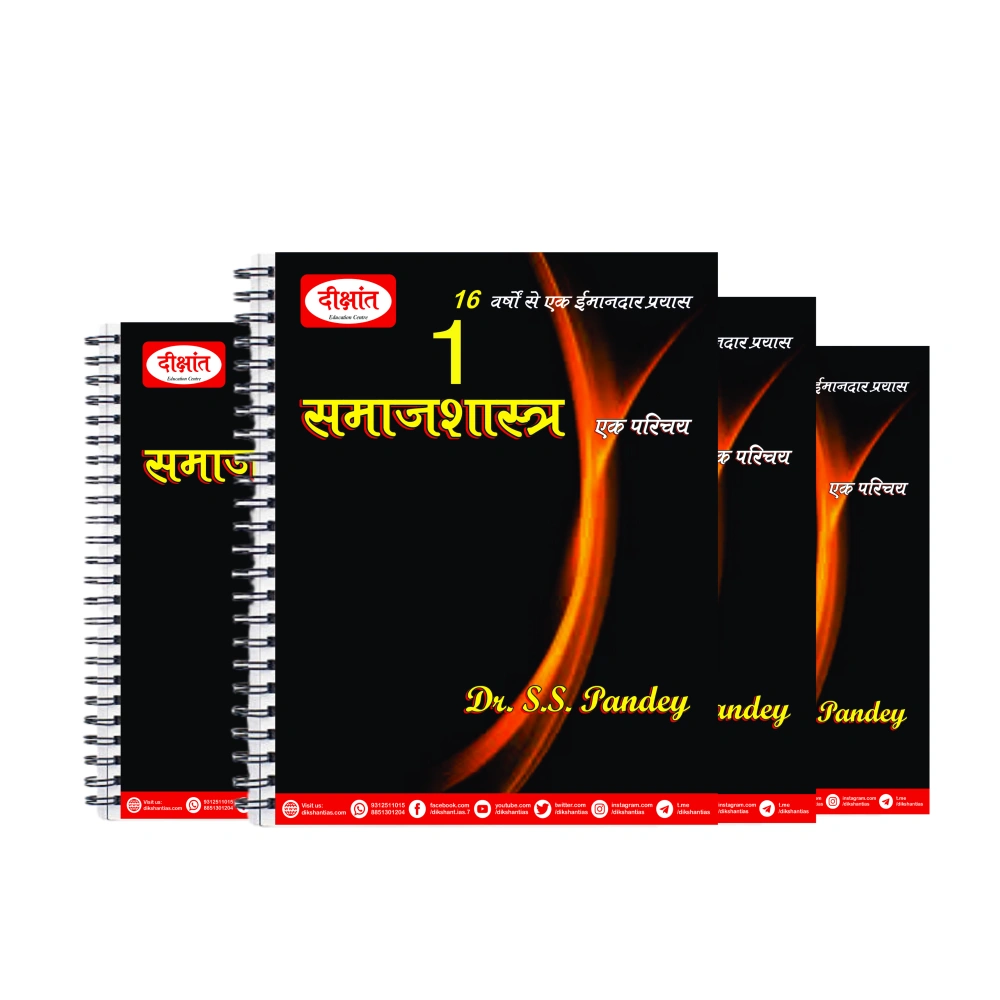
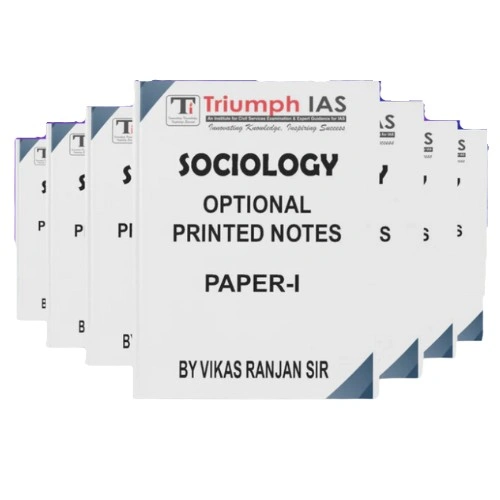
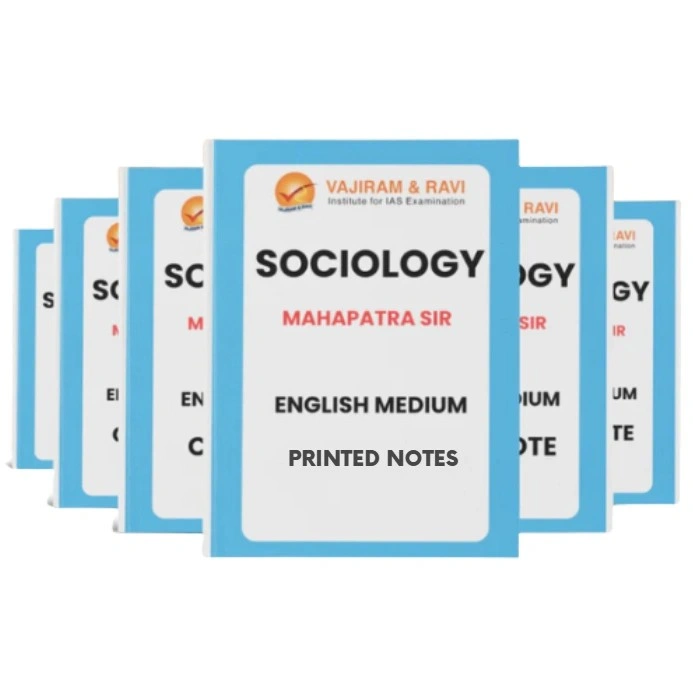
On Competer you can get sociology optional printed material delivered anywhere in India. Popular sets include the SS Pandey Sociology Notes (25 modules, 4 booklets), the Vikash Ranjan Sociology Notes from Triumph IAS (7 booklets), and the Mahapatra Sir Sociology Notes (6 booklets). These are syllabus-mapped and pair well with the standard books above.
| Format | Best For | Trade-off |
|---|---|---|
| Standard textbooks | First read, depth, original arguments | Bulky, slower to revise |
| Printed notes | Revision, answer frameworks, speed | Should not fully replace books |
| PDF / soft copy | Quick search, portability | Screen fatigue, harder to annotate |
| Hardcopy | Deep reading, retention, notes-making | Cost, storage |
Value-for-money tip: buy NCERTs and one thinker book new, and invest in one good consolidated notes set rather than duplicating five overlapping guides.
Current Affairs and Answer Enrichment for Paper 2
Paper 2 is where current affairs decides your marks. Questions on caste violence, farmers’ movements, women’s issues, migration, secularism and social media are all drawn from recent events — and examiners expect you to link a classical concept to a current example. This is exactly why a monthly sociology-oriented current-affairs habit matters.
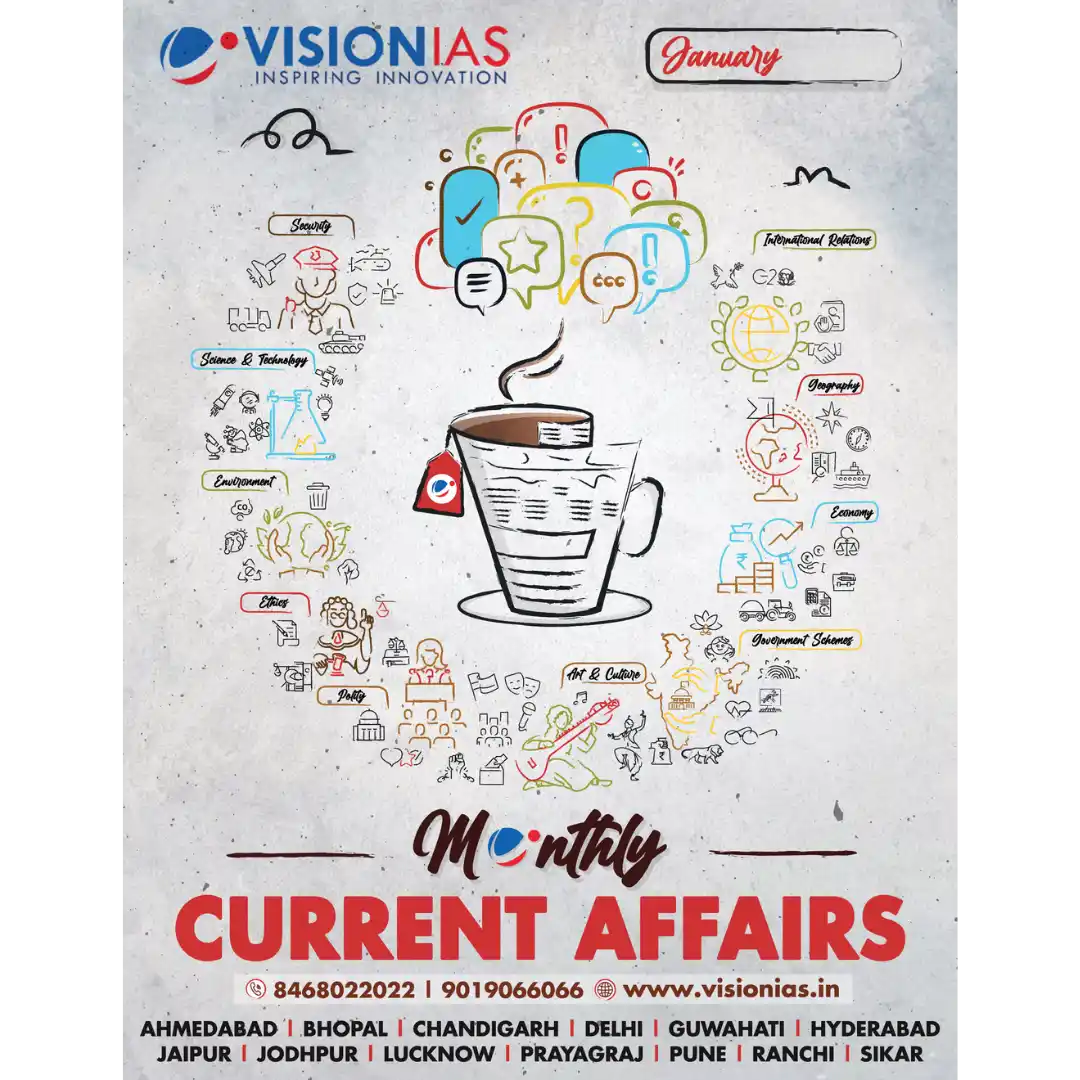
Maintain a running note of society-related news from a monthly magazine such as the Vision IAS Current Affairs Magazine (January 2026) or the December 2025 edition, and tag each item to a syllabus theme (caste, gender, tribe, kinship, work). For answer enrichment, keep a bank of sociologist quotes and named thinkers — citing Srinivas on caste, Durkheim on religion, or Beteille on inequality instantly lifts an answer above the generic.
Toppers’ Booklists and Selection Criteria
Sociology has produced consistent high scorers — many rank-holders in the top 100 have scored 300+ out of 500 in the optional. Their booklists are strikingly lean: NCERTs, Sangwan or IGNOU material, Haralambos, one thinker book, M.N. Srinivas and Yogendra Singh, plus their own current-affairs register. The pattern is always fewer sources, more revisions.
When choosing any book, apply four selection criteria: pick the latest edition (syllabus and examples stay current), confirm it is syllabus-aligned, prefer established authors and publishers, and cross-check with teacher or topper recommendations. Avoid unknown guides that promise to “cover everything” — breadth without depth does not score.
| Criterion | Why It Matters |
|---|---|
| Latest edition | Updated data, current examples for Paper 2 |
| Syllabus-aligned | No wasted reading on off-syllabus content |
| Established author/publisher | Reliable arguments you can cite |
| Teacher/topper recommended | Proven exam relevance |
How to Prepare Sociology Optional Without Coaching
Sociology is among the most self-study-friendly optionals, and thousands clear it without coaching. Start with NCERTs, move to Nitin Sangwan and Haralambos, make crisp syllabus-wise notes in your own words, and begin answer writing early with previous year questions (PYQs). Solve at least ten years of PYQs, get your answers reviewed if possible, and revise your consolidated notes repeatedly. Add a monthly current-affairs note for Paper 2 and a personal quote bank, and you have a complete no-coaching plan. Discipline in revision matters far more than any coaching brand.
Is Sociology Optional Easy to Score in UPSC?
Sociology is considered relatively scoring because the syllabus is short, the language is intuitive, it overlaps with GS Paper 1, Essay and Ethics, and it needs no prior academic background. That said, “easy” does not mean automatic marks — the difference between an average and a top score is diagrammatic answers, thinker citations and current-affairs linkage. With the right lean booklist, disciplined revision and consistent answer practice, a well-prepared aspirant can realistically target 260–300+ out of 500.
Frequently Asked Questions
Which books are best for sociology optional in UPSC?
The best sociology optional books for UPSC are the NCERTs (Class 11 and 12), Nitin Sangwan’s Essential Sociology as a consolidated read, Haralambos & Holborn and Francis Abraham for Paper 1 theory, and M.N. Srinivas, A.R. Desai and Yogendra Singh for Paper 2 Indian society. Read 5–6 core books thoroughly rather than collecting fifteen.
Is NCERT enough for sociology optional?
No, NCERTs are not enough on their own — they build the foundation and vocabulary but do not offer the depth needed for 250-mark Mains papers. Use the four sociology NCERTs as a starting point, then move to standard books and a consolidated guide like Nitin Sangwan for exam-level understanding.
Is Nitin Sangwan’s Essential Sociology enough for UPSC?
Essential Sociology by Nitin Sangwan is an excellent consolidated book covering both papers and is enough as your primary revision and answer-writing resource. However, read Haralambos, Francis Abraham and M.N. Srinivas at least once for the depth and original arguments that fetch higher marks.
How many books should I read for sociology optional?
Read only 5–6 core books and revise them four or five times. Limit yourself to one primary and one supplementary book per topic. Depth of understanding and repeated revision score far more than the number of sources, and too many books usually mean an unfinished syllabus.
Which is the best sociology optional book for beginners?
Beginners should start with the Class 11 and 12 NCERTs, then Nitin Sangwan’s Essential Sociology for a full-syllabus overview, followed by Haralambos for Paper 1 and M.N. Srinivas for Paper 2. This sequence builds concepts gradually without overwhelming a fresher.
Is sociology optional easy to score in UPSC?
Sociology is relatively scoring because of its short, intuitive syllabus and overlap with GS and Essay. High scores still require diagrammatic answers, thinker citations and current-affairs linkage. With a lean booklist, disciplined revision and answer practice, 260–300+ out of 500 is achievable.
Recommended Study Material
Continue Reading
Anthropology Optional Syllabus 2026: Paper 1 & 2 + PDF
The anthropology optional syllabus for UPSC CSE Mains is divided into two papers of 250 marks each, totalling…

SBI PO Syllabus 2026: Prelims, Mains, Pattern & PDF
The SBI PO syllabus covers three subjects in Prelims — English Language, Quantitative Aptitude and Reasoning Ability —…
UPSC Prelims Syllabus 2026: GS & CSAT Topics, Pattern + PDF
Short answer: the upsc prelims syllabus has two papers — General Studies Paper I (100 questions, 200 marks)…