IBPS PO Syllabus 2026: Prelims & Mains Pattern + PDF
IBPS PO syllabus 2026 explained — subject-wise Prelims & Mains topics, exam pattern, marks, negative marking, weightage and a free PDF study plan.

The IBPS PO syllabus covers three subjects in Prelims (English Language, Quantitative Aptitude and Reasoning Ability) and five components in Mains (Reasoning & Computer Aptitude, Data Analysis & Interpretation, General/Economy/Banking Awareness, English Language, and a Descriptive test of essay and letter writing). Selection runs across three stages — Prelims, Mains and Interview — with 0.25 negative marking on every wrong objective answer, and the final merit list is prepared in an 80:20 ratio of Mains to Interview marks.
This guide breaks down the complete, subject-wise ibps po syllabus 2026 with the latest exam pattern, marks, timing, high-weightage topics, last-year question trends, a ready-to-follow 90-day study plan, a printable checklist, and a free one-click PDF option — everything you need to plan preparation without hopping across ten coaching pages.
IBPS PO Syllabus 2026 at a Glance (Quick Answer)
Short on time? Here is the entire ibps po syllabus and pattern in one snapshot before we go deep.
| Key Point | Details |
|---|---|
| Stages | Prelims → Mains → Interview |
| Prelims subjects | English, Quantitative Aptitude, Reasoning (100 marks, 60 min) |
| Mains subjects | Reasoning & Computer Aptitude, Data Analysis & Interpretation, GA/Economy/Banking, English + Descriptive (225 marks) |
| Descriptive paper | Yes — 1 essay + 1 letter, 25 marks, 30 min |
| Negative marking | 0.25 per wrong objective answer (Prelims & Mains) |
| Final merit | Mains 80% + Interview 20% (Prelims not counted) |
| Medium | English & Hindi (English section in English only) |
Everything below expands each of these points with the exact section-wise pattern, topic lists, weightage and a study plan. Always cross-check final marks and dates against the official IBPS notification when it is released.
IBPS PO 2026: Exam Overview & Selection Process
The Institute of Banking Personnel Selection (IBPS) conducts the Probationary Officer (PO) / Management Trainee (MT) exam every year to recruit officers for participating public sector banks. The Common Recruitment Process (CRP PO/MT) is fully online (computer-based) and runs in three sequential stages. You must clear each stage to move to the next; only Mains and Interview scores count towards final selection.
| Stage | Mode | Nature | Counts in Final Merit? |
|---|---|---|---|
| Preliminary Exam | Online objective | Qualifying / screening | No |
| Main Exam | Online objective + descriptive | Merit-deciding | Yes (80%) |
| Interview | Offline, in person | Merit-deciding | Yes (20%) |
Key facts to lock in before you start: the exam is conducted in English and Hindi (except the English section), there is a negative marking of 0.25 marks for every wrong answer in objective papers, and each section carries a separate qualifying cut-off. IBPS typically releases the official notification around July–August, with Prelims around October and Mains in November. Treat these as indicative windows and confirm exact dates from the official IBPS notification when it drops.
IBPS PO Exam Pattern 2026 (Prelims + Mains)
Understanding the ibps po exam pattern 2026 is the first step to reading the syllabus correctly — it tells you how many questions come from each topic, how much time you get, and where the marks sit. The Prelims is a fast, sectional-timed screening test; the Mains is a deeper, marks-heavy paper with an added descriptive component.
IBPS PO Prelims Exam Pattern
The ibps po prelims syllabus is tested across three sections in 60 minutes, with a strict 20-minute sectional time limit — you cannot return to a section once its clock runs out.
| Section | Questions | Marks | Medium | Time |
|---|---|---|---|---|
| English Language | 30 | 30 | English | 20 min |
| Quantitative Aptitude | 35 | 35 | English/Hindi | 20 min |
| Reasoning Ability | 35 | 35 | English/Hindi | 20 min |
| Total | 100 | 100 | — | 60 min |
IBPS PO Mains Exam Pattern (2026)
The ibps po mains syllabus is tested through four objective sections plus a separate descriptive paper. The objective test carries 200 marks; the descriptive test carries 25 marks, taking the total to 225 marks.
| Section | Questions | Marks | Time |
|---|---|---|---|
| Reasoning & Computer Aptitude | 45 | 60 | 60 min |
| Data Analysis & Interpretation | 35 | 60 | 45 min |
| General / Economy / Banking Awareness | 40 | 40 | 35 min |
| English Language | 35 | 40 | 40 min |
| Objective Total | 155 | 200 | 180 min |
| Descriptive Test (Essay + Letter) | 2 | 25 | 30 min |
| Grand Total | 157 | 225 | 210 min |
Note: IBPS may fine-tune the exact question count or marks per section in the official notification. The structure above reflects the pattern used in recent cycles and is the safest basis for planning your 2026 preparation until the official notification confirms otherwise.
IBPS PO Prelims Syllabus 2026 (Subject-Wise)
The Prelims tests speed and accuracy on core banking-aptitude topics. Below is the complete ibps po subject wise syllabus for each Prelims section.
Quantitative Aptitude
This section rewards calculation speed and topic recognition. High-scoring areas are Data Interpretation, Simplification/Approximation, and the arithmetic word-problem cluster.
- Simplification & Approximation
- Number Series (missing & wrong-term)
- Quadratic Equations
- Data Interpretation (tabular, bar, line, pie, caselet)
- Percentage, Ratio & Proportion, Averages
- Profit & Loss, Discount
- Simple & Compound Interest
- Time, Speed & Distance; Boats & Streams; Trains
- Time & Work, Pipes & Cisterns
- Mensuration (2D & 3D)
- Mixtures & Alligation
- Permutation, Combination & Probability
- Partnership, Ages, Data Sufficiency
Reasoning Ability
Puzzles and seating arrangement dominate this section — expect 15–20 of the 35 marks from these alone. Master arrangement sets first.
- Puzzles (box, floor, scheduling, comparison)
- Seating Arrangement (linear, circular, square)
- Syllogism
- Inequality (coded & direct)
- Blood Relations
- Direction Sense
- Order & Ranking
- Coding-Decoding
- Alphanumeric & Number Series
- Data Sufficiency
- Input-Output (mostly Mains)
English Language
Reading Comprehension carries the biggest chunk; grammar-based error and improvement questions are the quickest to attempt.
- Reading Comprehension
- Cloze Test
- Para Jumbles / Sentence Rearrangement
- Error Detection / Spotting Errors
- Sentence Improvement
- Fill in the Blanks (single & double)
- Word Usage / Vocabulary
- Para Completion / Connectors
IBPS PO Mains Syllabus 2026 (Subject-Wise)
The Mains raises the difficulty and adds Computer Aptitude and deeper Banking/Economy awareness. Here is the complete ibps po mains syllabus, section by section.
Reasoning & Computer Aptitude
Reasoning: High-level puzzles & seating, input-output, coding-decoding (new pattern), logical reasoning (statement & assumption, cause & effect, course of action, syllogism), data sufficiency, blood relations, direction sense.
Computer Aptitude: History & generations of computers, hardware & software, input/output devices, operating systems, MS Office (Word, Excel, PowerPoint), internet & networking, database basics (DBMS), shortcut keys, computer abbreviations, and basic security (virus, firewall).
Data Analysis & Interpretation
- Advanced DI (tabular, missing, caselet, bar-line combos)
- Data Sufficiency
- Quantity comparison (Quantity I vs II)
- Number series & probability
- Arithmetic-based DI (P&L, interest, ratios embedded in charts)
General, Economy & Banking Awareness
This section is your fastest-to-score area if you revise well, and it directly overlaps with what you read for any banking exam. Focus on the last 6 months of current affairs plus static banking knowledge.
- Banking & financial awareness (RBI functions, monetary policy, repo/reverse repo, CRR, SLR)
- Types of banks, NPAs, Basel norms, priority sector lending
- Financial institutions & regulators (SEBI, IRDAI, NABARD, SIDBI)
- FinTech, UPI, digital banking, payment systems (NEFT, RTGS, IMPS)
- Government schemes (financial inclusion, Jan Dhan, MUDRA, insurance schemes)
- Union Budget & Economic Survey highlights
- National & international current affairs, awards, sports, summits
- Static GK (capitals, currencies, headquarters, important days)
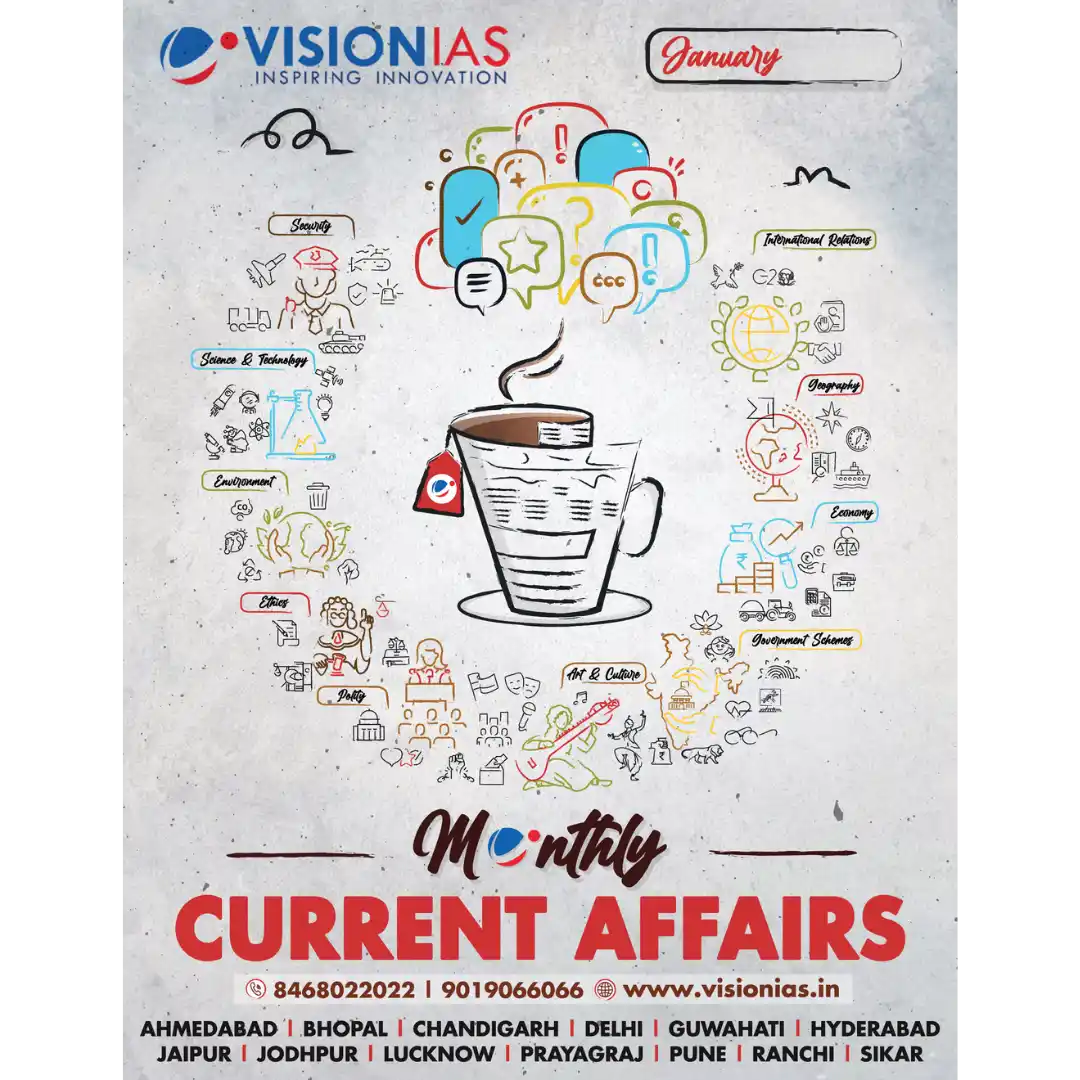
To build a strong economy and banking-awareness base, a concise economy resource such as the Vision IAS Economics Notes helps you understand RBI, fiscal-monetary concepts and budget terms in plain language, while a monthly digest like the Vision IAS Current Affairs Magazine (January 2026) keeps your GA section current.
English Language + Descriptive
Objective English: Reading Comprehension (business/economy passages), cloze test, para jumbles, error spotting, sentence rearrangement, vocabulary in context, and word/phrase replacement.
Descriptive (30 minutes, 25 marks): One essay and one letter, testing written English similar to the SBI PO descriptive test. Covered in detail below.
IBPS PO Descriptive Test: Essay & Letter Writing
The descriptive paper is where many candidates leave easy marks on the table. You type two answers in 30 minutes: a letter (formal or informal) and an essay, each around 150–200 words. Themes are drawn from banking, economy, technology, and social issues.
| Component | Word Limit | Sample Topics | Scoring Tips |
|---|---|---|---|
| Letter Writing | ~150 words | Complaint about a faulty ATM; request to upgrade to net banking; letter to editor on digital fraud | Correct format, clear purpose, polite tone, no grammatical slips |
| Essay Writing | ~200 words | Impact of UPI on cash economy; role of AI in banking; financial literacy in rural India | Intro-body-conclusion structure, 2–3 real examples, balanced view |
Practical tips: plan for one minute, write in short paragraphs, use simple correct sentences over complex risky ones, and always add a one-line conclusion. Even a clean, average-content answer scores well if the language is error-free.
IBPS PO Topic-Wise Weightage & Last-Year Trends
Knowing which topics actually appeared — and how often — lets you prioritise. The table below shows the approximate number of questions per key topic based on recent Prelims and Mains papers (2024–25). Numbers vary slightly by shift, but the priority order is stable.
| Subject | High-Weightage Topics | Approx. Questions |
|---|---|---|
| Quantitative Aptitude | Data Interpretation | 10–15 |
| Quantitative Aptitude | Arithmetic word problems | 8–10 |
| Quantitative Aptitude | Simplification / Number Series / Quadratic | 8–12 |
| Reasoning Ability | Puzzles & Seating Arrangement | 15–20 |
| Reasoning Ability | Syllogism / Inequality / Coding | 8–12 |
| English Language | Reading Comprehension | 8–12 |
| English Language | Cloze / Error / Para Jumbles | 10–15 |
| Mains GA | Current + Banking Awareness | 25–30 |
Which subject is most important for IBPS PO? There is no single “most important” subject because each has a sectional cut-off you must clear — but in terms of marks-per-hour, Reasoning (puzzles & seating) and Data Interpretation offer the highest return, while General/Banking Awareness in Mains is the biggest scoring opportunity relative to the time it takes to prepare. In short: you cannot skip any section, but you should invest your sharpest effort in DI, puzzles and GA.
Is the IBPS PO Syllabus & Pattern Changed for 2026?
A common worry among aspirants is whether the pattern has been overhauled. The honest answer: the core syllabus stays largely the same year to year. What IBPS occasionally adjusts is the Mains structure — the split of marks across the four objective sections and the exact question counts. For 2026, plan around the recent pattern shown above (200-mark objective test across four sections plus a 25-mark descriptive paper). Do not rebuild your strategy on rumours; the moment the official notification is out, verify the section marks and timing and adjust only if something has genuinely changed.
IBPS PO vs SBI PO vs IBPS Clerk vs RRB PO
Many aspirants prepare for several banking exams together. The good news: the core syllabus overlaps heavily, so smart preparation covers all of them. Here is how the ibps po syllabus compares.
| Feature | IBPS PO | SBI PO | IBPS Clerk | RRB PO (Officer Scale I) |
|---|---|---|---|---|
| Prelims sections | English, Quant, Reasoning | English, Quant, Reasoning | English, Quant, Reasoning | Reasoning, Quant (no English) |
| Descriptive test | Yes (Essay + Letter) | Yes (Essay + Letter) | No | No |
| Computer Aptitude | Yes (with Reasoning) | Yes | Basic | Yes (in Mains) |
| Interview | Yes | Yes (+ Group Exercise) | No | Yes (Scale I) |
| Overall difficulty | Moderate–High | High | Moderate | Moderate |
Is IBPS PO tougher than SBI PO? Generally, SBI PO is considered slightly tougher due to higher difficulty in reasoning/DI, the added Group Exercise in the interview stage, and steeper competition per vacancy. IBPS PO is moderate-to-high but more predictable, making it an excellent target if you have prepared the standard banking syllabus. Because the syllabi overlap so heavily, preparing well for one puts you in strong shape for the other.
IBPS PO Interview & Final Merit (80:20)
Candidates who clear Mains are called for an interview of 100 marks. You must score a minimum of 40% (35% for SC/ST/OBC/PwBD) to qualify. The final merit list combines Mains and Interview scores in an 80:20 weightage — Prelims marks are not added.
| Component | Weightage in Final Merit | Qualifying Requirement |
|---|---|---|
| Preliminary Exam | 0% (screening only) | Sectional + overall cut-off |
| Main Exam | 80% | Sectional + overall cut-off |
| Interview | 20% | Minimum 40% (35% reserved) |
Because Mains carries 80% of the final weight, your merit rank is essentially decided there. Treat the interview seriously — brush up on banking terms, current affairs, and your own bio-data — but invest the bulk of your effort in the Mains.
IBPS PO 90-Day Study Plan (Subject-Wise)
Most pages tell you to “prepare for 4–6 months” and stop there. Here is a concrete, topic-mapped 90-day plan you can start today. Adjust the pace to your baseline, but keep the sequence.
| Phase | Days | Focus |
|---|---|---|
| Foundation | 1–30 | Quant basics (percentage, ratio, arithmetic), Reasoning (inequality, syllogism, puzzles intro), English grammar rules; start daily current affairs |
| Skill-Building | 31–60 | Data Interpretation, advanced puzzles & seating, RC practice, Computer Aptitude, banking & economy awareness; begin sectional tests |
| Test & Revision | 61–80 | Full-length Prelims + Mains mocks, error analysis, speed drills, descriptive essay/letter practice twice a week |
| Peak | 81–90 | Daily mocks, revise formula & GA notes, current-affairs of last 6 months, mock interviews for later |
How many months are enough to prepare for IBPS PO? A dedicated 4–6 months (this 90-day plan plus a buffer) is enough for most graduates. Working professionals should stretch to 6 months at 2–3 focused hours a day, prioritising DI, puzzles and GA. If you are starting from a weak base in maths or English, add an extra month of foundation before beginning the 90-day cycle.
Best Books & Resources Mapped to the Syllabus
Map your resources to the syllabus so nothing is left uncovered:
- Quant: A standard quantitative aptitude book for concepts + previous-year DI sets for speed.
- Reasoning: A dedicated reasoning book for puzzles/seating, plus daily online puzzle practice.
- English: A grammar handbook + daily editorial reading for RC and vocabulary.
- Banking & Economy Awareness: Build the static base with the Vision IAS Economics Notes and stay current with the Vision IAS Current Affairs Magazine (December 2025) and January 2026 edition for the latest banking, budget and economy updates.
- Descriptive: Practice one essay + one letter every week and get feedback on structure and grammar.
IBPS PO Syllabus PDF Download & One-Page Checklist
You can save the entire syllabus above as an ibps po syllabus pdf download for offline planning — use your browser’s Print → “Save as PDF” on this page to get a clean, ad-light copy with the exam pattern tables, subject-wise topics and the 90-day plan all in one file. No sign-up, no app install.
Use this printable checklist to tick off topics as you finish them:
| Subject | Must-Finish Topics | Done? |
|---|---|---|
| Quant | DI, Arithmetic, Simplification, Number Series, Quadratic | ☐ |
| Reasoning | Puzzles, Seating, Syllogism, Inequality, Coding | ☐ |
| English | RC, Cloze, Para Jumbles, Error Detection | ☐ |
| Computer Aptitude | Hardware/Software, MS Office, Networking, Security | ☐ |
| GA / Banking | RBI, Monetary Policy, Schemes, Budget, Current Affairs | ☐ |
| Descriptive | 5 Essays + 5 Letters practised | ☐ |
Common Mistakes to Avoid
- Ignoring sectional cut-offs — clearing overall but failing one section rejects you.
- Attempting too many questions and triggering the 0.25 negative marking.
- Leaving the descriptive test to the last week — it is 25 easy marks.
- Cramming static GA and skipping the last-6-months current affairs.
- Doing endless theory without full-length mocks and error analysis.
- Neglecting Computer Aptitude, which is quick and high-accuracy in Mains.
- Rebuilding your plan on unverified “pattern change” rumours instead of the official notification.
Frequently Asked Questions
What is the syllabus of IBPS PO 2026?
The IBPS PO 2026 syllabus has two exam stages. Prelims covers English Language, Quantitative Aptitude and Reasoning Ability. Mains covers Reasoning & Computer Aptitude, Data Analysis & Interpretation, General/Economy/Banking Awareness, English Language, and a descriptive test with essay and letter writing.
Is the IBPS PO syllabus and pattern changed for 2026?
The core syllabus remains largely the same. IBPS periodically revises the Mains structure — for 2026, expect the objective test to carry around 200 marks across four sections plus a 25-mark descriptive test. Always confirm exact marks and timing from the official IBPS notification.
Is there negative marking in the IBPS PO exam?
Yes. There is a negative marking of 0.25 marks for every wrong answer in all objective sections of both Prelims and Mains. There is no negative marking for unattempted questions or for the descriptive test.
Which subject is most important for IBPS PO?
Every subject has a sectional cut-off, so none can be skipped. However, Reasoning (puzzles and seating) and Data Interpretation give the highest marks per hour of study, and General/Banking Awareness in Mains is the biggest scoring opportunity relative to preparation time — making these the smartest areas to prioritise.
Is IBPS PO tougher than SBI PO?
SBI PO is generally considered slightly tougher because of harder reasoning/DI, an added Group Exercise in the interview, and steeper competition. IBPS PO is moderate-to-high in difficulty but more predictable. Since the syllabi overlap heavily, preparing for one keeps you ready for the other.
What is the difference between IBPS PO Prelims and Mains syllabus?
Prelims tests three basic sections (English, Quant, Reasoning) for screening only. Mains is deeper and adds Computer Aptitude, dedicated Data Analysis & Interpretation, detailed Banking/Economy awareness, and a descriptive writing test — and its marks decide 80% of the final merit.
Does IBPS PO Mains have a descriptive paper?
Yes. IBPS PO Mains includes a descriptive test worth 25 marks with a 30-minute limit, requiring one essay and one letter. It tests written English similar to the SBI PO descriptive paper and is a valuable, often-underprepared scoring area.
How many months are enough to prepare for IBPS PO?
Around 4–6 months of consistent study is enough for most aspirants. Follow a structured 90-day core plan for concepts and mocks, then use the remaining weeks for revision, current affairs and full-length tests to sharpen speed and accuracy.
Recommended Study Material
Continue Reading
SSC CHSL Syllabus 2026: Tier 1, Tier 2 & Skill Test + PDF
The SSC CHSL syllabus for 2026 is divided into three stages: Tier 1 (a 100-question objective Computer Based…
SSC CPO Syllabus 2025: Paper 1 & 2, Exam Pattern + PDF
The ssc cpo syllabus is built around two computer-based papers: Paper 1 tests Reasoning, General Knowledge, Quantitative Aptitude…
Best Book for SSC GK 2026: Top Picks + Buying Guide
The best book for SSC GK is not a single title but a three-part combination: Lucent's General Knowledge…