UGC NET Syllabus 2026: Paper 1 & Paper 2 (All 87 Subjects) + PDF Download
Complete UGC NET syllabus 2026 — Paper 1 common 10 units, Paper 2 subject-wise topics for 87 subjects, exam pattern, marking scheme, unit weightage, Hindi guidance and PDF download.

Short answer: The UGC NET syllabus has two parts — a common Paper 1 (10 units testing teaching and research aptitude, 50 questions / 100 marks) that every candidate writes regardless of subject, and a subject-specific Paper 2 (100 questions / 200 marks) chosen from 87 subjects. The exam is conducted by the National Testing Agency (NTA) in online Computer-Based Test (CBT) mode, has 150 questions for 300 marks in a single 3-hour session, awards 2 marks per correct answer, and carries no negative marking.
This guide gives you the full, up-to-date UGC NET syllabus for 2026 — a clean unit-by-unit sub-topic checklist for Paper 1, the complete subject-wise list for Paper 2, the exam pattern and marking scheme, unit-wise weightage based on previous-year trends, Hindi-medium guidance, a PDF download section, and a realistic study plan. Use it as your single reference so you know exactly what to study and in what order. Always confirm fine details against the latest official notification on the NTA portal before you apply, since NTA periodically revises individual subject syllabi.
UGC NET Syllabus 2026 Overview
UGC NET (University Grants Commission National Eligibility Test) determines eligibility for Assistant Professor and Junior Research Fellowship (JRF), and increasingly serves as a gateway for PhD admissions. NTA conducts it twice a year (typically June and December cycles) in CBT mode at centres across India. Both papers are objective (MCQ) and are attempted together in one 180-minute slot with no separate time limit per paper.
The syllabus is split cleanly: Paper 1 is identical for all candidates and tests general teaching/research aptitude and reasoning; Paper 2 tests deep knowledge of your chosen subject. Knowing the structure first — before topics — saves weeks of misdirected effort.
| Particular | Detail |
|---|---|
| Conducting Body | National Testing Agency (NTA) |
| Exam Mode | Online – Computer-Based Test (CBT) |
| Papers | Paper 1 (common) + Paper 2 (subject-specific) |
| Total Questions | 150 (Paper 1: 50, Paper 2: 100) |
| Total Marks | 300 |
| Duration | 3 hours (180 minutes), single session |
| Question Type | Multiple Choice Questions (MCQ) |
| Marking | +2 per correct answer; no negative marking |
| Number of Subjects (Paper 2) | 87 subjects |
| Medium | English & Hindi (some subjects subject-specific) |
| Official Portal | ugcnet.nta.nic.in / ugcnetonline.in |
UGC NET Exam Pattern and Marking Scheme
Understanding the UGC NET exam pattern and marking scheme is the first step in planning your preparation. There are no descriptive answers — everything is MCQ-based and machine-evaluated. Because there is no negative marking, you should attempt every single question; leaving any blank only costs you potential marks.
| Paper | Questions | Marks per Q | Total Marks | Nature |
|---|---|---|---|---|
| Paper 1 | 50 | 2 | 100 | Teaching & Research Aptitude (common to all) |
| Paper 2 | 100 | 2 | 200 | Subject chosen by candidate |
| Total | 150 | 2 | 300 | Single 3-hour session |
Key marking rules:
- Each correct answer = +2 marks.
- No negative marking for wrong answers — attempt all 150.
- If a question is dropped/incorrect, full marks are given to all who attempted it (as per NTA’s standard policy).
- There is no fixed pass percentage; instead, the top 6% of candidates (subject + category wise) are declared eligible, so cut-offs move every cycle with the difficulty level and candidate pool.
- Qualifying cut-offs differ for JRF and Assistant Professor, and by category.
UGC NET Paper 1 Syllabus 2026
The UGC NET Paper 1 syllabus is the highest-ROI part of your preparation because it is common to every subject and fully predictable. It has 10 units, each contributing roughly 5 questions (10 marks). Master Paper 1 well and you bank up to 100 marks that have nothing to do with your subject expertise. Below is the clean unit-wise sub-topic checklist most pages bury in dense tables.
| Unit | Title | Approx. Questions |
|---|---|---|
| I | Teaching Aptitude | 5 |
| II | Research Aptitude | 5 |
| III | Comprehension | 5 |
| IV | Communication | 5 |
| V | Mathematical Reasoning & Aptitude | 5 |
| VI | Logical Reasoning | 5 |
| VII | Data Interpretation | 5 |
| VIII | Information & Communication Technology (ICT) | 5 |
| IX | People, Development & Environment | 5 |
| X | Higher Education System | 5 |
Is UGC NET Paper 1 syllabus same for all subjects?
Yes. Paper 1 is identical for every candidate — whether you choose Commerce, History, Computer Science or any other subject, you write the same 50 questions covering these 10 units. This is exactly why Paper 1 deserves disciplined, early preparation: the content never changes with your subject.
Unit-by-Unit Sub-Topic Checklist (Paper 1)
- Unit I – Teaching Aptitude: Concept, objectives, levels & characteristics of teaching; learner characteristics; factors affecting teaching; teaching methods (teacher-centred vs learner-centred, offline vs online, swayam, MOOCs); teaching support systems; evaluation systems (formative, summative, choice-based credit system).
- Unit II – Research Aptitude: Meaning, types & characteristics of research; positivism & post-positivism; methods (experimental, descriptive, historical, qualitative, quantitative); steps of research; thesis & article writing; application of ICT in research; research ethics.
- Unit III – Comprehension: A passage of text given; questions answered based on comprehension (reading, inference and vocabulary in context).
- Unit IV – Communication: Meaning, types & characteristics; effective communication (verbal & non-verbal, intercultural, group, classroom); barriers to communication; mass-media and society.
- Unit V – Mathematical Reasoning & Aptitude: Types of reasoning; number series, letter series, codes & relationships; mathematical aptitude (fraction, time & distance, ratio, proportion, percentage, profit & loss, interest & discounting, averages).
- Unit VI – Logical Reasoning: Understanding the structure of arguments; evaluating & distinguishing deductive and inductive reasoning; analogies; Venn diagram; Indian logic (Pramanas); structure and kinds of Anumana, Vyapti, Hetvabhasas.
- Unit VII – Data Interpretation: Sources, acquisition & classification of data; quantitative & qualitative data; graphical representation (bar chart, histograms, pie chart, table chart, line chart) and mapping; data interpretation; data & governance.
- Unit VIII – ICT: General abbreviations & terminology; basics of internet, intranet, email, audio & video conferencing; digital initiatives in higher education; ICT and governance.
- Unit IX – People, Development & Environment: Development & environment (Millennium/Sustainable Development Goals); human and environment interaction; environmental issues (local, regional, global), pollutants, climate change; impacts of pollutants on human health; natural & energy resources; natural hazards and disasters.
- Unit X – Higher Education System: Institutions of higher learning & education in ancient India; evolution of higher learning and research in post-independence India; oriental, conventional & non-conventional learning programmes; professional, technical & skill-based education; value education & environmental education; policies, governance and administration.
UGC NET Paper 1 Unit-Wise Weightage (Trend Analysis)
While NTA notifies ~5 questions per unit, previous-year papers show consistent patterns in which units are scoring and which are conceptually heavy. Use this concrete weightage table to sequence your revision — lock the high-certainty, high-return units first.
| Unit | Typical Questions | Difficulty | Scoring Priority |
|---|---|---|---|
| Teaching Aptitude | 4–6 | Easy–Moderate | High |
| Research Aptitude | 4–6 | Moderate | High |
| Higher Education System | 4–6 | Easy (factual) | Very High |
| Mathematical Reasoning | 4–5 | Moderate | High (practice-based) |
| Data Interpretation | 4–5 | Moderate | High (practice-based) |
| Logical Reasoning | 4–5 | Moderate | Medium–High |
| People, Development & Environment | 4–5 | Easy–Moderate | High |
| ICT | 4–5 | Easy | Very High |
| Communication | 3–5 | Easy | High |
| Comprehension | 5 | Easy (reading) | Very High |
Fastest-marks units: Comprehension, ICT, Higher Education System and Communication are largely factual or reading-based — these give you the quickest, most reliable marks. Mathematical Reasoning and Data Interpretation reward daily practice, so start them early rather than cramming.
UGC NET Paper 2 Subject-Wise Syllabus 2026
The UGC NET Paper 2 subject-wise syllabus tests your chosen subject in depth across 100 questions (200 marks). You select one subject at the time of application, and it should normally match your post-graduation discipline. Each subject has its own detailed unit structure (most have 10 units) notified by NTA. Below is the consolidated list of popular Paper 2 subjects with their official subject codes; the full list runs to 87 subjects.
| Subject | Code | Subject | Code |
|---|---|---|---|
| Economics | 01 | Political Science | 02 |
| Philosophy | 03 | Psychology | 04 |
| Sociology | 05 | History | 06 |
| Anthropology | 07 | Commerce | 08 |
| Education | 09 | Social Work | 10 |
| Defence & Strategic Studies | 11 | Home Science | 12 |
| Public Administration | 14 | Population Studies | 15 |
| Music | 16 | Management | 17 |
| Hindi | 20 | English | 30 |
| Sanskrit | 25 | Geography | 80 |
| Law | 58 | Mass Communication & Journalism | 63 |
| Computer Science & Applications | 87 | Environmental Sciences | 89 |
| Physical Education | 47 | Library & Information Science | 59 |
| Human Rights & Duties | 92 | Tourism Administration & Mgmt | 93 |
| Forensic Science | 82 | Yoga | 100 |
Note: codes are indicative of NTA’s listing; always confirm your subject code from the official notification before applying, since the wrong code locks you into the wrong Paper 2.
How many subjects are there in UGC NET 2026?
UGC NET 2026 is conducted in 87 subjects. This is the result of NTA’s recent expansion under the new syllabus of 87 subjects — the list grew from 85 to 87 with the addition of newer disciplines. Returning aspirants should note this change and confirm whether their intended subject has been newly added or renamed.
What Changed: New Subjects (85 → 87)
For candidates who appeared earlier, the headline change is the expansion to 87 subjects, with recent additions in emerging and applied disciplines. The core Paper 1 structure (10 units) and the marking scheme remain unchanged. Always cross-check your subject’s latest unit-wise PDF on the official portal, because NTA periodically revises individual subject syllabi even when the overall pattern stays constant.
| Aspect | Earlier | 2026 |
|---|---|---|
| Total Paper 2 subjects | 85 | 87 |
| Paper 1 units | 10 | 10 (unchanged) |
| Marking scheme | +2, no negative | +2, no negative (unchanged) |
| Mode | CBT | CBT (unchanged) |
Popular Paper 2 Subject Syllabus Highlights
Here is a quick orientation to the syllabus structure of the most-attempted Paper 2 subjects, so you can see how the units are organised in your discipline.
UGC NET History Syllabus 2026
History (Code 06) spans 10 units from prehistoric cultures and the Indus civilisation through ancient, medieval and modern India to historiography, world history, and tools/methods of history. Expect questions on sources, archaeology, art & architecture, socio-economic and political developments, and modern movements.
UGC NET Commerce Syllabus 2026
Commerce (Code 08) covers Business Environment & International Business, Accounting & Auditing, Business Economics, Business Finance, Business Statistics & Research Methods, Business Management & HRM, Banking & Financial Institutions, Marketing Management, Legal Aspects of Business, and Income Tax & Corporate Tax Planning.
UGC NET Economics Syllabus 2026
Economics (Code 01) includes Micro & Macroeconomics, Statistics & Econometrics, Mathematical Economics, International Economics, Public Economics, Money & Banking, Growth & Development Economics, Environmental & Demographic Economics, and the Indian Economy. Candidates eyeing this subject often overlap with UPSC Economics preparation; the Vision IAS Economics Notes are a useful bridge for core concepts.
UGC NET Education Syllabus 2026
Education (Code 09) covers Educational Studies, History/Politics & Economics of Education, Learner & Learning Process, Teacher Education, Curriculum Studies, Research in Education, Pedagogy/Andragogy & Assessment, Technology in/for Education, Educational Management & Policy, and Inclusive Education.
UGC NET Political Science Syllabus 2026
Political Science (Code 02) spans Political Theory, Indian Political Thought, Western Political Thought, Comparative Politics, International Relations, India’s Foreign Policy, Public Administration, Indian Government & Politics, and research methods. Aspirants who also prepare PSIR for UPSC find strong overlap; faculty notes such as the Shubhra Ranjan PSIR Notes cover much of this conceptual ground.
UGC NET Computer Science Syllabus 2026
Computer Science & Applications (Code 87) covers Discrete Structures, Computer System Architecture, Programming & Data Structures, Theory of Computation & Compilers, Operating Systems, DBMS, Software Engineering, Data Communication & Networks, AI/ML, and emerging areas.
UGC NET English Syllabus 2026
English (Code 30) covers Drama, Poetry, Fiction/Short Story, Non-Fictional Prose, Language: Basic Concepts, English in Use, Cultural Studies, Literary Criticism, Literary Theory post-WWII, and Research Methods. It is heavily text- and theory-based.
UGC NET Hindi Syllabus 2026
Hindi (Code 20) covers हिंदी साहित्य का इतिहास, काव्यशास्त्र, भाषाविज्ञान, गद्य विधाएँ, and major poets/authors across periods — entirely in the Hindi medium for that subject.
UGC NET Syllabus 2026 PDF Download
You can get the official UGC NET syllabus 2026 PDF download directly from NTA. Most aspirants need two PDFs: the common Paper 1 syllabus and the PDF for their chosen Paper 2 subject. The challenge with most websites is that 80+ subject links are scattered — below is a clean, organised view of what to download and from where.
| Document | Medium | Where to Download |
|---|---|---|
| Paper 1 Syllabus (common) | English & Hindi | ugcnet.nta.nic.in → Syllabus |
| Paper 2 – Your Subject | English (Hindi for language subjects) | ugcnet.nta.nic.in → subject-wise PDF |
| Official Notification | English & Hindi | ugcnet.nta.nic.in |
| Information Bulletin | English & Hindi | ugcnetonline.in |
How can I download the UGC NET syllabus PDF?
Visit ugcnet.nta.nic.in, open the ‘Syllabus’ or ‘Information Bulletin’ section, download the Paper 1 PDF (common to all), then scroll to the subject list and download the PDF for your specific Paper 2 subject. Save both as one folder so you study Paper 1 + Paper 2 from a single consolidated reference rather than juggling dozens of links. Keeping the official syllabus printed beside your notes prevents you from studying out-of-syllabus material.
UGC NET Syllabus 2026 in Hindi
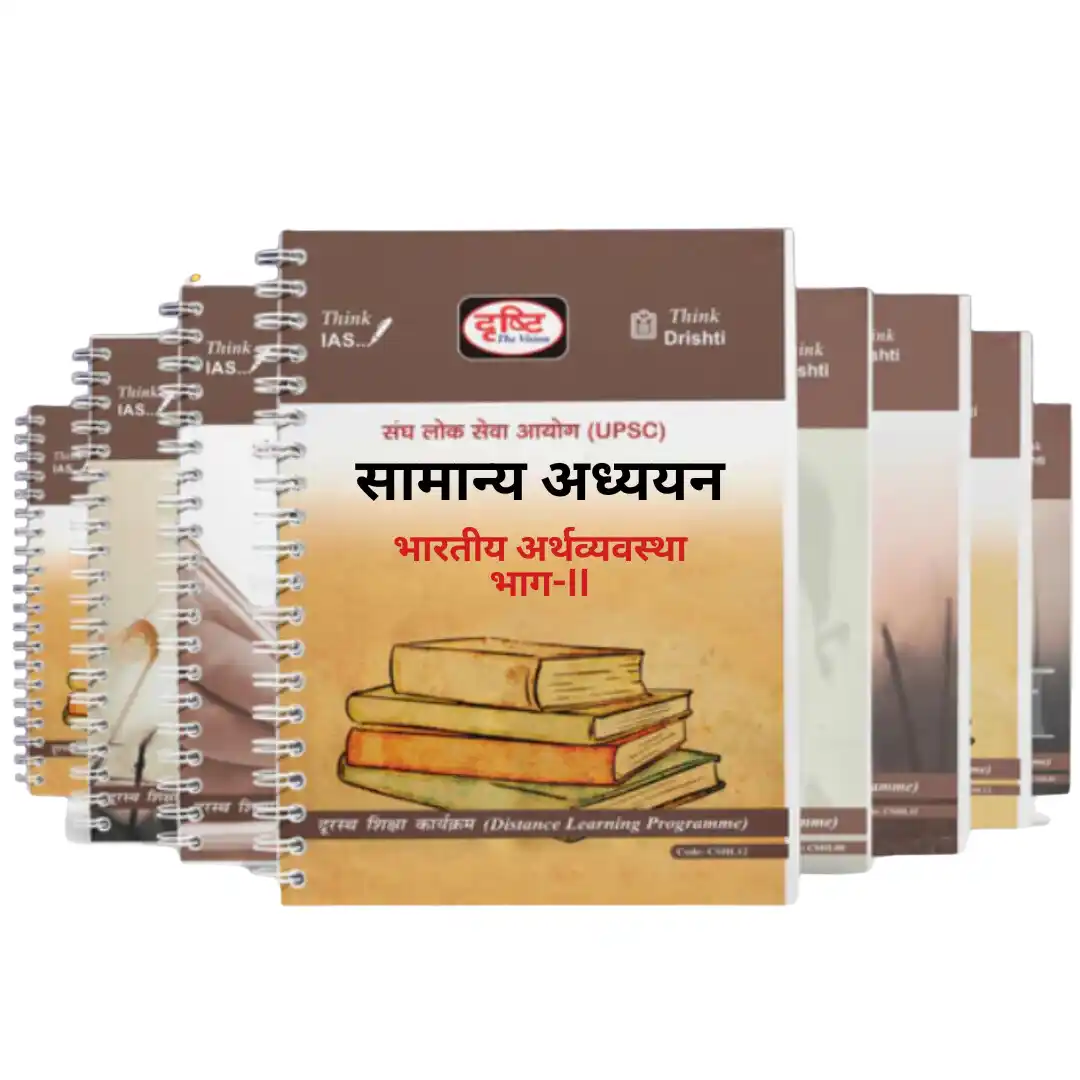
NTA releases the UGC NET syllabus in Hindi for Paper 1 and for most Paper 2 subjects, since the exam itself is bilingual (except language-specific subjects). Hindi-medium aspirants should download the Hindi version of both PDFs and note that, in case of any ambiguity, the English version is treated as final by NTA. Hindi-medium candidates preparing overlapping general-studies content can use the Drishti IAS Hindi Study Material for clear conceptual coverage in Hindi.
Important tips for Hindi-medium candidates: practice mock tests in Hindi so the terminology becomes familiar; for Mathematical Reasoning, Data Interpretation and ICT, learn the standard English abbreviations too, because many technical terms appear identically in both mediums.
JRF vs Assistant Professor: How the Syllabus Maps to Eligibility
The syllabus is the same for everyone, but your target changes how hard you must push. NTA declares the top 6% of candidates (subject- and category-wise) as eligible for Assistant Professor; a smaller, higher-scoring slice additionally qualifies for JRF, subject to the age limit. In practice, JRF demands a noticeably higher percentile, which means you cannot afford to lose easy Paper 1 marks.
| Criterion | Assistant Professor | JRF |
|---|---|---|
| Syllabus | Paper 1 + Paper 2 (same) | Paper 1 + Paper 2 (same) |
| Score required | Top 6% (subject/category-wise) | Higher merit within that pool |
| Age limit | No upper age limit | Upper age limit applies (with relaxations) |
| Outcome | Eligibility to apply for AP posts | Fellowship for research/PhD + AP eligibility |
Strategic takeaway: since the syllabus is identical, the JRF margin is won in Paper 1 accuracy and in the high-weightage units of your Paper 2. Do not treat Paper 1 as secondary.
How to Use the Syllabus: Study Plan & Strategy
A syllabus is only useful if you sequence it well. Here is a practical way to convert the UGC NET syllabus into a study schedule, plus the unit-wise approach that wins the most marks per hour.
How many months are enough to prepare for UGC NET?
For most working aspirants, 3 to 4 months of consistent study is enough if you already hold a relevant master’s degree. Freshers or those balancing a job may need 5–6 months. The deciding factor is not total time but daily consistency — 2–3 focused hours daily, with weekend mock tests, beats irregular marathon sessions.
| Phase | Duration | Focus |
|---|---|---|
| Phase 1 – Foundation | Weeks 1–4 | Paper 1 units I–V + read full Paper 2 syllabus once |
| Phase 2 – Build | Weeks 5–9 | Paper 1 units VI–X + Paper 2 core units in depth |
| Phase 3 – Practice | Weeks 10–14 | Daily reasoning/DI practice + previous-year papers |
| Phase 4 – Revision | Final 2–3 weeks | Full-length mocks, weak-area revision, formula recall |
Subject-Wise Preparation Strategy
- Start Paper 1 first: it is common, predictable and high-return — the same 100 marks regardless of subject.
- Bank the factual units early: Higher Education System, ICT, Communication and Comprehension are quick wins.
- Practice the quant units daily: Mathematical Reasoning and Data Interpretation reward consistency, not last-minute cramming.
- For Paper 2, map units to weightage: identify the 3–4 highest-scoring units of your subject from previous-year papers and master them first.
- Solve previous-year question papers: nothing reveals the real depth of a unit better than past papers — they show NTA’s recurring themes.
- Take timed mocks: 150 questions in 180 minutes needs speed; mock tests build the stamina and time-sense.
Previous-year papers are the single most underrated resource. A disciplined PYQ habit — like the topic-wise approach in the Forum IAS Topic-Wise PYQ Toolkit — trains you to spot recurring patterns and the level of detail examiners expect, a skill that transfers directly to UGC NET preparation.
Common Mistakes to Avoid (Unit-Wise)
- Ignoring Paper 1 because “it’s general” — it is the easiest place to lose JRF by a few marks.
- Memorising ICT abbreviations without understanding digital-education initiatives, which is where recent questions trend.
- Skipping Mathematical Reasoning & DI practice until the last week.
- Studying Paper 2 without first reading the official unit list — leading to out-of-syllabus reading.
- Not attempting all questions — with no negative marking, every blank is a wasted mark.
Best Books & Study Material for UGC NET
For Paper 1, standard references include Trishna’s/KVS Madaan’s UGC NET Paper 1 books and a dedicated previous-year question bank. For Paper 2, use the standard textbook of your discipline plus a subject-specific guide aligned to the NTA units. Keep the official syllabus PDF printed alongside your notes so you study only what is examinable.
Which is the best book for UGC NET Paper 1?
KVS Madaan and Trishna (Pearson) are the most widely used UGC NET Paper 1 books, paired with a topic-wise previous-year question collection. Whichever you pick, ensure it covers all 10 units with solved PYQs and updates on higher-education policy and ICT. A book plus consistent mock practice beats relying on a single resource.
Other Recommended Study Materials
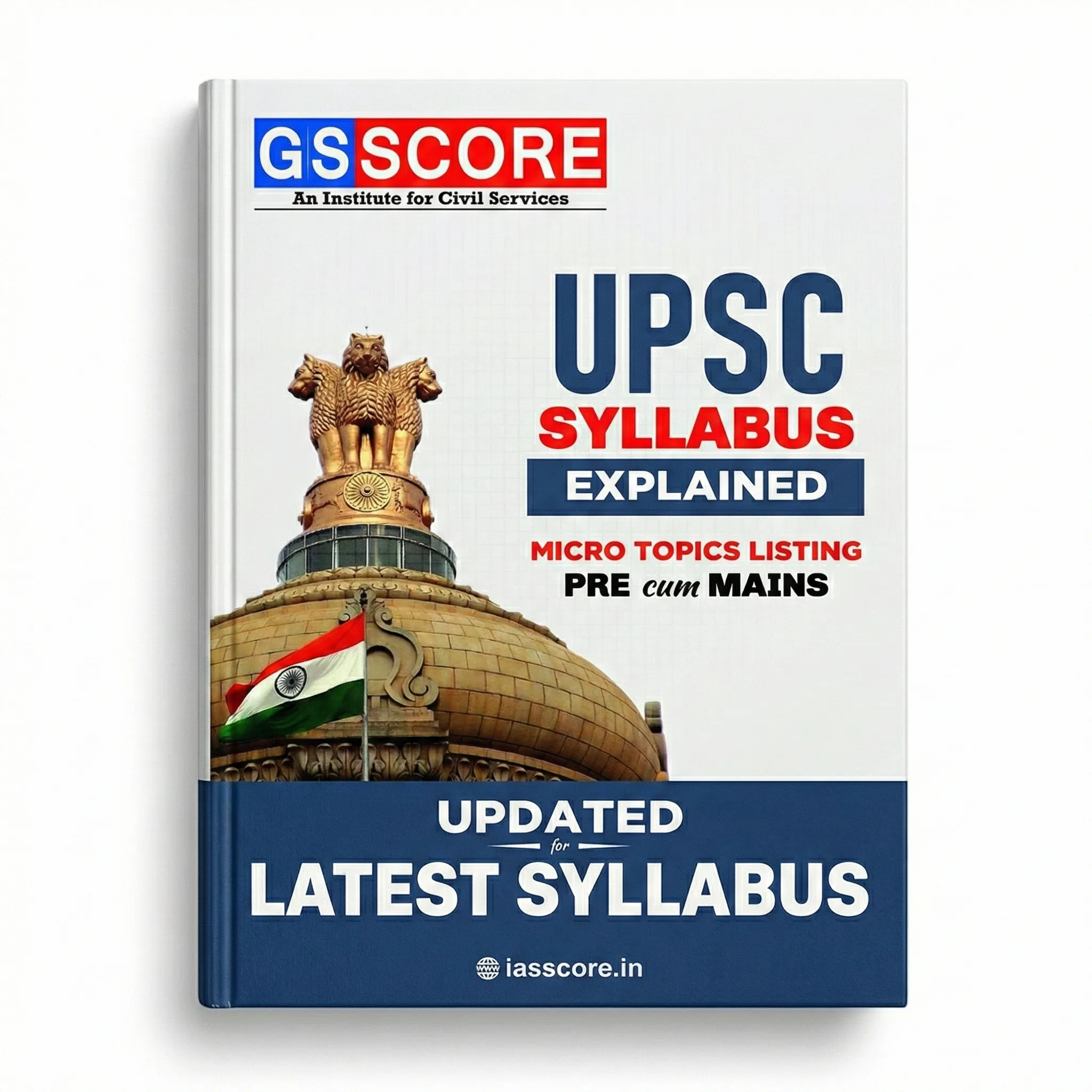
Current-affairs awareness helps with the Higher Education System, ICT and People/Development & Environment units, where policy updates appear. A reliable monthly digest such as the Vision IAS Current Affairs Magazine (January 2026) keeps you current on education policy, digital initiatives and environment developments. For aspirants who also need a structured syllabus reference for competitive prep, the GS Score Latest Syllabus Booklet is a clean, printed companion for organised revision.
| Need | Resource Type | Best Use |
|---|---|---|
| Paper 1 core | Dedicated Paper 1 book + PYQs | Build aptitude & reasoning base |
| Paper 2 subject | Standard textbook + NTA-aligned guide | Deep unit coverage |
| Current affairs/policy | Monthly magazine | HES, ICT, environment units |
| Practice | PYQ toolkit + mock tests | Speed, accuracy, pattern recognition |
Frequently Asked Questions
What is the syllabus of UGC NET?
The UGC NET syllabus has two parts: a common Paper 1 with 10 units (Teaching Aptitude, Research Aptitude, Comprehension, Communication, Mathematical Reasoning, Logical Reasoning, Data Interpretation, ICT, People/Development & Environment, and Higher Education System) and a subject-specific Paper 2 chosen from 87 subjects, each with its own detailed unit-wise topics.
Is UGC NET Paper 1 syllabus same for all subjects?
Yes. Paper 1 is identical for every candidate irrespective of the Paper 2 subject they choose. All aspirants attempt the same 50 questions covering the 10 common units, which makes Paper 1 the most predictable and high-return part of the exam.
How many units are there in UGC NET Paper 1?
There are 10 units in UGC NET Paper 1, each contributing roughly 5 questions (10 marks), for a total of 50 questions and 100 marks. They cover teaching and research aptitude, reasoning, data interpretation, ICT, environment and the higher education system.
Is there negative marking in UGC NET?
No, there is no negative marking in UGC NET. Each correct answer earns +2 marks and wrong answers carry no penalty, so you should attempt all 150 questions across both papers.
How many subjects are there in UGC NET 2026?
UGC NET 2026 is conducted in 87 subjects for Paper 2 following NTA’s expansion from 85 subjects. You choose one subject at the time of application, ideally matching your post-graduation discipline.
How can I download the UGC NET syllabus PDF?
Go to the official portal ugcnet.nta.nic.in, open the Syllabus or Information Bulletin section, download the common Paper 1 PDF, then download the PDF for your chosen Paper 2 subject. Both English and Hindi versions are available; save them together for a single consolidated reference.
Which is the best book for UGC NET Paper 1?
KVS Madaan and Trishna (Pearson) are the most widely used UGC NET Paper 1 books, ideally paired with a topic-wise previous-year question bank. Pick one that covers all 10 units with solved PYQs and current updates on higher-education policy and ICT, then reinforce it with regular mock tests rather than depending on a single book.
How many months are enough to prepare for UGC NET?
For most candidates with a relevant master’s degree, 3–4 months of consistent study is enough, while freshers or working aspirants may need 5–6 months. Daily consistency of 2–3 focused hours with weekend mock tests matters far more than the total number of months.
Is UGC NET syllabus available in Hindi?
Yes. NTA publishes the UGC NET syllabus in Hindi for Paper 1 and for most Paper 2 subjects, since the exam is bilingual except for language-specific subjects. If there is any ambiguity between versions, NTA treats the English text as final.
Recommended Study Material


Continue Reading
RRB JE Syllabus 2026: CBT 1 & CBT 2 Topics + PDF Download
The RRB JE syllabus is built around two computer-based stages: CBT 1 (100 marks — Mathematics, General Intelligence…
NEET Exam Pattern 2026: Marks, Questions & Marking Scheme
The NEET exam pattern for 2026 is a single 3-hour (180-minute) pen-and-paper test of 180 compulsory questions carrying…
Best Books for JEE Main 2026: Subject-Wise List (Physics, Chemistry, Maths)
The best books for JEE Main are your NCERT Class 11 and 12 textbooks (Physics, Chemistry, Maths) as…