RRB JE Syllabus 2026: CBT 1 & 2 Topics, Pattern + PDF
RRB JE syllabus 2026 with CBT 1 & CBT 2 topics, exam pattern, branch-wise Technical Abilities, weightage, negative marking, cut-off trends & PDF steps.

The rrb je syllabus spans two computer-based stages: CBT 1 (100 marks / 90 minutes — Mathematics, General Intelligence & Reasoning, General Awareness and General Science) and CBT 2 (150 marks / 120 minutes — General Awareness, Physics & Chemistry, Basics of Computers, Basics of Environment & Pollution Control, plus a decisive 100-mark branch-wise Technical Abilities section). There is negative marking of 1/3 mark per wrong answer, and selection runs CBT 1 → CBT 2 → Document Verification & Medical — with no interview. This guide breaks down every section and its weightage, minimum qualifying marks, previous-year cut-off trends, a 90-day study timeline, and exactly how to get the syllabus PDF.
- Stages: CBT 1 → CBT 2 → Document Verification → Medical (no interview, no aptitude test).
- CBT 1: 100 questions, 100 marks, 90 minutes — screening only.
- CBT 2: 150 questions, 150 marks, 120 minutes — decides merit; 100 of those marks are branch-wise Technical Abilities.
- Negative marking: 1/3 mark per wrong answer in both CBTs.
- Qualifying marks: UR/EWS 40%, OBC-NCL 30%, SC 30%, ST 25% (up to 2% relaxation possible).
RRB JE Syllabus 2026 Overview & Latest Exam Context
The Railway Recruitment Board (RRB) conducts the Junior Engineer (JE) examination to fill technical posts such as Junior Engineer, Junior Engineer (IT), Depot Material Superintendent (DMS) and Chemical & Metallurgical Assistant (CMA) across Indian Railways. The RRB JE 2026 recruitment cycle continues the two-stage Computer Based Test (CBT) structure that RRBs have used in recent notifications, followed by Document Verification and a Medical Examination.
The eligibility bar is a diploma or degree in the relevant engineering discipline, with an age band of roughly 18–33 years (with statutory relaxations). Because the final merit is decided almost entirely by CBT 2 — and within CBT 2 by the 100-mark Technical Abilities section — understanding the rrb je syllabus 2026 at a topic level is the single biggest lever a serious aspirant has. Below we map the full syllabus stage by stage, then layer weightage, cut-offs, books and a timeline on top of it. Always cross-check the final numbers against the official CEN, since section splits can be revised notification to notification.
| Stage | Purpose | Marks | Duration | Nature |
|---|---|---|---|---|
| CBT 1 | Screening / shortlisting | 100 | 90 minutes | Qualifying + shortlist for CBT 2 |
| CBT 2 | Merit decision | 150 | 120 minutes | Score counts toward final merit |
| Document Verification | Eligibility check | — | — | Qualifying |
| Medical Examination | Fitness (A2/A3/B1/B2/C1) | — | — | Qualifying |
RRB JE Exam Pattern (CBT 1 & CBT 2)
The rrb je exam pattern is objective, computer-based and bilingual. Every wrong answer carries a penalty of 1/3 of the marks allotted to that question, so guesswork is expensive. PwBD candidates receive a scribe and 20 minutes of extra compensatory time per hour where eligible.
RRB JE CBT 1 Exam Pattern
CBT 1 has 100 questions worth 1 mark each, to be attempted in 90 minutes. It is only a screening test — marks do not carry to the final merit — but you must clear the sectionless overall cut-off to be shortlisted for CBT 2 (typically around 15 times the community-wise vacancies).
| Subject | No. of Questions | Marks |
|---|---|---|
| Mathematics | 30 | 30 |
| General Intelligence & Reasoning | 25 | 25 |
| General Awareness | 15 | 15 |
| General Science | 30 | 30 |
| Total | 100 | 100 |
RRB JE CBT 2 Exam Pattern
The rrb je cbt 2 syllabus is tested through 150 questions worth 1 mark each in 120 minutes, for a total of 150 marks. This is the score that decides your rank. Note how General Awareness, Physics & Chemistry, Computers and Environment together form a 50-mark “general” block, while the 100-mark Technical Abilities section is where the merit is actually won or lost.
| Subject | No. of Questions | Marks |
|---|---|---|
| General Awareness | 15 | 15 |
| Physics & Chemistry | 15 | 15 |
| Basics of Computers & Applications | 10 | 10 |
| Basics of Environment & Pollution Control | 10 | 10 |
| Technical Abilities (branch-wise) | 100 | 100 |
| Total | 150 | 150 |
RRB JE CBT 1 Syllabus (Section-Wise Topics)
The rrb je cbt 1 syllabus is common to all branches and mirrors the standard RRB general-aptitude template. Here is the exam-accurate, sub-topic-level breakdown.
Mathematics (30 marks)
Number systems, BODMAS, decimals, fractions, LCM & HCF, ratio and proportion, percentages, mensuration, time and work, time and distance, simple and compound interest, profit and loss, algebra, geometry and trigonometry, elementary statistics, square roots, age calculations, calendar & clock, and pipes & cisterns. Expect calculation-heavy, single-step to two-step problems — speed matters more than depth.
General Intelligence & Reasoning (25 marks)
Analogies, alphabetical and number series, coding-decoding, mathematical operations, relationships (blood relations), syllogism, jumbling, Venn diagram, data interpretation and sufficiency, conclusions and decision making, similarities and differences, analytical reasoning, classification, directions, statement–arguments and statement–assumptions. This section is highly scoring with practice because question types repeat.
General Awareness (15 marks)
Knowledge of current affairs, Indian geography, culture and history including freedom struggle, Indian polity and constitution, Indian economy, environmental issues concerning India and the world, sports, general scientific and technological developments. Prioritise the last 6–12 months of current affairs plus static railway and government-scheme facts.
General Science (30 marks)
Physics, Chemistry and Life Sciences at roughly the Class 10 (matriculation) level. This is a high-return section for CBT 1 because it overlaps directly with the Physics & Chemistry portion you will need again in CBT 2. NCERT Class 9–10 science is more than enough.
| CBT 1 Subject | Weightage | Difficulty (PY trend) | Priority |
|---|---|---|---|
| General Science | 30% | Easy–Moderate | Very High |
| Mathematics | 30% | Moderate | High |
| Reasoning | 25% | Easy | High |
| General Awareness | 15% | Moderate | Medium |
RRB JE CBT 2 Syllabus (General Sections)
The CBT 2 syllabus repeats and deepens some CBT 1 subjects and adds new ones. The 50-mark general block below is the same for every candidate; the 100-mark technical block changes with your engineering discipline.
General Awareness (15 marks)
Same scope as CBT 1 — current affairs, history, geography, polity, economy, sports and science & technology — but questions can be marginally tougher. Carry forward your CBT 1 preparation.
Physics & Chemistry (15 marks)
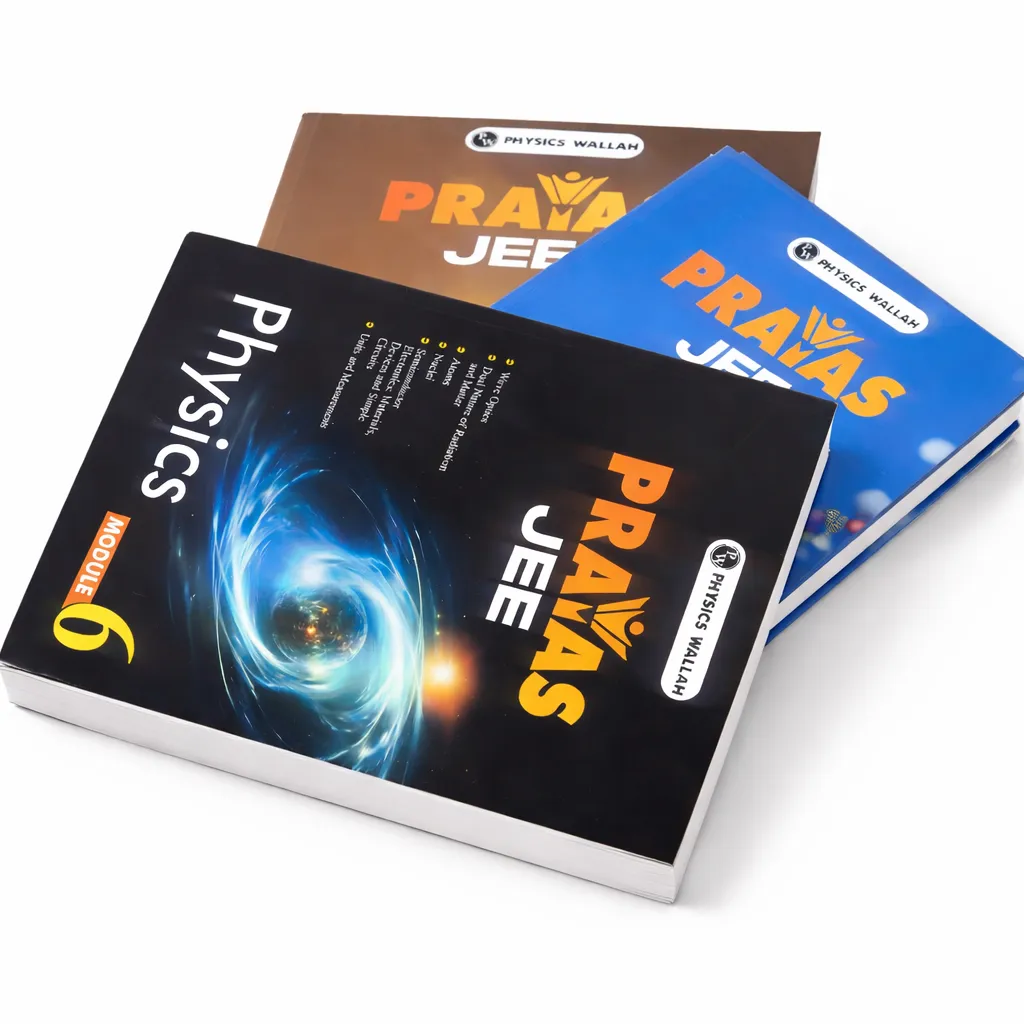
Up to Class 10 CBSE level. Physics: units and measurement, motion, force and Newton’s laws, work-energy-power, gravitation, heat and thermodynamics basics, light, sound, electricity and magnetism. Chemistry: matter, atomic structure, periodic classification, chemical reactions, acids-bases-salts, metals and non-metals, carbon compounds. Candidates who have prepared foundation science modules for JEE/NEET already have a strong base here — printed sets like the eSaral IIT JEE Modules and the Careerwill NEET Study Module Set cover this Physics & Chemistry foundation cleanly.
Basics of Computers & Applications (10 marks)
Architecture of computers, input and output devices, storage devices, networking, operating systems (Windows, Unix, Linux), MS Office, various data representation, internet and email, websites and web browsers, computer virus. Short, factual and easy to score full marks with a week of focused study.
Basics of Environment & Pollution Control (10 marks)
Basics of environment, adverse effects of environmental pollution and control strategies, air, water and noise pollution and their effects and control, waste management, global warming, acid rain, ozone depletion. Another quick-win section — factual and memory-based.
RRB JE Technical Abilities Syllabus (Branch-Wise, 100 Marks)
The rrb je technical abilities syllabus is where your discipline decides the questions. You choose your Technical Abilities group based on the post/qualification you applied for. This 100-mark section is the largest single component in the entire recruitment and the primary driver of merit — so treat it as your core preparation, not an add-on.
Does the Technical Abilities syllabus differ by branch?
Yes. RRB groups multiple diploma/degree branches into exam “streams,” and the technical questions are drawn from the standard curriculum of that stream. The main groupings are Civil & Allied, Electrical & Allied, Electronics & Allied, Mechanical & Allied, and the Chemical & Metallurgical Assistant (CMA) / Junior Engineer (IT) streams. So two candidates sitting the same CBT 2 can face completely different 100-mark technical papers. The table below maps each stream to its core topics.
| Branch / Stream | Core Technical Topics |
|---|---|
| Civil & Allied | Engineering mechanics, building materials, surveying, strength of materials, structural analysis, RCC & steel structures, hydraulics, environmental engineering, transportation engineering, estimation & costing, construction & management |
| Electrical & Allied | Basic electrical, circuits & measurement, magnetic circuits, AC fundamentals, electrical machines, transmission & distribution, generation, utilisation of energy, single-phase & three-phase induction motors, transformers |
| Electronics & Allied | Electronic components & materials, semiconductor devices, network theory, electronic measurements, digital electronics, microprocessors, communication systems, control systems, electronic instruments |
| Mechanical & Allied | Engineering mechanics, thermodynamics, IC engines, fluid mechanics & machinery, heat transfer, refrigeration & air-conditioning, manufacturing & production, strength of materials, machine design, kinematics & dynamics of machines |
| CMA (Chemical & Metallurgical Assistant) | Physics, Chemistry & basics of computers and applications, environment & pollution control, and relevant chemical/metallurgical fundamentals |
| Junior Engineer (IT) | Computer organisation, programming (C/C++/Java), DBMS, data structures, operating systems, computer networks, information systems, software engineering, web technology |
Because the same physics and chemistry foundations underpin the technical streams, foundation-level printed modules such as the PW Prayas JEE Modules are a useful bridge for candidates strengthening their core science before moving to discipline-specific texts.
Which Subjects Have the Highest Weightage in RRB JE?
If you rank the whole recruitment by marks, the priority order is unambiguous. In CBT 2, the branch-wise Technical Abilities section (100 of 150 marks, ~67%) dwarfs everything else and is the deciding factor for merit. In CBT 1, Mathematics and General Science lead at 30 marks each, followed by Reasoning at 25 and General Awareness at 15.
| Section | Stage | Marks | Share | Merit impact |
|---|---|---|---|---|
| Technical Abilities (branch-wise) | CBT 2 | 100 | ~67% of CBT 2 | Decides merit |
| Mathematics | CBT 1 | 30 | 30% of CBT 1 | Screening only |
| General Science | CBT 1 | 30 | 30% of CBT 1 | Screening only |
| General Intelligence & Reasoning | CBT 1 | 25 | 25% of CBT 1 | Screening only |
| General block (GA + P&C + Computers + Env) | CBT 2 | 50 | ~33% of CBT 2 | Counts toward merit |
High-Yield Topics & Marks Distribution (PY Analysis)
Top-ranking pages list topics but rarely tell you where the marks actually cluster. Based on previous-year RRB JE question trends, here is an indicative distribution to help you prioritise the technical section — always the deciding factor.
| Stream | Highest-Yield Topics | Approx. Share of Technical Marks |
|---|---|---|
| Civil | Strength of materials, surveying, RCC, estimation & costing | 40–50% |
| Electrical | Electrical machines, circuits & measurement, AC fundamentals | 45–55% |
| Mechanical | Thermodynamics, SOM, fluid mechanics, production engineering | 45–55% |
| Electronics | Digital electronics, semiconductor devices, network theory | 40–50% |
The practical takeaway: 3–4 core subjects typically account for roughly half your technical marks. Master those first, then expand outward. Within the general block, Basics of Computers and Basics of Environment (20 marks combined) are the easiest full-mark opportunities and should never be left for the last day.
Negative Marking, Qualifying Marks & Merit Rules
There is negative marking of 1/3 mark for every wrong answer in both CBT 1 and CBT 2. Unanswered questions carry no penalty. This makes accuracy discipline critical — a candidate who attempts 120 with 90% accuracy usually outscores one who attempts 150 with 75% accuracy.
Minimum qualifying marks (percentage of the paper) by community are typically: UR/EWS 40%, OBC (NCL) 30%, SC 30% and ST 25%. These can be relaxed by up to 2% for reserved categories in specific situations. Meeting the qualifying percentage only makes you eligible — final selection is by normalised CBT 2 merit within your vacancy pool.
How normalisation and CBT 2 decide final merit
Because CBTs are held across multiple shifts of varying difficulty, RRB applies a normalisation formula to CBT 2 scores. Your normalised CBT 2 marks — dominated by the 100-mark Technical Abilities section — form the merit list. CBT 1 is purely a gateway; it does not add to your final score. So while you must clear CBT 1 comfortably, your rank is built almost entirely in CBT 2.
Selection Process: Stages & Is There an Interview?
The RRB JE selection process has four stages and no interview and no separate aptitude test:
- Stage 1 — CBT 1: Screening test; qualify to be shortlisted.
- Stage 2 — CBT 2: Merit-deciding test with the branch-wise technical section.
- Stage 3 — Document Verification (DV): Eligibility and certificate check for shortlisted candidates.
- Stage 4 — Medical Examination: Fitness classification (A2, A3, B1, B2, C1 etc.) as per the post.
There is no personality test, physical efficiency test or interview at any stage — the entire selection is objective-marks driven, which is exactly why syllabus mastery translates so directly into a job.
RRB JE Cut-Off & Good Attempts Trend
Cut-offs vary by RRB region, community and vacancy count, but the CBT 1 qualifying trend broadly clusters as below. Treat these as planning benchmarks, not guarantees — official cut-offs are released only after each stage.
| Category | Indicative CBT 1 Cut-off (out of 100) | Good Attempts (of 100) |
|---|---|---|
| UR / EWS | 68–78 | 78–85 |
| OBC-NCL | 65–74 | 75–82 |
| SC | 58–68 | 70–78 |
| ST | 50–62 | 65–74 |
In CBT 2, a “good attempt” is roughly 110–125 accurate questions out of 150, with the technical section attempted almost fully. The gap between qualifying and selection is almost always closed in the technical portion.
How to Download the RRB JE Syllabus PDF
You can get the official rrb je syllabus pdf download from the detailed CEN (Centralised Employment Notice) published on any RRB regional website (e.g., rrbcdg.gov.in and other zonal RRB portals) under the JE recruitment notification. Follow these steps:
- Open your zonal RRB website and go to the JE (CEN) notification section.
- Click the detailed CEN PDF — not the short advertisement.
- Scroll to the syllabus annexure, which carries the complete section-wise and branch-wise syllabus.
- Save/print the annexure pages and use them as a topic checklist.
For a print-ready, exam-ready workflow, download the official CEN PDF, then keep a one-page checklist that maps each technical topic to your standard reference book — this converts the raw syllabus into a trackable study plan. Competer prints and delivers full study-material sets so you can prepare from physical booklets rather than screens; if you are simultaneously building science foundations, the module sets linked above are a convenient starting point.
RRB JE vs SSC JE Syllabus: Which Should You Target?
Many diploma holders sit both exams. The core technical syllabus overlaps heavily, but the structure and general sections differ — which affects your preparation split.
| Feature | RRB JE | SSC JE |
|---|---|---|
| Stages | CBT 1 + CBT 2 + DV + Medical | Paper 1 + Paper 2 + DV + Medical |
| Technical weight | 100/150 in CBT 2 | 200/300 in Paper 2 |
| General block | GA, Physics-Chem, Computers, Environment | GI & Reasoning + General Awareness |
| Streams | Civil, Electrical, Electronics, Mechanical, CMA, IT | Civil, Electrical, Mechanical |
| Interview | No | No |
If your branch is Electronics, IT or a chemical/metallurgical field, RRB JE offers streams SSC JE does not. If you are Civil/Electrical/Mechanical and want a longer, more purely technical paper, SSC JE Paper 2 rewards deep technical depth. Preparing the technical core well lets you attempt both.
Preparation Strategy & 90-Day Timeline
The winning approach is to treat CBT 1 as a hygiene target (clear it comfortably) while investing most hours in the CBT 2 technical section. Here is a syllabus-mapped 90-day plan.
| Phase | Days | Focus |
|---|---|---|
| Foundation | 1–30 | Class 9–10 Science & Maths, Reasoning basics, start 3 core technical subjects |
| Core Technical | 31–60 | Finish all technical topics, Physics-Chem, Computers, Environment; begin sectional tests |
| Practice & Revision | 61–80 | Full-length mocks, PYQ practice, weak-area drilling, current affairs |
| Peak & Simulation | 81–90 | Daily full mocks, normalisation-aware accuracy training, quick revision notes |
Subject-wise tips
- Technical: Solve at least 10 years of branch PYQs; questions repeat in concept if not in wording.
- Maths & Reasoning: Timed practice — target under 45 seconds per question.
- Physics & Chemistry / Science: Stick to NCERT-level clarity; do not over-read.
- Computers & Environment: One-time factual read plus two revisions — near-full marks with low effort.
- GA: A daily 20-minute current-affairs habit beats last-minute cramming.
Common mistakes to avoid
- Over-preparing CBT 1 (which doesn’t count) while neglecting technical depth.
- Ignoring negative marking and over-attempting.
- Skipping the easy 20-mark Computers + Environment block.
- Not practising in a shift-simulated, timed environment before the real CBT.
Frequently Asked Questions
What is the syllabus of RRB JE CBT 1 and CBT 2?
CBT 1 covers Mathematics, General Intelligence & Reasoning, General Awareness and General Science (100 marks). CBT 2 covers General Awareness, Physics & Chemistry, Basics of Computers & Applications, Basics of Environment & Pollution Control and a 100-mark branch-wise Technical Abilities section (150 marks total).
Is there negative marking in the RRB JE exam?
Yes. Both CBT 1 and CBT 2 deduct 1/3 mark for every wrong answer. Unanswered questions are not penalised, so accuracy is more valuable than sheer volume of attempts.
What are the minimum qualifying marks for RRB JE CBT 1 and CBT 2?
The typical qualifying percentages are UR/EWS 40%, OBC-NCL 30%, SC 30% and ST 25%, with up to 2% relaxation possible for reserved categories in certain cases. Qualifying only makes you eligible; final selection is by normalised CBT 2 merit.
How many stages are there in the RRB JE selection process, and is there an interview?
There are four stages — CBT 1, CBT 2, Document Verification and Medical Examination. There is no interview, no personality test and no separate aptitude test; selection is entirely objective-marks based.
What is the Technical Abilities syllabus for RRB JE and does it differ by branch?
Yes, it differs by branch. RRB groups engineering disciplines into streams — Civil, Electrical, Electronics, Mechanical, CMA and JE (IT) — and each candidate’s 100-mark Technical Abilities paper is drawn from that stream’s standard diploma/degree curriculum, so two candidates in the same CBT 2 can face entirely different technical questions.
Which subjects have the highest weightage in RRB JE?
The branch-wise Technical Abilities section (100 of 150 marks, about 67% of CBT 2) has by far the highest weightage and decides merit. In CBT 1, Mathematics and General Science lead at 30 marks each, followed by Reasoning (25) and General Awareness (15).
What is the RRB JE CBT 2 exam pattern and total marks?
CBT 2 has 150 objective questions worth 1 mark each, for a total of 150 marks in 120 minutes: General Awareness (15), Physics & Chemistry (15), Basics of Computers & Applications (10), Basics of Environment & Pollution Control (10) and branch-wise Technical Abilities (100). Negative marking of 1/3 applies.
Does the CBT 2 Technical Abilities score count toward the final merit?
Yes — and decisively. The 100-mark Technical Abilities section is the single largest component of CBT 2, and normalised CBT 2 marks form the final merit list. Mastering your branch’s technical syllabus is the biggest determinant of selection.
How do I download the RRB JE syllabus PDF?
Open the RRB JE CEN notification on any RRB regional website (such as rrbcdg.gov.in), click the detailed CEN PDF, and go to the syllabus annexure — it contains the complete section-wise and branch-wise syllabus, which you can print and use as a checklist.
Recommended Study Material


Continue Reading
MPSC Syllabus 2026: Rajyaseva Prelims, Mains + PDF
The MPSC syllabus for the Rajyaseva (Maharashtra Civil Services) examination now follows a revised, UPSC-style descriptive pattern: a…
UPPCS Syllabus 2026: Prelims, Mains (8 Papers) + PDF Download
Quick answer: The UPPCS syllabus for 2026 spans three stages run by the Uttar Pradesh Public Service Commission…
KVS Syllabus 2025: PRT, TGT, PGT Pattern + PDF
The KVS syllabus 2025 for PRT, TGT and PGT is set by Kendriya Vidyalaya Sangathan (kvsangathan.nic.in) and is…