UPPCS Syllabus 2026: Prelims, Mains (8 Papers) + PDF Download
Complete UPPCS syllabus 2026 — Prelims GS + CSAT, Mains 8 papers (1500 marks) with UP-specific GS V & VI, exam pattern, weightage & free PDF (Hindi & English).

Quick answer: The UPPCS syllabus for 2026 spans three stages run by the Uttar Pradesh Public Service Commission (UPPSC) — a Preliminary exam with two objective papers (General Studies Paper 1 and CSAT Paper 2), a Mains exam of 8 compulsory papers totalling 1500 marks, and a 100-mark Personality Test (Interview). The headline change for the 2026 cycle: UPPSC has removed optional subjects from the Mains and added two new Uttar Pradesh-focused papers — General Studies V and VI. This guide breaks down the complete UPPCS Prelims and Mains syllabus topic-by-topic, the exam pattern, subject-wise weightage, a study timeline, and how to get the UPPCS syllabus PDF in both Hindi and English.
UPPCS Syllabus 2026: Key Takeaways
- Three stages: Prelims (screening) → Mains (1500 marks) → Interview (100 marks).
- Prelims: 2 papers of 200 marks each — GS Paper 1 (merit) and CSAT Paper 2 (qualifying at 33%).
- Mains: 8 compulsory papers — General Hindi, Essay, and GS I–VI. No optional subject.
- New for 2026: GS V and GS VI are dedicated to Uttar Pradesh (400 marks combined).
- Final merit: Mains (1500) + Interview (100) = 1600 marks. Prelims marks are not added.
- Language: Papers are bilingual, so the UPPCS syllabus in Hindi and English is identical.
UPPCS Syllabus 2026 at a Glance
Before the detailed breakdown, here is a quick snapshot of the UPPCS (also written as UPPSC PCS) examination structure. The Combined State/Upper Subordinate Services exam recruits for posts such as Deputy Collector (SDM), Deputy Superintendent of Police (DySP), Block Development Officer (BDO), Assistant Regional Transport Officer (ARTO), and dozens of other Group A and Group B state services.
| Stage | Type | Papers | Total Marks | Nature |
|---|---|---|---|---|
| Prelims | Objective (MCQ) | 2 (GS + CSAT) | 400 (GS counted for merit) | Screening / qualifying |
| Mains | Descriptive | 8 compulsory | 1500 | Merit |
| Interview | Personality Test | — | 100 | Merit |
| Grand Total | — | — | 1600 | Mains + Interview decide final rank |
Prelims marks are not added to the final merit — they only decide who qualifies for the Mains. The final rank is built from Mains (1500) plus Interview (100), a combined 1600 marks. Understanding this weighting early tells you where the real battle is fought: the descriptive Mains, not the objective Prelims.
UPPCS Prelims Exam Pattern 2026
The UPPCS Prelims is an offline (OMR-based) objective test held on a single day in two sessions. It has two papers of two hours each. Paper 1 (General Studies) is the scoring, merit-deciding paper, while Paper 2 (CSAT) is only qualifying. This UPPCS exam pattern mirrors UPSC’s screening structure but with a few state-specific twists noted below.
| Paper | Subject | Questions | Marks | Duration | Nature |
|---|---|---|---|---|---|
| Paper 1 | General Studies (GS) | 150 | 200 | 2 hours | Merit ranking |
| Paper 2 | General Studies II (CSAT) | 100 | 200 | 2 hours | Qualifying (33%) |
Key rules aspirants must remember about the UPPCS exam pattern:
- Negative marking: 0.33 (one-third) of the marks allotted to a question are deducted for every wrong answer in both papers.
- CSAT qualifying cut-off: A candidate must score at least 33% (i.e., 66 out of 200) in Paper 2 (CSAT) to be considered; below this the GS score is not evaluated for the cut-off.
- Language: Question papers are bilingual (Hindi and English), so the UPPCS syllabus in Hindi and English is identical.
- Timing: Both papers are MCQ-based and taken on the same day in morning and afternoon sessions.
- Number of questions: GS Paper 1 has 150 questions; CSAT Paper 2 has 100 questions.
What is the exam pattern for UPPCS Prelims?
UPPCS Prelims has two papers of 200 marks each. Paper 1 (GS) has 150 questions and decides the Prelims merit; Paper 2 (CSAT) has 100 questions and is only qualifying at 33%. Each carries a 0.33 negative marking penalty for wrong answers, and both are offline OMR objective papers of two hours held on the same day.
UPPCS Prelims Syllabus — GS Paper 1
The UPPCS Prelims syllabus for General Studies Paper 1 overlaps heavily with the UPSC Prelims GS syllabus but adds a distinct layer of Uttar Pradesh-specific general knowledge. Below is the complete topic list.
| Area | Topics Covered |
|---|---|
| Current Affairs | National and international events of current importance |
| History | History of India and the Indian National Movement |
| Indian & World Geography | Physical, social and economic geography of India and the world |
| Polity & Governance | Constitution, political system, Panchayati Raj, public policy, rights issues |
| Economic & Social Development | Sustainable development, poverty, inclusion, demographics, social sector initiatives |
| Environment & Ecology | Environmental ecology, biodiversity, climate change (general awareness) |
| General Science | Everyday science and scientific developments |
| UP-Specific GK | Education, culture, agriculture, trade, commerce, living & social customs of Uttar Pradesh |
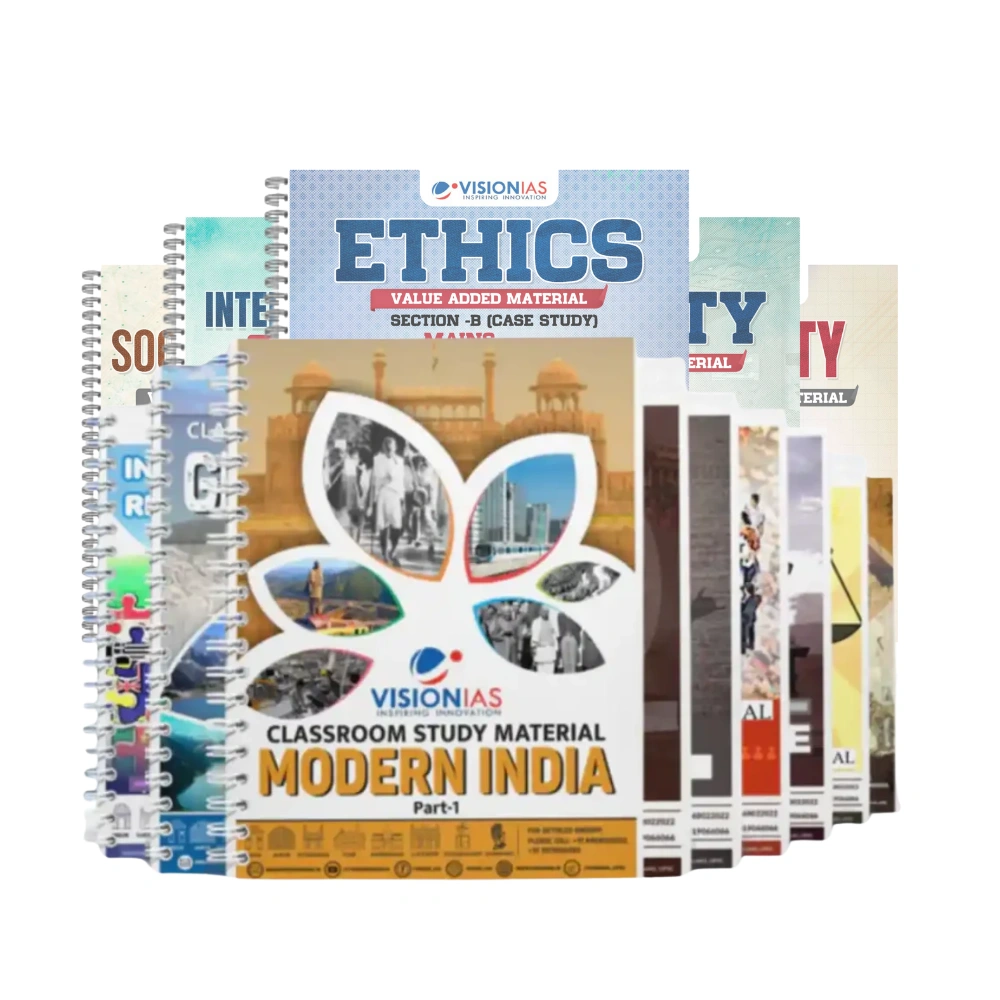
The UP-specific general knowledge segment is where UPPCS diverges sharply from UPSC — aspirants must add focused study of Uttar Pradesh’s geography, history, polity and current schemes. A structured GS foundation such as the Vision IAS GS 2026-27 booklets covers the national portion, which you then supplement with a dedicated UP GK source. Historically, roughly 15–20 questions in the Prelims GS paper have carried a direct UP angle, so this layer is not optional padding — it is a reliable pocket of scorable marks.
UPPCS Prelims Syllabus — CSAT (Paper 2)
Paper 2, the Civil Services Aptitude Test (CSAT), is qualifying but must not be neglected — every year candidates fail the entire Prelims because they miss the 33% CSAT bar. The syllabus is:
| Section | What It Tests |
|---|---|
| Comprehension | Reading passages and answering inference-based questions |
| Interpersonal & Communication Skills | Communication-based reasoning |
| Logical Reasoning & Analytical Ability | Syllogisms, series, statements-assumptions |
| Decision-Making & Problem-Solving | Situational judgement (usually no negative marking for these) |
| General Mental Ability | Puzzles, arrangements, coding-decoding |
| Elementary Mathematics | Numbers, percentages, ratio, time-speed-distance, mensuration — up to Class X level |
| General English | Comprehension up to Class X standard |
| General Hindi | Comprehension and language up to Class X standard |
Note that UPPCS CSAT uniquely includes a General Hindi comprehension component, which UPSC’s CSAT does not. Since CSAT is now purely qualifying, a few weeks of targeted practice is enough for most; regular mock testing with a resource like the Vision IAS CSAT Test Series keeps the aptitude and comprehension muscles sharp. A practical rule of thumb: attempt the comprehension and elementary-maths sets first, since they are the fastest route to the 66 marks you need to qualify.
Is CSAT qualifying in UPPCS?
Yes. CSAT (Paper 2) in UPPCS Prelims is qualifying in nature. You must score a minimum of 33% (66 marks out of 200) to clear it. Marks scored in CSAT beyond the qualifying threshold are not counted toward the Prelims merit — only General Studies Paper 1 decides the Prelims cut-off ranking.
UPPCS Mains Syllabus 2026 — 8 Compulsory Papers
The UPPCS Mains syllabus was overhauled for 2026. UPPSC scrapped the optional subject entirely and restructured the exam into 8 compulsory papers worth 1500 marks. Two brand-new General Studies papers — GS V and GS VI — are devoted almost entirely to Uttar Pradesh. Here is the full Mains structure.
| Paper | Subject | Marks | Duration |
|---|---|---|---|
| Paper 1 | General Hindi | 150 | 3 hours |
| Paper 2 | Essay | 150 | 3 hours |
| Paper 3 | General Studies I | 200 | 3 hours |
| Paper 4 | General Studies II | 200 | 3 hours |
| Paper 5 | General Studies III | 200 | 3 hours |
| Paper 6 | General Studies IV | 200 | 3 hours |
| Paper 7 | General Studies V (UP-specific) | 200 | 3 hours |
| Paper 8 | General Studies VI (UP-specific) | 200 | 3 hours |
| Total | 1500 | — | |
General Hindi and Essay each carry 150 marks; the six General Studies papers carry 200 marks each, adding up to 1200. Together that is the 1500-mark Mains. Every paper is descriptive and three hours long, which means answer-writing speed and structure — not just knowledge — determine your score.
Has the optional subject been removed from UPPCS Mains?
Yes. From the 2026 cycle, UPPSC has removed all optional subjects from the UPPCS Mains. The two optional papers (600 marks) have been replaced by two new compulsory General Studies papers — GS V and GS VI — that focus specifically on Uttar Pradesh’s history, geography, economy, governance and development. This makes the exam fully General-Studies-based and levels the field across streams.
How many papers are there in UPPCS Mains?
There are 8 compulsory papers in UPPCS Mains for 2026: General Hindi (150 marks), Essay (150 marks), and six General Studies papers, GS I to GS VI (200 marks each). The six GS papers together carry 1200 marks, and the grand Mains total is 1500 marks. There is no optional subject.
Paper-Wise UPPCS Mains Syllabus Breakdown
This section gives an exam-ready, sub-topic-level view of each Mains paper — mapped to the standard sources a serious aspirant should build notes from.
Paper 1 — General Hindi (150 marks)
Tests command over the Hindi language: precis writing (संक्षेपण), letter/official correspondence writing, comprehension of a passage (अपठित गद्यांश), grammar, idioms and proverbs (मुहावरे-लोकोक्तियाँ), synonyms/antonyms, and vocabulary. This is a scoring paper for well-prepared Hindi-medium aspirants and, crucially, a paper where even English-medium candidates can secure safe marks with a fortnight of focused grammar and precis practice.
Paper 2 — Essay (150 marks)
Candidates write three essays (one from each of three sections), typically covering: (A) Literature & Culture, Social sphere; (B) Science, Environment & Technology, Economic sphere; (C) Agriculture-Industry-Trade, National & International events, Natural calamities. Structure, balance and current relevance carry the marks. Model frameworks such as the Vajiram Essay Notes help build a repeatable essay template — an introduction that frames the debate, a body with multi-dimensional (social, economic, political, environmental) arguments, and a forward-looking conclusion.
Paper 3 — General Studies I
Covers History of India and Indian Culture, the Freedom Struggle, post-independence consolidation, Geography of India and the World (physical, economic, social), and world history highlights. Expect questions on art and culture, modern Indian history, and Indian society. Standard sources: NCERTs, and consolidated GS booklets like the Vajiram GS Notes.
Paper 4 — General Studies II
Focuses on the Indian Constitution, Polity, Social Justice, Governance, and International Relations — the functioning of the executive, legislature and judiciary, Panchayati Raj, welfare schemes, statutory and constitutional bodies, and India’s foreign relations. A dedicated Polity Notes booklet is the natural spine for this paper.
Paper 5 — General Studies III
Covers the Economy, Science & Technology, Environment, Biodiversity, Disaster Management, and Internal Security. Includes economic development, agriculture and food security, budgeting, inclusive growth, S&T developments and indigenous technology, conservation, and security challenges. Pair standard economy notes with a continuous current-affairs habit, since this paper is the most dynamic.
Paper 6 — General Studies IV (Ethics)
Ethics, Integrity and Aptitude — ethics in human interface, attitude, emotional intelligence, contributions of moral thinkers, public/civil service values, probity in governance, and case studies. Case-study answer writing is decisive here. Structured ethics material such as the Drishti IAS Ethics Notes (Hindi) is a strong fit for Hindi-medium aspirants.
UPPCS GS V & VI — The Uttar Pradesh-Specific Papers
These two papers are the single biggest differentiator of the 2026 UPPCS Mains, and the area where most coaching content is thin. Together they carry 400 marks and are dedicated to Uttar Pradesh. Master these and you unlock a decisive scoring edge that a purely UPSC-oriented preparation cannot give you.
| Paper | Core Themes (Uttar Pradesh Focus) |
|---|---|
| GS V | UP’s history, art, culture and heritage; UP geography and demography; UP polity, administration and governance structures; social development and welfare schemes of the state |
| GS VI | UP economy — agriculture, industry, MSMEs, infrastructure; state-specific development models; investment (e.g., industrial corridors, ODOP — One District One Product); science & technology and environment in the UP context; disaster management in the state |
Practical preparation for GS V & VI means studying: the geography and river systems of UP (the Ganga-Yamuna doab, the Terai belt, the Bundelkhand region); medieval and modern history connected to the region; the structure of the state secretariat, districts and local bodies; flagship UP schemes; and the state’s flagship economic initiatives like ODOP and the expressway/industrial corridors. Because ready-made material for these papers is scarce, aspirants build their own notes from the UP government’s economic survey and state board textbooks, supplemented by current-affairs magazines that track UP developments such as the Vision IAS Current Affairs (Hindi).
Which subjects carry the most marks in UPPCS Mains?
The six General Studies papers dominate at 1200 of the 1500 Mains marks. Within that, the four national GS papers (GS I–IV) total 800 marks and the two UP-specific papers (GS V–VI) total 400 marks. General Hindi and Essay contribute 150 marks each. There is no single high-weight optional anymore, so breadth across all GS papers matters more than depth in one subject.
UPPCS vs UPSC Syllabus — Side-by-Side Comparison
A common aspirant question is whether they can reuse UPSC study material for UPPCS. The answer is largely yes for the national GS portion, with important structural differences.
| Feature | UPPCS (UPPSC) | UPSC (CSE) |
|---|---|---|
| Stages | Prelims, Mains, Interview | Prelims, Mains, Interview |
| Prelims papers | GS + CSAT (both 200 marks) | GS + CSAT (both 200 marks) |
| CSAT Hindi section | Yes (General Hindi included) | No |
| Mains papers | 8 compulsory (no optional) | 9 papers incl. 2 optional |
| Optional subject | Removed (2026 onward) | Retained (48 optionals) |
| State-specific papers | GS V & VI on Uttar Pradesh | None |
| Mains total marks | 1500 | 1750 |
| Interview marks | 100 | 275 |
Is UPPCS syllabus same as UPSC?
Not exactly. The core General Studies topics (history, polity, geography, economy, environment, science, ethics) overlap around 70-80%, so UPSC material is directly reusable for those. But UPPCS differs in three ways: it has no optional subject, it adds two Uttar Pradesh-specific GS papers (GS V and VI), and its CSAT includes a General Hindi component. So you can share most GS prep but must add dedicated UP-focused and General Hindi preparation.
Subject-Wise Weightage & Trend Analysis
Understanding where the marks concentrate helps you allocate study hours efficiently. Based on the 2026 pattern, here is the approximate weightage across the whole exam.
| Segment | Marks | Approx. Share of Merit (Mains + Interview = 1600) |
|---|---|---|
| National GS (GS I-IV) | 800 | 50% |
| UP-specific GS (GS V-VI) | 400 | 25% |
| General Hindi | 150 | ~9% |
| Essay | 150 | ~9% |
| Interview | 100 | ~6% |
The takeaway: the four national GS papers dominate at 800 marks, but the 400-mark UP block is where competition is won because fewer candidates prepare it seriously. Neglecting General Hindi and Essay (300 combined marks) is a frequent, costly mistake — these are among the most predictable, syllabus-bounded papers in the entire exam, and small consistent gains there compound over a 1600-mark merit list.
UPPCS Preparation Strategy & Study Plan
Here is a realistic 10-12 month timeline that maps each section to a study window. Adjust based on whether you are a fresher or a repeater.
| Phase | Duration | Focus |
|---|---|---|
| Foundation | Months 1-3 | NCERTs + core GS (History, Polity, Geography, Economy); begin UP GK |
| Advanced GS | Months 4-6 | Standard GS notes, Environment, Science & Tech; deep-dive UP GS V & VI |
| Answer Writing + CSAT | Months 7-8 | Daily Mains answer practice, Essay/Hindi drills, weekly CSAT mocks |
| Prelims Sprint | Months 9-10 | Full-length Prelims mocks, current affairs revision, PYQ analysis |
| Mains + Interview | Post-Prelims | Intensive Mains writing, UP-specific revision, personality test prep |
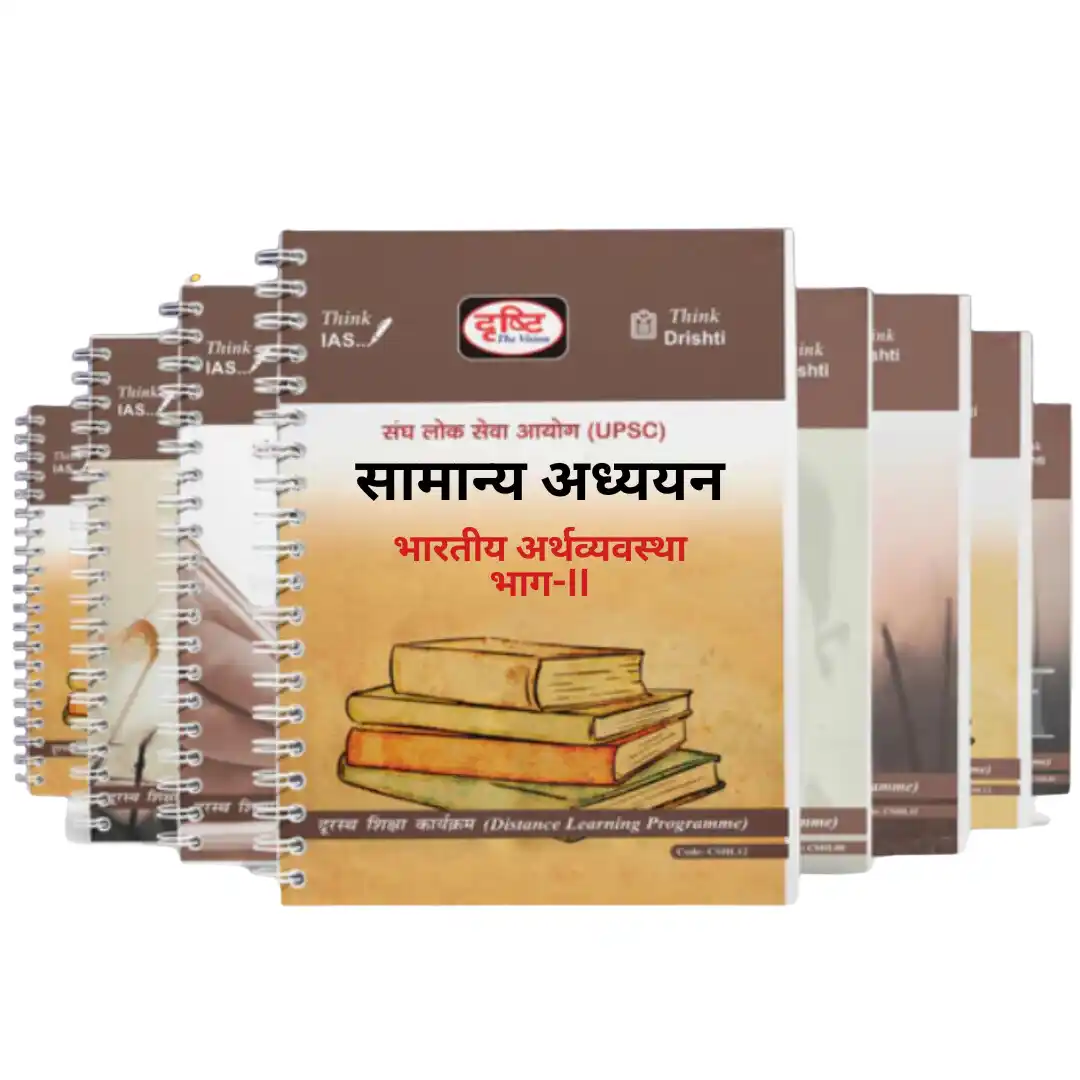
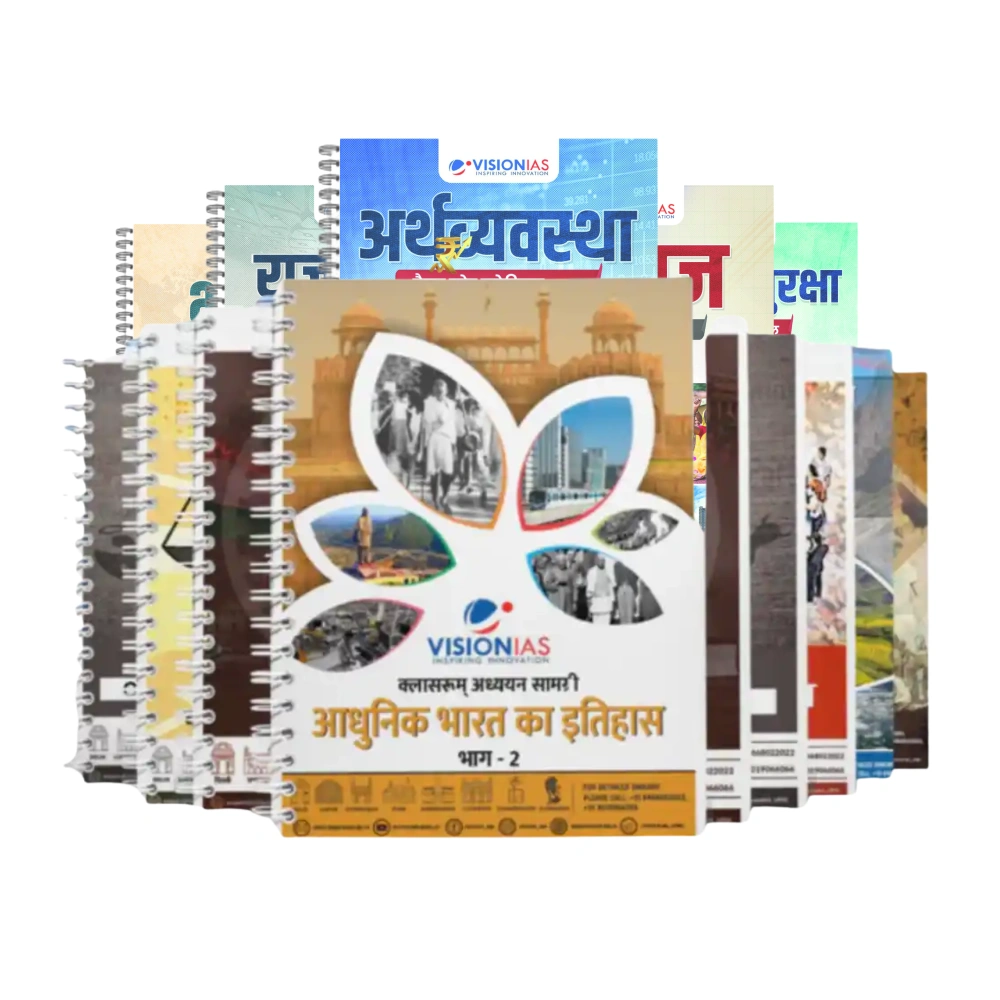
Recommended workflow: build strong subject notes early, run a continuous current-affairs habit, and test relentlessly. Hindi-medium aspirants can anchor their foundation on a complete Hindi package like the Drishti IAS GS Notes in Hindi or the more extensive Vision IAS Hindi GS Notes (54 booklets), then layer UP-specific study on top.
Common Mistakes to Avoid
- Treating CSAT as automatic — every year serious candidates fail the 33% qualifying bar.
- Under-preparing GS V & VI, assuming UPSC material is enough — it is not for the UP papers.
- Ignoring General Hindi (150 marks) and Essay (150 marks) until the last month.
- No answer-writing practice — Mains is descriptive; theory alone does not convert to marks.
- Skipping previous-year question paper analysis, which reveals recurring UP themes.
- Chasing too many sources — one standard note set per subject, revised multiple times, beats ten unfinished books.
UPPCS Syllabus PDF Download (Hindi & English)
You can download the official UPPCS syllabus PDF directly from the UPPSC website. Because question papers are bilingual, the same document serves both mediums; a Hindi-structured breakdown is essential for the large Hindi-medium aspirant base.
| Resource | Where to Get It |
|---|---|
| Official UPPCS syllabus PDF (English) | uppsc.up.nic.in → Candidate Segment → Syllabus |
| UPPCS syllabus PDF (Hindi) | Same official portal — notification/syllabus section (bilingual) |
| Official notification | UPPSC Combined State/Upper Subordinate Services advertisement |
How to download the UPPCS syllabus PDF in Hindi?
Visit the official UPPSC website at uppsc.up.nic.in, open the “Candidate Segment” or the relevant Combined State/Upper Subordinate Services notification, and locate the Syllabus link. The syllabus document is published bilingually, so the same PDF contains the Hindi (हिंदी) version of the Prelims and Mains topics. Download and save it directly — the official copy is free and does not require sign-up.
Best Study Material for UPPCS 2026
Since the UPPCS syllabus overlaps heavily with UPSC GS, the same high-quality GS material works for both — you simply add a UP-specific layer. A strong combination is a complete GS notes set, a current-affairs magazine subscription, and a CSAT test series. For a full national-GS foundation, the Vision IAS GS 2026-27 booklets (English) or the Hindi GS notes cover Papers I-IV comprehensively, while a CSAT-focused resource keeps the qualifying paper safe. Layer the UP-specific study for GS V & VI on top of this national spine, and you have a complete, syllabus-aligned toolkit.
What is the total marks of UPPCS exam?
The final merit of the UPPCS exam is based on 1600 marks — Mains (1500) plus Interview/Personality Test (100). The Prelims (two papers of 200 marks each, total 400) is only a screening stage and its marks are not added to the final merit. So while you sit for 400 marks of Prelims, only the 1600 marks from Mains and Interview determine your rank and selection.
Frequently Asked Questions
What is the syllabus of UPPCS?
The UPPCS syllabus has three stages. Prelims covers General Studies (current affairs, history, geography, polity, economy, environment, science, UP GK) plus a qualifying CSAT paper. Mains has 8 compulsory papers — General Hindi, Essay, and GS I-VI — with GS V and VI focused on Uttar Pradesh. The final stage is a 100-mark Personality Test.
How many papers are there in UPPCS Mains?
There are 8 compulsory papers in UPPCS Mains 2026: General Hindi (150 marks), Essay (150 marks), and six General Studies papers GS I to GS VI (200 marks each). The total is 1500 marks. There is no optional subject anymore.
Has the optional subject been removed from UPPCS Mains?
Yes. From 2026, UPPSC removed all optional subjects and replaced them with two new compulsory papers — GS V and GS VI — dedicated to Uttar Pradesh’s history, geography, economy, governance and development. The Mains is now fully General-Studies-based.
Is CSAT qualifying in UPPCS?
Yes, CSAT (Prelims Paper 2) is qualifying. You need a minimum of 33% (66 out of 200 marks) to clear it. Only General Studies Paper 1 counts toward the Prelims merit ranking, but failing CSAT disqualifies you regardless of your GS score.
Is the UPPCS syllabus the same as UPSC?
The core General Studies topics overlap around 70-80%, so most UPSC material is reusable. The key differences: UPPCS has no optional subject, adds two Uttar Pradesh-specific GS papers, and includes a General Hindi section in CSAT. You must add UP-focused and Hindi preparation on top of shared GS study.
What is the total marks of the UPPCS exam?
The final merit is out of 1600 marks — Mains (1500) plus Interview (100). Prelims (400 marks total across two papers) is only a screening stage and is not counted in the final merit.
Is the UPPCS syllabus available in Hindi?
Yes. UPPSC publishes the syllabus bilingually, so the UPPCS syllabus in Hindi and English is contained in the same official PDF on uppsc.up.nic.in. Because the question papers themselves are bilingual, Hindi-medium and English-medium aspirants study identical topics.
What is different in the UPPSC syllabus 2026 compared to earlier years?
The major change in the UPPSC syllabus 2026 is the removal of optional subjects from the Mains and the introduction of two Uttar Pradesh-specific papers, GS V and GS VI. The Prelims pattern (GS + qualifying CSAT) and the overall three-stage structure remain the same as before.
Recommended Study Material
Continue Reading
JPSC Syllabus 2026: Prelims, Mains Pattern + PDF
The JPSC syllabus for the Combined Civil Services Examination is prescribed by the Jharkhand Public Service Commission (JPSC,…
DSSSB Syllabus 2026: PRT, TGT, PGT Exam Pattern + PDF Download
The DSSSB syllabus for 2026 is built around a two-stage structure: a Tier 1 Computer-Based Test of 200…
Best Study Material for UPSC 2026: Subject-Wise Buying Guide
The best study material for UPSC is a four-layer stack: NCERT textbooks (Class 6–12), one standard reference book…