Best Study Material for UPSC 2026: Subject-Wise Buying Guide
The best study material for UPSC 2026: subject-wise booklist, NCERT plan, coaching notes compared, Hindi-medium list, and budget kits from ₹2,000.

The best study material for UPSC is a four-layer stack: NCERT textbooks (Class 6–12), one standard reference book per GS subject — Laxmikanth for Polity, Spectrum for Modern History, Ramesh Singh for Economy — one monthly current affairs magazine, and optionally one set of coaching printed notes for fast revision. A Prelims-ready starter kit costs about ₹2,000–2,500; a full Prelims-plus-Mains kit with coaching notes and a test series runs ₹11,000–13,000. UPSC rewards 3–4 revisions of limited sources, not a bigger bookshelf — anything beyond this upsc study material list 2026 is redundant.
| Layer | What to Buy | Cost |
|---|---|---|
| 1. NCERTs | Class 6–12, key subjects | Free PDFs or ₹1,200–1,500 printed |
| 2. Standard books | One per GS subject (7 books) | ~₹3,500 |
| 3. Current affairs | One newspaper + one monthly magazine | ₹250–350/month |
| 4. Coaching notes (optional) | One GS booklet set | ₹4,000–6,600 |
Layer 1: NCERTs — The Non-Negotiable Foundation
Roughly 25–35 Prelims questions every year are traceable to NCERT-level concepts. Buy printed sets or download free PDFs from ncert.nic.in:
- History: Class 6–8 (old editions), Class 11–12 Themes in Indian History
- Geography: Class 11–12 (Fundamentals of Physical and Human Geography, India: Physical Environment)
- Polity: Class 9–12 (Indian Constitution at Work is the key one)
- Economy: Class 11 Indian Economic Development, Class 12 Macroeconomics
- Science: Class 6–10, selectively
Finish these once before touching reference books — they make everything after faster.
Best Study Material for UPSC: The Subject-Wise Standard Booklist
| Subject | Book (Latest Edition) | Approx. Price |
|---|---|---|
| Polity | Indian Polity — M. Laxmikanth, 7th edition (covers J&K reorganisation, recent amendments) | ₹550–650 |
| Modern History | Spectrum’s A Brief History of Modern India, 2025 edition | ₹300–400 |
| Economy | Indian Economy — Ramesh Singh, 16th edition | ₹750–900 |
| Geography | Certificate Physical & Human Geography — G.C. Leong; Geography of India — Majid Husain | ₹700–850 (both) |
| Art & Culture | Indian Art and Culture — Nitin Singhania, latest edition | ₹500–600 |
| Science & Tech | Science and Technology — Ravi P. Agrahari, latest edition | ₹450–550 |
| Environment | Environment — Shankar IAS Academy | ₹300–400 |
One book per subject. Buying two references for the same subject is the single most common money-wasting mistake.
Best Study Material for UPSC Prelims and Mains: Stage-Wise Plan
The best study material for UPSC Prelims is fact-dense and PYQ-driven; the best study material for UPSC Mains is analysis-heavy. Stage your purchases accordingly:
| Stage | Buy | Skip for Now |
|---|---|---|
| Months 1–6 (foundation) | NCERTs, Laxmikanth, Spectrum, Ramesh Singh, one monthly magazine | Optional notes, mains test series |
| Months 7–10 (Prelims push) | Topic-wise PYQ pack, prelims test series, CSAT practice set | New theory books |
| Post-Prelims (Mains) | GS2/GS3 value-added material, ethics and essay notes, optional notes | — |
For Mains, GS Paper 1 runs on the same history and geography books; GS2 and GS3 need current-affairs-linked notes (coaching value-added materials work well); GS4 needs one ethics booklet plus case-study practice; Essay needs a slim set such as Vajiram’s ₹488 essay booklet.
Best Coaching Study Material for UPSC: A Neutral Comparison
Coaching printed notes are a compression layer, not a replacement for standard books. Here is how the four most-bought GS sets on Competer compare:
| Set | Booklets | Price | Best For | Rating |
|---|---|---|---|---|
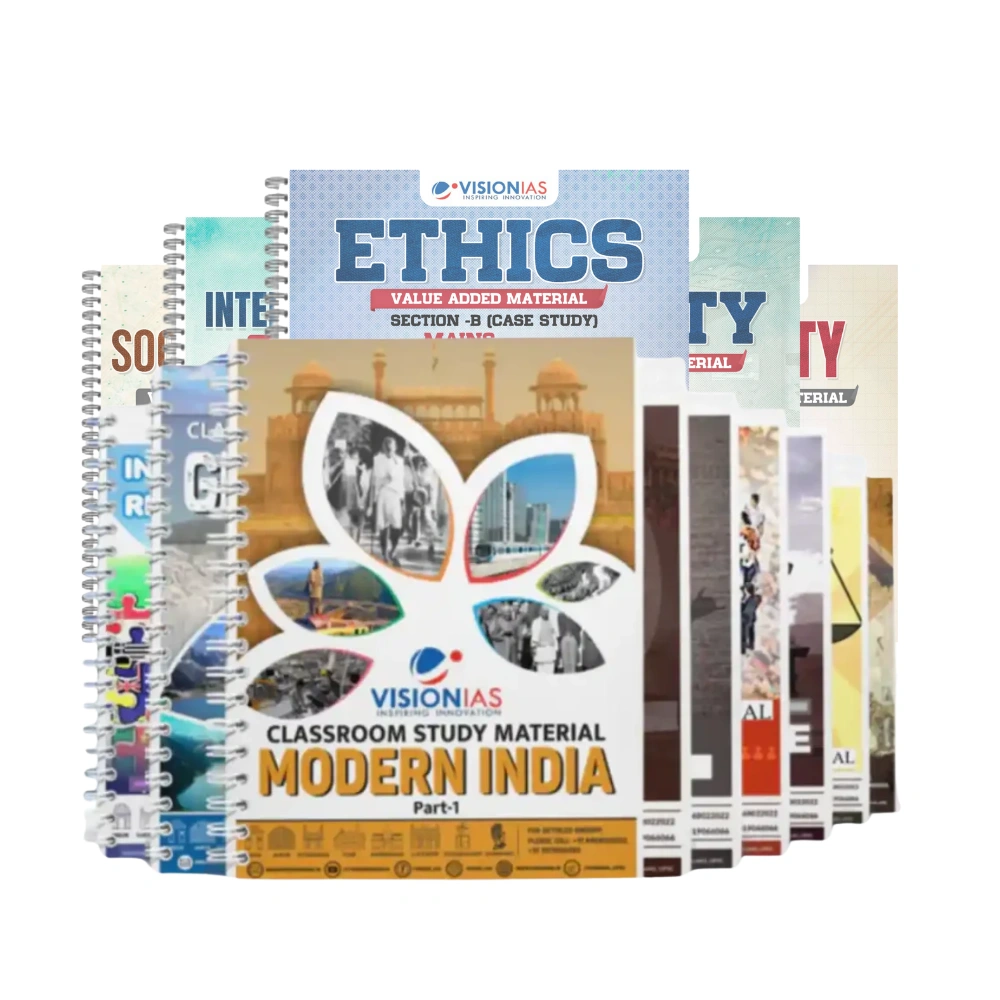
| Vision IAS GS 2026–27 (with VAMs) | 56 | ₹6,599 | Concise revision + mains value addition | 4.2★ (259) |
| Vajiram & Ravi GS 2026 | 27 | ₹4,899 | Classroom-depth polity and economy | 4.2★ (261) |
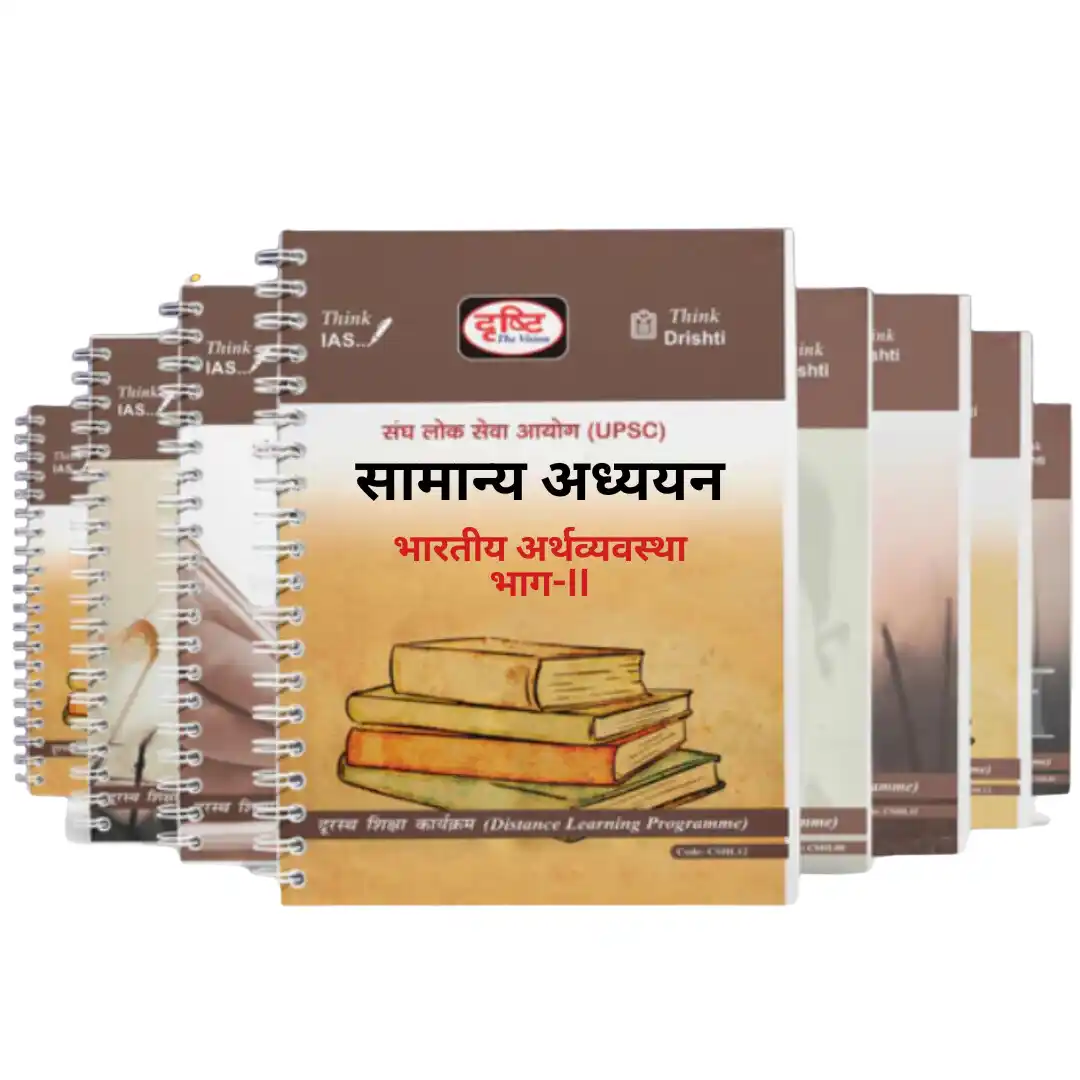
| Drishti IAS (English 27 / Hindi 18) | 27 / 18 | ₹4,999 / ₹3,999 | Hindi-medium aspirants, lucid language | 4.3★ (264) |
| Next IAS 2025–26 | 18 | ₹4,288 | Science & tech, compact GS coverage | 4.2★ (253) |
If you buy only one set, the Vision IAS GS 2026–27 booklets (56 booklets, ₹6,599) remain the most widely used because the Value Added Materials double as mains answer fodder.
Budget-Tiered Buying Plan (Exact Totals)
- ₹2,000–2,500 starter kit: Free NCERT PDFs + Laxmikanth (~₹600) + Spectrum (~₹350) + Ramesh Singh (~₹800) + two monthly magazines (~₹400). This core is the best study material for IAS self study at the foundation stage.
- ₹5,500–6,000 mid kit: Starter kit + Shankar Environment + Singhania Art & Culture + a topic-wise PYQ pack (~₹2,245).
- ₹12,000–13,000 full kit: Mid kit + one coaching GS set + the Vision IAS Prelims Test Series 2026 (₹1,249) + 10–12 monthly magazines.
Hindi-Medium Study Material for UPSC
Hindi-medium aspirants should use NCERT Hindi editions, Bharat ki Rajvyavastha (Laxmikanth), Spectrum’s Adhunik Bharat ka Itihas and Ramesh Singh’s Bhartiya Arthvyavastha. For coaching notes, Drishti IAS Hindi Study Material (18 booklets, ₹3,999) is the most-reviewed Hindi GS set, Vision IAS publishes its monthly magazine in Hindi (₹225–299), and Drishti and Forum IAS both run Hindi prelims test series.
What NOT to Buy: Five Money-Wasting Mistakes
- Two reference books for the same subject — pick one economy book, not Ramesh Singh and a second title.
- Optional-subject notes before your Prelims foundation is done.
- Outdated editions — a pre-2020 Laxmikanth misses J&K reorganisation and recent amendments.
- Newspaper + two magazines + daily CA PDFs simultaneously; one newspaper and one monthly magazine suffice.
- Multiple toppers’ handwritten notes — they were written for their revision, not yours.
Current Affairs + Best Online Study Material for UPSC (Free)
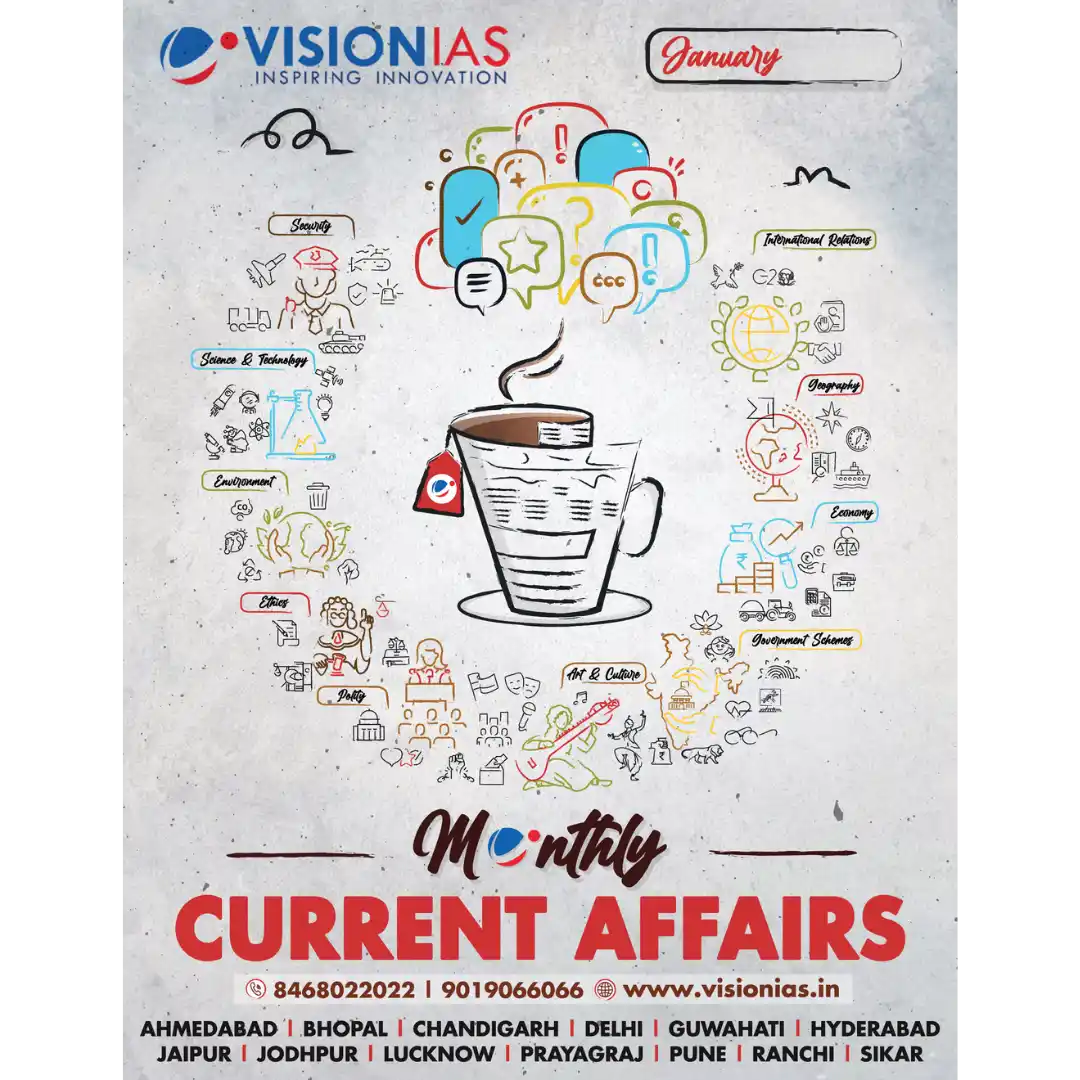
Read The Hindu or Indian Express daily (45–60 minutes maximum) and consolidate with one monthly compilation — the Vision IAS Current Affairs Magazine January 2026 (₹299) is the most widely used. Add Yojana and Kurukshetra selectively for mains enrichment. Free online sources: PIB releases, Sansad TV discussions, PRS Legislative Research bill summaries, ncert.nic.in PDFs, and free daily quizzes from major coaching websites.
One Revision System + Buying Timeline
Combine the layers: standard book for the first reading → one-page-per-chapter self-notes → coaching booklet as the second-reading compressor → monthly magazine notes merged into the same subject file. Target 3–4 full revision cycles before Prelims. Timeline: months 1–2 NCERTs + Laxmikanth + Spectrum; month 3 economy + environment; months 4–6 coaching GS set + magazine subscription; months 7–8 test series + PYQ pack; post-Prelims ethics, essay and optional notes.
FAQ
Which study material is best for UPSC preparation?
NCERTs plus one standard book per subject (Laxmikanth, Spectrum, Ramesh Singh, Leong, Singhania, Agrahari, Shankar), one monthly current affairs magazine, and PYQs. Coaching printed notes are an optional time-saving layer.
Is NCERT enough for UPSC Prelims?
No. NCERTs build the base, but roughly two-thirds of Prelims questions need standard reference books, current affairs and PYQ practice on top. NCERT is necessary, not sufficient.
Which coaching institute’s study material is best for UPSC?
Vision IAS booklets are the most widely used for GS revision and value addition, Vajiram offers deeper classroom-style coverage, and Drishti IAS leads for Hindi medium. Choose by medium and stage, not brand.
Can I crack UPSC with self-study material only?
Yes — every recent batch includes rankers who prepared without classroom coaching using the booklist above. The one near-mandatory paid component is a test series for evaluation and exam temperament.
How can I get free study material for UPSC?
Download NCERT PDFs from ncert.nic.in, follow PIB and Sansad TV for current affairs, use PRS India for bills and acts, and pick up free daily quizzes and sample PDFs from coaching websites.
Are printed notes of Vision IAS good for UPSC?
Yes, as a revision and consolidation layer. The 2026–27 set of 56 booklets holds a 4.2★ average from 259 buyers on Competer, and its Value Added Materials are especially useful for GS2/GS3 mains answers.
Which books should I buy first for UPSC 2026?
Start with Laxmikanth’s Indian Polity, Spectrum’s Modern India, the relevant NCERTs and one monthly magazine — roughly ₹2,000 in total. Add economy, environment and coaching notes only after one full reading.
Is coaching material necessary for UPSC, or are standard books enough?
Standard books cover the full syllabus, so coaching material is not mandatory. Its real value is compression — 18–56 booklets that roughly halve second-reading time — and ready current-affairs linkage for mains.
Is online (PDF) study material as good as printed books for UPSC?
For NCERTs, PIB and PRS, free PDFs work fine. For standard books and coaching notes that you will revise 3–4 times with margin notes, most aspirants retain better with print. Pick one mode per source and annotate it consistently rather than maintaining both.
Recommended Study Material
Continue Reading
RRB NTPC Syllabus 2026: CBT 1 & CBT 2 Subjects, Pattern + PDF Download
The RRB NTPC syllabus is built around two computer-based stages — CBT 1 and CBT 2 — and…
Super TET Syllabus 2025: Subject-Wise Marks + PDF
The Super TET syllabus is a single 150-mark objective paper covering 10 subject heads — Language (40 marks),…
SSC JE Syllabus 2026: Civil, Electrical & Mechanical + PDF
Quick answer: The SSC JE syllabus is split across two Computer-Based papers — Paper 1 (200 marks: General…