CTET Paper 2 Syllabus 2026: Subjects, Pattern + PDF
Complete CTET Paper 2 syllabus 2026 — subject-wise topics, marks, exam pattern, content-vs-pedagogy split, language codes, PDF checklist & prep strategy for Classes 6-8.

The CTET Paper 2 syllabus covers five sections for a total of 150 marks: Child Development & Pedagogy (30), Language I (30), Language II (30), and either Mathematics & Science (60) or Social Studies/Social Science (60). Paper 2 is meant for candidates who want to teach Classes 6 to 8, it is conducted by the CBSE, and its subject content is based on the NCERT curriculum. Both languages and Child Development & Pedagogy are compulsory, while you choose one optional subject group based on your teaching background. There is no negative marking, and you need 60% (90/150) to qualify.
This guide gives you the complete, chapter-by-chapter ctet paper 2 syllabus 2026, the exam pattern, the exact content-versus-pedagogy split for every subject, the language code list, a printable PDF-checklist plan, and a section-wise preparation strategy — everything a Classes 6–8 aspirant needs to plan preparation in one place.
Quick Answer: CTET Paper 2 Syllabus at a Glance
- Sections: 4 sections you attempt (CDP, Language I, Language II, and one optional subject group).
- Compulsory: Child Development & Pedagogy (30) + Language I (30) + Language II (30) = 90 marks.
- Optional (pick one): Mathematics & Science (60) or Social Studies/Social Science (60).
- Total: 150 MCQs / 150 marks / 150 minutes (2.5 hours), no negative marking.
- Basis: NCERT curriculum of Classes VI–VIII; questions target the 11–14 age group.
- Passing mark: 60% (90/150) for General; ~55% relaxation for reserved categories as per the appointing authority.
CTET Paper 2 Syllabus 2026: Overview
The Central Teacher Eligibility Test (CTET) is conducted by the Central Board of Secondary Education (CBSE) to certify eligibility for teaching posts in central government schools. Paper 2 is for candidates aspiring to become teachers for Classes VI to VIII (upper primary/elementary level). A valid CTET Paper 2 certificate is required for teaching vacancies in Kendriya Vidyalayas (KVs), Navodaya Vidyalayas (NVs), Central Tibetan Schools, and schools under the administrative control of the central government, and it is widely accepted by many state and private schools.
The entire syllabus is anchored to the NCERT curriculum of the relevant classes. Questions test not just subject knowledge but also your understanding of the concepts, their pedagogical application, and your teaching-learning ability at the elementary level. The CTET is conducted in Computer-Based Test (CBT) mode, with a bilingual (English and Hindi) question paper.
Key Facts at a Glance
| Parameter | Detail |
|---|---|
| Conducting Body | Central Board of Secondary Education (CBSE) |
| Applicable For | Teachers of Classes VI–VIII (Upper Primary) |
| Total Questions | 150 Multiple Choice Questions (MCQs) |
| Total Marks | 150 |
| Duration | 2.5 hours (150 minutes) |
| Mode | Computer-Based Test (CBT) |
| Negative Marking | None |
| Languages | English & Hindi (bilingual question paper) |
| Curriculum Base | NCERT syllabus of Classes VI–VIII |
| Certificate Validity | Lifetime |
CTET Paper 2 Exam Pattern 2026
Understanding the ctet paper 2 exam pattern is the first step in building an efficient study plan. The paper carries 150 objective-type questions of one mark each, and every question has four options with a single correct answer. There is no negative marking, so you should attempt all 150 questions. You get 2.5 hours to complete the test, which works out to roughly one minute per question.
| Section | Compulsory / Optional | No. of Questions | Marks |
|---|---|---|---|
| Child Development & Pedagogy | Compulsory | 30 | 30 |
| Language I | Compulsory | 30 | 30 |
| Language II | Compulsory | 30 | 30 |
| Mathematics & Science OR | Optional (choose one group) | 60 | 60 |
| Social Studies / Social Science | Optional (choose one group) | 60 | 60 |
| Total | — | 150 | 150 |
The structure is fixed: Child Development & Pedagogy and both languages are compulsory for every candidate. Only the fourth block changes — a Mathematics/Science teacher attempts the Maths & Science section, while a candidate from a humanities background attempts Social Studies/Social Science. A candidate targeting all subjects at the elementary level may appear for either group, but writes only one 60-mark section in a single sitting.
How Many Subjects Are There in CTET Paper 2?
Effectively you attempt four sections: Child Development & Pedagogy, Language I, Language II, and one optional subject group (Maths & Science or Social Science). The Maths & Science group internally splits into two subjects (30 marks Mathematics + 30 marks Science), while the Social Science group is a single 60-mark paper covering History, Geography, and Social & Political Life together.
CTET Paper 2 Marks & Qualifying Criteria
To qualify, a candidate must score at least 60% overall — that is 90 out of 150 marks. For reserved categories (SC/ST/OBC/PwD/EWS), states and appointing bodies typically relax this to around 55%, though the appointing authority’s rules apply. The score is calculated on the full 150 marks, not section-wise, so strong performance in the 60-mark optional block can compensate for a weaker language section.
| Category | Qualifying % | Marks (out of 150) |
|---|---|---|
| General | 60% | 90 |
| SC / ST / OBC / PwD / EWS | 55% (as per relaxation) | ~82–83 |
The CTET certificate is valid for a lifetime, so once you clear Paper 2 you never need to re-qualify for eligibility purposes, though you may reappear to improve your score. Note that qualifying CTET establishes eligibility only — it does not by itself guarantee a teaching job; actual appointment depends on the recruiting body’s separate selection process.
Child Development and Pedagogy Syllabus (30 Marks)
The ctet paper 2 child development and pedagogy syllabus is identical in structure to Paper 1 but frames questions around the 11–14 year age group (adolescents). This section is a scoring goldmine because it is theory-based and repeats predictable concepts year after year. The 30 marks are broadly split into three areas.
| Sub-area | Approx. Questions | Key Topics |
|---|---|---|
| Child Development | ~15 | Concept of development & its relationship with learning; principles of development of children; influence of heredity & environment; socialisation processes; Piaget, Kohlberg & Vygotsky (construct & critical perspectives); concepts of child-centred & progressive education; intelligence & its construct; multi-dimensional intelligence; language & thought; gender as a social construct; individual differences among learners; assessment for learning vs assessment of learning |
| Inclusive Education | ~5 | Addressing learners from diverse backgrounds; addressing the needs of children with learning difficulties, impairment etc.; addressing talented, creative & specially-abled learners |
| Learning & Pedagogy | ~10 | How children think and learn; children as problem solvers; alternative conceptions of learning; cognition & emotions; motivation and learning; factors contributing to learning (personal & environmental) |
Because this section rewards conceptual clarity over memorisation, focus on understanding the developmental theories and their classroom implications rather than rote-learning definitions. Pay special attention to how each theory applies to adolescent learners, since that framing is what separates Paper 2 questions from Paper 1.
Language I & Language II Syllabus (30 + 30 Marks)
Both languages are compulsory. Language I is your medium of instruction and tests proficiency in that language, while Language II tests your elements of language, comprehension, and communication ability — it must be different from Language I. Each language section carries 30 marks, split between comprehension passages and language pedagogy.
| Component | Language I (30) | Language II (30) |
|---|---|---|
| Reading Comprehension | ~15 marks: 2 unseen prose/drama passages (literary, narrative or discursive) with questions on comprehension, inference, grammar & verbal ability | ~15 marks: 2 unseen prose passages (discursive or literary) with questions on comprehension, grammar & verbal ability |
| Pedagogy of Language Development | ~15 marks: learning & acquisition; principles of language teaching; role of listening & speaking; language skills; evaluating language comprehension; teaching-learning materials; remedial teaching | ~15 marks: same pedagogy sub-topics as Language I; challenges of teaching language in a diverse classroom; role of grammar in learning a language |
Note that Language I usually includes a poetry passage and leans more literary, while Language II leans towards discursive/factual passages. Choose the language you are most fluent in as Language I to maximise the comprehension marks, and remember that the language pedagogy half of each section is high-scoring because the concepts repeat across cycles.
Mathematics & Science Syllabus (60 Marks)
The ctet paper 2 maths and science syllabus is for candidates with a Maths/Science teaching background. This 60-mark block is divided into Mathematics (30 marks) and Science (30 marks). Within each, roughly 20 questions are content-based and 10 are pedagogy-based — a critical detail for scoring that most competitors omit.
Mathematics (30 Marks) — Content + Pedagogy
| Area | Chapter-wise Topics (Checklist) |
|---|---|
| Number System | Knowing our numbers; playing with numbers; whole numbers; negative numbers & integers; fractions |
| Algebra | Introduction to algebra; ratio and proportion |
| Geometry | Basic geometrical ideas (2-D); understanding elementary shapes (2-D & 3-D); symmetry: reflection; construction (using straight edge, scale, protractor, compasses) |
| Mensuration | Area & perimeter of plane figures; volume & surface area concepts |
| Data Handling | Collection, organisation & interpretation of data; bar graphs; basic probability & statistics concepts |
| Pedagogical Issues (~10 marks) | Nature of mathematics/logical thinking; place of mathematics in curriculum; language of mathematics; community mathematics; evaluation through formal & informal methods; problems of teaching; error analysis & diagnostic/remedial teaching |
Science (30 Marks) — Content + Pedagogy
| Area | Chapter-wise Topics (Checklist) |
|---|---|
| Food | Sources of food; components of food; cleaning food |
| Materials | Materials of daily use; grouping & separation of materials; changes around us |
| The World of the Living | Living & non-living; plants & animals; the cell; microorganisms; reproduction; diversity & adaptation |
| Moving Things, People & Ideas | Motion; force; simple machines; transport & communication |
| How Things Work | Electric current & circuits; magnets & magnetism |
| Natural Phenomena | Light & reflection; sound; natural events (rain, thunder, earthquake) |
| Natural Resources | Air, water, soil; conservation; sources of energy; pollution |
| Pedagogical Issues (~10 marks) | Nature & structure of science; natural science aims & objectives; understanding & appreciating science; approaches/integrated approach; observation/experiment/discovery (method of science); innovation; text material/aids; evaluation; problems; remedial teaching |
A common mistake is to over-prepare content and neglect pedagogy. Since pedagogy is worth about a third of this block (roughly 20 of 60 marks across Maths and Science) and repeats predictable themes, it delivers the highest return per hour of study.
Social Studies / Social Science Syllabus (60 Marks)
The ctet paper 2 social science syllabus is for candidates from a humanities/arts background. This 60-mark paper is split into 40 marks of content (History, Geography, Social & Political Life) and 20 marks of pedagogy. Understanding this content-vs-pedagogy weightage helps you allocate revision time correctly.
| Component | Marks | Major Topics (Checklist) |
|---|---|---|
| History | ~20 | When, where & how; earliest societies; first farmers & herders; first cities; early states; new ideas; first empire; contacts with distant lands; political developments; culture & science; new kings & kingdoms; Sultans of Delhi; architecture; creation of an empire; social change; regional cultures; Revolt of 1857-58; women & reform; challenging the caste system; the nationalist movement; India after independence |
| Geography | ~10 | Geography as a social study & a science; planet earth in the solar system; globe; environment (its components); air; water; human environment (settlement, transport, communication); resources (types — natural & human); agriculture |
| Social & Political Life | ~10 | Diversity; government (local, state, central); democracy; state government; understanding media; unpacking gender; the Constitution; parliamentary government; the judiciary; social justice & the marginalised; economic presence of the government |
| Pedagogical Issues | ~20 | Concept & nature of Social Science/Social Studies; class-room processes, activities & discourse; developing critical thinking; enquiry/empirical evidence; problems of teaching Social Science; sources — primary & secondary; projects work; evaluation |
Because the pedagogy component here is a full 20 marks — larger than in the Maths & Science group — Social Science candidates should treat teaching methodology as a core subject in its own right, not an afterthought.
Content vs Pedagogy Split in CTET Paper 2
One of the most under-explained aspects of the ctet paper 2 syllabus is how many marks come from pure subject content versus teaching pedagogy. Getting this right lets you plan revision around where the marks actually sit rather than where the reading feels heaviest.
| Section | Content Marks | Pedagogy Marks |
|---|---|---|
| Child Development & Pedagogy | — | 30 (fully pedagogy/theory) |
| Language I | ~15 (comprehension) | ~15 |
| Language II | ~15 (comprehension) | ~15 |
| Maths & Science (if chosen) | ~40 | ~20 |
| Social Science (if chosen) | ~40 | ~20 |
Add it up and roughly 80–90 of the 150 marks are tied to pedagogy and teaching methodology rather than raw subject facts. That is why toppers treat pedagogy as the backbone of their preparation.
CTET Paper 2 Language Code List (Language I & II)
The CBSE allows you to choose Language I and Language II from an official list of about 20 languages, each with a specific code you must enter in the application form. Language I and Language II must be two different languages.
| Code | Language | Code | Language |
|---|---|---|---|
| 01 | English | 11 | Manipuri |
| 02 | Hindi | 12 | Marathi |
| 03 | Assamese | 13 | Mizo |
| 04 | Bengali | 14 | Nepali |
| 05 | Garo | 15 | Oriya (Odia) |
| 06 | Gujarati | 16 | Punjabi |
| 07 | Kannada | 17 | Sanskrit |
| 08 | Khasi | 18 | Tamil |
| 09 | Malayalam | 19 | Telugu |
| 10 | Marathi/Tibetan | 20 | Urdu |
Selection rule: Language I is the medium in which you are most proficient and intend to teach; Language II must be different from Language I and is usually English or Hindi. Verify the current official list and codes in the CTET notification before filling the form, as the exact code order can be revised.
CTET Paper 1 vs Paper 2 Syllabus: The Difference
Candidates often ask how Paper 1 and Paper 2 differ. The structure (CDP + two languages + subject block, 150 marks) is the same, but the target class level and the fourth subject block change substantially.
| Aspect | Paper 1 | Paper 2 |
|---|---|---|
| For teaching | Classes I–V (Primary) | Classes VI–VIII (Upper Primary) |
| CDP | Age 6–11 focus | Age 11–14 (adolescent) focus |
| Subject block | Mathematics (30) + Environmental Studies (30) | Maths & Science (60) OR Social Science (60) — choose one |
| Choice of optional | No choice; EVS is fixed | Candidate chooses subject group |
| Content depth | Foundational/primary level | Deeper, subject-specialised level |
If you want to teach both primary and upper-primary classes, you can appear for both papers in the same cycle and pay the fee for both. Clearing Paper 1 makes you eligible for Classes I–V, while clearing Paper 2 makes you eligible for Classes VI–VIII.
Should You Choose Maths & Science or Social Science?
This decision should be driven by your graduation background and comfort, not by which section “looks easier.” A wrong choice can cost you the 60-mark block.
- Choose Maths & Science if you graduated in science/engineering/mathematics streams (B.Sc., B.Tech, or a science-heavy B.Ed.), or you are comfortable with numerical problem-solving and formulas. This group has more calculation and less rote learning.
- Choose Social Science if you have an arts/humanities background (B.A. in History, Geography, Political Science, Economics) or you prefer reading, memory-based, and conceptual questions over calculations.
- Note on eligibility: Your appointment eligibility is tied to the subject you qualify in. A Maths & Science pass typically makes you eligible for Maths/Science teaching posts, while a Social Science pass makes you eligible for Social Science posts — so align your choice with the subject you actually want to teach.
CTET Paper 2 Weightage & Preparation Strategy
A smart ctet paper 2 strategy allocates time to the highest-yield, most predictable sections first. Here is a section-wise priority and effort map based on scoring potential and repeat trends.
| Section | Marks | Scoring Potential | Priority |
|---|---|---|---|
| Child Development & Pedagogy | 30 | Very High (theory, repeats) | 1 |
| Pedagogy portions (of Maths/Sci or SST) | ~20 | High (fixed concepts) | 2 |
| Language I (your strong language) | 30 | High | 3 |
| Subject Content (Maths & Sci / SST) | ~40 | Moderate (NCERT-based) | 4 |
| Language II | 30 | Moderate | 5 |
High-Yield Preparation Tips
- Master NCERT first: The entire content syllabus is drawn from NCERT Classes VI–VIII. Read those textbooks cover to cover before touching any guide.
- Don’t skip pedagogy: Across CDP, language, and subject sections, roughly 80–90 of 150 marks are pedagogy/teaching-methodology based. Pedagogy is high-scoring and repeats every cycle.
- Solve previous year papers: CTET recycles concepts heavily. Solving 5–10 past papers reveals the exact question style and high-frequency topics.
- Practise CBT mock tests: Since the exam is computer-based, take timed online mocks to build speed — you have exactly one minute per question.
- Attempt everything: With no negative marking, leave no question blank; even an educated guess can add marks.
Best Books & Study Material for CTET Paper 2
Your core resource is the set of NCERT textbooks for Classes VI–VIII in your chosen subject group, supplemented by a good CDP/pedagogy guide and a previous-year question bank. Beyond CTET, many teaching aspirants also prepare for state TETs and civil-service exams, and a well-organised printed set makes revision far faster than juggling loose PDFs.
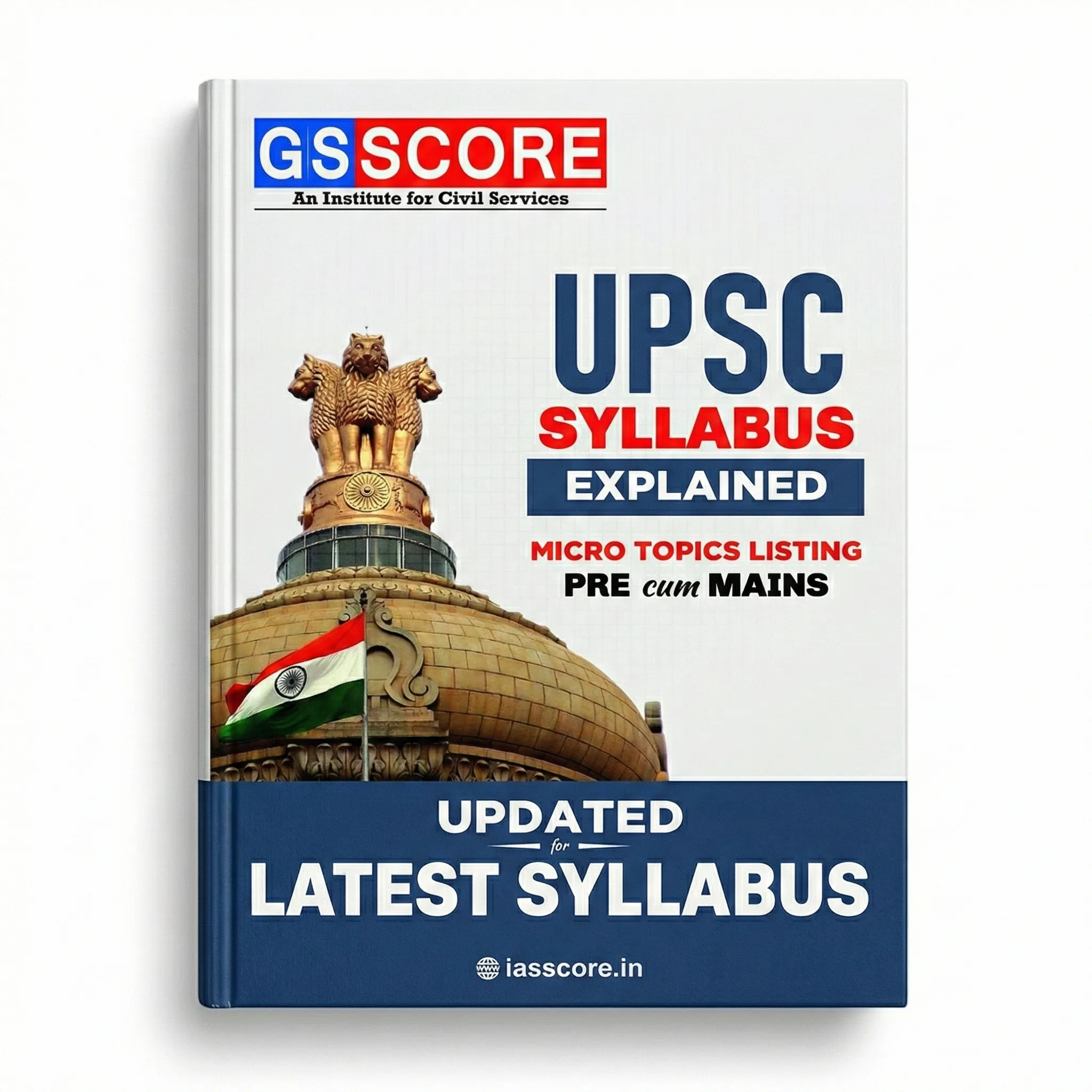
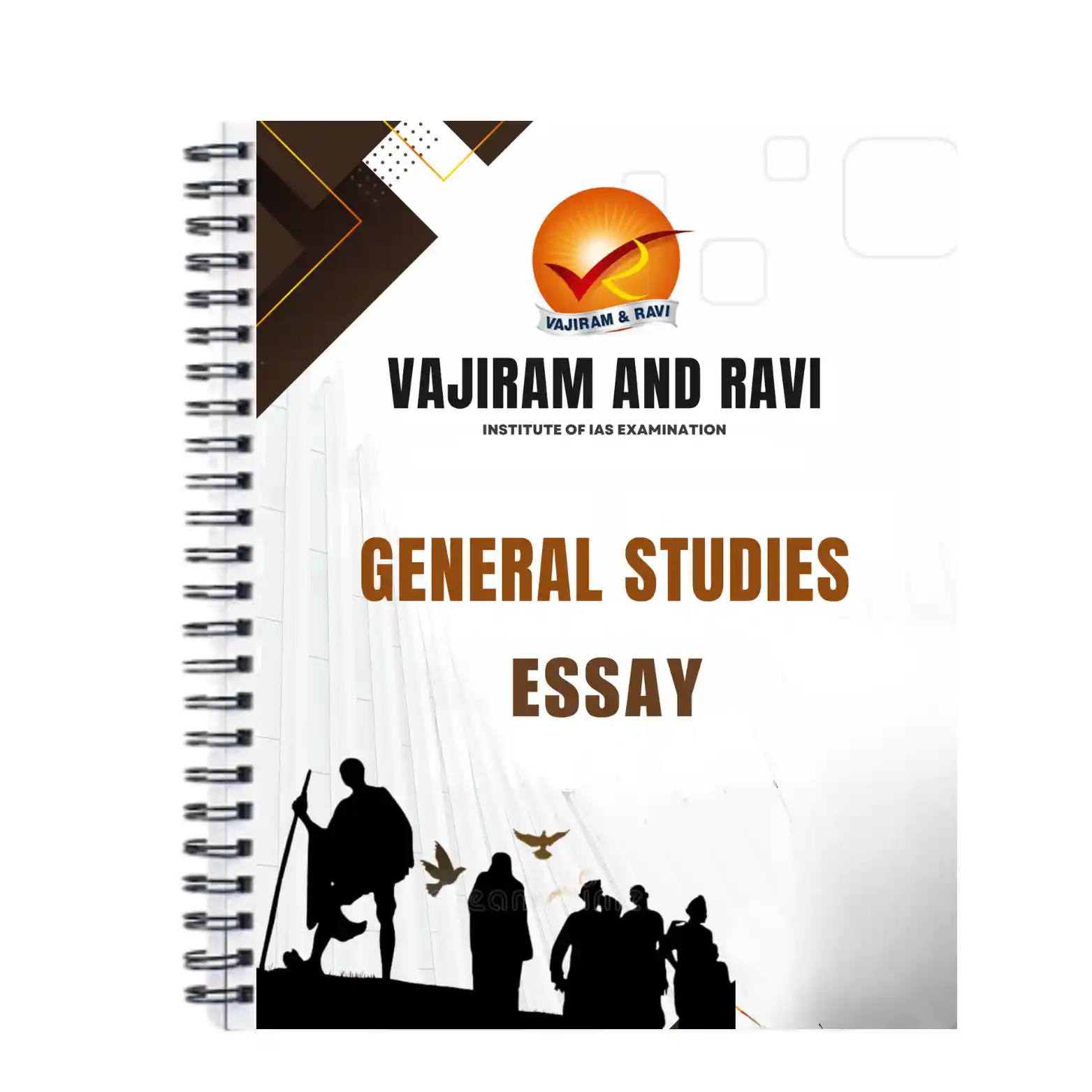
Competer prints and delivers structured study material across competitive exams. If you are also eyeing UPSC or state PCS alongside teaching, a compact syllabus booklet like the GS Score Latest Syllabus Booklet 2026-27 helps you map an entire syllabus at a glance — a habit that transfers directly to organising the CTET syllabus into a checklist. For candidates who want to sharpen comprehension and essay-style writing (useful for the language pedagogy sections), the Vajiram Essay Notes offer structured practice, and aspirants building broader social-science awareness often use concise notes such as the Vision IAS Economics Notes to reinforce fundamentals. Pair these with focused CTET practice and consistent mock testing to lock in your 60% target.
CTET Paper 2 Syllabus PDF Download
For offline revision, you can create your own ctet paper 2 syllabus pdf download from the official CTET notification available on the CBSE CTET website (ctet.nic.in). The official information bulletin contains the complete, authoritative syllabus with the language codes and the detailed subject topics. We recommend printing a subject-segregated checklist from the topic tables above so you can tick off each NCERT chapter as you complete it — a printable revision checklist is one of the fastest ways to track syllabus coverage in the final month.
Related links you will want next: the CTET notification & dates, eligibility criteria, exam pattern, mock tests, and previous year question papers — keep these handy alongside the syllabus so your preparation stays on schedule.
Frequently Asked Questions
What is the syllabus of CTET Paper 2?
The CTET Paper 2 syllabus has five sections totalling 150 marks: Child Development & Pedagogy (30), Language I (30), Language II (30), and either Mathematics & Science (60) or Social Studies/Social Science (60). The content is based on the NCERT curriculum of Classes VI–VIII and tests both subject knowledge and teaching pedagogy for the 11–14 age group.
How many subjects are there in CTET Paper 2?
You attempt four sections: Child Development & Pedagogy, Language I, Language II, and one optional subject group. The optional group is either Mathematics & Science (which internally splits into 30 marks Maths + 30 marks Science) or Social Studies/Social Science (a combined 60-mark paper of History, Geography and Social & Political Life).
Are both Language I and Language II compulsory in CTET Paper 2?
Yes. Both Language I and Language II are compulsory and each carries 30 marks. Language I is your medium of instruction and tests proficiency, while Language II tests elements of language, comprehension and pedagogy. The two languages you select must be different from each other.
Should I choose Maths & Science or Social Science in CTET Paper 2?
Choose Maths & Science if your graduation is in a science, engineering or mathematics stream or you are comfortable with numerical problem-solving. Choose Social Science if you have an arts/humanities background or prefer reading and memory-based questions. Because your teaching-post eligibility is tied to the subject you qualify in, align the choice with the subject you actually intend to teach rather than the section that seems easier.
Is there negative marking in CTET Paper 2?
No, there is no negative marking in CTET Paper 2. Every question carries one mark and there is no penalty for a wrong answer, so you should attempt all 150 questions within the 2.5-hour duration.
How many marks is CTET Paper 2 out of and what is the passing mark?
CTET Paper 2 is out of 150 marks (150 MCQs of one mark each). To qualify, candidates must score at least 60%, i.e. 90 out of 150 marks. Reserved categories (SC/ST/OBC/PwD/EWS) usually get relaxation to around 55% (about 82–83 marks) as per the appointing authority’s rules.
Is the CTET Paper 2 syllabus based on NCERT?
Yes. The subject content of CTET Paper 2 is based on the NCERT curriculum of Classes VI–VIII, though the difficulty level and linkages of the questions are up to the senior secondary standard. Thoroughly reading the relevant NCERT textbooks is the strongest foundation for clearing the exam.
What is the difference between CTET Paper 1 and Paper 2 syllabus?
Both papers share the same 150-mark structure (CDP + Language I + Language II + a subject block). The difference is the class level and the subject block: Paper 1 is for Classes I–V with a fixed Mathematics + Environmental Studies block, while Paper 2 is for Classes VI–VIII and lets you choose Mathematics & Science or Social Science. Paper 2’s Child Development & Pedagogy also focuses on the 11–14 adolescent age group and the subject content is more specialised.
Recommended Study Material
Continue Reading
UPSC Mains Syllabus 2026: All 9 Papers + PDF Download
The upsc mains syllabus for the Civil Services Examination 2026 consists of 9 descriptive papers — one Essay…
TNPSC Group 1 Syllabus 2026: Prelims, Mains + PDF
The tnpsc group 1 syllabus covers a three-stage selection — a Preliminary Examination (200 objective questions, 300 marks),…
HPSC Syllabus 2026: HCS Prelims, Mains (New Pattern) & PDF Download
The HPSC syllabus for the Haryana Civil Services (HCS) exam 2026 spans three stages — Preliminary (objective), Mains…