JEE Main 2026 Preparation: Study Plan, Timetable & Books
JEE Main 2026 preparation made simple: a 6-month study plan, daily timetable, subject-wise strategy, high-weightage chapters and the best books to score 99+.

JEE Main 2026 preparation works best when you combine a syllabus-first approach with a phase-wise study plan: build concepts from NCERT and standard modules (roughly 4-5 months), practise chapter-wise and previous-year questions (2 months), and finish with mock tests plus revision (final 4-6 weeks). Study 6-8 focused hours a day split across Physics, Chemistry and Maths, front-load high-weightage chapters, and log every mistake in an error notebook. Do this consistently and a 99+ percentile is realistic even without coaching.
This guide is a complete, ready-to-use roadmap — the JEE Main 2026 exam pattern, chapter-wise weightage tables, a 6-month plan, a printable daily timetable, subject-wise strategy, a marks-to-percentile map, a curated booklist, and separate plans for droppers, Class 12 students and first-timers. The weightage figures below are built from an analysis of the last several years of JEE Main question papers, so you can sequence your effort by where marks have actually appeared — not guesswork. Follow it end to end and you will not have to hunt across ten different websites for a strategy.
JEE Main 2026 Preparation: Quick Snapshot
Before you build a plan, fix the target and the timeline in your head. JEE Main 2026 is conducted by the National Testing Agency (NTA) in two sessions — Session 1 around late January 2026 and Session 2 around early April 2026 — and your better score of the two counts. That two-attempt structure is a gift: it lets you treat Session 1 as a high-stakes mock and peak for Session 2.
| Parameter | Details (JEE Main 2026) |
|---|---|
| Conducting body | National Testing Agency (NTA) |
| Sessions | Session 1 (January 2026) & Session 2 (April 2026) |
| Mode | Computer-Based Test (CBT); Paper 2 drawing offline |
| Papers | Paper 1 (B.E./B.Tech), Paper 2A (B.Arch), Paper 2B (B.Planning) |
| Subjects (Paper 1) | Physics, Chemistry, Mathematics |
| Total marks | 300 |
| Duration | 3 hours (180 minutes) |
| Best score counted | Higher NTA percentile of the two sessions |
How to Prepare for JEE Main 2026: The 5-Step Method
If you want a one-line answer to “how to prepare for JEE Main 2026”, it is this: master the syllabus from NCERT and standard modules, then convert that knowledge into speed and accuracy through relentless problem-solving and mock analysis. Here is the method broken into five steps you will see repeated throughout this guide.
- Step 1 — Know the battlefield: Internalise the exam pattern, marking scheme and the full syllabus before you touch a single problem.
- Step 2 — Build concepts: Finish the theory subject by subject using NCERT plus one reliable module set, chapter by chapter.
- Step 3 — Practise with weightage in mind: Solve chapter-wise questions, prioritising high-ROI chapters, then attempt previous-year papers (PYQs).
- Step 4 — Test under exam conditions: Take full-length mock tests weekly and analyse every mistake in an error notebook.
- Step 5 — Revise ruthlessly: In the last 30 days, only revise, take mocks and fix weak areas — no new topics.
JEE Main 2026 Exam Pattern & Marking Scheme
Your study plan must be built on the exact exam pattern, because that decides where your marks come from. JEE Main 2026 Paper 1 has 75 questions worth 300 marks — 25 questions per subject, all compulsory, split into 20 multiple-choice questions (Section A) and 5 numerical-value questions (Section B).
| Subject | Section A (MCQ) | Section B (Numerical) | Questions to attempt | Marks |
|---|---|---|---|---|
| Physics | 20 | 5 | 25 | 100 |
| Chemistry | 20 | 5 | 25 | 100 |
| Mathematics | 20 | 5 | 25 | 100 |
| Total | 60 | 15 | 75 | 300 |
The marking scheme is uniform across both sections: +4 for every correct answer and −1 for every wrong answer, including the numerical questions. Unattempted questions score zero. That negative marking means accuracy matters as much as speed — a rushed, low-accuracy attempt of 70 questions can score worse than a calm, high-accuracy attempt of 60.
JEE Main 2026 Syllabus: The Base of Your Plan
The JEE Main 2026 syllabus is drawn almost entirely from the Class 11 and Class 12 NCERT curriculum, which is why NCERT (especially for Chemistry) is non-negotiable. Map the syllabus first and treat every chapter as a checklist item you will tick off during the concept-building phase.
| Subject | Broad units to cover |
|---|---|
| Physics | Mechanics, Thermodynamics & Kinetic Theory, Oscillations & Waves, Electrostatics, Current Electricity, Magnetism & EMI, Optics, Modern Physics, Semiconductors, Experimental Skills |
| Chemistry | Physical (Mole Concept, Thermodynamics, Equilibrium, Electrochemistry, Kinetics), Inorganic (Periodic Table, Bonding, Coordination, p/d/f-block), Organic (GOC, Hydrocarbons, Functional Groups, Biomolecules, Polymers) |
| Mathematics | Sets & Relations, Complex Numbers, Quadratic Equations, Matrices & Determinants, Sequences & Series, Calculus (Limits, Continuity, Differentiation, Integration, Differential Equations), Coordinate Geometry, Vectors & 3D, Trigonometry, Probability & Statistics |
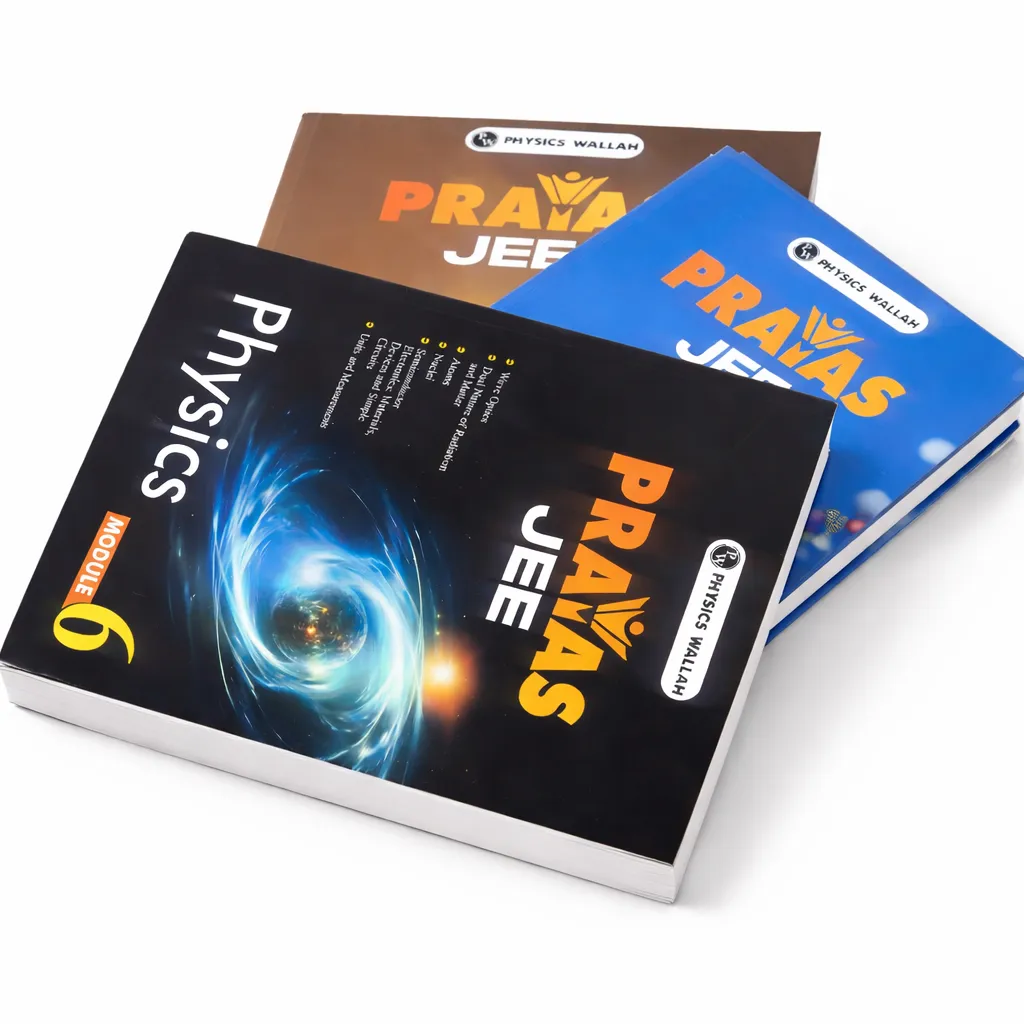
Note that NTA has, in recent cycles, trimmed a few chapters from the earlier syllabus. Always cross-check the latest official syllabus PDF before finalising your chapter list so you do not waste hours on deleted topics. A structured module set such as the PW Prayas JEE Modules 2026 (18-book set for Class 11+12) already sequences the syllabus chapter by chapter, which removes the guesswork of what to study next.
High-Weightage Chapters: Where the Marks Actually Are
Not all chapters are equal. Every year a handful of chapters contribute a disproportionate share of the paper, and smart aspirants front-load these. The tables below give approximate, PYQ-based weightage — use them to sequence revision and to decide what you can never afford to leave weak. (Weightage fluctuates slightly year to year; treat these as strong indicators, not guarantees.)
Physics: High-Weightage Chapters
| Chapter / Area | Approx. weightage | Priority |
|---|---|---|
| Modern Physics & Semiconductors | 12-15% | Very High |
| Electrodynamics (Current, EMI, Magnetism) | 18-22% | Very High |
| Mechanics (Kinematics, Laws, Rotation) | 18-20% | Very High |
| Heat & Thermodynamics | 8-10% | High |
| Optics (Ray & Wave) | 8-10% | High |
| Oscillations & Waves | 6-8% | Medium |
Chemistry: High-Weightage Chapters
| Chapter / Area | Approx. weightage | Priority |
|---|---|---|
| Physical Chemistry (Thermo, Equilibrium, Electrochem, Kinetics) | 32-36% | Very High |
| Organic Chemistry (GOC, Functional Groups, Biomolecules) | 32-36% | Very High |
| Inorganic (Periodic, Bonding, Coordination, p-block) | 28-32% | Very High |
| Mole Concept & Stoichiometry | 6-8% | High |
Mathematics: High-Weightage Chapters
| Chapter / Area | Approx. weightage | Priority |
|---|---|---|
| Calculus (Limits, Differentiation, Integration, AOD, Area) | 28-32% | Very High |
| Coordinate Geometry (Straight Lines, Circles, Conics) | 16-18% | Very High |
| Algebra (Matrices, Determinants, Complex, Progressions) | 16-20% | High |
| Vectors & 3D Geometry | 10-12% | High |
| Probability & Statistics | 6-8% | Medium |
| Trigonometry | 4-6% | Medium |
JEE Main 2026 Marks vs Percentile: Set a Realistic Target
Before you can chase “99 percentile” or “250+”, you need to know what those numbers mean in marks. The mapping below is approximate and based on recent years’ trends — the exact cutoff shifts every session with paper difficulty and the number of candidates, so use it to set a target band, not as a promise. What it makes clear is the shape of the curve: the jump from 90 to 99 percentile is a huge climb in marks, so every accurate attempt in the top band is worth far more than it looks.
| Approx. marks (out of 300) | Approx. percentile band | What it typically means |
|---|---|---|
| 250+ | ~99.5+ | Top NITs/IIITs range; strong JEE Advanced qualifier |
| 200-250 | ~99.0-99.5 | Good NIT branches within reach |
| 160-200 | ~97-99 | Competitive for many NIT/IIIT/GFTI seats |
| 120-160 | ~90-97 | Solid score; opens several government-college options |
| 90-120 | ~80-90 | Qualifying-plus; broadens counselling choices |
| ~65-90 | ~72-80 | Around the general-category qualifying zone |
Read the table as a ladder, not a ceiling. If you are targeting 99 percentile, your working goal is roughly 200+ marks — which usually means near-complete Chemistry, most of Maths, and no silly errors in Physics. Reverse-engineer your daily plan from that number.
JEE Main 2026 Preparation in 6 Months: Phase-Wise Study Plan
Is 6 months enough to prepare for JEE Main 2026? Yes — if you already have Class 11 basics and you follow a disciplined phase-wise plan, six months of honest, focused work is enough to cross 90 percentile and, for strong students, touch 99. The trick is not to spread yourself thin: divide the six months into three clear phases so you always know whether today is a “learn”, “practise” or “test” day.
| Phase | Duration | Focus | Daily split |
|---|---|---|---|
| Phase 1 — Concept Building | Months 1-3 | Finish theory + solved examples, chapter by chapter, all 3 subjects in parallel | 50% theory, 50% practice |
| Phase 2 — Practice & Weightage | Months 4-5 | Chapter-wise problem sets, high-weightage chapters, start PYQs | 30% revision, 70% problem-solving |
| Phase 3 — Mock & Revision | Month 6 | Full-length mocks, PYQ papers, error-notebook revision, no new topics | 40% mocks, 60% analysis & revision |
If you have a longer runway — say you are in Class 11 or starting in mid-2025 — simply stretch Phase 1 across a year and keep Phases 2 and 3 the same length. The proportions matter more than the absolute months. Working from a complete module set like the eSaral IIT JEE Modules 2026 keeps Phase 1 on rails because each module bundles theory, solved examples and exercises for a chapter in one place.
JEE Main 2026 Study Plan: Daily & Weekly Timetable
How many hours should you study daily for JEE Main 2026? Aim for 6-8 focused hours on school/college days and 9-10 on holidays, split roughly equally across the three subjects so none is neglected. Focused means phone away, timer running — four deep hours beat eight distracted ones. Use the printable template below and fill in the chapter names for the week ahead every Sunday night.
| Time slot | Weekday plan | Purpose |
|---|---|---|
| 6:00 – 7:30 AM | Maths — theory + 15 problems | Fresh mind for the toughest calculation subject |
| School / college | — | Note doubts as they arise |
| 4:00 – 5:30 PM | Physics — concept + numericals | Conceptual clarity + application |
| 6:00 – 7:30 PM | Chemistry — NCERT + practice | Rotate Physical / Organic / Inorganic daily |
| 8:30 – 9:30 PM | Backlog / error-notebook review | Fix yesterday’s mistakes |
| Sunday | 1 full mock + 2-hour analysis | Weekly checkpoint |
Fill the template yourself so the plan is realistic for your school timings. The one non-negotiable rule: touch all three subjects every single day, even if only for 45 minutes each. Long gaps from any subject cause silent decay that you only discover in the exam hall.
Subject-Wise Strategy for JEE Main 2026
Physics: Concepts First, Then Numericals
Physics rewards conceptual clarity over rote learning. Read the theory, derive the key formulas yourself once, then drill numericals until the approach becomes reflex. Prioritise Mechanics and Electrodynamics early because they underpin later chapters. Maintain a formula sheet per chapter and revise it daily — in a timed paper you cannot afford to re-derive. HC Verma for concepts and DC Pandey for problem sets is the classic pairing.
Chemistry: NCERT Plus Targeted Memorisation
Chemistry is your score-booster because it is the least time-consuming in the exam. For Inorganic, NCERT is close to sufficient — read it line by line and make short notes of exceptions. Organic needs mechanism understanding plus reaction-sheet memorisation; do not mug reactions in isolation. Physical Chemistry is numerical-heavy, so treat it like Physics. A tight NCERT-plus-notes loop here can win you 80+ marks in under 45 minutes.
Mathematics: Daily Practice & Speed
Maths cannot be crammed — it is a skill built by solving problems every single day. Focus on Calculus and Coordinate Geometry first as they carry the most weight, and learn shortcuts and standard results to save seconds per question. Speed comes from pattern recognition, and pattern recognition comes from volume. Solve, review the ones you got wrong, and re-solve them a week later.
Best Books for JEE Main 2026 Preparation
Which are the best books for JEE Main 2026 preparation? The answer is fewer books, mastered deeply — one concept book and one problem book per subject, plus NCERT for Chemistry. Chasing ten books per subject is the single most common mistake droppers make. Here is a lean, proven booklist.
| Subject | Concept / Theory | Practice / Problems |
|---|---|---|
| Physics | NCERT + HC Verma (Concepts of Physics) | DC Pandey (Arihant), previous-year papers |
| Chemistry | NCERT (both classes) + OP Tandon | Physical: RC Mukherjee; Inorganic: JD Lee; Organic: MS Chouhan |
| Mathematics | NCERT + RD Sharma (Objective) / Cengage | Cengage series, Arihant, PYQ compilations |
You do not have to buy every book above. A well-designed integrated module set already condenses NCERT-line theory with solved examples and graded exercises, which is why many self-study aspirants prefer a single ready module set over assembling a shelf of separate titles. The PW Prayas JEE Modules and eSaral IIT JEE Modules both cover the full Class 11+12 syllabus in this integrated format, so you can use them as your spine and add HC Verma or a problem book only where you want extra depth.
When Should You Start JEE Main 2026 Preparation?
The best time to start preparing for JEE Main 2026 was the first day of Class 11; the second-best time is today. What changes with your starting point is not whether you can succeed but how you sequence the plan. The table below differentiates the three most common aspirant profiles, which most generic guides ignore.
| Profile | Ideal start | Core strategy |
|---|---|---|
| Class 11 student | Now (18+ months) | Build strong fundamentals; finish Class 11 syllabus thoroughly; no rush, deep understanding |
| Class 12 student | Now (8-10 months) | Balance boards + JEE; use overlap; prioritise high-weightage chapters; weekly mocks from month 4 |
| Dropper | Full year available | Diagnose weak areas first; rebuild concepts fast; heavy on PYQs and mocks; peak twice for both sessions |
| Late starter (6 months) | Immediately | Ruthless prioritisation of high-weightage chapters; NCERT + one module + PYQs only |
Droppers: A Different Game
Droppers already have a foundation, so their year is about closing specific gaps, not relearning everything. Start with a full diagnostic mock to find your weak chapters, then spend the first three months rebuilding those. Droppers should be mock-heavy from month four and use both sessions aggressively. The biggest dropper risk is not lack of knowledge — it is burnout and negativity, so protect your mindset as carefully as your syllabus.
Session 1 vs Session 2: Using the Two-Attempt Structure
JEE Main 2026’s two sessions are a strategic advantage most aspirants waste. Because only your better percentile counts, you can plan your peak deliberately instead of gambling everything on one date.
| Aspect | Session 1 (January) | Session 2 (April) |
|---|---|---|
| Goal | Secure a strong baseline; treat as a real, high-stakes rehearsal | Improve on Session 1; target your peak percentile |
| Best for | Locking in a safe score, reducing pressure | Fixing weak areas found in Session 1 |
| Strategy | Complete syllabus + 15-20 mocks before it | Deep error analysis of Session 1 + focused revision |
Attempt both sessions if you can. Even if Session 1 goes well, Session 2 costs you little and can only raise your final score. Use the January result as precise, personalised feedback on what to fix before April.
Mock Tests, PYQs & the Error-Notebook Workflow
Mock tests and previous-year questions are where preparation converts into percentile. PYQs reveal the exam’s real difficulty and recurring patterns — solve at least the last 8-10 years, and every online mock you can. But solving is only half the job; analysis is the other half, and it is where most aspirants leak marks.
Maintain an error notebook with a fixed four-column format for every mistake, and revise it before each new mock. This single habit is the difference between plateauing and improving.
| Question / Topic | Mistake type | Correct approach | Re-test date |
|---|---|---|---|
| e.g. Rotational dynamics Q | Conceptual gap | Torque about correct axis | +7 days |
| e.g. Definite integral | Silly / calculation | Check limits, use property | +3 days |
| e.g. Coordination compound | Forgot fact | Add to Inorganic short notes | +5 days |
Classify every error as conceptual, silly/calculation, or forgotten-fact — because each needs a different fix. Conceptual gaps mean re-study; silly errors mean slow down and re-check; forgotten facts go into your short notes. Re-attempt each logged question on its scheduled date until you get it right cold.
Final 30-Day Revision Plan for JEE Main 2026
The last 30 days can lift you a full percentile band — or sink you if you panic and start new topics. The rule for the final month is simple: no new chapters, only revision, mocks and error-notebook fixes.
- Days 30-16: One full-length mock every alternate day, followed by 2-3 hours of analysis. Revise formula sheets and short notes daily.
- Days 15-6: Increase to a mock every day. Focus revision on high-weightage chapters and your error notebook. Revisit PYQs of the last 5 years.
- Days 5-1: Lighten the load. Only quick revision of formula sheets, reaction sheets and NCERT one-liners. Sleep well; no all-nighters.
Fix your exam-hall strategy in advance: attempt Chemistry first (fastest), then Maths or Physics based on your strength, and mark tough questions for review rather than getting stuck. Guarding against negative marking in the last 20 minutes protects your score.
Can You Crack JEE Main 2026 Without Coaching?
Yes — thousands of self-study aspirants crack JEE Main and even JEE Advanced every year without joining a coaching institute. What coaching sells is structure, doubt-solving and peer pressure, and you can replicate all three at home. Use a sequenced module set for structure, online forums and video lectures for doubts, and a fixed timetable plus mock schedule for discipline. Self-study also saves commute time you can pour back into problem-solving.
To crack JEE Main 2026 without coaching, you need three things in place: complete, syllabus-mapped study material; a strict weekly mock-and-review cycle; and honesty in your error notebook. A curated self-study bundle — module sets plus PYQ practice — mapped to the phase plan above gives you the same coverage a coaching classroom would, at a fraction of the cost. That is exactly the gap products like the eSaral IIT JEE Modules 2026 are built to fill for self-studying aspirants.
Common Mistakes to Avoid in JEE Main 2026 Preparation
- Collecting too many books: Mastering one concept book and one problem book per subject beats skimming ten.
- Ignoring NCERT for Chemistry: A large share of Chemistry questions come straight from NCERT lines.
- Solving without analysing: A mock you don’t review is a mock wasted — the error notebook is where marks are made.
- Neglecting one subject: Weak Maths or Physics drags your percentile more than a slightly weaker “favourite” subject.
- Studying without a timetable: Inconsistent, mood-based study leaves silent backlogs that surface in the exam.
- Chasing new topics in the last month: The final 30 days are for revision and mocks, never fresh chapters.
- Ignoring health: Sleep, short breaks and light exercise protect the consistency the whole plan depends on.
Consistency, not intensity, wins JEE. A student who studies six honest hours every day for six months will almost always outperform one who does twelve-hour bursts followed by three idle days. Build the habit, trust the plan, and let the daily reps compound.
Frequently Asked Questions
How to prepare for JEE Main 2026?
Prepare for JEE Main 2026 in three phases: build concepts from NCERT and standard modules (months 1-3), practise chapter-wise questions and PYQs while prioritising high-weightage chapters (months 4-5), then take weekly full-length mocks and revise using an error notebook in the final month. Study 6-8 focused hours daily, split equally across Physics, Chemistry and Maths.
When should I start preparing for JEE Main 2026?
Start as early as you can — Class 11 students get 18+ months to build deep fundamentals, while Class 12 students and droppers should begin immediately with 8-12 months to spare. If you are a late starter with only 6 months, start today and prioritise high-weightage chapters, NCERT, one module set and PYQs. The plan changes with your start date, but a disciplined phase-wise approach works at every stage.
Is 6 months enough to prepare for JEE Main 2026?
Yes, 6 months is enough if you already have basic Class 11 concepts and follow a disciplined phase-wise plan. Spend three months on concept-building, two on practice and high-weightage chapters, and the final month on mocks and revision. With 6-8 consistent hours a day, crossing 90 percentile is realistic and 99+ is achievable for focused students.
How many hours should I study daily for JEE Main 2026?
Aim for 6-8 focused hours on school or college days and 9-10 hours on holidays, divided roughly equally among the three subjects. Quality matters more than quantity — four deep, phone-free hours outperform eight distracted ones. Touch all three subjects every day, even briefly, to prevent silent decay in any one of them.
Can I crack JEE Main 2026 without coaching?
Yes. Many aspirants clear JEE Main without coaching by using a complete, syllabus-mapped module set for structure, online lectures and forums for doubts, and a strict weekly mock-and-review routine for discipline. Self-study also saves commute time you can redirect into problem-solving. The key is consistency and honest error analysis.
Which are the best books for JEE Main 2026 preparation?
Use fewer books, mastered deeply: NCERT plus HC Verma and DC Pandey for Physics; NCERT plus OP Tandon, MS Chouhan (Organic), JD Lee (Inorganic) and RC Mukherjee (Physical) for Chemistry; and NCERT plus Cengage or RD Sharma Objective for Maths. An integrated Class 11+12 module set can serve as your single spine, with a problem book added only where you want extra depth.
Is NCERT enough for JEE Main 2026?
NCERT is essential but not fully sufficient on its own. For Chemistry — especially Inorganic and Organic — NCERT covers a large share of the paper. For Physics and Maths, NCERT builds the base, but you also need a problem-focused book or module set (like HC Verma, DC Pandey or Cengage) to reach JEE-level difficulty and speed.
How can I score 99 percentile or 250+ in JEE Main 2026?
To score 99 percentile or 250+, master high-weightage chapters, achieve near-perfect accuracy in Chemistry to save time, and build speed in Maths through daily practice. Roughly, 99 percentile maps to around 200+ marks and 250+ to about 99.5 percentile, though exact cutoffs vary each session. Take 20+ full-length mocks, analyse every mistake in an error notebook, and use both January and April sessions strategically — high accuracy and disciplined revision matter more than attempting every question.
Recommended Study Material

Continue Reading
SSC JE Syllabus 2026: Paper 1 & 2 + PDF Download
The SSC JE syllabus is split across two objective, computer-based papers. Paper 1 (200 marks, 2 hours) tests…
UPSC Ethics Syllabus 2026: GS Paper 4 Topics + PDF
The upsc ethics syllabus is the official prescribed content for General Studies Paper 4 — titled Ethics, Integrity…

Best Test Series for UPSC 2026: 9 Options Compared with Prices
The best test series for UPSC 2026 is Vision IAS for Prelims — the most representative difficulty, detailed…