History Optional Syllabus 2026: UPSC Paper 1 & 2 + PDF
Complete history optional syllabus for UPSC 2026: topic-wise Paper 1 & Paper 2, exam pattern and marks, booklist, PYQ weightage, Hindi-medium notes and a free PDF checklist.

The history optional syllabus for UPSC Civil Services Mains carries 500 marks across two papers of 250 marks each (Paper VI and Paper VII), with three hours per paper. Paper 1 covers Ancient and Medieval India (from prehistoric sources up to the 18th-century decline of the Mughals), while Paper 2 covers Modern India (European penetration to post-independence consolidation) plus World History. History remains one of the most chosen and consistently scoring optionals because it overlaps heavily with GS Paper 1, the Essay paper, and even Prelims.
This guide gives you the full official topic-wise syllabus for both papers, the exam pattern and answer structure, a data-driven weightage breakdown, the standard booklist, a realistic study timeline, Hindi-medium guidance, and a downloadable PDF checklist — plus the notes and PYQ resources you need to actually finish the course. Whether you are still deciding your optional or already deep into preparation, this is built to be the single reference page you keep open.
Quick answer (for those in a hurry)
- Total marks: 500 — Paper 1 (250) + Paper 2 (250), each 3 hours.
- Paper 1: Ancient & Medieval India, including a compulsory ~20-mark map question.
- Paper 2: Modern India (Section A) + World History (Section B).
- Length: One of the longer optionals; first full pass takes about 5–6 months.
- Coaching: Optional — the syllabus is static and self-study-friendly with the right notes and PYQs.
- PDF: Mirror the exact official notification wording into a one-page, tickable checklist (template below).
History Optional Syllabus at a Glance: Marks & Exam Pattern
Before the topic list, fix the structure in your head. The history optional exam pattern and marks are identical to every other optional in UPSC CSE Mains: two conventional (descriptive) papers, each 250 marks, together contributing 500 of the 1750 marks that decide the final merit. That is roughly 28% of your written total — enough to make or break a rank.
| Component | Details |
|---|---|
| Paper 1 (Paper VI) | Ancient & Medieval India — 250 marks |
| Paper 2 (Paper VII) | Modern India + World History — 250 marks |
| Total marks | 500 (both papers combined) |
| Duration per paper | 3 hours |
| Number of questions | 8 questions; attempt 5 |
| Compulsory questions | Q1 and Q5 (one from each section) |
| Medium | English or any Eighth Schedule language (incl. Hindi) |
| Nature | Descriptive / essay-type, with a map question in Paper 1 |
Each paper is split into two sections — Section A and Section B. Q1 and Q5 are compulsory and are usually short-note or map/identification style. From the remaining six questions you choose three, but you must attempt at least one from each section. Getting this attempt strategy wrong is a common cause of low scores, so internalise it early.
What is the exam pattern and answer structure?
A typical History answer is 150–200 words for a 15-mark part and around 250 words for a 20-mark part. Examiners reward a clear introduction with a date or context, a body organised by historiographical arguments, use of primary sources and named historians (R.S. Sharma, Romila Thapar, Irfan Habib, Bipan Chandra), and a balanced conclusion. In Paper 1, one compulsory question asks you to mark and describe ~20 historical places on an outline map of India — a high-yield, fully scoring component that most aspirants under-prepare.
History Optional Syllabus UPSC Paper 1 (Ancient & Medieval India)
The history optional syllabus UPSC Paper 1 spans roughly 24–25 topics moving chronologically from sources and prehistory to the twilight of the Mughal Empire. Section A is largely Ancient India and Section B is Early Medieval and Medieval India. Below is the complete topic-wise list.
| # | Paper 1 Topic | Key Sub-areas |
|---|---|---|
| 1 | Sources | Archaeological sources, epigraphy, numismatics, literary sources (indigenous & foreign accounts) |
| 2 | Pre-history & Proto-history | Geographical factors; hunting-gathering (Palaeolithic, Mesolithic); beginning of agriculture (Neolithic, Chalcolithic) |
| 3 | Indus Valley Civilization | Origin, extent, town planning, economy, society, religion, decline |
| 4 | Megalithic Cultures | Distribution of pastoral and farming cultures outside the Indus; development of community life |
| 5 | Aryans & Vedic Period | Expansions of Aryans; Rig Vedic society; later Vedic polity, economy, religion, varna system |
| 6 | Period of Mahajanapadas | Rise of states, republics vs monarchies; Jainism & Buddhism; rise of Magadha |
| 7 | Mauryan Empire | Chandragupta, Kautilya’s Arthashastra; Ashoka, edicts, Dhamma; administration, art, decline |
| 8 | Post-Mauryan Period | Indo-Greeks, Sakas, Kushanas, Satavahanas; society, economy, art (Gandhara, Mathura, Amaravati) |
| 9 | Guptas & Vakatakas | Gupta administration, agrarian economy, feudalism; Sanskrit literature; science; art & culture |
| 10 | Regional States (750–1200) | Palas, Pratiharas, Rashtrakutas; Cholas; feudal polity, agrarian structure, trade |
| 11 | Early Medieval India | Land grants, temple architecture, Bhakti (Alvars, Nayanars); Sankaracharya; Arab conquest of Sind |
| 12 | Cultural Traditions | Philosophy, science, education, art, religious movements up to c.750 CE |
| 13 | Delhi Sultanate (13th–14th c.) | Ghurid invasion; Slave, Khalji, Tughlaq dynasties; administration, agrarian & urban economy |
| 14 | Sultanate Culture & Society | Sufism, Bhakti; Indo-Islamic architecture; literature; foreign travellers (Ibn Battuta) |
| 15 | Vijayanagara & Bahmani | Political history, Krishnadevaraya; administration, economy, society; art & literature |
| 16 | Mughal Empire (16th–17th c.) | Babur to Aurangzeb; Sher Shah; Mansabdari & Jagirdari; land revenue; Akbar’s religious policy |
| 17 | Economy & Society under Mughals | Population, agriculture, craft, trade, urbanisation; commercialisation; European trade |
| 18 | Mughal Culture | Architecture, painting, literature; regional cultural developments |
| 19 | Decline of the Mughals (18th c.) | Later Mughals; rise of successor states — Marathas, Sikhs, Rajputs, Awadh, Bengal, Hyderabad |
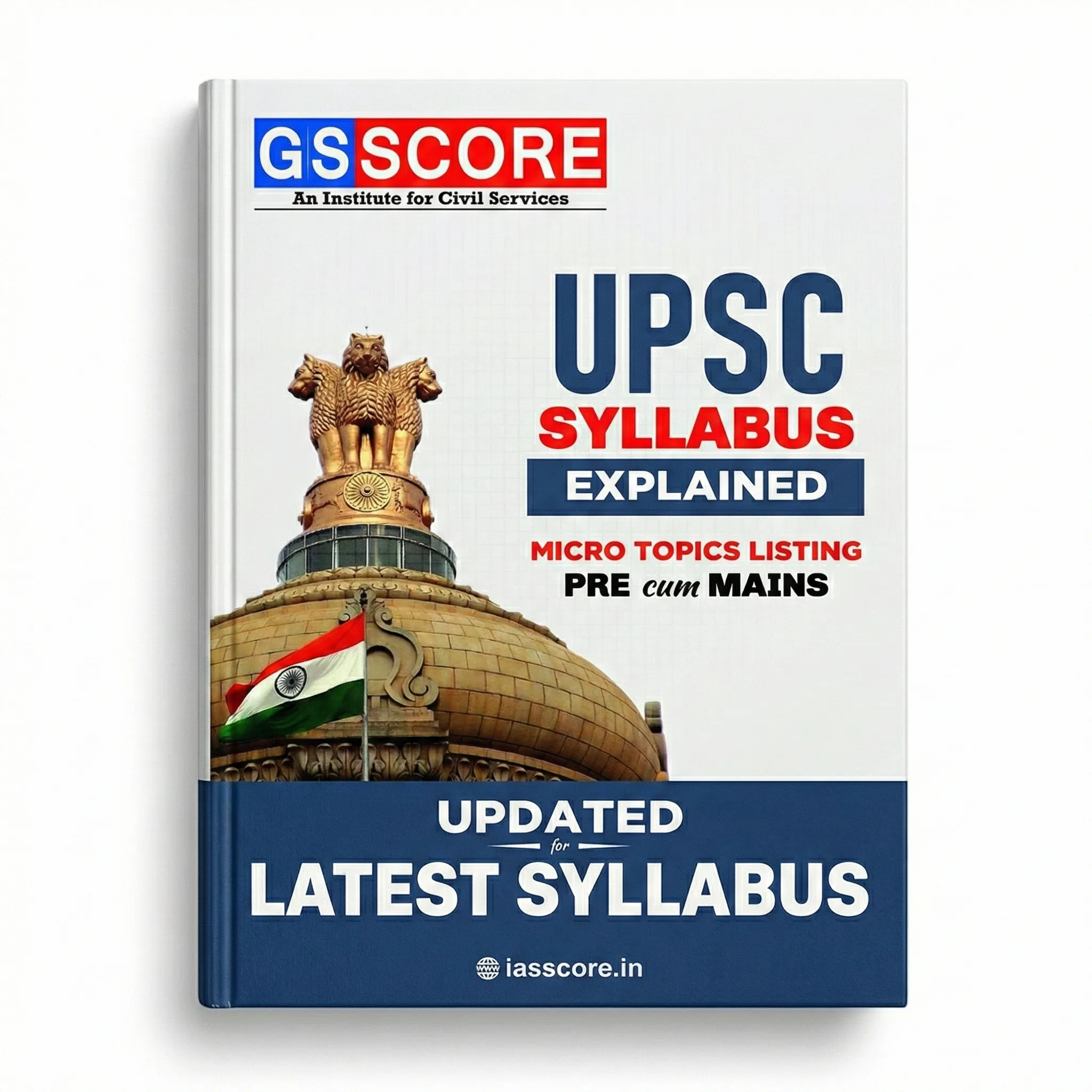
The list above condenses the official numbered heads; the actual UPSC notification breaks a few of these into finer sub-heads, which is why aspirants quote anywhere from 20 to 25 “topics.” The chronological spine — Sources → IVC → Vedic → Mauryas → Guptas → Sultanate → Vijayanagara → Mughals → 18th-century decline — is what you must be able to recite in your sleep. Pairing each head with a good syllabus booklet such as the GS Score Latest Syllabus Booklet keeps your revision anchored to the exact official wording.
History Optional Syllabus Paper 1 and Paper 2: Where They Differ
A frequent People-Also-Ask query is the difference between the two papers. Understanding the history optional syllabus paper 1 and paper 2 split helps you allocate months correctly, because the sources, skills, and even answer style differ.
| Aspect | Paper 1 | Paper 2 |
|---|---|---|
| Time period | Prehistory to 1750s (Ancient & Medieval) | 1750s to present (Modern India) + World History |
| Core focus | Sources, archaeology, dynasties, culture | Colonialism, nationalism, post-1947 India, global events |
| GS overlap | Art & Culture (GS-1) | Modern India & World History (GS-1) |
| Special component | Map question (~20 marks) | World History section (Section B) |
| Difficulty for beginners | More factual/archaeological memory | More analytical/argument-based |
| Typical prep time | 3–3.5 months | 3–3.5 months |
History Optional Syllabus UPSC Paper 2 (Modern India & World History)
Paper 2 has roughly 25–27 topics. Section A is Modern Indian History (European penetration through post-independence consolidation) and Section B is World History from the Enlightenment to the collapse of the USSR. This paper overlaps the most with GS Paper 1, so effort here compounds.
Section A — Modern India
| # | Paper 2 (Modern India) Topic | Key Sub-areas |
|---|---|---|
| 1 | European Penetration | Portuguese, Dutch, French, English East India companies; commercial rivalry |
| 2 | British Expansion | Bengal (Plassey, Buxar); Mysore, Marathas, Sikhs; subsidiary alliance, doctrine of lapse |
| 3 | Colonial Economy | De-industrialisation, land revenue (Permanent, Ryotwari, Mahalwari), drain of wealth, famines |
| 4 | Administrative Structure | Civil service, army, police, judiciary; local government; education policy |
| 5 | Cultural Encounter & Social Reform | Raja Rammohan Roy, Brahmo, Arya, Prarthana Samaj; caste & women reform; press |
| 6 | Popular Resistance (1757–1857) | Peasant, tribal, civil rebellions; the Revolt of 1857 — causes, nature, aftermath |
| 7 | Rise of Nationalism | Factors; Indian National Congress; Moderates & Extremists; Swadeshi movement |
| 8 | Gandhian Era | Non-Cooperation, Civil Disobedience, Quit India; Champaran, Kheda, Bardoli |
| 9 | Nationalism & Other Strands | Revolutionaries, Left, trade unions, peasant movements; communalism & Partition |
| 10 | Constitutional Developments | Acts of 1909, 1919, 1935; Cripps, Cabinet Mission; transfer of power |
| 11 | Post-Independence Consolidation | Integration of princely states; linguistic reorganisation; land reforms; foreign policy |
Section B — World History
| # | World History Topic | Key Sub-areas |
|---|---|---|
| 12 | Enlightenment & Modern Ideas | Renaissance legacy, rationalism, scientific revolution, rights of man |
| 13 | Origins of Modern Politics | American Revolution; French Revolution & Napoleon |
| 14 | Industrialisation | English Industrial Revolution; spread to Europe, USA, Japan; socialism & Marxism |
| 15 | Nation-State System | Unification of Germany & Italy; nationalism in Europe; disintegration of empires |
| 16 | Imperialism & Colonialism | South-East Asia, Africa; economic & political dimensions; anti-colonial resistance |
| 17 | Revolutions | Russian Revolution of 1917; Chinese Revolution of 1949 |
| 18 | World Wars | WWI & WWII — causes, consequences; League of Nations, UNO; the inter-war years |
| 19 | The World after WWII | Cold War, blocs, NAM; decolonisation of Asia & Africa; unification of Europe |
| 20 | Contemporary World | Collapse of the USSR, end of Cold War; unipolar world; new global order |
Topic-Wise Weightage: High-Yield vs Low-Yield Areas
Many syllabus pages stop at the list — they never tell you what to prioritise. Based on trends across recent Mains papers, here is an indicative weightage so you invest hours where marks actually come from. Treat these as planning estimates, not guarantees; UPSC deliberately rotates emphasis.
| Segment | Approx. Marks/Paper | Priority |
|---|---|---|
| Ancient — IVC, Mauryas, Guptas, Sources | 90–110 | High |
| Ancient — Vedic, Mahajanapadas, culture | 50–70 | Medium-High |
| Medieval — Sultanate, Mughals, economy | 90–110 | High |
| Medieval — Vijayanagara, regional states | 40–55 | Medium |
| Modern — Freedom struggle & Gandhian era | 90–110 | Very High |
| Modern — Economy, reform, 1857 | 60–80 | High |
| World History — Revolutions, World Wars, Cold War | 80–100 | High |
| Map question (Paper 1) | ~20 (guaranteed) | Must-do |
The takeaway: the freedom struggle, the Mughals, the IVC, and the World War/Cold War clusters repeat almost every year, while niche archaeology and obscure regional dynasties appear rarely. Anchor your revision to a topic-wise Previous Year Question set — the Forum IAS Topic-Wise PYQ Toolkit is a fast way to see which syllabus lines are asked repeatedly versus which are cold, so you don’t waste weeks on low-return topics.
Mapping Previous-Year Questions to the Syllabus
Weak PYQ integration is the single biggest gap on competing pages. History rewards pattern recognition: the same themes return in fresh wording. A few illustrative recurring lines:
- IVC: town planning, trade, and “continuity vs decline” debates appear in most cycles.
- Mauryas: Ashoka’s Dhamma and Arthashastra administration are perennial 15-markers.
- Mughals: Mansabdari, agrarian crisis, and Akbar’s policies recur.
- Freedom struggle: Gandhian mass movements, Moderate vs Extremist methods, and revolutionary nationalism dominate Paper 2.
- World History: causes of the World Wars, the Russian Revolution, and decolonisation are the safest bets.
Practise writing at least one full answer against each high-frequency line before Prelims, then revise them in the Mains gap. This converts the syllabus from a reading list into an answer-writing plan.
Why Choose History Optional? Scoring Potential & GS Overlap
History is popular for concrete reasons, not sentiment. Its GS overlap is among the widest of any optional, its material is abundant, and it produces toppers in almost every batch.
- Overlap with GS-1: Ancient/Medieval Art & Culture, Modern Indian History, and World History are directly shared, saving hundreds of study hours.
- Essay advantage: historical examples and quotes strengthen philosophical and social essays.
- Prelims support: Ancient, Medieval, Modern, and Art & Culture questions overlap the History optional base.
- Abundant material: NCERTs plus a stable set of standard references — no scramble for scattered sources.
- Static syllabus: unlike current-affairs-heavy optionals, most content does not change year to year, so notes stay valid.
Because so much of History feeds GS-1, pairing your optional with strong GS notes multiplies returns. Aspirants often build the GS base with a set like the Vision IAS GS Booklets 2026-27 and layer optional-specific depth on top.
Advantages and Disadvantages of History Optional
Honesty helps the decision-stage searcher. History is not a shortcut; it is a high-ceiling, high-effort choice.
| Advantages | Disadvantages |
|---|---|
| Large GS-1, Essay & Prelims overlap | Lengthy syllabus — two full eras plus World History |
| Static content; notes rarely go stale | Fact-heavy Paper 1 demands strong memory & revision |
| Abundant, standardised study material | Answer writing needs historiography to stand out |
| Consistent topper track record | Map question & World History are often neglected |
| Interesting, narrative subject — sustains motivation | Marking can be strict without value addition |
History Optional Booklist UPSC: Recommended Standard Books
The right history optional booklist UPSC is a compact set of NCERTs for foundation plus standard references for depth. You do not need every book on the market — you need to revise these repeatedly.
| # | Book | Use |
|---|---|---|
| 1 | NCERT — Ancient, Medieval, Modern India (old & new) | Foundation for both papers |
| 2 | India’s Ancient Past — R.S. Sharma | Ancient India core (Paper 1) |
| 3 | History of Medieval India — Satish Chandra | Sultanate & Mughals (Paper 1) |
| 4 | A History of Ancient & Early Medieval India — Upinder Singh | Depth & sources for Paper 1 |
| 5 | History of Modern India — Bipan Chandra | Modern India core (Paper 2) |
| 6 | India’s Struggle for Independence — Bipan Chandra | Freedom struggle (Paper 2) |
| 7 | Modern India — Sumit Sarkar | Analytical depth, Paper 2 |
| 8 | History of the World — Arjun Dev / Jain & Mathur | World History (Paper 2, Section B) |
| 9 | Mastering Modern World History — Norman Lowe | World Wars, Cold War depth |
| 10 | A New Look at Modern Indian History — B.L. Grover | Structured revision, Paper 2 |
| 11 | Oxford School Atlas / historical atlas | Map question practice (Paper 1) |
Read NCERTs once for narrative, then shift to the standard references and never re-buy — revise the same set three or four times. A dedicated historical atlas is non-negotiable for the map question.
History Optional Syllabus in Hindi (हिंदी माध्यम)
History is one of the strongest optionals for Hindi-medium aspirants, yet most English-only pages ignore this large audience. The history optional syllabus in Hindi is identical in content — only the answer medium changes. Standard Hindi resources exist for every topic: NCERTs in Hindi, R.S. Sharma and Satish Chandra in Hindi translation, and Arjun Dev’s world history (विश्व का इतिहास). You can write the entire paper in Hindi without any disadvantage, and History’s static syllabus makes translated notes reliable year after year.
For the GS foundation that overlaps this optional, Hindi-medium candidates commonly use the Drishti IAS Hindi Study Material to lock the base, then add optional-specific reading in Hindi on top. Keep your answer-writing practice in Hindi from day one so terminology and phrasing become second nature.
How to Prepare History Optional (With a Realistic Timeline)
A working strategy has four pillars: NCERT foundation, standard-reference depth, PYQ-driven prioritisation, and relentless answer writing plus map practice. Here is a coverage-time estimate for a first full pass.
| Phase | Duration | Focus |
|---|---|---|
| Phase 1 — Foundation | 3–4 weeks | All relevant NCERTs (Ancient, Medieval, Modern, World) |
| Phase 2 — Paper 1 depth | 7–8 weeks | R.S. Sharma, Satish Chandra, Upinder Singh; notes + map practice |
| Phase 3 — Paper 2 depth | 7–8 weeks | Bipan Chandra, Sumit Sarkar, world history; notes |
| Phase 4 — PYQ & answer writing | 4–5 weeks | Topic-wise PYQs, model answers, value addition |
| Phase 5 — Revision & tests | Ongoing | Multiple revisions, full-length mock papers, map drills |
A disciplined aspirant can complete the first pass of both papers in about 5–6 months and then rely on quick revisions. The mistake to avoid is endless reading with zero writing — start answer practice by the end of Phase 2.
Can I prepare History optional without coaching?
Yes. History is arguably the most self-study-friendly optional because its sources are standardised and its syllabus is static. What self-study aspirants lack is a topic-mapped note set, PYQ organisation, and answer feedback — all of which you can substitute with good printed notes, a PYQ toolkit, and peer or test-series evaluation. Consistency and revision matter far more than coaching for this subject.
Answer Writing & Map Practice: The Hidden Score Multipliers
Two components separate 260+ scorers from 320+ scorers. First, historiography: cite the debate (e.g., “nationalist vs Marxist vs subaltern readings of 1857”) and name the historian. Second, the map question in Paper 1 — around 20 easy marks if you have practised ~200 historically significant sites (Harappan cities, Buddhist/Jain centres, capitals, ports, battle sites). Mark on a blank outline map weekly. Add a one-line significance for each place; the map answer wants the location plus why it matters. These two habits, plus a crisp introduction-body-conclusion structure, reliably lift scores by 30–40 marks over a purely content-focused approach.
History vs Other Popular Optionals
Decision-stage searchers want a comparison, so here is how History stacks against PSIR, Sociology, and Geography.
| Optional | Syllabus Length | GS/Essay Overlap | Best For |
|---|---|---|---|
| History | Long (2 eras + World) | High (GS-1, Essay, Prelims) | Strong memory + interest in narrative |
| PSIR | Moderate | High (GS-2, IR) | Current-affairs-oriented aspirants |
| Sociology | Short | Moderate (GS-1, Essay) | Fast completion, limited time |
| Geography | Moderate–Long | Moderate (GS-1, Prelims) | Science/diagram-friendly aspirants |
If you enjoy stories and can commit to revision, History’s overlap makes it hard to beat. If time is short, aspirants sometimes prefer a compact optional such as PSIR (Shubhra Ranjan notes). Choose based on interest and background — the optional you can revise five times beats the one you “should” take.
UPSC History Optional Syllabus PDF Download & One-Page Checklist
For a UPSC history optional syllabus PDF download, use the exact official wording from the current UPSC notification and mirror it into a printable one-page checklist so you can tick topics as you finish them. A practical checklist has three columns per topic: Read (NCERT/standard book done), Notes (made/revised), and Practice (PYQ answer + map). Print it, stick it on your wall, and colour each cell green only after a full revision.
| Topic | Read | Notes | Practice (PYQ + Map) |
|---|---|---|---|
| Sources / Pre-history | ☐ | ☐ | ☐ |
| IVC & Vedic | ☐ | ☐ | ☐ |
| Mauryas & Guptas | ☐ | ☐ | ☐ |
| Sultanate & Mughals | ☐ | ☐ | ☐ |
| Freedom struggle | ☐ | ☐ | ☐ |
| World History | ☐ | ☐ | ☐ |
A clean, official-wording syllabus booklet like the GS Score Latest Syllabus Booklet doubles as your master reference and checklist source, so your notes never drift from what UPSC actually asks. Keep the PDF on your phone for quick recall of topic names during revision.
Common Mistakes to Avoid
- Ignoring the map question — it is guaranteed, scoring, and under-practised.
- Neglecting World History — Section B of Paper 2 is often left for the end and rushed.
- Reading without writing — content without answer practice caps your score.
- No historiography — generic answers get generic marks; name the debate and the historian.
- Buying too many books — one revision of ten sources beats one reading of thirty.
- Skipping revision — Paper 1 is fact-dense; without three revisions, retention collapses.
Frequently Asked Questions
What is the syllabus of History optional in UPSC?
The History optional syllabus has two papers of 250 marks each. Paper 1 covers Ancient and Medieval India — from sources, prehistory, the Indus Valley Civilization, Vedic period, Mauryas and Guptas, through the Delhi Sultanate, Vijayanagara, and the Mughals up to the 18th century. Paper 2 covers Modern India (European penetration, colonial economy, social reform, the freedom struggle, and post-independence consolidation) plus World History (Enlightenment, revolutions, imperialism, world wars, decolonisation, and the Cold War).
Is History optional easy to score in UPSC?
History is a high-ceiling optional — very good scores are achievable with structured answer writing, historiography, and map practice, but it is not “easy” in the sense of low effort. The syllabus is lengthy and Paper 1 is fact-heavy, so consistent revision is essential. Aspirants who write practice answers and prepare the map question routinely score well; those who only read tend to plateau.
How many marks is History optional in UPSC?
History optional carries 500 marks in total — Paper 1 (Paper VI) is 250 marks and Paper 2 (Paper VII) is 250 marks, each written in three hours. Together the optional contributes 500 of the 1750 marks in the Mains written exam, making it a decisive component for your final rank.
What is the difference between Paper 1 and Paper 2 in History optional?
Paper 1 covers Ancient and Medieval India (prehistory to the 1750s) and includes a compulsory map question worth about 20 marks; it is more factual and memory-heavy, overlapping GS-1 Art & Culture. Paper 2 covers Modern India (Section A) plus World History (Section B) and is more analytical and argument-based, overlapping GS-1 Modern Indian History and World History. Most aspirants budget roughly equal time — about 3–3.5 months each — but adjust based on whether facts or analysis is your weaker skill.
Which books are best for History optional?
Start with NCERTs, then use R.S. Sharma and Upinder Singh for Ancient India, Satish Chandra for Medieval India, Bipan Chandra and Sumit Sarkar for Modern India, and Arjun Dev or Norman Lowe for World History. Add a historical atlas for the map question. Revising this compact set several times is far more effective than adding more titles.
Is the History optional syllabus lengthy and how long does it take to complete?
Yes, it is one of the longer optionals because it spans two full eras of Indian history plus World History. A focused aspirant can complete the first full pass of both papers in about 5–6 months, followed by faster revisions. Building answer writing and map practice into that timeline — rather than after it — is what keeps the length manageable.
Does History optional overlap with the GS papers?
Significantly. Paper 1 overlaps GS-1 Art & Culture, and Paper 2 overlaps GS-1 Modern Indian History and World History. Historical examples also strengthen the Essay paper, and the base helps with Prelims history and culture questions. This wide overlap is a major reason aspirants choose History and pair it with strong GS notes for compounding returns.
Can I prepare History optional without coaching?
Yes. History is one of the most self-study-friendly optionals because its booklist is standardised and its syllabus is static, so notes stay valid across attempts. Self-study aspirants mainly miss three things — a topic-mapped note set, organised previous-year questions, and answer feedback. You can substitute these with good printed notes, a topic-wise PYQ toolkit, and a test series or peer evaluation. For this subject, disciplined revision and regular answer writing matter far more than classroom coaching.
Recommended Study Material

Continue Reading
OJAS GPSC Syllabus 2026: Class 1-2, Prelims, Mains + PDF
The ojas gpsc syllabus for Class 1-2 (Gujarat Administrative, Civil and allied services) is a three-stage syllabus covering…
Best Book for SSC GK 2026: Lucent vs Blackbook + Booklist
The best book for SSC GK is Lucent's General Knowledge for static General Awareness, paired with the Blackbook…
CTET Paper 1 Syllabus 2026: Subject-Wise + PDF
The ctet paper 1 syllabus is for candidates who want to teach Classes I to V (primary level)…