UPSC CSAT Syllabus 2026: Full Topics, Pattern + PDF Download
UPSC CSAT syllabus 2026: all 7 official heads, maths & reasoning topics, exam pattern, qualifying marks, weightage plus a free English & Hindi PDF download.

The upsc csat syllabus for UPSC Prelims Paper II (CSAT) has seven official heads: comprehension; interpersonal and communication skills; logical reasoning and analytical ability; decision-making and problem-solving; general mental ability; basic numeracy up to Class X level; and data interpretation up to Class X level. CSAT is a qualifying paper only — you must score at least 33% (66.67 out of 200 marks) to clear it, and those marks are not added to the Prelims merit; only your General Studies Paper I score decides whether you reach Mains. This guide gives the exact notification wording, a topic-wise maths and reasoning breakdown, previous-year weightage, a difficulty-based priority plan, the best books, and a print-ready PDF in English and Hindi.
What Is CSAT (General Studies Paper II) in UPSC Prelims?
CSAT stands for the Civil Services Aptitude Test, officially named General Studies Paper II in the UPSC Civil Services Preliminary Examination. Introduced in 2011, it tests an aspirant’s aptitude, reasoning, comprehension and basic quantitative ability rather than static knowledge. It runs alongside GS Paper I (the current affairs, history, polity, geography, economy and environment paper) on the same day — Paper I in the morning session and Paper II (CSAT) in the afternoon session.
Since 2015, CSAT has been a qualifying paper. It works like a pass/fail gate: clear the 33% cut-off and it disappears from your scorecard for ranking purposes; fail it and even an excellent GS Paper I score is wasted, because you are eliminated from Prelims entirely. This single fact makes CSAT deceptively important — and in 2023–2024 it became a genuine filter that ended many campaigns before Mains even began.
Is CSAT Paper 1 or 2 in UPSC Prelims?
CSAT is Paper 2 (Paper II) of the UPSC Prelims. General Studies is Paper 1 and is held first; CSAT / GS Paper II is held second, in the afternoon slot. Both papers are compulsory — you must appear in and sit for both to be evaluated. If you skip CSAT, your candidature is cancelled even if you top GS Paper I. Keep the order clear: Paper 1 = General Studies (merit-deciding), Paper 2 = CSAT (qualifying only).
CSAT Exam Pattern and Qualifying Marks
Understanding the csat exam pattern and qualifying marks is the first step to a smart strategy. The paper has 80 objective questions carrying 200 marks, to be attempted in 2 hours (with compensatory time for eligible PwBD candidates). Each correct answer earns 2.5 marks, and there is a negative marking of one-third (0.83 marks) for every wrong answer.
| Parameter | Detail |
|---|---|
| Paper name | General Studies Paper II (CSAT) |
| Number of questions | 80 |
| Total marks | 200 |
| Duration | 2 hours (120 minutes) |
| Marks per correct answer | 2.5 |
| Negative marking | 1/3 (0.83 marks deducted per wrong answer) |
| Question type | Objective (MCQ) |
| Medium | English & Hindi (bilingual) |
| Nature | Qualifying — minimum 33% required |
To qualify, you need 33% of 200 = 66.67 marks, which works out to roughly 27 correct answers if you attempt only sure questions (27 × 2.5 = 67.5). Realistically, aim for 35–45 confident attempts to build a safe buffer against negative marking. Because CSAT marks are not added to the merit list, there is no benefit to scoring 150 over 70 — cross the line comfortably and redirect your energy to GS Paper I.
UPSC CSAT Syllabus 2026: The 7 Official Heads (Exact UPSC Wording)
The upsc prelims paper 2 syllabus is defined by UPSC in seven bullet points in the official notification, and it has not changed for 2026. Most coaching pages paraphrase these; below is the verbatim structure so you know exactly what is examinable and what is padding.
| # | Official Syllabus Head | What It Tests |
|---|---|---|
| 1 | Comprehension | Understanding English & bilingual passages, main idea, inference, tone |
| 2 | Interpersonal skills including communication skills | Situational communication, tested largely through comprehension passages |
| 3 | Logical reasoning and analytical ability | Syllogisms, statements-conclusions, assumptions, arguments |
| 4 | Decision-making and problem-solving | Administrative/ethical situations (traditionally no negative marking on these) |
| 5 | General mental ability | Series, coding-decoding, blood relations, direction, clocks, calendars |
| 6 | Basic numeracy (numbers and their relations, orders of magnitude) — Class X level | Arithmetic, percentages, ratios, averages, time-speed-distance |
| 7 | Data interpretation (charts, graphs, tables, data sufficiency) — Class X level | Reading data sets, comparison, calculation-based DI |
Two clarifications aspirants often miss. First, interpersonal and communication skills has never been tested as a standalone section — UPSC folds it into comprehension passages. Second, both basic numeracy and data interpretation are explicitly capped at Class X level, so you do not need Class 11–12 calculus, trigonometry or advanced statistics. Because the syllabus wording is stable, the seven heads above are the same set you should plan around for the upsc csat syllabus 2026 cycle.
Topic-Wise UPSC CSAT Maths Syllabus (Basic Numeracy)
The upsc csat maths syllabus is arithmetic-heavy and stays at Class X level, but the questions are application-oriented and time-pressured. Here is the complete, topic-wise numeracy tree with the concepts that actually recur in the paper.
| Topic | Sub-Topics to Master | Priority |
|---|---|---|
| Number System | LCM/HCF, divisibility, factors, remainders, unit digits | High |
| Percentages | Percentage change, successive change, applications | High |
| Ratio & Proportion | Ratios, proportion, partnership, mixtures & alligation | High |
| Averages | Simple & weighted averages, age problems | Medium |
| Profit & Loss | Cost/selling price, discount, marked price | Medium |
| Simple & Compound Interest | SI, CI, difference between SI & CI, growth | Medium |
| Time, Speed & Distance | Relative speed, trains, boats & streams | High |
| Time & Work | Work efficiency, pipes & cisterns | Medium |
| Mensuration | Area, perimeter, volume of 2D/3D shapes | Medium |
| Permutation, Combination & Probability | Basic counting, simple probability | Low–Medium |
Aspirants weak in maths should not try to master every topic. Lock in percentages, ratios, averages, time-speed-distance and number system first — these four to five heads deliver a disproportionate share of solvable questions. A structured booklet plus daily practice matters more than volume; the Vajiram CSAT Complete Booklet Set with Practice Questions covers each of these numeracy topics with worked examples and drills.
Topic-Wise UPSC CSAT Reasoning & Data Interpretation Syllabus
The upsc csat reasoning syllabus combines logical reasoning, analytical ability and general mental ability. This is the most scoring cluster for non-maths aspirants because the questions are logic-based rather than calculation-heavy, and once you learn the pattern the accuracy is high.
| Reasoning Topic | What to Practise | Typical Difficulty |
|---|---|---|
| Coding-Decoding | Letter/number coding, symbol substitution | Easy–Moderate |
| Blood Relations | Family tree, coded relations | Easy–Moderate |
| Seating Arrangement | Linear, circular, matrix puzzles | Moderate–Hard |
| Syllogism | Statements & conclusions, Venn logic | Moderate |
| Venn Diagrams | Set relationships, region counting | Easy–Moderate |
| Series | Number series, letter series, analogy | Easy |
| Direction Sense | Distance & direction tracking | Easy |
| Calendar & Clock | Day calculation, angle problems | Moderate |
| Puzzles & Arrangements | Grouping, ranking, order-based puzzles | Hard |
| Statement–Assumption / Argument | Course of action, strong/weak arguments | Moderate |
Data Interpretation (DI) sits at the intersection of reasoning and numeracy. Expect line graphs, bar charts, pie charts, tables and data-sufficiency questions where you decide whether the given data is enough to answer. DI rewards fast, approximate calculation and percentage sense more than exact arithmetic — practise reading a data set and eliminating options rather than computing every figure.
CSAT Previous-Year Weightage: What Actually Appears
Syllabus lists tell you what can come; weightage tells you what does come. Across recent papers, comprehension and reasoning together dominate, while numeracy and DI have grown sharply — the core reason CSAT became harder. The approximate distribution of the 80 questions in recent years looks like this.
| Section | Approx. Questions (recent trend) | Share of Paper |
|---|---|---|
| Reading Comprehension | 26–30 | ~33–37% |
| Basic Numeracy (Maths) | 15–22 | ~19–27% |
| Logical Reasoning & Analytical Ability | 14–20 | ~18–25% |
| General Mental Ability | 6–10 | ~8–12% |
| Data Interpretation | 3–6 | ~4–7% |
| Decision-Making | 0–5 | ~0–6% |
The takeaway: comprehension is the single largest block, so no aspirant — however weak in maths — can ignore it. To study exactly how questions have evolved topic by topic, work through a topic-wise PYQ compilation such as the Forum IAS UPSC Prelims Toolkit (Topic-Wise PYQ 1992–2025), which lets you see the frequency of each concept before you allocate prep hours.
Why CSAT Became a ‘Filter’ Paper in 2024–2025
Until 2022, most sincere aspirants cleared CSAT almost automatically. Then the 2023 and 2024 papers raised the maths and DI difficulty, added longer analytical passages, and cut the number of easy comprehension questions. The result: a large share of candidates who focused only on GS Paper I failed to reach 66.67 marks and were eliminated. CSAT stopped being a formality and became a real screening gate.
What this means for your 2026 prep:
- Do not defer CSAT to the last month. Begin practice 4–6 months before Prelims with weekly sectional tests.
- Maths can no longer be skipped. Even non-maths aspirants must lock 12–15 reliable numeracy/DI questions.
- Full-length mocks are non-negotiable. The paper’s difficulty is now about time management under pressure, which only mock tests build.
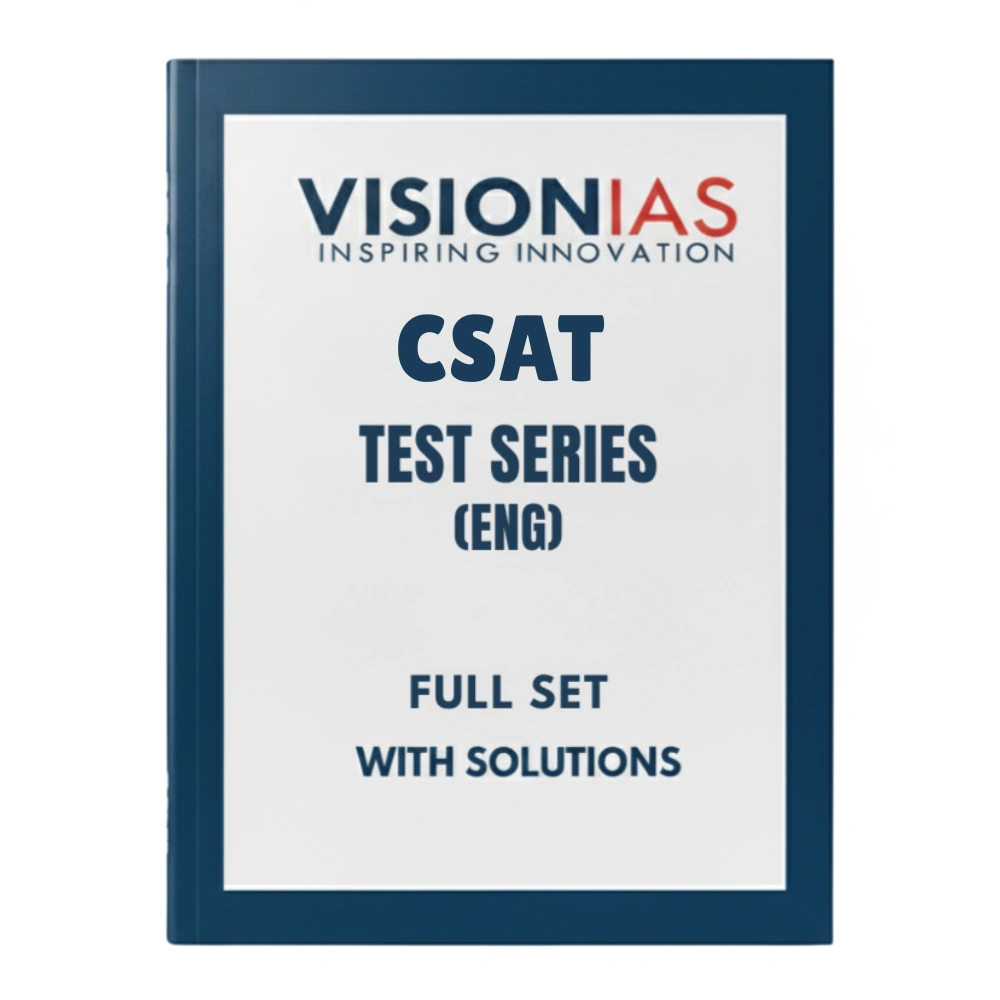
A dedicated CSAT mock series calibrated to the new difficulty is the fastest way to diagnose gaps. Options like the Vision IAS CSAT Test Series 2025-26 and the Drishti IAS CSAT Test Series 2026 replicate the current pattern so you walk into the exam hall knowing your realistic score.
Is CSAT Tougher Than GS Paper 1?
For most aspirants since 2023, CSAT now feels tougher than GS Paper I — not because the syllabus is larger (it is far smaller and fixed), but because CSAT is a speed-and-accuracy test with a hard time limit, while GS Paper I rewards accumulated knowledge and elimination. The difficulty of CSAT is concentrated in two places: dense analytical comprehension passages and multi-step numeracy/DI questions that must be solved in roughly 90 seconds each. A candidate can “know” the whole CSAT syllabus and still miss the cut-off through poor time management, whereas GS Paper I rarely traps well-read candidates that way.
The honest answer is that it depends on your background. Engineering and commerce graduates often find CSAT the easier of the two papers, while many humanities and Hindi-medium aspirants find it harder. The safe conclusion for 2026: treat CSAT as a paper that can genuinely end your attempt, give it structured weekly practice, and never assume it will clear itself.
Topic-Priority Plan Based on the New Difficulty
Given the rising difficulty, prioritise by return on effort. Here is a difficulty-adjusted priority map to sequence your preparation.
| Priority | Focus Areas | Why |
|---|---|---|
| Tier 1 (start first) | Reading comprehension, percentages, ratios, series, coding-decoding, blood relations, direction | Highest weightage + fastest accuracy gains |
| Tier 2 (build next) | Time-speed-distance, averages, syllogism, seating arrangement, Venn diagrams, calendar/clock | Consistent 15–20 marks with practice |
| Tier 3 (finish later) | SI/CI, mensuration, DI, probability, puzzles | Lower frequency or higher time cost per question |
Comprehension vs Maths: Time & Question-Selection Strategy
Your strategy should differ based on your background. With only 120 minutes for 80 questions, you have roughly 90 seconds per question — but you should never attempt all 80. Select and skip deliberately.
If you are weak in maths
Make comprehension your engine. Attempt all reading-comprehension questions first (they need no calculation), then reasoning topics like coding-decoding, blood relations, direction and series. Target 55–60 minutes on comprehension + reasoning, secure 30+ correct there, and pick only the 8–10 easiest maths/DI questions. This route can comfortably clear 66.67 without touching hard numeracy.
If you are strong in maths
Reverse the order: bank 20–25 maths/reasoning questions fast in the first 45 minutes, then spend the remaining time on comprehension. Maths gives near-certain marks with low negative-marking risk when your fundamentals are solid, so you clear the paper with a large buffer and can even leave early.
General rule for everyone
- Do two passes: easy/known questions first, doubtful ones second.
- Attempt a question only if you can eliminate at least two options — otherwise skip to avoid the 0.83 penalty.
- Read every comprehension passage twice but questions once; the answer is always inside the passage, not outside knowledge.
Hindi-Medium Aspirants: Specific Pointers
CSAT is bilingual, but the English comprehension passages are the reference version and the Hindi translation is sometimes stiff or ambiguous. Hindi-medium candidates should keep three things in mind:
- Cross-check the passage in English when the Hindi wording feels unclear — comparing both versions often resolves the intended meaning.
- Practise with bilingual material so exam-day translation quirks do not surprise you. Hindi-medium study resources such as the Drishti IAS Hindi Study Material help build comfort with the paper’s language style.
- Do not skip English comprehension practice. Even if you write GS in Hindi, developing English reading speed is the single biggest CSAT advantage because many passages read more naturally in English.
Best Books for CSAT Preparation
The right resources keep CSAT prep focused and time-efficient. Below is a practical, section-wise resource list that matches the syllabus heads rather than generic recommendations.
| Section | Recommended Resource Type |
|---|---|
| Comprehension | Daily newspaper editorials + passage-practice sets |
| Reasoning & General Mental Ability | Aptitude book (e.g., R.S. Aggarwal) + topic-wise drills |
| Basic Numeracy | Class VI–X NCERT maths + CSAT arithmetic booklet |
| Data Interpretation | DI practice sets with timed drills |
| Full syllabus + practice | Consolidated CSAT booklet with solved PYQs |
| Exam simulation | Full-length CSAT mock test series |
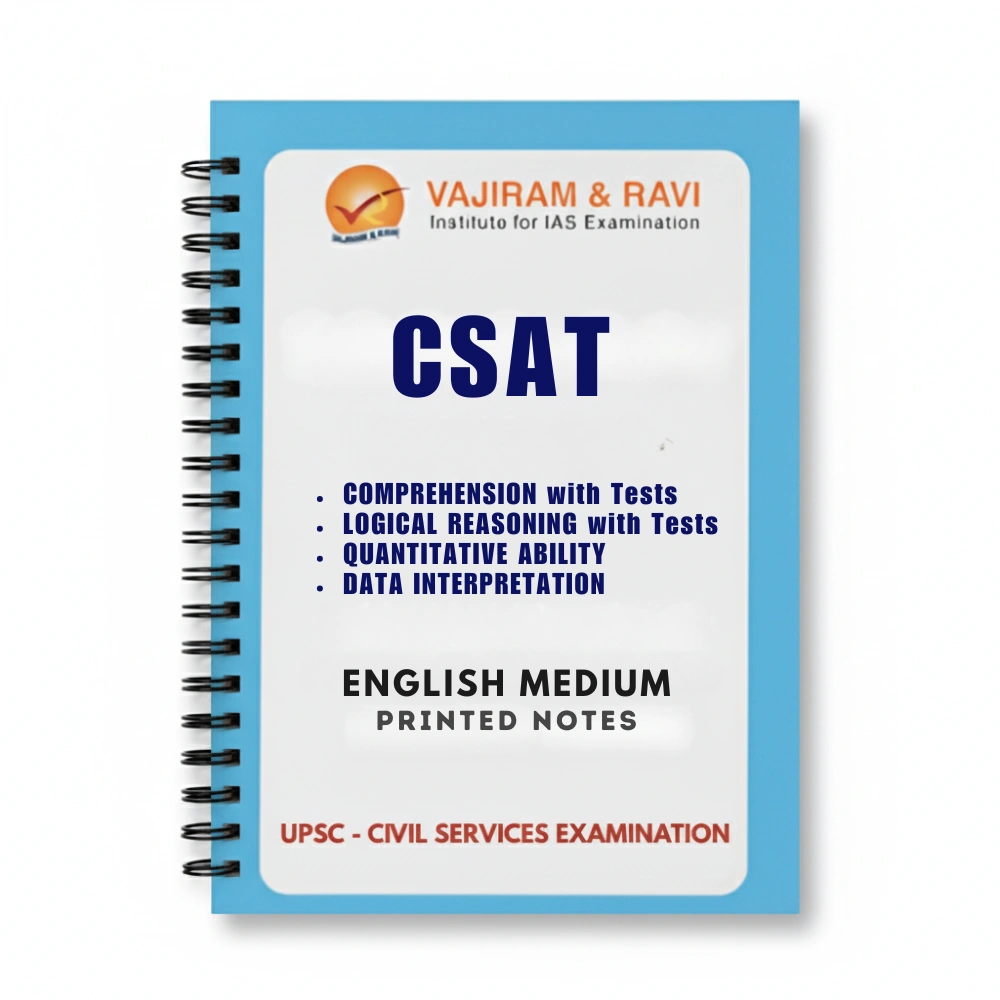
Do not over-collect books — two or three well-worked resources beat ten skimmed ones. Pick one aptitude reference, one consolidated CSAT booklet and one mock series, then repeat them. For a single consolidated resource, the Vajiram CSAT Complete Booklet Set 2025-26 with Practice Questions bundles theory and practice across all seven heads, and you can pair it with a mock series to convert study into scores.
Download the CSAT Syllabus PDF (English & Hindi)
A print-ready csat syllabus pdf download is the fastest way to pin the complete topic tree above your study desk. Keep both the English and Hindi versions handy so you can map every UPSC notification bullet to a specific study resource and track what you have covered. If you also want the full official syllabus in booklet form covering Prelims, Mains and CSAT together, the GS Score Latest Syllabus Booklet 2026-27 is a clean, printed reference you can annotate as you progress.
Use the PDF as a checklist: tick each numeracy and reasoning topic as you finish theory, then tick it again after you clear a sectional mock on it. Two ticks per topic — theory done, tested — is a reliable readiness signal for the upsc csat syllabus 2026.
Common CSAT Mistakes to Avoid
- Treating CSAT as a formality. Post-2023, this assumption ends campaigns. Give it consistent weekly time.
- Ignoring comprehension practice. It is the largest block; neglecting it is the most expensive error.
- Over-attempting under pressure. Guessing blindly triggers negative marking; discipline beats bravado.
- Studying theory without timed mocks. CSAT is a time-management test disguised as an aptitude test.
- Skipping maths entirely. You now need at least 12–15 reliable numeracy/DI questions to be safe.
Frequently Asked Questions
What is the syllabus of CSAT in UPSC?
The CSAT syllabus has seven official heads: comprehension; interpersonal and communication skills; logical reasoning and analytical ability; decision-making and problem-solving; general mental ability; basic numeracy up to Class X level; and data interpretation up to Class X level. The paper carries 80 questions for 200 marks.
Is CSAT paper 1 or 2 in UPSC Prelims?
CSAT is Paper 2 (General Studies Paper II) of UPSC Prelims. General Studies is Paper 1 and is held in the morning; CSAT is held in the afternoon on the same day. Both papers are compulsory to appear in.
What is the qualifying or passing marks for CSAT?
You must score at least 33% in CSAT, which is 66.67 marks out of 200. This is roughly 27 correct answers. CSAT marks are qualifying only and are not added to your Prelims merit — only GS Paper I decides your ranking.
Is CSAT maths of which class level?
CSAT basic numeracy and data interpretation are explicitly set at Class X level in the UPSC notification. You do not need Class 11–12 topics like calculus or trigonometry — the focus is arithmetic such as percentages, ratios, averages, time-speed-distance and simple data reading.
How many questions are asked in CSAT and what is the marking scheme?
CSAT has 80 questions for 200 marks in 2 hours. Each correct answer gives 2.5 marks, and each wrong answer deducts one-third (0.83 marks) as negative marking. To be safe, aim for 35–45 accurate attempts to comfortably cross 66.67.
Is CSAT tougher than GS Paper 1?
For most aspirants since 2023, CSAT feels tougher because it is a timed speed-and-accuracy test rather than a knowledge test, and its comprehension and numeracy questions must be solved in about 90 seconds each. Engineering and commerce backgrounds often find it easier; humanities and Hindi-medium aspirants usually find it harder. Either way, do not assume it will clear itself.
Which are the best books for CSAT preparation?
Keep it lean: one aptitude reference (such as R.S. Aggarwal) for reasoning and general mental ability, Class VI–X NCERT maths plus a CSAT arithmetic booklet for numeracy, daily editorial reading with passage sets for comprehension, and one full-length mock series for exam simulation. A single consolidated CSAT booklet with solved PYQs covering all seven heads reduces book-hopping.
Is CSAT counted in the final UPSC merit list?
No. CSAT is a qualifying paper — its marks are not counted in the Prelims merit or the final UPSC merit list. It only decides whether you clear Prelims; your Mains and Interview scores determine the final rank. However, you must still cross the 33% CSAT cut-off to move ahead.
Recommended Study Material


Continue Reading
Sociology Optional Syllabus 2026: Paper 1 & 2 + Free PDF
The sociology optional syllabus for UPSC has two papers of 250 marks each (500 marks total): Paper 1…
Best Books for Banking Exams 2026: Subject-Wise List (IBPS, SBI, RBI)
The best books for banking exams in 2026 are R.S. Aggarwal's Quantitative Aptitude for maths, R.S. Aggarwal's A…
UKPSC Syllabus 2025: Prelims, Mains, Pattern + PDF (Hindi & English)
The UKPSC syllabus for the Combined State Civil / Upper Subordinate Services (Uttarakhand PCS) is spread across three…