WBCS Syllabus 2026: Prelims, Mains, Optional + PDF
Complete WBCS syllabus 2026 — subject-wise Prelims & Mains syllabus, exam pattern, 40 optional subjects, negative marking, cutoff & official PDF download.

The WBCS syllabus for 2026 is divided across three stages conducted by the West Bengal Public Service Commission (WBPSC): Preliminary (1 objective paper of 200 marks), Mains (6 compulsory papers plus 2 optional papers for Group A & B), and a Personality Test/Interview. The Prelims covers 8 subjects of 25 marks each, carries negative marking of 1/3 mark per wrong answer, and acts only as a screening test, while the Mains marks and the interview decide the final merit. This guide gives you the complete, subject-wise WBCS syllabus 2026 for every stage, the full exam pattern, the entire optional subjects list with codes, and a link to the official WBPSC syllabus PDF download.
Last updated: October 2026 — aligned with the latest WBPSC notification and gazette.
WBCS Syllabus 2026 at a Glance (Quick Answers)
If you are short on time, here are the fast facts aspirants search for most, before the detailed breakdown below.
| Question | Quick answer |
|---|---|
| Number of stages | 3 — Prelims, Mains, Personality Test |
| Prelims format | 1 paper, 200 MCQs, 200 marks, 2.5 hours |
| Negative marking (Prelims) | Yes — 1/3 mark per wrong answer |
| Mains papers | 8 (6 compulsory + 2 optional) for Group A & B; 6 for Group C & D |
| Optional subjects offered | About 40 (literatures, humanities, sciences, engineering) |
| Does Prelims count in merit? | No — screening only; merit = Mains + Interview |
| Official syllabus source | WBPSC advertisement PDF at wbpsc.gov.in |
WBCS Syllabus 2026 Overview & Selection Process
The West Bengal Civil Service (Executive) examination, popularly called WBCS, recruits officers for Group A, B, C and D state services — from WBCS (Exe.) and WBPS (police) to the Commercial Tax, Labour, and Co-operative services. Understanding the wbcs syllabus 2026 correctly means first understanding how the three stages connect, because each stage has a different weightage, marking scheme, and purpose.
The selection happens in three sequential stages. You must clear each to advance to the next:
| Stage | Nature | Marks | Purpose |
|---|---|---|---|
| Preliminary Examination | Objective (MCQ), single paper | 200 | Screening only — marks not counted in final merit |
| Main Examination | Descriptive + objective papers | 1,200–1,800 (group-wise) | Counted in final merit |
| Personality Test / Interview | Oral | 100–200 (group-wise) | Counted in final merit |
A crucial point many aspirants miss: Prelims marks are purely for qualification. Your final rank is calculated from Mains written marks plus the Personality Test only. This changes how you should allocate preparation time — Prelims must be cleared comfortably, but the real battle for rank is in the Mains.
Before you map the syllabus, confirm you meet the broad eligibility window: candidates generally need to be a graduate of a recognised university, be an Indian citizen, and fall within the prescribed age band (roughly 21–36 years for most groups as on 1 January of the exam year, with group-wise variation and statutory relaxations for SC/ST/OBC, PwD and other categories). Always verify the exact age limit, number of attempts, and language eligibility against the current WBPSC advertisement, because these are revised from time to time.
WBCS Exam Pattern 2026 (Prelims + Mains at a Glance)
Before diving into topics, fix the wbcs exam pattern 2026 in your mind. The structure differs sharply between the two written stages, and the Mains structure further changes by the group (A, B, C, D) you are competing for.
| Feature | Prelims | Mains |
|---|---|---|
| Number of papers | 1 | 8 (6 compulsory + 2 optional) / 6 for Group C & D aspirants |
| Type | Objective (MCQ) | Descriptive + 2 objective compulsory papers |
| Total marks | 200 | 1,200–1,800 depending on group |
| Duration | 2.5 hours | 3 hours per paper |
| Negative marking | Yes — 1/3 per wrong MCQ | Only in the two objective-type papers |
| Role in merit | Qualifying / screening | Counted in final rank |
WBCS Prelims Syllabus 2026 (Subject-Wise)
The wbcs prelims syllabus consists of a single compulsory objective paper of 200 marks carrying 200 multiple-choice questions, to be answered in 2 hours 30 minutes. The paper is divided into 8 subjects of 25 marks (25 questions) each, giving equal weightage to every area. This equal-weightage design is unique to WBCS — unlike UPSC, you cannot afford to ignore any single subject.
| Subject | Marks | Approx. Questions | Key Focus |
|---|---|---|---|
| English Composition | 25 | 25 | Synonyms, antonyms, idioms, grammar, sentence correction |
| General Science | 25 | 25 | Physics, Chemistry, Biology — everyday science, NCERT level |
| Current Events of National & International Importance | 25 | 25 | Last 12 months — polity, economy, sports, awards, summits |
| History of India | 25 | 25 | Ancient, medieval, modern India |
| Geography of India (with special reference to West Bengal) | 25 | 25 | Physical, economic geography; WB rivers, soils, districts |
| Indian Polity & Economy | 25 | 25 | Constitution, governance, Five-Year Plans, budget basics |
| Indian National Movement | 25 | 25 | 1857 to 1947, Bengal’s role, leaders and sessions |
| General Mental Ability | 25 | 25 | Reasoning, series, coding-decoding, basic arithmetic |
Subject-wise Prelims depth
The West Bengal focus in Geography and History is the single biggest differentiator from a UPSC-style preparation. Expect questions on Bengal’s rivers (Teesta, Damodar, Mahananda), the Sundarbans, tea and jute belts, district reorganisation, and the Bengal renaissance. Current Events is wide — revise at least the last 12 months. A monthly current-affairs compilation such as the Vision IAS Current Affairs Magazine (January 2026) is an efficient way to lock down national and international events without drowning in newspapers.
Is there negative marking in WBCS prelims?
Yes. WBCS Prelims carries negative marking of 1/3 of the allotted mark for every wrong answer. Since each question is worth 1 mark, a wrong answer costs you 0.33 marks. Unanswered questions carry no penalty. This is the clarity most top pages gloss over: with 200 questions and equal weightage, blind guessing is statistically dangerous. The safe rule is to attempt a question only when you can confidently eliminate at least two options, converting a blind 1-in-4 guess into a favourable 1-in-2.
WBCS Prelims qualifying cutoff guidance
WBPSC does not publish a fixed qualifying percentage in advance; the Prelims cutoff is set each year based on vacancies and the number of candidates to be shortlisted for Mains (typically a few thousand). As a working benchmark from recent cycles, general-category aspirants have usually needed roughly 48–55% (around 96–110 out of 200) to stay safe, with relaxations for reserved categories. Treat 110+ as a comfortable target rather than the bare minimum.
WBCS Mains Syllabus 2026 (Compulsory Papers)
The wbcs mains syllabus is where the examination truly tests depth. The Mains consists of six compulsory papers for every candidate, plus two optional papers (one optional subject studied across two papers) that are compulsory only for those competing for Group A and Group B services. Candidates aiming only at Group C and Group D write the six compulsory papers.
| Paper | Subject | Marks | Type |
|---|---|---|---|
| Paper I | Bengali / Hindi / Urdu / Nepali / Santali (language) | 200 | Descriptive (qualifying in nature for many) |
| Paper II | English (Essay, Précis, Composition) | 200 | Descriptive |
| Paper III | General Studies – I | 200 | Objective (MCQ) |
| Paper IV | General Studies – II | 200 | Objective (MCQ) |
| Paper V | The Constitution of India & Indian Economy (incl. role & functions of RBI) | 200 | Objective (MCQ) |
| Paper VI | Arithmetic & Test of Reasoning | 200 | Objective (MCQ) |
Compulsory language paper — qualifying nature explained
Paper I (the vernacular language — Bengali, Hindi, Urdu, Nepali or Santali as chosen) tests drafting, translation, précis, composition, letter-writing and grammar. For candidates whose medium differs, the exact counting varies, but the practical point is this: the language paper is largely qualifying in character — you must score the minimum to stay in the race, but it rarely adds to your competitive edge. Do not over-invest here beyond securing a safe pass; redirect that time to GS and your optional.
General Studies I & II, Constitution, and Arithmetic papers
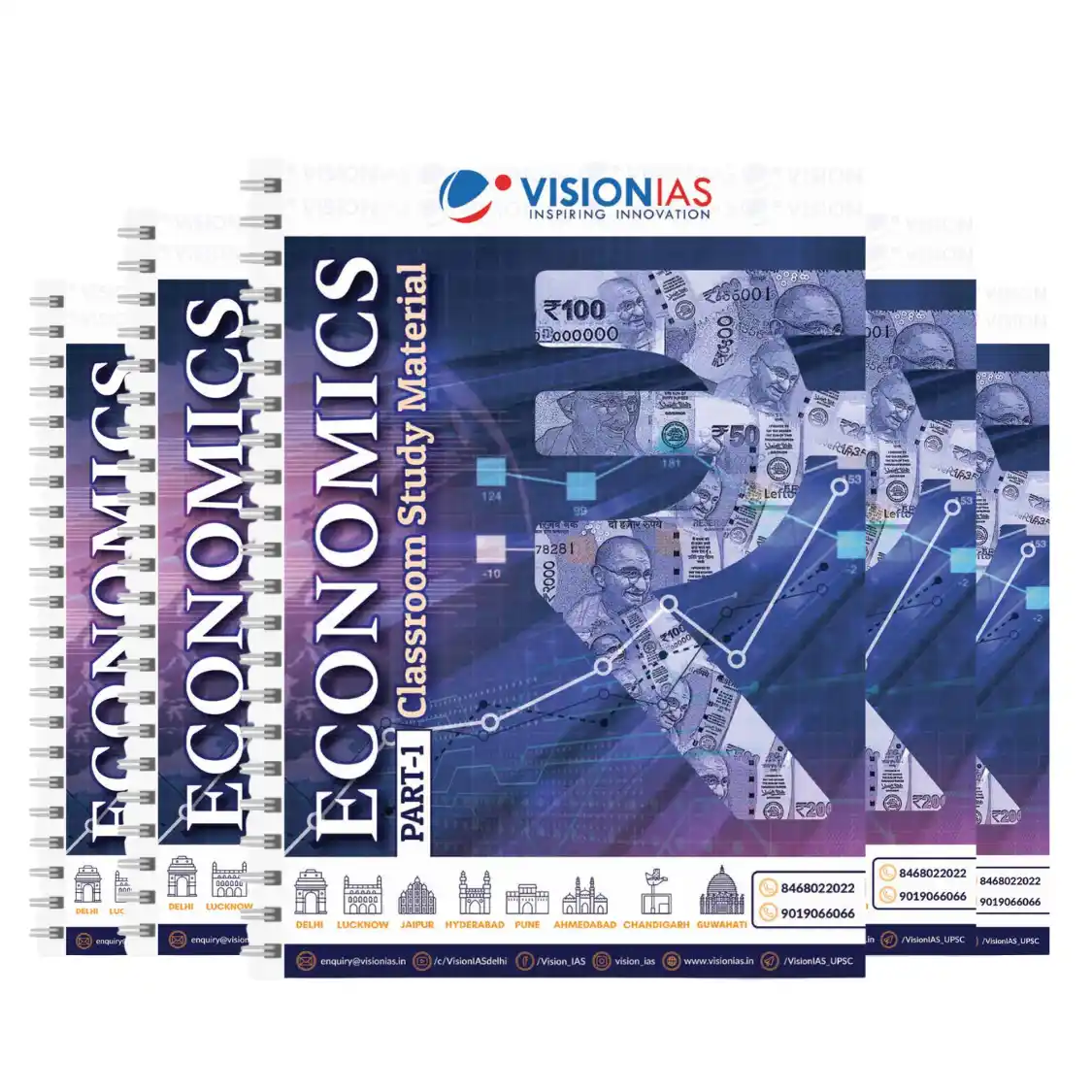
Papers III to VI are objective (MCQ) and carry negative marking. GS-I spans Indian history, geography (with West Bengal emphasis), and general science; GS-II covers polity, Indian national movement, current events, and general knowledge. Paper V combines the Constitution of India with the Indian Economy and the role and functions of the RBI — a focused, high-return area. A tightly structured economy resource like the Vision IAS Economics Notes maps cleanly onto Paper V’s economy and RBI portions. Paper VI (Arithmetic & Test of Reasoning) rewards speed and accuracy and is highly scorable with daily practice.
WBCS Mains Optional Papers & Group-Wise Pattern
For Group A and Group B, two additional papers come from a single optional subject (each optional subject is divided into Paper I and Paper II of 200 marks each). This is the section with the widest confusion, so the table below settles the group-wise clarity that most pages leave vague.
| Group | Compulsory Papers | Optional Papers | Approx. Mains Total | Interview Marks |
|---|---|---|---|---|
| Group A | 6 | 2 (one optional subject) | ~1,600–1,800 | 200 |
| Group B | 6 | 2 (one optional subject) | ~1,600–1,800 | 200 |
| Group C | 6 | Not required | ~1,200 | 150 |
| Group D | 6 | Not required | ~1,200 | 100 |
In short: if you aspire to the top services (Group A — WBCS Exe., Group B — WBPS), the optional subject is non-negotiable and can decide your rank. If you are targeting Group C or D, your optional is irrelevant and you compete purely on the six compulsory papers plus interview.
WBCS Optional Subjects List 2026 (With Codes)
The wbcs optional subjects list offered by WBPSC runs to around 40 subjects, including literatures of several languages. You choose one subject, written across two papers. Below is the consolidated list with indicative serial codes (verify the exact code against the current notification).
| # | Optional Subject | # | Optional Subject |
|---|---|---|---|
| 1 | Bengali | 21 | Mathematics |
| 2 | Hindi | 22 | Statistics |
| 3 | Sanskrit | 23 | Physics |
| 4 | English | 24 | Chemistry |
| 5 | Pali | 25 | Botany |
| 6 | Arabic | 26 | Zoology |
| 7 | Persian | 27 | Geology |
| 8 | French | 28 | Physiology |
| 9 | Urdu | 29 | Economics |
| 10 | Santali | 30 | Commerce & Accountancy |
| 11 | History | 31 | Political Science |
| 12 | Geography | 32 | Sociology |
| 13 | Philosophy | 33 | Public Administration |
| 14 | Psychology | 34 | Anthropology |
| 15 | Education | 35 | Law |
| 16 | Agriculture | 36 | Computer Science |
| 17 | Animal Husbandry & Veterinary Science | 37 | Management |
| 18 | Fishery Science | 38 | Nepali |
| 19 | Medical Science | 39 | Mechanical Engineering |
| 20 | Sociology (Rural) | 40 | Civil / Electrical Engineering |
Per-optional topic breakdown (popular choices)
Here is the paper-wise topic depth that top pages rarely provide — a quick map of what the most-chosen WBCS optionals actually test.
| Optional | Paper I core | Paper II core |
|---|---|---|
| Geography | Geomorphology, climatology, oceanography, biogeography, geographical thought | Geography of India & West Bengal — resources, agriculture, industry, settlement |
| Political Science | Political theory, Indian government & politics, Constitution | Comparative politics, international relations, India & the world |
| Sociology | Fundamentals of sociology, thinkers, research methods | Indian society — structure, change, social movements, rural/urban |
| History | Ancient & medieval India, art and culture | Modern India, national movement, world history, Bengal history |
| Economics | Micro & macroeconomics, international economics, public finance | Indian economy — planning, agriculture, industry, money & banking |
| Public Administration | Administrative theory, concepts, thinkers | Indian administration — Centre-State, civil services, local government |
Because WBCS and UPSC optional syllabi overlap heavily in structure, well-organised UPSC optional material transfers directly. For Geography aspirants, the Vajiram Geography Optional Notes cover Paper I and Paper II thematically; Sociology candidates can build a strong base with the SS Pandey Sociology Notes; and for Political Science, the Shubhra Ranjan PSIR Optional Material is a widely used standard.
Which optional subject is best for WBCS?
There is no universally “best” optional — the best optional is the one you can score highest in. That said, Geography, Political Science, Sociology, History and Public Administration are perennial favourites because of overlap with the GS papers, abundant study material, and scoring potential. Science/engineering graduates often retain their core subject (e.g., Physics, Zoology, Commerce) for depth advantage. Pick based on your academic background, interest, availability of guidance, and past-year scoring trends — not on crowd behaviour.
WBCS Personality Test / Interview 2026
The final stage is the Personality Test (interview), which assesses general awareness, aptitude for public service, personality, and communication. The marks differ by the group you are shortlisted for, and these marks count towards your final rank.
| Group | Interview Marks |
|---|---|
| Group A | 200 |
| Group B | 200 |
| Group C | 150 |
| Group D | 100 |
For Group A and B, 200 interview marks over a close Mains field can swing dozens of ranks — so do not treat the interview as an afterthought. Expect questions on West Bengal’s administration, current state and national affairs, your optional subject, and your home district.
WBCS Syllabus PDF Download (Official WBPSC)
For the authoritative, legally binding version of the syllabus, always refer to the official WBPSC gazette notification. You can complete your wbcs syllabus pdf download from the official West Bengal Public Service Commission website (wbpsc.gov.in) under the WBCS (Exe.) Examination notification/advertisement section. Download the current year’s advertisement PDF, which contains the full Prelims and Mains syllabus, the optional subjects list with codes, and the marking scheme. Cross-check any third-party syllabus (including this page) against that gazette before finalising your plan.
Subject-Wise Preparation Strategy & Weightage
A syllabus is only useful when you translate it into a weightage-aware strategy. Here is how the smart WBCS aspirant allocates effort.
| Area | Why it matters | Strategy |
|---|---|---|
| West Bengal Geography & History | Unique to WBCS; high, repeat weightage | Build a dedicated WB notebook — rivers, districts, renaissance, freedom movement in Bengal |
| Current Events | Appears in Prelims and Mains GS | One monthly magazine + daily notes; revise last 12 months |
| Arithmetic & Reasoning (Mains Paper VI) | Fully scorable, objective | Daily timed practice; aim for near-full marks |
| Constitution & Economy (Mains Paper V) | Focused, static, high-return | Standard polity + economy notes; revise RBI functions |
| Optional (Group A/B) | 400 marks — rank decider | Start early; one source thoroughly beaten over many sources |
| Language papers | Largely qualifying | Secure the pass mark; don’t over-invest |
Can I clear WBCS without coaching?
Yes — many candidates clear WBCS through self-study. The syllabus is well-defined and the resources are widely available. What self-study demands is discipline: a fixed timetable, the right books, regular answer-writing for the descriptive Mains papers, and a mock-test routine for the objective papers. Coaching mainly offers structure and doubt-clearing; if you can impose structure on yourself and build a solid note-bank from standard material, coaching is optional rather than essential.
Is WBCS tougher than UPSC?
No — WBCS is generally considered less tough than UPSC in syllabus depth and competition intensity. UPSC’s Mains is fully descriptive with nine papers and a far larger, pan-India applicant pool, while WBCS has a lighter optional load (only for Group A/B) and several objective Mains papers. However, WBCS has its own challenges: the West Bengal-specific Geography and History, the vernacular language paper, and intense state-level competition. They are different exams rather than strictly harder/easier across the board — and the strong syllabus overlap means UPSC-grade material serves WBCS aspirants well.
How long does it take to prepare for WBCS?
Most successful candidates put in 10–14 months of focused preparation, though the right figure depends on your starting base, whether you are a working professional, and whether you need an optional for Group A/B. A graduate with a strong GS foundation can compress this; a complete beginner should plan for a full year that covers one relaxed foundation cycle, one core-building cycle, and a dedicated revision-plus-mock phase before each stage.
Month-Wise WBCS 2026 Study Plan
Mapping the syllabus to a timetable is where most aspirants stumble. Here is a workable skeleton you can adapt to your start date.
| Phase | Duration | Focus |
|---|---|---|
| Foundation | Months 1–3 | NCERTs, basic polity/economy/geography, begin optional (Group A/B), start current affairs notebook |
| Core building | Months 4–6 | Complete static GS, WB Geography & History deep-dive, finish one optional paper |
| Mains orientation | Months 7–8 | Answer-writing practice, language & English papers, Arithmetic/Reasoning drills |
| Prelims sprint | Final 6–8 weeks before Prelims | Full-length mocks, 8-subject revision, current affairs revision |
| Post-Prelims to Mains | Gap period | Intensive Mains + optional revision, mock Mains papers |
| Interview prep | After Mains result | Mock interviews, WB affairs, bio-data based questions |
Common Mistakes WBCS Aspirants Make
Avoiding these pitfalls is as valuable as studying the syllabus:
- Ignoring the West Bengal-specific portions of Geography and History — a guaranteed scoring area that outsiders neglect.
- Over-attempting Prelims MCQs despite the 1/3 negative marking — discipline in guessing protects your score.
- Starting the optional subject too late (Group A/B) — 400 marks cannot be crammed.
- Treating the language paper casually enough to fail its qualifying mark.
- Neglecting answer-writing practice for descriptive Mains papers until it is too late.
- Relying on scattered sources instead of beating a few standard books thoroughly.
- Studying the syllabus from an outdated PDF — always reconcile with the latest WBPSC advertisement before you plan.
Related Quick Links
Plan your WBCS 2026 journey end-to-end: bookmark the official WBPSC advertisement for answer keys and results, collect previous years’ question papers for trend analysis, and check the latest WBCS salary and pay-scale structure (7th Pay Commission state matrix) to understand the career payoff across Group A to D services. Pair these with a disciplined note-bank built from standard GS and optional material, and you have a complete preparation ecosystem.
Frequently Asked Questions
What is the syllabus of WBCS exam?
The WBCS syllabus spans three stages: Prelims (one 200-mark objective paper across 8 subjects — English, General Science, Current Events, History of India, Geography of India with West Bengal focus, Indian Polity & Economy, Indian National Movement, and General Mental Ability), Mains (6 compulsory papers plus 2 optional papers for Group A & B), and a Personality Test/Interview.
Is there negative marking in WBCS prelims?
Yes. WBCS Prelims deducts 1/3 of the mark for each wrong answer — since every question carries 1 mark, a wrong answer costs 0.33. Unanswered questions carry no penalty, so avoid blind guessing unless you can eliminate at least two options. The two objective-type Mains papers also carry negative marking.
How many papers are there in WBCS Mains?
WBCS Mains has 8 papers for Group A & B candidates — 6 compulsory papers (one language, English, GS-I, GS-II, Constitution & Indian Economy, and Arithmetic & Reasoning) plus 2 optional papers from one chosen subject. Candidates targeting only Group C and D write the 6 compulsory papers without the optional.
What are the optional subjects in WBCS?
WBPSC offers around 40 optional subjects, including Geography, Political Science, Sociology, History, Economics, Public Administration, Philosophy, Psychology, Commerce & Accountancy, Law, Anthropology, the sciences (Physics, Chemistry, Botany, Zoology, Mathematics, Statistics), engineering branches, and several literatures such as Bengali, Hindi, Sanskrit, Urdu and Nepali.
Which optional subject is best for WBCS?
The best optional is the one you can score highest in. Geography, Political Science, Sociology, History and Public Administration are popular due to GS overlap and abundant material, while graduates often keep their core subject. Choose based on your background, interest, guidance availability, and past-year scoring trends rather than popularity.
What is the exam pattern of WBCS 2026?
WBCS 2026 has three stages: a 200-mark, 200-question objective Prelims (2.5 hours, 1/3 negative marking, screening only); a Mains of 6 compulsory papers plus 2 optional papers (Group A/B), totalling roughly 1,200–1,800 marks group-wise; and a Personality Test worth 200 marks for Group A/B, 150 for Group C, and 100 for Group D. Final merit uses Mains plus interview marks.
Is WBCS tougher than UPSC?
Generally, no. WBCS is considered less demanding than UPSC in syllabus depth and competition, since UPSC Mains is fully descriptive with nine papers and a national applicant pool, whereas WBCS carries several objective Mains papers and an optional only for Group A/B. WBCS does, however, add West Bengal-specific Geography and History and a vernacular language paper, so the two are better treated as different exams than as strictly harder or easier.
Can I clear WBCS without coaching?
Yes. The WBCS syllabus is well-defined and standard material is widely available, so disciplined self-study with a fixed timetable, regular answer-writing for the descriptive papers, and consistent mock tests is enough for many candidates. Coaching mainly adds structure and doubt-clearing; it is helpful but not essential if you can build and revise a solid note-bank on your own.
Recommended Study Material
Continue Reading
RRB JE Syllabus 2026: CBT 1 & 2 Topics, Pattern + PDF
The rrb je syllabus spans two computer-based stages: CBT 1 (100 marks / 90 minutes — Mathematics, General…
UPSC Exam Pattern 2026: Prelims, Mains & Interview Marks
The UPSC exam pattern for the Civil Services Examination (CSE) is a three-stage process: the Preliminary Examination (400…
NEET Exam Pattern 2026: Marks, Questions & Marking Scheme
The NEET exam pattern for 2026 is a single pen-and-paper (OMR) test of 180 compulsory multiple-choice questions carrying…