JEE Main Syllabus 2026: Physics, Chemistry, Maths + PDF
Complete JEE Main syllabus 2026: subject-wise Physics, Chemistry & Maths chapters, deleted topics, chapter-wise weightage & official PDF download.

The JEE Main syllabus for 2026 is set by the National Testing Agency (NTA) and is fully based on the NCERT Class 11 and Class 12 curriculum across three subjects — Physics, Chemistry and Mathematics. In total it covers roughly 20–21 units in Physics, 28 chapters in Chemistry (Physical, Inorganic and Organic) and about 16 units in Mathematics, with no new additions for 2026 and the same deleted chapters that NTA removed in the 2024 revision still excluded. This guide gives you the complete official subject-wise topic list, a printable chapter checklist, consolidated chapter-wise weightage tables, the deleted-syllabus comparison, the full exam pattern for Paper 1, Paper 2A and Paper 2B, and a strategy to actually finish it on time. The figures below are compiled from NTA’s official syllabus bulletin and the question-distribution pattern seen across the last five years of papers.
JEE Main Syllabus 2026: Quick One-Screen Snapshot
Before the deep dive, here is the entire jee main syllabus 2026 condensed into a single mobile-friendly overview. JEE Main is a Computer-Based Test (CBT) conducted by NTA twice a year (Session 1 in late January, Session 2 in April), and the better of your two attempts is counted. The syllabus is identical for every session and every attempt — there is no “easier” version for any sitting.
| Subject | Approx. Units / Chapters | Source | Section A (Theory) | Section B (Numerical) |
|---|---|---|---|---|
| Physics | 20 units + 1 practical/experimental skills unit | NCERT Class 11 & 12 | 20 MCQs | 5 numerical (all 5 to be attempted in 2025–26) |
| Chemistry | 28 chapters (Physical + Inorganic + Organic) | NCERT Class 11 & 12 | 20 MCQs | 5 numerical |
| Mathematics | 16 units | NCERT Class 11 & 12 | 20 MCQs | 5 numerical |
Each subject carries 100 marks, so Paper 1 (B.E./B.Tech) totals 300 marks across 75 questions to be answered. Marking is +4 for a correct answer and −1 for a wrong one, with no negative marking debate left open since NTA now requires all five Section B numericals to be attempted.
Why This JEE Main Syllabus Guide Matters
Most pages ranking for the jee main syllabus simply dump generic NCERT chapter names and bury the official PDF link several scrolls down. Aspirants then waste hours cross-checking what is actually examinable versus what was deleted, and they get no clear sense of which chapters carry the most marks. This guide is built to fix exactly those gaps: a clean checkbox-style chapter checklist you can print and tick while revising, a consolidated multi-year chapter-wise weightage view, one unambiguous “what changed versus last year” deleted-syllabus table, and a high-ROI versus low-ROI chapter map so you know what to prioritise when you are short on time.
We also clearly separate the JEE Main syllabus from the JEE Advanced syllabus, since confusing the two is one of the most common and costly mistakes. The bottom line: JEE Main sticks strictly to NCERT-level topics, while JEE Advanced goes deeper and adds topics NCERT does not emphasise. Get the Main syllabus right first — it is the gateway exam that decides whether you even sit for Advanced.
JEE Main Physics Syllabus 2026 (Complete Official List)
The jee main physics syllabus is divided into Section A (theoretical, ~80% weight) and Section B (experimental/practical skills, ~20% weight). NTA lists 20 theory units plus one experimental-skills unit. Physics is the subject where conceptual clarity and numerical practice matter most, and it is consistently the highest-scoring differentiator at the top of the rank list.
| Unit No. | Unit Name | Key Topics |
|---|---|---|
| 1 | Physics and Measurement | Units, dimensions, errors, significant figures |
| 2 | Kinematics | Motion in a straight line and plane, projectile, relative velocity |
| 3 | Laws of Motion | Newton’s laws, friction, circular motion dynamics |
| 4 | Work, Energy and Power | Work-energy theorem, conservation, collisions |
| 5 | Rotational Motion | Centre of mass, torque, moment of inertia, angular momentum |
| 6 | Gravitation | Kepler’s laws, gravitational PE, satellites, escape velocity |
| 7 | Properties of Solids and Liquids | Elasticity, surface tension, viscosity, calorimetry |
| 8 | Thermodynamics | Laws of thermodynamics, heat engines, isothermal/adiabatic processes |
| 9 | Kinetic Theory of Gases | Gas laws, RMS speed, degrees of freedom, mean free path |
| 10 | Oscillations and Waves | SHM, damped/forced oscillations, wave motion, Doppler effect |
| 11 | Electrostatics | Coulomb’s law, Gauss’s law, potential, capacitors |
| 12 | Current Electricity | Ohm’s law, Kirchhoff’s laws, Wheatstone bridge, cells |
| 13 | Magnetic Effects of Current & Magnetism | Biot-Savart, Ampere’s law, magnetic dipole, earth’s magnetism |
| 14 | Electromagnetic Induction & Alternating Currents | Faraday’s law, self/mutual inductance, LCR circuits, transformers |
| 15 | Electromagnetic Waves | Displacement current, EM spectrum, properties |
| 16 | Optics | Ray optics, instruments, interference, diffraction, polarisation |
| 17 | Dual Nature of Matter and Radiation | Photoelectric effect, de Broglie wavelength, Einstein’s equation |
| 18 | Atoms and Nuclei | Bohr model, radioactivity, nuclear reactions, mass-energy |
| 19 | Electronic Devices | Semiconductors, diodes, transistors, logic gates |
| 20 | Experimental Skills (Section B) | Vernier calipers, screw gauge, metre bridge, focal length, p-n diode characteristics |
JEE Main 2026 Physics Section B: Experimental Skills Syllabus
The experimental-skills unit is frequently overlooked yet predictably tested. Be fluent with vernier calipers and screw gauge readings, the simple pendulum, Young’s modulus by Searle’s method, surface tension and viscosity experiments, the metre bridge and potentiometer, the focal length of mirrors and lenses, and the characteristic curves of a p-n junction diode and a Zener diode. Two to three questions usually come directly from this unit, so it offers easy marks for disciplined students.
JEE Main Physics Chapter-Wise Weightage (Multi-Year View)
Weightage shifts slightly year to year, but the pattern across the last 5 years is remarkably stable. The table below consolidates the average number of questions and approximate percentage weight so you can plan jee main chapter wise weightage at a glance. Mechanics plus Electrodynamics together account for over half of the Physics paper.
| Chapter / Group | Avg. Questions | Approx. Weightage | Priority |
|---|---|---|---|
| Mechanics (Kinematics, Laws of Motion, Rotation, WEP) | 6–7 | ~25–28% | High ROI |
| Electrodynamics (Electrostatics, Current, Magnetism, EMI) | 6–7 | ~26–28% | High ROI |
| Optics & Modern Physics | 4–5 | ~18–20% | High ROI |
| Heat & Thermodynamics | 2–3 | ~10% | Medium |
| Oscillations & Waves | 1–2 | ~7% | Medium |
| Properties of Matter & Gravitation | 1–2 | ~6% | Medium |
| Units, Measurement & Experimental Skills | 2–3 | ~8–9% | High ROI (easy) |
Strategy takeaway: if you are short on time, lock down Mechanics, Electrodynamics, Modern Physics and Experimental Skills first — they alone can comfortably fetch 70+ of the 100 Physics marks.
JEE Main Chemistry Syllabus 2026 (Complete Official List)
The jee main chemistry syllabus is split into three streams — Physical, Inorganic and Organic Chemistry — totalling around 28 chapters. Chemistry is widely regarded as the most scoring subject in JEE Main because a large share of questions are direct, NCERT-line, and memory-plus-application based. NTA dropped Section B’s optional-question choice from 2025 onward, so attempt all five numericals.
JEE Main 2026 Physical Chemistry Chapter List
| No. | Chapter | Key Topics |
|---|---|---|
| 1 | Some Basic Concepts in Chemistry | Mole concept, stoichiometry, empirical/molecular formula |
| 2 | Atomic Structure | Bohr model, quantum numbers, orbitals, electronic configuration |
| 3 | Chemical Bonding & Molecular Structure | VSEPR, hybridisation, MOT, hydrogen bonding |
| 4 | Chemical Thermodynamics | First law, enthalpy, entropy, Gibbs energy, spontaneity |
| 5 | Solutions | Concentration terms, Raoult’s law, colligative properties |
| 6 | Equilibrium | Chemical & ionic equilibrium, pH, buffer, solubility product |
| 7 | Redox Reactions and Electrochemistry | Oxidation number, Nernst equation, conductance, cells |
| 8 | Chemical Kinetics | Rate law, order, Arrhenius equation, half-life |
JEE Main 2026 Inorganic Chemistry Chapter List
| No. | Chapter | Key Topics |
|---|---|---|
| 1 | Classification of Elements & Periodicity | Periodic trends, ionisation energy, electronegativity |
| 2 | Hydrogen | Preparation, hydrides, water, hydrogen peroxide |
| 3 | s-Block Elements | Alkali & alkaline earth metals, properties, compounds |
| 4 | p-Block Elements | Groups 13–18, anomalies, important compounds |
| 5 | d- and f-Block Elements | Transition metals, lanthanides, actinides, K2Cr2O7, KMnO4 |
| 6 | Coordination Compounds | Nomenclature, isomerism, VBT, CFT, applications |
JEE Main 2026 Organic Chemistry Chapter List
| No. | Chapter | Key Topics |
|---|---|---|
| 1 | Basic Principles of Organic Chemistry | GOC, IUPAC, isomerism, electronic effects, reaction mechanisms |
| 2 | Hydrocarbons | Alkanes, alkenes, alkynes, aromatic hydrocarbons |
| 3 | Haloalkanes and Haloarenes | SN1/SN2, elimination, reactivity |
| 4 | Alcohols, Phenols and Ethers | Preparation, reactions, acidity |
| 5 | Aldehydes, Ketones and Carboxylic Acids | Carbonyl reactions, aldol, Cannizzaro, acidity |
| 6 | Amines | Basicity, diazonium salts, Hofmann |
| 7 | Biomolecules | Carbohydrates, proteins, vitamins, nucleic acids |
| 8 | Principles Related to Practical Chemistry | Qualitative analysis, purification, functional group tests |
JEE Main 2026 Chemistry Section B: Experiment Skills Syllabus
The practical-chemistry component covers detection of extra elements (N, S, halogens), functional-group identification, salt analysis for common cations and anions, preparation of inorganic and organic compounds, and titrimetric exercises (acid-base, redox). These map directly to the “Principles Related to Practical Chemistry” chapter and are reliably worth a couple of questions.
JEE Main Chemistry Chapter-Wise Weightage
| Branch / Chapter | Avg. Questions | Approx. Weightage | Priority |
|---|---|---|---|
| Physical Chemistry (overall) | 9–10 | ~36–40% | High ROI |
| Organic Chemistry (overall) | 8–9 | ~32–36% | High ROI |
| Inorganic Chemistry (overall) | 7–8 | ~28–30% | High ROI |
| Coordination Compounds | 2 | ~7–8% | High ROI |
| Chemical Bonding | 2 | ~7% | High ROI |
| p-Block Elements | 2–3 | ~8–9% | High ROI |
| Thermodynamics & Equilibrium | 2–3 | ~8% | High ROI |
| Aldehydes, Ketones & Carboxylic Acids | 2 | ~6–7% | Medium |
Inorganic Chemistry is the highest-yield-per-hour branch because most questions are fact-recall from NCERT lines. Coordination Compounds and p-Block are the single most repeated chapters — never leave them.
JEE Main Maths Syllabus 2026 (Complete Official List)
The jee main maths syllabus has 16 units. Mathematics decides speed and accuracy under pressure; Calculus and Algebra together dominate the paper. Note that NTA removed Mathematical Reasoning entirely in the 2024 revision, so it is not part of the 2026 syllabus.
| Unit No. | Unit Name | Key Topics |
|---|---|---|
| 1 | Sets, Relations and Functions | Types of functions, domain/range, composition, inverse |
| 2 | Complex Numbers and Quadratic Equations | Argand plane, modulus, roots, nature of roots |
| 3 | Matrices and Determinants | Operations, inverse, system of equations, properties |
| 4 | Permutations and Combinations | Fundamental principle, arrangements, selections |
| 5 | Binomial Theorem | General term, middle term, applications |
| 6 | Sequences and Series | AP, GP, HP, AGP, special series, sum to n terms |
| 7 | Limit, Continuity and Differentiability | Limits, L’Hopital, continuity, differentiation rules |
| 8 | Integral Calculus | Indefinite & definite integrals, properties, area under curves |
| 9 | Differential Equations | Order, degree, variable separable, linear DE |
| 10 | Coordinate Geometry | Straight lines, circles, parabola, ellipse, hyperbola |
| 11 | Three Dimensional Geometry | Direction cosines, lines, planes, distances |
| 12 | Vector Algebra | Dot/cross product, scalar triple product |
| 13 | Statistics and Probability | Mean, variance, probability, Bayes’ theorem |
| 14 | Trigonometry | Identities, equations, inverse trigonometric functions, heights & distances |
| 15 | Differential Calculus (Applications) | Tangents, normals, maxima/minima, monotonicity |
| 16 | Mathematical Induction | Principle and applications |
JEE Main 2026 Mathematics: Important Subtopics
Within these units, the recurring hotspots are: definite integration and area, application of derivatives (maxima/minima), conic sections (especially the ellipse and parabola), matrices and determinants, complex numbers, and probability. Sequences, binomial and 3D geometry are short, formula-driven and high-ROI for last-month revision.
JEE Main Maths Chapter-Wise Weightage
| Chapter / Group | Avg. Questions | Approx. Weightage | Priority |
|---|---|---|---|
| Calculus (Limits, Differentiation, Integration, AOD, DE) | 7–8 | ~30–33% | High ROI |
| Coordinate Geometry (2D + 3D) | 4–5 | ~17–18% | High ROI |
| Algebra (Complex No., Quadratic, Matrices, Sequences, Binomial) | 5–6 | ~22–24% | High ROI |
| Trigonometry & Inverse Trig | 2 | ~7% | Medium |
| Vectors & 3D Geometry | 2–3 | ~9–10% | High ROI |
| Probability & Statistics | 2 | ~7% | Medium |
| Permutations, Combinations & Sets | 1–2 | ~6% | Medium |
If time is tight, prioritise Calculus, Algebra, Coordinate Geometry and Vectors/3D — they reliably cover roughly 80% of the Maths paper.
JEE Main Deleted Syllabus 2026: What Changed vs Last Year
One of the biggest sources of confusion is the jee main deleted syllabus 2026. NTA carried out a major trimming in 2024, removing a set of chapters and topics that students should now skip. For 2026, no further chapters were added and no deleted topics were restored — the 2024 reduced syllabus continues. Here is the single clear comparison so you don’t revise dead weight.
| Subject | Deleted / Removed Topics (not in 2026 syllabus) | Status |
|---|---|---|
| Physics | Communication Systems; some experimental-skills duplicates | Removed |
| Chemistry | States of Matter (as separate unit); Surface Chemistry; Hydrogen (reduced); s-Block (trimmed); General Principles & Processes of Isolation of Metals (Metallurgy); Environmental Chemistry; Polymers; Chemistry in Everyday Life | Removed |
| Mathematics | Mathematical Reasoning; Mathematical Induction (partly); some Trigonometry (heights & distances trimmed); Sets & Relations (reduced) | Removed / Reduced |
Important nuance: some of these topics still appear in the NCERT textbook and remain part of your Class 12 board exam. So you may still study them for boards — just don’t spend JEE Main practice time on Polymers, Environmental Chemistry, Chemistry in Everyday Life, or Mathematical Reasoning, because NTA will not ask them. Always cross-check the latest official PDF before finalising, as NTA can revise year to year.
How to Download the Official JEE Main Syllabus PDF
For the authoritative jee main syllabus pdf download, do not rely on third-party lists alone. Follow these steps:
- Visit the official NTA JEE Main portal at jeemain.nta.nic.in.
- Open the latest “Information Bulletin” or “Syllabus” link for the current cycle.
- Download the subject-wise PDF, which lists Physics, Chemistry and Mathematics units along with the B.Arch and B.Plan syllabi.
- Cross-verify any topic against the NCERT Class 11 and 12 textbooks — the PDF and NCERT should agree.
Print the PDF and pair it with the checkbox checklist below so revision becomes a simple tick-off exercise rather than a guessing game.
Printable JEE Main Syllabus Checklist (Tick While Revising)
This is the one-screen, checkbox-style tracker the top pages don’t offer. Print it, paste it above your desk, and mark each chapter Done / Revised / Tested.
| Physics | Chemistry | Mathematics |
|---|---|---|
| ☐ Mechanics (Kinematics → Rotation) | ☐ Mole Concept & Stoichiometry | ☐ Sets, Relations, Functions |
| ☐ Gravitation | ☐ Atomic Structure | ☐ Complex Numbers & Quadratics |
| ☐ Thermodynamics & KTG | ☐ Chemical Bonding | ☐ Matrices & Determinants |
| ☐ Oscillations & Waves | ☐ Thermodynamics & Equilibrium | ☐ Permutation, Combination, Binomial |
| ☐ Electrostatics & Capacitors | ☐ Solutions & Electrochemistry | ☐ Sequences & Series |
| ☐ Current Electricity | ☐ Chemical Kinetics | ☐ Limits, Continuity, Differentiability |
| ☐ Magnetism & EMI | ☐ Periodicity, s & p-Block | ☐ Integral Calculus & Area |
| ☐ EM Waves & Optics | ☐ d & f-Block, Coordination Compounds | ☐ Application of Derivatives |
| ☐ Modern Physics (Dual Nature, Atoms, Nuclei) | ☐ GOC & Hydrocarbons | ☐ Differential Equations |
| ☐ Electronic Devices | ☐ Oxygen/Nitrogen functional groups | ☐ Coordinate Geometry (2D) |
| ☐ Experimental Skills | ☐ Biomolecules & Practical Chemistry | ☐ Vectors & 3D Geometry |
| ☐ Probability & Statistics |
A structured module set makes this checklist far easier to clear because every chapter is mapped to theory plus solved examples and practice. The eSaral IIT JEE Modules 2026 bundle the complete Physics, Chemistry and Maths syllabus into ready-to-revise booklets aligned to exactly this unit structure.
JEE Main 2026 Exam Pattern: Paper 1, Paper 2A & Paper 2B
The syllabus is delivered through three papers depending on the course you target. Paper 1 is for B.E./B.Tech, Paper 2A for B.Arch and Paper 2B for B.Plan. All are computer-based except the Drawing test in Paper 2A, which is pen-and-paper.
JEE Main Paper 1 (B.E./B.Tech) Pattern
| Subject | Section A (MCQ) | Section B (Numerical) | Marks |
|---|---|---|---|
| Physics | 20 | 5 | 100 |
| Chemistry | 20 | 5 | 100 |
| Mathematics | 20 | 5 | 100 |
| Total | 60 | 15 | 300 |
You answer 75 questions in 3 hours. Marking: +4 correct, −1 incorrect, 0 unattempted. From 2025 onwards all five Section B numericals per subject are compulsory (the earlier “any 5 of 10” choice is removed).
JEE Main Paper 2A (B.Arch) Pattern
| Section | Questions | Marks |
|---|---|---|
| Mathematics (Part I) | 20 + 5 | 100 |
| Aptitude Test (Part II) | 50 | 200 |
| Drawing Test (Part III) | 2 | 100 |
| Total | 77 | 400 |
JEE Main Paper 2B (B.Plan) Pattern
| Section | Questions | Marks |
|---|---|---|
| Mathematics (Part I) | 20 + 5 | 100 |
| Aptitude Test (Part II) | 50 | 200 |
| Planning-Based Questions (Part III) | 25 | 100 |
| Total | 100 | 400 |
The Mathematics syllabus is shared across Paper 1, 2A and 2B. The Aptitude, Drawing and Planning sections have their own NTA-specified topic lists (3D perception, architectural awareness, sketching, development/government schemes for planning).
JEE Main 2026 Exam Overview: Conducting Body, Mode & Dates
JEE Main 2026 is conducted by the National Testing Agency (NTA) in two sessions, both in CBT mode. Session 1 is typically held in the last week of January and Session 2 in early April. Candidates may appear in either or both sessions, and the higher NTA score (normalised percentile) is used for ranking. There is no upper age limit, and a candidate is allowed three consecutive years of attempts.
| Parameter | Detail |
|---|---|
| Conducting Body | National Testing Agency (NTA) |
| Mode | Computer-Based Test (CBT); Drawing in Paper 2A is offline |
| Sessions | 2 (January & April) |
| Attempts Allowed | Both sessions per year; 3 consecutive years |
| Languages | 13 (including English, Hindi & regional) |
| Eligibility | Class 12 pass / appearing; no age limit |
| Negative Marking | −1 per wrong answer |
Is the JEE Main Syllabus the Same for Every Session and Attempt?
Yes — the jee main syllabus is identical for Session 1 (January) and Session 2 (April), and it does not change between attempts within a year. NTA publishes one syllabus per cycle and applies it to every shift and every paper. There is no “lighter” version for any session, and difficulty is balanced across shifts through the percentile normalisation system, so no sitting is officially easier. The only thing that varies between sessions and shifts is the specific set of questions asked — not the topics they can be drawn from. Practically, this means you prepare one syllabus once and reuse it across both attempts; your better percentile is the one that counts.
Is the JEE Main Syllabus the Same as NCERT (Class 11 & 12)?
Yes — almost entirely. Every unit in the jee main syllabus maps to NCERT Class 11 and Class 12 chapters; NTA does not introduce topics outside the NCERT framework for Main. The difference is depth and application: JEE Main asks higher-order, multi-concept and numerical questions on the same NCERT topics rather than direct textbook recall. This is why strong students treat NCERT as the foundation and then layer problem-solving practice on top. For Chemistry especially, NCERT lines are often quoted verbatim in inorganic questions.
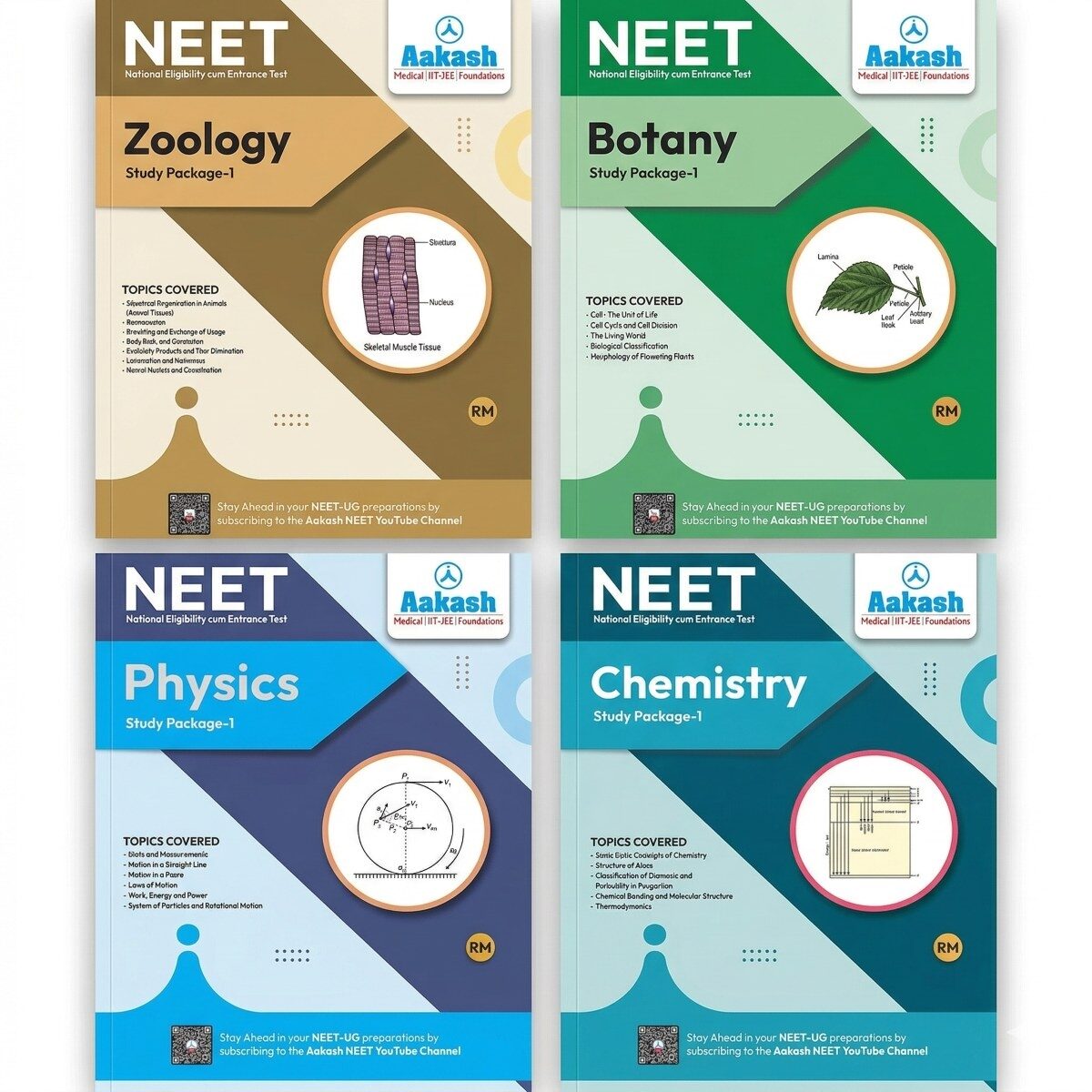
Aspirants who balance boards and JEE Main can build that NCERT base early — even from Class 10 with a foundation series. Study packages such as the Aakash Class 10 study material help cement the fundamentals that JEE Main later tests, while a full Aakash 11th + 12th complete book set covers the Physics and Chemistry NCERT depth shared between competitive exams.
JEE Main Syllabus vs JEE Advanced Syllabus: The Key Difference
This distinction trips up thousands of aspirants. JEE Main is the qualifying exam (for NITs, IIITs, GFTIs and as the gateway to Advanced); JEE Advanced is the second-stage exam for the IITs. The syllabi overlap heavily but are not identical.
| Aspect | JEE Main | JEE Advanced |
|---|---|---|
| Conducting Body | NTA | IIT (rotating) |
| Syllabus Base | Strictly NCERT Class 11 & 12 | NCERT + extra depth & some extra topics |
| Question Difficulty | Moderate, direct application | Conceptual, multi-step, tougher |
| Extra Topics | — | Thermal physics depth, certain organic mechanisms, equilibrium depth |
| Question Types | MCQ + numerical | MCQ, multiple-correct, matrix-match, paragraph, integer |
Is the JEE Main syllabus harder than JEE Advanced? No — Advanced is conceptually harder and unpredictable, while Main is broader-but-shallower and rewards speed and accuracy. Clear Main first; Advanced builds on the same chapters with greater depth.
High-ROI vs Low-ROI Chapters: What to Prioritise If Short on Time
Not every chapter deserves equal time. Using the weightage tables above, here is a strategic priority map — the strategic angle most ranking pages skip entirely.
| Priority | Physics | Chemistry | Maths |
|---|---|---|---|
| Must-do (High ROI) | Mechanics, Electrodynamics, Modern Physics, Experimental Skills | Inorganic (Coordination, p-Block), Physical (Thermo, Equilibrium), GOC | Calculus, Algebra, Coordinate & 3D Geometry, Vectors |
| Do-if-time (Medium) | Thermodynamics, Oscillations & Waves | Solutions, Kinetics, Aldehydes/Ketones | Trigonometry, Probability |
| Light-touch (Low ROI) | Properties of Matter, EM Waves | Biomolecules, Practical Chemistry (memory only) | Sets & Relations, Mathematical Induction |
Even “low ROI” chapters should not be fully skipped — they are short and can be the deciding question in a tie-break percentile. The point is sequencing, not abandoning.
How to Cover the Entire JEE Main Syllabus: A Practical Plan
Finishing the syllabus is a function of structure, not just hours. Here is a workable timeline for a one-year preparation cycle:
- Months 1–6: Complete the full NCERT-aligned syllabus once, subject by subject, with chapter-end problems. Tick the checklist as you go.
- Months 7–9: Layer in previous-year questions (PYQs) chapter-wise and start sectional tests, focusing on high-weightage chapters.
- Months 10–11: Full-length mock tests in CBT mode, timed at 3 hours, twice a week. Analyse every mistake.
- Final month: Revision only — formula sheets, error logs, and the checklist’s “Tested” column. No new topics.
Subject-specific tips: in Physics, master derivations then solve volume; in Chemistry, read NCERT inorganic line-by-line and practise organic mechanisms; in Maths, build speed with daily timed sets on calculus and algebra. A consolidated module set like the eSaral IIT JEE Modules keeps all three subjects in one syllabus-aligned system so you are never hunting across scattered sources.
Common Mistakes Aspirants Make With the Syllabus
- Revising deleted topics: Hours wasted on Polymers, Environmental Chemistry or Mathematical Reasoning — all removed.
- Ignoring Experimental Skills: An easy 8–9% in Physics left on the table.
- Confusing Main with Advanced depth: Over-preparing on Advanced-only depth before Main basics are solid.
- Skipping NCERT for Chemistry: Direct NCERT-line inorganic questions get missed.
- Treating all chapters equally: No weightage-based prioritisation, so high-yield chapters get the same time as one-question chapters.
- Not practising in CBT mode: The exam is on-screen; pen-paper-only practice hurts speed.
How Many Chapters Are There in JEE Main Physics, Chemistry and Maths?
To summarise the count clearly: Physics has 20 theory units plus 1 experimental-skills unit (21 total); Chemistry has about 28 chapters split across Physical (8), Inorganic (6) and Organic (8) plus practical principles; Mathematics has 16 units. That is roughly 65 chapters in all — entirely covered by NCERT Class 11 and 12, with the deleted topics excluded. Knowing the exact count helps you build a realistic day-by-day study calendar.
Final Note: A Neutral, Student-Friendly Recap
The jee main syllabus 2026 is stable, NCERT-anchored, and fully knowable in advance — which means there are no surprises, only execution. Download the official NTA PDF, cross-check it against NCERT, print the checklist above, and prioritise the high-weightage chapters in Mechanics, Electrodynamics, Inorganic Chemistry and Calculus. Pair the syllabus with disciplined PYQ practice and CBT mocks, and you have a complete, beatable roadmap. Keep your study material syllabus-aligned so your effort always maps to what NTA actually tests.
Frequently Asked Questions
What is the syllabus of JEE Main 2026?
The JEE Main 2026 syllabus covers Physics (20 theory units + experimental skills), Chemistry (about 28 chapters across Physical, Inorganic and Organic) and Mathematics (16 units), all based on NCERT Class 11 and 12, with the topics deleted in the 2024 revision still excluded.
Is the JEE Main syllabus the same as NCERT Class 11 and 12?
Yes, the JEE Main syllabus is fully aligned with NCERT Class 11 and 12. The difference is in depth — JEE Main asks application-based and numerical questions on the same NCERT topics rather than direct textbook recall.
Which chapters have been deleted from the JEE Main syllabus?
Deleted topics include Communication Systems (Physics); Surface Chemistry, States of Matter, Metallurgy, Environmental Chemistry, Polymers and Chemistry in Everyday Life (Chemistry); and Mathematical Reasoning plus trimmed Trigonometry and Sets (Maths). These remain in NCERT for boards but are not asked in JEE Main.
What are the most important high-weightage chapters in JEE Main?
High-weightage chapters are Mechanics and Electrodynamics in Physics, Coordination Compounds, p-Block and Thermodynamics in Chemistry, and Calculus, Algebra and Coordinate Geometry in Maths. Together these high-ROI chapters can fetch the majority of marks in each subject.
How many chapters are there in JEE Main Physics, Chemistry and Maths?
JEE Main Physics has 20 theory units plus 1 experimental-skills unit (21 total), Chemistry has about 28 chapters across Physical (8), Inorganic (6) and Organic (8) plus practical principles, and Mathematics has 16 units — roughly 65 chapters in all, fully covered by NCERT Class 11 and 12 with deleted topics excluded.
Is the JEE Main syllabus the same for all sessions and attempts?
Yes. The JEE Main syllabus is identical for Session 1 and Session 2 and does not differ between attempts. NTA uses one syllabus per cycle for every shift and paper, and percentile normalisation keeps difficulty comparable, so no session is officially easier. Only the specific questions change, not the topics.
How can I download the official JEE Main syllabus PDF?
Visit the official NTA portal at jeemain.nta.nic.in, open the latest Information Bulletin or Syllabus link for the current cycle, and download the subject-wise PDF covering Physics, Chemistry, Mathematics and the Paper 2 syllabi. Cross-verify each topic against your NCERT textbooks.
Is the JEE Main syllabus harder than the JEE Advanced syllabus?
No. JEE Advanced is conceptually harder and more unpredictable, while JEE Main is broader but shallower and rewards speed and accuracy. The syllabi overlap heavily, but Advanced adds extra depth and a few topics beyond the strictly NCERT-based Main syllabus.
Recommended Study Material

Continue Reading
Vision IAS vs Drishti IAS 2026: Study Material, Notes & Verdict
Vision IAS vs Drishti IAS comes down to two decisions: your medium and your stage. For English-medium aspirants…
SSC MTS Syllabus 2025: Subject-Wise Topics, Pattern & PDF
The SSC MTS syllabus for the Computer-Based Examination (Paper-I) covers four subjects — Numerical & Mathematical Ability, Reasoning…
OJAS GPSC Syllabus 2026: Class 1-2 Pattern + PDF Download
The OJAS GPSC syllabus for the Class 1-2 (Gujarat Administrative Service / Gujarat Civil Service) exam covers a…