Vision IAS vs Drishti IAS 2026: Study Material, Notes & Verdict
Vision IAS vs Drishti IAS compared for 2026: study material booklets, Hindi vs English medium, notes for Prelims and Mains, test series, fees and a clear buy verdict.

Vision IAS vs Drishti IAS comes down to two decisions: your medium and your stage. For English-medium aspirants who want analytical, Mains-ready depth and the strongest current affairs, Vision IAS study material is the better buy. For Hindi-medium aspirants and anyone who wants fast, exam-focused Prelims revision, Drishti IAS notes win on clarity and value. Many successful aspirants use both — Drishti to revise quickly and Vision for depth and current affairs — and this guide shows exactly how to choose, booklet by booklet, so you buy once and buy right.
Below is a complete, buyer-focused breakdown of vision ias vs drishti ias study material: booklet counts, writing style, Hindi vs English suitability, Prelims vs Mains orientation, test series, fees, ratings and a decision framework by aspirant profile.
How we compared: this verdict is based on the current 2026-27 editions listed on Competer, publicly stated booklet counts, aggregated aspirant reviews, and the way each brand’s content maps to the UPSC Prelims and Mains formats. Prices and booklet counts are as of August 2026 and can change with new editions — always check the live product page before ordering.
Vision IAS vs Drishti IAS: The Quick Verdict
If you have only 30 seconds, here is the bottom line on vision ias vs drishti ias which is better for buying study material:
| You are… | Buy | Why |
|---|---|---|
| English medium, Mains-focused | Vision IAS | Deeper analysis, answer-writing angles, best current affairs |
| Hindi medium aspirant | Drishti IAS | Native Hindi content, clean language, strong for the Hindi paper |
| Prelims in a few months | Drishti IAS | Concise, fast-revision booklets built for objective recall |
| Repeater / want the “complete library” | Vision IAS | 56+ granular booklets covering every micro-topic |
| Tight budget | Drishti IAS | Fewer booklets, lower total ticket size |
| Want the strongest single combo | Both | Drishti for revision + Vision current affairs for Mains |
Both are premium, widely-trusted UPSC brands. Neither is “bad”. The real question is fit — and fit is decided by medium, months left to the exam, and whether you are optimising for Prelims recall or Mains depth. Get those three inputs right and the choice below becomes obvious.
Study Material Comparison: Booklets, Depth and Style
The single biggest difference in vision ias vs drishti ias study material is granularity. Vision IAS splits General Studies into a large number of thin, topic-specific booklets, while Drishti consolidates the syllabus into fewer, denser booklets. More booklets means finer coverage and easier topic-wise carrying; fewer booklets means faster end-to-end revision. Neither approach is objectively better — they suit different timelines.
| Feature | Vision IAS | Drishti IAS |
|---|---|---|
| English GS booklets | ~56 booklets (2026–27) | ~27 booklets |
| Hindi GS booklets | ~54 booklets | ~18 booklets |
| Granularity | Very high — micro-topic level | Consolidated — subject/section level |
| Writing style | Analytical, exam-answer oriented | Simple, direct, revision-friendly |
| Depth | Higher — leans towards Mains | Concise — leans towards Prelims |
| Current affairs integration | Excellent (monthly magazine + VAM) | Good (integrated + separate current affairs) |
| Best medium | English (also strong Hindi) | Hindi (also solid English) |
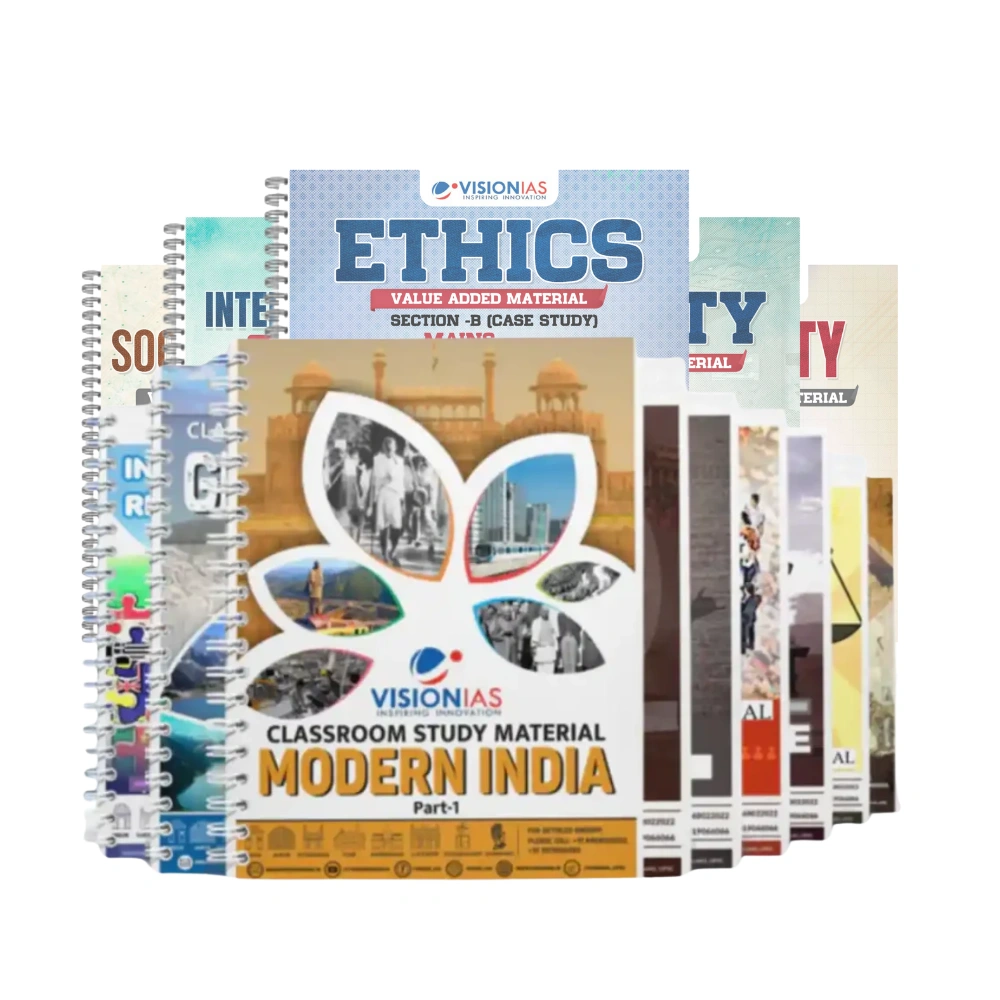
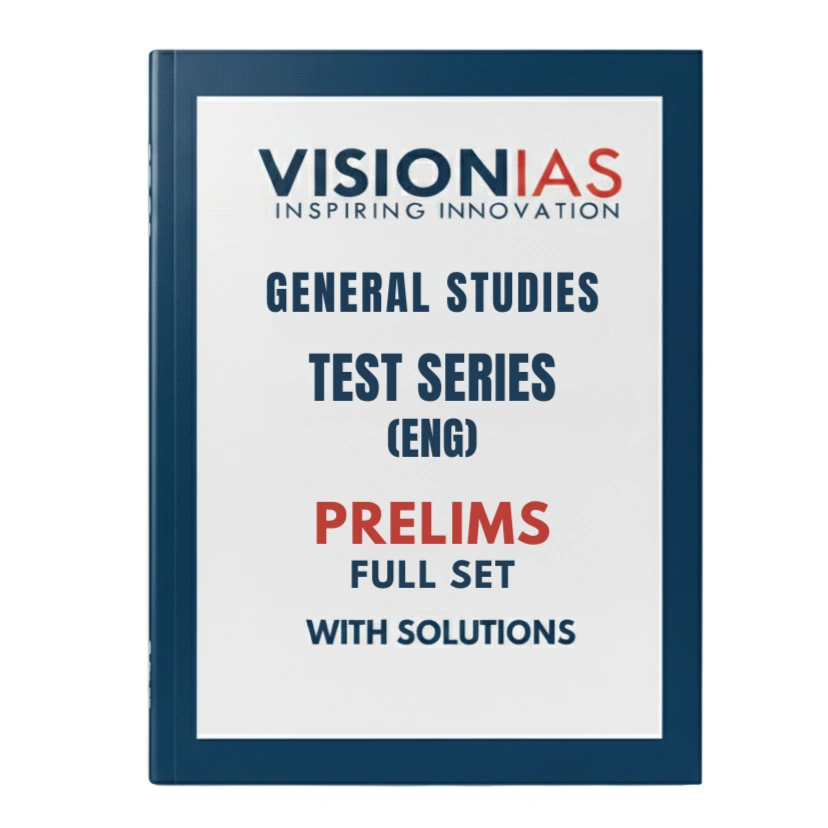
Vision’s flagship set — the Vision IAS GS 2026-27 (56 booklets with Value Added Materials) — is effectively a full self-study library. Because each theme sits in its own booklet, you can carry only what you are revising that week, and the Value Added Materials (maps, data, case studies) plug the exact gaps examiners test in Mains.
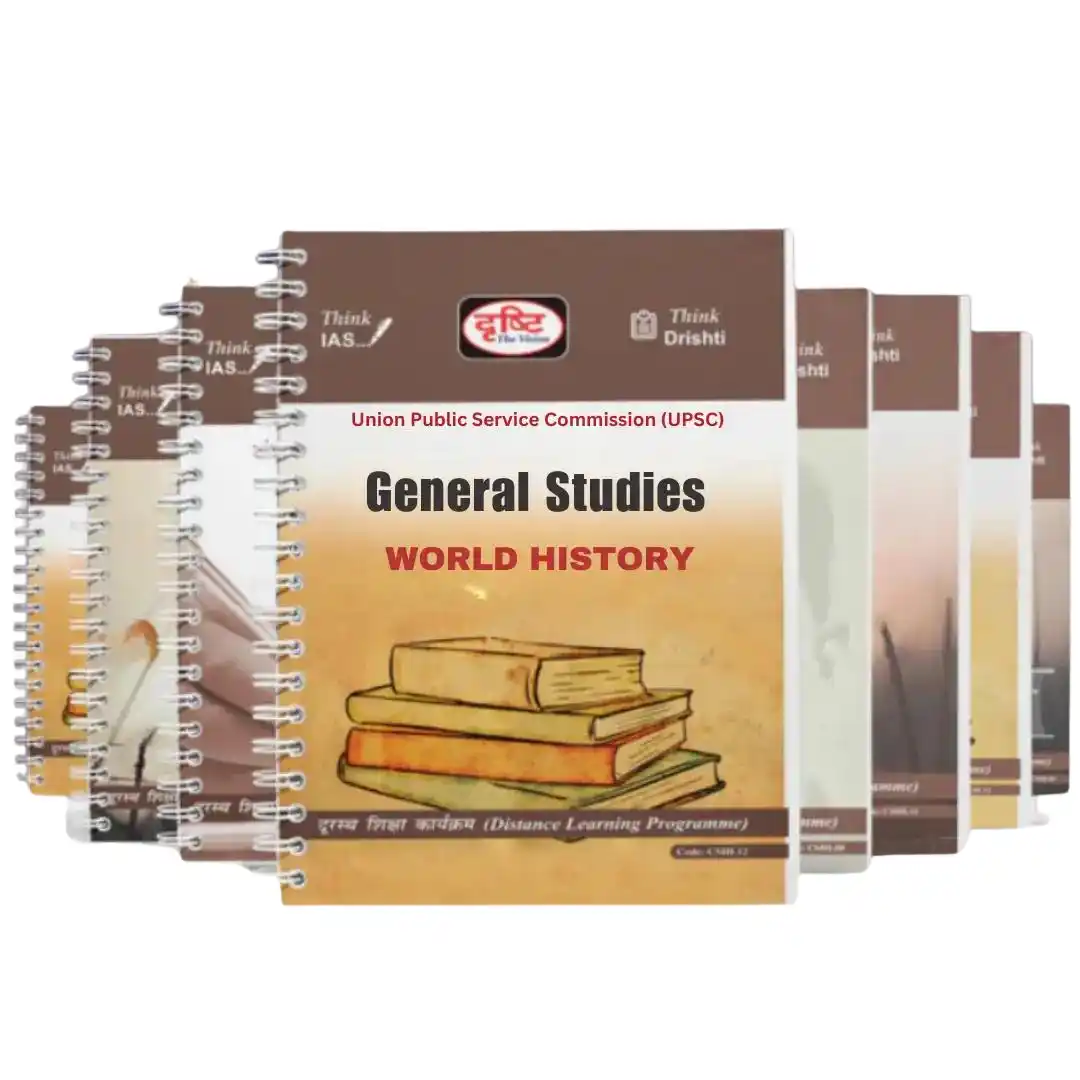
Drishti’s English set — the Drishti IAS English Study Material (27 printed booklets) — takes the opposite philosophy: cover the syllabus completely but keep it tight enough to revise before Prelims without drowning. That conciseness is a feature, not a shortcut, for aspirants short on time.
How many booklets are there in Vision IAS and Drishti IAS study material?
In English medium, Vision IAS ships roughly 56 GS booklets (plus an 11-part Value Added Materials set), while Drishti IAS ships about 27 printed booklets. In Hindi medium, Vision offers around 54 booklets and Drishti around 18. So Vision gives you roughly twice the booklet count — more depth, but also more pages to read and revise. If you cannot realistically finish twice the reading before your attempt, the higher booklet count works against you rather than for you.
Printed booklets vs PDFs: does the format matter?
Both brands’ material circulates as printed booklets and, in some cases, digital notes. For most aspirants, printed booklets are worth it: they are easier to annotate, better for long revision hours, and reduce screen fatigue during a two-to-three-year preparation. PDFs are handy for search and portability, but heavy underlining and margin notes — the way strong candidates actually consolidate — happen best on paper. Whichever you pick, confirm you are buying the latest edition; UPSC-relevant data, schemes and current affairs age quickly, and an old edition is the most common hidden cost in this comparison.
Vision IAS vs Drishti IAS Notes for Prelims vs Mains
This is where the two brands genuinely diverge, and it should drive your purchase more than price.
Which is better for UPSC Prelims, Vision IAS or Drishti IAS notes?
For pure vision ias vs drishti ias notes for prelims, Drishti has the edge for most aspirants. Its concise booklets are built for repeated, fast revision and objective recall — exactly what the Prelims MCQ format rewards. Vision’s notes are also Prelims-capable, but their depth means you need more time to consolidate. If Prelims is 3–5 months away and you want to revise the full syllabus 3–4 times, Drishti is easier to finish. If you have 12+ months, Vision’s depth pays off in both stages.
Which is better for Mains?
For Mains, Vision IAS is the stronger buy. The notes are written in an analytical, dimension-first style — causes, effects, stakeholders, way-forward — which maps directly onto the 10 and 15-mark answer structure. Combined with Vision’s current affairs, this makes it the natural choice for GS Mains and essay support. Drishti can support Mains, but you will supplement it more heavily with current affairs and value additions.
| Stage | Winner | Reason |
|---|---|---|
| Prelims (factual recall) | Drishti IAS | Concise, fast to revise, objective-friendly |
| Mains (answer writing) | Vision IAS | Analytical depth, dimensions, current linkage |
| Current affairs | Vision IAS | Monthly magazine widely rated best-in-class |
| Quick single-book revision | Drishti IAS | Fewer booklets to cover before D-day |
Drishti IAS vs Vision IAS Hindi Medium: The Clear Winner
For drishti ias vs vision ias hindi medium, Drishti IAS is the established leader. Drishti was built Hindi-first: its content is authored in Hindi rather than translated, so the language is natural, the terminology is standard for the Hindi optional and Hindi GS paper, and explanations don’t read like conversions from English. Hindi-medium aspirants consistently find Drishti easier to internalise, which matters when you are reading the same material dozens of times.
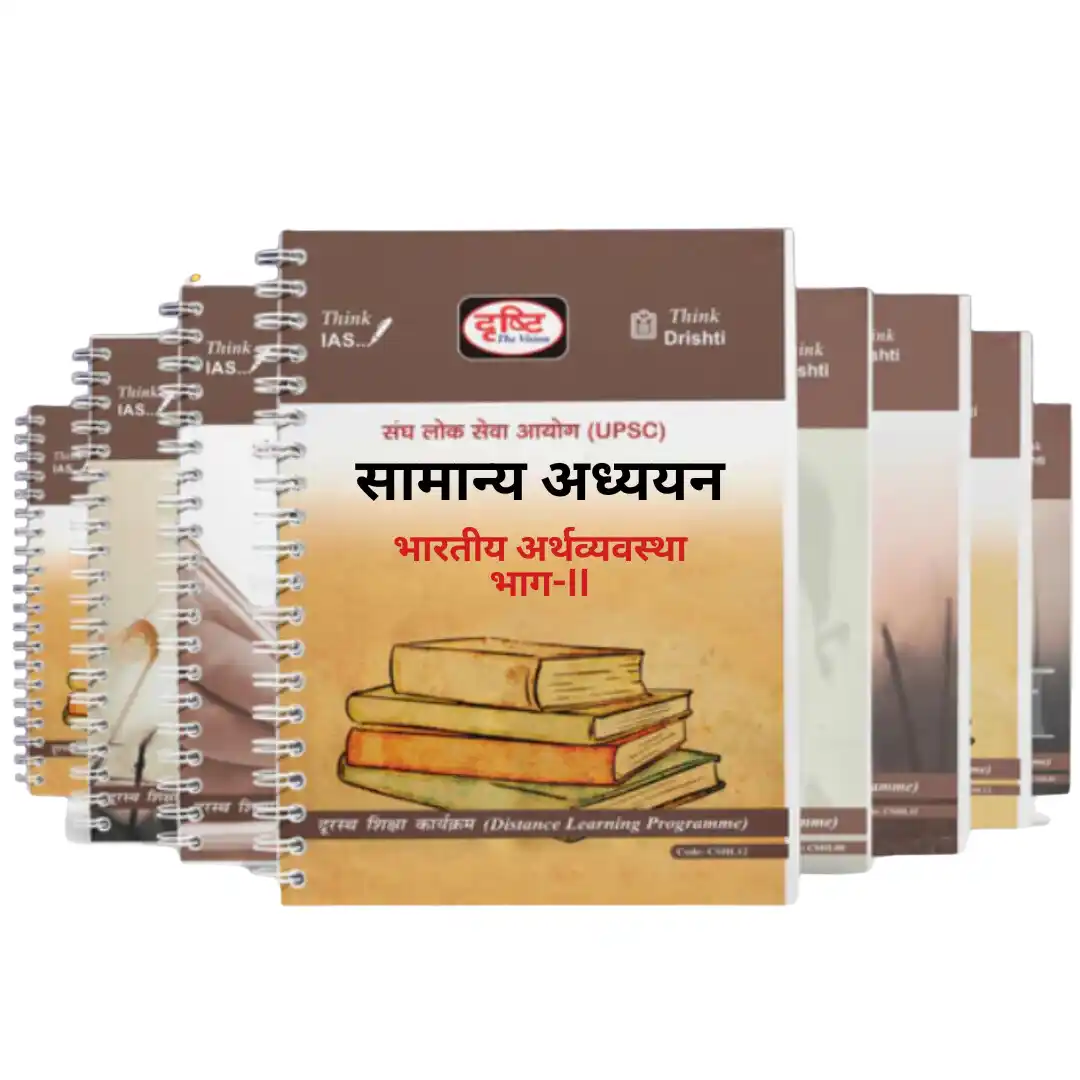
That said, Vision IAS now offers a genuinely strong Hindi line too. If you want Vision’s analytical depth in Hindi, the Vision IAS GS Notes in Hindi 2026-27 (54 booklets) deliver the same granular coverage. But for most Hindi-medium candidates — especially those targeting Prelims and wanting clean, exam-ready language — the Drishti IAS Hindi Study Material (18 booklets) remains the most cost-effective first purchase.
Is Drishti IAS good for Hindi medium aspirants?
Yes — Drishti IAS is widely regarded as a top choice for Hindi-medium UPSC aspirants. Its notes, current affairs and video ecosystem are all strong in Hindi, and its 18-booklet Hindi set covers the GS syllabus concisely. If you study primarily in Hindi, start with Drishti and add Vision’s Hindi current affairs for extra depth on dynamic topics.
Vision IAS vs Drishti IAS Test Series Compared
Notes get you knowledge; the test series converts it into marks. On vision ias vs drishti ias test series, the two serve slightly different goals, and the best answer is often about what you need at this point in your preparation rather than which is “tougher”.
Vision IAS Prelims tests are known for being analytical and closely aligned to the actual UPSC pattern — tricky, application-based MCQs with detailed explanations that teach elimination technique. Drishti’s Prelims tests are excellent for speed-building and confidence, with broad syllabus coverage at a lower price point, and are a reliable Hindi-medium option.
| Test Series | Strength | Sample price |
|---|---|---|
| Vision IAS Prelims Test Series 2026 | UPSC-pattern, analytical, deep explanations | ~₹1,249 |
| Drishti IAS Prelims Test Series 2026 | Speed-building, wide coverage, value | ~₹899 |
| Vision IAS Mains Test Series | Answer-writing evaluation, model answers | ~₹699 |
| Drishti CSAT / Hindi Prelims | Good for Hindi medium & CSAT practice | ~₹855–₹899 |
Which test series is better, Vision IAS or Drishti IAS?
For sharpening accuracy and simulating the real exam, Vision IAS’s test series is generally rated tougher and more analytical — the better choice if you are targeting a high Prelims score and want your weak areas exposed early. Drishti’s series is better if you are still building the habit of writing full-length tests under time pressure, or want a Hindi-medium option. Serious aspirants often take Vision for the challenge and Drishti (or another brand) for extra volume. The real value of any test series is the post-test analysis, so pick whichever you will actually review, not just attempt.
Vision IAS vs Drishti IAS Fees Comparison
On vision ias vs drishti ias fees comparison, remember that classroom coaching fees and study-material prices are very different things. Drishti publicly lists programme fees spanning roughly ₹12,000 to ₹5,00,000 depending on the course, while Vision typically prices full programmes on enquiry. But if you only want the notes — which is what most aspirants actually buy — the comparison is far simpler and cheaper.
| Product (study material only) | Booklets | Price |
|---|---|---|
| Vision IAS GS 2026-27 (English) + VAM | 56 | ₹6,599 |
| Vision IAS GS Notes (Hindi) 2026-27 | 54 | ₹6,999 |
| Drishti IAS English Study Material | 27 | ₹4,999 |
| Drishti IAS Hindi Study Material | 18 | ₹3,999 |
| Vision IAS Prelims Test Series | — | ₹1,249 |
| Drishti IAS Prelims Test Series | — | ₹899 |
Prices above are indicative and as of August 2026; check the product page for the live figure before ordering, since edition changes and offers move these numbers.
Which coaching is cheaper, Vision IAS or Drishti IAS?
For study material, Drishti IAS is cheaper — its English set (₹4,999) and Hindi set (₹3,999) cost less than Vision’s larger 56/54-booklet sets (₹6,599–₹6,999), simply because Drishti ships fewer booklets. Per-booklet, the value is comparable; you are paying for coverage breadth, not a quality gap. If total budget is your main constraint, Drishti gives you a complete, exam-ready library for less.
Star Ratings, Reviews and Reputation
Both brands enjoy strong aspirant trust, but they carry different review profiles. In aggregate feedback, Vision IAS tends to score higher on average rating (around 4.5 stars across ~186 reviews) while Drishti carries a larger review volume (around 3.83 stars across ~379 reviews). A larger sample naturally pulls an average down, so read this as “both are well-reviewed”, with Vision slightly ahead on average satisfaction and Drishti ahead on sheer popularity — a reflection of its massive Hindi-medium user base.
| Metric | Vision IAS | Drishti IAS |
|---|---|---|
| Average rating | ~4.5★ | ~3.83★ |
| Review count | ~186 | ~379 |
| Strongest reputation for | Current affairs & Mains notes | Hindi content & Prelims revision |
| Faculty ecosystem | Experienced, Mains-answer focused | Dr. Vikas Divyakirti-led, video-strong |
Current Affairs and Faculty
Current affairs can decide 30–40 marks in Prelims and shape half of GS Mains, so magazine quality matters. Vision IAS’s monthly current affairs magazine is one of the most widely used documents in the entire UPSC ecosystem — comprehensive, well-categorised by GS paper, and with value-added boxes. If you buy nothing else from Vision, the current affairs alone is worth it. The latest Vision IAS Current Affairs Magazine (January 2026, English) is a low-cost way to test the quality before committing to the full notes set.
Drishti’s current affairs is also reliable and especially valuable for Hindi-medium aspirants, backed by Dr. Vikas Divyakirti’s widely-followed video lectures. On faculty and mentorship, Drishti’s video-first ecosystem is a genuine differentiator for self-studying candidates who learn better by listening; Vision leans more towards written analysis and Mains answer evaluation. If you are a video learner, that alone can tip the decision towards Drishti regardless of medium.
Can You Use Both Vision IAS and Drishti IAS Together?
Yes — and for many aspirants this is the smartest strategy rather than an either/or. The two brands complement each other cleanly because their strengths sit in different places.
Can I use both Vision IAS and Drishti IAS study material together?
Absolutely. A proven combination is: use Drishti notes as your concise base for Prelims revision and Vision current affairs plus Vision GS notes for Mains depth. Do not, however, buy two full GS sets in the same medium and read both cover-to-cover — that wastes time on overlap. Pick one as your primary source, and use the other only for the topics or the stage where it is stronger.
| Goal | Primary source | Supplement with |
|---|---|---|
| Fast Prelims revision | Drishti GS booklets | Vision current affairs |
| Mains answer depth | Vision GS notes + VAM | Drishti for quick recall |
| Hindi medium full prep | Drishti Hindi set | Vision Hindi current affairs |
Which Should You Buy? Decision Framework by Profile
Generic advice fails because aspirants differ. Match yourself to a profile below.
- Fresher, 12+ months to exam, English medium: Start with Vision IAS GS notes — the depth builds strong fundamentals for both stages, and you have time to read it fully.
- Repeater who already knows basics: Vision for granular gap-filling and current affairs; you don’t need a from-scratch concise set.
- Working professional, limited hours: Drishti — fewer booklets means you can realistically finish and revise. Add Vision current affairs monthly.
- Hindi medium, any stage: Drishti Hindi set first; add Vision Hindi current affairs.
- Prelims in under 4 months: Drishti for revision + a rigorous test series like Vision’s.
- Optional subject buyer: These GS brands don’t cover optionals — pair either with dedicated optional notes (e.g., Shubhra Ranjan PSIR, Vajiram Economics) available on Competer.
Common mistakes to avoid
- Buying both full GS sets “to be safe”: you will run out of time before you run out of material. Depth without revision doesn’t score.
- Picking on price alone: the cheaper set is only cheaper if you can finish it in your medium and timeline.
- Ignoring the edition: an outdated set is the most expensive mistake — schemes, data and current affairs go stale fast.
- Skipping the test series: notes without regular tests leave accuracy untested until the real exam.
Are Vision IAS Notes Enough to Clear UPSC?
Vision IAS notes are comprehensive enough to serve as your core GS resource for both Prelims and Mains — but “enough” also requires NCERTs for basics, a current affairs habit, answer-writing practice, and a test series. No single notes set clears UPSC on its own. Treat Vision (or Drishti) as your backbone, then layer NCERTs, current affairs, PYQs and mock tests on top. Used that way, either brand is more than capable of taking you from beginner to interview-ready.
Is Vision IAS Better Than Drishti IAS?
Vision IAS is better for English-medium, Mains-oriented, depth-seeking aspirants and for current affairs; Drishti IAS is better for Hindi-medium aspirants, fast Prelims revision and tighter budgets. “Better” is conditional — there is no universal winner. Decide by your medium first, your stage second, and your budget third, and the right choice becomes obvious.
Frequently Asked Questions
Is Vision IAS better than Drishti IAS?
It depends on your needs. Vision IAS is better for English-medium aspirants wanting analytical, Mains-ready depth and the strongest current affairs. Drishti IAS is better for Hindi-medium aspirants and fast Prelims revision. Neither is universally superior — choose by medium, stage and budget.
Which is better for UPSC Prelims, Vision IAS or Drishti IAS notes?
For Prelims, Drishti IAS notes suit most aspirants because their concise booklets are built for fast, repeated revision and objective recall. Vision’s notes work too but are deeper and take longer to consolidate, making them ideal when you have more preparation time.
Is Drishti IAS good for Hindi medium aspirants?
Yes. Drishti IAS is widely considered a top choice for Hindi-medium UPSC aspirants because its content is authored Hindi-first, with natural language and standard terminology. Its 18-booklet Hindi set covers the GS syllabus concisely and pairs well with Vision’s Hindi current affairs.
Which coaching is cheaper, Vision IAS or Drishti IAS?
For study material, Drishti IAS is cheaper — its English set costs about ₹4,999 and Hindi set about ₹3,999, versus Vision’s larger 56/54-booklet sets at ₹6,599–₹6,999. Drishti ships fewer booklets, so the total ticket size is lower for a complete library.
How many booklets are there in Vision IAS and Drishti IAS study material?
In English, Vision IAS ships about 56 GS booklets plus an 11-part Value Added Materials set, while Drishti ships about 27. In Hindi, Vision offers around 54 booklets and Drishti around 18. Vision gives roughly double the booklet count — more depth, but more to revise.
Are Vision IAS notes enough to clear UPSC?
Vision IAS notes are comprehensive enough to be your core GS resource, but not sufficient alone. You still need NCERTs, current affairs, answer-writing practice, PYQs and a test series. Used as a backbone with these additions, Vision notes can take you from beginner to interview-ready.
Which test series is better, Vision IAS or Drishti IAS?
Vision IAS’s test series is generally rated tougher and more analytical, making it better for exposing weak areas and targeting a high Prelims score. Drishti’s series is better for speed-building, time-pressure practice and Hindi-medium aspirants. Many candidates use Vision for difficulty and Drishti for extra volume.
Can I use both Vision IAS and Drishti IAS study material together?
Yes, and it is often the smartest approach. Use Drishti notes as a concise base for Prelims revision and Vision GS notes plus current affairs for Mains depth. Just avoid reading two full GS sets in the same medium cover-to-cover — pick one primary source and use the other selectively.
Recommended Study Material
Continue Reading
JPSC Syllabus 2026: Prelims & Mains Pattern + PDF Download
The JPSC syllabus covers a three-stage selection process for the Jharkhand Combined Civil Services Examination — a Preliminary…
SSC MTS Syllabus 2025: Subject-Wise Topics, Exam Pattern & PDF
Last reviewed: August 2026. Cross-checked against the Staff Selection Commission's official Scheme of Examination. The SSC MTS syllabus…
CGPSC Syllabus 2025: Prelims, Mains & Exam Pattern + PDF
The CGPSC syllabus for the Chhattisgarh State Service Examination (SSE) runs across three stages: a Preliminary exam of…