CGPSC Syllabus 2025: Prelims, Mains & Exam Pattern + PDF
CGPSC syllabus 2025 explained: Prelims, Mains (7 papers, 1400 marks), interview, exam pattern, negative marking, topic weightage & official PDF download guide.

The CGPSC syllabus for the Chhattisgarh State Service Examination (SSE) runs across three stages: a Preliminary exam of two objective papers (200 marks each, 400 total), a Mains exam of seven descriptive papers (200 marks each, 1400 total), and an Interview / Personality Test of 150 marks. Prelims is only a qualifying screening test; the Mains (1400) plus Interview (150) — a combined 1550 marks — decide your final rank and selection. This guide breaks down every paper topic-by-topic, the exam pattern, marks and weightage, the heavy Chhattisgarh-specific portion, a printable study checklist, and where to download the CGPSC syllabus PDF in Hindi and English.
CGPSC Syllabus 2025 at a Glance
- Stages: Prelims (screening) → Mains (written) → Interview.
- Prelims: 2 objective papers × 200 marks = 400 marks (qualifying only, 1/3 negative marking).
- Mains: 7 descriptive papers × 200 marks = 1400 marks (counts in merit, no negative marking).
- Interview: 150 marks.
- Final merit: Mains 1400 + Interview 150 = 1550 marks.
- Official source: psc.cg.gov.in (Hindi & English PDF with each notification).
Whether you are a first-attempt aspirant or a re-taker refining strategy, treat this page as a single hub — bookmark it, convert each list below into a checklist, and map every heading to the study material you own. We start with the selection process, because understanding how the three stages connect is the foundation of a smart plan.
CGPSC Selection Process: Prelims, Mains & Interview
The Chhattisgarh Public Service Commission (CGPSC) conducts the State Service Examination annually to recruit officers for posts such as Deputy Collector, DSP, State Tax Officer, Naib Tehsildar, District Excise Officer, Development Block Officer and other Class I and Class II services of the Chhattisgarh government. Recruitment happens in three sequential stages, and you must clear each stage to advance to the next.
- Stage 1 – Preliminary Examination (Objective / Screening): Two papers of 200 marks each. Purely a qualifying filter — marks here are not added to the final merit. Only candidates who clear the Prelims cut-off (roughly 12–15 times the number of vacancies) are called for Mains.
- Stage 2 – Main Examination (Descriptive / Written): Seven papers totalling 1400 marks. These marks count fully towards the final merit list.
- Stage 3 – Interview / Personality Test: 150 marks. Added to the Mains score.
Your final rank = Mains (1400) + Interview (150) = 1550 marks. Because Prelims is only a gateway, most toppers spend the bulk of their year building the descriptive answer-writing and Chhattisgarh-GK depth that the Mains rewards, while treating Prelims as a hurdle to be cleared with disciplined MCQ practice.
| Stage | Type | Papers | Total Marks | Counts in Final Merit? |
|---|---|---|---|---|
| Preliminary Exam | Objective (MCQ) | 2 | 400 | No (qualifying only) |
| Main Exam | Descriptive (written) | 7 | 1400 | Yes |
| Interview | Personality Test | — | 150 | Yes |
| Final Selection | Mains + Interview | — | 1550 | — |
CGPSC Exam Pattern 2025 (Prelims + Mains at a Glance)
Before diving into topics, internalise the CGPSC exam pattern — it dictates how you allocate time, whether you attempt every question, and how you manage negative marking. The Prelims is bilingual (Hindi and English), so aspirants preparing the CGPSC syllabus in Hindi are not disadvantaged in the question paper itself.
| Feature | Prelims | Mains |
|---|---|---|
| Nature | Objective (MCQ) | Descriptive (written) |
| Number of papers | 2 (GS + Aptitude/CSAT) | 7 papers |
| Marks per paper | 200 | 200 |
| Total marks | 400 | 1400 |
| Duration per paper | 2 hours | 3 hours |
| Negative marking | Yes (1/3 mark deducted) | No |
| Language | Hindi & English | Hindi & English (Language paper tests both) |
| Role in selection | Qualifying screening | Counts towards merit |
A quick, high-value clarification aspirants always ask: the Prelims and Mains syllabus are NOT the same. Prelims tests recognition and speed over a broad objective base (static GK + Chhattisgarh GK + aptitude), whereas Mains tests analytical depth, structured answer writing and application across seven specialised descriptive papers. The subjects overlap in name, but the treatment, difficulty and expectation differ sharply.
CGPSC Prelims Syllabus 2025 (Paper 1 & Paper 2)
The CGPSC Prelims syllabus consists of two compulsory papers, each of 200 marks and 2 hours. Paper 1 is General Studies and Paper 2 is the Aptitude Test (CSAT-style). Both carry equal weight for qualifying, though many aspirants underestimate Paper 2 and miss the cut-off despite scoring well in Paper 1.
Prelims Paper 1 – General Studies (200 marks)
This is the make-or-break paper for Chhattisgarh-specific candidates, because a large chunk of questions comes from Chhattisgarh’s history, geography, polity, economy and current affairs. The broad areas are:
- History of India and Indian National Movement: Ancient, Medieval and Modern India; social, economic and cultural history; the freedom struggle, key reformers, revolts and movements.
- History of Chhattisgarh & contribution to the freedom movement: Regional dynasties, princely states, tribal revolts, Chhattisgarh’s role in India’s independence, statehood movement (formation on 1 November 2000).
- Geography of India: Physical, social and economic geography; monsoon, rivers, agriculture, minerals, industries.
- Geography of Chhattisgarh: Physiography, rivers (Mahanadi, Indravati, Shivnath), forests, climate, minerals (coal, iron ore, bauxite, limestone), agriculture and crops.
- Constitution of India & Panchayati Raj: Salient features, fundamental rights and duties, DPSP, Union and State governments, 73rd/74th amendments, local self-government in Chhattisgarh.
- Economy of India and Chhattisgarh: Planning, budgeting, poverty, agriculture, industry; Chhattisgarh’s economy, state budget, PSUs, industrial policy.
- General Science & Technology: Everyday science — physics, chemistry, biology basics, health, IT, space and defence developments.
- Current Affairs: National, international and especially Chhattisgarh state affairs, government schemes, sports, awards and appointments.
- Chhattisgarh’s culture, literature, art, festivals, tribes and folk traditions: Tribal groups (Gond, Halba, Kanwar, Baiga, Oraon), folk dances (Panthi, Raut Nacha, Karma, Saila), festivals (Hareli, Pola, Madai, Bastar Dussehra), local languages and literature.
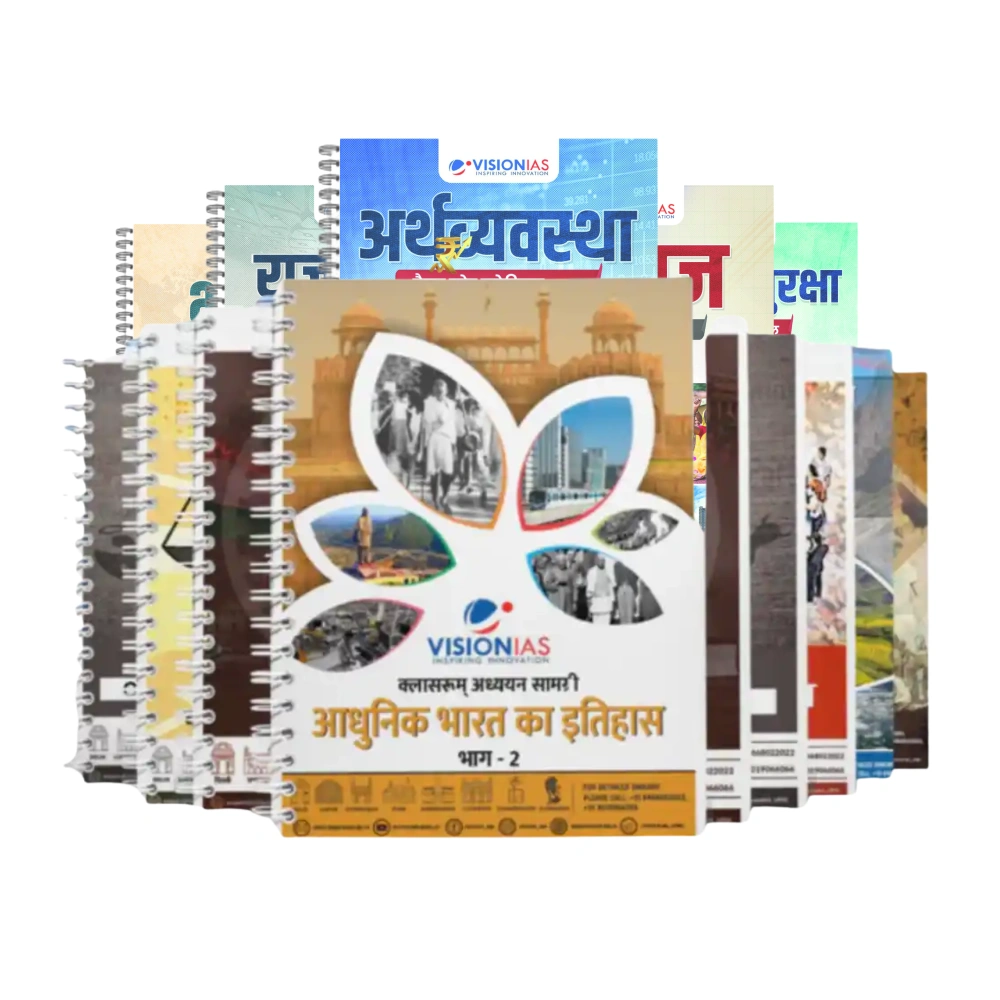
A well-organised set of General Studies notes covering polity, economy, history, geography and science makes this paper far more manageable. Hindi-medium aspirants often build their static base from a comprehensive set like the Vision IAS GS Notes in Hindi (54 booklets), then layer Chhattisgarh-specific state GK on top.
Prelims Paper 2 – Aptitude Test / CSAT (200 marks)
Paper 2 mirrors the UPSC CSAT format and tests reasoning, comprehension and basic numeracy. Do not treat it casually — a weak Paper 2 has failed many strong Paper 1 scorers. The topics are:
- Comprehension: Reading passages and answering inference-based questions.
- Interpersonal skills & communication skills.
- Logical reasoning & analytical ability.
- Decision-making & problem-solving.
- General mental ability.
- Basic numeracy (numbers and their relations, orders of magnitude — Class 10 level) and Data Interpretation (charts, graphs, tables — Class 10 level).
- Hindi language comprehension skill (Class 10 level).
| Paper | Subject | Marks | Questions (approx.) | Duration | Negative Marking |
|---|---|---|---|---|---|
| Paper 1 | General Studies | 200 | 100 | 2 hours | 1/3 per wrong answer |
| Paper 2 | Aptitude Test (CSAT) | 200 | 100 | 2 hours | 1/3 per wrong answer |
| Total | 400 | 200 | 4 hours | — | |
Yes, there is negative marking in CGPSC Prelims: one-third (1/3) of the marks assigned to a question are deducted for every wrong answer. With roughly 2 marks per question, a wrong answer costs about 0.66 marks. Blind guessing is punished, but educated elimination (narrowing to two options) still has positive expected value. Targeted MCQ drilling with a structured question bank — for example the topic-wise PYQ approach in the Forum IAS Prelims PYQ Toolkit — trains you to recognise trap options and manage the negative-marking risk.
CGPSC Mains Syllabus 2025 (All 7 Papers Explained)
The CGPSC Mains syllabus is where selection is truly decided. It has seven descriptive papers of 200 marks each — a total of 1400 marks — written over multiple days, each with a 3-hour window. There are two language/essay papers and five General Studies papers (GS-I to GS-V). Unlike UPSC, CGPSC folds several optional-style subjects directly into its GS papers, so there is no separate optional subject to choose. The papers are:
| Paper | Name | Marks | Duration |
|---|---|---|---|
| Paper 1 | Language (Hindi & English) | 200 | 3 hours |
| Paper 2 | Essay (Nibandh) | 200 | 3 hours |
| Paper 3 | General Studies – I (History, Constitution & Public Administration) | 200 | 3 hours |
| Paper 4 | General Studies – II (Science, Technology & Reasoning-Aptitude) | 200 | 3 hours |
| Paper 5 | General Studies – III (Economy, Geography of India & Chhattisgarh) | 200 | 3 hours |
| Paper 6 | General Studies – IV (Philosophy, Sociology, Ethics & Human Values) | 200 | 3 hours |
| Paper 7 | General Studies – V (Chhattisgarh: History, Culture, Governance & Development) | 200 | 3 hours |
| Total Mains | 1400 | — | |
So to answer a very common query directly: there are 7 papers in CGPSC Mains, and the total marks of the CGPSC Mains exam is 1400. Below is the granular, topic-by-topic breakdown that most competing pages skip — turn each list into a study checklist.
Question Paper 1 – Language (200 marks)
The Language paper tests functional command of both Hindi and English. It rewards clean drafting. Typical components include:
- Hindi: Grammar (vyakaran), comprehension (apathit gadyansh), precis writing (sankshepan), letter/application/report writing, translation (Hindi to English and vice versa), idioms and proverbs (muhavare aur lokoktiyan), and administrative vocabulary.
- English: Comprehension, precis writing, letter and report writing, grammar and usage, vocabulary, and translation.
- General: Paragraph writing, expansion of ideas, and formal correspondence formats used in government administration.
Question Paper 2 – Essay (200 marks)
The Essay (Nibandh) paper asks candidates to write long, structured essays — usually a choice across sections covering national issues, Chhattisgarh-specific themes, socio-economic topics, science and environment, and philosophical/abstract prompts. Marks reward structure (introduction–body–conclusion), balanced argument, relevant data, and language fluency. Practising essays in your medium of choice and studying model essays — such as those in the Vajiram Essay Notes — sharpens both flow and content depth.
Question Paper 3 – General Studies I (History, Constitution & Public Administration)
GS-I is content-heavy and blends national and Chhattisgarh material:
- History of India: Ancient India (Indus Valley, Vedic age, Mauryas, Guptas), Medieval India (Delhi Sultanate, Mughals, Bhakti-Sufi movements), Modern India (British expansion, 1857 revolt, socio-religious reforms, freedom struggle, post-independence consolidation).
- History & contribution of Chhattisgarh: Ancient and medieval dynasties (Kalchuri, Nagvanshi, Kanker), tribal and peasant revolts, Chhattisgarh in the freedom movement, statehood movement.
- Indian Constitution: Making of the Constitution, preamble, fundamental rights and duties, DPSP, Union and State executive, legislature and judiciary, amendments, emergency provisions, centre–state relations.
- Public Administration: Concepts and theories of administration, principles of organisation, personnel and financial administration, accountability and control, good governance, e-governance, administrative reforms.
- Panchayati Raj & local governance in India and Chhattisgarh (73rd and 74th amendments, PESA in Fifth Schedule areas).
Question Paper 4 – General Studies II (Science, Technology & Reasoning-Aptitude)
- General Science: Physics, chemistry and biology fundamentals; everyday applications; nutrition and health; diseases and public health programmes.
- Science & Technology in India: Space (ISRO), defence, nuclear energy, biotechnology, information technology, robotics, artificial intelligence and recent breakthroughs.
- Environment & Ecology: Biodiversity, conservation, climate change, pollution, environmental legislation, Chhattisgarh’s forests and wildlife.
- Reasoning & Aptitude: Logical reasoning, analytical ability, data interpretation, basic numeracy, mental ability — the descriptive counterpart to Prelims CSAT.
- Computer & IT applications in administration and daily life.
Question Paper 5 – General Studies III (Economy, Geography of India & Chhattisgarh)
- Indian Economy: Economic planning, budgeting and fiscal policy, banking and monetary policy, agriculture, industry, services, poverty and unemployment, inflation, GST, foreign trade, economic reforms.
- Economy of Chhattisgarh: State budget and finances, agriculture and forest-based economy, minerals and industries, PSUs, tribal and rural economy, state schemes.
- Geography of India: Physical features, drainage, climate, soils, natural vegetation, agriculture, minerals, energy, transport and population.
- Geography of Chhattisgarh: Location and physiography, rivers and drainage, climate, soils and forests, minerals, agriculture, industries, energy resources and demography.
- Human & economic geography concepts, resources and sustainable development.
Because economy is fast-moving and data-driven, a dedicated set of economy notes plus a current-affairs magazine keeps this paper current. Many aspirants pair a static base like the Vision IAS Economics Notes with a monthly current-affairs magazine for the latest schemes and figures.
Question Paper 6 – General Studies IV (Philosophy, Sociology, Ethics & Human Values)
- Philosophy: Indian and Western philosophical thought, ethics and morality, values and their application to public life.
- Sociology: Basic sociological concepts, social structure, social institutions, social change, social problems, caste, class, gender and community — with a focus on Chhattisgarh’s tribal and rural society.
- Ethics, Integrity & Aptitude: Human values, ethics in public administration, attitude, emotional intelligence, probity in governance, case studies on ethical dilemmas.
- Social welfare & development: Welfare schemes for weaker sections, tribal welfare, women and child development, human development indicators.
Question Paper 7 – General Studies V (Chhattisgarh Special)
This is the paper that most sharply distinguishes CGPSC from a national exam and, in practice, decides many final ranks. It is dedicated almost entirely to Chhattisgarh:
- History & archaeology of Chhattisgarh: Ancient sites, dynasties, monuments, coins and inscriptions.
- Literature of Chhattisgarh: Chhattisgarhi and Hindi literature, major writers and poets, oral traditions.
- Art, culture & heritage: Folk dances (Panthi, Raut Nacha, Karma, Saila), folk music, painting, sculpture, handicrafts, fairs and festivals (Bastar Dussehra, Madai, Hareli, Pola).
- Tribes & tribal culture: Major tribes (Gond, Baiga, Halba, Kanwar, Oraon, Kamar, Abujhmaria), their customs, social organisation, and welfare.
- Geography & natural resources of Chhattisgarh: Forests, rivers, minerals, wildlife sanctuaries and national parks.
- Polity, governance & administration of Chhattisgarh: State government structure, administrative divisions and districts, local self-government, tribal governance (PESA/Fifth Schedule).
- Economy & development of Chhattisgarh: State budget, agriculture, industries, PSUs, flagship state schemes, rural development, and social welfare programmes.
- Current affairs of Chhattisgarh: Recent state policies, schemes, appointments, awards, sports and events.
| Mains Paper | Core Subjects Folded In | Chhattisgarh Emphasis |
|---|---|---|
| GS-I | History, Constitution, Public Administration | High (regional history, local governance) |
| GS-II | Science & Tech, Environment, Reasoning | Moderate (state environment) |
| GS-III | Economy, Geography (India + CG) | High (state economy & geography) |
| GS-IV | Philosophy, Sociology, Ethics, Welfare | Moderate (tribal society) |
| GS-V | Chhattisgarh History, Culture, Governance | Very High (entirely CG-focused) |
CGPSC Mains Exam Pattern & Mark Distribution
Each Mains paper is descriptive, carries 200 marks, and runs for 3 hours. There is no negative marking in Mains. Answers are expected to be structured, point-wise or paragraph form as appropriate, and — critically — grounded in Chhattisgarh examples wherever the question allows. The 1400-mark Mains score plus the 150-mark Interview constitute your entire final merit, so answer-writing practice under a timer is non-negotiable.
| Component | Papers | Marks per Paper | Total |
|---|---|---|---|
| Language + Essay | 2 | 200 | 400 |
| General Studies (GS I–V) | 5 | 200 | 1000 |
| Total Written (Mains) | 7 | — | 1400 |
| Interview / Personality Test | — | — | 150 |
| Grand Total (Final Merit) | — | — | 1550 |
CGPSC Interview / Personality Test (150 Marks)
Candidates who clear the Mains cut-off are invited for the Interview, also called the Personality Test, which carries 150 marks. The board assesses mental alertness, clarity and logical reasoning, balance of judgement, leadership, social cohesion, integrity, and depth of interest in current affairs — with a natural focus on Chhattisgarh’s society, administration and development. Your Detailed Application Form (DAF) — education, hobbies, home district, work experience — is the primary source of questions, so know your own form thoroughly. The Interview marks are added to the 1400 Mains marks, and even a swing of 15–25 interview marks routinely reshuffles the final rank list.
CGPSC Syllabus PDF Download (Prelims & Mains)
The official CGPSC syllabus PDF is always the one attached to the notification released by the Chhattisgarh Public Service Commission at psc.cg.gov.in. When a new State Service Examination notification is published, download the official Hindi and English syllabus PDF directly from the commission’s website, because coaching-site PDFs can lag behind the latest notification.
To make your CGPSC syllabus PDF download instantly usable, don’t just save the file — convert it into a printable, topic-wise checklist. Below is a ready-to-print tracker structure you can replicate in a notebook or spreadsheet:
| Paper | Topic | Sub-topic | Status | PYQ Practised? |
|---|---|---|---|---|
| Prelims P1 | Chhattisgarh History | Tribal revolts | Not started | No |
| Prelims P2 | CSAT | Data Interpretation | Revising | Yes |
| Mains GS-V | CG Folk Culture | Panthi & Raut Nacha | Done | Yes |
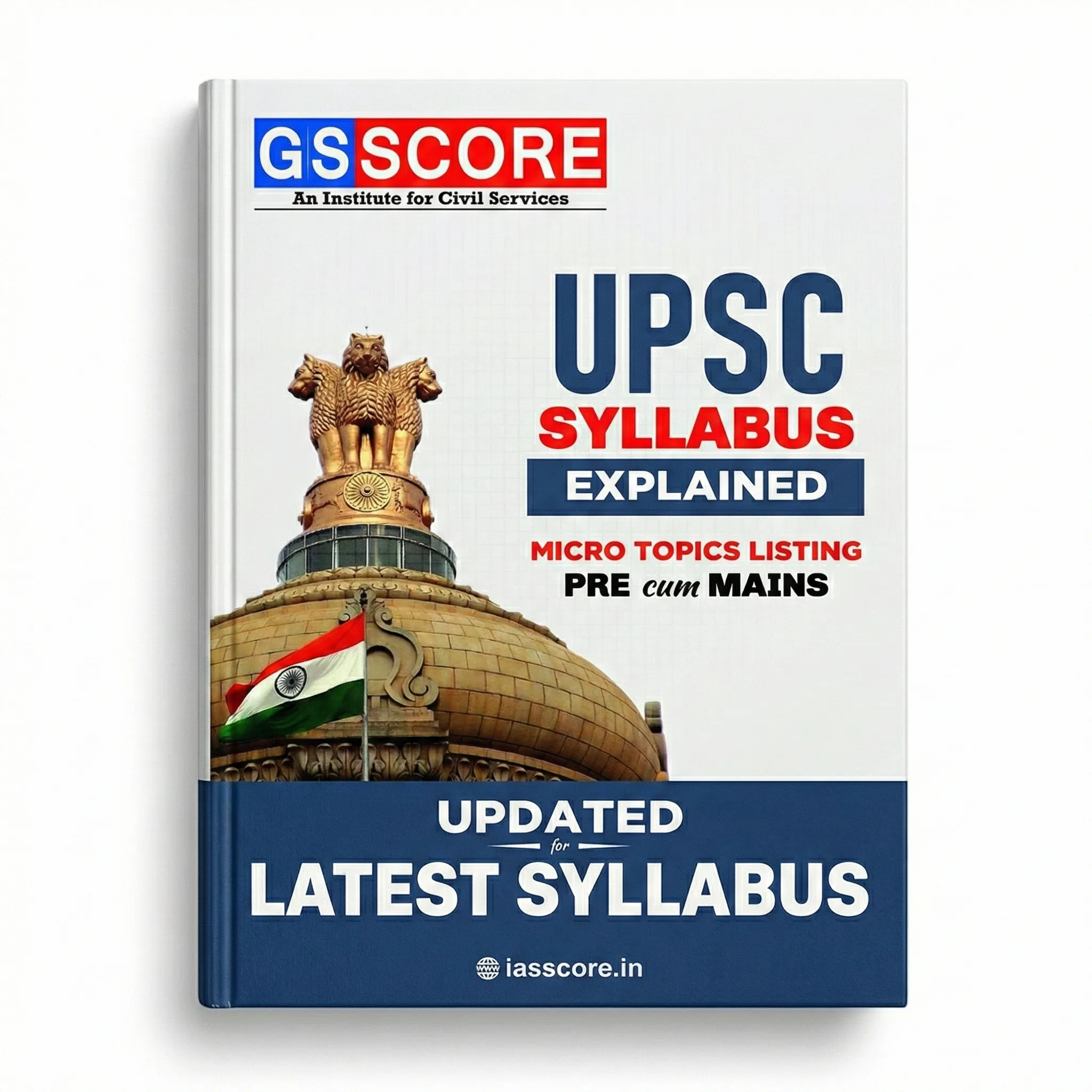
A neatly organised syllabus booklet you can annotate is especially useful here; aspirants who like a printed reference often keep the GS Score Latest Syllabus Booklet on the desk while planning, then adapt the framework to CGPSC’s state-specific papers.
CGPSC Syllabus in Hindi (हिंदी में सिलेबस)
Because CGPSC is a heavily Hindi-medium exam and the question papers are bilingual, Hindi-medium aspirants should prepare directly in Hindi. Here is the core structure in Hindi for quick reference:
- प्रारंभिक परीक्षा (Prelims): प्रश्नपत्र 1 – सामान्य अध्ययन (200 अंक), प्रश्नपत्र 2 – योग्यता परीक्षा / CSAT (200 अंक)। कुल 400 अंक, प्रत्येक 2 घंटे, नकारात्मक अंकन (1/3) लागू।
- मुख्य परीक्षा (Mains): कुल 7 प्रश्नपत्र, प्रत्येक 200 अंक, कुल 1400 अंक — भाषा, निबंध, तथा सामान्य अध्ययन I से V।
- साक्षात्कार (Interview): 150 अंक।
- अंतिम चयन: मुख्य परीक्षा (1400) + साक्षात्कार (150) = 1550 अंक।
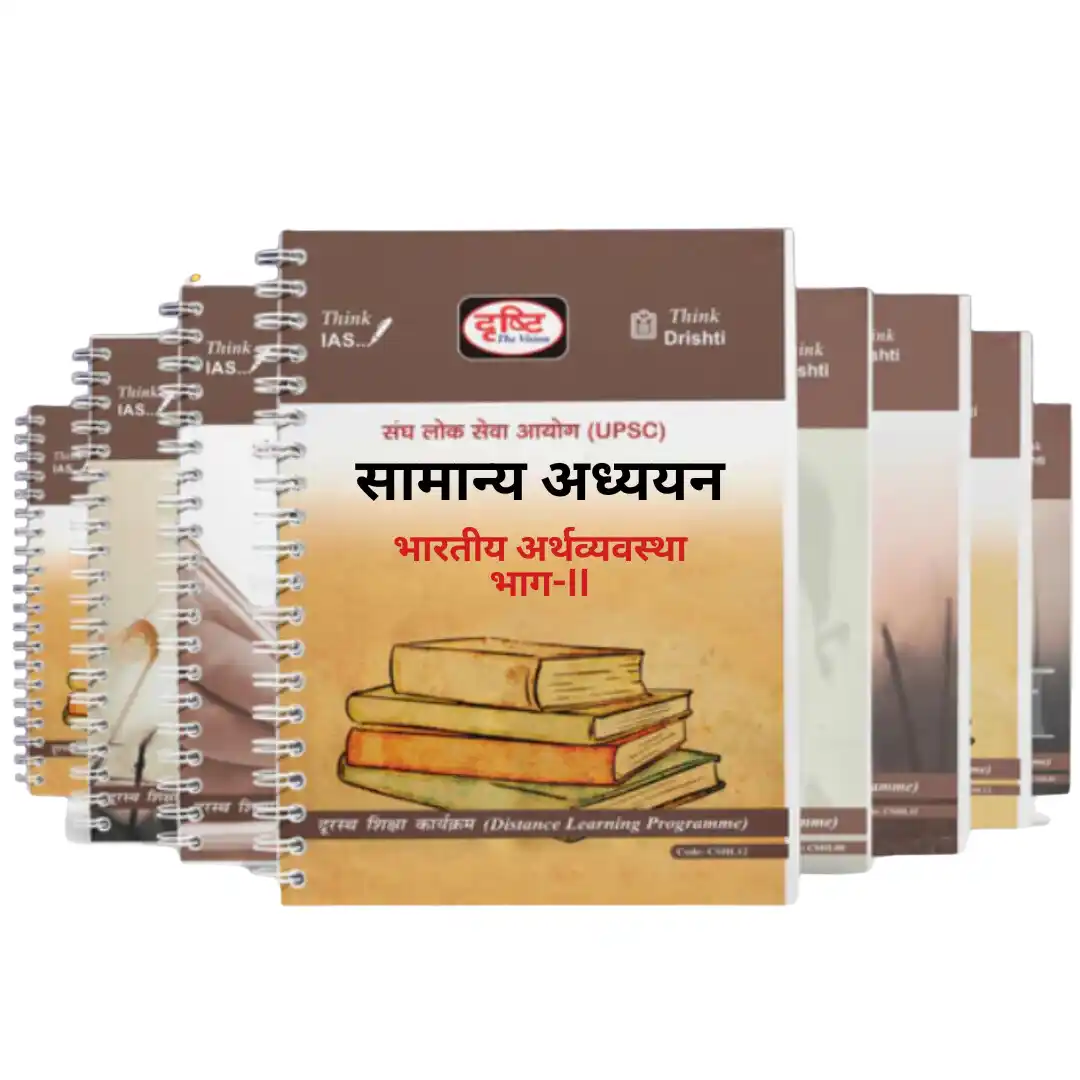
For a Hindi-medium static foundation across polity, history, geography, economy and science, a complete Hindi GS set such as the Drishti IAS Hindi Study Material gives you exam-ready notes that you can supplement with Chhattisgarh-specific state GK.
Topic Weightage & PYQ Analysis: Where to Focus
Not all topics carry equal marks or appear equally often. Based on past CGPSC papers, the Chhattisgarh-specific portion — spread across Prelims Paper 1 and Mains GS-III and GS-V — is disproportionately rewarding and less competitive to master than generic national GK. Use this indicative weightage to prioritise:
| Area | Indicative Weightage | Priority | Why It Matters |
|---|---|---|---|
| Chhattisgarh GK (history, culture, geography, economy, current affairs) | High | Top | Low competition, high recurrence, decides GS-V & state questions |
| Indian Polity & Constitution | High | Top | Static, scoring, overlaps Prelims + GS-I |
| Indian & CG Economy | Medium-High | High | Dynamic; pairs with current affairs |
| History (India + CG) | Medium-High | High | Large but predictable |
| Geography (India + CG) | Medium | Medium | Map-based, scoring with practice |
| Science & Technology | Medium | Medium | NCERT + current developments |
| CSAT / Aptitude | Qualifying-critical | High | Ignored at your peril — fails Paper 1 toppers |
Solving previous year questions (PYQs) topic-wise is the single fastest way to internalise this weightage and the commission’s question style. A structured PYQ toolkit that arranges questions by topic — like the Forum IAS Prelims PYQ Toolkit — trains pattern recognition that raw reading cannot; apply the same topic-wise drilling discipline to CGPSC state papers.
Is the CGPSC Syllabus Similar to the UPSC Syllabus?
Aspirants preparing for both exams often ask how much overlap exists. The honest answer: the national GS core is broadly similar, but CGPSC differs in three decisive ways.
- No optional subject: UPSC Mains has a two-paper optional worth 500 marks; CGPSC has none — it folds optional-style subjects into GS papers, so everyone studies the same syllabus.
- Heavy Chhattisgarh weighting: An entire Mains paper (GS-V) plus large chunks of Prelims Paper 1, GS-I and GS-III are Chhattisgarh-specific — content no UPSC book covers.
- Different mark structure: CGPSC Prelims is 400 marks (2 papers) versus UPSC’s 400 too, but CGPSC Mains is 1400 marks across 7 papers, and the interview is 150 (versus UPSC’s 275).
Practically, a UPSC foundation transfers well to the national portion, but you cannot skip dedicated Chhattisgarh GK — it is where CGPSC ranks are won or lost.
How to Use the CGPSC Syllabus to Build a Study Plan
A syllabus is only useful if it becomes a plan. Here is a practical, syllabus-to-schedule method used by selected candidates:
- Step 1 – Print the checklist. Break every paper into the sub-topics listed above and mark each as Not started / Revising / Done.
- Step 2 – Front-load Chhattisgarh GK. Since CG content spans Prelims and Mains and has the best marks-per-hour return, cover it early and revise it repeatedly.
- Step 3 – Integrate Prelims and Mains. Study a subject once at Mains depth, then compress it into MCQ recall for Prelims — do not prepare them as two separate silos.
- Step 4 – Start answer writing early. Write at least 2–3 Mains answers daily from month one; the seven descriptive papers reward practice more than passive reading.
- Step 5 – Layer current affairs monthly. Maintain a running note of national and Chhattisgarh current affairs; a monthly current-affairs magazine keeps GS-II, GS-III and GS-V updated.
- Step 6 – Revise in cycles. Plan three full revisions before Prelims and two focused revisions of GS-V before Mains.
Common Mistakes CGPSC Aspirants Make
- Neglecting CSAT (Paper 2): Assuming it is easy and failing the qualifying cut-off despite a strong GS paper.
- Under-preparing GS-V (Chhattisgarh): Treating the state paper as an afterthought when it often decides the final rank.
- Confusing the year label: Mixing up 2025 and 2026 notifications. Always cross-check the syllabus and pattern against the latest official CGPSC notification before you start, as the commission occasionally revises paper structures.
- Reading without writing: Consuming notes endlessly but never practising 3-hour descriptive answers.
- Ignoring PYQs: Skipping previous-year analysis and therefore missing the commission’s predictable question patterns.
- No revision plan: Covering the syllabus once and hoping to remember it months later.
Recommended Study Material Mapped to the CGPSC Syllabus
Because CGPSC folds subjects into GS papers, a strong national GS foundation plus Chhattisgarh-specific state GK is the winning combination. Here is a simple syllabus-to-material map:
| Syllabus Area | What Helps | Suggested Resource |
|---|---|---|
| Static GS (Hindi medium) | Complete Hindi GS notes | Vision IAS GS Notes in Hindi / Drishti IAS Hindi Material |
| Economy & current data | Economy notes + monthly CA | Vision IAS Economics Notes |
| Essay writing | Model essays & structure | Vajiram Essay Notes |
| Prelims practice / PYQ | Topic-wise PYQ & MCQ drills | Forum IAS Prelims PYQ Toolkit |
| Syllabus reference | Printed syllabus framework | GS Score Syllabus Booklet |
Add a dedicated Chhattisgarh GK book for the state-specific portions (GS-V and the CG parts of GS-I and GS-III), which no generic national material fully covers.
Frequently Asked Questions
What is the CGPSC syllabus for Prelims and Mains?
The CGPSC Prelims syllabus has two objective papers of 200 marks each — Paper 1 (General Studies, including heavy Chhattisgarh GK) and Paper 2 (Aptitude/CSAT). The Mains syllabus has seven descriptive papers of 200 marks each (total 1400) — Language, Essay, and General Studies I to V — covering history, polity, public administration, science, reasoning, economy, geography, philosophy, sociology, ethics and a dedicated Chhattisgarh paper.
What is the CGPSC exam pattern and selection process?
CGPSC selection has three stages: Prelims (2 objective papers, 400 marks, qualifying only, with 1/3 negative marking), Mains (7 descriptive papers, 1400 marks), and Interview/Personality Test (150 marks). Prelims marks do not count in the final merit; the final rank is decided by Mains (1400) + Interview (150) = 1550 marks.
How many papers are there in CGPSC Mains?
There are 7 papers in CGPSC Mains: Paper 1 (Language), Paper 2 (Essay), and Paper 3 to Paper 7 (General Studies I to V). Each carries 200 marks, adding up to a total of 1400 marks.
Is there negative marking in the CGPSC Prelims exam?
Yes. In CGPSC Prelims, one-third (1/3) of the marks allotted to a question are deducted for each wrong answer. There is no negative marking in the descriptive Mains papers.
Are the CGPSC Prelims and Mains syllabus the same?
No. The subjects overlap in name, but Prelims is objective (MCQ, recognition and speed) and only a qualifying screening test, while Mains is descriptive (structured answer writing and analysis) across seven papers and its marks count fully towards the final merit.
How many marks does the CGPSC interview carry, and what is the total Mains marks?
The CGPSC Interview / Personality Test carries 150 marks. The Mains written exam totals 1400 marks. Together, Mains (1400) + Interview (150) = 1550 marks decide the final selection and rank.
Is the CGPSC syllabus similar to the UPSC syllabus?
The national General Studies core overlaps, so a UPSC foundation helps. But CGPSC has no optional subject, folds those subjects into its GS papers, and adds a heavy Chhattisgarh-specific load — an entire GS-V paper plus parts of Prelims Paper 1, GS-I and GS-III — which UPSC material does not cover.
Where can I download the CGPSC syllabus PDF?
Download the official CGPSC syllabus PDF (Hindi and English) from the Chhattisgarh Public Service Commission website, psc.cg.gov.in, attached to the latest State Service Examination notification. Then convert it into a printable topic-wise checklist for tracking your preparation.
Recommended Study Material

Continue Reading
OJAS GPSC Syllabus 2026: Class 1-2 Pattern + PDF Download
The OJAS GPSC syllabus for the Class 1-2 (Gujarat Administrative Service / Gujarat Civil Service) exam covers a…
UPSC Previous Year Question Papers: Free PDF (2014-2026)
UPSC previous year question papers are free, downloadable PDFs of past Civil Services Prelims (GS Paper-I & CSAT…
MPSC Syllabus 2026: Prelims, Mains, Pattern + PDF (Marathi)
The MPSC syllabus for the Maharashtra State Services (Rajyaseva) exam is divided across three stages — Prelims (2…