Best Books for JEE Advanced 2026: Subject-Wise Toppers’ List
Best books for JEE Advanced 2026 — a ranked, subject-wise list for Physics, Chemistry & Maths, with must-buy vs optional tiers, topic-wise picks and a study timeline.

The best books for JEE Advanced are H.C. Verma and D.C. Pandey for Physics; NCERT with O.P. Tandon, M.S. Chauhan and J.D. Lee for Chemistry; and Cengage (G. Tewani) plus Vikas Gupta & Pankaj Joshi for Maths — all layered on a rock-solid NCERT foundation, especially for Chemistry. You do not need 8-9 books per subject; you need 3 core books done cold, plus one problem book per subject for depth. This guide gives a ranked, subject-wise shortlist of exactly which books to buy first, which to skip, how to map single books to tough topics, and how to sequence them over a 1-year or 2-year timeline for JEE Advanced 2026.
Key takeaways:
- Physics: H.C. Verma for concepts → D.C. Pandey for practice → Irodov only for top ranks.
- Chemistry: NCERT is non-negotiable → M.S. Chauhan (Organic), J.D. Lee (Inorganic), O.P. Tandon / R.C. Mukherjee (Physical).
- Maths: NCERT + Cengage (G. Tewani) → Vikas Gupta & Pankaj Joshi for the hardest problems.
- Golden rule: 2-3 books per subject, revised multiple times, plus 10-15 years of PYQs. Depth beats breadth.
Quick Verdict: The Best Books for JEE Advanced (Must-Buy Booklist)
Most aspirants over-buy. Before we go deep, here is the honest, minimum-viable list that clears JEE Advanced for the vast majority of serious aspirants. Buy these first, finish them completely, and only then consider the advanced foreign titles.
| Subject | Core Concept Book | Core Problem Book | Add Only If Targeting Top 1000 |
|---|---|---|---|
| Physics | H.C. Verma Vol 1 & 2 | D.C. Pandey (Understanding Physics) | Irodov |
| Chemistry | NCERT + O.P. Tandon (Physical/Inorganic) | M.S. Chauhan (Organic) + J.D. Lee (Inorganic) | Atkins, Peter Sykes |
| Maths | NCERT + Cengage (G. Tewani) | Vikas Gupta & Pankaj Joshi (Advanced Problems) | I.A. Maron, S.L. Loney |
That is 6-7 books total, not 25. If you master this stack and do the last 10 years of PYQs, you are competitive. A structured, pre-organised alternative is a coaching-style module set like the eSaral IIT JEE Modules 2026, which sequence theory, solved examples and practice in the exact order you should study — useful for self-study aspirants who find managing 7 separate books overwhelming.
How We Chose These Books
This shortlist reflects the titles named most consistently in JEE Advanced topper interviews and IITian recommendations, cross-checked against the current JEE Advanced syllabus and the exam’s actual question style (multi-concept, reasoning-heavy). We have prioritised books that are widely used by coaching institutes and easily available in India, flagged foreign titles as optional rather than essential, and avoided padding the list with lookalike books that add volume but not new value. Where a single book is clearly the best for one hard chapter, we say so in the topic-to-book map below rather than sending you back through an entire volume.
Best Books for JEE Advanced Physics
Physics at the JEE Advanced level rewards conceptual clarity over rote formula recall. The exam sets multi-concept problems where a single question fuses, say, rotational mechanics with SHM. Your book stack must therefore build concepts first and drill application second.
| Book Title | Author | Best For |
|---|---|---|
| Concepts of Physics (Vol 1 & 2) | H.C. Verma | The single best concept-builder — non-negotiable. Read theory + solve every in-text and exercise problem. |
| Understanding Physics (5-book series) | D.C. Pandey | Best for JEE-pattern practice and topic-wise question variety after HCV. |
| Fundamentals of Physics | Halliday, Resnick & Walker | Deeper theory and clean derivations for topics HCV covers thinly (e.g. modern physics, waves). |
| Problems in General Physics | I.E. Irodov | Advanced problem practice — only for top-rank aspirants after the above are done. |
| Aptitude Test Problems in Physics | S.S. Krotov | Olympiad-style toughest problems — optional, top 500 only. |
Is HC Verma or DC Pandey better for JEE Advanced Physics?
They are not competitors — they are sequential. H.C. Verma builds the concept and gives you the intuition; D.C. Pandey gives you the volume and variety of JEE-pattern problems to convert that intuition into speed. The correct approach is HCV first for theory and foundational problems, then D.C. Pandey for exam-oriented drilling. If you must pick only one because of time, use HCV for the Class 11 foundation and D.C. Pandey for the final year of practice.
Is Irodov necessary for JEE Advanced?
Honestly, no — not for most aspirants. Irodov is a Russian problem book that is significantly harder and often more abstract than actual JEE Advanced questions. It is worth it only if you are targeting a top-1000 (ideally top-500) rank and have already exhausted HCV and D.C. Pandey. Attempting Irodov before your basics are solid wastes time and dents confidence. Selective chapters (Electrodynamics, Mechanics) are enough; you do not need to solve the whole book.
Best Books for JEE Advanced Chemistry
Chemistry is where NCERT matters most, especially Inorganic and Physical. Split your preparation into the three branches and pick one reference per branch rather than hoarding. Chemistry is also the most scoring of the three subjects at Advanced level, because a large share of questions are memory- and NCERT-anchored rather than purely calculation-heavy — which is exactly why skipping NCERT here is so expensive.
Physical Chemistry
| Book Title | Author | Best For |
|---|---|---|
| Modern Approach to Chemical Calculations | R.C. Mukherjee | Best for mole concept and numerical problem-solving — builds calculation speed. |
| Physical Chemistry (G.R.B.) | O.P. Tandon | Complete theory + solved problems for the entire physical syllabus. |
| Physical Chemistry | P.W. Atkins | Deep conceptual reference for thermodynamics & equilibrium — optional, advanced. |
Organic Chemistry
| Book Title | Author | Best For |
|---|---|---|
| Advanced Problems in Organic Chemistry | M.S. Chauhan | Best problem book for JEE Advanced Organic — mechanism-based practice. |
| Organic Chemistry | Morrison & Boyd | Gold-standard theory and reaction mechanisms — reference, not cover-to-cover. |
| A Guidebook to Mechanism in Organic Chemistry | Peter Sykes | Deep mechanism understanding — optional, top-rank only. |
Inorganic Chemistry
| Book Title | Author | Best For |
|---|---|---|
| NCERT Chemistry (Class 11 & 12) | NCERT | Non-negotiable base — a large share of Inorganic questions map directly to NCERT lines. |
| Concise Inorganic Chemistry | J.D. Lee (adapted Indian edition) | Best reference for coordination compounds, p-block and periodic trends beyond NCERT. |
| Inorganic Chemistry (G.R.B.) | O.P. Tandon | Structured Indian coverage with exam-oriented question sets. |
Which is the best Organic Chemistry book for JEE Advanced?
For problem-solving, M.S. Chauhan’s Advanced Problems in Organic Chemistry is the most recommended — it is calibrated to the JEE Advanced difficulty and reasoning style. For theory and mechanisms, Morrison & Boyd remains the classic, but use it as a reference for specific reactions rather than reading it front to back. The combination of NCERT for named reactions, Morrison & Boyd for mechanism depth, and M.S. Chauhan for practice covers Organic completely.
Best Books for JEE Advanced Maths
Maths at JEE Advanced is about problem exposure and pattern recognition. Cengage’s topic-wise series (G. Tewani) is the modern all-rounder; pair it with Vikas Gupta for the hardest problems and classic titles for specific chapters.
| Book Title | Author | Best For |
|---|---|---|
| Mathematics (topic-wise series) | Cengage — G. Tewani | Best all-round set: theory + graded problems for every chapter. |
| Advanced Problems in Mathematics | Vikas Gupta & Pankaj Joshi | Best for JEE Advanced-level tough problems and mixed-concept questions. |
| Objective Mathematics | R.D. Sharma | Best for building fundamentals and initial fluency (great for Class 11). |
| Plane Trigonometry & Coordinate Geometry | S.L. Loney | Best single books for Trigonometry and Conics/Coordinate Geometry. |
| Problems in Calculus of One Variable | I.A. Maron | Best for mastering single-variable Calculus depth. |
| Higher Algebra | Hall & Knight | Best for Algebra fundamentals — Permutations, Binomial, Progressions. |
| Problems Plus in IIT Mathematics | A. Das Gupta | Mixed advanced problem practice for revision. |
Is NCERT Enough for JEE Advanced?
No — NCERT alone is not enough to crack JEE Advanced, but it is the mandatory foundation you cannot skip. The distinction is subject-wise:
- Chemistry: NCERT is close to sufficient for Inorganic (especially Class 12) and covers most of Physical theory. A large share of Inorganic questions trace directly to NCERT. You must finish NCERT Chemistry line-by-line before touching reference books.
- Physics: NCERT builds concepts and definitions but its problems are far below JEE Advanced difficulty. Use it for theory reinforcement only; the real work happens in HCV and D.C. Pandey.
- Maths: NCERT gives you the syllabus scope and basic problems, but the difficulty gap is largest here. You will need Cengage and Vikas Gupta for genuine Advanced-level questions.
Bottom line: complete NCERT first as the base for all three subjects, then layer reference books on top. Skipping NCERT — particularly for Chemistry — is the most common and most costly mistake serious aspirants make.
JEE Advanced 2026: Exam Overview, Dates & Eligibility
JEE Advanced 2026 is expected to be conducted by IIT Roorkee, with the exam tentatively scheduled for around mid-May 2026. Only the top ~2,50,000 qualified candidates from JEE Main 2026 are eligible to appear. Your book choice should reflect this filter: you are already past the JEE Main level, so you need depth and reasoning, not more basic-formula drill.
| Parameter | Detail (JEE Advanced 2026) |
|---|---|
| Conducting body | IIT Roorkee (under JAB), to be confirmed officially |
| Tentative exam date | Around mid-May 2026 (check official notice) |
| Papers | Paper 1 & Paper 2 (both compulsory) |
| Subjects | Physics, Chemistry, Mathematics |
| Mode | Computer-based test (CBT) |
| Eligibility | Top ~2.5 lakh JEE Main 2026 qualifiers; max 2 attempts in consecutive years |
| Question types | MCQ (single/multiple correct), numerical value, match-the-column, comprehension |
Always cross-check the latest edition of your reference books against the current syllabus — after recent syllabus revisions, a few topics were trimmed, and buying a pre-revision edition can leave you studying deleted chapters or missing added ones. Prefer the newest print run of any title, and confirm exam dates on the official JEE Advanced website before planning your timeline.
JEE Main vs JEE Advanced: Why Your Books Must Change
The two exams test the same syllabus at completely different depths. Understanding this gap tells you why a Main-level book stack fails at Advanced.
| Aspect | JEE Main | JEE Advanced |
|---|---|---|
| Question style | Direct, single-concept, formula application | Multi-concept, reasoning-heavy, unpredictable |
| Difficulty | Moderate | High to very high |
| Best-suited books | NCERT, D.C. Pandey, R.D. Sharma, HCV | HCV + Irodov, M.S. Chauhan, Cengage + Vikas Gupta |
| Skill tested | Speed & accuracy on standard problems | Conceptual depth & problem-solving creativity |
| Approach | Cover the full syllabus fast | Master fewer books at greater depth |
If you cleared JEE Main comfortably, do not simply solve more Main-level questions. Shift to problem books (Vikas Gupta, M.S. Chauhan, Irodov selectively) that force multi-step reasoning.
Topic-to-Book Mapping: One Book Per Tough Chapter
This is the guidance most listicles skip. When a specific chapter is giving you trouble, go to the single best book for it rather than re-reading everything.
| Topic / Chapter | Best Single Book |
|---|---|
| Rotational Mechanics | H.C. Verma Vol 1 + D.C. Pandey (Mechanics) |
| Electrodynamics / Modern Physics | Irodov (selective) + HRW theory |
| Conic Sections / Coordinate Geometry | S.L. Loney |
| Calculus (Limits, Differentiation, Integration) | I.A. Maron + Cengage |
| Algebra (P&C, Binomial, Progressions) | Hall & Knight |
| Electrochemistry / Thermodynamics | O.P. Tandon + Atkins (advanced) |
| Organic Reaction Mechanisms | Morrison & Boyd + M.S. Chauhan |
| Coordination Compounds / p-block | J.D. Lee + NCERT |
Priority Tiering: Must-Have vs Optional
Do not treat every recommended book as equal. Buy Tier 1 immediately, buy Tier 2 during your practice phase, and treat Tier 3 as optional for high rank targets only.
| Tier | Physics | Chemistry | Maths |
|---|---|---|---|
| Tier 1 — Buy first | H.C. Verma Vol 1 & 2 | NCERT + M.S. Chauhan | NCERT + Cengage |
| Tier 2 — Practice phase | D.C. Pandey series | O.P. Tandon + J.D. Lee | Vikas Gupta & Pankaj Joshi |
| Tier 3 — Optional (top ranks) | Irodov, Krotov, HRW | Atkins, Peter Sykes, Morrison & Boyd (full) | I.A. Maron, S.L. Loney, Hall & Knight |
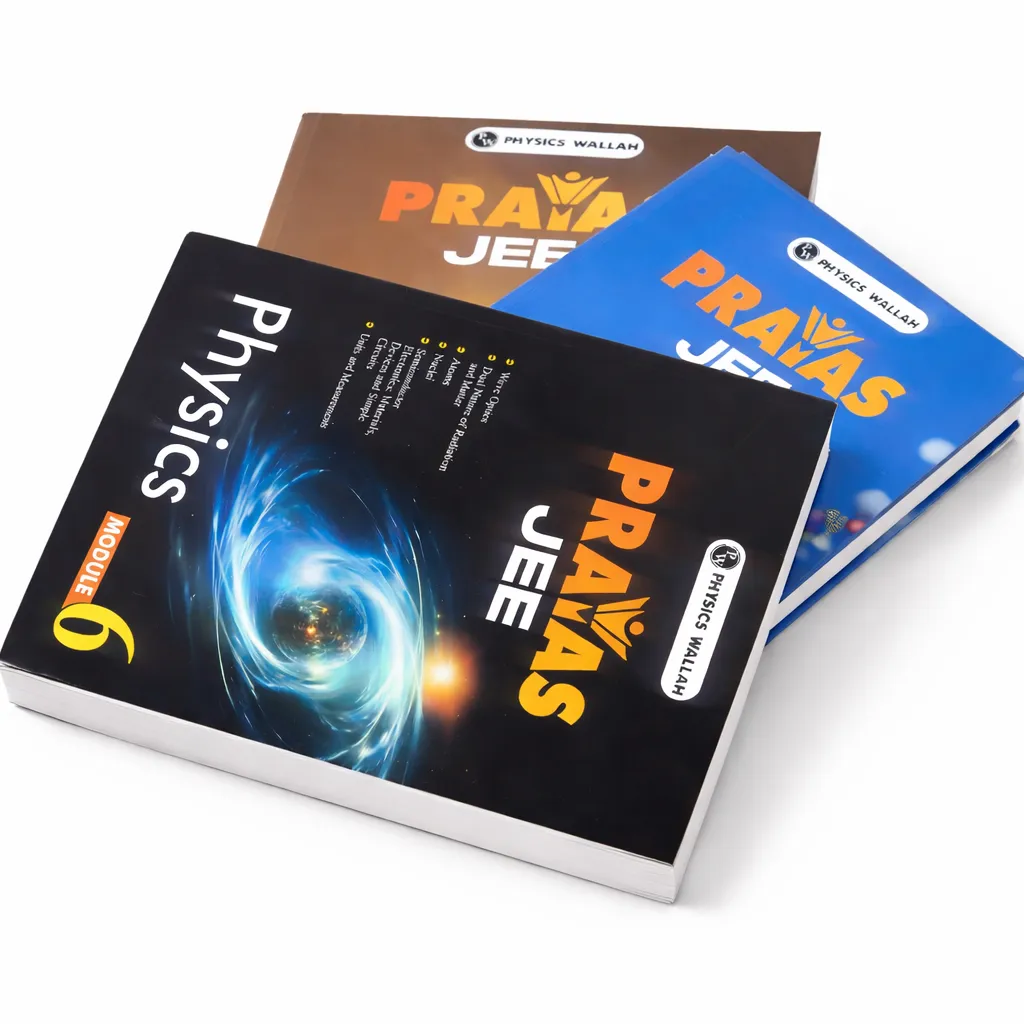
A pre-sequenced module set removes the guesswork of assembling this stack yourself. The PW Prayas JEE Modules for 2026 (18-book set for Class 11 + 12) bundle theory, solved examples and tiered practice in one flow — a practical choice for droppers or self-study aspirants who want one organised system instead of juggling separate publishers.
How Many Books Should I Study for JEE Advanced?
Aim for 2-3 books per subject, not more. The winning formula is: 1 concept book + 1 problem book + NCERT (for Chemistry and as a base for all). Aspirants who buy 6-7 books per subject rarely finish even one properly — depth beats breadth every time. It is far better to solve H.C. Verma three times than to skim HCV, Irodov, Krotov and HRW once each. Master fewer books completely, revise them, and pour the rest of your time into PYQs and mock tests.
Which Books Do JEE Advanced Toppers Recommend?
Toppers and IITians are remarkably consistent in their recommendations, and their lists are shorter than you would expect. The recurring JEE Advanced reference books recommended by toppers are:
- Physics: H.C. Verma for concepts, D.C. Pandey for practice, Irodov selectively for the final push.
- Chemistry: NCERT cover-to-cover, M.S. Chauhan for Organic problems, J.D. Lee for Inorganic, O.P. Tandon / R.C. Mukherjee for Physical.
- Maths: Cengage (G. Tewani) as the backbone, Vikas Gupta & Pankaj Joshi for tough problems, S.L. Loney and Maron for specific chapters.
The common thread in every topper interview is not the book list — it is depth and revision. They finished a small set of books multiple times and solved 10-15 years of PYQs, rather than collecting titles.
How to Sequence Your Books: 1-Year vs 2-Year Timeline
When you buy a book matters as much as which book. Here is how to phase your reading depending on whether you are starting in Class 11 (2-year runway) or you are a dropper/Class 12 aspirant (1-year runway).
| Phase | 2-Year Plan (Class 11 start) | 1-Year Plan (Dropper / Class 12) |
|---|---|---|
| Foundation | NCERT + HCV Vol 1 + R.D. Sharma + NCERT Chemistry | NCERT (fast) + HCV + Cengage — 2-3 months |
| Concept depth | Add O.P. Tandon, Morrison & Boyd, Cengage across Class 11-12 | D.C. Pandey + M.S. Chauhan + J.D. Lee — months 3-6 |
| Advanced practice | Vikas Gupta, D.C. Pandey, selective Irodov | Vikas Gupta + selective Irodov — months 6-9 |
| Revision & PYQ | Full PYQs + mock series in final 4-5 months | PYQs + daily mocks — final 3 months |
How to Actually Use These Books (Strategy That Wins)
Owning the best books for JEE Advanced 2026 is worthless without a method. Follow this workflow:
- Theory first, then problems: Read the concept from one book, solve its solved examples, then attempt the exercises without looking back.
- One problem book at a time: Finish D.C. Pandey before opening Irodov. Parallel-reading three problem books guarantees you finish none.
- Maintain an error log: Note every wrong question and the concept it exposed. Revise this log weekly — it is the highest-ROI habit in the final months.
- PYQs are compulsory: Solve the last 10-15 years of JEE Advanced papers topic-wise, then full-paper. PYQs reveal the exam’s reasoning style better than any reference book.
- Pair books with mock tests: After finishing a chapter’s problem set, take a timed sectional test. A weekly full-length mock in the last three months is non-negotiable.
- Revise, do not re-buy: Three passes of one book beat one pass of three books.
Can I clear JEE Advanced with self-study using these books?
Yes — many rank-holders are self-study students. What self-study demands is discipline, a fixed daily schedule, honest self-testing, and a mentor or online resource to clear doubts. The book stack above is exactly what coaching institutes teach from; the difference is structure. If you struggle to sequence topics on your own, a ready-made module system such as the eSaral IIT JEE Modules 2026 or the PW Prayas JEE Modules gives you the coaching-style flow — theory, examples, practice, revision — without a classroom. Combine free resources (NCERT, YouTube lectures, PYQ PDFs) with one paid problem set per subject to keep costs down.
Price & Value: Where to Buy and What to Spend
You do not need to spend a fortune. A complete Tier-1 + Tier-2 stack costs far less than one month of coaching. Approximate price ranges (individual titles) are ₹250-₹600 for standard Indian references (HCV, D.C. Pandey, O.P. Tandon, R.D. Sharma), ₹150-₹400 for NCERT and M.S. Chauhan, and ₹400-₹900 for imported/premium titles (J.D. Lee, Atkins, full Cengage sets). Buying a bundled module set often works out cheaper per page than assembling 7 separate books and saves the effort of sequencing them yourself. Whichever route you choose, prioritise the latest edition aligned to the current syllabus, and Hindi-medium aspirants should confirm a Hindi print run exists before ordering (HCV, D.C. Pandey and NCERT are widely available in Hindi).
Common Book-Buying Mistakes to Avoid
- Over-buying: Collecting 20 books you never finish. Stick to 2-3 per subject.
- Skipping NCERT: Especially fatal for Chemistry Inorganic.
- Starting Irodov/Krotov too early: They demolish confidence if basics are shaky.
- Ignoring PYQs: No book substitutes for actual JEE Advanced past papers.
- Buying outdated editions: Always check the book matches the revised syllabus.
- Reading without solving: Physics and Maths are learnt by solving, not reading.
Frequently Asked Questions
Which books are best for JEE Advanced Physics, Chemistry and Maths?
For Physics, H.C. Verma and D.C. Pandey (Irodov for top ranks). For Chemistry, NCERT plus M.S. Chauhan (Organic), J.D. Lee (Inorganic) and O.P. Tandon/R.C. Mukherjee (Physical). For Maths, Cengage by G. Tewani and Advanced Problems by Vikas Gupta & Pankaj Joshi, with S.L. Loney and I.A. Maron for specific chapters.
Is NCERT enough to crack JEE Advanced?
No, but it is the mandatory base. NCERT is nearly sufficient for Inorganic Chemistry and covers core theory across subjects, but its problem difficulty is far below Advanced level. Finish NCERT first, then add reference and problem books, especially for Physics and Maths.
Is Irodov necessary for JEE Advanced?
Not for most aspirants. Irodov is worth it only after you have mastered H.C. Verma and D.C. Pandey and are targeting a top-1000 rank. Solve selective chapters rather than the whole book, and never start it before your fundamentals are solid.
How many books should I study for JEE Advanced?
Two to three per subject — one concept book, one problem book, plus NCERT. Mastering a small set through multiple revisions beats owning many books you never finish. Depth and PYQ practice matter more than the number of titles.
Which is the best Organic Chemistry book for JEE Advanced?
M.S. Chauhan’s Advanced Problems in Organic Chemistry is the best for JEE-calibrated problem practice, paired with Morrison & Boyd as a mechanism reference and NCERT for named reactions. Peter Sykes is optional for top-rank aspirants wanting deeper mechanism theory.
Can I clear JEE Advanced with self-study using these books?
Yes. Many rank-holders self-study using exactly this stack. Success needs a fixed schedule, honest self-testing, PYQ practice and a reliable doubt-clearing resource. A pre-sequenced module set can supply coaching-style structure if you find organising separate books difficult.
Which reference books do JEE Advanced toppers recommend for 2026?
The consistently recommended set for JEE Advanced 2026 is H.C. Verma and D.C. Pandey for Physics; NCERT with M.S. Chauhan, J.D. Lee and O.P. Tandon for Chemistry; and Cengage (G. Tewani) with Vikas Gupta & Pankaj Joshi for Maths. Toppers stress finishing this short list multiple times over collecting more titles.
Should I buy standard books or coaching modules for JEE Advanced?
Both can work. Standard books (HCV, Cengage, M.S. Chauhan) give you the best individual titles but leave sequencing to you. Pre-organised module sets bundle theory, examples and graded practice in study order, which suits self-study aspirants and droppers who want a coaching-style flow without juggling multiple publishers. Whichever you pick, PYQs and revision decide your rank.
Recommended Study Material

Continue Reading
MPSC Syllabus 2025: Prelims, Mains, New Pattern + Marathi/English PDF
The MPSC syllabus for the Rajyaseva (State Services) exam covers three stages — Prelims (2 objective papers, 400…
Best Books for JEE Main 2026: Subject-Wise List + Prices
The best books for JEE Main are NCERT (the non-negotiable foundation, especially for Chemistry) plus two trusted references…
History Optional Syllabus 2026: Paper 1 & 2 + PDF
The history optional syllabus for UPSC CSE 2026 is divided into two papers of 250 marks each (500…