MPSC Syllabus 2025: Prelims, Mains, New Pattern + Marathi/English PDF
Complete MPSC syllabus 2025 for Rajyaseva Prelims & Mains — new descriptive pattern, marking scheme, optional subjects, Maharashtra topics and Marathi + English PDF download.

The MPSC syllabus for the Rajyaseva (State Services) exam covers three stages — Prelims (2 objective papers, 400 marks), Mains (9 descriptive papers under the new 2025 pattern) and a 275-mark Interview. From the 2025 Rajyaseva Main Examination, MPSC has moved from the old objective, 6-paper Mains to a UPSC-style descriptive pattern with Essay, four General Studies papers and two optional-subject papers. This guide gives the complete, up-to-date Prelims and Mains topic breakdown, the revised mpsc syllabus and exam pattern, the marking scheme, and clean Marathi + English PDF downloads. Every figure here is cross-checked against the official notices on mpsc.gov.in and should be verified there before you finalise your plan, since the Commission updates schemes cadre by cadre.
MPSC Syllabus 2025 at a Glance
The Maharashtra Public Service Commission (MPSC) conducts the Rajyaseva/State Services examination to recruit officers such as Deputy Collector, DySP, Tehsildar, BDO and other Class-I and Class-II posts. The single biggest change aspirants must understand is the shift to a descriptive Mains from 2025. Here is the full structure at a glance before we go stage by stage.
| Stage | Papers | Type | Total Marks | Purpose |
|---|---|---|---|---|
| Prelims | 2 (GS Paper I + CSAT Paper II) | Objective (MCQ) | 400 | Screening / qualifying for Mains |
| Mains (New 2025) | 9 (2 language + Essay + GS I–IV + 2 optional) | Descriptive | 1750 (merit) + 600 qualifying | Merit ranking |
| Interview | Personality Test | Viva-voce | 275 | Final merit |
Total marks counted for the final merit list under the new pattern are 1750 (Mains merit papers) + 275 (Interview) = 2025 marks. The two language papers and the CSAT paper are only qualifying — a crucial point most aspirants miss.
MPSC Selection Process: Prelims, Mains, Interview
MPSC Rajyaseva selection is a three-stage funnel. You clear each stage to reach the next, and only the Mains and Interview marks decide your final rank.
- Stage 1 — Preliminary Examination: Two objective papers on the same day. Marks are for screening only and are not added to the final merit. Only Paper I is used to draw the Prelims cut-off; Paper II (CSAT) must be passed at 33%.
- Stage 2 — Main Examination: Nine descriptive papers (from 2025). This is where your rank is largely built.
- Stage 3 — Interview / Personality Test: 275 marks, added to the Mains merit total to produce the final rank.
MPSC Prelims Syllabus and Exam Pattern
The mpsc prelims syllabus has two papers of 200 marks each, held on the same day. Both are objective, multiple-choice, and carry negative marking. Paper I decides the cut-off; Paper II (CSAT) is qualifying in nature.
| Paper | Subject | Questions | Marks | Duration | Nature |
|---|---|---|---|---|---|
| Paper I | General Studies | 100 | 200 | 2 hours | Merit (cut-off) |
| Paper II | CSAT (Aptitude) | 80 | 200 | 2 hours | Qualifying (33%) |
What is the MPSC Prelims exam pattern and total marks?
In short: two papers, 200 marks each, 400 marks total, both objective and on the same day. Paper I (General Studies) is scored for the cut-off; Paper II (CSAT) only needs 33% to qualify and is not counted toward the Prelims merit. Both papers use 1/4 negative marking. Prelims marks are never carried into the final rank — they only decide who advances to Mains.
Prelims Paper I (General Studies) Topics
- Current events of state, national and international importance
- History of India and the Indian National Movement, with emphasis on Maharashtra
- Maharashtra, India and World Geography — physical, social and economic geography
- Maharashtra and India Polity and Governance — Constitution, political system, Panchayati Raj, urban governance, public policy, rights issues
- Economic and social development — sustainable development, poverty, inclusion, demographics, social-sector initiatives
- General issues on Environmental Ecology, Biodiversity and Climate Change (no subject specialisation required)
- General Science
Prelims Paper II (CSAT) Topics
- Comprehension
- Interpersonal skills including communication skills
- Logical reasoning and analytical ability
- Decision-making and problem-solving
- General mental ability
- Basic numeracy (numbers and their relations, orders of magnitude — Class X level) and data interpretation (charts, graphs, tables — Class X level)
- Marathi and English language comprehension skills (Class X/XII level)
Because CSAT is now only qualifying at 33%, many aspirants under-prepare and then fail to clear it. A short, focused practice set such as the Vajiram CSAT Complete Booklet Set with practice questions or a timed Vision IAS CSAT Test Series is enough to secure the qualifying mark without eating into GS time.
MPSC Mains Syllabus and Exam Pattern (New 2025)
The mpsc mains syllabus was completely revamped for the 2025 Rajyaseva Main Examination. The old objective, six-paper Mains is gone. In its place is a nine-paper descriptive pattern closely modelled on UPSC Civil Services, which reintroduces optional subjects. This is the heart of the mpsc rajyaseva syllabus 2025.
| Paper | Subject | Marks | Nature | Counted in Merit? |
|---|---|---|---|---|
| Paper A | Marathi (compulsory) | 300 | Descriptive | Qualifying only |
| Paper B | English (compulsory) | 300 | Descriptive | Qualifying only |
| Paper I | Essay | 250 | Descriptive | Yes |
| Paper II | General Studies I | 250 | Descriptive | Yes |
| Paper III | General Studies II | 250 | Descriptive | Yes |
| Paper IV | General Studies III | 250 | Descriptive | Yes |
| Paper V | General Studies IV | 250 | Descriptive | Yes |
| Paper VI | Optional Subject — Paper 1 | 250 | Descriptive | Yes |
| Paper VII | Optional Subject — Paper 2 | 250 | Descriptive | Yes |
Merit total = 1750 marks (Essay + GS I–IV + two optional papers). The Marathi and English language papers (300 each) are qualifying — you must pass them, but the marks are not added to your rank. Add the 275-mark Interview and the grand total for the final merit is 2025 marks.
The new Essay paper alone is worth 250 marks, so structured practice matters. Resources built for the descriptive format, like the Vajiram Essay Notes, transfer directly because MPSC now expects UPSC-style argumentation and structure.
Which optional subjects can I choose?
Under the new descriptive Mains, you pick one optional subject and write two papers (Paper VI and Paper VII) of 250 marks each. The list mirrors the UPSC optional list closely and typically includes literatures of languages (Marathi, English, Hindi and others), plus subjects such as History, Geography, Public Administration, Political Science & International Relations, Sociology, Economics, Law, Agriculture, and various science and engineering disciplines. Because the choice is worth 500 merit marks, pick early based on your graduation background, availability of quality material, and past scoring trends — then confirm the exact approved list in the current MPSC notification before locking it in.
Old vs New MPSC Pattern: The One Table That Clears the Confusion
There is genuine contradiction across the web about the number of papers, whether optionals exist, and the negative-marking fraction. Here is a single, clear comparison with the effective exam year.
| Feature | Old Pattern (till 2024) | New Pattern (from 2025) |
|---|---|---|
| Mains format | Mostly objective (MCQ) | Descriptive (written) |
| Number of Mains papers | 6 | 9 |
| Optional subject | None | Yes — two papers (250 each) |
| Language papers | Marathi + English (mixed) | Marathi (300) + English (300), qualifying |
| Essay paper | Not separate | Separate paper (250) |
| Mains merit marks | 800 | 1750 |
| Interview | 100 | 275 |
| Grand total | 900 | 2025 |
So, to settle the debate: the new MPSC syllabus adds optional subjects (they did not exist in the old objective Mains), moves Mains to descriptive writing, and raises the total from 900 to 2025 marks.
MPSC Mains GS I–IV Detailed Syllabus
The four General Studies papers under the new mpsc syllabus and exam pattern mirror the UPSC GS structure, which is why UPSC GS material works well for MPSC too.
| Paper | Core Areas |
|---|---|
| GS-I | History (India & Maharashtra), Indian Heritage & Culture, World & Indian Geography, Maharashtra Geography, Indian Society |
| GS-II | Indian Constitution, Polity, Governance, Social Justice, Welfare Schemes, International Relations |
| GS-III | Economy, Agriculture, Science & Technology, Environment, Biodiversity, Disaster Management, Internal Security |
| GS-IV | Ethics, Integrity, Aptitude, Emotional Intelligence, Public/Civil Service Values, Case Studies |
Because the overlap with UPSC GS is roughly 70–80%, comprehensive booklet sets such as the Vision IAS English Study Material or the Hindi-friendly Drishti IAS Hindi Study Material cover the bulk of GS I–IV. You then top it up with dedicated Maharashtra content (covered next).
Maharashtra-Specific Content: The Highest-Scoring Area
This is the section most national coaching notes skip — and it is the single most scoring, high-weightage part of the MPSC syllabus in both Prelims and Mains. Maharashtra-specific material rarely has tough competition, so mastering it directly lifts your rank.
| Domain | Key Maharashtra Topics |
|---|---|
| History | Shivaji & the Maratha Empire, Peshwas, social reformers (Phule, Ambedkar, Shahu, Agarkar, Ranade), Samyukta Maharashtra movement |
| Geography | Physiography (Konkan, Western Ghats/Sahyadri, Deccan plateau), rivers, climate, soils, crops, irrigation, minerals, industries |
| Polity & Governance | State legislature, Panchayati Raj in Maharashtra, urban local bodies, state schemes, cooperative movement |
| Economy | State budget, agriculture & sugar cooperatives, industrial policy, HDI & social indicators of Maharashtra |
| Culture | Saints & Bhakti movement (Dnyaneshwar, Tukaram, Eknath), festivals, folk arts (Lavani, Tamasha, Powada), literature |
Budget 30–40% of your Prelims Paper I revision to Maharashtra history, geography and polity. In Mains GS-I and GS-II you can consistently weave Maharashtra examples into national answers for extra credit.
MPSC Marking Scheme and Negative Marking
Understanding the marking scheme prevents avoidable losses, especially in Prelims where negative marking is aggressive.
| Item | Detail |
|---|---|
| Prelims marks per question | Paper I: 2 marks each; Paper II: 2.5 marks each |
| Prelims negative marking | 1/4 (25%) of the marks for each wrong answer |
| CSAT qualifying mark | 33% (Paper II) |
| Mains qualifying papers | Marathi (300) + English (300) — must pass, not counted in merit |
| Mains merit papers | Essay + GS I–IV + Optional I&II = 1750 |
| Interview | 275 marks |
Note the common mix-up: UPSC deducts 1/3 in its Prelims, while MPSC deducts 1/4 (25%). Also remember that multiple markings or blank answers do not attract negative marks — only a genuinely wrong single answer does.
MPSC Interview / Personality Test
The final stage is a 275-mark personality test. It assesses mental alertness, clarity and depth of interest, balance of judgement, leadership, social cohesion and integrity — not textbook knowledge. Because it is added to the 1750 Mains merit marks, a strong interview can move you up several ranks. Prepare with your Detailed Application Form (DAF), current affairs of Maharashtra and India, and mock interviews.
MPSC Syllabus PDF: Marathi and English Download
Most competing pages bury or gate the actual file. Here is a clean, clearly labelled set so you can grab the exact document you need. The official, authoritative source is always the MPSC portal (mpsc.gov.in), where the revised syllabus and exam-pattern notices are published in both Marathi and English. If you are searching specifically for the mpsc syllabus in marathi pdf or want the mpsc new syllabus 2025 pdf download, the same portal serves both languages from a single notice.
| Document | Language | Where to get it |
|---|---|---|
| MPSC Rajyaseva Prelims Syllabus | Marathi + English | mpsc.gov.in → Syllabus section |
| MPSC Rajyaseva Mains Syllabus (New 2025) | Marathi + English | mpsc.gov.in → Revised Mains notice |
| Revised Exam Pattern Notice | Marathi + English | mpsc.gov.in → Notices/Press notes |
How can I download the MPSC syllabus PDF in Marathi?
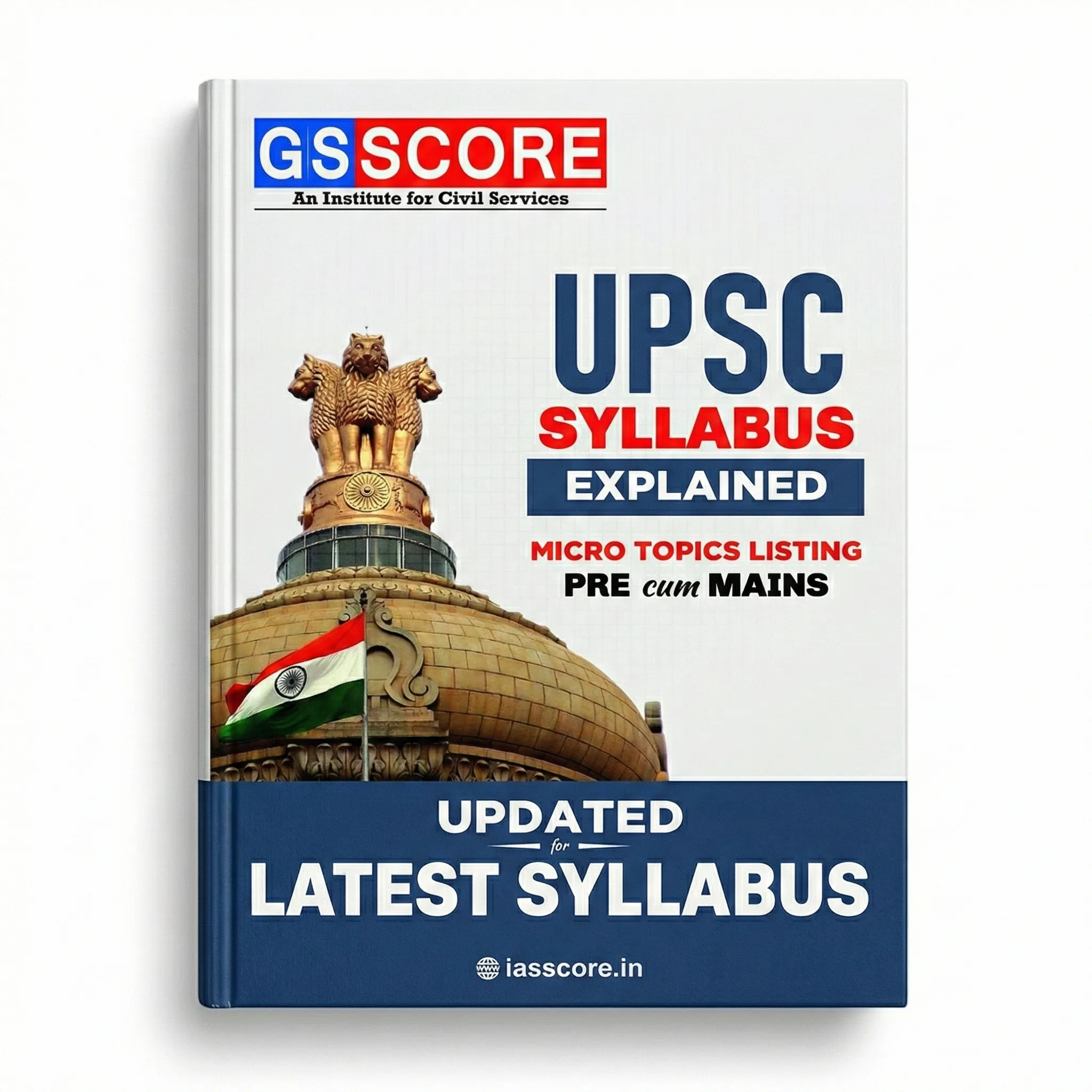
Visit mpsc.gov.in, open the “Syllabus” or “Revised Syllabus” section, and download the Rajyaseva Prelims and Mains PDFs — both are published in Marathi (मराठी) and English. Because MPSC releases the same document bilingually, you can keep both open side by side while you plan preparation. Always match the file date to the latest notification so you are not studying a superseded version. If you want a printed, subject-organised syllabus reference to annotate, the GS Score Latest Syllabus Booklet is a handy companion (structured for the shared UPSC/state-PCS GS framework).
MPSC Syllabus by Exam: Beyond Rajyaseva
MPSC conducts far more than the State Services exam. Most pages ignore these, so here is a quick differentiated view — the syllabus depth varies by cadre.
| Exam | Level / Posts | Syllabus Focus |
|---|---|---|
| Rajyaseva (State Services) | Class I & II (Dy Collector, DySP, Tehsildar) | Full Prelims + descriptive Mains (this guide) |
| MPSC Combined (Group B) | PSI, STI, ASO | Prelims + Mains, objective, GS + aptitude + post-specific |
| MPSC Group C | Clerk, Tax Assistant, Excise SI | Objective; Marathi, English, GK, arithmetic, IT |
| Engineering Services | Civil / Mechanical / Electrical | GS + engineering discipline papers |
| Agriculture & Forest Services | Agri Officer, Forest Ranger | GS + subject-specific (agri science / forestry & science) |
If you are targeting the Combined or Subordinate Services, the CSAT-style aptitude and general-studies base overlaps heavily with the Rajyaseva Prelims Paper I & II, so the same foundation books serve you well.
Subject-Wise Booklist Mapped to the MPSC Syllabus
Because the new Mains is descriptive and mirrors UPSC GS, UPSC-grade material now maps cleanly onto MPSC topics. Here is a practical mapping — add dedicated Maharashtra state/board textbooks on top.
| Syllabus Area | Recommended Material |
|---|---|
| GS Foundation (Prelims + Mains I–IV) | Vision IAS English Study Material / Drishti IAS English Study Material |
| CSAT Paper II | Vajiram CSAT Complete Booklet Set |
| Essay (Mains Paper I) | Vajiram Essay Notes |
| Current Affairs (Prelims + Mains) | Vision IAS Current Affairs Magazine |
| PYQ Practice | Forum IAS Prelims Toolkit (Topic-wise PYQ) |
Hindi-medium aspirants can substitute the Drishti IAS Hindi Study Material for the GS foundation and pair it with Marathi state-board textbooks for Maharashtra-specific content.
How to Cover the MPSC Syllabus: Weightage and Plan
Coverage without prioritisation wastes months. Use this weightage-first approach.
| Subject | Approx. Prelims Weightage | Priority |
|---|---|---|
| Polity & Governance | 15–18% | High |
| History (incl. Maharashtra) | 15–18% | High |
| Geography (incl. Maharashtra) | 15–18% | High |
| Economy & Social Development | 12–15% | High |
| Environment & Ecology | 8–10% | Medium |
| Science & Technology | 8–10% | Medium |
| Current Affairs | 10–15% | High (ongoing) |
Treat these percentages as planning estimates drawn from recent question trends, not official quotas — MPSC does not publish a fixed topic weightage, so keep some flexibility year to year.
A realistic 10–12 month plan
- Months 1–4: Build the static base — Polity, History, Geography, Economy — with parallel Maharashtra content. Start daily current affairs.
- Months 5–7: Finish Environment, Science & Tech; begin your optional subject (both Mains papers); start descriptive answer writing.
- Months 8–9: Prelims test series + CSAT practice; intensive revision of high-weightage areas.
- Months 10–12: Post-Prelims — full-length Mains answer writing, Essay practice, Marathi/English language paper revision, and optional consolidation.
Common mistakes to avoid
- Ignoring CSAT because it is “only qualifying” — every year candidates fail the 33% cut-off.
- Studying national GS but neglecting Maharashtra-specific topics, which are the easiest scoring marks.
- Preparing Mains in objective mode — the 2025 pattern is descriptive; answer writing must start early.
- Delaying the optional subject — two 250-mark papers (500 marks) are decisive for merit.
MPSC vs UPSC Syllabus: Key Differences
The new MPSC pattern is UPSC-inspired but not identical. Both now have descriptive Mains with GS I–IV, Essay, language papers and optional subjects. Differences: MPSC Prelims uses 1/4 negative marking (UPSC uses 1/3), MPSC adds heavy Maharashtra-specific content, the Marathi language paper is compulsory-qualifying, and the marks structures differ. This strong overlap is exactly why UPSC GS material is efficient for MPSC preparation.
How This Guide Is Kept Accurate
The pattern, mark totals and topic lists above are compiled from the MPSC Rajyaseva examination notifications and the revised Mains scheme published on the official Commission website, mpsc.gov.in. Because MPSC rolls out the descriptive pattern and finalises the optional-subject list through successive notices, always confirm the current year’s official notification and syllabus PDF before you commit to a study plan. Where sources online disagree — most often on the number of Mains papers, whether optionals exist, and the negative-marking fraction — we have flagged the correct current position and its effective year rather than repeating outdated figures.
Frequently Asked Questions
What is the syllabus of MPSC?
The MPSC Rajyaseva syllabus has three stages: Prelims with General Studies Paper I and CSAT Paper II (400 marks, objective); Mains with nine descriptive papers — Marathi, English, Essay, General Studies I–IV and two optional-subject papers; and a 275-mark Interview. It covers history, geography, polity, economy, environment, science and Maharashtra-specific topics.
Is MPSC syllabus same as UPSC?
Not identical, but very close after the 2025 revision. Both have descriptive Mains with GS I–IV, Essay, language and optional papers. MPSC differs by using 1/4 negative marking in Prelims (UPSC uses 1/3), a compulsory Marathi paper, and substantial Maharashtra-specific content in history, geography and polity.
How many papers are there in MPSC exam?
Under the new 2025 pattern, Prelims has 2 papers and Mains has 9 papers (Marathi, English, Essay, GS I–IV, and two optional papers). The old Mains had only 6 objective papers, which is the source of much online confusion.
Is there an optional subject in the new MPSC syllabus?
Yes. The new descriptive Mains (from 2025) reintroduces optional subjects with two papers of 250 marks each (500 marks total). The old objective Mains had no optional subject at all.
What is the MPSC Prelims exam pattern and total marks?
MPSC Prelims has two objective papers of 200 marks each, held on the same day, for a total of 400 marks. Paper I (General Studies, 100 questions) is scored for the cut-off; Paper II (CSAT, 80 questions) is qualifying at 33%. Both carry 1/4 negative marking, and Prelims marks are not added to the final merit.
Is there negative marking in the MPSC exam?
Yes, in the Prelims. MPSC deducts 1/4 (25%) of the marks for each wrong answer in both objective papers. There is no negative marking for unattempted questions, and the descriptive Mains has no negative marking.
Which optional subjects can I choose in MPSC Mains?
You choose one optional subject and write two 250-mark papers. The approved list closely follows UPSC’s and generally includes language literatures (Marathi, English, Hindi and more) plus subjects like History, Geography, Public Administration, Political Science & IR, Sociology, Economics, Law, Agriculture and several science/engineering disciplines. Confirm the exact list in the latest MPSC notification, and choose based on your background and material availability.
Can I write the MPSC exam in Marathi, and how do I download the syllabus PDF?
Yes — you can answer in Marathi or English (except the language-specific papers). Download the official syllabus PDF from mpsc.gov.in, which publishes the Prelims and revised Mains syllabus in both Marathi and English; open the Syllabus/Notices section to get the bilingual files.
Recommended Study Material
Continue Reading
CDS Syllabus 2026: Subject-Wise Topics, Pattern + PDF
The CDS syllabus covers three written papers for IMA, INA and AFA — English, General Knowledge and Elementary…
SSC CGL Preparation 2026: Plan, Books & Strategy
SSC CGL preparation for 2026 can be cracked in a single attempt with 4-6 months of focused self-study…
Bank PO Preparation 2026: Full Roadmap, Timetable, Syllabus & Books
Bank PO preparation is a 6–9 month, three-stage effort — Prelims, Mains and Interview — built around four…