SSC CGL Preparation 2026: Plan, Books & Strategy
Complete SSC CGL preparation guide for 2026 — exam pattern, subject-wise strategy, 90-day study plan, best books, mock tests, cut-off trends and how to prepare at home without coaching.

SSC CGL preparation for 2026 can be cracked in a single attempt with 4-6 months of focused self-study — roughly 5-6 hours a day for a full-time aspirant, or 3-4 quality hours for a working professional. The winning formula is simple: master the Tier 1 pattern (4 sections × 25 questions = 200 marks with 0.50 negative marking), build a subject-wise, PYQ-driven study plan, and finish with 25-30 full-length mock tests to sharpen speed and accuracy. This guide gives you the exact exam pattern, a granular 90-day timetable, subject-wise strategy, the best books, a Tier 2 deep-dive and cut-off trends — everything you need to prepare at home without coaching.
SSC CGL Preparation 2026: The 60-Second Roadmap
Before we go deep, here is the entire journey compressed into a single view. SSC CGL (Combined Graduate Level) recruits graduates into posts like Assistant Section Officer, Inspector (Income Tax/CGST), Auditor, Accountant and more. The selection has two computer-based stages — Tier 1 (qualifying screening) and Tier 2 (merit-deciding) — followed by document verification and, for some posts, a skill/typing test.
| Milestone | What to do | Ideal timeline |
|---|---|---|
| Foundation | Read syllabus, build basics in Quant & English, start GA | Month 1-2 |
| Practice | Chapter-wise questions + PYQs, sectional tests | Month 3-4 |
| Mocks & revision | 25-30 full mocks, error logs, Tier 2 depth | Month 5-6 |
| Final sprint | Formula revision, current affairs, exam-day strategy | Last 15 days |
These SSC CGL preparation tips for 2026 assume a first-attempt, self-study aspirant. Adjust the pace to your baseline — a strong maths background can compress the foundation phase, while a weak English base may need extra weeks. The three levers that decide your result are the same for everyone: the official syllabus, consistent daily practice, and honest mock analysis.
SSC CGL 2026 Exam Pattern & Marking Scheme
You cannot design a strategy without internalising the pattern. Tier 1 is common to all posts and is purely qualifying in the latest scheme — but a strong Tier 1 score builds the speed and confidence you carry into Tier 2, which decides your final merit. Every question in Tier 1 carries 2 marks with a 0.50 negative mark for each wrong answer.
| Tier 1 Section | Questions | Marks | Suggested time |
|---|---|---|---|
| General Intelligence & Reasoning | 25 | 50 | 10-12 min |
| General Awareness | 25 | 50 | 6-8 min |
| Quantitative Aptitude | 25 | 50 | 20-22 min |
| English Comprehension | 25 | 50 | 10-12 min |
| Total | 100 | 200 | 60 min |
Tier 2 is where the merit is made. It is a multi-paper structure — most candidates only sit Paper 1, while Paper 2 (Statistics) and Paper 3 (Economics/Finance & Accounts) apply only to specific posts such as Junior Statistical Officer and Assistant Audit/Accounts Officer.
| Tier 2 Paper | Sections | Questions | Marks | Applies to |
|---|---|---|---|---|
| Paper 1 (compulsory) | Maths & Reasoning; English & GK; Computer; DEST | 150 + 20 (computer) | 450 + 60 | All posts |
| Paper 2 | Statistics | 100 | 200 | JSO only |
| Paper 3 | General Studies (Finance & Economics) | 100 | 200 | AAO posts |
In Tier 2 Paper 1, the Maths & Reasoning module carries a heavier 1 mark negative for its MCQ sections, while the Data Entry Speed Test (DEST) is qualifying. Knowing these numbers lets you plan attempts to protect your net score — more on that math below.
Understand the Latest SSC CGL Syllabus Before You Start
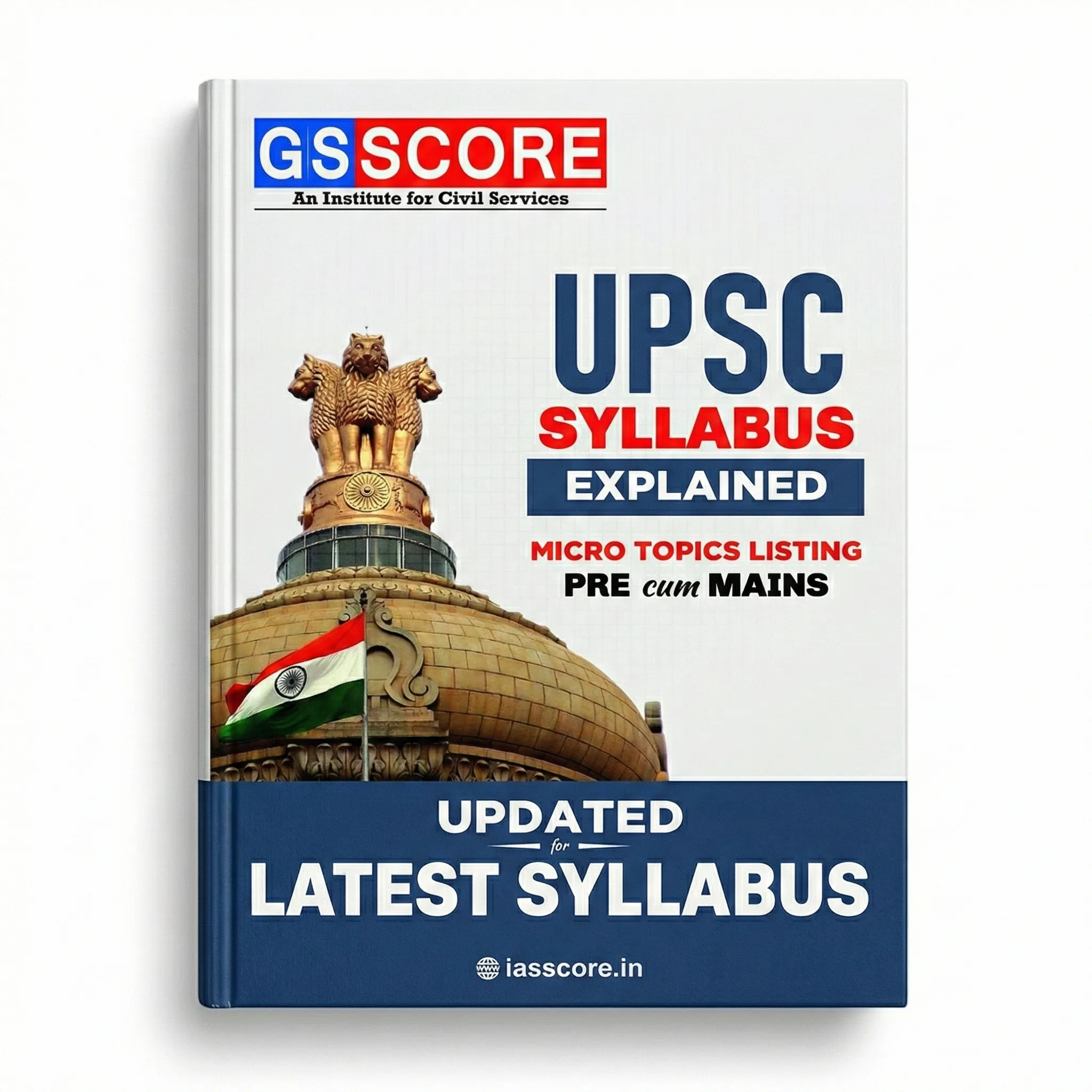
The single biggest mistake first-timers make is opening a book before reading the official syllabus. SSC repeats topics year after year, and a quick weightage analysis of previous-year papers tells you exactly where to invest. Print the syllabus, stick it on your wall, and tick topics as you finish them. If you want a disciplined, one-place syllabus reference to model your habit on, a structured booklet like the GS Score Latest Syllabus Booklet shows how serious aspirants map every micro-topic before touching a question bank.
Broadly, the four Tier 1 subjects break down like this:
- Quantitative Aptitude: Arithmetic (percentage, ratio, profit & loss, time-speed-work), Advanced maths (algebra, geometry, trigonometry, mensuration), and Data Interpretation.
- Reasoning: Analogy, classification, series, coding-decoding, syllogism, non-verbal (mirror/paper folding), and puzzles.
- English: Grammar (error spotting, fill-ups), vocabulary (synonyms, antonyms, idioms), and comprehension (cloze test, para-jumbles, RC).
- General Awareness: History, Polity, Geography, Economics, General Science, and static + current affairs.
Subject-Wise SSC CGL Preparation Strategy
A generic “study 6 hours a day” is useless without knowing where those hours go. Here is a subject-wise SSC CGL preparation strategy built around high-ROI topics — the ones that historically carry the most marks per section.
Quantitative Aptitude (the game-changer)
Quant is the most scoring and the most time-consuming section. Start with arithmetic because it feeds both Tier 1 and Tier 2, then move to advanced maths. Build a formula sheet from day one and learn Vedic/short-trick methods for calculation speed. Aim to solve 40-50 questions daily by the practice phase.
Reasoning (your accuracy anchor)
Reasoning is the fastest to master and the easiest to score 45+/50. Non-verbal and coding-decoding are almost guaranteed marks. Practise until pattern recognition becomes reflexive — this is the section you finish quickly to buy time for Quant.
English (the silent merit-maker)
Many aspirants underprepare English and lose the Tier 2 merit race. Build vocabulary daily (10-15 words), master 8-10 core grammar rules, and read editorials to crack cloze tests and RC. One-word substitution and idioms are repeat-heavy in PYQs.
General Awareness (fastest to attempt)
GA rewards memory, not calculation — you can answer 25 questions in under 7 minutes. Static GK (Polity, History, Science) plus 6-8 months of current affairs is enough. This is your time-bank for the exam.
| Section | High-ROI topics (do first) | Target score /50 |
|---|---|---|
| Quant | Percentage, DI, geometry, trigonometry, mensuration | 40+ |
| Reasoning | Coding-decoding, series, non-verbal, analogy | 45+ |
| English | Error spotting, cloze, one-word substitution, idioms | 38+ |
| General Awareness | Polity, Science, static GK, current affairs | 35+ |
Best Order to Attempt Sections + Negative Marking Math
One of the most-asked People-Also-Ask questions is: what is the best order to attempt sections in SSC CGL Tier 1? The proven sequence protects your accuracy and your clock:
| Order | Section | Time budget | Why this order |
|---|---|---|---|
| 1 | General Awareness | 6-7 min | Pure recall, no calculation — banks time |
| 2 | Reasoning | 10-12 min | High accuracy, builds momentum |
| 3 | English | 10-12 min | Moderate speed, keeps mind fresh for Quant |
| 4 | Quantitative Aptitude | 20-22 min | Most time-hungry — do last with remaining buffer |
The negative marking math: Each correct answer is +2 and each wrong is -0.50 — a 4:1 reward-to-penalty ratio, so intelligent guessing where you can eliminate 2 of 4 options is statistically profitable. A safe rule: if you can confidently eliminate at least two choices, attempt; if it is a blind guess, skip. Aim for 90%+ accuracy on your attempts — a candidate who attempts 85 questions at 92% accuracy nets far more than one who attempts all 100 at 78%.
SSC CGL Study Plan & Timetable: A 90-Day Micro Calendar
Top-ranking pages tell you to “study 5-6 hours a day” and stop there. Here is the granular, day-wise SSC CGL study plan that ties hours to specific topics. This 90-day timetable assumes ~6 hours daily; scale it to a 5-6 month plan by spending two days on each block instead of one.
| Phase (days) | Quant focus | Reasoning + English | GA + practice |
|---|---|---|---|
| Day 1-20 | Arithmetic: percentage, ratio, profit-loss, average, TSD | Analogy, series, coding + grammar basics, vocab | Polity + History static, 30 min daily current affairs |
| Day 21-45 | Advanced maths: algebra, geometry, trigonometry, mensuration | Syllogism, non-verbal + error spotting, cloze | Geography + Economics static, current affairs notes |
| Day 46-65 | Data Interpretation + mixed arithmetic revision | Puzzles, seating + RC, para-jumbles, one-word | Science static, monthly CA revision, sectional tests |
| Day 66-80 | Full-length Quant sets + weak-area drills | Sectional mocks, grammar rule revision | Full GA mocks, PYQ analysis |
| Day 81-90 | Formula sheet revision, speed drills | Error-log revisit | Full mocks daily + current affairs sprint |
Variant plans for different aspirants
- Working professional (3-4 hrs/day): Do 1 subject on weekdays (rotate Quant-Reasoning-English-GA) and reserve weekends for mocks and PYQ analysis. Stretch the 90-day plan to 5 months.
- Zero-budget aspirant: Use free PYQ PDFs, YouTube concept lectures, and one printed reference book per subject instead of a coaching package. Discipline, not money, clears SSC CGL.
- 50-day crash plan (revision only): Only for repeaters with basics done — skip theory, do 1 full mock + error log daily, and revise formula and CA notes.
Best Books for SSC CGL Preparation (Tier 1 & Tier 2)
The best books for SSC CGL preparation are the ones matched to your weak areas — not the longest list. Below is a comparison table mapping each recommended book to the need it solves, so you buy only what you will actually finish.
| Subject | Best book | Best for |
|---|---|---|
| Quant (foundation) | RS Aggarwal – Quantitative Aptitude | Concept clarity + basic practice |
| Quant (advanced/PYQ) | Kiran / Rakesh Yadav SSC Maths Chapterwise | Exam-level questions + shortcuts |
| Reasoning | RS Aggarwal – Verbal & Non-Verbal Reasoning | Full-coverage practice |
| English | SP Bakshi (Arihant) – Objective English | Grammar + vocabulary + comprehension |
| General Awareness | Lucent’s General Knowledge | Static GK single-source revision |
| Current Affairs | Monthly current affairs magazine + NCERT | Recent events + conceptual base |
| Tier 2 Statistics | NCERT Statistics (Class 11) + a dedicated SSC statistics book | JSO Paper 2 concepts |
For Tier 2 you rarely need new books — you need harder practice on the same subjects, plus dedicated material for Statistics (Paper 2) or Finance & Economics (Paper 3) if your target post requires them. For the current-affairs half of General Awareness, a monthly magazine is far more efficient than scattered notes. A well-curated issue like the Vision IAS Current Affairs Magazine (January 2026) or the December 2025 English edition gives you exam-ready coverage of schemes, awards, appointments and economy updates that overlap heavily with SSC’s GA section. Pair it with NCERTs for static concepts and you have the GA section covered end to end.
Mock Tests, PYQ Analysis & the Error-Log System
Every topper credits mocks — but most aspirants take them wrong. A mock is not a scorecard; it is a diagnostic. How many mock tests should you attempt before the SSC CGL exam? Target 25-30 full-length mocks plus sectional tests, and analyse each for at least as long as you took to write it.
The PYQ-first approach
Previous-year questions are the highest-ROI resource in SSC preparation because SSC recycles concepts relentlessly. Solve the last 5-6 years of papers, tag each question by topic, and you will see which chapters carry the most marks. Aspirants who study PYQ toolkits — the same disciplined, topic-wise approach behind a resource like the Forum IAS Topic-Wise PYQ Toolkit — learn to prioritise high-weight topics instead of studying everything equally.
The error log
Maintain a physical or spreadsheet error log with four columns: question, why I got it wrong (concept/silly/time), correct method, and revision date. Revisit it weekly. This single habit typically adds 15-25 marks over a preparation cycle because it stops you repeating the same mistakes.
| Metric to track | Where | Target by exam day |
|---|---|---|
| Accuracy % | Every mock | 90%+ |
| Section time overshoot | Mock analysis | Within budget |
| Repeated error topics | Error log | Zero repeats |
| Weekly mock score trend | Score sheet | Upward curve |
SSC CGL Tier 2 Deep Dive: Statistics, Economics & DEST
Most guides skim Tier 2 — a costly gap, because Tier 2 alone decides your merit. Tier 2 Paper 1 tests the same subjects as Tier 1 but at a tougher level, plus a Computer Knowledge module and the DEST typing test.
DEST / typing test
The Data Entry Speed Test requires typing ~2000 key depressions in 15 minutes (roughly 27-35 words per minute). It is qualifying, not scored — but candidates fail it every year by ignoring it. Practise 15 minutes of typing daily on free tools from the practice phase onwards.
Statistics (Paper 2 – JSO aspirants)
If you target Junior Statistical Officer, Paper 2 covers measures of central tendency, dispersion, probability, correlation, regression, index numbers, and sampling. NCERT Statistics (Class 11) plus a dedicated SSC statistics book is the standard combo.
Economics & Finance (Paper 3 – AAO aspirants)
Paper 3 covers fundamentals of accounting, finance, and economics/governance. A conceptual economics base helps here — aspirants often build it using structured economy notes such as the Vision IAS Economics Notes before layering SSC-specific accounting practice on top. Only attempt Paper 3 if you have applied for AAO-type posts.
Current Affairs & General Awareness Strategy
GA is where prepared candidates gain a decisive edge because it costs the least time in the exam. Split it into static and dynamic. For static, one-source revision from Lucent works. For dynamic, follow a daily newspaper (The Hindu, The Indian Express or Economic Times) for 30 minutes and consolidate with a monthly magazine so you never revise loose clippings.
- Make one-line current affairs notes daily; revise monthly compilations twice before the exam.
- Focus on the last 6-8 months before the exam — SSC leans recent.
- Prioritise national schemes, appointments, sports, awards, science & tech, and economy/banking news.
How to Prepare for SSC CGL at Home Without Coaching
Can you clear SSC CGL without coaching by self-study at home? Absolutely — a large share of selected candidates are self-taught. Coaching sells structure and accountability, both of which you can replicate for free with discipline. Here is the self-study framework:
- Structure: Follow the 90-day plan above; treat it like a job with fixed hours.
- Concepts: Use free YouTube lectures for tough topics and one reference book per subject.
- Accountability: Join a Telegram/Discord peer group, share daily mock scores, and set weekly targets.
- Testing: Buy one good online test series — this is the one paid resource worth prioritising.
- Language/medium: The exam is bilingual (English & Hindi). Prepare in your stronger medium; normalization across shifts is handled by SSC, so focus on accuracy, not shift luck.
Common Mistakes, Cut-Off Trends & Exam-Day Tips
Set your target using previous-year cut-off trends so your daily effort has a number to beat. Cut-offs vary by category and post, but the indicative Tier 1 qualifying trend looks like this:
| Category | Indicative Tier 1 cut-off (/200) |
|---|---|
| General (UR) | 135-155 |
| OBC | 125-145 |
| EWS | 120-140 |
| SC | 105-125 |
| ST | 95-115 |
Common mistakes to avoid:
- Studying without solving PYQs — you miss the exam’s actual difficulty and pattern.
- Hoarding books instead of finishing one per subject.
- Taking mocks without analysing them.
- Ignoring English and GA while over-investing in Quant.
- Skipping DEST/typing practice until the last week.
- Neglecting revision — new topics without revision equals forgotten topics.
Exam-day tips: Sleep well the night before, reach the centre early, do a first pass answering only sure questions, mark doubtful ones for review, and never chase a single hard Quant question at the cost of five easy GA marks. Trust your section order and your clock.
Frequently Asked Questions
How many hours should I study daily to crack SSC CGL?
Full-time aspirants should study 5-6 focused hours daily, while working professionals can manage with 3-4 quality hours plus longer weekend sessions. Consistency and analysis matter more than raw hours — 4 productive hours beat 8 distracted ones.
Can I clear SSC CGL without coaching by self-study at home?
Yes. Many selected candidates are entirely self-taught. With a structured 90-day plan, one reference book per subject, free concept lectures, PYQs, and a good online test series, you can clear SSC CGL at home without any coaching.
How many months are needed to prepare for SSC CGL 2026?
Most first-time aspirants need 4-6 months of consistent preparation. A strong maths and English base can compress this to 3-4 months, while beginners should plan for 6-8 months to build fundamentals before heavy practice.
Which subject should I start with in SSC CGL preparation?
Start with Quantitative Aptitude because it is the most time-consuming and scoring, and its arithmetic base feeds Tier 2 as well. Run General Awareness in parallel from day one since it only needs daily reading, not deep sittings.
Which is the most difficult section in SSC CGL and how to tackle it?
Quantitative Aptitude is generally the toughest and most time-consuming section. Tackle it by mastering arithmetic first, building a formula sheet, learning calculation shortcuts, and solving 40-50 timed questions daily until speed and accuracy both rise.
What are the best books for SSC CGL Tier 1 and Tier 2?
For Tier 1, use RS Aggarwal or Rakesh Yadav/Kiran chapterwise for Quant, RS Aggarwal for Reasoning, SP Bakshi (Arihant) for English, and Lucent’s GK plus a monthly current affairs magazine for General Awareness. Tier 2 needs the same subjects at a tougher level, adding NCERT Statistics (Class 11) with a dedicated statistics book for JSO Paper 2, and accounting/economics material for AAO Paper 3. Finish one book per subject rather than collecting many.
What is the best order to attempt sections in SSC CGL Tier 1?
The safest order is General Awareness first (fast pure recall that banks time), then Reasoning (high accuracy, builds momentum), then English (moderate speed), and Quantitative Aptitude last with your remaining buffer since it is the most time-hungry. This sequence protects both accuracy and the clock, and stops one hard Quant question from eating time you need elsewhere.
How many mock tests should I attempt before the SSC CGL exam?
Attempt 25-30 full-length mock tests plus sectional tests, and analyse each one thoroughly using an error log. The analysis matters more than the score — it is what converts mistakes into marks by exam day.
Recommended Study Material


Continue Reading
SSC MTS Syllabus 2025: Subject-Wise Topics, Pattern & PDF
The SSC MTS syllabus for the Computer-Based Examination (Paper-I) covers four subjects — Numerical & Mathematical Ability, Reasoning…
RBI Grade B Syllabus 2026: Phase 1, Phase 2 & Interview + PDF
The RBI Grade B syllabus is a three-stage structure: Phase 1 (Prelims) covers General Awareness, English, Quantitative Aptitude…
NCERT Books for UPSC 2026: Subject-Wise List + Free PDF
NCERT books for UPSC are the single best starting point for any beginner: you need roughly 40-44 NCERTs…