CDS Syllabus 2026: Subject-Wise Topics, Pattern + PDF
CDS syllabus 2026: subject-wise English, GK & Maths topics, exam pattern, marking scheme, best books & a free PDF checklist for IMA, INA, AFA & OTA.

The CDS syllabus covers three written papers for IMA, INA and AFA — English, General Knowledge and Elementary Mathematics (100 marks each, 2 hours each) — while the OTA exam has only English and General Knowledge (200 marks total). Every question is an objective MCQ with a 1/3rd negative-marking penalty, and the syllabus is identical for both CDS 1 and CDS 2 cycles conducted by the UPSC each year.
Quick answer: CDS has 3 subjects (English, GK, Elementary Mathematics) for IMA/INA/AFA and 2 subjects (English, GK) for OTA. Total written marks: 300 for IMA/INA/AFA, 200 for OTA. Maths is Class-10 level and is not in the OTA paper. The syllabus does not change between CDS 1 and CDS 2.
This guide gives you the complete, subject-wise CDS syllabus for 2026 (based on the topics listed in the official UPSC CDS notification), the latest CDS exam pattern, previous-year weightage of topics, a high-yield preparation strategy, the best books, and a free downloadable topic checklist so you can plan your preparation for a commission in the Indian Armed Forces.
What Is the CDS Exam? (Overview)
The Combined Defence Services (CDS) Examination is a national-level written test conducted twice a year by the Union Public Service Commission (UPSC) to recruit graduates into the four officer-training academies of the Indian Armed Forces. Successful written candidates are shortlisted for the SSB (Services Selection Board) interview before final selection.
The four academies the CDS exam recruits for are:
- Indian Military Academy (IMA), Dehradun — for the Indian Army.
- Indian Naval Academy (INA), Ezhimala — for the Indian Navy.
- Air Force Academy (AFA), Hyderabad — for the Indian Air Force.
- Officers’ Training Academy (OTA), Chennai — for the Short Service Commission (both men and women).
The written stage is where most aspirants are filtered out, which is why understanding the CDS syllabus 2026 topic by topic — and knowing what carries the most marks — matters more than reading everything blindly.
What Are the Subjects in the CDS Exam?
There are only three subjects across the entire CDS syllabus, and how many you write depends on the academy you apply for:
- English — common to all candidates (IMA, INA, AFA and OTA).
- General Knowledge (GK) — common to all candidates.
- Elementary Mathematics — only for IMA, INA and AFA candidates; not part of the OTA exam.
So an IMA/INA/AFA aspirant prepares three subjects, while an OTA-only aspirant prepares two. There is no separate essay, descriptive or optional paper — the entire written stage is objective. The sections below break down each subject topic by topic.
CDS Syllabus 2026 & Exam Pattern: Quick Overview
The CDS exam pattern 2026 differs by academy. Candidates applying for IMA, INA and AFA write three papers; those applying only for OTA write two papers. Here is the complete structure at a glance.
| Academy | Papers | Total Marks | Time per Paper |
|---|---|---|---|
| IMA, INA & AFA | English + GK + Elementary Mathematics | 300 | 2 hours each |
| OTA | English + General Knowledge | 200 | 2 hours each |
CDS Exam Pattern for IMA / INA / AFA
| Subject | Duration | Maximum Marks |
|---|---|---|
| English | 2 hours | 100 |
| General Knowledge | 2 hours | 100 |
| Elementary Mathematics | 2 hours | 100 |
| Total | 6 hours | 300 |
CDS Exam Pattern for OTA
| Subject | Duration | Maximum Marks |
|---|---|---|
| English | 2 hours | 100 |
| General Knowledge | 2 hours | 100 |
| Total | 4 hours | 200 |
Key features of the CDS exam pattern 2026
- Question type: All papers are objective (multiple-choice questions) conducted offline in OMR-sheet mode.
- Negative marking: One-third (1/3) of the marks assigned to a question are deducted for every wrong answer.
- Language: The English paper is in English only; the GK and Mathematics papers are set in both English and Hindi (bilingual).
- Standard: The Elementary Mathematics paper is of Matriculation (Class 10) level; English and GK are of graduation level.
- Qualifying marks: The UPSC sets a minimum qualifying percentage for each paper (typically around 20% per subject in recent cycles); a candidate must clear both the sectional minimum and the overall cut-off, so no single paper can be ignored.
- SSB Interview: Qualified candidates then face an SSB interview worth 300 marks (IMA/INA/AFA) or 200 marks (OTA) — equal to the total written marks.
Note: subject topics below reflect the syllabus as published in the official UPSC CDS notification; always cross-check the latest notification on upsc.gov.in for any year-specific change before your exam.
CDS English Syllabus (Subject-Wise)
The English paper tests a candidate’s command over the language, comprehension, and ability to use words correctly. The CDS English and General Knowledge syllabus subject wise is where scoring is easiest with consistent practice, because the question types repeat every year. There is no fixed sectional split published by UPSC, but based on previous-year papers, the topic-wise distribution is fairly predictable.
| English Topic | Approx. Questions (of 120) | Priority |
|---|---|---|
| Spotting Errors | 15-20 | High |
| Reading Comprehension | 15-25 | High |
| Sentence Improvement / Ordering | 15-20 | High |
| Fill in the Blanks | 10-15 | Medium |
| Synonyms & Antonyms | 10-20 | Medium |
| Idioms & Phrases | 8-12 | Medium |
| Ordering of Words / Jumbled Sentences | 8-10 | Medium |
The core CDS English syllabus includes: Spotting Errors, Synonyms and Antonyms, Reading Comprehension passages, Selecting Words (fill in the blanks), Ordering of Words in a Sentence, Sentence Improvement, Idioms and Phrases, and Ordering of Sentences. Grammar fundamentals — tenses, articles, prepositions, subject-verb agreement and voice — underpin most of these question types, so brushing up grammar rules gives the highest return.
CDS General Knowledge Syllabus (Subject-Wise)
The General Knowledge paper is the widest in scope and, for many aspirants, the hardest to score in because it covers both static subjects and current affairs. The official CDS syllabus describes it as covering current events and matters of everyday observation and experience in scientific aspects, as may be expected of an educated person, plus History, Geography and Polity of India.
Subject-wise GK weightage (based on last 5 years’ papers)
| GK Section | Approx. Questions (of 120) | Static / Current |
|---|---|---|
| History (Ancient, Medieval, Modern, Freedom Struggle) | 18-22 | Static |
| Geography (Indian & World, Physical) | 16-20 | Static |
| General Science (Physics, Chemistry, Biology) | 20-25 | Static |
| Polity & Constitution | 12-16 | Static |
| Economics | 10-14 | Static + Current |
| Current Affairs & Sports | 15-20 | Current |
| Defence & Environment | 8-12 | Static + Current |
Notice that General Science and History together account for nearly 40% of the GK paper — these are your highest-yield static areas. The current-affairs window that matters most is roughly the 6-9 months before the exam date, with emphasis on defence exercises, new weapon inductions, appointments, awards, sports events and major government schemes. A rough static-vs-current split in CDS GK is about 70:30, so do not neglect the static base while chasing current affairs.
A monthly current-affairs compilation keeps this manageable. Many defence aspirants use UPSC-grade magazines because the coverage overlaps heavily — the Vision IAS Current Affairs Magazine (January 2026, English) is a compact way to cover national and international events, defence news and government schemes in one place.
CDS Elementary Mathematics Syllabus (Detailed)
The CDS maths syllabus (Elementary Mathematics) applies only to IMA, INA and AFA candidates — it is not part of the OTA exam. The entire paper is of Matriculation / Class 10 standard, so the concepts are familiar; the challenge is speed and accuracy under negative marking. Here is the complete CDS elementary mathematics syllabus broken into its official heads.
Arithmetic
- Number System: Natural numbers, Integers, Rational and Real numbers, HCF and LCM.
- Fundamental operations: Addition, subtraction, multiplication, division, square roots, decimal fractions.
- Unitary method: Time and distance, time and work, percentages, applications to simple and compound interest, profit and loss, ratio and proportion, variation.
- Elementary Number Theory: Division algorithm, prime and composite numbers, tests of divisibility by 2, 3, 4, 5, 9 and 11, Euclidean algorithm, Logarithms.
Algebra
- Basic operations, simple factors, Remainder Theorem, HCF and LCM of polynomials.
- Theory of polynomials, solutions of quadratic equations, relation between roots and coefficients (only real roots to be considered).
- Simultaneous linear equations in two unknowns — analytical and graphical solutions.
- Simultaneous linear inequations in two variables and their solutions.
- Practical problems leading to two simultaneous linear equations/inequations, or a quadratic equation in one variable. Set language and set notation, rational expressions and conditional identities, Laws of indices.
Trigonometry
- Sine, cosine, tangent and their reciprocals (when the angle lies between 0° and 90°).
- Values of sin x, cos x and tan x for standard angles: x = 0°, 30°, 45°, 60° and 90°.
- Simple trigonometric identities and use of trigonometric tables.
- Simple cases of heights and distances.
Geometry
- Lines and angles, plane and plane figures; theorems on properties of angles at a point.
- Parallel lines, sides and angles of a triangle, congruency of triangles, similar triangles.
- Concurrence of medians and altitudes; properties of angles, sides and diagonals of a parallelogram, rectangle and square.
- Circles and their properties, including tangents and normals; loci.
Mensuration
- Areas of squares, rectangles, parallelograms, triangles and circles.
- Areas of figures which can be split into these (field book).
- Surface area and volume of cuboids, lateral surface and volume of right circular cones and cylinders.
- Surface area and volume of spheres.
Statistics
- Collection and tabulation of statistical data, graphical representation — frequency polygons, histograms, bar charts, pie charts, etc.
- Measures of central tendency — mean, median and mode.
CDS Maths topic-wise weightage
| Maths Topic | Approx. Questions (of 100) | Priority |
|---|---|---|
| Arithmetic (incl. Number System) | 25-32 | High |
| Geometry | 16-20 | High |
| Mensuration | 14-18 | High |
| Algebra | 12-16 | Medium |
| Trigonometry | 12-16 | Medium |
| Statistics | 4-8 | Low-Medium |
Arithmetic, Geometry and Mensuration together deliver around 60% of the Maths marks — master these first. Statistics is the lowest-effort, highest-certainty scoring area (formulae are fixed and questions are direct), so it should never be skipped.
What is the difficulty level of CDS Maths?
On paper the CDS maths syllabus is easy — every topic is Class 10 or below, with no calculus, matrices or coordinate geometry beyond basics. In practice, the difficulty comes from solving accurately at speed under 1/3rd negative marking. A well-prepared candidate finds most questions moderate, with a handful of lengthy Arithmetic word problems and multi-step Geometry/Mensuration questions acting as the real filters. The fix is timed PYQ practice, not harder theory.
CDS OTA Syllabus: Is There Maths?
No — there is no Mathematics paper in the CDS OTA exam. The CDS syllabus for OTA consists of only two papers: English (100 marks) and General Knowledge (100 marks), for a total of 200 marks. The topics inside these two papers are exactly the same as those in the IMA/INA/AFA English and GK papers; only the Elementary Mathematics paper is dropped. This makes OTA a popular choice for graduates from non-mathematical backgrounds, and it is the route through which women officers are commissioned under the Short Service Commission.
Is the CDS Syllabus the Same for CDS 1 and CDS 2?
Yes. The UPSC conducts the CDS examination twice a year — commonly referred to as CDS 1 (notification early in the year) and CDS 2 (notification around mid-year) — but the syllabus, exam pattern, marks and standard are identical across both cycles. There is no difference in the topics you need to study. The only differences are the exam dates, the notification, and the number of vacancies announced. So a candidate preparing for CDS 1 2026 is automatically prepared for CDS 2 2026 with the same study material — no separate syllabus revision is needed.
Most Repeated Topics: PYQ-Based Analysis (Last 5 Years)
Prioritising the syllabus using previous-year question (PYQ) trends is the single biggest edge you can get. Below are the topics that have appeared most consistently in the last five years of CDS papers.
| Subject | Most Repeated High-Yield Topics |
|---|---|
| Mathematics | Time & Work, Percentages, Profit & Loss, Mensuration (cylinder/cone/sphere), Triangles & Circles, Trigonometric identities & heights/distances |
| General Knowledge | Freedom struggle & Governor-Generals, Fundamental Rights & Constitutional bodies, Human physiology, Physics (light, electricity), Indian rivers & soils, Budget/economy basics, Defence exercises |
| English | Subject-verb agreement errors, Preposition & article errors, Comprehension inference, One-word substitution, Common idioms |
A dedicated topic-wise PYQ workbook makes this analysis effortless. Aspirants who also target UPSC-level exams often use the Forum IAS Prelims Toolkit (Topic-Wise PYQ 1992-2025) because the History, Polity, Geography and Science PYQs overlap directly with the CDS GK paper.
CDS Preparation Strategy: High-Yield vs Low-Yield
With three papers and a wide GK syllabus, blind studying wastes time. Use this priority-based approach tied directly to the weightage tables above.
Step 1 — Lock the high-yield static base
Cover General Science (Class 6-10 NCERT level), Modern History (freedom struggle), Indian Polity fundamentals, and the top Maths chapters (Arithmetic, Mensuration, Geometry) first. These carry the most marks and are stable year after year.
Step 2 — Layer current affairs on top
Read a monthly current-affairs magazine for the 6-9 months before your exam, focusing on defence, appointments, awards, sports and schemes. Do not start current affairs from scratch a week before the exam.
Step 3 — Practice under negative-marking conditions
Because 1/3rd is deducted per wrong answer, blind guessing hurts. Solve full-length PYQ papers with a timer and an OMR sheet to build the instinct for when to attempt and when to leave a question.
| Priority | Focus Areas | Why |
|---|---|---|
| High-yield | General Science, Modern History, Arithmetic, Mensuration, Geometry, Spotting Errors | Maximum marks, predictable, repeat yearly |
| Medium-yield | Polity, Geography, Algebra, Trigonometry, Comprehension, Synonyms/Antonyms | Steady marks, moderate effort |
| Low-yield (don’t skip) | Statistics, Idioms, Environment, Economics theory | Fixed formulae/direct questions — easy certain marks |
Best Books for CDS Preparation 2026
The right books, mapped to the syllabus, cut preparation time dramatically. Here is a subject-wise list widely recommended for CDS.
| Subject | Recommended Books |
|---|---|
| Elementary Mathematics | R.S. Aggarwal (Quantitative Aptitude), Pathfinder CDS (Arihant) |
| English | Wren & Martin (High School English Grammar), Objective General English by S.P. Bakshi |
| General Knowledge | Lucent’s General Knowledge, Manorama Yearbook, NCERTs (Class 6-10) |
| Current Affairs | A monthly current-affairs magazine + daily newspaper |
| Practice | CDS Previous Year Solved Papers (topic-wise) |
For the current-affairs and GK component, a structured monthly magazine such as the Vision IAS Current Affairs Magazine saves you from scattered note-making. If you want the entire prescribed reading in printed, ready-to-study form, Competer prints and delivers standard study material and PYQ compilations across India so you don’t have to assemble it piece by piece.
How the Written Syllabus Connects to the SSB Interview
Clearing the written exam is only half the journey. Qualified candidates are called for the SSB interview, a 5-day process worth 300 marks (IMA/INA/AFA) or 200 marks (OTA) — equal to the entire written total. This means the SSB weighs as heavily as all three written papers combined.
The GK you build for the written paper directly feeds the SSB’s Group Discussion, lecturette and personal interview, where awareness of current defence and national affairs is tested again. Strong English comprehension helps in the Thematic Apperception Test (TAT) and Word Association Test (WAT). In short, a syllabus-driven written preparation quietly builds your SSB foundation too — so treat GK and English as long-term investments, not exam-day cramming.
CDS Syllabus PDF Download & Study Planner
To make revision easy, use the printable checklist below as your CDS syllabus PDF download reference. You can tick each topic as you complete it, then again during revision.
| Paper | Topic Checklist |
|---|---|
| Mathematics | Number System · Fundamental operations · Unitary method · Number Theory · Algebra · Trigonometry · Geometry · Mensuration · Statistics |
| English | Spotting Errors · Comprehension · Synonyms/Antonyms · Fill in the Blanks · Sentence Ordering · Sentence Improvement · Idioms & Phrases · Word Ordering |
| General Knowledge | History · Geography · Polity · Economics · General Science · Environment · Current Affairs · Defence · Sports |
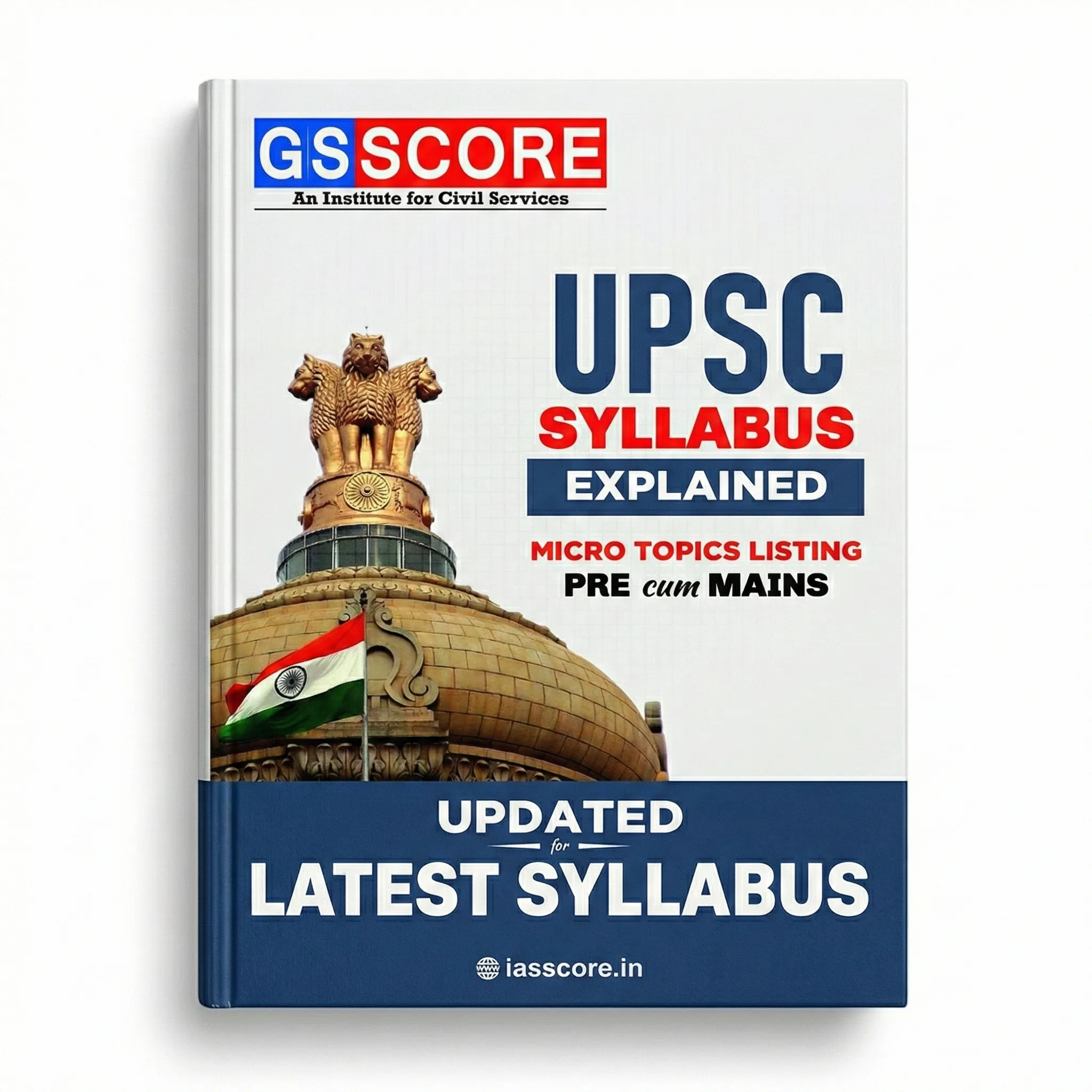
The full syllabus is laid out on this page so you can screenshot or print it directly without waiting for a download. For a formal, exam-body-style syllabus booklet you can keep on your desk, the GS Score Latest Syllabus Booklet 2026-27 is a printed reference many aspirants pair with their notes.
Common Mistakes CDS Aspirants Make
- Ignoring negative marking: Attempting every question blindly can drag your score below the cut-off. Attempt only when reasonably sure.
- Over-reading current affairs, under-reading static GK: 70% of GK is static — NCERTs and Lucent matter more than random news apps.
- Treating Maths as too easy: Class 10 concepts still need speed practice; careless errors under time pressure cost the most.
- Skipping PYQs: The single most predictive resource. Solve at least 5 years of papers.
- Missing sectional cut-offs: You must clear each paper’s minimum qualifying marks, so a weak subject cannot be compensated entirely by a strong one.
- Neglecting the SSB early: Awareness and communication built during written prep pays off directly in the interview.
Frequently Asked Questions
What is the syllabus of the CDS exam?
The CDS syllabus has three subjects for IMA, INA and AFA — English, General Knowledge and Elementary Mathematics (Class 10 level) — each worth 100 marks. The OTA exam has only English and General Knowledge. GK covers History, Geography, Polity, Economics, General Science, Environment, Current Affairs and Defence.
What are the subjects in the CDS exam?
There are three subjects: English, General Knowledge and Elementary Mathematics. IMA, INA and AFA candidates write all three, while OTA candidates write only English and General Knowledge. There is no descriptive or optional paper — every question is objective.
Is there Maths in the CDS OTA exam?
No. The CDS OTA exam has only two papers — English and General Knowledge, totalling 200 marks. Elementary Mathematics is required only for IMA, INA and AFA candidates, not for OTA.
What is the CDS exam pattern and marking scheme?
All papers are objective MCQs conducted offline on OMR sheets. Each paper is 100 marks with a 2-hour duration. There is negative marking of one-third (1/3) of the marks for every wrong answer, so accuracy matters more than attempting everything.
What is the difficulty level of CDS Maths?
The CDS Elementary Mathematics paper is of Matriculation (Class 10) standard, so the concepts are basic. The real difficulty is speed and accuracy under negative marking — Arithmetic, Mensuration and Geometry carry the most marks and should be practised first.
Is the CDS syllabus the same for CDS 1 and CDS 2?
Yes. The syllabus, exam pattern, marks and standard are exactly the same for both CDS 1 and CDS 2. Only the notification dates and vacancies differ, so the same preparation and study material work for both cycles.
Which books are best for CDS preparation?
For Maths, R.S. Aggarwal and Arihant’s Pathfinder CDS; for English, Wren & Martin and S.P. Bakshi’s Objective General English; for GK, Lucent’s General Knowledge with NCERTs (Class 6-10) and a monthly current-affairs magazine. Pair these with topic-wise previous-year solved papers.
How many marks is each CDS paper and what is the total?
Each CDS paper carries 100 marks. For IMA, INA and AFA the written total is 300 marks (three papers), while for OTA it is 200 marks (two papers). The SSB interview carries an equal weightage — 300 or 200 marks respectively.
Recommended Study Material


Continue Reading
JPSC Syllabus 2025: Prelims, Mains Pattern + PDF Download
The JPSC syllabus for 2025 covers the Combined Civil Services Examination (CCSE) across three stages: a Preliminary exam…
RRB NTPC Syllabus 2026: CBT 1 & CBT 2 Topics, Pattern + PDF
The rrb ntpc syllabus covers three subjects across both stages of the computer-based test — General Awareness, Mathematics,…

UGC NET Political Science Syllabus 2026: Units, PDF + Weightage
Last updated: October 2026 · Based on NTA's official Subject Code 02 syllabus and our own analysis of…