Best Test Series for UPSC 2026: Ranked, Compared & Priced
Best test series for UPSC 2026 compared side-by-side: Vision IAS vs ForumIAS vs Insights — real prices, test counts, honest hit-ratio and how to pick in 5 minutes.

The best test series for UPSC in 2026 for most first-attempt aspirants is Vision IAS (closest exam-day simulation and the largest All-India rank pool), while repeat aspirants chasing accuracy are better served by ForumIAS (the toughest, most analytical questions), and budget-conscious candidates get the most value from InsightsIAS (strong content plus free STEP UP tests). In one line: pick Vision IAS if you are new, ForumIAS if you already score above the cut-off in mocks, and add a dedicated CSAT series regardless. Everything below is a neutral, side-by-side comparison with actual indicative prices, test counts and realistic hit-ratio expectations so you can decide in about five minutes.
This guide is built to be truly comparative — not a single-brand pitch. We cover Prelims and Mains, sectional versus full-length, free versus paid, CSAT, a full price table, the 2026 All-India mock timetable, aspirant sentiment, and a practical method to actually use a test series rather than just buy one.
How we compared (and last updated): This page was last reviewed in September 2025 for the 2026 Prelims cycle. Prices, test counts and schedules are indicative, collected from each provider’s public 2026 Prelims listings and cross-checked against aspirant discussion on r/UPSC and provider announcement pages; they change with early-bird offers, centre and language, so always confirm the live price on the provider’s own page before paying. Difficulty, rank-pool and explanation-quality judgments reflect widely repeated aspirant feedback across multiple attempt cohorts, not a single reviewer’s opinion. Where a claim cannot be independently verified (for example, “question repeat” percentages), we say so plainly instead of repeating marketing numbers.
Why a Test Series Is Essential for UPSC Prelims 2026
UPSC Prelims is a negative-marking elimination filter where roughly 98% of candidates are screened out. A test series is the only tool that reproduces that pressure before the real exam. It does four things no amount of reading can: benchmarking, ranking, simulation and forced revision.
- Benchmarking: You discover your real score against a large peer group, not your imagined score.
- All-India ranking: A big rank pool (30,000–100,000 test-takers on flagship series) tells you where you actually stand versus the 1,000-odd who clear.
- Exam simulation: Two-hour timed sittings train elimination, calculated guessing and the discipline of leaving unknowns.
- Revision engine: Each test is a spaced-repetition trigger. The syllabus is impossible to retain without repeated retrieval, and tests force retrieval.
Toppers consistently say the same thing in interviews: the number of tests matters less than the number of tests you seriously reviewed. A test series is worth it — but only when paired with an error log and revision cycle, which we detail later.
Best Test Series for UPSC 2026: Quick Comparison Matrix
This is the neutral, side-by-side view most top-ranking pages skip. Prices and test counts are indicative for the 2026 GS Prelims cycle and vary by centre and offer.
| Provider | Approx. Tests (Prelims GS) | Medium | Language | Analytics Depth | Indicative Price |
|---|---|---|---|---|---|
| Vision IAS | 35–40 | Online + Offline | English + Hindi | High (large AIR pool) | ₹1,249 |
| ForumIAS | 30–35 | Online + Offline | English | Very High (SFG model) | ₹1,140 |
| InsightsIAS | 35–45 (+free STEP UP) | Online | English + Hindi | High | ₹1,000–1,500 |
| Vajiram & Ravi | 30–36 | Online + Offline | English + Hindi | Medium-High | ₹1,299 |
| GS Score | 30–34 | Online + Offline | English + Hindi | Medium-High | ₹1,000–1,400 |
| NextIAS | 30–35 | Online + Offline | English + Hindi | Medium | ₹799 |
| PW OnlyIAS | 30–40 | Online | English + Hindi | Medium | ₹899 |
| Drishti IAS | 30–35 | Online + Offline | Hindi + English | Medium | ₹899 |
| ClearIAS | 40+ | Online | English | Medium (app-based) | Free–₹1,500 |
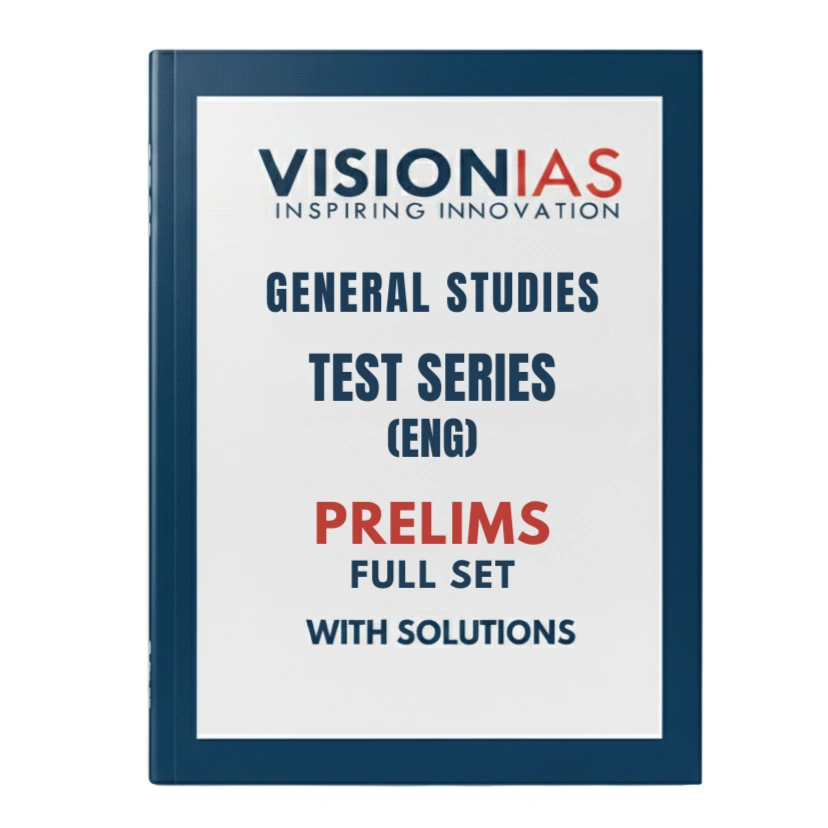
If you want a single starting point, the Vision IAS Prelims Test Series 2026 is the most widely attempted flagship, which is precisely why its rank pool is the most reliable benchmark.
How to Choose the Right UPSC Test Series: 7 Criteria
“Which test series is best for UPSC” is the wrong question until you fix your criteria. Judge every option on these seven, in order of importance:
| Criterion | What to Look For | Why It Matters |
|---|---|---|
| Question quality & hit ratio | UPSC-standard framing, statement-based MCQs | Guessy or factual-only questions waste your time |
| Syllabus coverage | Micro-topic mapping, current affairs integration | Ensures no blind spots before Prelims |
| Explanation depth | Full context, not one-line answers | You learn more from solutions than questions |
| Difficulty progression | Easy → moderate → tough as dates advance | Builds temperament for a hard paper |
| Analytics & AIR pool | Percentile, topic-wise accuracy, large cohort | Honest benchmarking needs numbers |
| Language & medium | Hindi/English, online/offline availability | Comfort and access decide consistency |
| Cost & value | Price per test, freebies, solution PDFs | Budget should not force a compromise |
A pro tip most pages miss: read one free sample test’s explanation before you buy. Explanation quality is the single biggest differentiator between a good and a mediocre series, and it is the hardest thing to fake.
Vision IAS vs ForumIAS vs Insights Test Series: Head-to-Head
This is the comparison aspirants search for most. Here is the honest breakdown of vision ias vs forum ias vs insights test series.
Is Vision IAS or Forum IAS test series better for UPSC?
Vision IAS wins on simulation and rank pool. Its papers are balanced, closest to the actual UPSC difficulty band, and its All-India rank is the most representative benchmark simply because the most candidates attempt it. It is the safest pick for first and second attempts.
ForumIAS wins on rigour. Its Simulator/SFG model and question framing are tougher and more analytical, designed to expose weaknesses ruthlessly. If you already score 100+ consistently and want to eliminate silly errors, ForumIAS sharpens you more. Beginners sometimes find it demoralising.
InsightsIAS wins on value and volume. Its content quality is strong, its Hindi support is solid, and its free STEP UP initiative lets you sample seriously before paying.
| Factor | Vision IAS | ForumIAS | InsightsIAS |
|---|---|---|---|
| Best for | First/second attempt | Repeat aspirants | Value seekers |
| Difficulty | Balanced, exam-like | Hard, analytical | Moderate-hard |
| Rank pool size | Largest | Large | Large |
| Explanations | Detailed | Very detailed | Detailed |
| Free tests | Limited | Limited | Yes (STEP UP) |
| Ideal score stage | 60–110 | 100+ | Any |
Verdict: start with Vision IAS if you are new; add or switch to ForumIAS Prelims Test Series once you are consistently above the cut-off in mocks and want to fine-tune accuracy.
Best All India Test Series for UPSC: The Rank Pool Argument
The phrase best all india test series for upsc really means “which series has the largest, most serious cohort.” A rank of 500 among 2,000 casual test-takers is meaningless; a rank of 5,000 among 60,000 serious aspirants tells you a great deal. On this metric, Vision IAS and ForumIAS lead, followed by InsightsIAS and GS Score. NextIAS and PW OnlyIAS have smaller but rapidly growing pools and are excellent value entries.
For the best online test series for upsc cse, all major providers now offer app or portal-based attempts with instant percentile, topic-wise accuracy and time-per-question analytics. Online is now the default; offline centres remain useful mainly for the discipline of a fixed hall environment.
Is online or offline test series better for UPSC?
For most aspirants in 2026, online is the better default — you get instant analytics, a far larger All-India rank pool, the flexibility to attempt within a window, and access regardless of your city. Offline is worth the premium in exactly one situation: if you struggle with self-discipline and need the fixed, distraction-free hall environment to sit a full two-hour paper without pausing. A practical hybrid many toppers use is to enrol online for the analytics and rank pool, but simulate at least the final 6–8 full-length mocks in strict offline-like conditions — a quiet room, printed OMR, phone switched off. The medium matters far less than whether you attempt under genuine exam pressure and review every paper.
Prelims vs Mains, Sectional vs Full-Length
A test series is not one product. Understand the four types before you spend.
| Type | Purpose | When to Use | Example Focus |
|---|---|---|---|
| Sectional (Prelims) | Subject-wise mastery | Foundation stage | Polity, History, Economy |
| Full-length (Prelims) | Full 100-question simulation | Final 3–4 months | Complete GS paper |
| CSAT | Clear the 33% qualifier | Throughout, ramped near exam | Comprehension, maths, reasoning |
| Mains (GS 1–4) | Answer writing & speed | Post-Prelims | Structured 150/250-word answers |
For best mains test series for upsc, Vision IAS and ForumIAS again lead on evaluation quality and turnaround. Mains is about feedback, not just questions — a series with detailed, timely evaluator comments is worth far more than one with a big test count and generic model answers. The Vision IAS Mains Test Series 2026 is a strong, affordable entry point for structured answer-writing practice.
Don’t Ignore CSAT: The Silent Eliminator
Since 2023, CSAT has eliminated thousands of candidates who cleared the GS cut-off comfortably. It is qualifying (66/200 = 33%), but the difficulty has risen sharply on maths and reasoning. A dedicated CSAT test series is now non-negotiable for non-maths backgrounds. This is a gap almost every “best test series” list ignores.
| CSAT Test Series | Medium | Indicative Price | Best For |
|---|---|---|---|
| Vision IAS CSAT | English | ₹1,249 | Comprehensive, exam-like sets |
| Vajiram CSAT | English | ₹1,655 | Booklet + practice combined |
| Drishti IAS CSAT | English | ₹855 | Budget, Hindi-friendly ecosystem |
If maths and comprehension worry you, add the Vision IAS CSAT Test Series 2025-26 early rather than treating CSAT as an afterthought in the last month.
Free vs Paid UPSC Test Series: Value-for-Money Picks
You do not always need to pay. Free options are genuinely useful for sampling and for candidates on a tight budget.
| Option | Type | Cost | Best Use |
|---|---|---|---|
| Insights STEP UP | Free full-length | ₹0 | Sampling quality, budget prep |
| ClearIAS app tests | Free + paid | Free–₹1,500 | Daily practice on mobile |
| NextIAS Prelims | Paid | ₹799 | Best budget paid series |
| PW OnlyIAS Prelims | Paid | ₹899 | Value + Hindi support |
| Drishti Prelims (Hindi) | Paid | ₹899 | Hindi-medium aspirants |
Which is the best free test series for UPSC? Insights STEP UP is the most credible free full-length option, and ClearIAS app tests are the best for daily on-the-go MCQ practice. But treat free tests as a supplement — the paid flagships give you the rank pool and explanation depth that free tests usually cannot. For best value paid, the NextIAS Prelims Test Series 2026 at ₹799 is hard to beat.
Realistic Hit Ratio: What to Actually Expect
Beware any series claiming “80–90% questions repeated in Prelims.” That is marketing. The honest, verifiable range is that a good test series captures 40–55% of the themes/areas that appear, and directly repeats far fewer exact questions. UPSC deliberately avoids predictability.
| Claim | Reality |
|---|---|
| “90% questions repeated” | Marketing; not verifiable |
| Exact question repeats | Typically 5–15 questions, varies yearly |
| Theme/area overlap | 40–55% is a strong, honest outcome |
| Real value | Elimination skill, temperament, revision |
The point of a test series is not prediction — it is training. The aspirants who benefit most use tests to fix elimination technique and reduce negative marking, not to “spot” questions.
Best Test Series for UPSC by Aspirant Type
There is no single best; there is a best for you. This segmentation is what generic lists miss.
| You Are… | Recommended Pick | Why |
|---|---|---|
| Beginner / first attempt | Vision IAS | Balanced difficulty, biggest benchmark |
| Repeat aspirant (100+) | ForumIAS | Tougher, error-eliminating |
| Working professional | NextIAS / PW OnlyIAS | Affordable, fully online, flexible |
| Hindi medium | Drishti IAS / Vision IAS Hindi | Strong Hindi content ecosystem |
| Tight budget | NextIAS + Insights free | Lowest cost, solid quality |
| Revision stage | Vision IAS full-length | Large pool, exam simulation |
| Weak in CSAT | Vision IAS / Vajiram CSAT | Dedicated CSAT rigour |
Hindi-medium aspirants can pair the Drishti IAS Prelims Test Series in Hindi with a strong current-affairs source for full coverage.
UPSC 2026 Test Series Timetable and All-India Mock Dates
Flagship series publish their schedules from mid-2025 for the 2026 cycle. While exact dates differ by provider, the standard structure is consistent. Plan your enrolment around it.
| Phase | Approx. Window (2025–26) | Test Type |
|---|---|---|
| Foundation | Sep 2025 – Dec 2025 | Sectional tests |
| Consolidation | Jan 2026 – Feb 2026 | Sectional + first full-lengths |
| Simulation | Mar 2026 – Apr 2026 | Full-length All-India mocks |
| Revision | Apr 2026 – May 2026 | Full-length + CSAT sprint |
| UPSC Prelims 2026 | Expected May 2026 | Actual exam |
Note: The UPSC Prelims 2026 date is as per the official calendar; always confirm on upsc.gov.in. Enrol so that you complete at least 8–12 full-length tests before the exam.
How to Actually Use a Test Series (Most Aspirants Get This Wrong)
Buying is 10% of the value; using it well is the other 90%. Follow this cycle for every single test:
- Attempt under real conditions: 2 hours, no breaks, no notes, negative marking enforced.
- Analyse before checking score: Note which questions you guessed and why.
- Maintain an error log: Record every wrong answer with the reason — silly error, knowledge gap, or wrong elimination.
- Read every explanation: Even for correct answers; UPSC tests the surrounding concept.
- Revise weak areas within 48 hours: Retrieval fades fast.
- Re-attempt after 3 weeks: Confirm the gap is closed.
| Revision Cycle | Action | Goal |
|---|---|---|
| Day 0 | Attempt + analyse | Simulation + honest score |
| Day 1–2 | Error log + explanations | Fix knowledge gaps |
| Week 3 | Re-attempt weak sections | Confirm retention |
| Ongoing | Track error patterns | Cut negative marks |
Pair your tests with strong PYQ analysis — the ForumIAS Prelims Toolkit (Topic-wise PYQ 1992–2025) is an excellent companion for understanding how UPSC frames repeated themes.
Common Mistakes That Waste a Good Test Series
Even the best test series for UPSC fails you if you fall into these traps that aspirants report year after year:
- Chasing scores, not analysis: Attempting the next test before fully reviewing the last one. The review is where the learning is.
- Joining three or four series at once: Coverage anxiety leads to half-finishing everything and mastering nothing.
- Skipping explanations for correct answers: You may have got it right by luck or wrong reasoning; the explanation confirms the concept.
- Treating CSAT as an afterthought: Starting CSAT in the last three weeks is the most common self-inflicted elimination.
- No error log: Without a written record of why you got questions wrong, the same mistake repeats on exam day.
Aspirant Reviews and Reddit Sentiment
Across r/UPSC and aspirant forums, the recurring sentiment is consistent: Vision IAS is praised for being “closest to the real paper,” ForumIAS for being “brutal but the best for accuracy,” and Insights for “best free tests.” A common warning is to avoid joining three or four series at once — most aspirants who do so end up half-completing all of them. Toppers repeatedly advise picking one primary series, finishing it fully, and supplementing with free full-lengths only.
How Many Test Series Should You Join?
One primary, done thoroughly, plus one free supplement. That is the topper consensus. Two paid full-length series is the practical maximum, and only if you have the time to genuinely review both. Joining more series does not raise your score; reviewing tests deeply does.
Final Verdict: The Best Test Series for UPSC 2026
For most aspirants, Vision IAS is the best all-round test series for UPSC 2026 — balanced difficulty, the largest rank pool and reliable simulation. Repeat aspirants aiming to eliminate errors should choose ForumIAS. Budget-conscious and working candidates get outstanding value from NextIAS or PW OnlyIAS, and everyone should add a dedicated CSAT series. Whichever you pick, remember: the series is only as good as your error log and revision cycle.
Frequently Asked Questions
Which test series is best for UPSC Prelims 2026?
Vision IAS is the best all-round choice for most aspirants in 2026 due to its balanced, exam-like difficulty and the largest All-India rank pool. Repeat aspirants who want tougher, error-eliminating questions often prefer ForumIAS, while NextIAS and PW OnlyIAS offer the best value.
Is Vision IAS or Forum IAS test series better for UPSC?
Vision IAS is better for first and second attempts because its papers closely simulate the actual exam and its rank pool is the most representative. ForumIAS is better for repeat aspirants scoring above 100 who want harder, more analytical questions to fine-tune accuracy and cut silly errors.
How many test series should I join for UPSC Prelims?
Join one primary paid series and finish it completely, optionally supplementing with a free series like Insights STEP UP. Two paid full-length series is the practical maximum. More series do not improve your score; deep review of each test does.
Are UPSC test series worth it and do questions actually repeat?
Yes, test series are worth it for benchmarking, exam simulation and forced revision. However, be realistic: a good series overlaps with 40–55% of exam themes, not the “80–90% repeated” figure marketing claims. The real value is improved elimination skill and lower negative marking.
How much does a UPSC test series cost?
A Prelims GS test series typically costs ₹799 to ₹1,655 depending on the provider and number of tests. NextIAS (₹799) and PW OnlyIAS (₹899) are budget picks, while Vision IAS (₹1,249) and Vajiram (₹1,299) sit at the premium end. Free options like Insights STEP UP also exist.
When should I start the UPSC Prelims test series?
Start sectional tests during your foundation phase (around 8–9 months before Prelims) and shift to full-length All-India mocks in the final 3–4 months. Aim to complete at least 8–12 full-length tests before the exam, with CSAT practice ramped up in the last two months.
Which is the best free test series for UPSC?
Insights STEP UP is the most credible free full-length test series, giving you genuine exam-like papers and detailed explanations at no cost. ClearIAS app tests are best for daily mobile MCQ practice. Use free tests to sample quality and for budget prep, but remember that paid flagships still offer the larger rank pool and deeper explanations that improve benchmarking.
Is online or offline test series better for UPSC?
Online is the better default for most aspirants in 2026 — it gives instant analytics, a much larger All-India rank pool, flexible attempt windows and access from any city. Offline is worth it mainly if you need a fixed, distraction-free hall to build discipline. A strong hybrid is to enrol online for the analytics and simulate the final full-length mocks in strict offline-like conditions.
Recommended Study Material
Continue Reading
RRB Technician Syllabus 2026: Grade 1 & 3, Pattern + PDF
The rrb technician syllabus for 2026 is a single-stage Computer Based Test (CBT) offered in two roles —…
CGPSC Syllabus 2025: Prelims, Mains & Exam Pattern + PDF
The CGPSC syllabus for the Chhattisgarh State Service Examination (SSE) runs across three stages: a Preliminary exam of…
UPSC Ethics Syllabus 2026: GS Paper 4 Topics, PDF & Books
The upsc ethics syllabus is the official UPSC-notified syllabus for General Studies Paper 4 — titled Ethics, Integrity…