CAPF Syllabus 2026: Paper 1 & 2, Pattern + PDF
Complete CAPF syllabus 2026 for UPSC Assistant Commandant: Paper 1 & Paper 2 topics, exam pattern, marks, negative marking, PET/PST standards, books + PDF.

The CAPF syllabus for the UPSC Assistant Commandant (AC) exam is built around two written papers plus a Personality Test: Paper 1 (General Ability & Intelligence) carries 250 marks with 125 objective questions in 2 hours, and Paper 2 (General Studies, Essay & Comprehension) is a 200-mark descriptive paper of 3 hours. Add the 150-mark Interview and the exam totals 600 marks. There is negative marking in Paper 1 only. This guide lays out the complete, topic-wise upsc capf ac syllabus 2026, the exam pattern and marking scheme, previous-year weightage trends, the full physical (PET/PST) and medical standards, a book list, and a printable checklist you can turn straight into a study plan.
CAPF AC 2026 Exam Overview
The Central Armed Police Forces (Assistant Commandant) examination is conducted every year by the Union Public Service Commission (UPSC) to recruit Assistant Commandants in the BSF, CRPF, CISF, ITBP and SSB. Before you dive into the topic list, here is the snapshot every aspirant searches for first.
| Particular | Detail |
|---|---|
| Exam name | CAPF Assistant Commandant (AC) |
| Conducting body | Union Public Service Commission (UPSC) |
| Forces recruited for | BSF, CRPF, CISF, ITBP, SSB |
| Selection stages | Written Exam (Paper 1 + Paper 2) → PST/PET → Medical → Interview/Personality Test |
| Written mode | Paper 1 — Offline OMR (objective); Paper 2 — Offline descriptive |
| Total written marks | 450 (250 + 200) |
| Interview marks | 150 |
| Grand total | 600 |
| Negative marking | Yes — 1/3 (0.33) per wrong answer in Paper 1 |
| Notification | UPSC CAPF AC notification (typically April–May); apply on upsc.gov.in |
Note: exact dates change each cycle — always confirm against the official UPSC notification for 2026. The syllabus, however, has stayed stable for years, so the topics below are exactly what you should study now while you wait for the calendar.
CAPF Assistant Commandant Exam Pattern
The written stage is where most aspirants are filtered, so understanding the capf assistant commandant exam pattern is the first step to a smart study plan. There are exactly two written papers, and both are held on the same day.
| Paper | Name | Type | Marks | Questions | Duration |
|---|---|---|---|---|---|
| Paper 1 | General Ability & Intelligence | Objective (MCQ) | 250 | 125 | 2 hours (10 AM–12 PM) |
| Paper 2 | General Studies, Essay & Comprehension | Descriptive | 200 | — | 3 hours (2 PM–5 PM) |
Each MCQ in Paper 1 carries 2 marks (125 × 2 = 250). Paper 2 can be attempted in English or Hindi for the essay component, but the comprehension/précis section must be answered in English only — more on the language rules below. Both papers are pen-and-paper (offline); there is no computer-based test.
Marking scheme and negative marking
Yes, there is negative marking — but only in the objective Paper 1. For every wrong answer, one-third (0.33) of the marks assigned to that question is deducted. Since each question is worth 2 marks, a wrong answer costs you roughly 0.66 marks. Unattempted questions carry no penalty. Paper 2 is descriptive and is marked on content, structure and expression — there is no negative marking there. The practical rule: attempt a question only when you can confidently eliminate at least two of the four options, and never leave blind guesses on the OMR sheet.
The Paper 1 qualifying condition (most aspirants miss this)
A crucial rule: Paper 2 is evaluated only if you score the minimum qualifying marks in Paper 1 fixed by UPSC that year. In other words, a brilliant essay counts for nothing if your objective paper falls below the cut-off. Treat Paper 1 as your gateway — clear it comfortably first, then let your Paper 2 marks build your final rank. UPSC also fixes a minimum qualifying standard in Paper 2 and in the aggregate, so you cannot afford to abandon either paper.
CAPF Syllabus Paper 1: General Ability & Intelligence
Paper 1 tests broad awareness and reasoning across six areas. The official capf syllabus paper 1 lists these subjects without a fixed per-topic weightage, but previous-year papers reveal a clear pattern of where the marks actually come from. Here is the complete topic-wise breakdown.
| Subject | Sub-topics covered |
|---|---|
| General Mental Ability | Logical reasoning, quantitative aptitude (up to Class 10 level), numerical ability, data interpretation |
| General Science | Everyday science, scientific temper, understanding of experiments, information & communication technology, space & defence technology |
| Current Events of National & International Importance | Culture, music, arts, literature, sports, governance, societal & developmental issues, economy, science & tech, national/international affairs, UN and international bodies |
| Indian Polity & Economy | Constitution, political system, Panchayati Raj, social systems, public policy, rights issues; economic and social development, poverty, inclusion, demographics, planning |
| History of India | Ancient, medieval and modern India, freedom struggle, social & economic aspects, national integration |
| Indian & World Geography | Physical, social and economic geography of India and the world |
Paper 1 weightage & PYQ trend (data-driven priority)
Most guides stop at listing the six subjects. Based on the previous-year question trend, this is roughly how the 125 questions distribute — use it to prioritise your revision, not to skip topics.
| Area | Approx. questions | Priority |
|---|---|---|
| General Mental Ability (Reasoning + Maths) | 20–30 | High — scoring & accuracy-driven |
| Current Events (National + International) | 25–35 | High — largest chunk in recent years |
| Indian Polity & Economy | 15–20 | High — stable, NCERT-based |
| General Science | 15–20 | Medium — factual, quick to revise |
| History of India | 12–18 | Medium — modern India dominates |
| Geography (India + World) | 12–18 | Medium — maps & physical geography |
These bands are indicative, drawn from the pattern of recent papers rather than any official split — treat them as a revision priority guide, not a guarantee. The takeaway: Current Events + Mental Ability + Polity alone can decide whether you clear the Paper 1 cut-off. A structured current-affairs habit and a solid grip on reasoning give the fastest return. Working through a topic-wise PYQ set makes this concrete — the Forum IAS Prelims Toolkit with topic-wise PYQs (1992–2025) lets you map each syllabus unit to real questions and see the pattern for yourself.
CAPF Syllabus Paper 2: Essay, Comprehension & Language Skills
Paper 2 is the descriptive paper that separates rank-holders from the crowd, and it is where the top-ranking guides are thinnest. The capf paper 2 essay comprehension syllabus has two parts within a single 200-mark, 3-hour paper.
| Part | Component | Approx. marks | Language allowed |
|---|---|---|---|
| Part A | Essay questions (short essays on a range of topics) | ~80 | English or Hindi |
| Part B | Comprehension, précis writing, developing counter-arguments, other communication/language skills | ~120 | English only |
How Paper 2 is marked (and how to score)
Examiners assess Part A essays on relevance to the topic, logical flow, balanced arguments, use of examples/data, and clarity of expression. Part B tests precision: a good précis is about one-third of the passage length, retains all key ideas, and drops nothing essential. Counter-argument questions reward candidates who can fairly state a position and then dismantle it with reasoned points. Because these are language and reasoning skills, they improve fastest with practice, not memorisation — write two essays and two précis a week and get them reviewed.
Sample Paper 2 structure & word limits
| Question type | What to do | Indicative word limit |
|---|---|---|
| Essay (Part A) | Structured argument with intro, body, conclusion | 250–400 words each |
| Comprehension | Answer questions strictly from the passage | As directed (short answers) |
| Précis | Condense passage to ~1/3, give a title | ~1/3 of original |
| Counter-argument | State the view, then refute with reasons | 150–250 words |
Word limits are indicative and vary by question paper — always follow the instruction printed against each question. Practising well-structured short essays is the single highest-value Paper 2 activity. A ready reference of themes and model structures such as the Vajiram Essay Notes for GS gives you frameworks and current examples you can adapt directly under the clock.
Language & medium rules (Hindi-medium candidates, read this)
This is where many candidates lose easy marks through confusion. Part A (essay) may be written in English or Hindi, at your choice. Part B (comprehension, précis, counter-argument, communication skills) must be attempted in English only. So even a Hindi-medium aspirant must build functional English reading and writing skills for the second half of Paper 2. Plan for it early rather than discovering it in the exam hall.
CAPF AC Eligibility (Age, Nationality & Education)
Syllabus mastery is wasted if you are not eligible to sit the exam, so confirm these basics against the notification before you commit months of preparation.
| Criterion | Requirement |
|---|---|
| Nationality | Citizen of India (or other categories specified in the UPSC notification) |
| Age limit | 20 to 25 years as on the notified cut-off date |
| Age relaxation | OBC +3 years, SC/ST +5 years; further relaxations for specified categories |
| Education | Bachelor’s degree from a recognised university (final-year students can often apply provisionally) |
| Physical | Must meet the PST/PET and medical standards detailed below |
Because age and relaxation rules are revised periodically, treat the numbers above as a planning guide and verify the exact eligibility clauses in the 2026 notification.
CAPF Physical Standards (PST) by Gender
After clearing the written exam, candidates face the Physical Standard Test (PST), which verifies body measurements. Falling short here disqualifies you regardless of your written score, so know the capf physical standard and PET details in advance.
| Standard | Male | Female |
|---|---|---|
| Height (general) | 165 cm | 157 cm |
| Chest (unexpanded / expanded) | 81 cm / 86 cm (min. 5 cm expansion) | Not applicable |
| Weight | Proportionate to height and age | Proportionate to height and age |
Relaxations in height and chest apply to candidates from Scheduled Tribes and certain hill/North-Eastern regions (such as Gorkhas, Garhwalis, Assamese and candidates from Ladakh and the North-East) as specified in the notification.
CAPF Physical Efficiency Test (PET) Standards
The PET is qualifying — you either meet the timing/distance or you do not; it carries no marks toward your rank. Train for these well before the exam, because six months of running cannot be crammed in a fortnight.
| Event | Male | Female |
|---|---|---|
| 100 metres race | 16 seconds | 18 seconds |
| 800 metres race | 3 minutes 45 seconds | 4 minutes 45 seconds |
| Long jump | 3.5 metres (3 chances) | 3.0 metres (3 chances) |
| Shot put (7.26 kg) | 4.5 metres | Not applicable |
Pregnancy at the time of the PET is treated as a temporary disqualification for female candidates, as stated in the notification. Because the PET is only qualifying, aim to clear each event with a comfortable margin rather than scraping the cut-off under exam-day pressure.
CAPF Medical Standards
The medical examination checks that you meet the health requirements of a uniformed force. Vision standards are the most commonly asked about.
| Parameter | Requirement |
|---|---|
| Distant vision (corrected) | 6/6 or 6/9 in the better eye; 6/12 or 6/9 in the worse eye |
| Near vision | N6 (better eye), N9 (worse eye) |
| Refraction / eye surgery | Limits on myopia/hypermetropia; LASIK generally permitted within specified limits |
| General health | Free from disease/deformity likely to interfere with duties; normal colour vision, hearing and blood pressure |
| Knock knee / flat foot | Not permitted |
Always cross-check the exact medical guidelines in the year’s official notification, as thresholds are periodically revised. If you have undergone LASIK or wear high-power lenses, get an eye specialist to confirm you fall within the permitted limits well before the medical board date.
Interview / Personality Test (150 Marks)
Candidates who qualify the written exam, PST, PET and medical are called for the Interview or Personality Test, conducted by a UPSC board and worth 150 marks. The board assesses leadership potential, mental alertness, integrity, ability to take initiative, and suitability for a career in the armed police forces. Your final merit is built from Paper 1 + Paper 2 + Interview (600 marks total), so a strong interview can meaningfully lift your rank. Stay current with national security, defence and governance affairs, and be ready to justify your choice of a CAPF career.
Downloadable CAPF Syllabus PDF & Printable Checklist
Use this consolidated checklist as your capf syllabus pdf download — copy it into a document, print it, and tick each unit as you finish. It maps every syllabus area to a status column so it doubles as a study tracker.
| Paper | Unit to complete | Status |
|---|---|---|
| Paper 1 | General Mental Ability (reasoning + Class-10 maths) | ☐ |
| Paper 1 | General Science + ICT + space/defence tech | ☐ |
| Paper 1 | Current Events (national + international) | ☐ |
| Paper 1 | Indian Polity & Economy | ☐ |
| Paper 1 | History of India (focus modern) | ☐ |
| Paper 1 | Indian & World Geography | ☐ |
| Paper 2 | Essay writing practice (English/Hindi) | ☐ |
| Paper 2 | Comprehension & précis (English) | ☐ |
| Paper 2 | Counter-argument & communication skills | ☐ |
| Physical | PET training (runs, jump, shot put) | ☐ |
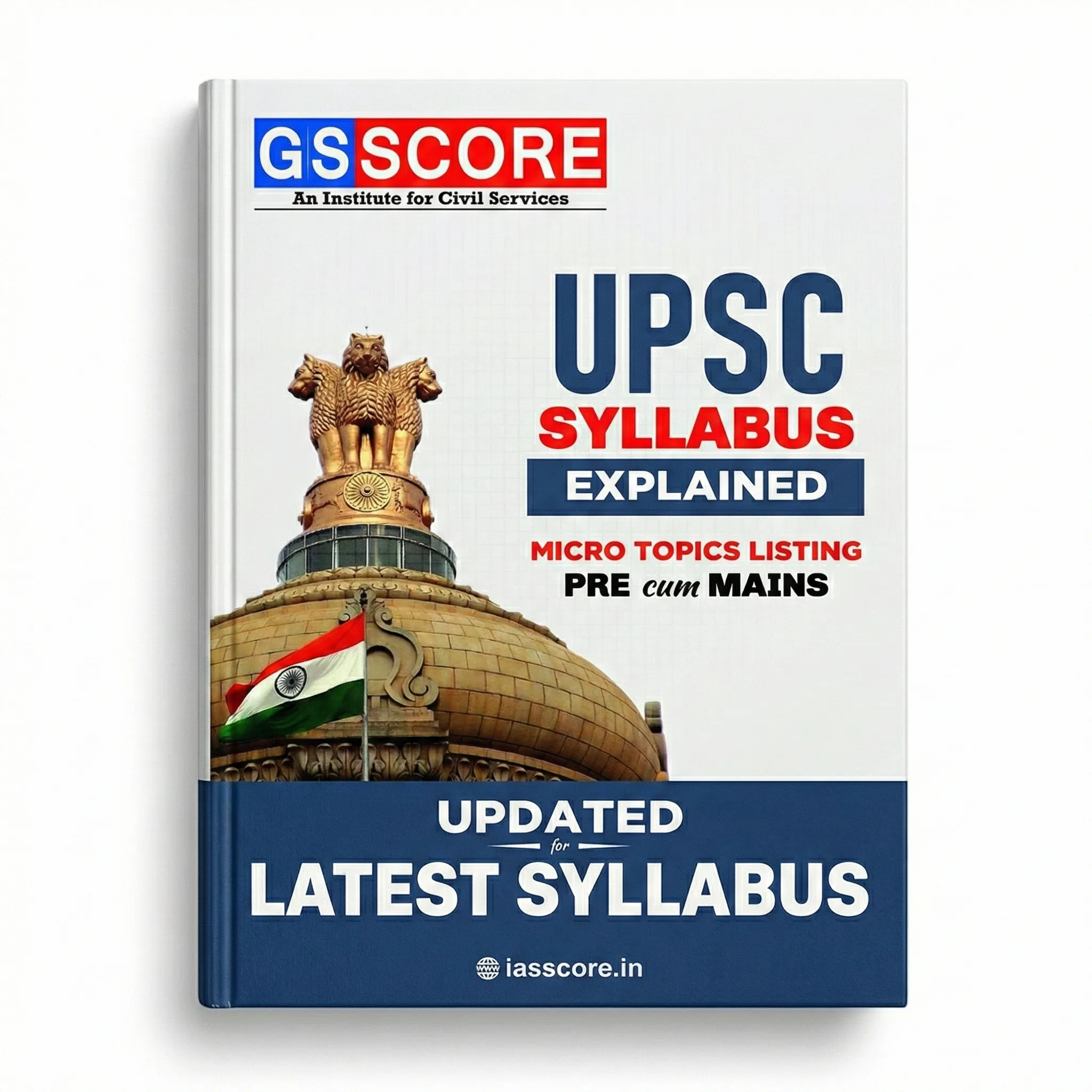
For the exact, authoritative wording, download the syllabus straight from the CAPF AC notification PDF on upsc.gov.in — that official file is the version examiners set questions from. If you want the official syllabus wording alongside the UPSC CSE syllabus in one printed reference, the GS Score Latest Syllabus Booklet 2026-27 is a handy desk copy — much of the CAPF Paper 1 content overlaps directly with the UPSC GS foundation.
How to Prepare for the CAPF Syllabus: Timeline & Books
A focused 5–6 month plan is enough for most working aspirants, provided current affairs and physical training run in parallel from day one.
Week-wise preparation timeline
| Phase | Duration | Focus |
|---|---|---|
| Foundation | Weeks 1–8 | NCERT-based Polity, History, Geography, Science; start daily current affairs; begin PET runs |
| Skill-building | Weeks 9–16 | Reasoning & maths practice; weekly essays and précis; monthly current-affairs revision |
| Practice | Weeks 17–22 | Full-length Paper 1 mocks with negative marking; timed Paper 2 answer writing |
| Revision | Weeks 23–24 | Rapid revision, PYQ analysis, PET timing trials, interview awareness |
Best books & study material for CAPF
You do not need a separate CAPF-only library — the syllabus overlaps heavily with UPSC GS, so quality GS material does double duty. Practical picks:
- Foundation GS notes: A structured booklet set such as the Vision IAS GS 2026-27 Booklets covers Polity, History, Geography, Economy and Science in one place — ideal for Paper 1 and the GS spine of Paper 2.
- Current affairs: The largest and most volatile chunk of Paper 1. A monthly compilation like the Vision IAS Current Affairs Magazine (January 2026) keeps national and international events organised for quick revision.
- PYQ practice: The Forum IAS Topic-Wise PYQ Toolkit (1992–2025) to internalise the objective pattern.
- Essay & descriptive: The Vajiram Essay Notes for frameworks, themes and examples for Paper 2 Part A.
- NCERTs (Class 6–12): free and non-negotiable for Science, History, Geography and Polity fundamentals.
Free vs paid: what to spend on
Keep NCERTs, newspaper current affairs and the official UPSC notification free. Spend where it saves time and adds structure — a consolidated GS note set, a monthly current-affairs magazine, and a PYQ compilation. Avoid buying five overlapping sources for the same subject; depth in one beats shallow coverage across many.
CAPF vs UPSC CSE: Key Differences
Aspirants often ask how CAPF compares with the Civil Services Exam. Both are UPSC exams with overlapping GS content, but the structure, scale and physical demands differ sharply.
| Aspect | CAPF AC | UPSC CSE |
|---|---|---|
| Stages | Written (2 papers) + PST/PET + Medical + Interview | Prelims + Mains (9 papers) + Interview |
| Written papers | 2 (250 + 200) | Prelims (400) + Mains (1750) |
| Optional subject | None | Yes (one optional, 500 marks) |
| Physical test | Compulsory PST + PET | None |
| Preparation load | Moderate — 5–6 months for many | Heavy — 12–18 months typically |
| Outcome | Assistant Commandant in CAPFs | IAS/IPS/IFS and allied services |
The GS overlap is real, which is why many candidates prepare for both — but CAPF adds a fitness dimension that CSE does not, and rewards candidates who train physically alongside their books. Is the CAPF exam tough to crack? It is competitive, but with a stable syllabus, fewer papers than CSE and a moderate 5–6 month runway, a disciplined aspirant who clears the Paper 1 cut-off and stays PET-ready has a very realistic shot.
Frequently Asked Questions
What is the syllabus of CAPF?
The CAPF (Assistant Commandant) syllabus has two papers. Paper 1 (General Ability & Intelligence) covers General Mental Ability, General Science, Current Events, Indian Polity & Economy, History of India, and Indian & World Geography. Paper 2 (General Studies, Essay & Comprehension) tests essay writing plus comprehension, précis, counter-arguments and communication skills.
What is the exam pattern for UPSC CAPF AC (Paper 1 and Paper 2)?
Paper 1 is objective — 125 MCQs for 250 marks in 2 hours with negative marking. Paper 2 is descriptive — 200 marks in 3 hours, split into a Part A essay (English or Hindi) and a Part B comprehension/précis section (English only). A 150-mark Interview follows, taking the total to 600 marks.
Is there negative marking in the CAPF exam?
Yes. In the objective Paper 1, one-third (0.33) of the marks for a question is deducted for each wrong answer. Since each question is worth 2 marks, a wrong answer costs about 0.66 marks. There is no negative marking in the descriptive Paper 2, and unattempted questions are not penalised.
How many papers are there in the CAPF exam and what are the total marks?
There are two written papers — Paper 1 (250 marks) and Paper 2 (200 marks) — totalling 450 marks, plus a 150-mark Interview/Personality Test. The grand total for final merit is 600 marks. Importantly, Paper 2 is evaluated only if you clear the minimum qualifying marks in Paper 1.
What is the difference between UPSC CSE and CAPF exam?
CAPF AC has two written papers (450 marks), a compulsory physical test (PST/PET) and a 150-mark interview, and recruits Assistant Commandants for the armed police forces. UPSC CSE is far larger — Prelims plus nine Mains papers (including an optional subject) and an interview — has no physical test, and leads to services like IAS, IPS and IFS. The GS content overlaps, but CSE demands much heavier and longer preparation.
Is the CAPF exam tough to crack?
It is competitive but manageable. The syllabus is stable, there are only two written papers, and 5–6 months of focused study suffices for many aspirants. The extra challenge is the physical stage — a candidate who clears the Paper 1 cut-off, writes a structured Paper 2 and stays PET-ready throughout has a realistic chance.
What are the physical standards (height/PET) required for CAPF AC?
Minimum height is 165 cm for men and 157 cm for women, with a male chest of 81 cm (5 cm expansion). The PET includes a 100 m race (16 sec men / 18 sec women), an 800 m race (3:45 men / 4:45 women), long jump (3.5 m men / 3.0 m women) and shot put of 4.5 m for men. Relaxations apply for certain categories.
Which books are best for CAPF syllabus preparation?
Start with NCERTs (Class 6–12) for fundamentals, add a consolidated GS note set for Polity, History, Geography, Economy and Science, keep a monthly current-affairs magazine for the large current-events section, and practise with a topic-wise PYQ toolkit. For Paper 2, an essay-notes reference helps you build structured, example-rich answers.
What is the age limit and eligibility for CAPF AC?
Candidates must be Indian citizens aged 20 to 25 years as on the notified cut-off date (with +3 years for OBC and +5 years for SC/ST, plus other specified relaxations) and hold a bachelor’s degree from a recognised university. Final-year students can usually apply provisionally. Confirm the exact dates and relaxations in the 2026 notification.
Recommended Study Material


Continue Reading
Geography Optional Syllabus (UPSC 2026): Paper 1 & 2, Booklist + PDF
The geography optional syllabus for UPSC has two papers — Paper I (Principles of Geography) and Paper II…

UGC NET Commerce Syllabus 2026: Units, Weightage + PDF
Quick answer: The UGC NET Commerce syllabus (Subject Code 08) has two parts — a common Paper 1…
CAPF Syllabus 2026: Paper 1 & 2, Exam Pattern, PET + PDF
Last updated: June 2026 · Based on the official UPSC CAPF (AC) Examination notification.The CAPF syllabus for the…