CGPSC Syllabus 2025: Prelims, Mains + PDF Download
CGPSC syllabus 2025 with topic-wise Prelims & Mains, exam pattern, marks, CG GK weightage, Hindi overview and PDF download steps.

The CGPSC syllabus spans three stages: an objective Prelims (Paper 1 General Studies + Paper 2 Aptitude Test, 200 marks each), a seven-paper descriptive Mains worth 1,400 marks, and a 150-mark Interview. Paper 1 leans heavily on Chhattisgarh (CG) history, geography, polity, economy and current affairs; Mains adds five General Studies papers plus a language paper and an essay. This guide gives you the full topic-wise breakdown, exam pattern, marks, previous-year weightage, a Hindi-medium overview, and exactly how to get the official Prelims + Mains PDF — everything you need to plan your preparation from start to finish.
How to use this page: the tables below map the CGPSC State Service Examination stage by stage so you can turn them into a printable checklist. Exam structures are revised periodically, so always confirm every figure against the year’s official notification at psc.cg.gov.in before you finalise a study plan.
CGPSC Syllabus 2025: Selection Process at a Glance
The Chhattisgarh Public Service Commission (CGPSC) conducts the State Service Examination (SSE) to recruit officers for posts like Deputy Collector, Deputy Superintendent of Police, Chhattisgarh Accounts Service, Excise, Labour and other Class I/II services. Before diving into the topic lists, understand how the three stages connect, because the cgpsc syllabus 2025 is designed around this funnel.
| Stage | Nature | Total Marks | Counts in Final Merit? |
|---|---|---|---|
| Preliminary Exam | Objective (2 papers) | 400 (Paper 2 qualifying) | No — screening only |
| Main Exam | Descriptive (7 papers) | 1,400 | Yes |
| Interview / Personality Test | Viva-voce | 150 | Yes |
| Final Selection | Mains + Interview | 1,550 | Merit basis |
Key point most pages miss: your Prelims score does not add to the final merit — it only decides whether you qualify for Mains (roughly 12–15 candidates per vacancy are shortlisted). The final rank is built purely on the 1,550 marks from Mains and Interview. That single fact should shape how you allocate study time from day one.
CGPSC Prelims Syllabus and Exam Pattern
The cgpsc prelims syllabus covers two objective papers held on the same day. Both are 200 marks and 2 hours each. Paper 1 (General Studies) is the ranking paper for the Prelims cut-off, while Paper 2 (Aptitude Test) is qualifying — you only need 33% to clear it, but you must attempt it.
| Paper | Subject | Questions | Marks | Duration | Type |
|---|---|---|---|---|---|
| Paper 1 | General Studies | 100 | 200 | 2 hours | Ranking |
| Paper 2 | Aptitude Test | 100 | 200 | 2 hours | Qualifying (33%) |
Negative marking: Yes. CGPSC deducts one-third (1/3) of the marks allotted to a question for every wrong answer in both Prelims papers. Since each question carries 2 marks, a wrong answer costs you roughly 0.667 marks. There is no penalty for unattempted questions, so avoid blind guessing when you can eliminate none of the options.
CGPSC Prelims Paper 1: General Studies (Topic-Wise)
Paper 1 blends national-level General Studies with a strong Chhattisgarh layer. This is where aspirants win or lose, because CG-specific questions are highly scoring and relatively predictable year to year.
| Section | Key Topics |
|---|---|
| History of India | Ancient, Medieval & Modern India; Indian National Movement; freedom struggle |
| History & Culture of Chhattisgarh | Contribution of CG to the freedom movement, dynasties, tribal revolts, art, dance, festivals, jatra |
| Geography (India & CG) | Physical, social, economic geography of India and Chhattisgarh; rivers, minerals, climate, agriculture |
| Indian Polity & Constitution | Preamble, Fundamental Rights & Duties, DPSP, Parliament, Panchayati Raj, governance |
| Economy (India & CG) | Economic development, planning, budget, poverty, employment; Chhattisgarh economy & schemes |
| General Science & Technology | Physics, Chemistry, Biology basics; everyday science; ICT and space |
| Environment & Ecology | Biodiversity, forests of CG, conservation, climate change, environmental issues |
| Current Affairs | National, international and Chhattisgarh-specific current events, awards, sports, schemes |
CGPSC Prelims Paper 2: Aptitude Test (Which Subjects Are Included?)
Paper 2 is the CGPSC equivalent of UPSC’s CSAT, but with a unique twist: it tests Hindi and Chhattisgarhi language comprehension alongside reasoning and maths. Which subjects are included in CGPSC Prelims Paper 2? Here is the exact breakdown.
| Component | What It Covers |
|---|---|
| Comprehension | Reading passages and answering inference-based questions |
| Interpersonal & Communication Skills | Situational and decision-making questions |
| Logical Reasoning & Analytical Ability | Series, coding-decoding, syllogism, arrangements |
| Decision Making & Problem Solving | Administrative scenario reasoning |
| General Mental Ability | Numerical relations, patterns, clocks, calendars |
| Basic Numeracy & Data Interpretation | Numbers, percentages, ratios; tables, graphs, charts (Class 10 level) |
| Hindi Language Comprehension | Hindi passage-based questions |
| Chhattisgarhi Language Comprehension | Chhattisgarhi passage/usage — a CGPSC-exclusive component |
Because Paper 2 is only qualifying, do not over-invest — but the Chhattisgarhi and Hindi comprehension portions are where local aspirants have a natural edge over the maths-heavy sections. Clear the 33% bar early with a few timed mocks, then redirect your hours to Paper 1 and Mains.
CGPSC Mains Syllabus 2025: Seven Descriptive Papers
How many papers are there in CGPSC Mains? Seven. The cgpsc mains syllabus comprises two language/essay papers and five General Studies papers, each worth 200 marks, for a grand total of 1,400 marks. All papers are descriptive (written), and this is the stage that decides your final rank.
| Paper | Title | Marks | Duration |
|---|---|---|---|
| Paper 1 | Language (Hindi, English & Chhattisgarhi) | 200 | 3 hours |
| Paper 2 | Essay (Nibandh) | 200 | 3 hours |
| Paper 3 | GS-1: History & Constitution / Public Administration | 200 | 3 hours |
| Paper 4 | GS-2: Science, Technology & Environment | 200 | 3 hours |
| Paper 5 | GS-3: Economy & Geography | 200 | 3 hours |
| Paper 6 | GS-4: Mathematics, Reasoning & Statistics (Aptitude) | 200 | 3 hours |
| Paper 7 | GS-5: Philosophy, History of Human Thought & Sociology | 200 | 3 hours |
Subject-Wise Breakdown of the Five GS Mains Papers
Here is what each descriptive GS paper actually contains — the granular map you need to build a study plan and match topics to books.
| GS Paper | Core Areas |
|---|---|
| GS-1 (Paper 3) | History of India & Chhattisgarh; Indian Constitution; Public Administration; governance and administrative structure of CG |
| GS-2 (Paper 4) | General Science; Science & Technology; Environment & Biodiversity; agriculture, health and technology applications |
| GS-3 (Paper 5) | Indian & Chhattisgarh Economy; economic planning & schemes; Geography of India & CG; industry, minerals and infrastructure |
| GS-4 (Paper 6) | Mathematics, Reasoning, Data Interpretation & Statistics (higher level than Prelims Paper 2) |
| GS-5 (Paper 7) | Philosophy; History of Human Thought (Indian & Western thinkers); Sociology; ethics and social issues |
Language Paper (Paper 1) structure: This single paper is split into three parts — Hindi, English and Chhattisgarhi — with sections on précis writing, comprehension, letter/report drafting, grammar, translation and idioms. The Chhattisgarhi portion is qualifying in nature but must be taken seriously, as weak language scores drag down the aggregate that decides your rank.
The Chhattisgarh-Specific Syllabus (CG GK Deep Dive)
This is the single biggest edge in CGPSC — and where most syllabus pages stay vague. Roughly 30–40% of GS content across Prelims and Mains is Chhattisgarh-specific. Master this granular CG layer and you clear cut-offs comfortably; ignore it and no amount of national GS will save you.
| CG Domain | High-Yield Topics |
|---|---|
| CG History | Kalachuri, Nagvanshi & Marathas; Halba Vidroh, tribal & peasant revolts; role of CG in 1857 and freedom struggle; Veer Narayan Singh |
| CG Geography | Physiographic divisions, Mahanadi & tributaries, forests, national parks (Kanger Valley, Indravati), minerals (coal, iron ore, bauxite), climate |
| CG Polity & Administration | Formation of Chhattisgarh (2000), state administrative setup, Panchayati Raj, PESA, Fifth Schedule areas |
| CG Economy | State budget, agriculture & forest produce (tendu, mahua), industries, power sector, flagship state schemes |
| CG Art & Culture | Tribal culture, Panthi, Raut Nacha, Karma & Suā dances, folk literature, fairs, festivals, cuisine |
| CG Current Affairs | State policies, appointments, sports, welfare schemes, honours and recent developments |
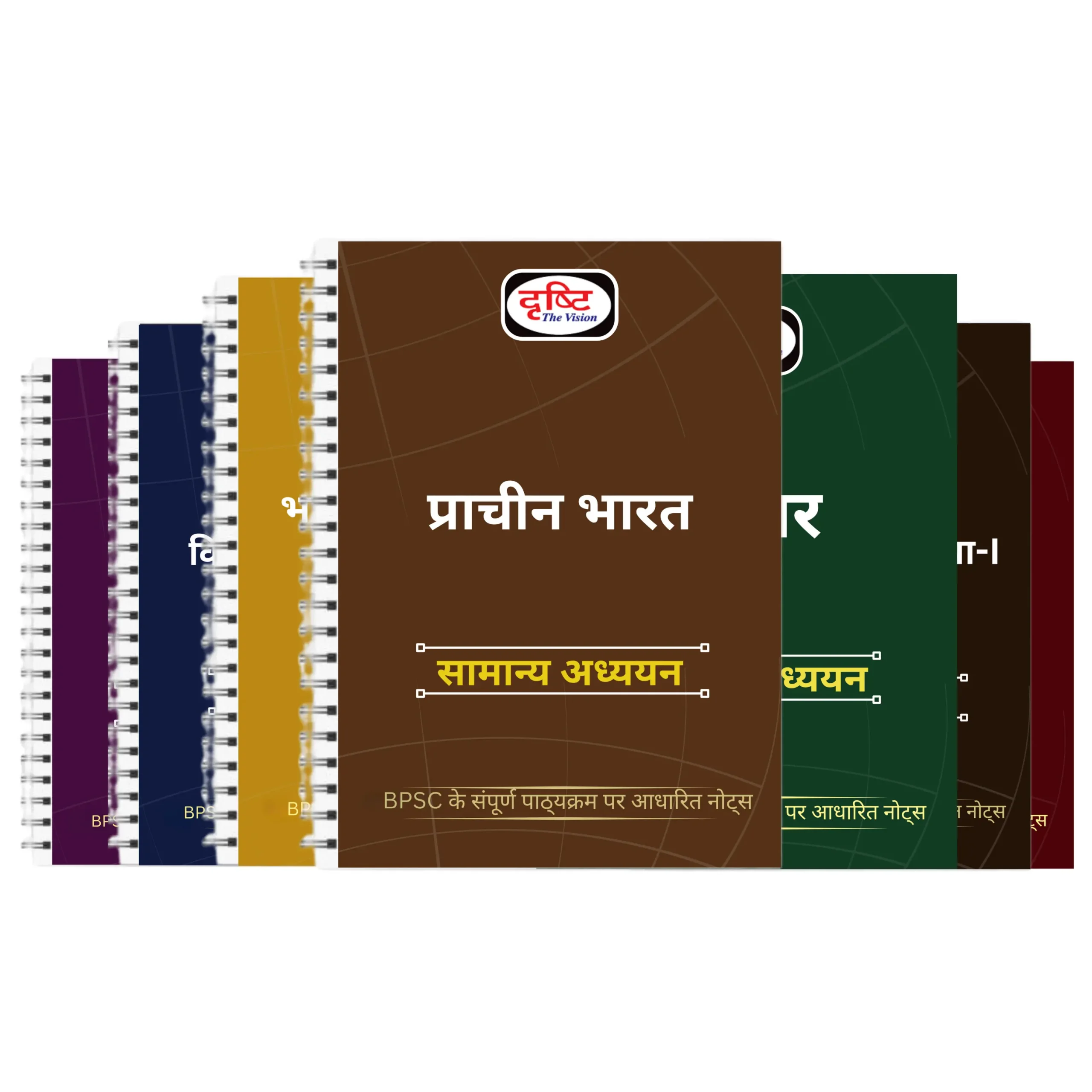
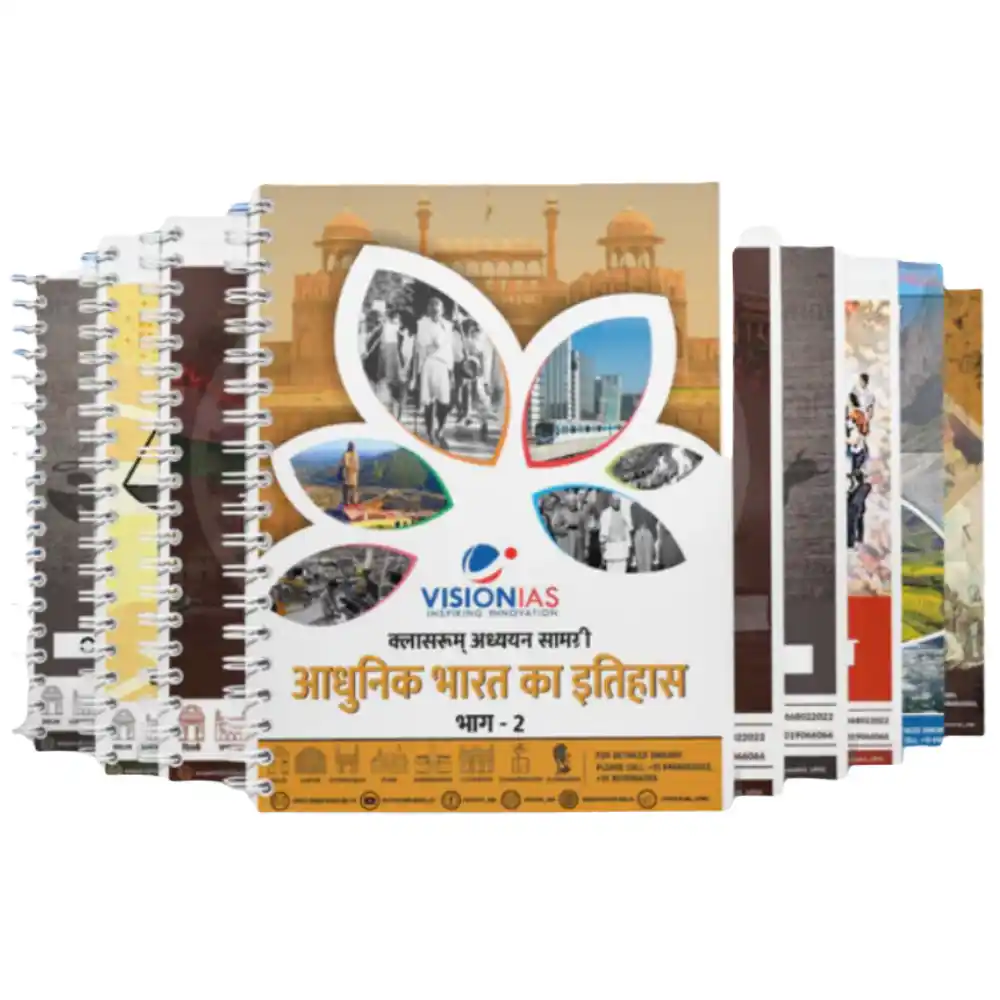
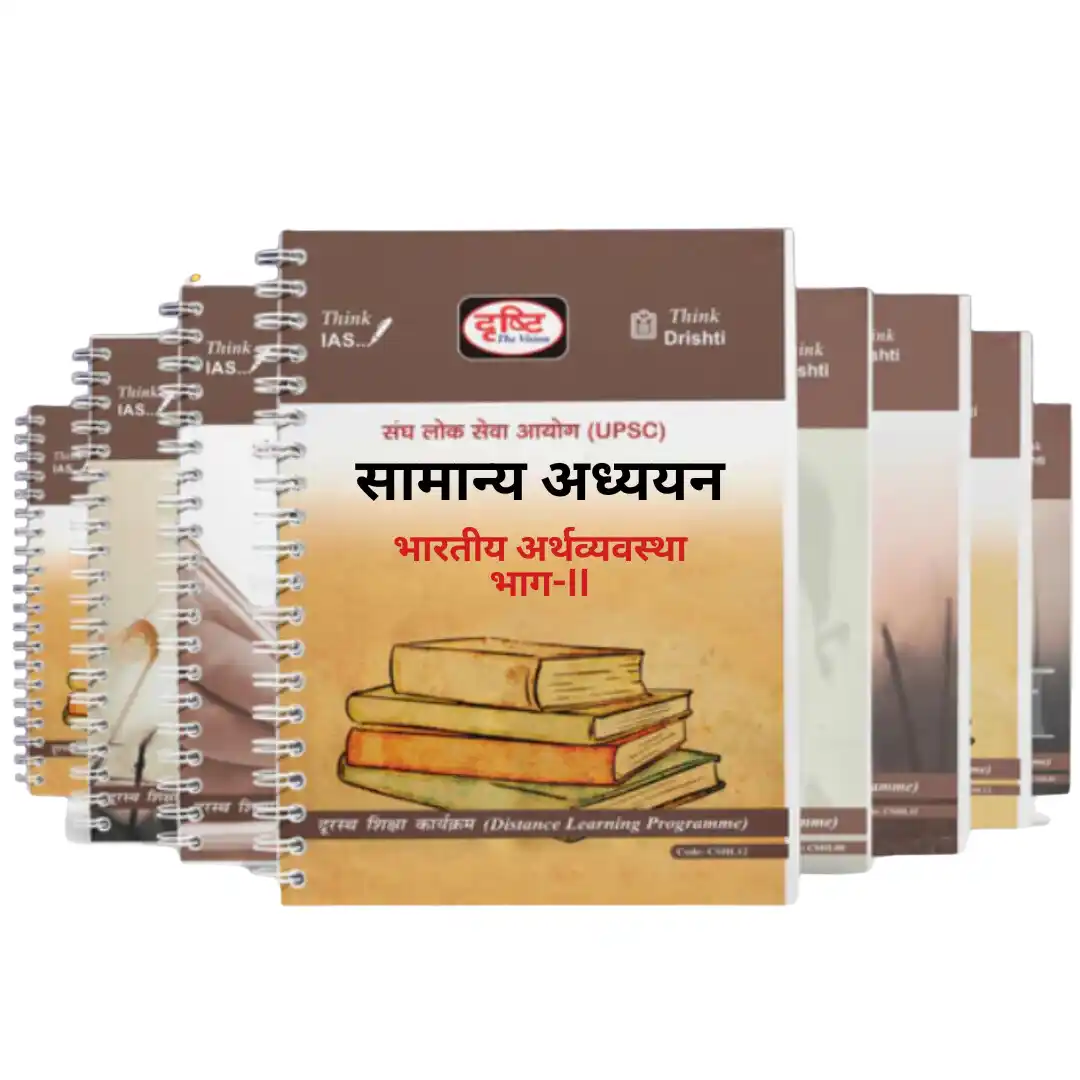
Because dedicated CG material is scarcer in the market, most successful aspirants pair a strong national GS base with focused CG notes. A structured Hindi-medium GS foundation such as the Vision IAS Hindi Study Material or the Drishti IAS Hindi Study Material (18 booklets) covers the national portion of History, Polity, Geography, Economy and Science thoroughly, freeing you to spend dedicated hours purely on the Chhattisgarh layer.
CGPSC Exam Pattern 2025: Marks Distribution Summary
What is the exam pattern of CGPSC, and how many total marks is the CGPSC exam? Below is the consolidated view. The stages tested for merit (Mains + Interview) sum to 1,550 marks; the Prelims 400 marks are only for screening.
| Stage | Papers | Marks per Paper | Stage Total | Marking |
|---|---|---|---|---|
| Prelims | 2 objective | 200 | 400 | Negative (1/3) |
| Mains | 7 descriptive | 200 | 1,400 | No negative |
| Interview | Personality Test | — | 150 | Viva |
| Final Merit (Mains + Interview) | 1,550 | — | ||
In short: Prelims is a pass/fail gate, Mains carries the overwhelming weight of the score, and the Interview fine-tunes the final rank. Budget your effort in that proportion.
How the CGPSC Syllabus Compares to UPSC
Many aspirants prepare for CGPSC alongside UPSC, so it helps to see where the two syllabi overlap and where they diverge. The GS backbone is shared, which is why quality UPSC-oriented notes transfer well; the differences lie in the state layer, the language paper and the absence of an optional subject.
| Feature | CGPSC | UPSC (CSE) |
|---|---|---|
| Prelims papers | GS + Aptitude (Aptitude qualifying) | GS + CSAT (CSAT qualifying) |
| Mains GS papers | 5 common GS papers | 4 GS papers |
| Optional subject | None (all papers common) | One optional (2 papers) |
| Language component | Hindi, English & Chhattisgarhi | One Indian language + English |
| State-specific load | Heavy Chhattisgarh focus (30–40%) | Minimal state focus |
The practical takeaway: build your core GS with standard national material, then bolt on a dedicated Chhattisgarh module and Chhattisgarhi language practice that UPSC preparation will not give you.
What’s New: CGPSC Syllabus Changes for 2025-26
A change-log that most competitor pages skip entirely. Keep these updates in mind while planning:
- Seven-paper Mains with GS-5: The revised pattern includes a fifth GS paper (Philosophy, History of Human Thought & Sociology) — older two-optional-paper formats are discontinued, so ignore outdated booklists.
- No separate optional subject: Unlike UPSC, current CGPSC has no candidate-chosen optional; all five GS papers are common, which simplifies your preparation strategy.
- Chhattisgarhi language weight: Chhattisgarhi comprehension appears in both Prelims Paper 2 and the Mains language paper — a locally rooted requirement newcomers underestimate.
- Rising CG current-affairs share: Recent papers show more state-scheme and state-policy questions, making monthly current-affairs revision non-negotiable.
Always cross-verify the pattern against the latest official CGPSC notification for your exam year, as the Commission periodically revises paper structures.
Previous-Year Weightage & Marks Analysis
Weightage-based prioritisation is where you convert the syllabus into a smart plan. The table below reflects broad trends from recent CGPSC Prelims Paper 1 papers (approximate, for planning only — treat exact percentages as indicative, not official).
| Subject Area | Approx. Prelims Weightage | Priority |
|---|---|---|
| Chhattisgarh GK (History, Geo, Polity, Economy, Culture) | 30–40% | Very High |
| Indian Polity & Constitution | 10–14% | High |
| Geography (India + CG) | 10–12% | High |
| History & Freedom Movement | 8–12% | Medium-High |
| Economy (India + CG) | 8–10% | Medium-High |
| General Science & Technology | 8–10% | Medium |
| Environment & Ecology | 5–8% | Medium |
| Current Affairs | 10–15% | High |
The takeaway is clear: Chhattisgarh-specific study plus current affairs together can decide almost half your Prelims score. To keep current affairs sharp for both national and state questions, a monthly compilation such as the Vision IAS Current Affairs Magazine (Hindi Medium) gives you exam-ready notes without hunting across newspapers daily.
CGPSC Syllabus in Hindi (हिंदी में)
Since the overwhelming majority of CGPSC aspirants prepare in Hindi, here is the syllabus mapped in the medium you actually study in. The exam paper itself is bilingual (Hindi & English).
| Paper / पेपर | Subject / विषय (हिंदी) |
|---|---|
| प्रारंभिक पेपर 1 | सामान्य अध्ययन — भारत व छत्तीसगढ़ का इतिहास, भूगोल, राजव्यवस्था, अर्थव्यवस्था, विज्ञान, पर्यावरण, समसामयिकी |
| प्रारंभिक पेपर 2 | अभिरुचि परीक्षा — तार्किक क्षमता, सामान्य मानसिक योग्यता, आंकड़ा निर्वचन, हिंदी व छत्तीसगढ़ी भाषा |
| मुख्य पेपर 1 | भाषा — हिंदी, अंग्रेज़ी व छत्तीसगढ़ी |
| मुख्य पेपर 2 | निबंध |
| मुख्य पेपर 3–7 | सामान्य अध्ययन 1 से 5 (इतिहास, संविधान, विज्ञान, अर्थशास्त्र, भूगोल, गणित, समाजशास्त्र, दर्शन) |
For Hindi-medium GS coverage that matches this structure, the Drishti IAS GS Notes in Hindi (18 booklets) are a popular, comprehensive base for History, Polity, Geography, Economy and Science.
How to Download the CGPSC Syllabus PDF (Prelims & Mains)
You can get the official cgpsc syllabus pdf download directly from the Commission, and use a topic-table version like this article for quick daily reference:
- Step 1: Visit the official CGPSC portal (psc.cg.gov.in) and open the latest State Service Examination notification.
- Step 2: Scroll to the “Syllabus” or “Detailed Advertisement” annexure and click the Prelims + Mains syllabus PDF link.
- Step 3: Save the file; it lists Paper 1, Paper 2 and all seven Mains papers with the official topic wording.
- Step 4: Bookmark this page and use the tables above as your printable, one-click topic checklist while revising.
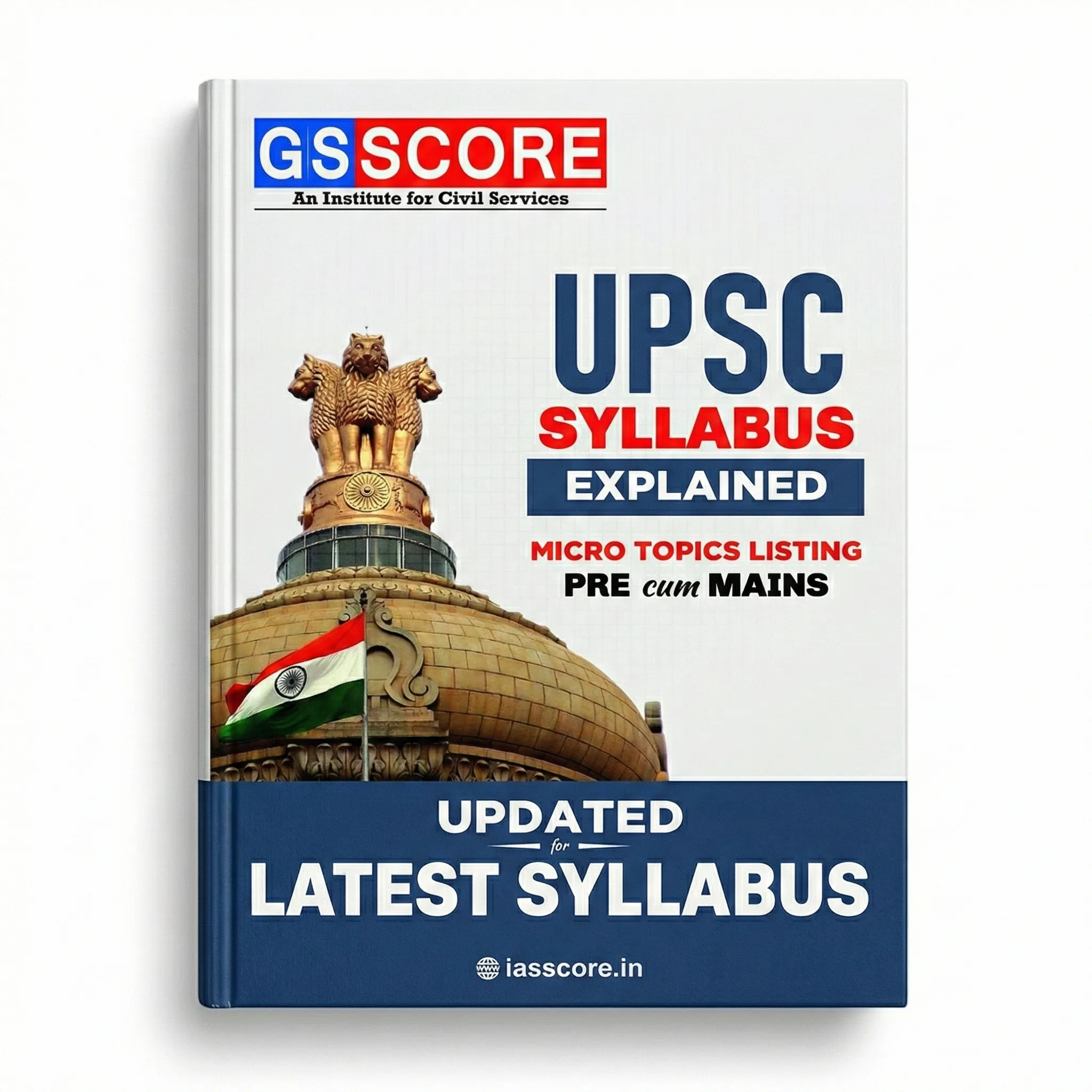
If you want a single consolidated syllabus reference to keep on your desk, the GS Score Latest Syllabus Booklet 2026-27 is a handy printed companion for General Studies coverage that overlaps heavily with the CGPSC GS structure.
Preparation Strategy: How to Use the CGPSC Syllabus
A syllabus is only useful if it drives your timetable. Here is a practical way to convert the cgpsc syllabus 2025 into results.
Build a strong national GS base first
History, Polity, Geography, Economy, Science and Environment form the shared backbone of both Prelims and Mains. Cover these with standard printed notes, then revise twice before moving on.
Layer Chhattisgarh on top
Dedicate fixed weekly slots to CG history, geography, polity, economy and culture. This is your differentiator — treat it as a full subject, not an afterthought.
Practice descriptive writing early
Mains carries 1,400 of the 1,550 merit marks, so start answer-writing and essay practice months before the exam. Since CGPSC parallels other state PCS patterns, structured state-PCS material like the Drishti BPSC Books (Hindi Medium, 24-book set) is useful for building descriptive-answer discipline and covering overlapping GS themes for a Hindi-medium aspirant.
Revise current affairs monthly
Maintain a running note of national and Chhattisgarh events, schemes, appointments and awards. Consolidate monthly rather than cramming at the end.
Common mistakes to avoid
- Ignoring the qualifying-but-mandatory Paper 2 and language sections until the last week.
- Under-preparing Chhattisgarhi language despite its dual appearance in Prelims and Mains.
- Studying only in English notes when the paper trend and comfort favour Hindi medium.
- Chasing every national topic while neglecting the high-yield CG layer.
Is CGPSC Tougher Than UPSC?
Overall, UPSC is considered tougher on scale, competition ratio and depth of the interview. However, CGPSC has its own difficulty: the intense Chhattisgarh-specific factual load, the Chhattisgarhi language requirement and the five common GS papers demand broad, state-rooted knowledge. For a CG-domicile aspirant strong in local GK, CGPSC can feel more approachable than UPSC — but its five-GS-paper Mains and factual precision make it far from easy. The two exams share enough GS overlap that quality UPSC-style GS notes remain a solid foundation for CGPSC preparation.
Frequently Asked Questions
What is the syllabus of CGPSC?
The CGPSC syllabus has three stages: Prelims (Paper 1 General Studies covering India & Chhattisgarh history, geography, polity, economy, science, environment and current affairs; Paper 2 Aptitude Test with reasoning, numeracy, data interpretation and Hindi/Chhattisgarhi language), Mains (seven descriptive papers — language, essay and five GS papers spanning history, constitution, public administration, science, economy, geography, maths, sociology and philosophy), and a 150-mark Interview.
What is the exam pattern of CGPSC?
CGPSC has three stages. Prelims is objective with two 200-mark papers (Paper 1 ranking, Paper 2 qualifying at 33%) and one-third negative marking. Mains is descriptive with seven 200-mark papers totalling 1,400 marks and no negative marking. The Interview carries 150 marks. Final merit is based only on Mains plus Interview (1,550 marks); Prelims is a screening stage.
How many papers are there in CGPSC Mains?
CGPSC Mains has seven descriptive papers, each worth 200 marks for a total of 1,400 marks: one language paper (Hindi, English & Chhattisgarhi), one essay paper, and five General Studies papers (GS-1 to GS-5).
Is there negative marking in CGPSC Prelims?
Yes. CGPSC deducts one-third (1/3) of the marks allotted to a question for each wrong answer in both Prelims papers. As each question carries 2 marks, a wrong answer costs about 0.667 marks, while unattempted questions carry no penalty.
How many total marks is the CGPSC exam?
Prelims totals 400 marks (screening only), Mains totals 1,400 marks, and the Interview carries 150 marks. The final merit is calculated on Mains plus Interview, i.e. 1,550 marks; the Prelims score does not count toward the final rank.
Which subjects are included in CGPSC Prelims Paper 2 (Aptitude)?
Paper 2 includes comprehension, interpersonal and communication skills, logical reasoning and analytical ability, decision-making and problem-solving, general mental ability, basic numeracy and data interpretation, plus Hindi and Chhattisgarhi language comprehension. It is qualifying, requiring 33% to pass.
Is CGPSC tougher than UPSC?
UPSC is generally tougher on scale, competition and interview depth. CGPSC is challenging in its own way — a heavy Chhattisgarh-specific factual load, a Chhattisgarhi language requirement and five common GS papers in Mains. For a CG-domicile aspirant strong in local GK it can feel more approachable, but it is far from easy. The shared GS overlap means good UPSC-style notes remain a strong foundation.
How do I download the CGPSC syllabus PDF?
Visit the official CGPSC website (psc.cg.gov.in), open the latest State Service Examination notification, go to the syllabus or detailed advertisement annexure, and download the Prelims + Mains syllabus PDF. You can also use the topic-wise tables in this guide as a printable checklist for daily revision.
Recommended Study Material
Continue Reading
UGC NET Syllabus 2026: Paper 1 & Paper 2 (All 87 Subjects) + PDF Download
Short answer: The UGC NET syllabus has two parts — a common Paper 1 (10 units testing teaching…
UPSC Prelims Syllabus 2026: Subject-Wise GS + CSAT + PDF
The UPSC Prelims syllabus covers two objective papers — General Studies Paper 1 (100 questions, 200 marks) and…
NEET Exam Pattern 2026: Marks, Questions & Marking Scheme
The NEET exam pattern for 2026 is a single 3-hour (180-minute) pen-and-paper test of 180 compulsory questions carrying…