HPSC Syllabus 2026: HCS Prelims, Mains (New Pattern) & PDF Download
Complete HPSC syllabus 2026 for HCS Prelims, Mains (new 6-paper pattern) & Interview — with Haryana-specific topics, exam pattern, qualifying marks, booklist and PDF download.

The HPSC syllabus for the Haryana Civil Services (HCS) exam 2026 spans three stages — Preliminary (objective), Mains (descriptive) and a Personality Test (interview). The single biggest change is the January 2026 Mains pattern: the optional subject has been removed, and Mains now has 6 compulsory papers of 100 marks each (600 marks total). Prelims keeps two papers — General Studies (Paper I) and CSAT (Paper II, qualifying only at 33%) — and Haryana-specific General Knowledge is the single most decisive scoring area across every stage.
The 2026 HPSC HCS syllabus in one line: two objective Prelims papers (GS + CSAT) screen you, six descriptive Mains papers (two language + GS-I to GS-IV including a standalone Ethics paper) decide 600 of your 675 merit marks, and a 75-mark interview does the rest — with Haryana history, geography, polity, economy and current affairs woven through it all.
- Optional subject: removed — every candidate now writes the same six papers.
- Ethics (GS-IV): now a standalone 100-mark Mains paper.
- Language papers: English & Essay and Hindi & Essay are both compulsory (100 marks each).
- Final merit: Mains (600) + Interview (75) = 675; Prelims marks are not added.
This guide gives you the complete, up-to-date hpsc hcs syllabus 2026 — stage by stage, paper by paper, subject by subject — plus the full exam pattern, an old-vs-new comparison, an exhaustive Haryana GK checklist, qualifying-marks rules, a booklist mapped to every GS paper, a stage-wise timeline, PDF-download steps, and answers to the questions aspirants ask most. It is written for both English-medium and Hindi-medium candidates, because Hindi & Essay is now a compulsory 100-mark paper.
HPSC HCS Syllabus & Exam Pattern 2026: Overview
Before the detail, here is the exam at a glance. The Haryana Public Service Commission (HPSC) conducts the Haryana Civil Services (Executive Branch) and Allied Services examination to recruit officers such as HCS (Executive), DSP, ETO, BDPO, District Food & Supplies Officer and other Group A/B posts. The full notification and official syllabus are published on the HPSC portal.
| Particular | Detail |
|---|---|
| Conducting Body | Haryana Public Service Commission (HPSC) |
| Exam Name | Haryana Civil Services (HCS) Exam 2026 |
| Posts | HCS (Executive), DSP, ETO, BDPO, Allied Group A & B services |
| Stages | Prelims → Mains → Interview / Personality Test |
| Prelims Marks | Paper I (100) + Paper II CSAT (100, qualifying) |
| Mains Marks | 600 marks (6 compulsory papers × 100) |
| Interview Marks | 75 marks |
| Final Merit | Mains (600) + Interview (75) = 675 marks |
| Mode | Prelims — Objective (OMR); Mains — Descriptive (offline) |
| Medium | English & Hindi (paper-specific) |
| Official Website | hpsc.gov.in |
Note that the final merit list is prepared from the Mains (600) + Interview (75) = 675 marks only. Prelims marks are not added to the final score — Prelims is purely a screening test, and CSAT in Prelims is purely qualifying. This is a structural point that shapes your entire strategy and is explained in detail below.
HCS Eligibility 2026: Quick Reference
Syllabus aside, candidates almost always check eligibility in the same search session, so here is the quick reference. Always confirm the exact figures against the current official notification, as the Commission sets them cycle by cycle.
| Criterion | Requirement (verify in notification) |
|---|---|
| Nationality | Citizen of India |
| Educational Qualification | Bachelor’s degree from a recognised university (any discipline) |
| Minimum Age | Generally 21 years |
| Maximum Age | Generally 42 years, with category-wise relaxation as per HPSC rules |
| Haryana-specific knowledge | Matriculation/Higher with Hindi/Sanskrit is commonly required as per HPSC norms |
Because age limits and relaxations change with each notification, treat the figures above as indicative and lock the exact numbers from the official HPSC advertisement before you apply.
HCS Selection Process: The Three Stages
The HCS recruitment follows the classic UPSC-style funnel, and understanding the shortlisting ratios helps you set realistic targets at each level.
- Stage I — Preliminary Examination: An objective screening test. Candidates roughly 12–13 times the number of vacancies (based on Paper I score, with Paper II/CSAT only needing to be qualified) are shortlisted for Mains.
- Stage II — Main Examination: Six descriptive papers of 100 marks each. Candidates are shortlisted for the interview at a ratio of about 1:3 (three times the vacancies) on the basis of Mains marks.
- Stage III — Personality Test / Interview: 75 marks, assessing personality, awareness, decision-making and suitability for administrative service.
| Stage | Type | Marks | Counts in Final Merit? |
|---|---|---|---|
| Prelims Paper I (GS) | Objective | 100 | No (screening only) |
| Prelims Paper II (CSAT) | Objective | 100 (qualifying) | No (qualifying) |
| Mains (6 papers) | Descriptive | 600 | Yes |
| Personality Test | Interview | 75 | Yes |
| Final Merit | — | 675 | — |
HCS Exam Pattern 2026: Complete Overview
The hpsc hcs exam pattern 2026 has two distinct structures — one objective (Prelims) and one descriptive (Mains). Here is the consolidated pattern.
Prelims Pattern
| Paper | Subject | Questions | Marks | Duration | Nature |
|---|---|---|---|---|---|
| Paper I | General Studies | 100 | 100 | 2 hours | Merit / screening |
| Paper II | CSAT (Aptitude) | 100 | 100 | 2 hours | Qualifying (33%) |
Negative marking: There is a negative marking of one-fourth (0.25) for every wrong answer in the Prelims objective papers. Unanswered questions carry no penalty, so intelligent question selection matters.
Mains Pattern (New January 2026)
| Paper | Subject | Marks | Duration |
|---|---|---|---|
| Paper I | English (incl. Essay) | 100 | 3 hours |
| Paper II | Hindi (incl. Essay) | 100 | 3 hours |
| Paper III | General Studies–I | 100 | 3 hours |
| Paper IV | General Studies–II | 100 | 3 hours |
| Paper V | General Studies–III | 100 | 3 hours |
| Paper VI | General Studies–IV (Ethics) | 100 | 3 hours |
| Total | 600 | — | |
Old Pattern vs New 2026 Pattern: What Changed
If you prepared earlier or are a repeat aspirant, this is the table you need. The HPSC revamped the Mains structure for 2026, aligning it more closely with the UPSC framework and removing the optional subject altogether.
| Feature | Old HCS Pattern | New 2026 Pattern |
|---|---|---|
| Optional subject | Yes (1 optional) | Removed |
| Number of Mains papers | Language + GS + Optional | 6 compulsory papers |
| Ethics as separate paper | Not a standalone paper | Yes — GS-IV (Ethics), 100 marks |
| Mains total marks | Varied with optional | 600 marks (fixed) |
| GS papers | Fewer GS papers | GS-I, II, III, IV |
| Language papers | English + Hindi | English & Essay + Hindi & Essay |
| Interview | Personality Test | Personality Test (75 marks) |
The key takeaways: (1) you no longer need to master a full optional subject, which levels the field for generalists; (2) Ethics is now a dedicated 100-mark paper that can swing your final rank; and (3) Essay-writing skill is doubly important because it sits inside both language papers.
HCS Prelims Syllabus 2026
The hpsc hcs prelims syllabus mirrors the broad General Studies framework of state PSCs, with a strong Haryana-specific layer that distinguishes it from UPSC.
Paper I — General Studies (100 marks)
- History of India and the Indian National Movement — ancient, medieval and modern India, freedom struggle.
- Geography — India and World physical, social and economic geography; Haryana geography.
- Indian Polity & Governance — Constitution, political system, Panchayati Raj, public policy, rights issues.
- Economic and Social Development — sustainable development, poverty, inclusion, demographics, social sector initiatives.
- General Science & Technology — everyday science, developments in S&T.
- Environment & Ecology, Biodiversity, Climate Change — general issues, may not require subject specialisation.
- Current Events — national and international importance.
- History, Geography, Economy, Polity & Current Affairs of Haryana — the Haryana-specific GS component (high weightage).
Paper II — CSAT (100 marks, qualifying)
- Comprehension
- Interpersonal skills including communication skills
- Logical reasoning and analytical ability
- Decision-making and problem-solving
- General mental ability
- Basic numeracy (numbers and their relations, orders of magnitude — Class X level) and data interpretation (charts, graphs, tables — Class X level)
Is CSAT Qualifying in HPSC HCS Prelims?
Yes. CSAT (Paper II) is qualifying only — you must score at least 33% (about 33 out of 100) to clear it, but your CSAT marks are NOT used to rank you. Only Paper I (GS) decides who is shortlisted for Mains. The strategic implication is important: do not over-invest in CSAT at the cost of GS. Many aspirants treat CSAT casually and then fail to clear the 33% cutoff, especially candidates from non-mathematical backgrounds who neglect numeracy and data interpretation. Practise just enough to comfortably cross the qualifying bar — a focused CSAT test series is usually sufficient — and pour the bulk of your hours into GS and Haryana GK, which actually drive your screening score.
HCS Mains Syllabus 2026 (600 Marks Total)
The new hpsc hcs mains syllabus new pattern consists of six descriptive papers. Below is the paper-wise and subject-wise breakdown you need to build your answer-writing preparation.
Paper I — English & Essay (100 marks)
- Essay writing on contemporary, social, economic and Haryana-related themes
- Comprehension / precis writing
- Grammar, usage and vocabulary
- Letter/report/paragraph writing
- Translation (where applicable)
Paper II — Hindi & Essay (हिंदी एवं निबंध, 100 marks)
- निबंध लेखन (Essay writing in Hindi)
- संक्षेपण एवं अपठित गद्यांश (precis and comprehension)
- व्याकरण, मुहावरे एवं लोकोक्तियाँ (grammar, idioms, proverbs)
- पत्र/प्रतिवेदन लेखन (letter / report writing)
- अनुवाद (translation)
Paper III — General Studies-I
- History: Indian heritage and culture; ancient, medieval, modern India; freedom struggle; post-independence consolidation; world history. History of Haryana — ancient sites (Rakhigarhi, Banawali, Mitathal), Mahabharata-Kurukshetra connection, role of Haryana in the 1857 revolt and the freedom movement.
- Geography: physical, social, economic geography of India and the world; resources; Geography of Haryana — rivers (Yamuna, Ghaggar), agro-climatic zones, NCR, canals and groundwater issues.
- Indian Society & Haryana Society: social structure, diversity, women, population, urbanisation; Haryana’s social issues such as sex ratio and Beti Bachao Beti Padhao.
Paper IV — General Studies-II
- Polity & Constitution: Indian Constitution, federalism, separation of powers, Parliament and state legislatures, judiciary, constitutional bodies.
- Governance: e-governance, citizen charters, transparency, accountability; Haryana governance — state schemes, Saral portal, PPP (Parivar Pehchan Patra), district administration.
- Social Justice: welfare schemes, health, education, poverty and hunger; vulnerable sections.
- International Relations: India and its neighbourhood, bilateral and global groupings, institutions.
Paper V — General Studies-III
- Economy: planning, growth, budgeting, inclusive development; agriculture, MSP, food processing; Haryana economy — agriculture, industries (Gurugram-Manesar belt), MSME, employment.
- Science & Technology: developments, applications, IT, space, biotech, defence tech.
- Environment: conservation, pollution, climate change, environmental impact assessment; Haryana environment — Aravalli, stubble burning, air quality, Sukhna and wetlands.
- Disaster Management & Internal Security: disaster types and management; security challenges, role of external state and non-state actors, cyber security, money laundering.
Paper VI — General Studies-IV (Ethics, Integrity & Aptitude)
- Ethics and human interface; attitude; aptitude and foundational values for civil service
- Emotional intelligence; contributions of moral thinkers and philosophers
- Public/civil service values and ethics in public administration; probity in governance
- Case studies on the above themes — applied to administrative and Haryana-specific scenarios
How Many Papers Are There in HPSC HCS Mains?
There are exactly six papers in HCS Mains under the new 2026 pattern, each carrying 100 marks for a total of 600 marks: English & Essay, Hindi & Essay, GS-I, GS-II, GS-III and GS-IV (Ethics). All six are compulsory and descriptive.
Is There an Optional Subject in HCS Mains Now?
No. The optional subject has been removed in the new January 2026 pattern. Every candidate now writes the same six compulsory papers, so there is no optional-subject choice or scaling to worry about — a significant simplification that favours well-rounded GS preparation over deep single-subject specialisation.
Haryana-Specific Topics: The Decisive Scoring Area
This is where most coaching and news pages stay thin — and where you can win marks. Haryana GK appears in Prelims Paper I, runs through all four GS Mains papers, and surfaces in essays and the interview. Treat it as a standalone, exhaustive subject. Below is a consolidated checklist.
| Theme | Key Haryana Topics to Master |
|---|---|
| History | Rakhigarhi & Indus sites, Kurukshetra/Mahabharata, 1857 revolt in Haryana, freedom fighters (Rao Tula Ram), formation of Haryana (1 Nov 1966) |
| Geography | Rivers (Yamuna, Ghaggar, Markanda), Aravalli & Shivalik, agro-climatic zones, districts & divisions, NCR towns, canals (Western Yamuna) |
| Polity & Admin | State government structure, districts (22), Panchayati Raj, Lokayukta, State Election Commission, Saral & PPP portals |
| Economy | Agriculture & crops, MSP procurement, dairy & livestock, Gurugram IT/auto hub, MSME, HSIIDC, per-capita income |
| Schemes | Beti Bachao Beti Padhao, Mhara Gaon Jagmag Gaon, Parivar Pehchan Patra, Mukhyamantri schemes, sports policy |
| Art & Culture | Folk dances (Phag, Ghoomar, Saang), festivals, fairs (Surajkund Mela), Haryanvi language & literature |
| Sports & Awards | Haryana’s dominance in wrestling/boxing/athletics, Olympic medallists, sports nurseries |
| Current Affairs | State budget, new policies, recent appointments, government initiatives, Haryana in the news |
Build a dedicated Haryana notebook and revise it weekly. Pair it with a state-current-affairs habit — read the Haryana pages of a leading daily and convert points into one-liners. National current affairs still matter (for GS and essays), and a structured monthly magazine such as the Vision IAS Current Affairs magazine keeps the national-international layer organised so you can spend your extra hours on the Haryana layer.
HCS Interview / Personality Test (75 Marks)
The final stage is a 75-mark Personality Test. The board assesses mental alertness, critical assimilation, clarity and logic of exposition, balance of judgement, depth of interest, social cohesion, leadership and intellectual and moral integrity. Expect questions on your Detailed Application Form (DAF) — your background, education, hobbies, home district — plus Haryana affairs, national current events and situational/administrative judgement. Because the interview sits on a 600-mark Mains base, even a 10–15 mark swing here can change your rank materially, so mock interviews and a strong grasp of Haryana current affairs are non-negotiable.
Minimum Qualifying Marks for HCS Mains and Interview
Candidates frequently ask about cutoffs. The standard HPSC qualifying thresholds are summarised below; always confirm the exact figures in the official notification for your cycle.
| Component | Minimum Qualifying Marks |
|---|---|
| Prelims Paper II (CSAT) | 33% (qualifying) |
| Each Mains paper | Typically a minimum percentage must be secured (commonly 25–30% per paper as per HPSC norms) |
| Aggregate to be eligible for interview | As fixed by HPSC (a minimum aggregate in Mains) |
| Interview / Personality Test | A candidate must secure the minimum qualifying marks set by the Commission |
The practical reading: clear CSAT comfortably, do not fall below the per-paper floor in any Mains paper (especially the language papers, where neglect can sink an otherwise strong candidate), and aim well above the aggregate to be safely inside the 1:3 interview shortlist.
HCS Booklist 2026: Material Mapped to Every Paper
Here is the gap almost every ranking page leaves open — a concrete booklist that ties each Mains paper to ready study material. Because HCS GS overlaps heavily with the UPSC General Studies framework, well-structured UPSC GS notes cover the bulk of GS-I to GS-IV; you then layer Haryana-specific material on top.
| Paper | What to Study | Recommended Material |
|---|---|---|
| GS-I, II, III | History, Geography, Polity, Economy, S&T, Environment | Comprehensive GS booklets + NCERTs + Haryana notes |
| GS-IV (Ethics) | Ethics theory, thinkers, case studies | Dedicated Ethics notes |
| English & Essay | Essay structure, comprehension, grammar | Essay notes + daily writing practice |
| Hindi & Essay | निबंध, व्याकरण, अपठित | Hindi-medium GS & essay material |
| Prelims GS | Full objective coverage + PYQ | GS notes + topic-wise PYQ toolkit |
| CSAT | Reasoning, numeracy, comprehension | CSAT practice set / test series |
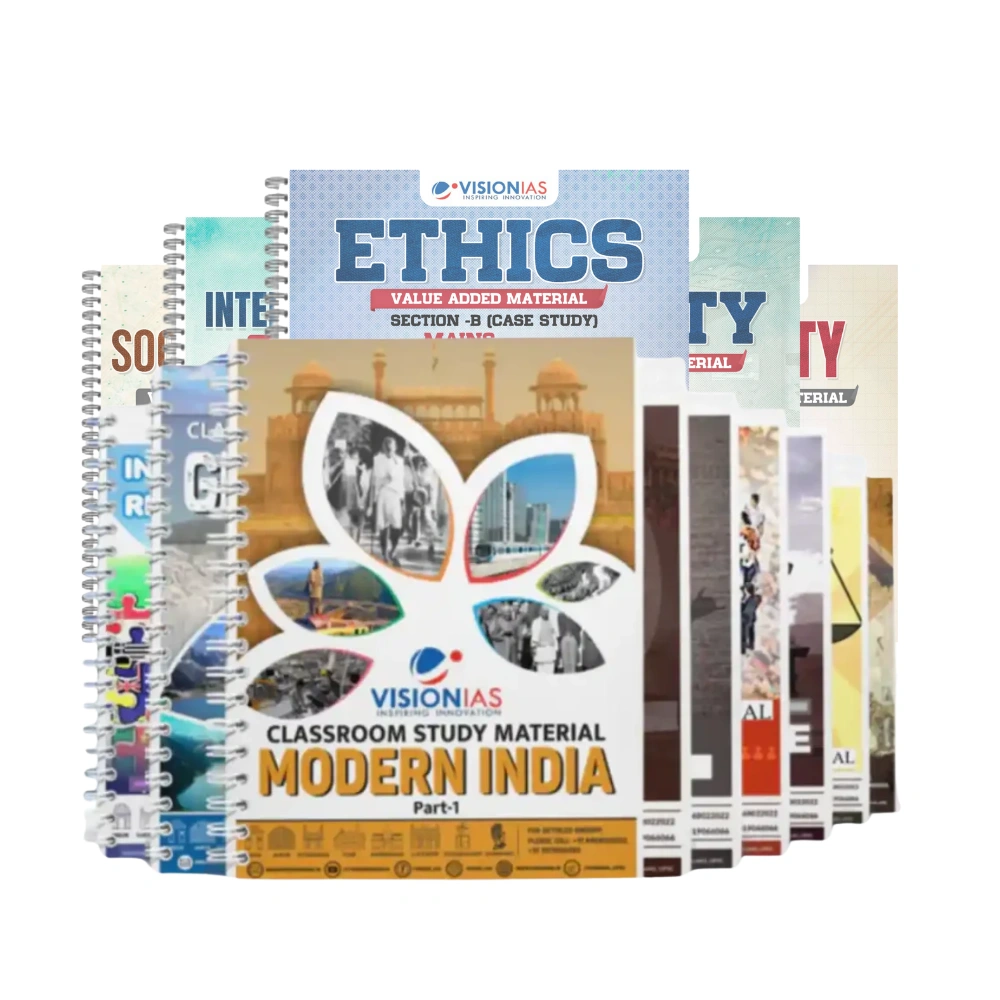
For the GS papers, a complete booklet set such as the Vision IAS GS 2026-27 booklets gives you ready, exam-oriented coverage of History, Polity, Geography, Economy, S&T and Environment that you can adapt directly to HCS answer-writing. For the standalone Ethics paper, the Drishti IAS Ethics notes compress theory, thinkers and case-study frameworks into a revisable format — invaluable now that GS-IV is a full 100-mark paper. And because the English & Essay paper rewards structured essays, the Vajiram Essay notes give you tested introductions, frameworks and topic banks you can reuse in both language papers.
HPSC Syllabus in Hindi: For Hindi-Medium Aspirants
Most pages ranking for hpsc syllabus in hindi are English-only — a real disservice, because Hindi & Essay (हिंदी एवं निबंध) is a compulsory 100-mark Mains paper and a large share of Haryana aspirants prepare in Hindi. If you are a Hindi-medium candidate, study the same six-paper structure but build your GS material in Hindi so your terminology and answer-writing stay consistent. The Drishti IAS Hindi study material covers the full GS spectrum in Hindi medium, which maps cleanly onto GS-I to GS-IV and supports the Hindi & Essay paper. Practise निबंध and precis weekly, and keep a Haryana GK notebook in Hindi so your factual recall and expression are aligned for both the written papers and the interview.
Stage-Wise Preparation Strategy & Timeline
A realistic 8–10 month plan, with material checkpoints, keeps you on track from foundation to final merit.
| Phase | Months | Focus | Checkpoint |
|---|---|---|---|
| Foundation | 1–3 | NCERTs + GS booklets (Polity, History, Geography, Economy) | One full read of GS notes done |
| Haryana layer | 2–5 | Build Haryana GK + state current affairs notebook | Haryana notebook v1 ready |
| Prelims push | 4–6 | PYQ + Prelims test series + CSAT qualifying practice | 10+ full-length mocks |
| Mains build | 5–8 | Answer writing for GS-I–IV, Ethics case studies, essays (Eng & Hindi) | Daily answer-writing habit |
| Revision & mocks | 7–9 | Revise notes, full Mains tests, essay practice | Multiple full Mains tests |
| Interview | After Mains | DAF, Haryana affairs, mock interviews | 3+ mock interviews |
Preparation Tips Built Around the New Pattern
- Make Haryana GK a daily ritual — it is the highest-ROI scoring area and appears at every stage.
- Do not neglect the language papers — with English & Essay and Hindi & Essay together worth 200 marks, weak language skills can cap your final score even with strong GS.
- Treat Ethics seriously — as a new 100-mark paper, GS-IV is where prepared candidates separate themselves; practise case studies, not just theory.
- Clear CSAT, don’t chase it — secure the 33% comfortably and redirect time to GS and Haryana.
- Write daily — Mains is descriptive; answer-writing and essay practice from month five onward is what converts knowledge into marks.
- Integrate current affairs — link national, international and Haryana developments to static GS topics.
Common Mistakes HCS Aspirants Make
- Treating HCS as just “UPSC-lite” and ignoring the Haryana-specific layer that actually decides ranks.
- Over-preparing CSAT (which is only qualifying) while under-preparing GS Paper I (which screens you).
- Starting answer-writing too late, then struggling to finish six descriptive papers in time.
- Underestimating the language papers and losing easy marks in English/Hindi essays.
- Relying only on scattered PDFs instead of a structured, revisable note set per paper.
- Skipping mock interviews and walking into a 75-mark Personality Test unprepared.
Download HPSC HCS Syllabus 2026 PDF
To get the official hpsc hcs syllabus pdf download, follow these steps:
- Visit the official HPSC portal at hpsc.gov.in.
- Open the latest HCS examination notification under the advertisements/notifications section.
- Download the attached detailed syllabus and scheme of examination (PDF).
- Cross-check the version against the current notification, because the Commission can revise the scheme between cycles.
For your own preparation, save this page’s pattern and Haryana checklist tables as a PDF (print to PDF from your browser) so you have a compact, exam-ready reference alongside the official document. If you want a clean syllabus reference to keep beside your notes, the GS Score syllabus booklet is a handy printed companion for the General Studies framework that HCS shares with UPSC.
Shortlisting Scheme & Important Points to Remember
- Prelims screens candidates (about 12–13× vacancies) on Paper I; CSAT only needs 33% to qualify.
- Mains shortlists about 1:3 (3× vacancies) for the interview on the basis of the six descriptive papers (600 marks).
- Final merit = Mains (600) + Interview (75) = 675 marks; Prelims marks do not count.
- Negative marking of 0.25 applies in Prelims objective papers.
- No optional subject in the new 2026 Mains pattern.
- Ethics (GS-IV) is now a standalone 100-mark paper.
- Haryana-specific GK is woven through every stage — prepare it as a core subject, not an afterthought.
Conclusion
The 2026 cycle is the cleanest HCS structure in years: a two-paper objective Prelims, six compulsory 100-mark Mains papers with no optional and a dedicated Ethics paper, and a 75-mark Personality Test. The candidates who convert are the ones who master the Haryana layer, write daily for the descriptive papers, respect both language papers, and revise from a structured note set rather than loose PDFs. Map each paper to solid material early, build your Haryana notebook from day one, and you give yourself a real shot at the merit list. Browse Competer’s GS booklets, Ethics notes and Hindi-medium study material to assemble your HCS 2026 prep kit in one place.
Frequently Asked Questions
What is the syllabus of HPSC HCS 2026?
The HPSC HCS 2026 syllabus spans three stages. Prelims has General Studies (Paper I) and CSAT (Paper II, qualifying). Mains has six compulsory 100-mark papers — English & Essay, Hindi & Essay, GS-I, GS-II, GS-III and GS-IV (Ethics) — totalling 600 marks. A 75-mark Personality Test follows. Haryana-specific History, Geography, Polity, Economy and current affairs run across all stages.
What is the new exam pattern of HCS after January 2026?
Under the January 2026 pattern, the optional subject is removed and Mains consists of six compulsory descriptive papers of 100 marks each (600 total): two language papers (English & Essay, Hindi & Essay) and four General Studies papers including a standalone Ethics paper. Prelims remains two objective papers, and the interview carries 75 marks, making the final merit out of 675.
Is CSAT qualifying in HPSC HCS Prelims?
Yes. CSAT (Prelims Paper II) is qualifying only — you must score at least 33% to clear it, but those marks are not used to rank you. Shortlisting for Mains is based solely on General Studies Paper I, so you should clear CSAT comfortably and focus your energy on GS and Haryana GK.
How many papers are there in HPSC HCS Mains and is there an optional?
There are six compulsory papers in HCS Mains — English & Essay, Hindi & Essay, GS-I, GS-II, GS-III and GS-IV (Ethics) — each worth 100 marks. There is no optional subject in the new 2026 pattern; every candidate writes the same six papers.
What are the Haryana-specific topics in the HCS syllabus?
Haryana topics include state history (Rakhigarhi, Kurukshetra, 1857 revolt, formation in 1966), geography (Yamuna and Ghaggar rivers, Aravalli, agro-climatic zones, NCR), polity and administration, the Haryana economy (agriculture, Gurugram industry), government schemes (Parivar Pehchan Patra, Beti Bachao Beti Padhao), art, culture, folk dances, sports achievements and Haryana current affairs.
How can I download the HPSC HCS syllabus PDF?
Visit the official HPSC website at hpsc.gov.in, open the latest HCS examination notification, and download the attached detailed syllabus and scheme of examination as a PDF. Verify it against the current notification, since the Commission may revise the scheme between cycles.
Are Prelims marks added to the final HCS merit?
No. Prelims is only a screening test — its marks are not added to the final merit. The final HCS merit list is prepared from Mains (600 marks) plus the Personality Test (75 marks), for a total of 675 marks. This is why your Mains answer-writing and interview performance matter far more than your Prelims margin.
What is the age limit and eligibility for HPSC HCS 2026?
Broadly, you need a bachelor’s degree from a recognised university and must generally be between 21 and 42 years of age, with category-wise relaxation as per HPSC rules. A pass in Hindi/Sanskrit at the matriculation or higher level is commonly required as well. Because the exact figures and relaxations are set in each notification, confirm them from the official HPSC advertisement before applying.
Is HPSC HCS tougher than UPSC?
HCS covers a similar General Studies framework to UPSC, so the static syllabus is comparable, but the competition pool is smaller and the optional subject has been removed for 2026, which simplifies preparation. The distinctive difficulty in HCS is the heavy Haryana-specific component that runs through every stage — candidates who prepare UPSC-style content but neglect the Haryana layer tend to underperform relative to their general knowledge.
Recommended Study Material
Continue Reading
Best Test Series for UPSC 2026: 9 Options Compared with Prices
The best test series for UPSC 2026 is Vision IAS for Prelims — the most representative difficulty, detailed…

UPSC Exam Pattern 2026: Prelims, Mains & Interview Marks
The UPSC exam pattern follows a three-stage structure: the Preliminary Examination (400 marks, objective screening), the Main Examination…
IBPS RRB Syllabus 2026: Clerk, PO, Scale I, II & III + PDF
The IBPS RRB syllabus covers five core subjects — Reasoning, Quantitative/Numerical Ability, General Awareness, English or Hindi Language,…