HPSC Syllabus 2026: HCS Prelims, Mains Pattern + PDF
HPSC syllabus 2026 for HCS: new 6-paper Mains pattern, Prelims & CSAT topics, marks, weightage, Haryana GK, booklist, month-wise plan and free PDF download.

The HPSC syllabus — the official Haryana Civil Services (HCS) syllabus — for the 2026 examination spans three stages: a Preliminary exam (Paper I General Studies + Paper II CSAT, which is only qualifying), a Main examination that has moved to a new pattern of six descriptive papers worth 600 marks, and a Personality Test (Interview) of 75 marks. The final merit list is built from Mains (600) plus Interview (75), while Prelims is purely a screening filter. This guide breaks down every topic stage-by-stage and adds past-trend weightage, Haryana-specific GK depth, a month-wise plan and a booklist most pages skip.
Whether you are attempting HCS for the first time or switching from a UPSC preparation base, understanding the hpsc hcs syllabus 2026 in full detail is the single highest-return activity before you buy a single book. Let us map the entire exam.
HPSC HCS 2026 Syllabus & Selection Process Overview
The Haryana Public Service Commission (HPSC) conducts the Combined Competitive Examination to recruit Class-I and Class-II officers of the Haryana state services, popularly called HCS. The haryana civil services syllabus runs through three watertight stages, and you must clear each to reach the next.
| Stage | Nature | Marks | Counts in Final Merit? |
|---|---|---|---|
| Preliminary Examination | Objective (screening) | Paper I: 100 marks + Paper II CSAT: qualifying | No — only for shortlisting |
| Main Examination | Descriptive (6 papers) | 600 marks | Yes |
| Personality Test / Interview | Viva-voce | 75 marks | Yes |
| Final Merit | Mains + Interview | 675 marks | — |
The most important 2026 change: HCS Mains now follows a UPSC-style General-Studies structure of six papers (two language papers plus GS I–IV), and there is no optional subject any more. This makes the exam more predictable and standard-source driven than the older optional-based format, which is good news for aspirants using structured GS material.
What Changed in the HPSC HCS Syllabus & Exam Pattern 2026
Confusion around the change is exactly where most websites leave aspirants stranded. Here is the clean old-vs-new comparison so you know precisely what you are preparing for under the hpsc hcs exam pattern 2026.
| Element | Old HCS Pattern | New 2026 HCS Pattern |
|---|---|---|
| Mains structure | Compulsory papers + 1 optional subject (2 papers) | 6 papers: English, Hindi, GS I, II, III, IV |
| Optional subject | Required (from a list) | Removed — General Studies only |
| GS papers | Fewer GS papers | Four GS papers (GS I–IV) of 100 marks each |
| Total Mains marks | Varied by optional | 600 marks (6 × 100) |
| Interview | 75 marks | 75 marks (unchanged) |
| Prelims CSAT | Counted earlier in some cycles | Qualifying only |
Bottom line: if a coaching page or PDF still tells you to “choose an HCS optional,” it is outdated. The 2026 cycle rewards broad, well-organised General Studies coverage plus strong Haryana GK — not deep single-subject specialisation.
HPSC HCS Prelims Syllabus & Exam Pattern
The Prelims is the gateway. It has two papers held on the same day, and both are objective (MCQ) type. Paper I is the scoring one that decides your shortlist rank; Paper II (CSAT) only needs to be passed.
| Paper | Subject | Questions | Marks | Duration | Nature |
|---|---|---|---|---|---|
| Paper I | General Studies | 100 | 100 | 2 hours | Merit-ranking |
| Paper II | CSAT (Aptitude) | 100 | 100 | 2 hours | Qualifying (min. 33%) |
Negative marking: Yes — one-fourth (1/4th) of the marks assigned to a question is deducted for every wrong answer in the Prelims. Unanswered questions carry no penalty, so intelligent, calculated attempting beats blind guessing.
HPSC HCS Prelims Paper I — General Studies Syllabus
The hpsc hcs prelims syllabus for Paper I is broad and closely mirrors the UPSC Prelims GS canvas, with an added, non-negotiable layer of Haryana-specific general knowledge. Core areas include:
- History of India & Indian National Movement — ancient, medieval, modern, freedom struggle.
- Indian Polity & Governance — Constitution, political system, Panchayati Raj, public policy, rights issues.
- Geography — India and World physical, social and economic geography.
- Economic & Social Development — sustainable development, poverty, inclusion, demographics, social-sector initiatives.
- General Science & Technology — everyday science, recent developments in science & tech.
- Environment & Ecology — biodiversity, climate change (general awareness, no subject specialisation needed).
- Current Events — national and international importance.
- Haryana General Knowledge — history, geography, economy, polity, art, culture and current affairs of Haryana.
Prelims GS Subject-Wise Weightage (Trend-Based)
Here is the gap-filler no other page gives you: an indicative weightage drawn from past HCS/state-PCS trends so you know where to invest revision hours. Treat these as directional, not official quotas.
| Subject Area | Approx. Questions | Yield |
|---|---|---|
| Haryana GK (history, geo, economy, culture, current) | 18–25 | High — the real differentiator |
| Polity & Governance | 12–16 | High |
| History & National Movement | 12–15 | High |
| Geography (India + World) | 10–14 | Medium-High |
| Economy & Social Development | 10–13 | Medium-High |
| Current Affairs (national/international) | 10–15 | High |
| Science & Tech + Environment | 8–12 | Medium |
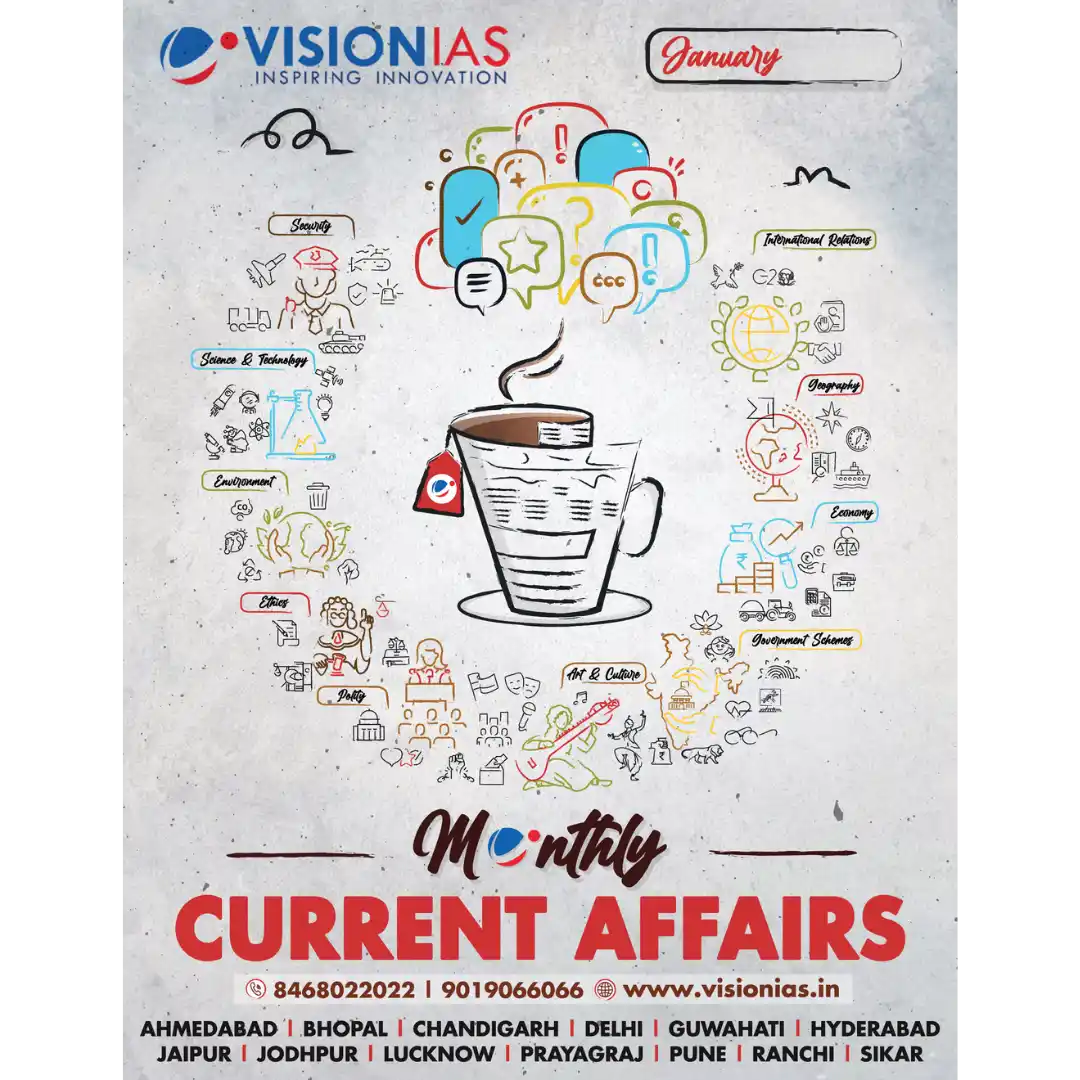
High-yield takeaway: Haryana GK plus current affairs together can decide 30+ questions. Aspirants who treat Haryana as a one-line bullet routinely miss the cut. Pair a standard GS foundation with a monthly current-affairs habit — a compilation such as the Vision IAS Current Affairs Magazine (January 2026) keeps national events organised while you build a separate Haryana notebook.
HPSC HCS Prelims Paper II — CSAT Syllabus
Paper II (CSAT) is qualifying — you need 33% but it will not add to your merit rank. Do not ignore it, though; every year candidates with strong GS scores are eliminated on CSAT. The syllabus covers:
- Comprehension
- Interpersonal skills including communication skills
- Logical reasoning and analytical ability
- Decision-making and problem-solving
- General mental ability
- Basic numeracy (numbers and their relations, orders of magnitude — Class X level)
- Data interpretation (charts, graphs, tables, data sufficiency — Class X level)
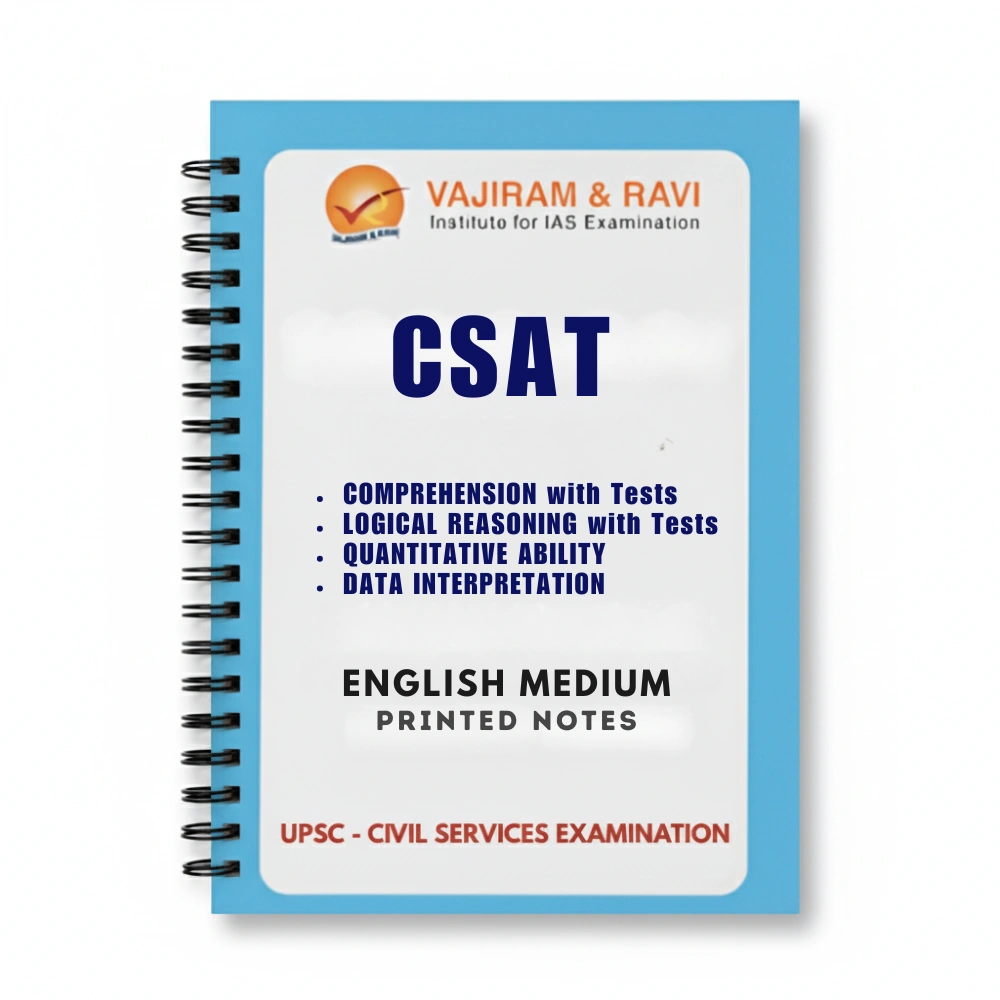
If your maths is rusty, do not gamble. A focused CSAT resource like the Vajiram CSAT Complete Booklet Set with practice questions covers comprehension, reasoning and DI in one place and is enough to comfortably clear the qualifying bar.
HPSC HCS Mains Syllabus & New 6-Paper Exam Pattern
The Mains is where ranks are made. Under the 2026 pattern the hpsc hcs mains syllabus is delivered through six descriptive papers, each of 100 marks and three hours, for a total of 600 marks. Two are language/qualifying-oriented papers and four are the merit-deciding General Studies papers.
| Paper | Subject | Marks | Duration |
|---|---|---|---|
| Paper A | English | 100 | 3 hours |
| Paper B | Hindi (in Devanagari script) | 100 | 3 hours |
| Paper I | General Studies I | 100 | 3 hours |
| Paper II | General Studies II | 100 | 3 hours |
| Paper III | General Studies III | 100 | 3 hours |
| Paper IV | General Studies IV (Ethics) | 100 | 3 hours |
| Total | Mains | 600 | — |
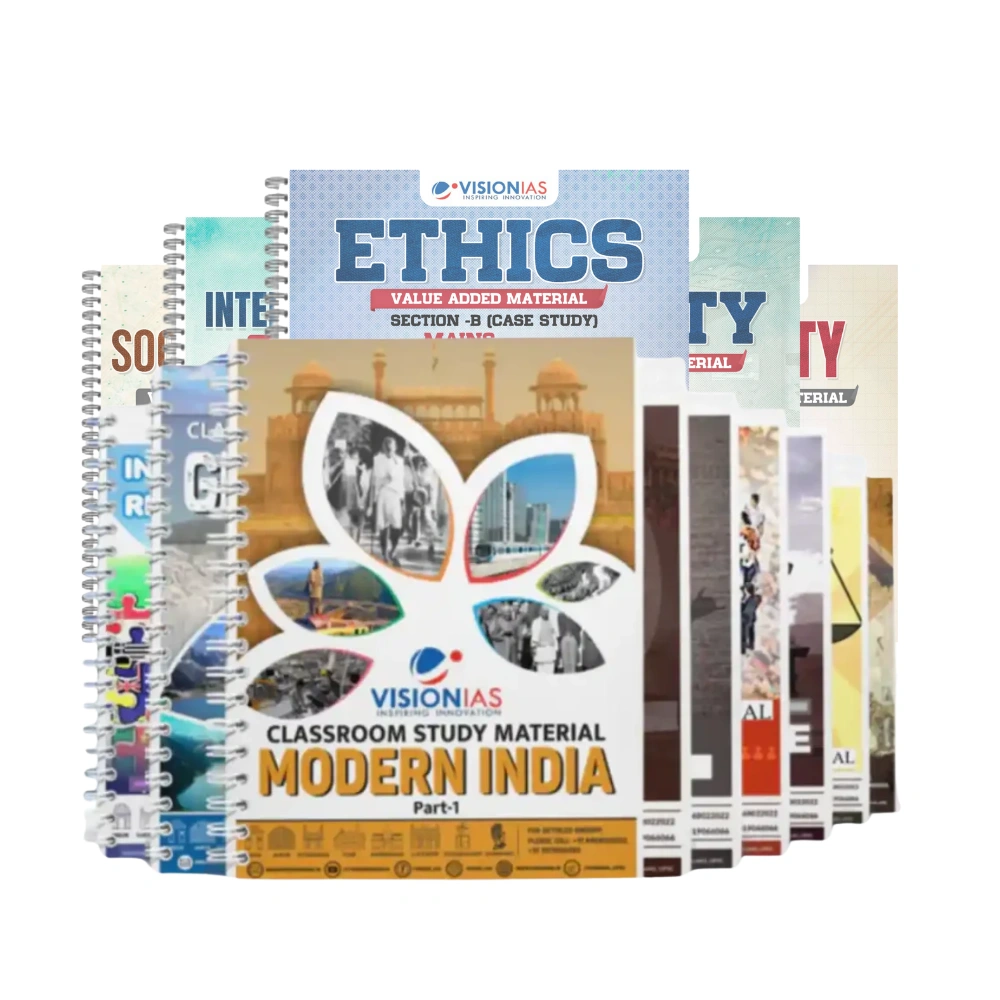
Because the structure now maps almost one-to-one onto the UPSC GS I–IV framework, well-structured UPSC General Studies material transfers directly. A comprehensive booklet set such as the Vision IAS GS 2026-27 Booklets (56 booklets with value-added material) covers the entire GS I–IV canvas; you then bolt on a dedicated Haryana module.
General Studies Paper I — Heritage, History, Society & Geography
- Indian culture — art forms, literature and architecture from ancient to modern times.
- Modern Indian history (mid-18th century onwards) — significant events, personalities, issues.
- The Freedom Struggle — its various stages and important contributors from across the country.
- Post-independence consolidation and reorganisation within the country.
- History of the world — industrial revolution, world wars, colonisation, decolonisation, political philosophies.
- Salient features of Indian society; diversity; role of women; population and associated issues; social empowerment; communalism, regionalism, secularism.
- Physical geography of the world; distribution of key natural resources; factors for location of industries.
- Geophysical phenomena — earthquakes, tsunamis, cyclones — and changes in geographical features.
General Studies Paper II — Polity, Constitution, Governance & IR
- Indian Constitution — historical underpinnings, evolution, features, amendments, basic structure.
- Functions and responsibilities of the Union and the States; federal structure; devolution to local levels.
- Separation of powers; dispute-redressal mechanisms; parliament and state legislatures.
- Executive and judiciary — structure, organisation and functioning; ministries and departments.
- Government policies and interventions for development in various sectors.
- Welfare schemes for vulnerable sections; mechanisms, laws, institutions for their protection.
- Governance, transparency and accountability; e-governance; citizens’ charters; role of civil services.
- India and its neighbourhood; bilateral, regional and global groupings; international institutions.
General Studies Paper III — Economy, Agriculture, Sci-Tech, Environment & Security
- Indian economy — planning, resource mobilisation, growth, development and employment.
- Inclusive growth, government budgeting and fiscal policy.
- Agriculture — cropping patterns, irrigation, storage, transport and marketing; e-technology for farmers; subsidies and MSP; food processing.
- Land reforms; effects of liberalisation; infrastructure — energy, ports, roads, airports, railways.
- Science and technology — developments and applications, indigenisation, IT, space, computers, biotech, IPR.
- Environment, conservation, pollution and environmental impact assessment; disaster management.
- Internal security — role of external state and non-state actors, communication networks, cyber security, money-laundering; security forces and their mandate.
General Studies Paper IV — Ethics, Integrity & Aptitude
- Ethics and human interface — essence, determinants and consequences of ethics in human action.
- Attitude — content, structure, function; moral and political attitudes; persuasion.
- Aptitude and foundational values for civil service — integrity, impartiality, objectivity, dedication to public service, empathy, tolerance and compassion.
- Emotional intelligence — concepts and their utility in administration and governance.
- Contributions of moral thinkers and philosophers from India and the world.
- Public/civil-service values and ethics in public administration; probity in governance; codes of conduct; RTI; challenges of corruption.
- Case studies on the above topics.
Language Papers — English & Hindi (Often Overlooked, Easily Scored)
The English and Hindi papers are under-explained on most pages, yet they are among the easiest places to protect marks. The Hindi paper must be answered in the Devanagari script. Both typically test:
- Essay / passage writing
- Précis writing (summarising a passage to a word limit)
- Comprehension of a given passage
- Grammar and usage / correction of sentences
- Translation (English to Hindi and vice-versa)
Treat these as qualifying-and-scoring: a candidate weak in one language can lose the exam despite excellent GS. Practising précis and translation for 20 minutes a day is enough for most aspirants.
Interview / Personality Test & Final Merit Calculation
Candidates who clear the Mains cut-off are called for the Personality Test, worth 75 marks. It assesses mental alertness, critical assimilation, clarity of expression, balance of judgement, leadership, and depth of interest — including knowledge of Haryana and current affairs. The final merit is computed as shown below.
| Component | Marks | Role |
|---|---|---|
| Mains (6 papers) | 600 | Counts in merit |
| Personality Test | 75 | Counts in merit |
| Grand Total | 675 | Final rank basis |
| Prelims | — | Screening only, not added |
Qualifying/minimum marks: Candidates must secure the commission-notified minimum in the language and GS papers; the CSAT in Prelims needs a minimum of 33%. Failing to meet minimum qualifying marks in any compulsory paper can lead to disqualification even if the aggregate is high.
Haryana-Specific GK: The Real HCS Differentiator
This is the section top-ranking pages skip — and it is exactly where HCS is won or lost. Unlike UPSC, HCS rewards deep knowledge of Haryana across both Prelims and the Interview. Build a dedicated Haryana notebook covering:
| Haryana GK Area | What to Cover |
|---|---|
| History | Ancient sites (Rakhigarhi), Kurukshetra, revolts of 1857, freedom movement figures, formation of Haryana (1966). |
| Geography | Rivers (Yamuna, Ghaggar), Aravalli range, agro-climatic zones, districts, soils, canals. |
| Economy | Agriculture & horticulture, industries (auto hub Gurugram/Faridabad), MSMEs, per-capita income, state budget highlights. |
| Polity & Administration | State legislature, districts & divisions, Panchayati Raj in Haryana, key state institutions. |
| Art & Culture | Folk dances (Phag, Loor, Saang), fairs & festivals, dialects, cuisine, sports culture. |
| Current Affairs | State schemes (education, women & agriculture initiatives), awards, sports achievements, recent government policies. |
Sources for Haryana GK: a standard Haryana GK book (English/Hindi), the state Economic Survey, Haryana government scheme portals, and a local newspaper for state current affairs. Maintain this as a living document you revise weekly.
Best Books & Source Mapping for HPSC HCS Preparation
Because the 2026 Mains is General-Studies-only, standard UPSC-grade GS material plus NCERTs plus a Haryana module is the winning combination. Here is a syllabus-unit-to-source map.
| Syllabus Unit | Recommended Source |
|---|---|
| Foundation (all subjects) | NCERTs, Classes 6–12 |
| History & Art/Culture | NCERT + standard modern history text + GS booklets |
| Polity & Governance | Laxmikanth-style polity + GS notes |
| Geography | NCERT + atlas + GS geography notes |
| Economy | NCERT + current economic survey highlights + GS economy notes |
| Prelims practice | Topic-wise PYQ + full-length mock tests |
| CSAT | Dedicated CSAT booklet + practice sets |
| Haryana GK | State GK book + Economic Survey + newspaper |
| Current Affairs | Monthly magazine + daily notes |
For consolidated GS coverage that doubles for Prelims and the new Mains, the Vision IAS GS 2026-27 booklets are a strong single-source base. For Prelims accuracy, working through Forum IAS’s Topic-Wise PYQ Toolkit (1992–2025) trains you on how objective questions are actually framed — the fastest way to convert reading into marks.
Month-Wise HPSC HCS Study Plan (Mapped to the Syllabus)
Another gap the top pages miss: an actual timeline. Here is a practical ~8-month plan you can compress or extend around the notification.
| Phase | Focus | Deliverable |
|---|---|---|
| Months 1–2 | NCERT foundation + Polity + Modern History; start Haryana notebook | Base notes ready |
| Months 3–4 | Geography, Economy, Environment, Sci-Tech; begin GS Mains answer notes | Full GS coverage once |
| Month 5 | Ethics (GS IV), language paper practice, deep Haryana GK | Mains framework built |
| Month 6 | CSAT practice + Prelims PYQ + first mock tests | Prelims readiness |
| Month 7 | Prelims full-length mocks, current affairs revision, Haryana revision | Peak for Prelims |
| Month 8+ | Post-Prelims: intensive Mains answer writing + language + interview prep | Mains & PT ready |
Prelims vs Mains Strategy & Common Mistakes
Prelims is a game of elimination and speed under 1/4th negative marking — accuracy and smart attempting matter more than knowing everything. Mains is a game of structured, time-bound answer writing across 600 marks in six papers. The skills are different, so your practice must be different: MCQ mocks for Prelims, daily answer writing for Mains.
- Ignoring Haryana GK — the most common and most costly error.
- Skipping CSAT until it is too late and getting eliminated on a qualifying paper.
- Chasing an “optional” that no longer exists in the 2026 pattern.
- No answer-writing practice — reading GS does not translate to Mains marks without written practice.
- Weak language-paper prep, especially Hindi in Devanagari for English-medium aspirants.
HPSC HCS Syllabus PDF Download & Official Reference
Always cross-check the final syllabus and pattern against the official notification for your cycle, as HPSC can revise details year to year. The authoritative source is the official commission website, hpsc.gov.in, where the detailed advertisement and syllabus are published. For a printable, single-file version combining the full stage-wise syllabus with the booklist above, use our hpsc hcs syllabus pdf download and keep it pinned above your study desk. Use the official PDF as the master and this guide as your strategy layer.
Frequently Asked Questions
What is the syllabus of HPSC HCS 2026?
The HPSC HCS 2026 syllabus has three stages: Prelims (Paper I General Studies of 100 marks plus a qualifying CSAT paper), Mains (six descriptive papers — English, Hindi and General Studies I–IV, 100 marks each, 600 total), and a 75-mark Personality Test. GS covers history, polity, geography, economy, science & tech, environment, ethics, current affairs and Haryana-specific GK.
What is the new exam pattern for HPSC HCS Mains?
Under the 2026 pattern, HCS Mains has six papers of 100 marks each and three hours each, totalling 600 marks: English, Hindi (in Devanagari), and General Studies I, II, III and IV. It is now a General-Studies-based format aligned closely with the UPSC GS structure.
How many papers are there in the HCS Mains exam?
There are six papers in the HCS Mains exam — two language papers (English and Hindi) and four General Studies papers (GS I to GS IV) — each carrying 100 marks for a combined 600 marks.
Is there an optional subject in the HCS Mains exam?
No. Under the new 2026 HCS Mains pattern there is no optional subject. The exam is entirely General-Studies-based across GS I–IV plus the two language papers, so you do not need to choose or prepare a separate optional.
Is there negative marking in the HPSC HCS Prelims?
Yes. In the HPSC HCS Prelims, one-fourth (1/4th) of the marks assigned to a question is deducted for each wrong answer. Unattempted questions attract no penalty, so calculated attempting is smarter than blind guessing.
What are the qualifying marks for HPSC HCS Prelims?
The CSAT (Paper II) in Prelims is qualifying and requires a minimum of 33%. Paper I (General Studies) is used to rank and shortlist candidates for the Mains, based on the cut-off set by the commission for each category and cycle.
How many stages are there in the HCS exam?
The HPSC HCS exam has three stages: the Preliminary examination (objective, screening only), the Main examination (six descriptive papers, 600 marks) and the Personality Test or Interview (75 marks). You must clear each stage to advance, and the final merit is based only on Mains plus Interview (675 marks).
Which books are best for HPSC HCS preparation?
Because the 2026 Mains is General-Studies-only, the strongest combination is NCERTs (Classes 6–12) for foundation, a standard polity text for Indian Polity, standard modern-history and geography sources, a consolidated GS booklet set for GS I–IV, a dedicated CSAT booklet, topic-wise PYQ for Prelims practice, and a Haryana GK book plus the state Economic Survey and a local newspaper for Haryana coverage. Add a monthly current-affairs magazine to keep national events organised, and match each source to a syllabus unit rather than hoarding books.
Recommended Study Material

Continue Reading
UPSC Ethics Syllabus (GS Paper 4): Topics, Marks + PDF 2026
The upsc ethics syllabus is the official topic list for General Studies Paper 4 — titled 'Ethics, Integrity…
Best Test Series for UPSC 2026: Ranked Comparison + Real Prices
The best test series for UPSC in 2026 is Vision IAS Prelims Test Series for question quality and…
NDA Syllabus 2026: Subject-Wise Maths & GAT + PDF
The NDA syllabus is set by UPSC and is divided into two papers written on the same day:…