UPSC Ethics Syllabus (GS Paper 4): Topics, Marks + PDF 2026
Complete UPSC ethics syllabus (GS Paper 4) 2026 — topic-wise table, 250-mark pattern, questions, thinkers list, case-study framework, booklist and printable PDF checklist.

The upsc ethics syllabus is the official topic list for General Studies Paper 4 — titled ‘Ethics, Integrity and Aptitude’ — a 250-mark paper written in 3 hours in the UPSC Civil Services Mains. In short, it covers nine areas: ethics & human interface, human values, attitude, aptitude and foundational civil-service values, emotional intelligence, moral thinkers, public-service values, probity in governance, and case studies. Unlike other GS papers it does not test facts; it tests your moral reasoning, values and decision-making through a theory section (Section A) and a case-studies section (Section B). Below you get the complete topic-by-topic breakdown, the exam pattern, marks and number of questions, the ethics-vs-integrity-vs-aptitude distinction, a moral-thinkers list, a case-study answer framework, the best booklist, and a clean printable one-page PDF checklist you can tick off.
UPSC Ethics Syllabus GS Paper 4: Quick Overview
GS Paper 4 was introduced in the 2013 Mains reform to make the civil services examination test not just what a candidate knows, but how a candidate thinks and acts when values conflict. It is the fourth of the four General Studies papers and carries the same weight as each of the others — 250 marks. What makes it distinctive is that a well-read but morally shallow answer scores poorly, while a simply written but ethically sound answer scores well. This is why toppers routinely call Ethics the most scoring paper in the entire Mains.
The paper is officially divided into two sections. Section A is theory-driven — it covers ethics, human values, attitude, aptitude, emotional intelligence, moral thinkers and probity in governance. Section B is fully applied — it presents 6 case studies drawn from real administrative and social dilemmas and asks you to resolve them. The official UPSC notification describes the paper as testing a candidate’s ‘attitude and approach to issues relating to integrity, probity in public life and problem-solving approach to various issues and conflicts faced by him in dealing with society.’
| Parameter | Detail |
|---|---|
| Paper name | General Studies Paper 4 — Ethics, Integrity & Aptitude |
| Total marks | 250 |
| Duration | 3 hours |
| Sections | Section A (Theory ~125 marks) + Section B (Case Studies ~125 marks) |
| Number of questions | ~12–14 (theory) + 6 case studies |
| Marking format | 10-mark (150 words) & 20-mark (250 words); case studies usually 20–25 marks each |
| Language | Answered in the medium opted for Mains |
| Nature | Qualitative/reasoning — tests moral compass, not memory |
Why Ethics Matters in the UPSC Mains
Across the nine Mains papers, Ethics is uniquely coachable in a short window and uniquely high-return. Because there is no fixed ‘correct’ body of facts, the difference between a 90/250 and a 130/250 is not more information — it is structure, clarity, real examples and a genuine ethical stance. Aspirants who treat Ethics seriously in the last three months often gain 30–40 marks over rivals who ignore it, and in an examination decided by single-digit margins that swing can change ranks by hundreds.
Ethics also feeds directly into the Personality Test (interview). The board frequently probes situational integrity — ‘What would you do if your senior asked you to sign an irregular file?’ — and the vocabulary, frameworks and thinkers you master for GS4 are exactly what let you answer with confidence. In that sense Ethics is a double-scoring investment.
Ethics vs Integrity vs Aptitude: What the Three Words Mean
The paper’s own title — ‘Ethics, Integrity and Aptitude’ — trips up many aspirants, so it is worth settling the difference before you study. The three are related but distinct, and examiners reward candidates who use each term precisely rather than interchangeably.
| Term | What it means | In the civil-service context |
|---|---|---|
| Ethics | The system of moral principles that decides what is right or wrong conduct | The broad framework — determinants and consequences of an official’s actions, and the values guiding them |
| Integrity | Consistency between one’s values, words and actions — being honest even when unobserved | A foundational value: refusing bribes, resisting undue pressure, keeping public and private conduct aligned |
| Aptitude | A natural or trained capacity and orientation for a role | The disposition suited to public service — dedication, impartiality, objectivity, empathy and compassion |
Put simply, ethics is the whole moral map, integrity is walking your talk on it, and aptitude is the temperament that makes you fit to serve on it. GS Paper 4 tests all three together — which is why it is named for all three.
Full GS Paper 4 Exam Pattern: Marks, Questions & Sections
Understanding the structure is the first step in preparation, because it dictates how you allocate your three hours. The paper is not sub-divided into fixed marks on the question paper, but in practice the split between Section A and Section B is close to 50:50. Below is the pattern consistently seen in recent years.
| Section | Content | Approx. marks | Question type |
|---|---|---|---|
| Section A | Theory: ethics, values, attitude, EI, thinkers, probity | ~120–130 | 10-mark (150 words) & 20-mark (250 words) |
| Section B | 6 case studies on administrative & social dilemmas | ~120–130 | ~20–25 marks each, sub-parts (a),(b),(c) |
| Total | Full paper | 250 | 3 hours, ~1.4 marks per minute |
A practical time budget: spend about 80 minutes on Section A and 90–95 minutes on Section B, keeping the case studies well-fed because they are where discrimination between candidates is sharpest. Never leave a case study half-answered — an incomplete decision costs more than a shorter but complete one.
Complete UPSC Ethics Syllabus: Topic-Wise Breakdown
This is the heart of the page — the complete upsc ethics integrity and aptitude syllabus exactly as notified by UPSC, expanded into sub-topics so nothing is missed. The official syllabus lists eight broad themes plus case studies. Study them in the order below; each builds on the previous one.
| # | Syllabus theme (official) | Key sub-topics to cover |
|---|---|---|
| 1 | Ethics & Human Interface | Essence, determinants and consequences of ethics in human actions; dimensions of ethics; ethics in private and public relationships |
| 2 | Human Values | Lessons from lives and teachings of great leaders, reformers and administrators; role of family, society and educational institutions in inculcating values |
| 3 | Attitude | Content, structure, function; influence and relation with thought and behaviour; moral and political attitudes; social influence and persuasion |
| 4 | Aptitude & Foundational Values for Civil Service | Integrity, impartiality and non-partisanship, objectivity, dedication to public service, empathy, tolerance and compassion towards the weaker sections |
| 5 | Emotional Intelligence | Concepts, and their utilities and application in administration and governance |
| 6 | Moral Thinkers & Philosophers | Contributions of moral thinkers and philosophers from India and the world |
| 7 | Public / Civil Service Values & Ethics in Public Administration | Status and problems; ethical concerns and dilemmas in government and private institutions; laws, rules, regulations and conscience as sources of ethical guidance; accountability and ethical governance; strengthening of ethical and moral values in governance; ethical issues in international relations and funding; corporate governance |
| 8 | Probity in Governance | Concept of public service; philosophical basis of governance and probity; information sharing and transparency in government, RTI, codes of ethics, codes of conduct, citizen’s charters, work culture, quality of service delivery, utilization of public funds, challenges of corruption |
| 9 | Case Studies | Case studies on the above issues (Section B) |
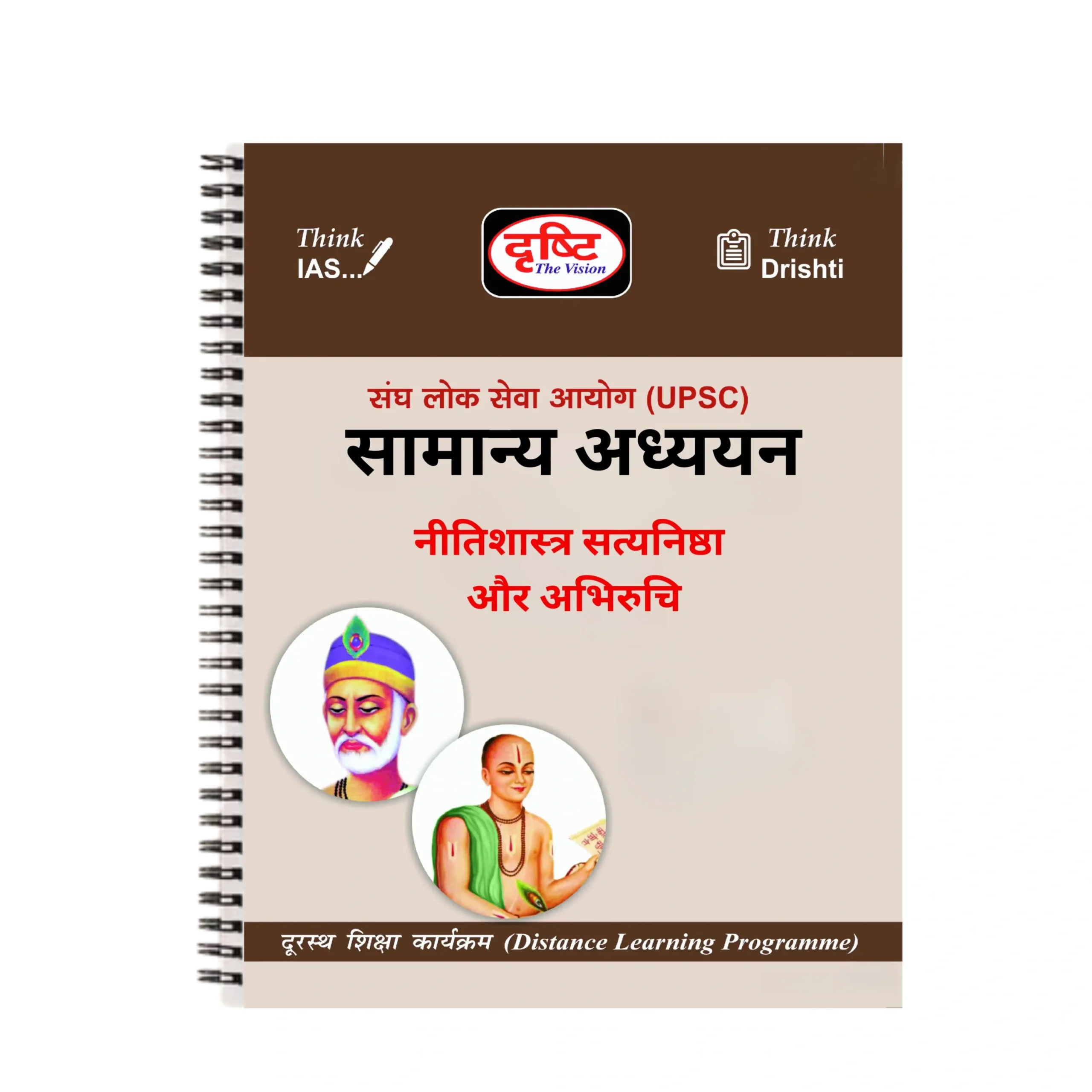
A curated GS4 notes set that follows exactly this official ordering saves weeks of assembling scattered material. Compact, tested printed notes such as the Drishti IAS Ethics Notes map one-to-one to these nine heads, which is why many aspirants use them as their single spine for GS4, supplementing only with current examples.
Section-by-Section Key Themes Explained
Ethics & Human Interface asks what makes an action right or wrong and where our sense of right comes from — conscience, law, religion, society. Human Values is best prepared by keeping a one-page note on 12–15 leaders (Gandhi, Ambedkar, Kalam, Nelson Mandela, Mother Teresa) with the specific value each embodies. Attitude and Emotional Intelligence are the most ‘psychology-flavoured’ parts and reward crisp definitions plus a governance example. Foundational values — integrity, impartiality, objectivity, empathy, compassion, dedication, tolerance, non-partisanship — appear almost every year and must be defined in one line each with a real IAS/IPS example ready.
Applied & Specialized Ethics Areas You Must Cover
Beyond the eight official heads, examiners increasingly frame theory questions and case studies around applied ethics — the branches where general principles meet a specific domain. Most competitor pages skip these; covering them is a direct scoring edge.
| Applied area | What to prepare |
|---|---|
| Corporate governance | Board accountability, whistleblower protection, CSR, conflicts of interest, insider trading |
| Environmental ethics | Intergenerational equity, sustainable development, anthropocentrism vs eco-centrism, climate justice |
| Biotechnology & bioethics | Gene editing, clinical trials, consent, GM crops, data privacy in health |
| Animal rights | Speciesism, welfare vs rights, cruelty in testing and food |
| Child labour | Rights of the child, dignity, poverty vs schooling trade-offs |
| Ageing & elderly care | Dignity, duty to parents, institutional vs family care |
| Euthanasia | Autonomy, sanctity of life, passive vs active, living wills |
| Media ethics | Truth, privacy, paid news, sensationalism, sting operations |
You do not need book-length depth here — a single page per area, with two arguments for, two against, and one Indian example, is enough to lift a case study from average to distinctive.
Indian & Western Moral Thinkers: The Consolidated List
Aspirants constantly search for a single, quotable list of thinkers because Section A rewards you for linking a value to a philosopher. Keep this table on your revision wall — one line per thinker is exactly the depth GS4 needs.
| Thinker | Tradition | Core contribution in one line |
|---|---|---|
| Mahatma Gandhi | Indian | Truth (satya) and non-violence (ahimsa) as means and ends; means must be as pure as ends |
| B. R. Ambedkar | Indian | Justice, social equality and constitutional morality over social morality |
| Kautilya (Chanakya) | Indian | Ethical statecraft; welfare of the people as the ruler’s dharma (Arthashastra) |
| Swami Vivekananda | Indian | Service to humanity as service to God; strength and self-realisation |
| Thiruvalluvar | Indian | Virtue, wealth and love in balanced living (Thirukkural) |
| Aristotle | Western | Virtue ethics — the golden mean; character built by habit |
| Immanuel Kant | Western | Deontology — act only on maxims you could will as universal law; duty for duty’s sake |
| Jeremy Bentham / J.S. Mill | Western | Utilitarianism — the greatest happiness of the greatest number |
| John Rawls | Western | Justice as fairness; the ‘veil of ignorance’ thought experiment |
| Socrates | Western | An unexamined life is not worth living; virtue is knowledge |
| Plato | Western | Justice as harmony of the soul and the just state |
Practise attaching one thinker to each foundational value — Kant to integrity, Rawls to impartiality and justice, Aristotle to character-building, Gandhi to means-ends purity. That single habit visibly raises answer quality.
Topic-Wise PYQ & Weightage Trend Analysis
Almost no ranking page tells you which sub-topics repeat and how many marks they fetch. Based on the last several years of GS4 papers, here is the practical weightage pattern so you study by return-on-effort, not alphabetically.
| Sub-topic | Typical weightage (Section A) | Repeat trend |
|---|---|---|
| Foundational values (integrity, objectivity, empathy) | High — 30–40 marks | Almost every year, often as definition + example |
| Attitude & Emotional Intelligence | Medium — 20–30 marks | Frequent, usually paired with an application |
| Probity in governance (RTI, corruption, transparency) | High — 25–35 marks | Very frequent, strong current-affairs overlap |
| Ethical dilemmas & conflict of interest | High | Recurs in both theory and case studies |
| Quotes & keyword-based questions | Medium — 10–20 marks | Rising trend; interpret a given quotation |
| Moral thinkers | Low–Medium | Occasional direct question; heavy indirect use |
| Case studies (Section B) | Very high — ~125 marks | Always; the single biggest scoring block |
Read the trend clearly: foundational values, probity and case studies together carry the paper. Devote most of your revision energy there and keep thinkers as a support layer. Since probity questions lean on current examples, a monthly digest like the Vision IAS Current Affairs Magazine gives you fresh corruption, RTI and governance cases to quote.
How to Write Case Studies: A Step-by-Step Framework
Section B is where marks are won or lost, yet it is the most under-explained part on rival pages. A case study gives you a realistic dilemma, lists sub-questions, and expects a reasoned decision. Use this five-step framework every single time so your structure is automatic under exam pressure.
| Step | What to do | Why it scores |
|---|---|---|
| 1. Identify stakeholders | List everyone affected — you, seniors, public, victim, institution | Shows sensitivity to consequences |
| 2. State the ethical dilemma | Name the conflicting values (e.g. loyalty vs law, compassion vs rules) | Proves you grasped the core, not just facts |
| 3. List available options | Give 3–4 realistic courses of action | Demonstrates balanced, non-idealistic thinking |
| 4. Evaluate each option | Weigh merits/demerits against law, rules and conscience | Displays reasoning — the actual marking criterion |
| 5. Take a clear decision | Choose one, justify it, add safeguards/follow-up | Examiners reward a firm, principled, practical stand |
A Solved Case-Study Example (Condensed)
Case: As a District Collector you discover that a large, politically backed contractor has used sub-standard material in a flood-relief embankment; the monsoon is two weeks away and re-tendering will take a month. Stakeholders: at-risk villagers, the contractor, your political superiors, your own integrity, the state exchequer. Dilemma: public safety vs political pressure and time constraint. Options: (a) ignore and hope; (b) order immediate independent inspection and emergency reinforcement while initiating action against the contractor; (c) quietly report upward and wait. Evaluation & decision: Option (b) protects lives (the paramount value), upholds the law, and is feasible via emergency provisions; you would document everything, requisition an alternative agency for urgent reinforcement, and recommend blacklisting. This structure — safety first, law respected, decision defended with a practical safeguard — is exactly what earns full marks.
Ethics Keyword, Quote & Terminology Bank
A ready vocabulary lifts every answer. Sprinkle these precisely (never as stuffing) and pair a quote with a value where it fits.
| Category | Use in answers |
|---|---|
| Power terms | Probity, rectitude, conscientiousness, moral courage, constitutional morality, spirit of service |
| Dilemma language | Conflict of interest, competing loyalties, means-ends debate, lesser of two evils |
| Governance terms | Transparency, accountability, citizen’s charter, code of conduct, whistleblower, RTI |
| Quotes | Gandhi: ‘A customer is the most important visitor…’; Kant: ‘Act only on that maxim…’; Mandela: ‘A good head and a good heart…’ |
Best Books for UPSC Ethics Preparation
You need one core book plus a supplement — not a stack. Over-reading Ethics wastes time better spent on answer-writing.
| Resource | Best for |
|---|---|
| Lexicon for Ethics (Niraj Kumar) | Fast, exam-oriented coverage of all terms and heads |
| Ethics, Integrity & Aptitude (Subba Rao & P. N. Roy Chowdhury) | Deeper conceptual clarity and examples |
| 2nd ARC Reports (esp. ‘Ethics in Governance’) | Probity, corruption, governance reforms — quote directly |
| Coaching GS4 printed notes | Consolidated, revision-friendly single spine |
| Monthly current affairs | Fresh probity and governance examples for case studies |
If you prefer one consolidated, revision-ready spine over assembling multiple books, a full GS package such as the Vision IAS GS 2026-27 Booklets includes the Ethics component alongside the rest of Mains, while the standalone Drishti IAS Ethics Notes work well for candidates who only want to strengthen GS4. To be certain your topic list matches the latest notification, the GS Score Latest Syllabus Booklet 2026-27 is a handy printed reference.
Preparation Strategy & Time Management
The winning approach to the upsc ethics syllabus gs paper 4 is answer-writing led, not reading-led. Read a head once, then immediately practise questions on it. Ethics rewards application, so every concept you learn must be attached to (a) a real example, (b) a thinker or quote, and (c) a governance context.
How to Prioritise Topics
Front-load foundational values, probity and case studies — they carry the most marks. Keep attitude, EI and thinkers as a second layer. Applied ethics (environment, media, bioethics) is your finishing polish. Maintain one personal ‘example bank’ notebook: 30–40 real stories (officers, movements, court cases) you can plug into any answer.
How to Prepare from Scratch — and in Just 1 Month
Starting from zero is not a handicap in Ethics, because there is no vast factual base to build. If you have a full cycle, spend the first fortnight reading one core book cover to cover to internalise the vocabulary, then shift permanently into answer-writing mode. If you have only a month, invert the ratio: skim theory in the first week, then write daily. A realistic one-month plan is — Week 1: skim all nine heads and start an example bank; Week 2: master foundational values and probity in depth; Week 3: two case studies every day using the five-step framework; Week 4: full-length papers plus revision of quotes, keywords and thinkers. The 30-day and 60-day tables below turn this into a day-by-day schedule.
30-Day and 60-Day Study Plan
| Phase | 60-day plan | 30-day crash plan |
|---|---|---|
| Week 1 | Ethics & human interface, human values, thinkers list | All theory heads skim + build example bank |
| Week 2 | Attitude, aptitude, foundational values, EI | Foundational values + probity in depth |
| Week 3 | Public service values, probity, applied ethics | Daily case-study practice (2/day) |
| Week 4 | Case-study framework + 2 case studies daily | Full-length paper + revision of quotes/keywords |
| Weeks 5–8 | Two full papers weekly, refine example bank, revise | — |
Micro-Syllabus Checklist & Printable PDF
Use this tick-list as your one-page ‘have I covered everything?’ audit. Copy it into a document and print it — it is the clean, printable upsc mains ethics syllabus pdf checklist that ranking pages promise but rarely deliver.
- Ethics & human interface — essence, determinants, consequences, dimensions
- Human values — leaders, family, society, education
- Attitude — structure, function, moral & political attitudes, persuasion
- Aptitude & foundational values — integrity, impartiality, objectivity, empathy, dedication, compassion, tolerance, non-partisanship
- Emotional intelligence — concept + governance application
- Moral thinkers — Indian & Western, one line each
- Public/civil service values — dilemmas, accountability, corporate & international ethics
- Probity in governance — RTI, transparency, codes of conduct, citizen’s charter, corruption, public funds
- Applied ethics — corporate, environmental, bioethics, animal rights, child labour, ageing, euthanasia, media
- Case studies — five-step framework practised on 40+ cases
- Example bank — 30–40 real stories ready
- Quote & keyword bank memorised
Tick every line before the exam and you will have covered the entire upsc ethics syllabus topics list with nothing left to chance.
Common Mistakes to Avoid in Ethics
First, writing preachy, idealistic answers with no practical safeguard — examiners want realism. Second, ignoring Section B until the last week; case studies need weeks of practice. Third, over-quoting without linking the quote to the argument. Fourth, giving vague decisions in case studies — always commit to one clear, justified course. Fifth, neglecting current affairs, which leaves probity answers dry. Avoid these five and you are already ahead of most candidates.
Final Thoughts: Making Ethics Your Highest-Scoring Paper
The upsc ethics syllabus is finite, coachable and — with disciplined answer-writing — the most reliable place to gain marks in the entire Mains. Master the nine official heads, keep a living example bank, drill the case-study framework, and revise your thinker and quote lists weekly. With the countdown to UPSC Mains 2026 already on, a candidate who commits eight focused weeks to GS4 can realistically move from average to top-quartile on this paper. Pair a consolidated notes spine with monthly current affairs, practise relentlessly, and let Ethics carry your rank.
Frequently Asked Questions
What is the syllabus of ethics in UPSC?
The UPSC ethics syllabus (GS Paper 4) covers nine areas: ethics and human interface, human values, attitude, aptitude and foundational values of civil service, emotional intelligence, moral thinkers and philosophers, public/civil service values and ethical dilemmas, probity in governance (RTI, transparency, codes of conduct, corruption), and case studies applying all of these.
How many marks is the ethics paper (GS Paper 4) in UPSC?
GS Paper 4 carries 250 marks and is written in 3 hours. It is split roughly evenly between Section A (theory, about 125 marks) and Section B (six case studies, about 125 marks), making it equal in weight to every other General Studies paper in the Mains.
How many questions come in GS Paper 4 Ethics?
The paper typically has around 12–14 theory questions in Section A (a mix of 10-mark/150-word and 20-mark/250-word answers) plus 6 case studies in Section B, each usually worth 20–25 marks and often broken into sub-parts (a), (b) and (c).
Which book is best for UPSC Ethics preparation?
Lexicon for Ethics by Niraj Kumar and Ethics, Integrity & Aptitude by Subba Rao & P. N. Roy Chowdhury are the two most recommended books, supported by the 2nd ARC report on ‘Ethics in Governance’. Many aspirants add a consolidated coaching notes set and a monthly current-affairs magazine for fresh case-study examples.
Is the ethics paper easy to score in UPSC?
Ethics is widely considered the most scoring GS paper because it tests reasoning rather than facts, so a clearly structured answer with real examples, thinkers and a firm decision scores well. Candidates who practise answer-writing and case studies for even two months often gain 30–40 marks over those who neglect it.
How do I prepare for UPSC Ethics in one month or from scratch?
Starting from scratch, skim all nine heads in the first week to learn the vocabulary, then switch to daily answer-writing. In a one-month plan: Week 1 skim theory and build an example bank; Week 2 master foundational values and probity; Week 3 write two case studies a day using the five-step framework; Week 4 attempt full papers and revise quotes, keywords and thinkers. Application beats reading — every concept should carry an example, a thinker and a governance context.
What is the difference between ethics, integrity and aptitude?
Ethics is the broad system of moral principles that decides right from wrong; integrity is consistency between your values, words and actions — honesty even when unobserved; and aptitude is the trained disposition suited to public service, such as impartiality, objectivity, empathy and dedication. GS Paper 4 is named after all three because it tests the moral framework, the honesty to uphold it, and the temperament to serve by it together.
How do I write case studies in the UPSC Ethics paper?
Use a five-step framework: identify all stakeholders, state the exact ethical dilemma (the conflicting values), list 3–4 realistic options, evaluate each against law, rules and conscience, then commit to one clear decision with practical safeguards. A firm, principled and feasible stand earns the highest marks.
Recommended Study Material
Continue Reading
UPSC Prelims Syllabus 2026: GS Paper 1 + CSAT Topics, Pattern & PDF Download
The UPSC Prelims syllabus for the Civil Services Examination (CSE) 2026 has two objective papers: General Studies Paper…
RPSC RAS Syllabus 2026: Prelims & Mains Pattern + PDF (Hindi & English)
The RPSC RAS syllabus follows a three-stage selection process — Prelims (1 objective paper of 200 marks), Mains…
DSSSB Syllabus 2026: PRT, TGT, PGT & Non-Teaching + PDF
The DSSSB syllabus is built around two clear parts: Section A — General Aptitude (100 marks) covering General…