IBPS Clerk Syllabus 2026: Prelims, Mains + Free PDF
Complete IBPS Clerk syllabus 2026: prelims & mains exam pattern, subject-wise topics, weightage tables, free PDF download & a 60-day study plan.

The IBPS Clerk syllabus covers three sections in Prelims — English Language, Numerical Ability and Reasoning Ability (100 questions, 100 marks, 60 minutes) — and four sections in Mains — Reasoning & Computer Aptitude, English Language, Quantitative Aptitude and General/Financial Awareness (160 questions, 200 marks, 125 minutes). Selection runs Prelims → Mains → Local Language Proficiency Test, there is no interview, your final merit is decided only by the Mains score, and every wrong answer carries a 0.25 negative-marking penalty.
This guide breaks down the complete ibps clerk syllabus 2026 section by section, the revised exam pattern for both stages, topic-wise weightage based on recent-year question trends, high-priority versus skippable topics, a 60-day study plan, and a free one-click syllabus PDF. Whether you are starting fresh or revising, everything you need to plan preparation is here. Exact marks and timing can vary by cycle, so always cross-check the official IBPS notification before your attempt.
IBPS Clerk Syllabus 2026 at a Glance
If you only read one section, read this. The table below is the fastest answer to “what is the syllabus for IBPS Clerk 2026” and the overall structure of the exam.
| Key Fact | Details |
|---|---|
| Post | Clerk (Clerical cadre / Customer Service Associate) |
| Stages | Prelims → Mains → Local Language Proficiency Test |
| Interview | No interview |
| Prelims | 3 sections, 100 questions, 100 marks, 60 minutes |
| Mains | 4 sections, 160 questions, 200 marks, 125 minutes |
| Negative marking | 0.25 per wrong answer (both stages) |
| Merit basis | Mains score only (Prelims & LPT are qualifying) |
| Prelims subjects | English, Numerical Ability, Reasoning Ability |
| Mains subjects | Reasoning & Computer Aptitude, English, Quantitative Aptitude, General/Financial Awareness |
IBPS Clerk 2026 Overview and Selection Process
IBPS (Institute of Banking Personnel Selection) conducts the Clerk (Clerical cadre / Customer Service Associate) recruitment every year to fill vacancies across participating public sector banks. The Common Recruitment Process (CRP Clerks) for 2026 follows a two-stage online examination followed by a language test. Unlike IBPS PO, the Clerk exam has no interview stage — your final merit is decided entirely by your Mains score.
The selection journey has three clear steps:
- Preliminary Examination — a qualifying screening test; marks are not counted in the final merit.
- Main Examination — the decisive stage; your Mains score determines final selection.
- Local Language Proficiency Test (LPT) — a qualifying check of the official language of the state you applied for.
| Stage | Type | Counts in Final Merit? |
|---|---|---|
| Preliminary Exam | Objective, online | No (qualifying only) |
| Main Exam | Objective, online | Yes (100%) |
| Local Language Proficiency Test | Language verification | No (qualifying only) |
Because Prelims is only a gateway, smart aspirants clear it comfortably and pour their energy into Mains, where the competition is actually decided.
IBPS Clerk Exam Pattern 2026 (Prelims and Mains)
Understanding the ibps clerk exam pattern 2026 is the first step to building a section-wise strategy. The Prelims is a fast, sectional-timed screening; the Mains is longer, tougher, and includes two sections not tested in Prelims — Computer Aptitude and General/Financial Awareness.
IBPS Clerk Prelims Exam Pattern
The ibps clerk prelims syllabus is assessed across three sections in 60 minutes, with a strict 20-minute sectional time limit for each section — you cannot move back and forth between sections.
| Section | Questions | Marks | Time (Sectional) |
|---|---|---|---|
| English Language | 30 | 30 | 20 minutes |
| Numerical Ability | 35 | 35 | 20 minutes |
| Reasoning Ability | 35 | 35 | 20 minutes |
| Total | 100 | 100 | 60 minutes |
IBPS Clerk Mains Exam Pattern 2026 (Revised)
The revised ibps clerk mains syllabus is tested across four sections in a composite 125-minute paper of 160 questions for 200 marks. The notable change in recent cycles is that Quantitative Aptitude now carries 50 marks (up from 35), raising the weight of numerical skills in the final merit.
| Section | Questions | Marks | Time |
|---|---|---|---|
| Reasoning Ability & Computer Aptitude | 40 | 60 | 45 minutes |
| English Language | 40 | 40 | 35 minutes |
| Quantitative Aptitude | 40 | 50 | 45 minutes |
| General/Financial Awareness | 40 | 50 | 35 minutes |
| Total | 160 | 200 | 125 minutes |
The four sections are individually timed; the aggregate composite duration is 125 minutes for the objective test. Always confirm the exact split in the official notification before your attempt.
Is There Negative Marking in IBPS Clerk?
Yes. There is a negative marking of 0.25 marks for every wrong answer in both Prelims and Mains. Questions left unanswered carry no penalty. This makes accuracy as important as speed — blind guessing on a 1-mark question risks a 0.25 deduction, so attempt only what you can reason through confidently.
IBPS Clerk Syllabus: Subject-Wise Topics (All Sections)
Below is the complete ibps clerk subject wise syllabus topics breakdown. The English, Reasoning and Quantitative sections appear in both stages (Mains is harder); Computer Aptitude and General/Financial Awareness appear only in Mains.
English Language Syllabus
- Reading Comprehension (passage-based, including economy/banking themes)
- Cloze Test and fillers (single and double blanks)
- Error Spotting / Sentence Correction
- Para Jumbles and sentence rearrangement
- Grammar (tenses, articles, prepositions, subject-verb agreement)
- Vocabulary (synonyms, antonyms, idioms, word usage)
- Phrase Replacement and sentence improvement
Reasoning Ability Syllabus
- Puzzles (floor, box, scheduling, comparison-based)
- Seating Arrangement (linear, circular, parallel rows)
- Syllogism
- Coding-Decoding
- Blood Relations
- Inequalities (direct and coded)
- Alphanumeric / Number Series and direction sense
- Order and Ranking, data sufficiency
Numerical / Quantitative Aptitude Syllabus
- Simplification and Approximation
- Data Interpretation (tables, bar, line, pie, caselet)
- Number Series (missing and wrong number)
- Arithmetic — Percentage, Ratio & Proportion, Average, Ages
- Simple Interest & Compound Interest
- Profit, Loss & Discount
- Time & Work, Time-Speed-Distance, Pipes & Cisterns
- Mensuration, Partnership, Mixtures & Alligation, Probability
- Quadratic Equations
Computer Aptitude Syllabus (Mains Only)
- Computer fundamentals — hardware and software basics
- Generations and history of computers
- Input/Output devices and memory (RAM, ROM, cache, storage)
- MS Office (Word, Excel, PowerPoint) shortcuts and features
- Operating systems and file management
- Networking, internet, LAN/WAN basics
- Computer abbreviations and terminology
- Basics of DBMS and cyber security awareness
General / Financial Awareness Syllabus (Mains Only)
- Current Affairs of the last 5-6 months (national and international)
- Banking & financial awareness — types of banks, accounts, NPAs, CRR/SLR/repo rate
- Regulatory bodies — RBI, SEBI, IRDAI, NABARD functions
- Banking terms and abbreviations (NEFT, RTGS, IMPS, UPI, KYC)
- Government schemes (PMJDY, PM Mudra, Atal Pension, etc.)
- Static GK — capitals, currencies, important days, awards
- Union Budget and Economic Survey highlights
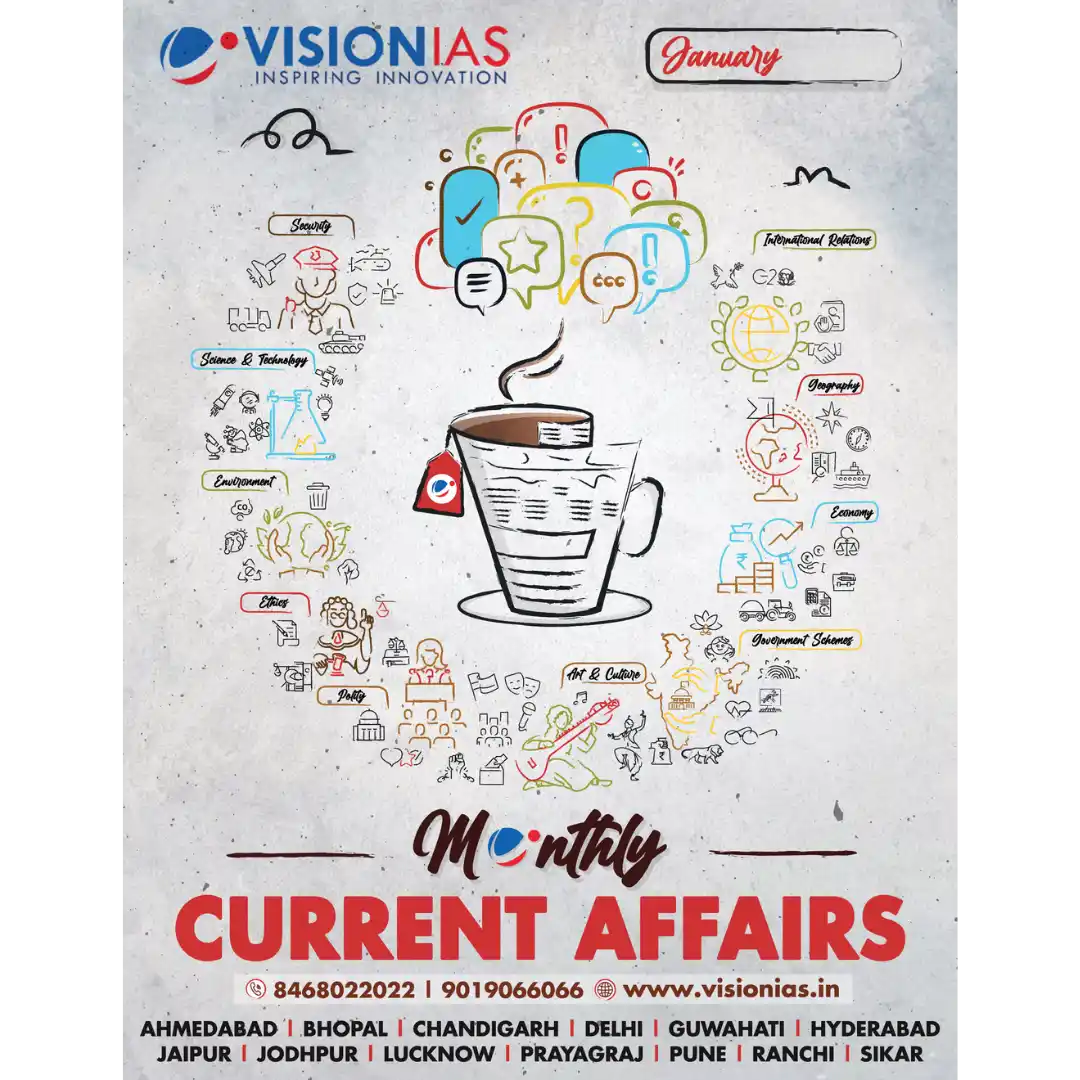
The General/Financial Awareness section is the fastest to attempt and the highest scoring per minute — but only if you have revised current affairs consistently. A focused monthly current affairs resource such as the Vision IAS Current Affairs Magazine (January 2026) and the preceding December 2025 edition give you a structured, exam-ready window of national, economic and banking updates instead of scrolling scattered sources.
IBPS Clerk Topic-Wise Weightage (Recent-Year Trends)
Generic syllabus lists rarely tell you where the marks actually sit. Based on the trend of questions asked over recent cycles, here is a weightage guide to prioritise your effort. Treat these as indicative ranges — the exact split shifts slightly every year.
Prelims Expected Weightage
| Section | High-Weight Topics | Approx. Questions |
|---|---|---|
| English (30) | Reading Comprehension | 7-10 |
| English (30) | Cloze Test / Error Spotting / Para Jumbles | 15-18 |
| Numerical (35) | Simplification & Approximation | 10-15 |
| Numerical (35) | Arithmetic word problems | 8-10 |
| Numerical (35) | Number Series & DI | 8-10 |
| Reasoning (35) | Puzzles & Seating Arrangement | 15-20 |
| Reasoning (35) | Inequality, Syllogism, Coding | 10-12 |
Mains Expected Weightage
| Section | High-Weight Topics | Approx. Questions |
|---|---|---|
| Reasoning & Computer (40) | Puzzles, Seating, Data Sufficiency | 20-25 |
| Reasoning & Computer (40) | Computer Aptitude | 5-10 |
| English (40) | RC, Cloze, Vocabulary | 20-25 |
| Quantitative (40) | Data Interpretation | 15-20 |
| Quantitative (40) | Arithmetic & Quadratic | 12-15 |
| General/Financial (40) | Banking & Current Affairs | 25-30 |
Which Subjects Are Most Important in IBPS Clerk?
Every section matters because you must clear a cut-off in each, but for scoring efficiency the priority order is clear. In Mains, General/Financial Awareness is the single biggest merit-differentiator — it needs no calculation and can be finished quickly. Quantitative Aptitude is the next most important because its 50-mark weight rewards Data Interpretation and arithmetic practice. Reasoning (puzzles and seating) decides your Prelims speed, and English is the steadiest section to hit an accuracy target. Computer Aptitude carries the fewest marks and is the most static to prepare, so it gives quick returns for minimal effort.
High-Priority vs Skippable Topics for Smart Prep
With a 20-minute sectional clock in Prelims, time-boxing is everything. Focus first on the topics that repeat every year and yield quick marks; treat low-frequency, high-effort topics as backups.
| Priority | Topics | Why |
|---|---|---|
| High (do first) | Simplification, Puzzles, Seating, RC, Syllogism, Inequality, Current Affairs | High frequency + high accuracy potential |
| Medium | DI, Number Series, Cloze, Coding-Decoding, Banking Awareness | Reliable marks with practice |
| Low / selective | Probability, Mensuration, Mixtures, complex DBMS/networking | Time-heavy or rarely asked — attempt last |
The rule of thumb: never spend more than 90 seconds on a single puzzle set or DI in Prelims. Lock the easy marks first, then return to the hard sets if time remains.
IBPS Clerk vs SBI Clerk vs RRB Clerk Syllabus
Aspirants often prepare for all three clerical exams together, so knowing where the syllabi overlap saves months. The core sections are nearly identical — the differences lie in exam pattern, additional sections and language testing.
| Feature | IBPS Clerk | SBI Clerk | RRB Clerk (Office Asst.) |
|---|---|---|---|
| Prelims Sections | English, Numerical, Reasoning | English, Numerical, Reasoning | Reasoning, Numerical (no English) |
| Prelims Marks | 100 | 100 | 80 |
| Mains Sections | Reasoning+Computer, English, Quant, GA/Financial | Reasoning+Computer, English, Quant, GA | Reasoning, Numerical, GA, English/Hindi, Computer |
| Interview | No | No | No |
| Language Test | Yes (LPT) | Yes | Yes (regional) |
Because a large share of the syllabus overlaps, a single strong foundation in Quant, Reasoning and English lets you sit all three. If you are mapping out your broader competitive-exam journey, structured previous-year practice such as a topic-wise PYQ toolkit illustrates how organised previous-year analysis compresses revision time — the same principle applies to banking mocks.
Local Language Proficiency Test (LPT) Explained
The Local Language Proficiency Test is a qualifying stage conducted after the Mains result. Its purpose is simple: since a bank clerk deals with local customers daily, IBPS verifies that you can read and speak the official/local language of the state or Union Territory you applied for. It does not add marks to your merit — it only confirms your eligibility for posting in that state.
- Who takes it: Candidates provisionally shortlisted after Mains for their applied-for state.
- Exemption: If you studied the specified local language up to Class 8 or 10 (as proven by your marksheet), you are usually exempted from the test.
- What if you fail: Failing or not appearing for the LPT leads to disqualification — the candidature is cancelled even if you cleared Mains. So apply for a state whose language you know well.
Always verify the accepted language list for each state in the official notification before choosing your preference.
60-Day IBPS Clerk Study Plan
A focused 2-3 month window is enough for most aspirants to clear IBPS Clerk, provided study is consistent and mock-driven. Here is a practical two-month schedule.
| Phase | Days | Focus |
|---|---|---|
| Foundation | Day 1-20 | Cover full syllabus basics: arithmetic, grammar, reasoning fundamentals; start daily current affairs |
| Application | Day 21-40 | Topic-wise practice sets, DI & puzzle drills, 3 sectional tests/week, banking awareness notes |
| Test & Revise | Day 41-55 | 1 full-length mock daily, detailed analysis, error log review, speed building |
| Peak | Day 56-60 | Only revision + mocks; revise current affairs of last 5 months, formula sheets |
The single most important habit is a daily mock plus 45-minute analysis in the last three weeks. Analysis — not just taking the test — is where accuracy and time management actually improve.
Section-Wise Preparation Tips and Strategy
Accuracy vs Speed
With 0.25 negative marking, target 85%+ accuracy in Prelims. It is better to attempt 78 questions with 90% accuracy than 95 questions with 70% accuracy. Build speed only after accuracy is locked.
Sectional Cut-offs
You must clear the cut-off in every section, not just the aggregate. Do not neglect your weakest section — a strong Quant score cannot rescue a below-cut-off English attempt.
Mock Test Cadence
Weeks 1-4: two sectional tests weekly. Weeks 5-6: alternate-day full mocks. Final two weeks: one full mock daily. Maintain an error log and revisit it every three days.
General/Financial Awareness Edge
This is the biggest merit-differentiator in Mains — it needs zero calculation and can be attempted in under 12 minutes. Read one monthly current affairs compilation religiously and make a one-page banking-terms sheet for last-week revision.
IBPS Clerk Syllabus PDF Download (Free)
You do not need to sign up, share your email, or wait behind a paywall. Use your browser’s print-to-PDF to save this complete, clean, printable ibps clerk syllabus pdf download for offline planning: open this page, press Ctrl+P (or Cmd+P on Mac), and choose “Save as PDF”. You get the full section-wise syllabus, both exam patterns, and the weightage tables in one distraction-free document you can print and pin to your study wall.
This one-click approach keeps the syllabus in front of you every day — no gated downloads and no upsells.
Common Mistakes to Avoid
- Ignoring sectional timing in Prelims — practise with the 20-minute lock from day one, not the week before.
- Over-attempting and inviting negative marks — leave questions you cannot solve within your time budget.
- Skipping General/Financial Awareness till the end — it is the easiest section to score and the hardest to cram last-minute.
- Choosing a state whose language you don’t know — it can cost you the job at the LPT stage.
- Taking mocks without analysing them — untracked mistakes repeat themselves in the real exam.
Frequently Asked Questions
What is the syllabus for IBPS Clerk 2026?
The IBPS Clerk 2026 syllabus covers English Language, Numerical Ability and Reasoning Ability in Prelims, and Reasoning & Computer Aptitude, English, Quantitative Aptitude and General/Financial Awareness in Mains. Topics range from reading comprehension, puzzles and simplification to data interpretation, banking awareness and current affairs.
Is there any interview in IBPS Clerk?
No. IBPS Clerk selection has no interview stage. The process is Prelims (qualifying) followed by Mains (merit-deciding) and a Local Language Proficiency Test. Your final selection depends entirely on your Mains score.
How many questions are there in IBPS Clerk Prelims and Mains?
Prelims has 100 questions for 100 marks in 60 minutes with 20-minute sectional timing. Mains has 160 questions for 200 marks across four sections in a composite 125-minute paper.
Is there negative marking in IBPS Clerk exam?
Yes. There is a negative marking of 0.25 marks for each wrong answer in both Prelims and Mains. Unattempted questions carry no penalty, so prioritise accuracy over blind guessing.
What is the revised exam pattern for IBPS Clerk Mains 2026?
The revised Mains pattern has 160 questions for 200 marks: Reasoning & Computer Aptitude (40Q/60M), English (40Q/40M), Quantitative Aptitude (40Q/50M, increased from 35) and General/Financial Awareness (40Q/50M), completed in a composite 125 minutes.
Which subjects are most important in IBPS Clerk exam?
In Mains, General/Financial Awareness and Quantitative Aptitude carry the most decisive weight — GA scores fast with no calculation, and Quant now carries 50 marks. In Prelims, Reasoning (puzzles, seating) and Numerical Ability decide your speed. You must still clear the cut-off in every section, so no subject can be fully skipped.
Can I clear IBPS Clerk in 2-3 months of preparation?
Yes, most aspirants can clear IBPS Clerk in 2-3 months with a consistent, mock-driven plan — roughly 20 days for basics, 20 days for topic practice, and the rest for daily full-length mocks, analysis and current affairs revision.
What is the Local Language Proficiency Test in IBPS Clerk?
The Local Language Proficiency Test (LPT) is a qualifying check conducted after the Mains result to confirm you can read and speak the official language of the state you applied for. It adds no marks to your merit, but failing or skipping it leads to disqualification. Candidates who studied that language up to Class 8 or 10 are usually exempted.
Recommended Study Material


Continue Reading
SSC CGL Preparation 2026: Plan, Books & Timetable
Short answer: winning ssc cgl preparation in 2026 comes down to five disciplined habits — master the Tier…
Super TET Syllabus 2026: Subject-Wise Topics, Pattern + PDF
The Super TET syllabus for the UP Assistant Teacher recruitment covers ten broad areas — Language, Mathematics, Science,…
CDS Syllabus 2026: Subject-Wise Topics, Pattern + PDF
The CDS syllabus covers three written papers for IMA, INA and AFA — English, General Knowledge and Elementary…