KPSC Syllabus 2026: KAS Prelims, Mains & Exam Pattern (+ PDF)
Complete KPSC syllabus 2026 for KAS: prelims & mains pattern, paper-wise GS topics, marks, negative marking, optional-paper update + free PDF download.

The KPSC syllabus for the KAS (Gazetted Probationers) exam is built around three stages: an objective Prelims (two papers, 400 marks, screening only), a descriptive Mains worth 1,750 merit marks (nine papers including two qualifying language papers, an Essay, and four General Studies papers), and a Personality Test/Interview of 200 marks. Final merit is decided on Mains + Interview = 1,950 marks; prelims marks are not counted for the final rank. Below you get the full paper-wise prelims and mains syllabus, the KPSC exam pattern 2026, negative-marking rules, the latest position on optional papers, a KAS-vs-UPSC comparison, and a free subject-wise kpsc kas syllabus pdf download.
This guide is written for Karnataka Administrative Service aspirants but also covers the Group B/C (FDA, SDA, PDO) pattern that most other pages ignore. Every table here maps directly to a study plan and booklist, so you can move from “what to read” to “reading it” the same day. Because KPSC revises details between cycles, treat this as your working map and confirm the final structure against the current-year official notification before you lock a timetable.
KPSC Syllabus 2026 (KAS) at a Glance
The Karnataka Public Service Commission (KPSC) conducts the Gazetted Probationers examination — popularly called KAS — to recruit officers to Group A and Group B posts in the Karnataka state administration. The selection funnel mirrors the UPSC Civil Services Examination in structure, which is why UPSC-grade General Studies material works well for KAS preparation. Here is the high-level snapshot every aspirant should memorise before going deeper.
| Parameter | Detail (KAS 2026) |
|---|---|
| Conducting body | Karnataka Public Service Commission (KPSC) |
| Exam name | Gazetted Probationers (KAS) Examination |
| Stages | Prelims → Mains → Personality Test (Interview) |
| Prelims marks | 400 (Paper I 200 + Paper II 200) — qualifying/screening only |
| Mains marks | 1,750 (counted for merit) |
| Interview marks | 200 |
| Final merit total | 1,950 (Mains + Interview) |
| Negative marking (Prelims) | Yes — 0.25 mark deducted per wrong answer |
| Language medium | Kannada or English (descriptive papers) |
| Age limit (general) | 21–35 years (relaxations for reserved categories) |
Two points trip up first-timers. First, prelims marks are never added to the final score — they only decide who sits for Mains. Second, the two language papers in Mains (Kannada and English) are qualifying — you must clear the minimum, but the marks do not enter the merit list. Everything else in Mains counts.
What Is the Syllabus for KPSC KAS Exam?
The syllabus for the KPSC KAS exam spans general studies of national and international importance with a deliberate, heavy tilt toward Karnataka-specific history, geography, polity, economy, culture and current affairs. At the prelims stage it is objective and broad; at the mains stage it becomes descriptive and analytical, demanding structured answer-writing across four General Studies papers plus an Essay and an ethics component. In short, the prelims tests recognition and elimination, while the mains tests articulation, depth and a clear Karnataka lens.
If you are coming from a UPSC background, treat the KAS syllabus as the UPSC GS syllabus plus a thick Karnataka layer. The national topics overlap almost completely; the state topics are where dedicated effort and local sources matter most.
KPSC Exam Pattern 2026 (All Three Stages)
The kpsc exam pattern 2026 follows the classic three-tier civil services design. Understanding the marks distribution is the single most useful thing you can do before opening a textbook, because it tells you where the merit list is actually won — in the Mains.
Stage I — Preliminary Examination (Objective)
| Paper | Subjects | Questions | Marks | Duration |
|---|---|---|---|---|
| Paper I | Current events; history; Indian & Karnataka geography; Indian polity; economic & social development; general issues on environment & ecology | 100 | 200 | 2 hours |
| Paper II | Topics of state, national & international importance; science & technology; environment; general mental ability; general aptitude | 100 | 200 | 2 hours |
| Total | 200 | 400 | 4 hours | |
Each question carries 2 marks and there is negative marking of 0.25 marks per wrong answer. Prelims is purely a screening filter — typically only candidates equal to roughly 20 times the number of vacancies (category-wise) are shortlisted for Mains. Confirm the exact shortlisting ratio in the year’s notification, as it varies with vacancy count.
Stage II — Main Examination (Descriptive)
| Paper | Subject | Marks | Counts for merit? |
|---|---|---|---|
| Paper 1 | Kannada (qualifying) | 150 | No (qualifying only) |
| Paper 2 | English (qualifying) | 150 | No (qualifying only) |
| Paper 3 | Essay | 250 | Yes |
| Paper 4 | General Studies I | 250 | Yes |
| Paper 5 | General Studies II | 250 | Yes |
| Paper 6 | General Studies III | 250 | Yes |
| Paper 7 | General Studies IV | 250 | Yes |
| Merit-counting total | 1,750 | — | |
Counting the two qualifying language papers, there are nine papers in all, but only seven feed the merit total of 1,750. The Essay paper carries 250 marks and is typically split into two essays of 125 marks each, drawn from different sections (one social/philosophical, one economic/administrative/scientific). The four GS papers carry 250 marks each.
Stage III — Personality Test (Interview)
| Component | Marks |
|---|---|
| Personality Test / Interview | 200 |
| Mains (merit papers) | 1,750 |
| Grand total for final merit | 1,950 |
The interview assesses mental alertness, balance of judgement, leadership, social cohesion and awareness of Karnataka and national affairs. Because Mains (1,750) dwarfs the interview (200), strong answer-writing is non-negotiable.
KPSC KAS Prelims Syllabus — Paper-Wise Topics
The kpsc kas prelims syllabus is divided across two papers, both objective with multiple-choice questions. Paper I leans toward humanities, current events and core polity/geography; Paper II leans toward state importance, science and technology, environment and aptitude.
Prelims Paper I — Detailed Topics
- Current events of state, national and international importance.
- History of India — ancient, medieval and modern, plus the Indian national movement.
- History of Karnataka — dynasties (Kadambas, Gangas, Chalukyas, Rashtrakutas, Hoysalas, Vijayanagara), the unification of Karnataka, and the state freedom struggle.
- Indian and Karnataka geography — physical, social and economic; rivers, soils, climate, agriculture and resources of Karnataka.
- Indian polity and governance — Constitution, political system, Panchayati Raj, public policy, rights issues.
- Economic and social development — sustainable development, poverty, inclusion, demographics, social-sector initiatives.
- General issues on environmental ecology, biodiversity and climate change (no subject specialisation required).
Prelims Paper II — Detailed Topics
- Topics of state, national and international importance.
- Science and technology — everyday science, recent developments, IT and space applications.
- Environment and ecology — conservation, pollution, climate policy.
- General mental ability — comprehension, logical reasoning, analytical ability, decision-making.
- Basic numeracy and data interpretation — charts, tables, graphs (class-X level).
- General aptitude and Karnataka-centric general knowledge.
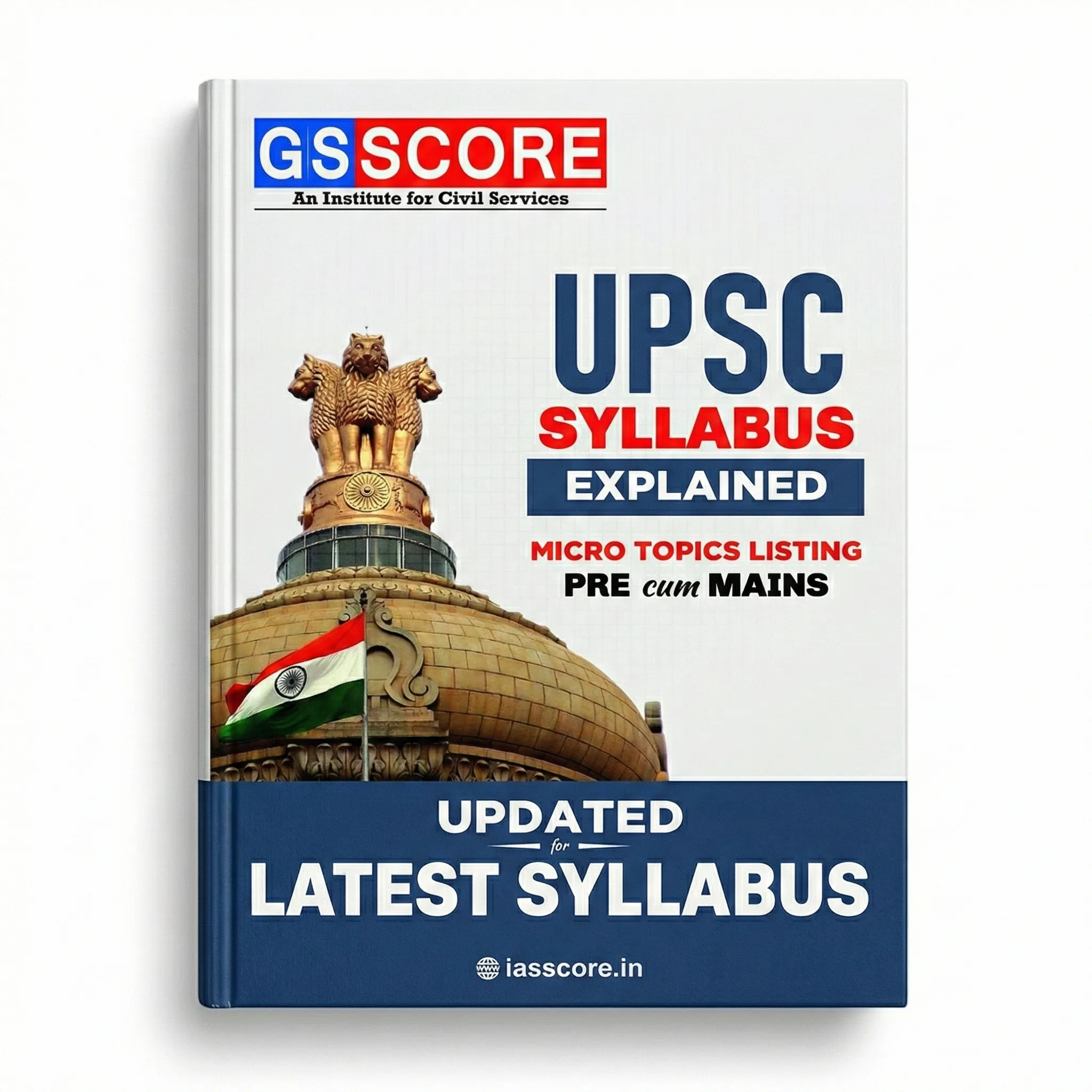
A free, official syllabus reference is invaluable here. The GS Score Latest Syllabus Booklet 2026-27 lays out the GS framework topic-by-topic so you can tick off prelims themes systematically.
Is There Negative Marking in KPSC Prelims?
Yes. KPSC prelims applies negative marking of 0.25 marks for every wrong answer. The practical takeaway is simple: do not blind-guess. Eliminate options first; attempt only when you can rule out at least two choices. Disciplined attempting — not raw knowledge alone — is what clears the KAS prelims cut-off. Always confirm the exact deduction fraction in the current year’s notification.
KPSC KAS Mains Syllabus — All Nine Papers Explained
The kpsc kas mains syllabus is where the exam is actually won. There are nine papers in KPSC KAS Mains: two qualifying language papers (Kannada and English), one Essay paper, and four General Studies papers. Below is the paper-wise breakdown that mirrors the structure of trusted UPSC GS Polity material and other GS resources.
Qualifying Papers — Kannada & English
Both language papers are descriptive and qualifying. They test comprehension, précis writing, translation, grammar and composition at a degree level. You must score the prescribed minimum (commonly around 35%) to have your GS papers evaluated — but the marks do not enter the merit list. Clear them comfortably; do not over-invest beyond that.
Essay Paper (250 Marks)
The Essay paper requires two essays of roughly 125 marks each. Topics span society, polity, economy, science-technology, environment, ethics and Karnataka-specific themes. Markers reward a clear thesis, balanced treatment, relevant data and a coherent conclusion. Practising structured essays against a model framework — such as the approach in the Vajiram Essay Notes — sharpens both your idea bank and your introduction-body-conclusion discipline.
General Studies Paper-Wise Breakdown
| GS Paper | Core Themes | Marks |
|---|---|---|
| GS I | History (Indian & Karnataka), art & culture, heritage, Indian society, social issues, geography | 250 |
| GS II | Geography (in depth), Constitution, polity, governance, public administration, social justice | 250 |
| GS III | Economy, agriculture, science & technology, environment, biodiversity, disaster management, internal security | 250 |
| GS IV | Ethics, integrity, aptitude, emotional intelligence, governance values, case studies | 250 |
GS I — History, Culture & Society
- Indian history and culture — ancient to modern, the freedom struggle, post-independence consolidation.
- Karnataka focus — dynasties, Vijayanagara empire, Karnataka unification, social reformers, literature, music traditions, folk arts (Yakshagana, Dollu Kunitha), architecture (Hampi, Belur, Halebid, Pattadakal).
- Indian society — diversity, social empowerment, communalism, regionalism, secularism, role of women, population issues.
GS II — Geography, Constitution & Public Administration
- Physical, social and economic geography of India and Karnataka.
- Indian Constitution — features, amendments, basic structure, federalism, separation of powers.
- Governance and public administration — Panchayati Raj in Karnataka, e-governance, accountability, RTI, citizens’ charters, welfare schemes.
- Social justice — vulnerable sections, government interventions, health, education and human-resource development.
GS III — Economy, Science, Tech & Environment
- Indian and Karnataka economy — growth, employment, fiscal policy, banking, inclusive development, infrastructure.
- Agriculture — cropping patterns, irrigation, food processing, marketing, Karnataka’s agrarian profile.
- Science & technology — indigenous tech, IT, biotech, space, governance applications.
- Environment — biodiversity, conservation, EIA, climate change; Western Ghats and Karnataka ecology.
- Disaster management and internal security challenges.
For the economy portion, structured GS notes save enormous time. Many KAS aspirants pair their state material with a focused resource like the Vision IAS Economics Notes to cover concepts and current developments together.
GS IV — Ethics, Integrity & Aptitude
- Ethics and human interface — essence, determinants and consequences of ethics in human action.
- Attitude, aptitude and foundational values for civil service — integrity, impartiality, objectivity, dedication, empathy.
- Emotional intelligence, contributions of moral thinkers and philosophers (Indian and Western).
- Probity in governance — public service values, codes of conduct, transparency, accountability.
- Case studies on the above themes — the highest-scoring and most differentiating part of GS IV.
Ethics is the easiest GS paper to score in once you have a keyword bank and case-study templates. A compact resource such as the Drishti IAS Ethics Notes gives you definitions, thinker quotes and case-study frameworks you can reuse across answers.
Are Optional Subjects Removed from KAS Mains? (Latest Status, 2026)
This is the single most confusing point across competitor pages, so here is a clear, dated statement. Under the revised KAS Mains scheme that KPSC moved to in the 2010s, the optional-subject papers were dropped in favour of an all-compulsory structure built around the four General Studies papers, the Essay and the two qualifying language papers. Older articles that still list “23 optionals” or “31 optionals” are describing the pre-revision pattern and are outdated.
As of 2026, plan your preparation for a compulsory-only KAS Mains (no optional subject). Because notification details can change between cycles, always cross-check the optional/compulsory position in the specific year’s official KPSC notification — but the working assumption for 2026 is no optional paper.
| Pattern | Optional papers? | Status |
|---|---|---|
| Pre-revision (older) | Yes — list of optional subjects | Outdated |
| Current/revised (2026) | No — all compulsory (GS + Essay + languages) | Plan for this |
Is KPSC and KAS Syllabus the Same? Is KAS the Same as UPSC?
Is KPSC and KAS Syllabus the Same?
Not exactly. “KPSC” is the commission that conducts many exams; “KAS” is one specific exam (Gazetted Probationers) it conducts. So the KAS syllabus is a subset of what KPSC examines. KPSC also runs Group B and Group C recruitments (FDA, SDA, PDO and others) with their own, shorter syllabi. When people say “kpsc syllabus” they usually mean the KAS syllabus, but technically KPSC covers much more.
Is KAS Syllabus Same as UPSC Syllabus?
They are very similar in structure and national content but not identical. The KAS Mains GS papers mirror UPSC’s GS I–IV themes, and the prelims overlaps heavily on history, polity, geography, economy and environment. The key difference is the Karnataka layer — state history, geography, polity, economy and current affairs — which UPSC does not test, plus the compulsory Kannada qualifying paper. This is exactly why UPSC GS notes form an excellent backbone for KAS, with state-specific sources added on top.
| Feature | KAS (KPSC) | UPSC CSE |
|---|---|---|
| Stages | Prelims → Mains → Interview | Prelims → Mains → Interview |
| Prelims papers | 2 (screening only) | GS + CSAT (CSAT qualifying) |
| Mains merit marks | 1,750 | 1,750 |
| Optional subject | No (compulsory-only, 2026) | Yes (one optional, 2 papers) |
| Language papers | Kannada + English (qualifying) | Indian language + English (qualifying) |
| Regional focus | Heavy Karnataka emphasis | National/international |
| Interview marks | 200 | 275 |
Can I Write the KPSC KAS Exam in English?
Yes. The descriptive KAS Mains GS and Essay papers can be written in either English or Kannada, by the candidate’s choice. Separately, there is a compulsory qualifying English paper and a compulsory qualifying Kannada paper — you must clear the prescribed minimum in both for your GS answer scripts to be evaluated, even though their marks do not count toward merit. So an English-medium aspirant can write the entire merit-bearing portion in English, but cannot skip the qualifying Kannada paper.
Karnataka-Specific Topics You Cannot Skip
The Karnataka layer is where most candidates with a UPSC background lose marks, and where Kannada-medium local aspirants gain an edge. Build a dedicated, state-focused notebook covering the following.
| Domain | Must-cover Karnataka topics |
|---|---|
| History | Kadamba, Ganga, Chalukya, Rashtrakuta, Hoysala, Vijayanagara dynasties; Karnataka unification; freedom fighters; social reformers |
| Geography | Western Ghats, major rivers (Kaveri, Krishna, Tungabhadra), soils, agro-climatic zones, minerals, irrigation projects |
| Polity & Governance | Karnataka Panchayati Raj, state administrative structure, key state schemes, Lokayukta |
| Economy | State budget highlights, IT/BT sector (Bengaluru), industries, agriculture, cooperative movement, HDI indicators |
| Culture | Yakshagana, Dollu Kunitha, Carnatic music, Kannada literature, Jnanpith awardees, UNESCO sites (Hampi, Pattadakal) |
| Current Affairs | State government decisions, policies, awards, sports, persons-in-news linked to Karnataka |
Topic-Wise Preparation Strategy & Booklist (Mapped to Each Paper)
A syllabus only matters if it converts into a reading plan. Here is a paper-mapped strategy that pairs national GS resources with Karnataka sources, so you are never guessing what to read next.
| Paper / Area | Strategy | Suggested resources |
|---|---|---|
| Prelims (both papers) | NCERTs → standard GS → daily current affairs → MCQ practice with strict negative-marking discipline | GS syllabus booklet + current affairs magazines + PYQ practice |
| GS I (History/Culture) | Build a timeline; add a separate Karnataka history/culture notebook | National GS history notes + state culture sources |
| GS II (Polity/Geo) | Master the Constitution conceptually, then layer Karnataka governance | Polity notes + state Panchayati Raj material |
| GS III (Economy/Sci-Tech/Env) | Concepts first, then current developments and Karnataka economy data | Economy notes + monthly current affairs |
| GS IV (Ethics) | Keyword bank + thinker quotes + 20–25 case-study templates | Ethics notes + answer-writing practice |
| Essay | One full essay every week against a model structure | Essay notes + current affairs for examples |
Current affairs is the connective tissue across every paper — prelims facts, GS examples and essay material all draw from it. Keeping a monthly magazine habit (consolidated, not scattered news) is the highest-leverage routine for a KAS candidate.
Common Mistakes KAS Aspirants Make
- Ignoring the Karnataka layer until late — it needs a dedicated notebook from day one.
- Blind guessing in prelims despite negative marking, sinking a borderline score.
- Treating language papers as optional effort — failing the qualifying minimum means the GS papers are never even evaluated.
- Under-practising answer-writing — the merit list is 1,750 Mains marks, all descriptive.
- Relying on outdated articles that still list removed optional subjects.
KPSC Group B & Group C (FDA, SDA, PDO) Pattern — Quick Reference
Most KAS-focused pages ignore the high-volume non-gazetted exams. If you are targeting KPSC FDA (First Division Assistant), SDA (Second Division Assistant) or PDO (Panchayat Development Officer), the structure is simpler — typically objective papers without a separate mains stage.
| Exam | Typical pattern | Core subjects |
|---|---|---|
| FDA / SDA | Paper I (General Kannada) + Paper II (General English) + Paper III (General Knowledge & Computer) | Language proficiency, GK, current affairs, basic computers, mental ability |
| PDO | Objective paper on GK, rural development & Panchayati Raj | General studies, rural development, Panchayati Raj institutions, current affairs |
For these exams, general-knowledge and current-affairs material plus Karnataka GK is the core requirement — much lighter than the full KAS GS load, but with the same Karnataka emphasis.
KPSC KAS Syllabus PDF Download
You can save this entire paper-wise breakdown for offline planning. For a structured, exam-ready GS syllabus reference you can print and tick off, the GS Score Latest Syllabus Booklet 2026-27 covers the full General Studies framework that underpins both KAS and UPSC. Pair it with the tables above as your kpsc kas syllabus pdf download checklist, and always validate the final structure against the current-year KPSC notification for the kpsc gazetted probationers syllabus before you lock your timetable.
Frequently Asked Questions
What is the syllabus for KPSC KAS exam?
The KPSC KAS syllabus covers general studies across history, geography, polity, economy, science & technology, environment, ethics and current affairs, with a strong Karnataka-specific focus. Prelims has two objective papers (400 marks, screening only) and Mains has nine descriptive papers — two qualifying language papers, an Essay, and four General Studies papers totalling 1,750 merit marks.
Is KPSC and KAS syllabus the same?
Largely, but not technically. KPSC is the commission that conducts several exams; KAS (Gazetted Probationers) is one of them. When people say “kpsc syllabus” they usually mean the KAS syllabus, but KPSC also conducts Group B/C exams (FDA, SDA, PDO) with their own simpler, mostly objective syllabi.
How many papers are there in KPSC KAS mains?
There are nine papers in KPSC KAS Mains: Kannada and English (both qualifying), one Essay paper, and four General Studies papers (GS I–IV). The two language papers only need to clear a minimum and are not counted for merit; the Essay and four GS papers (250 marks each) make up the 1,750 merit-counting total.
Is there negative marking in KPSC prelims?
Yes. KPSC prelims deducts marks for wrong answers — typically 0.25 marks per incorrect response. Always confirm the exact deduction in the current year’s notification, and avoid blind guessing; attempt a question only after eliminating at least two options.
Are optional subjects removed from KAS mains?
Under the revised KAS Mains scheme, optional-subject papers were dropped in favour of an all-compulsory structure (four GS papers, Essay and two qualifying language papers). For 2026, plan for a compulsory-only Mains with no optional subject, while cross-checking the official notification for that cycle.
Is KAS syllabus same as UPSC syllabus?
No, but they are close. The KAS GS papers mirror UPSC’s GS I–IV in structure and national content, so UPSC GS material is an excellent backbone. The differences are KAS’s heavy Karnataka layer (state history, geography, polity, economy and current affairs), the compulsory Kannada qualifying paper, and the absence of an optional subject in the current KAS scheme.
What is the exam pattern for KPSC 2026?
KPSC KAS 2026 follows three stages: Prelims (two objective papers, 400 marks, screening only, with 0.25 negative marking), Mains (nine descriptive papers — two qualifying language papers, an Essay and four GS papers, 1,750 merit marks), and a Personality Test/Interview of 200 marks. Final merit is Mains + Interview = 1,950 marks.
Can I write the KPSC KAS exam in English?
Yes. The descriptive KAS Mains GS and Essay papers can be written in either English or Kannada, and there is a compulsory qualifying English paper as well as a compulsory qualifying Kannada paper. You must clear the minimum in both language papers for your GS answer scripts to be evaluated.
Recommended Study Material
Continue Reading
NEET Exam Pattern 2026: Marks, Questions & Marking Scheme
The NEET exam pattern for 2026 is a single pen-and-paper (OMR) test of 180 compulsory multiple-choice questions carrying…
NEET Syllabus 2026: Subject-Wise Topics, Weightage + PDF
The NEET syllabus for 2026 is the official National Testing Agency (NTA) list of examinable topics — finalised…
UGC NET Political Science Syllabus 2026: Unit-Wise + PDF
In short: the ugc net political science syllabus has two papers — Paper 1 (General Aptitude, 50 questions…