KVS Syllabus 2025: PRT, TGT, PGT Pattern + PDF Download
Complete KVS syllabus 2025 — post-wise PRT, TGT & PGT topics, two-tier exam pattern, negative marking, weightage tables and KVS syllabus PDF download.

The kvs syllabus for teaching posts (PRT, TGT, PGT) and non-teaching posts is set by the Kendriya Vidyalaya Sangathan and follows a two-tier, bilingual, computer-based pattern: Tier 1 is an objective screening test covering reasoning, numerical ability, computer literacy, general awareness, English and Hindi, while Tier 2 is the merit-deciding paper built around the subject concerned plus pedagogy and Perspectives on Education & Leadership aligned with NEP 2020. There is negative marking on the objective questions, and the question paper is available in both English and Hindi. This guide gives you the complete post-wise syllabus, exam pattern, marking scheme, weightage tables, a download walkthrough, an 8-week plan, and the best study material to prepare with.
Editorial note: this page is structured around the official KVS recruitment framework and is reviewed each recruitment cycle. Exact question counts and marks vary by post and by notification, so we flag where you must confirm against the official advertisement. Last reviewed for the 2025 cycle.
Whether you are targeting Primary Teacher (PRT), Trained Graduate Teacher (TGT), Post Graduate Teacher (PGT) or a non-teaching role like Principal, Vice Principal, Finance Officer, Assistant Section Officer (ASO) or Stenographer, this page is engineered to be the single most complete KVS reference you will need this cycle.
Key takeaways (TL;DR):
- The KVS exam is two-tier — Tier 1 only screens; Tier 2 decides your merit.
- Yes, there is negative marking on Tier 1 objective questions; unattempted questions are not penalised.
- The test is bilingual (Hindi + English), except language-specific papers.
- CTET/TET is generally an eligibility requirement for PRT and TGT — confirm in the notification.
- The subject concerned + NEP 2020 / Perspectives on Education & Leadership carry the highest weight in Tier 2.
- Download the official syllabus from the notification PDF on kvsangathan.nic.in.
KVS Syllabus 2025 at a Glance: What Changed
KVS recruitment is conducted by the Kendriya Vidyalaya Sangathan, an autonomous body under the Ministry of Education, Government of India, to staff over 1,250 Kendriya Vidyalayas in India and abroad. The most important shift aspirants must internalise is that KVS has moved away from the old single-paper format to a two-tier examination. Many older blogs still describe one 180-mark paper — that pattern is outdated. Here is the clean comparison so there is zero confusion.
| Aspect | Old Pattern (single paper) | New Pattern (two-tier) |
|---|---|---|
| Stages | One written paper | Tier 1 (screening) + Tier 2 (merit) |
| Purpose | Final merit from one test | Tier 1 only qualifies; Tier 2 decides merit |
| Question type | Objective MCQ only | Tier 1 objective; Tier 2 objective + descriptive |
| Subject depth | Mixed in single paper | Deep subject-concerned focus in Tier 2 |
| Pedagogy / NEP 2020 | Limited | Heavy weight via Perspectives on Education & Leadership |
Key facts about the kvs syllabus 2025 you should lock in:
- Conducting body: Kendriya Vidyalaya Sangathan (KVS).
- Mode: Computer-Based Test (CBT), online.
- Medium: Bilingual — every question appears in both Hindi and English (except the language-specific papers).
- Level: National-level recruitment across PRT, TGT, PGT and non-teaching cadres.
- Marking: Objective sections carry negative marking in Tier 1; check the latest notification for the exact Tier 2 deduction.
How many stages does the KVS exam have?
The KVS teaching-post selection has up to three stages: Tier 1 (a common, fully objective screening CBT that only qualifies you), Tier 2 (the post-specific paper — subject concerned, pedagogy and Perspectives on Education & Leadership — whose score builds the merit list), and an interview or teaching demonstration / skill test where applicable. Your final rank is decided by Tier 2 plus the interview/demonstration weight; Tier 1 marks are not carried forward.
KVS Exam Pattern 2025: Tier 1 and Tier 2
The kvs exam pattern is the backbone of your preparation strategy. Tier 1 is a common screening test designed to filter candidates; your Tier 1 marks are not added to the final merit. Only candidates who clear the Tier 1 cut-off are called for Tier 2, and the Tier 2 score (subject + pedagogy + leadership) builds the merit list along with interview/demonstration where applicable.
What is the exam pattern for KVS Tier 1 and Tier 2?
Tier 1 is fully objective with multiple-choice questions across general aptitude and language sections. Tier 2 is the post-specific paper that goes deep into the subject concerned, education perspectives and pedagogy, and includes a descriptive component for several posts. The table below shows the typical Tier 1 structure for teaching posts.
| Tier 1 Section | No. of Questions | Marks |
|---|---|---|
| General English | 10 | 10 |
| General Hindi | 10 | 10 |
| General Knowledge & Current Affairs | 10 | 10 |
| Reasoning Ability | 10 | 10 |
| Computer Literacy | 10 | 10 |
| Numerical Ability / Quantitative Aptitude | (post-dependent) | (post-dependent) |
| Subject Concerned (in Tier 2) | Major share | Major share |
For most teaching posts, Tier 1 is a 150-mark screening segment that bundles the general sections above with the subject-concerned portion, while Tier 2 carries the heavier subject and pedagogy load. Always verify the exact question count for your post against the official notification, since KVS calibrates the split between PRT, TGT and PGT.
| Stage | Nature | Counts toward merit? | Typical duration |
|---|---|---|---|
| Tier 1 | Objective MCQ (screening) | No — qualifying only | 150 minutes |
| Tier 2 | Objective + Descriptive (subject + pedagogy + leadership) | Yes | 180 minutes |
| Interview / Demonstration | Skill & teaching demo (where applicable) | Yes | As scheduled |
KVS Marking Scheme 2025 and Negative Marking
Is there negative marking in the KVS exam?
Yes. KVS applies negative marking to the objective questions in Tier 1 — historically each wrong answer attracts a deduction (commonly a fraction of the mark per question), while unattempted questions carry no penalty. The descriptive component of Tier 2 is evaluated on content, structure and answer quality, so there is no negative marking on those written answers. Because the screening stage punishes blind guessing, accuracy beats reckless attempting.
| Component | Marks per correct | Negative marking |
|---|---|---|
| Tier 1 objective MCQ | +1 | Yes (fraction deducted per wrong answer) |
| Tier 2 objective MCQ | +1 (or as notified) | As per notification |
| Tier 2 descriptive answers | As allotted per question | No |
| Unattempted questions | 0 | No penalty |
How many marks is the KVS written exam?
The screening Tier 1 typically runs to around 150 marks for teaching posts, and Tier 2 — the merit paper — carries a larger weight built from the subject concerned, pedagogy and the Perspectives on Education & Leadership section. The combined written weight, before interview/demonstration, is therefore substantial; treat Tier 2 as the decisive battlefield because that is where rank is made. Because KVS can adjust the exact marks per post from one notification to the next, lock in the precise totals for your post from the official advertisement before you finalise your attempt strategy.
Common Sections Across All KVS Posts
Before the post-wise detail, note the sections that repeat across PRT, TGT and PGT in Tier 1. Mastering these once gives you a portable advantage across any post you apply for.
- General English: reading comprehension, error spotting, fill in the blanks, synonyms/antonyms, vocabulary, sentence improvement, narration and active/passive voice.
- General Hindi: अपठित गद्यांश, व्याकरण (संधि, समास, अलंकार, मुहावरे), पर्यायवाची/विलोम, वाक्य शुद्धि और शब्द ज्ञान.
- General Knowledge & Current Affairs: national and international events, awards, sports, books and authors, polity, history, geography, economy and science of the last 12 months.
- Reasoning Ability: analogies, series, coding-decoding, blood relations, syllogism, directions, classification and non-verbal reasoning.
- Computer Literacy: fundamentals of computers, MS Office, internet, networking basics, input/output devices and shortcuts.
- Numerical / Quantitative Ability: number system, percentages, ratio, average, profit & loss, time-speed-distance, data interpretation.
A consolidated GK and current-affairs habit pays off here. Many aspirants strengthen this section using a structured monthly magazine — a UPSC-grade resource like the Vision IAS Current Affairs Magazine January 2026 (English) works well because the same current events feed KVS GK questions.
KVS PRT Syllabus 2025
The kvs prt syllabus targets the Primary Teacher cadre (Classes I–V). The Tier 2 subject-concerned paper emphasises primary-level pedagogy, child development and the foundational stage as framed by NEP 2020 and the NCF for Foundational Stage. Apart from the common Tier 1 sections, PRT aspirants must master child-centric teaching methods.
KVS PRT subject-concerned topics
| Area | Key topics |
|---|---|
| Child Development & Pedagogy | Development of children 6–11 yrs, learning theories, inclusive education, assessment for learning |
| Mathematics (primary) | Numbers, operations, geometry basics, measurement, data handling and pedagogy of maths |
| Environmental Studies (EVS) | Family, plants, animals, water, travel, food, shelter and EVS pedagogy |
| Language I & II | Comprehension, language development, acquisition vs learning, teaching methods |
| Foundational Literacy & Numeracy | FLN goals, NIPUN Bharat, activity-based and play-based learning |
Because PRT pedagogy overlaps heavily with the CTET Paper 1 framework, candidates who have prepared for CTET Paper 1 will find a strong head start. Pair concept revision with daily MCQ drilling to convert understanding into screening-test speed.
KVS TGT Syllabus 2025
The kvs tgt syllabus serves Trained Graduate Teachers handling Classes VI–X. Tier 2 demands graduation-level command of the subject concerned plus secondary-stage pedagogy. TGT subjects include Hindi, English, Sanskrit, Mathematics, Science, Social Studies, and additional cadres like TGT (Work Experience), Art, Physical & Health Education.
TGT subject-wise Tier 2 focus
| TGT Subject | Core Tier 2 syllabus |
|---|---|
| Mathematics | Algebra, geometry, mensuration, trigonometry, statistics, number systems (up to Class X depth) |
| Science | Physics, Chemistry and Biology at secondary level — motion, light, matter, life processes, environment |
| Social Studies | History (ancient–modern India), geography, civics/polity, economics up to Class X |
| English | Grammar, literature, comprehension, phonetics and language pedagogy |
| Hindi | व्याकरण, साहित्य, गद्य-पद्य, भाषा शिक्षण विधियाँ |
| Sanskrit | व्याकरण, अनुवाद, श्लोक, संधि-समास और शिक्षण पद्धति |
For TGT Social Studies and General Knowledge depth, NCERT-anchored notes are gold. Aspirants frequently build their conceptual base using structured GS material; even UPSC-oriented sets like the Vajiram GS Notes 2026 (27 Booklets) double up as a reliable bank for history, geography and polity that overlaps with TGT Social Studies.
KVS PGT Syllabus 2025
The kvs pgt syllabus is the most demanding, targeting Post Graduate Teachers for senior secondary classes (XI–XII). Tier 2 expects post-graduation-level mastery of the subject concerned. PGT cadres include Physics, Chemistry, Biology, Mathematics, English, Hindi, Commerce, Economics, History, Geography, Political Science, Computer Science and Biotechnology.
PGT subject-wise Tier 2 focus
| PGT Subject | Indicative Tier 2 syllabus |
|---|---|
| Physics | Mechanics, thermodynamics, electromagnetism, optics, modern physics, electronics |
| Chemistry | Physical, organic and inorganic chemistry at +2 and graduate depth |
| Mathematics | Calculus, algebra, vectors, probability, linear programming, coordinate geometry |
| Biology | Cell biology, genetics, plant & animal physiology, ecology, biotechnology |
| Commerce | Accountancy, business studies, financial management, marketing, statistics |
| Economics | Micro & macro economics, Indian economy, statistics, development economics |
| Computer Science | Programming, data structures, DBMS, networking, operating systems, OOP concepts |
| History / Pol. Science / Geography | Honours-level depth in the chosen discipline with current linkages |
PGT preparation rewards depth over breadth. Map every Class XI–XII NCERT chapter to your post-graduate notes, then layer in higher-order application questions. The descriptive part of Tier 2 (discussed below) is where well-read PGT candidates separate themselves from rote learners.
Perspectives on Education & Leadership and NEP 2020
A defining feature of the new kvs syllabus across PRT, TGT and PGT is the Perspectives on Education & Leadership component in Tier 2. This section tests your grasp of educational philosophy, school leadership, classroom management and — crucially — the National Education Policy (NEP) 2020. Expect questions on:
- NEP 2020 structure (5+3+3+4), foundational literacy and numeracy, and multilingualism.
- National Curriculum Framework (NCF) and competency-based education.
- Inclusive education, child rights (RTE Act), and the role of the teacher as a facilitator.
- School leadership, management, mentoring and continuous professional development.
- Assessment reforms — holistic progress cards, formative vs summative assessment.
This section is scoring because the material is finite and conceptual. Make a one-page NEP 2020 cheat sheet and revise it weekly — it is among the highest return-on-effort topics in the entire syllabus.
KVS Tier 2 Descriptive Paper: How to Attempt
Most competitor pages list Tier 2 topics but skip the descriptive strategy entirely. This is a gap you can exploit. For posts with a descriptive component, you must write structured, pedagogy-rich answers rather than dumping facts.
Answer-writing tips for KVS Tier 2 descriptive questions
- Structure every answer: a crisp introduction, a body in points or short paragraphs, and a forward-looking conclusion (often linking to NEP 2020).
- Use the subject lens: a Maths PGT should show worked steps; a Social Studies TGT should cite examples and dates; a PRT should weave in child psychology.
- Quote frameworks: reference NEP 2020, NCF, FLN/NIPUN Bharat and learning theorists (Piaget, Vygotsky, Bloom’s taxonomy) where relevant.
- Manage time: allot fixed minutes per descriptive question and never leave a question blank — partial structured answers still earn marks.
- Practise answer writing: the discipline of writing essays and structured answers transfers directly. A resource like the Vajiram Essay Notes (GS 2025-2026) is a low-cost way to internalise introduction-body-conclusion flow.
Sample descriptive prompt (PGT/TGT): “Explain how competency-based assessment under NEP 2020 differs from rote-based examination, with two classroom examples.” A strong answer defines both, contrasts them in a short table or points, gives subject-specific examples, and closes with implementation challenges.
KVS Non-Teaching Posts Syllabus
KVS also recruits for non-teaching cadres. The syllabus shifts from pedagogy to administration, finance, law and office procedures depending on the role. The common Tier 1 sections (English, Hindi, GK, reasoning, numerical, computer literacy) still apply; the subject portion changes.
| Non-Teaching Post | Subject-specific syllabus focus |
|---|---|
| Principal / Vice Principal | Educational administration, leadership, school management, NEP 2020, CCS rules |
| Assistant Section Officer (ASO) | Office procedures, general administration, reasoning, English & numerical ability |
| Finance Officer / Assistant | Accountancy, financial rules (GFR), audit, budgeting, FR-SR |
| Stenographer | English/Hindi shorthand, transcription skill test, grammar, computer literacy |
| Junior Secretariat Assistant (JSA) | General English, reasoning, numerical aptitude, typing test, computer knowledge |
KVS Subject-Wise Weightage Snapshot
Weightage tables are where many ranking pages fall short. Use this indicative distribution to prioritise. The exact split is fixed by the current notification, but the relative emphasis is stable across cycles.
| Segment | PRT (approx weight) | TGT (approx weight) | PGT (approx weight) |
|---|---|---|---|
| Subject Concerned (Tier 2) | High | Very High | Highest |
| Pedagogy / Child Development | Very High | High | Moderate |
| Perspectives on Education & Leadership | Moderate | Moderate | Moderate–High |
| General Awareness & Current Affairs | Moderate | Moderate | Moderate |
| Reasoning & Numerical Ability | Moderate | Moderate | Low–Moderate |
| Languages (Eng + Hindi) | Moderate | Moderate | Low–Moderate |
| Computer Literacy | Low | Low | Low |
Week-by-Week KVS Study Plan (Printable Checklist)
Here is a ready-to-print 8-week plan mapped to the kvs syllabus. Scale it up or compress it depending on how many weeks you have before the exam.
| Week | Focus | Daily target |
|---|---|---|
| 1 | Subject concerned — core concepts (NCERT/PG base) | 3 hrs subject + 1 hr GK |
| 2 | Subject concerned — advanced topics + notes | 3 hrs subject + 1 hr reasoning |
| 3 | Pedagogy & Child Development | 2 hrs pedagogy + 2 hrs subject revision |
| 4 | Perspectives on Education & Leadership + NEP 2020 | 2 hrs NEP + 2 hrs MCQ practice |
| 5 | General English + General Hindi grammar | 2 hrs language + 2 hrs subject |
| 6 | Reasoning, Numerical Ability, Computer Literacy | 3 hrs aptitude + 1 hr current affairs |
| 7 | Full-length mock tests + descriptive answer writing | 1 mock + answer-writing daily |
| 8 | Revision, PYQs, cheat sheets, weak-area repair | PYQs + targeted revision |
The single biggest score multiplier in the last mile is solving previous-year papers and mock tests under timed conditions. PYQ practice trains you on KVS’s question style and exposes recurring themes. Many serious aspirants borrow disciplined PYQ practice from competitive-exam toolkits like the Forum IAS Prelims Toolkit: Topic-Wise PYQ (1992-2025) to build that test-taking muscle, since the topic-wise sorting method transfers to any objective exam.
Best Books and Study Material for KVS PRT, TGT and PGT
Which books are best for KVS PRT, TGT and PGT preparation?
There is no single magic book — the right kit combines (1) your subject-concerned standard text, (2) NCERTs for foundation, (3) a pedagogy + NEP 2020 guide, (4) a GK/current-affairs source, and (5) a PYQ + mock-test set. Here is a practical mapping.
| Syllabus area | What to study | Why it works |
|---|---|---|
| Subject concerned (PRT) | NCERTs Class I–VIII + pedagogy guide | Covers FLN and primary pedagogy directly |
| Subject concerned (TGT) | NCERTs up to Class X + graduation text | Matches secondary-stage depth |
| Subject concerned (PGT) | Class XI–XII NCERT + post-graduate notes | Senior-secondary mastery |
| Pedagogy + NEP 2020 | Child development + leadership guide | High-scoring, finite syllabus |
| GK & Current Affairs | Monthly magazine + yearbook | Feeds Tier 1 GK section |
| Practice | PYQ books + full-length mocks | Builds speed and accuracy |
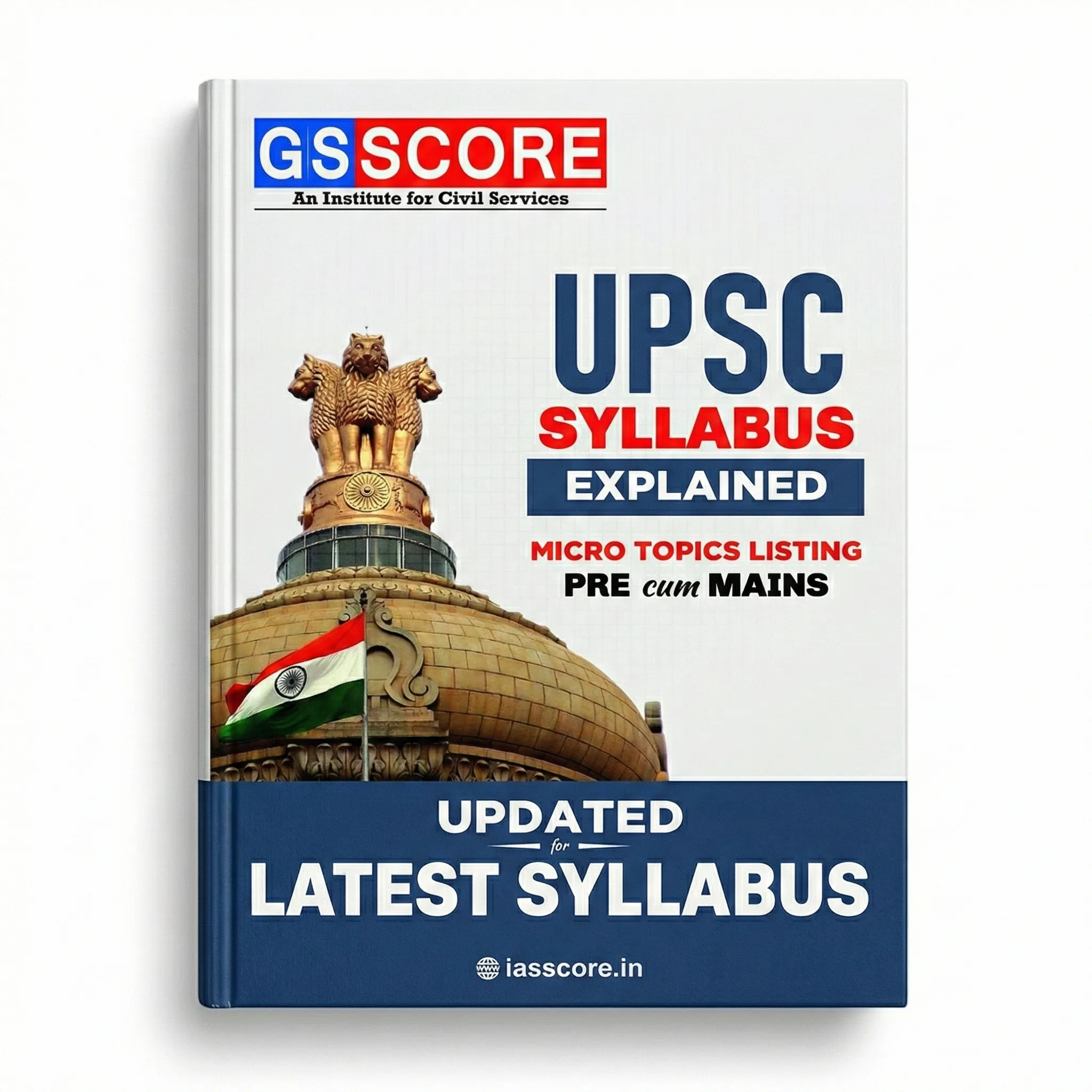
If you want the official framework neatly organised, a dedicated syllabus booklet keeps you anchored to exactly what is examinable — the GS Score Latest Syllabus Booklet is a handy companion for keeping the big picture in view while you drill subject topics. Competer prints and delivers these study materials across India so you can build your full KVS kit in one place.
How to Download the KVS Syllabus PDF
How can I download the KVS syllabus PDF?
Follow these steps for the official kvs syllabus pdf download:
- Visit the official KVS recruitment website (kvsangathan.nic.in) or the recruitment portal linked in the latest notification.
- Open the “Recruitment” or “Notifications” section and find the advertisement for PRT/TGT/PGT or the non-teaching post.
- Open the detailed notification PDF — the post-wise syllabus and exam pattern are annexed within it.
- Click download and save the PDF; print the syllabus pages and the week-by-week checklist above for quick daily reference.
Always treat the official notification PDF as the final authority. Coaching pages (including this one) summarise and organise it, but if anything ever conflicts, the official KVS document wins. Bookmark the page and re-check it when the fresh recruitment cycle opens.
Common Mistakes KVS Aspirants Make
- Preparing for the old single-paper pattern — always plan around the two-tier structure.
- Ignoring Tier 2 descriptive practice — objective-only preparation leaves marks on the table.
- Underrating NEP 2020 and pedagogy — these are the most predictable, scoring topics.
- Skipping negative-marking discipline — guessing blindly in Tier 1 can sink your screening score.
- No timed mock tests — concept knowledge without speed fails in a CBT.
- Neglecting the Hindi section — even strong English candidates lose easy marks here.
Frequently Asked Questions
What is the syllabus for the KVS exam?
The KVS syllabus has two tiers. Tier 1 covers General English, General Hindi, GK & Current Affairs, Reasoning, Numerical/Quantitative Ability and Computer Literacy. Tier 2 focuses on the subject concerned for your post (PRT/TGT/PGT), pedagogy/child development and Perspectives on Education & Leadership aligned with NEP 2020, and includes a descriptive component for several posts.
Is there negative marking in the KVS exam?
Yes. Objective MCQs in Tier 1 carry negative marking, with a fraction of a mark deducted for each wrong answer, while unattempted questions are not penalised. Descriptive answers in Tier 2 are not negatively marked. Prioritise accuracy over reckless attempting in the screening stage.
Is CTET necessary for the KVS PRT, TGT or PGT exam?
CTET (or an equivalent state TET) is generally required as an eligibility qualification for PRT and TGT teaching posts, in line with NCTE norms. PGT eligibility centres on the relevant post-graduate degree and B.Ed. Always confirm the exact eligibility — including any CTET requirement — in the current official KVS notification for your post.
Is the KVS exam bilingual (Hindi and English)?
Yes. The KVS computer-based test is bilingual — questions appear in both Hindi and English, except for the language-specific papers (such as the General Hindi, English or Sanskrit subject sections), which are set in the respective language.
What is the exam pattern for KVS Tier 1 and Tier 2?
Tier 1 is a fully objective screening CBT across English, Hindi, GK, reasoning, numerical ability and computer literacy, and only qualifies you. Tier 2 is the post-specific merit paper — subject concerned, pedagogy and Perspectives on Education & Leadership (NEP 2020) — and carries a descriptive component for several posts. Tier 2, with the interview/demonstration where applicable, decides your final rank.
How can I download the KVS syllabus PDF?
Go to the official KVS website (kvsangathan.nic.in) or the recruitment portal in the latest notification, open the Recruitment/Notifications section, download the detailed advertisement PDF for your post, and save the annexed post-wise syllabus and exam pattern. Print it alongside a study checklist for daily reference.
Which books are best for KVS PRT, TGT and PGT preparation?
Combine your subject-concerned standard text with NCERTs for the foundation, a dedicated pedagogy plus NEP 2020 guide, a current-affairs source for GK, and a previous-year-papers and mock-test set for practice. This five-part kit covers both Tier 1 and Tier 2 efficiently rather than relying on any single book.
Recommended Study Material

Continue Reading

Best Books for NEET 2026: Subject-Wise List + Toppers' Picks
The best books for NEET start with the NCERT textbooks for Physics, Chemistry and Biology (Class 11 and…
RRB Group D Syllabus 2026: Subject-Wise Topics, Exam Pattern + PDF
The rrb group d syllabus for the 2026 recruitment cycle is a single Computer Based Test (CBT) of…

CTET Syllabus 2026: Paper 1 & 2 Topics, Pattern + PDF
The CTET syllabus is set by the Central Board of Secondary Education (CBSE) and is split across two…