KVS Syllabus 2026: PRT, TGT, PGT Pattern + Free PDF
KVS syllabus 2026 for PRT, TGT, PGT & non-teaching posts: full Tier 1 & Tier 2 exam pattern, section-wise topics, marking scheme + free PDF download.

The KVS syllabus for 2026 is organised around a two-tier recruitment exam: a common Tier 1 (100 objective questions across six sections) that every PRT, TGT and PGT candidate writes, followed by a post-specific Tier 2 testing the subject you teach plus pedagogy. Non-teaching posts (Principal, Librarian, Finance Officer, Assistant) follow their own role-based pattern. This guide breaks down the complete post-wise and subject-wise KVS syllabus 2026, the Tier 1 and Tier 2 exam pattern, negative marking, the class-wise split-up syllabus for students, and a free, no-login PDF you can print.
Quick answer: Clear Tier 1 by mastering pedagogy (the “Perspectives on Education & Leadership” section alone is roughly 60% of the paper), then win your rank in the subject-specific Tier 2. PRT needs CTET Paper 1, TGT needs CTET Paper 2, and PGT generally does not need CTET. Always cross-check marks, vacancies and the negative-marking rule against the official KVS notification on kvsangathan.nic.in before you plan your attempt.
Kendriya Vidyalaya Sangathan (KVS) recruits teaching and non-teaching staff for its network of over 1,250 Kendriya Vidyalayas nationwide. Whether you are preparing for Primary Teacher (PRT), Trained Graduate Teacher (TGT), Post Graduate Teacher (PGT) or a non-teaching role, understanding the exact syllabus and weightage is the single biggest lever for a top rank. Below we cover every section the top-ranked pages cover — and the gaps they leave out.
KVS Recruitment 2026: Posts and Overview
KVS recruitment is conducted by the Sangathan (and in some cycles through a nodal agency) for both teaching and non-teaching cadres. A typical large recruitment cycle advertises several thousand vacancies across the posts below. The exact 2026 vacancy count is confirmed in the official notification, but the post categories and exam structure remain consistent.
| Category | Posts Covered | Eligibility (Core) | CTET/Equivalent |
|---|---|---|---|
| Teaching | PRT (Primary Teacher) | Senior Secondary + 2-yr D.El.Ed/B.El.Ed | CTET Paper 1 required |
| Teaching | TGT (Trained Graduate Teacher) | Graduation in subject + B.Ed | CTET Paper 2 required |
| Teaching | PGT (Post Graduate Teacher) | Master’s in subject + B.Ed | CTET not mandatory (NET/subject rules apply) |
| Teaching (Head) | Principal, Vice Principal | Master’s + B.Ed + administrative experience | As per RRs |
| Non-Teaching | Librarian, Finance Officer, Assistant Section Officer, Hindi Translator, Stenographer, LDC/UDC, Sub-Staff | Post-specific (Graduation/Diploma) | Not applicable |
Specialised TGT roles also appear in most cycles: TGT (Art Education), TGT (Work Experience), and TGT (Physical & Health Education) — each with a role-specific Tier 2 paper rather than an academic subject.
Age limit (indicative): PRT and TGT posts are commonly capped around 30 and 35 years respectively, PGT around 40 years, with the usual relaxations for SC/ST (5 years), OBC (3 years) and PwD candidates. These upper limits and category relaxations are fixed by the live notification, so treat the figures here as the standing KVS pattern and verify the 2026 cut-off date for age calculation.
KVS Exam Pattern 2026: Tier 1 and Tier 2 at a Glance
The headline change candidates search for is the KVS exam pattern 2026 tier 1 and tier 2 structure. KVS teaching selection now runs in two tiers: a common Tier 1 screening test and a post-specific Tier 2. Tier 1 is purely objective; Tier 2 carries a subject-heavy objective load and, for several posts, a descriptive component. Below is the single at-a-glance table covering all teaching posts in one view.
| Stage | Nature | Questions / Marks | Applies To | Mode |
|---|---|---|---|---|
| Tier 1 | Common objective (MCQ) | 100 questions / ~300 marks (3 marks each) | PRT, TGT, PGT | CBT (online) |
| Tier 2 | Subject + Pedagogy (objective, with descriptive for some posts) | Subject-specific (varies by post) | Post-specific | CBT / Descriptive |
| Demo / Interview | Teaching skill assessment | Qualifying + weighted | Shortlisted candidates | In-person |
The exact per-section mark split can be revised in the official notification, so treat the 3-marks-per-question figure as the long-standing KVS convention and confirm against the 2026 advertisement.
How many questions are asked in the KVS Tier 1 exam and what are the sections?
Tier 1 has 100 questions divided across six parts. It is the common qualifying-cum-ranking test for PRT, TGT and PGT alike. Here is the section-wise breakdown.
| Part | Section | Approx. Questions | Focus |
|---|---|---|---|
| I | General English | 10 | Grammar, comprehension, usage |
| II | General Hindi | 10 | Vyakaran, comprehension |
| III | General Awareness & Current Affairs | 10 | Static GK + current events |
| IV | Reasoning Ability | 5 | Verbal & non-verbal reasoning |
| V | Computer Literacy | 5 | MS Office, internet, fundamentals |
| VI | Perspectives on Education & Leadership (Pedagogy) | 60 | Educational psychology, NEP 2020, child development |
The key takeaway: Perspectives on Education & Leadership is the highest-weightage section by a wide margin. Roughly 60% of Tier 1 tests pedagogy, child development, inclusive education, and the National Education Policy 2020. Candidates who treat this as an afterthought lose the most marks. The language and GK sections are scoring but light; pedagogy decides your Tier 1 fate.
KVS Tier 1 Section-Wise Syllabus (Detailed)
Below is the detailed topic list for each Tier 1 part. These topics are common to PRT, TGT and PGT.
| Section | Key Topics |
|---|---|
| General English | Tenses, articles, prepositions, subject-verb agreement, voice, narration, synonyms/antonyms, idioms, error spotting, reading comprehension |
| General Hindi | Sandhi, samas, upsarg-pratyay, alankar, muhavare, vilom/paryayvachi, vakya shuddhi, gadyansh (comprehension) |
| General Awareness & Current Affairs | Indian history, polity, geography, economy, science, static GK, national & international current affairs, sports, awards, government schemes |
| Reasoning Ability | Analogies, series, coding-decoding, blood relations, puzzles, syllogism, direction sense, classification, non-verbal reasoning |
| Computer Literacy | Computer fundamentals, hardware/software, MS Word/Excel/PowerPoint, operating systems, internet & email, networking basics, shortcuts |
| Perspectives on Education & Leadership | Child development & pedagogy, learning theories, inclusive education, assessment & evaluation, NEP 2020, NCF, educational management & leadership, rights of the child (RTE) |
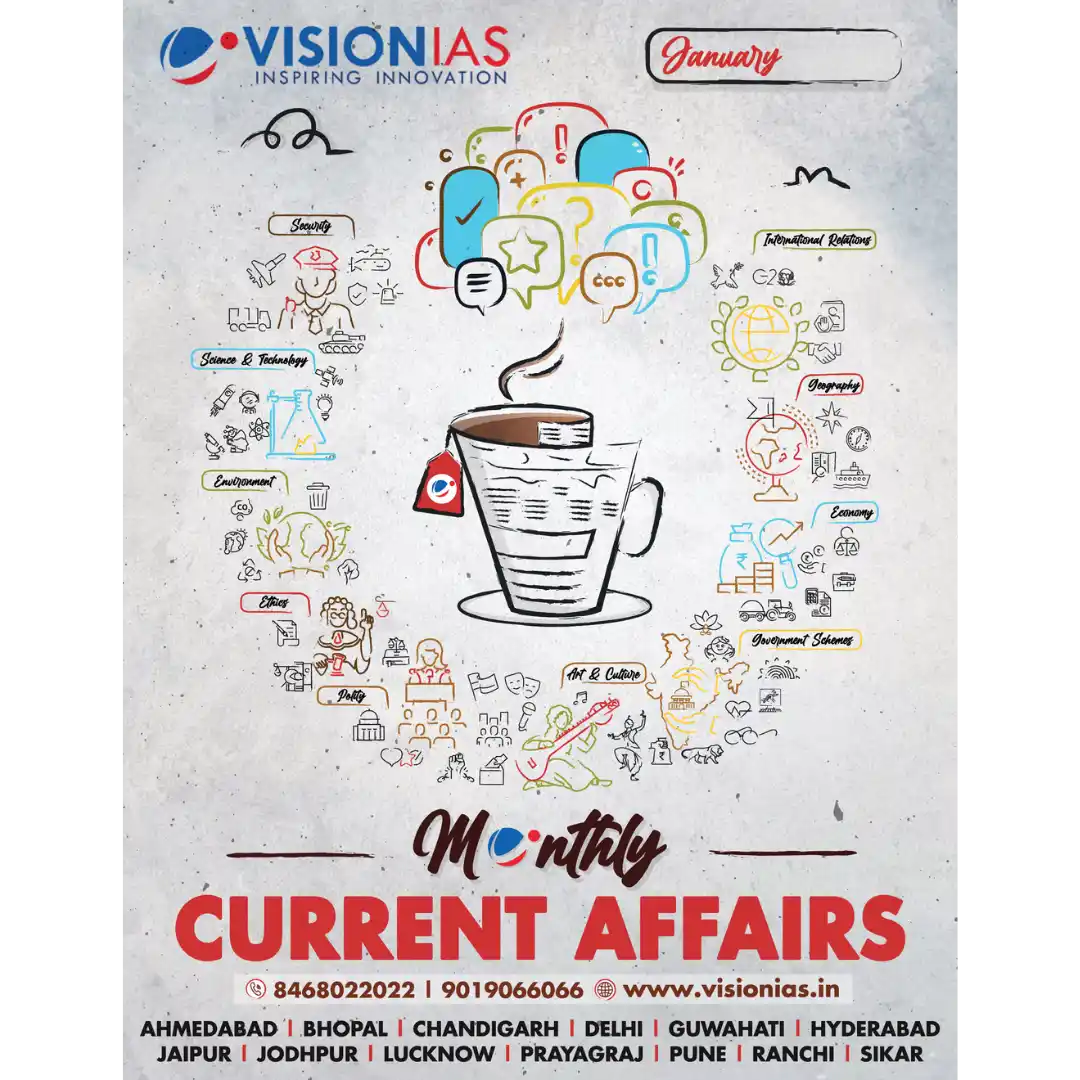
Current affairs is a recurring pain point because the question window keeps moving. A disciplined monthly digest keeps this section under control — candidates preparing for competitive exams often rely on a structured monthly compilation such as the Vision IAS Current Affairs Magazine (January 2026) to cover schemes, awards and national events in one pass.
KVS PRT Syllabus 2026 (Primary Teacher)
The KVS PRT syllabus targets teachers for Classes 1–5. Tier 1 is common; the PRT Tier 2 concentrates on primary-level pedagogy and the foundational subjects a primary teacher handles across the curriculum.
- Child development & pedagogy (primary stage): principles of development, learning, motivation, inclusive education, assessment for the 6–11 age group.
- Languages: language pedagogy, listening-speaking-reading-writing skills, teaching strategies at the primary level.
- Mathematics & EVS pedagogy: number sense, shapes, measurement; environmental studies concepts and how to teach them.
- NEP 2020 & foundational literacy/numeracy (FLN): NIPUN Bharat, play-based and activity-based learning.
Because CTET Paper 1 is required for PRT, strong CTET preparation overlaps directly with the PRT syllabus — see our topic-wise PYQ practice approach for how previous-year drilling compresses revision time.
KVS TGT Syllabus 2026 (Trained Graduate Teacher)
The KVS TGT syllabus is for teachers of Classes 6–10. Tier 2 is subject-specific at roughly graduation level, plus teaching methodology for that subject. TGT subjects commonly notified include:
| TGT Subject | Tier 2 Syllabus Scope |
|---|---|
| English | Literature, grammar, linguistics, English language teaching (ELT) methods |
| Hindi | Hindi sahitya, vyakaran, bhasha shikshan |
| Mathematics | Algebra, geometry, trigonometry, mensuration, statistics (up to graduation level) |
| Science | Physics, chemistry, biology fundamentals + science pedagogy |
| Social Science | History, geography, polity, economics (integrated) |
| Sanskrit | Vyakaran, sahitya, anuvad |
Specialised TGT roles have distinct Tier 2 papers: TGT (Art Education) covers drawing, painting, art history and art pedagogy; TGT (Work Experience) covers SUPW/vocational concepts; and TGT (Physical & Health Education) covers anatomy, physiology, sports science, rules of games and health education. CTET Paper 2 is required for all TGT posts.
KVS PGT Syllabus 2026 (Post Graduate Teacher)
The KVS PGT syllabus is for senior-secondary teachers (Classes 11–12) and is the most academically demanding, pitched at post-graduation level. Tier 2 tests deep subject mastery plus senior-level pedagogy.
| PGT Subject | Tier 2 Syllabus Scope |
|---|---|
| English | Advanced literature, literary theory, linguistics, ELT |
| Hindi | Hindi sahitya ka itihas, kavya shastra, advanced vyakaran |
| Physics / Chemistry / Biology | Full +2 and graduation/PG-level subject depth |
| Mathematics | Calculus, algebra, linear algebra, probability, higher mathematics |
| Economics | Micro, macro, Indian economy, statistics |
| History / Geography / Political Science | Honours-level subject syllabus + pedagogy |
| Computer Science / Commerce | Programming, data structures / accountancy, business studies |
What is the difference between KVS PRT, TGT and PGT syllabus?
All three share the same Tier 1. The difference is in Tier 2 depth and class level: PRT focuses on primary-stage (Class 1–5) pedagogy and foundational subjects; TGT covers graduation-level subject knowledge for Classes 6–10; PGT demands post-graduation-level subject mastery for Classes 11–12. PRT and TGT require CTET (Paper 1 and Paper 2 respectively), while PGT generally does not.
| Factor | PRT | TGT | PGT |
|---|---|---|---|
| Classes taught | 1–5 | 6–10 | 11–12 |
| Tier 2 depth | Primary pedagogy + FLN | Graduation-level subject | Post-graduation-level subject |
| Core qualification | Sr. Secondary + D.El.Ed/B.El.Ed | Graduation + B.Ed | Master’s + B.Ed |
| CTET | Paper 1 required | Paper 2 required | Generally not required |
KVS Non-Teaching Syllabus 2026 (Principal, Librarian, Finance Officer)
The KVS non-teaching syllabus replaces subject pedagogy with role-specific professional knowledge, alongside the common reasoning, English, Hindi, GK and computer sections.
| Post | Core Syllabus Areas |
|---|---|
| Principal / Vice Principal | Educational administration & leadership, management, current trends in education, NEP 2020, general ability, reasoning, language |
| Librarian | Library & information science, classification & cataloguing, library management, ICT in libraries, general awareness |
| Finance Officer / Assistant | Accountancy, financial rules (GFR), auditing, government financial procedures, quantitative aptitude |
| Stenographer / LDC / UDC | English, Hindi, general awareness, reasoning, computer, typing/shorthand skill test |
KVS Marking Scheme and Negative Marking
A clear marking scheme helps you decide when to attempt and when to leave a question. KVS has traditionally awarded a positive mark per correct answer with no negative marking in the objective teaching papers, but recent two-tier cycles have varied this — always confirm against the live notification.
| Element | Detail (Typical) |
|---|---|
| Marks per correct answer | 3 marks (Tier 1 teaching) |
| Negative marking | Generally none in KVS teaching objective papers (verify in 2026 notification) |
| Total Tier 1 | ~300 marks / 100 questions |
| Qualifying | Tier 1 shortlists candidates for Tier 2 as per category cut-off |
| Final selection | Tier 2 + demo/interview weightage |
Is there negative marking in the KVS exam?
KVS teaching recruitment objective papers have conventionally carried no negative marking, which means attempting every question is the optimal strategy. However, KVS has reserved the right to change this in revised patterns, so you must confirm the negative marking rule in the official 2026 advertisement before the exam. Where no negative marking applies, leave no question blank.
KVS Selection Process 2026: How the Stages Add Up
Knowing the syllabus is only half the battle — you also need to know how the stages combine into a final merit list. The KVS teaching selection flows through four steps, and only the right ones carry weight in your final score.
| Stage | Purpose | Counts Toward Final Merit? |
|---|---|---|
| Tier 1 (CBT) | Screening / shortlisting | Qualifying; shortlists for Tier 2 |
| Tier 2 (Subject + Pedagogy) | Subject mastery assessment | Yes — major weight |
| Demo Teaching / Skill Test | Classroom delivery & communication | Yes — weighted/qualifying as per RRs |
| Interview + Document Verification | Suitability & eligibility check | Interview weighted where applicable; DV is eligibility-only |
The practical message: a strong Tier 1 gets you through the door, but your Tier 2 subject score and demo performance build the rank. Budget preparation time accordingly rather than over-investing in the qualifying stage.
High-Weightage Topic Priority and Study Plan
Most top-ranked KVS pages stop at listing topics. Here is the actionable layer they miss — where the marks actually sit and the order in which to prepare.
| Priority | Area | Why |
|---|---|---|
| 1 (Highest) | Perspectives on Education & Leadership / Pedagogy | ~60% of Tier 1 — the single biggest scoring block |
| 2 | Your Tier 2 subject | Decides final rank; needs the longest runway |
| 3 | Current Affairs & General Awareness | Fully scoring if revised monthly |
| 4 | General English & Hindi | Quick, grammar-driven, high accuracy |
| 5 | Reasoning & Computer Literacy | Small count but easy marks |
A realistic 90-day plan: Weeks 1–6, build Tier 2 subject depth + daily pedagogy; Weeks 7–10, consolidate pedagogy, NEP 2020, and current affairs; Weeks 11–12, full-length mocks for both tiers with error logs. For subject revision, a well-structured printed syllabus booklet keeps you aligned — resources like the GS Score Latest Syllabus Booklet are useful for candidates who juggle KVS alongside other general-studies-heavy exams.
What Changed in the 2026 Pattern (vs the Old Single-Paper Format)
Earlier KVS teaching recruitment used a single combined paper mixing general sections and subject questions. The revised two-tier model separates a common screening Tier 1 from a specialised Tier 2. The practical implications:
- Two-stage filtering: you must clear Tier 1 before your subject expertise in Tier 2 counts.
- Heavier pedagogy weight: Perspectives on Education is now a dominant Tier 1 block, rewarding genuine teaching-theory preparation over rote GK.
- Descriptive component: some posts introduce a descriptive element in Tier 2 — practise written answers, not just MCQs.
KVS vs NVS Syllabus: Key Differences
Candidates often prepare for KVS and Navodaya Vidyalaya Samiti (NVS) together because both recruit PRT/TGT/PGT. The syllabi overlap heavily, but there are differences worth noting.
| Aspect | KVS | NVS |
|---|---|---|
| Recruiting body | Kendriya Vidyalaya Sangathan | Navodaya Vidyalaya Samiti |
| Pattern | Two-tier (Tier 1 + Tier 2) | Single/combined objective paper (post-wise) |
| Pedagogy weight | Very high in Tier 1 | Significant but distributed differently |
| Reasoning/aptitude | Smaller section | Often larger quantitative/reasoning block |
| Core subject syllabus | Nearly identical — same class levels | Nearly identical — same class levels |
Bottom line: your subject preparation transfers directly, but tune your general-sections strategy to each body’s weightage.
KVS Split-Up / Class-Wise Syllabus for Students (Class 1 to 12)
A distinct group of searchers wants the KVS student split-up syllabus — the month-wise academic distribution for Classes 1–12, not the recruitment exam. KVS follows the NCERT/CBSE curriculum, and each Kendriya Vidyalaya publishes a split-up (month-wise) syllabus that divides the annual NCERT syllabus across the two terms.
| Stage | Classes | Curriculum Basis |
|---|---|---|
| Primary | 1–5 | NCERT, FLN/NIPUN Bharat aligned |
| Upper Primary | 6–8 | NCERT, CBSE scheme |
| Secondary | 9–10 | CBSE syllabus + internal assessment |
| Senior Secondary | 11–12 | CBSE stream-wise (Science/Commerce/Humanities) |
If you landed here as a student or parent, the split-up syllabus is the month-wise breakup of the CBSE/NCERT syllabus for your class, usually published by your KV on its website at the start of the session. The recruitment syllabus in the rest of this article is for job aspirants.
How to Download the KVS Syllabus 2026 PDF (Free, No Login)
Many competing pages gate the kvs syllabus 2026 pdf download behind a sign-up. You can build a clean, printable KVS syllabus PDF directly from this page — no login required:
- Select the relevant sections above (Tier 1 breakdown + your post: PRT, TGT or PGT, or your non-teaching role).
- Use your browser’s Print → Save as PDF to export the exact post-wise and subject-wise tables.
- Keep the official KVS notification open alongside to confirm 2026 vacancy count and any pattern revision.
For the authoritative version, the detailed syllabus is also published inside the official recruitment notification on the KVS website (kvsangathan.nic.in) whenever a cycle is announced. Use this page to plan and revise; use the notification PDF to lock in the final marks, vacancy and pattern figures. This gives you an at-a-glance Tier 1 + Tier 2 syllabus covering all posts in one file, which you can print and tick off as you revise.
Related KVS Resources
To round out your preparation, pair the syllabus with: previous-year question papers (the fastest way to gauge real difficulty and recurring themes), expected cut-off trends by category, the official exam-date calendar, salary and 7th-CPC pay level for your post, and the full selection process (Tier 1 → Tier 2 → demo/interview → document verification). Practising with topic-wise PYQs — the method behind resources like the Forum IAS Topic-Wise PYQ Toolkit — is equally effective for KVS pedagogy and GK revision.
Frequently Asked Questions
What is the syllabus of KVS exam 2026?
The KVS exam 2026 syllabus has two parts: a common Tier 1 with 100 objective questions across General English, General Hindi, General Awareness & Current Affairs, Reasoning, Computer Literacy and Perspectives on Education & Leadership; and a post-specific Tier 2 testing your subject (PRT/TGT/PGT) or professional role (non-teaching) plus pedagogy.
What is the new exam pattern for KVS (Tier 1 and Tier 2)?
KVS teaching recruitment follows a two-tier pattern. Tier 1 is a common objective CBT of 100 questions (~300 marks) split into six sections, used to shortlist candidates. Tier 2 is post-specific, heavier on your teaching subject and pedagogy, and may include a descriptive component for some posts, followed by a demo/interview for shortlisted candidates.
Is there negative marking in the KVS exam?
KVS teaching objective papers have conventionally carried no negative marking, so attempting every question is advisable. KVS can revise this in the 2026 pattern, so confirm the negative marking rule in the official notification before your exam and adjust your attempt strategy accordingly.
Is CTET compulsory for KVS recruitment?
CTET is mandatory for PRT (CTET Paper 1) and TGT (CTET Paper 2) posts. For PGT, CTET is generally not required, though subject-specific or NET-related eligibility rules may apply. Non-teaching posts do not require CTET.
How do I download the KVS syllabus 2026 PDF?
You can create a free KVS syllabus 2026 PDF without any login: select the Tier 1 breakdown plus your post-wise section from this page and use your browser’s Print → Save as PDF option to export the tables into a clean, printable file. Cross-check it with the official KVS notification for the latest vacancy and pattern details.
Which section has the highest weightage in KVS Tier 1?
Perspectives on Education & Leadership — the pedagogy section — carries roughly 60 of the 100 Tier 1 questions, making it the highest-weightage block by a wide margin. It covers child development, learning theories, inclusive education, assessment, NEP 2020 and the NCF. Prioritise it over the lighter language, GK, reasoning and computer sections.
What is the difference between the KVS recruitment syllabus and the KVS split-up syllabus?
The recruitment syllabus is for job aspirants (PRT/TGT/PGT and non-teaching posts) and defines the Tier 1 and Tier 2 exam topics. The split-up syllabus is for school students of Classes 1–12 — a month-wise breakup of the NCERT/CBSE curriculum that each Kendriya Vidyalaya publishes at the start of the academic session. They are unrelated documents despite the similar name.
Is the KVS exam bilingual, and what is the duration?
KVS objective papers are typically conducted in a bilingual format (English and Hindi) except for language-specific questions. Tier 1 is generally allotted around three hours; the exact duration and language options are specified in the 2026 admit card and notification.
Recommended Study Material

Continue Reading
SSC CGL Preparation 2026: Plan, Strategy & Best Books
SSC CGL preparation in 2026 comes down to four moves: master the Tier-1 pattern (100 questions, 60 minutes,…
JEE Advanced Syllabus 2026: Subject-Wise Topics + PDF
The jee advanced syllabus for 2026 covers three subjects — Physics, Chemistry and Mathematics — across two compulsory…
DSSSB Syllabus 2026: PRT, TGT, PGT Exam Pattern + PDF Download
The DSSSB syllabus for 2026 is built around a two-stage structure: a Tier 1 Computer-Based Test of 200…