NEET Exam Pattern 2026: Marks, Questions & Marking Scheme
NEET exam pattern 2026: 180 questions, 720 marks, 3 hours, +4/-1 marking, subject-wise marks, chapter weightage and the 2027 CBT shift explained.

The NEET exam pattern for 2026 is a single pen-and-paper (OMR) test of 180 compulsory multiple-choice questions carrying 720 marks, to be completed in 3 hours (180 minutes). Every correct answer earns +4 marks, every wrong answer costs -1 mark (negative marking), and unattempted questions score 0. The paper is split across three subjects — Physics (45 questions/180 marks), Chemistry (45 questions/180 marks) and Biology (Botany + Zoology, 90 questions/360 marks) — and is offered in 13 languages, with English as the final reference version.
This guide gives you the complete, up-to-date breakdown of the NEET UG structure — total marks and number of questions, the NEET marking scheme 2026, subject-wise and chapter-wise weightage, exam duration and mode, languages, the tie-breaking rule, OMR-sheet rules, and the upcoming shift to Computer-Based Test (CBT) mode from NEET 2027. We also convert the pattern into a concrete exam-day strategy so you can plan both your preparation and your 180 minutes in the hall.
How to read this guide: the numbers below (180 questions, 720 marks, +4/-1 marking, 13 mediums) have been consistent since the National Medical Commission and NTA restored the pre-COVID structure in 2025. Always confirm the exact exam date, languages at your centre and any late changes against the official NEET UG information bulletin on the NTA website (neet.nta.nic.in) before your attempt, since NTA notifies the final pattern each cycle.
NEET Exam Pattern 2026 at a Glance
Here is the quick highlights table that captures the entire NEET exam pattern 2026 in one view. These are the numbers every aspirant and parent searches for first.
| Feature | Details (NEET UG 2026) |
|---|---|
| Exam mode | Offline — pen-and-paper (OMR sheet) |
| Total questions | 180 (all compulsory) |
| Total marks | 720 |
| Exam duration | 3 hours (180 minutes) |
| Number of subjects | 3 — Physics, Chemistry, Biology |
| Question type | Multiple Choice Questions (MCQ), 4 options each |
| Marking scheme | +4 correct, -1 incorrect, 0 unattempted |
| Languages | 13 (English, Hindi + 11 regional) |
| Conducting body | National Testing Agency (NTA) |
| Exam frequency | Once a year |
| Expected exam date | Around 3 May 2026 (single day) |
Use this table as your reference card. Every section below simply expands one row — so if you only remember three numbers, make them 180 questions, 720 marks and 3 hours.
NEET Total Marks and Number of Questions
The NEET total marks and number of questions are fixed: 180 questions for 720 marks. Since the maximum any correct answer can add is 4, the arithmetic is simple — 180 × 4 = 720. There is no separate sectional qualifying mark; your score is the aggregate across all three subjects, and the merit list is drawn from this total of 720.
A key change aspirants must note: since 2025 the National Medical Commission (NMC) and NTA restored the pre-COVID structure, removing the optional “Section B” that existed in 2021–2024. Earlier, each subject had Section A (35 compulsory questions) and Section B (15 questions, of which you attempted 10). From 2025 onwards, all 180 questions are compulsory — there is no choice and no optional set. This is the single most important update to the NEET exam pattern in recent years, and it is why older articles quoting “200 questions” or “3 hours 20 minutes” are now out of date.
Because there is no longer any optional section, selective preparation is riskier than before: you cannot skip a weak chapter and “make it up” with choice questions elsewhere. Broad, even coverage of all three subjects is now the safest route to a high aggregate out of 720.
NEET Exam Pattern Subject-Wise Marks
The NEET exam pattern subject wise marks distribution is weighted heavily toward Biology, which alone carries half the paper. This is why toppers almost always secure Biology first before moving to the other two subjects.
| Subject | Questions | Marks | Share of paper |
|---|---|---|---|
| Physics | 45 | 180 | 25% |
| Chemistry | 45 | 180 | 25% |
| Biology – Botany | 45 | 180 | 25% |
| Biology – Zoology | 45 | 180 | 25% |
| Total | 180 | 720 | 100% |
Biology is treated as two sub-sections — Botany and Zoology — each with 45 questions, together making 90 questions and 360 marks. Physics and Chemistry contribute 180 marks each. A well-structured module set that mirrors this split — like the Careerwill NEET Study Module Set built on the latest NTA pattern — helps you allocate study time in proportion to marks rather than guessing. The practical takeaway: a single mark gained in Biology is worth exactly the same as one gained in Physics, but Biology questions are usually faster to answer, so your marks-per-minute is highest there.
NEET Marking Scheme 2026 and Negative Marking
The NEET marking scheme 2026 rewards accuracy and penalises blind guessing. Understanding it changes how you decide which questions to attempt.
| Response | Marks awarded |
|---|---|
| Correct answer | +4 |
| Incorrect answer | -1 |
| Unattempted / left blank | 0 |
| More than one option marked | Treated as incorrect (-1) |
There is no negative marking for unattempted questions — leaving a question blank is always safer than a random guess. The swing between a right and a wrong answer is 5 marks (+4 versus -1), which is huge at the margins where ranks are decided. In a single-day national exam with lakhs of candidates, a difference of just 5–10 marks can move your rank by several thousand places.
Negative Marking Worked Example
Numbers make the risk concrete. Suppose three students each know 150 questions confidently and are unsure of 30.
| Scenario | Correct | Wrong | Blank | Score |
|---|---|---|---|---|
| Student A — leaves all 30 unsure blank | 150 | 0 | 30 | 600 |
| Student B — blind-guesses all 30 (gets ~7 right) | 157 | 23 | 0 | 605 |
| Student C — wild-guesses all 30 (gets ~4 right) | 154 | 26 | 0 | 590 |
The lesson: pure random guessing has a barely-positive expected value (at one-in-four odds you return +4 once and -1 three times = +1 over four questions), and it is easily erased by bad luck — as Student C shows. But educated guessing — where you can eliminate one or two options — tilts the odds firmly in your favour. The rule of thumb almost every topper follows: guess only when you can confidently rule out at least two of the four choices; otherwise leave it blank.
NEET Tie-Breaking Rule: What Happens at Equal Scores
Because 180 questions map to only 720 possible marks, thousands of candidates end up with identical scores, so NTA applies a tie-breaking order to decide rank. This is a high-value detail most pattern pages skip, yet it directly explains why your subject balance matters, not just your total. As per recent NTA policy, ties are resolved in this order:
- Higher marks (or percentile) in Biology — the largest section breaks the tie first.
- If still tied, higher marks in Chemistry.
- If still tied, higher marks in Physics.
- If still tied, a lower ratio of incorrect to correct responses across the whole paper (fewer wrong answers wins).
The age-based criterion and the earlier computerised random draw have been removed in recent cycles. The practical message: strengthening Biology not only earns the most marks but also protects your rank in a tie — one more reason to lock in Biology early and keep your wrong-answer count low. Always verify the exact tie-break sequence for your year in the official bulletin, as NTA occasionally refines it.
Old vs New NEET Exam Pattern: What Changed
Confusion persists because many online resources still describe the 2021–2024 format. This comparison clears it up.
| Element | Old pattern (2021–2024) | New pattern (2025–2026) |
|---|---|---|
| Questions per subject | 50 (35 in Section A + 15 in Section B) | 45 (single compulsory set) |
| Questions to attempt per subject | 45 (all A + 10 of 15 in B) | 45 (all compulsory) |
| Total questions displayed | 200 | 180 |
| Total questions attempted | 180 | 180 |
| Optional / choice questions | Yes (Section B) | No |
| Duration | 3 hours 20 minutes | 3 hours |
| Total marks | 720 | 720 |
So while total marks stayed at 720, the exam is now tighter: no Section B choice and 20 fewer minutes. Every question on the OMR must be answered on merit, which raises the premium on broad syllabus coverage over selective preparation. If you are studying from notes or test papers published before 2025, cross-check every pattern claim against this column — the “attempt 45 of 50” advice no longer applies.
Chapter-Wise and Topic-Wise Weightage
Most ranking pages stop at subject splits. But NEET questions are not spread evenly across chapters — a handful of high-yield units dominate every year. Prioritising these is the fastest route to a safe score. The tables below show approximate chapter-wise weightage based on recent NEET trends (figures are indicative and vary a few questions year to year; treat them as a planning guide, not a guarantee).
Physics High-Yield Chapters
| Unit / chapter area | Approx. questions | Approx. marks |
|---|---|---|
| Mechanics (Laws of Motion, Work-Energy, Rotation) | 10–12 | 40–48 |
| Electrodynamics (Current, Magnetism, EMI) | 9–11 | 36–44 |
| Modern Physics & Electronics | 7–8 | 28–32 |
| Optics & Waves | 5–6 | 20–24 |
| Thermodynamics & Kinetic Theory | 4–5 | 16–20 |
Chemistry High-Yield Chapters
| Branch / chapter area | Approx. questions | Approx. marks |
|---|---|---|
| Organic Chemistry (GOC, hydrocarbons, oxygen-containing) | 15–18 | 60–72 |
| Physical Chemistry (Equilibrium, Thermodynamics, Electrochemistry) | 14–16 | 56–64 |
| Inorganic Chemistry (Chemical Bonding, p-block, Coordination) | 12–14 | 48–56 |
Biology High-Yield Chapters
| Unit / chapter area | Approx. questions | Approx. marks |
|---|---|---|
| Human Physiology | 12–14 | 48–56 |
| Genetics & Evolution | 12–14 | 48–56 |
| Cell Biology & Biomolecules | 9–11 | 36–44 |
| Plant Physiology | 8–10 | 32–40 |
| Ecology & Environment | 8–10 | 32–40 |
| Reproduction (Plant + Human) | 7–9 | 28–36 |
Together, Organic + Physical Chemistry, Mechanics + Electrodynamics in Physics, and Human Physiology + Genetics in Biology cover a majority of the paper’s marks. If you are short on time, these clusters are where revision pays back fastest. A module set that is explicitly mapped to NCERT chapters with mind-maps — such as the Careerwill 23-module NEET set — lets you track your coverage against this weightage chapter by chapter, so you can see at a glance which high-yield units you have not yet secured.
NEET Exam Duration and Mode
The NEET exam duration and mode are fixed for 2026: a single offline, pen-and-paper exam of 3 hours conducted in one shift across the country on the same day. You mark answers on an OMR (Optical Mark Recognition) sheet using the ballpoint pen provided in the hall. There is no sectional timing — you are free to move between Physics, Chemistry and Biology as you wish within the 180 minutes.
The exam is held once a year. For 2026, NEET UG is expected around 3 May 2026 (the official date is confirmed by NTA in the information bulletin). Reporting time, document checks and biometric verification mean you should plan to reach the centre about two hours before the paper begins. Gates typically close well before the start time, and late entry is not permitted — so build buffer for traffic and security queues into your exam-day plan.
NEET Languages: 13 Mediums and the English Rule
NEET is conducted in 13 languages so aspirants can read the paper in the medium they studied in. The choice of medium is made during the application form and generally cannot be changed later.
| Language group | Mediums offered |
|---|---|
| National | English, Hindi |
| Regional (11) | Assamese, Bengali, Gujarati, Kannada, Malayalam, Marathi, Odia, Punjabi, Tamil, Telugu, Urdu |
A crucial rule: candidates opting for a regional or Hindi medium receive a bilingual question paper (regional + English). If there is any ambiguity or translation discrepancy, the English version is treated as the final and correct reference. For this reason, many aspirants study core terminology in English even when attempting in a regional medium, so a confusingly worded translation never costs them a mark they had earned.
OMR Sheet and Exam-Day Guidelines
Because NEET is OMR-based, small procedural errors can cost real marks. Follow these rules:
- Use only the ballpoint pen provided at the centre to darken bubbles — do not carry your own pen for marking.
- Fill the bubble completely; a faint or partial mark may not be read by the scanner.
- Do not erase or use whitener — OMR responses cannot be changed once marked, so decide before you darken.
- Fill in your test booklet code, roll number and other particulars correctly; a wrong booklet code can lead to wrong evaluation.
- Keep a duplicate OMR copy (carbonless layer) safely if provided — it is your evidence in case of a grievance.
- Carry the printed admit card, a valid photo ID, passport-size photographs and other documents listed in the bulletin.
These may sound trivial, but every year a number of candidates lose marks to avoidable OMR mistakes rather than to the questions themselves. Treat the first and last five minutes of the exam as “form-filling and verification” time, not solving time.
Pattern-to-Strategy: How to Use Your 180 Minutes
Knowing the pattern is only useful if you convert it into an attempt plan. With 180 questions in 180 minutes, you average one minute per question — but you should not spend it uniformly. The suggested sectional allocation below is built around scoring Biology first, because it is the largest, most factual and fastest-to-attempt section.
| Order | Subject | Questions | Suggested time | Why |
|---|---|---|---|---|
| 1st | Biology (Botany + Zoology) | 90 | 45–50 min | Highest marks, mostly recall — lock in 360 marks early |
| 2nd | Chemistry | 45 | 35–40 min | Mix of recall + short calculation — steady scoring |
| 3rd | Physics | 45 | 50–55 min | Most calculation-heavy — needs the most focused time |
| — | Review buffer | — | 10–15 min | Transfer any pending answers, re-check OMR, revisit flagged questions |
Attempt-order tips: do two passes — in Pass 1 solve only the questions you are sure of and flag the rest; in Pass 2 return to flagged questions with your remaining time. Never let a single tough Physics numerical eat five minutes early on; mark it and move. Build this rhythm through full-length mocks on recommended science modules so exam day feels routine rather than a fresh test of nerves.
NEET 2027 Exam Pattern: The Shift to CBT Mode
The biggest change on the horizon is the NEET 2027 exam pattern in CBT mode. Following recommendations to standardise high-stakes testing, NEET UG is expected to move from the current offline OMR format to a Computer-Based Test (online) from 2027. This would be the most significant structural change since the Section B removal. Treat it as expected rather than final until NTA notifies it formally.
Practically, a CBT transition changes how you prepare, not what you study:
- On-screen navigation: you read questions on a monitor and click answers — there is no OMR sheet to darken, no booklet code to fill.
- Review and flag tools: you can mark questions for review and jump between them digitally, making two-pass strategy easier than on paper.
- Rough work on paper, answers on screen: you still get a scratch sheet for Physics and numerical Chemistry, but the final response is a click.
- Screen stamina matters: three hours of on-screen reading needs practice — start taking mock tests on a computer so your eyes and clicking speed adapt.
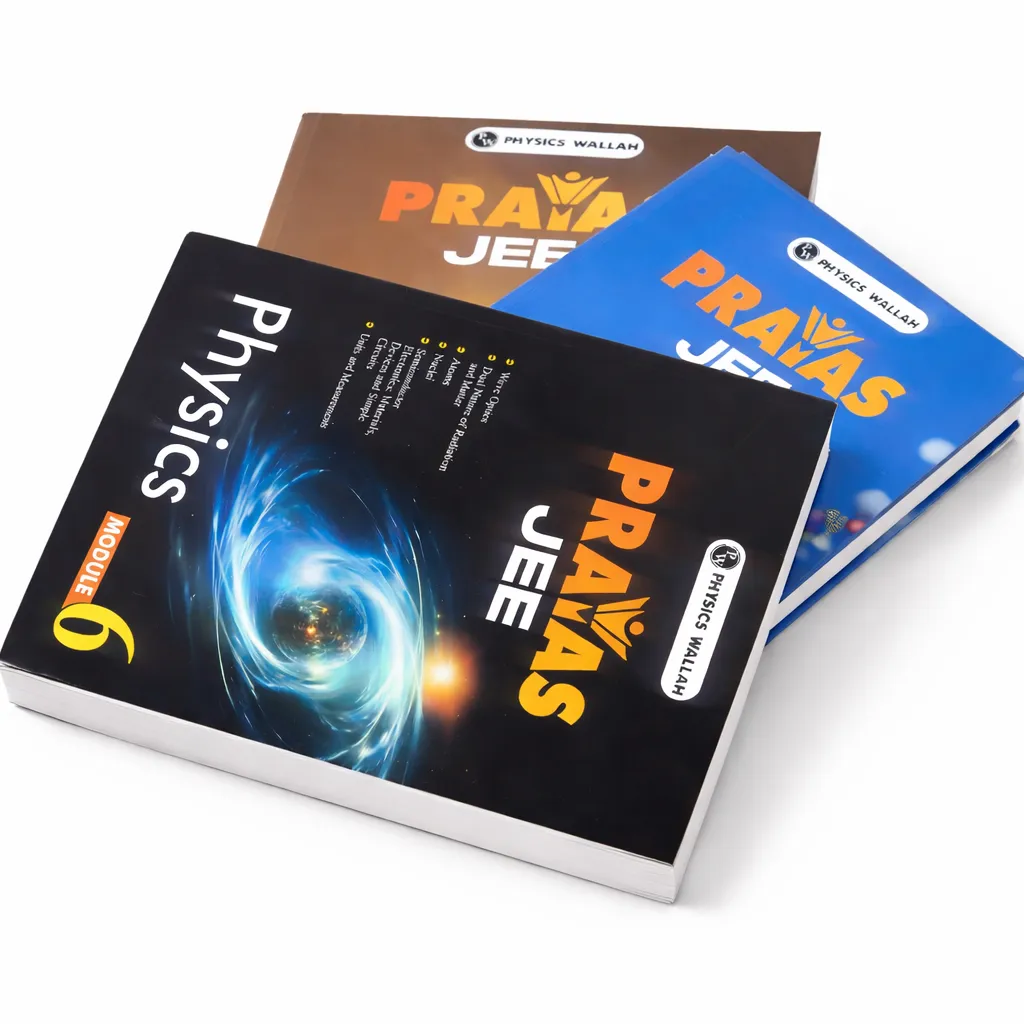
The marking scheme (+4/-1), subject split and 720-marks structure are expected to stay the same; only the medium of attempting changes. Students targeting 2027 should begin pairing their printed modules with online mock platforms now. Foundation-building science modules used by JEE aspirants — such as the eSaral IIT JEE modules and PW Prayas JEE modules — are useful supplements for strengthening Physics and Chemistry problem-solving that transfers directly to NEET’s calculation-heavy questions.
Tying the Pattern to Your Study Material
A pattern is a map; your study material is the vehicle. Because Biology carries 360 of 720 marks and Chemistry’s Organic + Physical branches are the densest scoring zones, your notes should be NCERT-aligned and chapter-mapped so you can revise by weightage. The Careerwill NEET Study Module Set — 23 modules, 4,200+ pages with mind-maps, built on the latest NTA pattern by Kota faculty — is structured for exactly this: you can revise high-yield chapters quickly and attempt chapter-wise questions to simulate the real 180-question load. Pair printed modules with regular full-length mocks to internalise the one-minute-per-question rhythm before exam day, and use the chapter weightage tables above to decide what to revise first in the final month.
Frequently Asked Questions
What is the exam pattern of NEET 2026?
NEET 2026 is a single offline pen-and-paper exam of 180 compulsory MCQs worth 720 marks, to be completed in 3 hours. It covers Physics, Chemistry and Biology, uses +4/-1 marking, and is offered in 13 languages with English as the final reference version.
How many questions are there in NEET and what are the total marks?
NEET has 180 questions carrying a total of 720 marks. All 180 questions are compulsory since 2025 — Physics has 45, Chemistry 45, and Biology 90 (45 Botany + 45 Zoology), each question worth 4 marks.
What is the marking scheme and negative marking in NEET?
Each correct answer gives +4 marks and each incorrect answer deducts 1 mark. Marking more than one option is treated as incorrect (-1). The 5-mark swing between right and wrong makes accuracy critical, so avoid blind guessing.
Is there negative marking for unattempted questions in NEET?
No. Unattempted or blank questions carry 0 marks with no penalty. Leaving a question blank is always safer than a random guess; guess only when you can eliminate at least two of the four options.
How many questions come from Physics, Chemistry and Biology in NEET?
Physics and Chemistry have 45 questions each (180 marks each), while Biology has 90 questions (360 marks), split equally between Botany and Zoology. Biology therefore accounts for half of the total 720 marks.
What is the duration of the NEET exam?
NEET is a 3-hour (180-minute) exam held in a single shift. There is no sectional time limit, so you can move freely between Physics, Chemistry and Biology. Plan for roughly one minute per question, with a short buffer to review and check your OMR sheet.
In how many languages is the NEET exam conducted?
NEET is conducted in 13 languages — English, Hindi and 11 regional mediums (Assamese, Bengali, Gujarati, Kannada, Malayalam, Marathi, Odia, Punjabi, Tamil, Telugu and Urdu). Regional-medium candidates get a bilingual paper, and the English version is the final reference in case of any discrepancy.
What changed in the NEET exam pattern from 2025?
From 2025 the optional Section B was removed, so all 180 questions are now compulsory with no choice, and the duration was reduced from 3 hours 20 minutes to 3 hours. The total marks (720) and the +4/-1 marking scheme stayed the same.
Will NEET 2027 be online (CBT) or offline?
NEET 2027 is expected to move to Computer-Based Test (online) mode, replacing the current offline OMR format. The marking scheme, subject split and 720-marks structure are expected to remain the same — only the mode of attempting changes to on-screen navigation. Confirm the final mode in NTA’s official notification.
Recommended Study Material


Continue Reading

UGC NET History Syllabus 2026: Unit-Wise + PDF Download
The ugc net history syllabus has two papers set by the NTA: Paper 1 (Teaching & Research Aptitude…
RRB JE Syllabus 2026: CBT 1 & 2 Topics, Pattern + PDF
The rrb je syllabus spans two computer-based stages: CBT 1 (100 marks / 90 minutes — Mathematics, General…
UPSC Previous Year Question Papers: Free PDF (2025)
UPSC previous year question papers are the official question booklets released by the Union Public Service Commission after…