NEET Syllabus 2026: Subject-Wise Topics, Weightage + PDF
Complete NEET syllabus 2026 — official NTA subject-wise topics for Physics, Chemistry & Biology, chapter-wise weightage, deleted topics, exam pattern + free PDF download.

The NEET syllabus for 2026 is the official National Testing Agency (NTA) list of examinable topics — finalised by the National Medical Commission (NMC) through the Undergraduate Medical Education Board (UGMEB) and drawn entirely from the NCERT Class 11 and Class 12 textbooks for Physics, Chemistry and Biology. It spans roughly 97 chapters across the three subjects, tested through 180 multiple-choice questions worth 720 marks. Biology carries the highest weightage at 50% of the paper, while Physics and Chemistry share the remaining 50% equally. For 2026 there are no fresh chapter deletions, so the syllabus is identical to 2025 — stable and NCERT-anchored.
This guide gives you the complete neet syllabus 2026 subject wise — every unit and chapter, a data-backed chapter-wise weightage table tied to previous-year question (PYQ) trends, a clear deleted-vs-retained comparison, the exam pattern, the official PDF download steps, and a study plan you can actually tick off. Bookmark it and use it to build your preparation from Day 1.
NEET Syllabus 2026: Release, Authority & Quick Facts
The NTA published the finalised NEET (UG) 2026 syllabus on its official portal, retaining the rationalised structure the NMC introduced in 2023–24. There are no new chapter removals for 2026, which is good news for aspirants who began preparing in Class 11 — nothing you have already studied has been pulled from scope. Because the entire paper is built strictly on NCERT, your prescribed school textbooks remain the single most important resource, and no reference book can substitute for reading them cover to cover.
| Particular | Detail (NEET 2026) |
|---|---|
| Conducting body | National Testing Agency (NTA) |
| Syllabus finalised by | NMC / UGMEB |
| Based on | NCERT Class 11 & 12 |
| Subjects | Physics, Chemistry, Biology (Botany + Zoology) |
| Total chapters | ~97 across three subjects |
| Total questions | 180 MCQs (200 asked, 180 attempted) |
| Total marks | 720 |
| Marking scheme | +4 correct, −1 wrong, 0 unattempted |
| Duration | 3 hours 20 minutes (200 minutes) |
| Official PDF source | neet.nta.nic.in |
NEET Exam Pattern 2026: Marks & Marking Scheme
Before you memorise topics, understand how they are tested — the pattern decides how you should prioritise the neet syllabus. The NEET 2026 paper presents 200 questions, of which you answer 180. Each subject has a Section A (35 questions, all compulsory) and a Section B (15 questions, of which you attempt any 10). Every correct answer earns +4 marks and every wrong answer costs −1, so negative marking makes accuracy as important as coverage.
| Subject | Section A | Section B (attempt 10 of 15) | Questions attempted | Marks |
|---|---|---|---|---|
| Physics | 35 | 15 (attempt 10) | 45 | 180 |
| Chemistry | 35 | 15 (attempt 10) | 45 | 180 |
| Biology (Botany + Zoology) | 70 | 30 (attempt 20) | 90 | 360 |
| Total | 140 | 60 (attempt 40) | 180 | 720 |
The single biggest strategic takeaway: Biology alone is worth 360 marks — half the paper. Master it and you have a huge head start on a competitive score. Because Section B lets you skip 5 of 15 questions per subject, it also rewards smart selection: read all 15, then answer only the 10 you are most confident about to protect yourself from negative marking.
NEET Physics Syllabus 2026: Unit & Chapter List
The neet physics syllabus spans Class 11 mechanics and thermal physics through Class 12 electromagnetism and modern physics. Physics is the section most students find hardest because it is numerical-heavy and concept-dense, so understanding the unit breakdown helps you prioritise high-yield chapters rather than spreading effort evenly.
| Class 11 Units | Class 12 Units |
|---|---|
| Physical World & Measurement | Electrostatics |
| Kinematics | Current Electricity |
| Laws of Motion | Magnetic Effects of Current & Magnetism |
| Work, Energy & Power | Electromagnetic Induction & Alternating Current |
| Motion of System of Particles & Rigid Body | Electromagnetic Waves |
| Gravitation | Optics (Ray & Wave) |
| Properties of Bulk Matter | Dual Nature of Matter & Radiation |
| Thermodynamics | Atoms & Nuclei |
| Behaviour of Perfect Gas & Kinetic Theory | Electronic Devices (Semiconductors) |
| Oscillations & Waves | — |
How to approach it: lock down mechanics first (Kinematics, Laws of Motion, Work-Energy-Power, Rotation) because it underpins later chapters and returns questions every year. Then build Electrostatics and Current Electricity, followed by Modern Physics and Optics, which are formula-light and high-return. Leave the most memory-heavy or least-tested sub-topics for last, and solve numericals daily rather than only reading theory.
NEET Chemistry Syllabus 2026: Physical, Organic & Inorganic
The neet chemistry syllabus divides naturally into three streams — Physical, Organic and Inorganic — each requiring a different approach. Physical Chemistry rewards numerical practice, Organic rewards mechanism and reaction-map understanding, and Inorganic rewards close NCERT reading and memorisation. A balanced attack across all three is essential; leaning on only one stream caps your score.
| Physical Chemistry | Organic Chemistry | Inorganic Chemistry |
|---|---|---|
| Some Basic Concepts of Chemistry | Basic Principles & Techniques of Organic Chemistry | Classification of Elements & Periodicity |
| Atomic Structure | Hydrocarbons | Chemical Bonding & Molecular Structure |
| States of Matter / Solutions | Haloalkanes & Haloarenes | The p-Block Elements |
| Thermodynamics | Alcohols, Phenols & Ethers | The d- & f-Block Elements |
| Equilibrium | Aldehydes, Ketones & Carboxylic Acids | Coordination Compounds |
| Redox Reactions / Electrochemistry | Amines / Organic Compounds with Nitrogen | The s-Block Elements |
| Chemical Kinetics | Biomolecules | Metallurgy (General Principles) |
How to approach it: Inorganic Chemistry is the fastest to score because most answers sit directly in NCERT lines — read them, don’t just skim. Organic hinges on mastering General Organic Chemistry (GOC) first, then chaining named reactions across chapters. Physical Chemistry needs formula fluency built through repeated problem-solving, especially in Equilibrium, Thermodynamics, Electrochemistry and Kinetics.
NEET Biology Syllabus 2026: Botany + Zoology Chapters
The neet biology syllabus is the highest-scoring section and combines Botany and Zoology. With 90 questions and 360 marks at stake, near-perfect Biology is the hallmark of top rankers. The syllabus follows NCERT line-by-line, meaning even single sentences, diagrams and example boxes from the textbook can appear as questions.
| Botany Units | Zoology Units |
|---|---|
| Diversity in Living World | Structural Organisation in Animals |
| Structural Organisation in Plants | Human Physiology (Digestion, Breathing, Circulation, Excretion, Locomotion, Neural & Chemical Coordination) |
| Cell Structure & Function | Human Reproduction & Reproductive Health |
| Plant Physiology (Photosynthesis, Respiration, Growth) | Evolution |
| Genetics & Evolution | Human Health & Disease |
| Biology in Human Welfare | Biotechnology: Principles & Processes / Applications |
| Ecology & Environment | Animal Kingdom & Biological Classification |
How to approach it: treat NCERT Biology as the exam paper in disguise. Read every line, annotate diagrams, and memorise examples, exceptions and scientific names. Human Physiology, Genetics & Evolution, Ecology and Cell Biology together account for a large slice of the section, so give them the deepest coverage and the most PYQ practice.
NEET Syllabus Chapter-Wise Weightage (Data-Backed)
Generic weightage tables float around the internet, but the numbers below reflect the actual distribution of questions across the last few years of NEET papers. Use this neet syllabus chapter wise weightage to sequence your revision — start with the heaviest, highest-return chapters first so your effort maps to marks.
| Subject | Overall Weightage | Approx. Questions | Approx. Marks |
|---|---|---|---|
| Biology (Botany + Zoology) | 50% | 90 | 360 |
| Physics | 25% | 45 | 180 |
| Chemistry | 25% | 45 | 180 |
High-weightage chapters by subject (based on PYQ trends)
| Subject | Highest-yield chapters | Typical questions/year |
|---|---|---|
| Biology | Human Physiology, Genetics & Evolution, Ecology, Cell Biology, Plant Physiology, Reproduction, Biotechnology | 4–8 each |
| Physics | Mechanics (Laws of Motion, WEP, Rotation), Electrostatics & Current Electricity, Modern Physics, Optics, Thermodynamics | 3–6 each |
| Chemistry | Chemical Bonding, Coordination Compounds, p-Block, Organic (GOC, Hydrocarbons, Oxygen-containing compounds), Equilibrium, Thermodynamics | 2–5 each |
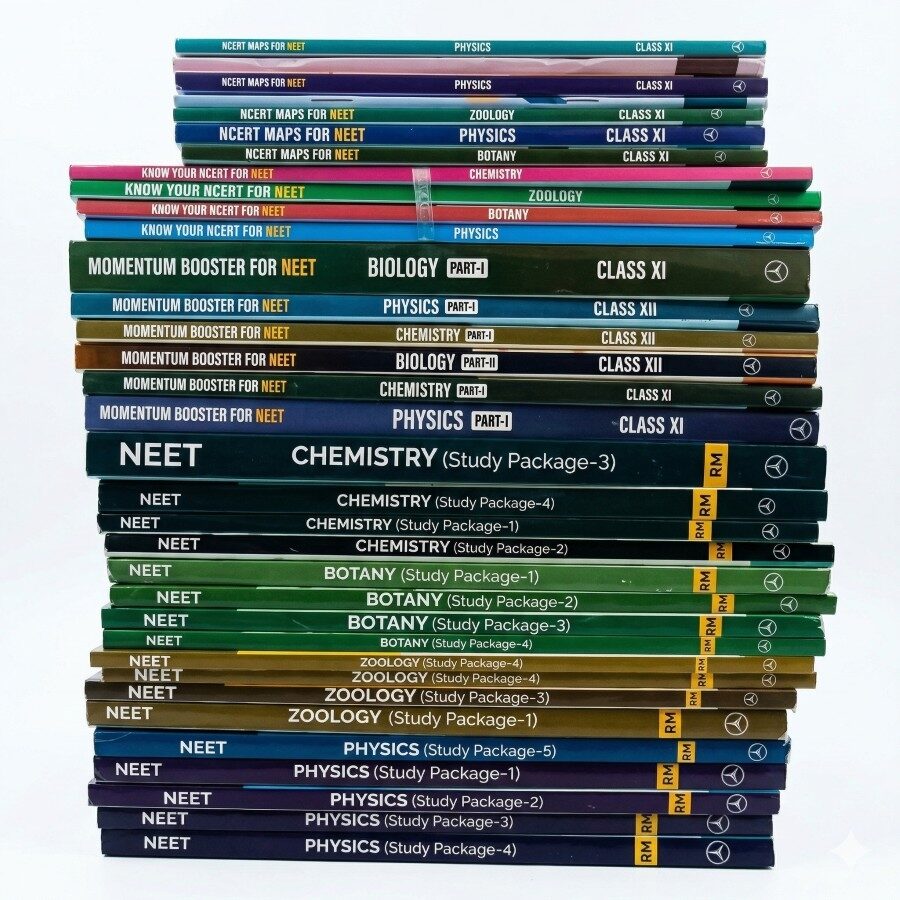
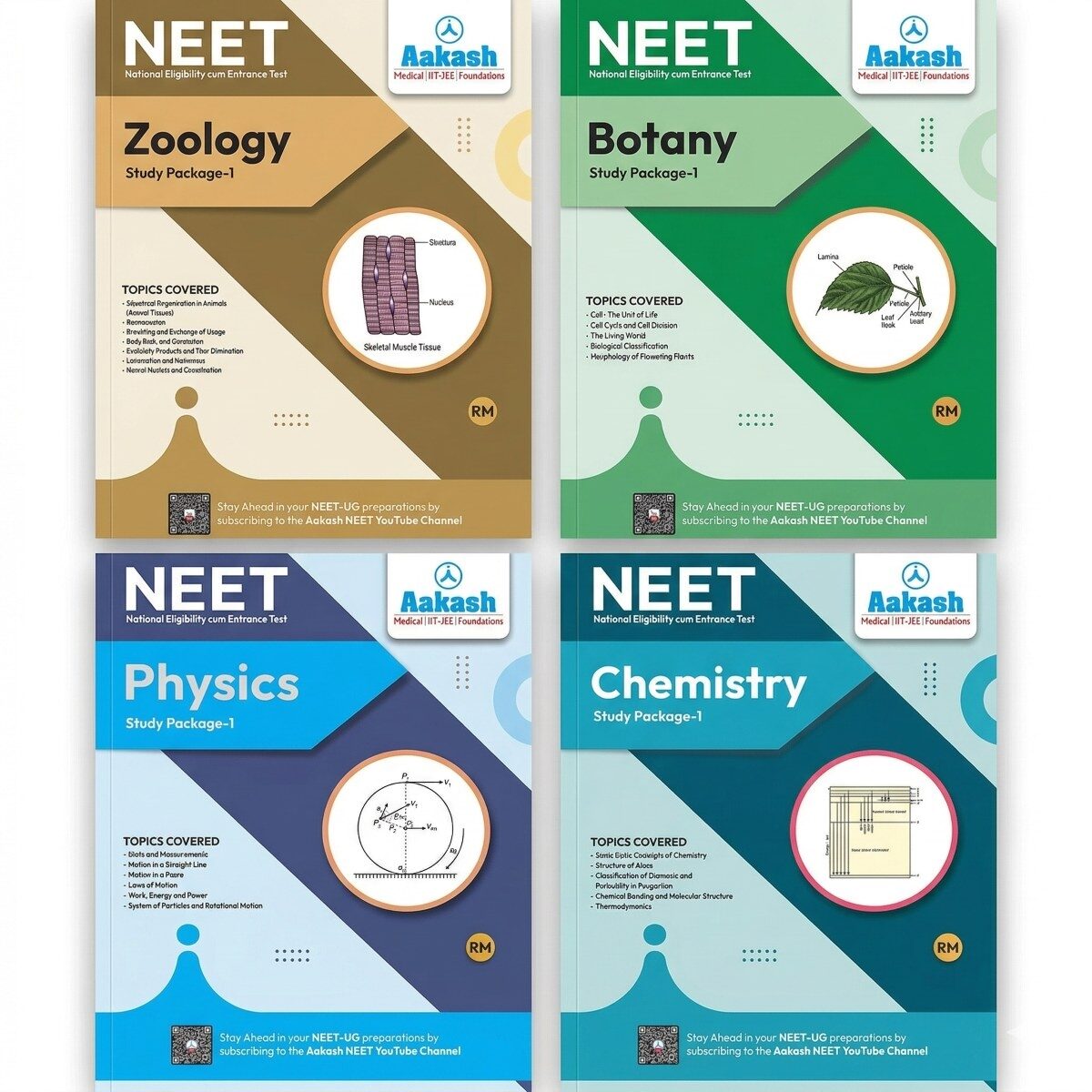
These figures vary a little year to year, so treat them as a priority order rather than a guarantee. The principle holds regardless: a handful of chapters per subject deliver a disproportionate share of marks, and the aspirants who rank highest are the ones who make those chapters near-unmissable before polishing the long tail. A well-organised booklet set that already sorts theory by chapter weightage saves weeks of planning — the Aakash NEET Medical Complete Package (35 booklets, 2026 edition) maps closely to this NCERT-aligned structure.
Is the NEET Syllabus the Same as Class 11 and 12 Boards?
Largely yes — the NEET syllabus is built on the same NCERT Class 11 and 12 curriculum that your board exams follow, which is why school study and NEET preparation overlap heavily. But there are three practical differences worth knowing so you don’t assume they are interchangeable:
- Depth of testing: boards reward descriptive answers and presentation; NEET tests precise recall and application through MCQs, so you must know facts exactly, not approximately.
- Selection of topics: after the NMC rationalisation, a few topics that may still appear in some state-board books are outside the current NEET scope — always match your study to the official NTA syllabus.
- Question style: NEET leans on subtle NCERT lines, exceptions and inter-chapter links that boards rarely probe, so line-by-line NCERT reading matters more for NEET.
In short, treat NCERT as shared ground between boards and NEET, but let the official NEET syllabus and PYQs decide how deeply you drill each topic.
NEET Deleted Syllabus 2026: What’s Out vs What’s Still In
Confusion around the neet deleted syllabus 2026 is common because two things get mixed up: the NMC’s one-time rationalisation of 2023–24, and any changes for 2026. To be clear — for 2026 there are no new deletions; the syllabus is identical to 2025. The table below settles the confusion.
| Topic / Chapter | Status for NEET 2026 |
|---|---|
| Physical World, Measurements (some sub-topics) | Rationalised earlier — reduced emphasis |
| Surface Chemistry, Solid State, Polymers, Chemistry in Everyday Life, s-Block (older detailed portions) | Trimmed in 2023–24 rationalisation |
| Digestion & Absorption, Mineral Nutrition (older detailed portions) | Reduced/removed earlier |
| Reproduction in Organisms, Strategies for Enhancement in Food Production | Removed in earlier rationalisation |
| Core Physics, Chemistry & Biology chapters listed above | Fully retained & examinable |
| Any 2026-specific removals | None — syllabus unchanged from 2025 |
Action point: always cross-check the official NTA PDF against your coaching module, because some legacy modules still print rationalised topics. Anything not in the current NCERT is not examinable — studying it wastes time you cannot afford. When in doubt, the official syllabus PDF is the final authority, not an old book or a forwarded message.
NEET Syllabus 2026 PDF Download (Official)
For the authoritative source, complete the neet syllabus 2026 pdf download directly from the NTA rather than relying on third-party copies that may be outdated. Follow these steps:
- Visit the official NEET portal: neet.nta.nic.in.
- Open the “Information Bulletin” or “Syllabus” section.
- Download the subject-wise NEET (UG) 2026 syllabus PDF.
- Cross-check its release date and version so you are reading the current file, not an archived one.
- Print the chapter list and keep it as a physical checklist you tick off after every completed chapter.
Pair the official PDF with a complete printed study set so you are not juggling scattered notes. The Aakash NEET 11th + 12th Complete 17-Book Set (2026 edition) covers both years of the syllabus in one delivered package — a practical fit for droppers who want the full spread in hand.
Printable one-page chapter checklist
Create a simple three-column checklist — Chapter | 1st reading done | Revision + PYQ done — for all ~97 chapters. Tick each cell only after you have solved at least 30 previous-year questions from that chapter. This single habit converts “I have studied it” into “I can score in it,” and it exposes silent weak spots long before a mock test does.
Recommended Books & Study Material (NCERT-First)
Because NEET is NCERT-based, your booklist should be NCERT-first, supplemented by structured practice material. Over-buying reference books is a classic mistake — depth beats breadth, and one practice set you actually finish outperforms five you only sample.
| Subject | Primary (must-do) | Supplementary |
|---|---|---|
| Physics | NCERT Class 11 & 12 | Concept + numerical practice modules |
| Chemistry | NCERT Class 11 & 12 (line-by-line) | Organic/Inorganic revision notes |
| Biology | NCERT Class 11 & 12 (memorise thoroughly) | Diagram + PYQ practice booklets |
If you prefer a ready coaching-grade package printed and delivered, the Aakash NEET Medical Complete Package or the more compact 17-book set gives you the full theory-plus-practice spread aligned to the 2026 syllabus.
Syllabus-Based Study Plan & Timetable
Knowing the syllabus is only half the battle — sequencing it by weightage is what produces rank. Revise heavy chapters first and light chapters last, so that if you run short on time you have already banked the high-return topics rather than the peripheral ones.
| Phase | Focus | Priority order |
|---|---|---|
| Months 1–5 | Complete NCERT for all 3 subjects (1st pass) | Biology > Chemistry > Physics |
| Months 6–8 | High-weightage chapters + PYQs | Human Physiology, Genetics, Mechanics, Organic, Coordination |
| Months 9–10 | Full-length mock tests + error log | All subjects, timed |
| Final 4–6 weeks | Revision, formula sheets, NCERT re-read | Weakest high-weightage topics first |
Dropper vs first-attempt strategy
First-attempt students (Class 12) should keep pace with boards and treat NCERT as shared preparation, folding NEET practice into their school study rather than running two separate tracks. Droppers already have one full pass done, so they should front-load mock tests from Month 1 and use the syllabus checklist to hunt weak chapters ruthlessly — the extra year is best spent on depth in Physics and Organic Chemistry, the two areas that usually separate a 600 from a 650+. Whichever camp you are in, let the weightage table, not comfort, decide the order in which you revise.
Common Mistakes to Avoid
- Ignoring the official PDF: studying deleted topics from old modules wastes weeks you cannot get back.
- Skimming NCERT: especially in Biology, single lines become questions — read, don’t scan.
- Chasing too many books: depth in NCERT + one practice set beats five half-read references.
- Neglecting negative marking: reckless guessing at −1 per wrong answer quietly sinks scores.
- Weightage-blind revision: revising in chapter order instead of weightage order leaves high-return topics under-practised.
- Skipping PYQs: previous-year questions reveal exactly how the syllabus is tested; solving them is non-negotiable.
Key Takeaways
The neet syllabus 2026 subject wise topics are entirely NCERT-based across ~97 chapters, tested through 180 questions worth 720 marks with +4/−1 marking. Biology at 50% is your scoring engine; Physics and Chemistry share the rest equally. There are no new deletions for 2026, so download the official NTA PDF, print a chapter checklist, revise by weightage, and drill previous-year questions relentlessly. Do that consistently and the syllabus stops being a worry and becomes a plan you can execute one ticked box at a time.
Frequently Asked Questions
What is the NEET 2026 syllabus?
The NEET 2026 syllabus is the official NTA/NMC-approved list of Physics, Chemistry and Biology topics drawn from NCERT Class 11 and 12 — around 97 chapters tested through 180 MCQs worth 720 marks. It is unchanged from 2025 with no new deletions.
Is the NEET syllabus based on NCERT?
Yes. The NEET syllabus is based entirely on NCERT Class 11 and 12 textbooks for Physics, Chemistry and Biology. NCERT should be your primary resource, especially for Biology where questions are often taken line-by-line from the text.
How many chapters are there in the NEET syllabus?
There are approximately 97 chapters in total across the three subjects — combining Physics, Chemistry (Physical, Organic, Inorganic) and Biology (Botany + Zoology) from both Class 11 and Class 12.
Which subject has the highest weightage in NEET?
Biology has the highest weightage at 50% — 90 questions and 360 marks, split between Botany and Zoology. Physics and Chemistry each carry 25% (45 questions and 180 marks each).
Which are the most important high-weightage chapters for NEET?
In Biology, focus on Human Physiology, Genetics & Evolution, Ecology, Cell Biology, Plant Physiology and Reproduction. In Physics, prioritise Mechanics, Electrostatics & Current Electricity, Modern Physics and Optics. In Chemistry, weight Chemical Bonding, Coordination Compounds, p-Block, GOC and Organic reactions, plus Equilibrium and Thermodynamics.
What topics have been deleted from the NEET 2026 syllabus?
No fresh topics were deleted for 2026. Earlier deletions came from the NMC 2023–24 rationalisation, which trimmed portions like Surface Chemistry, Polymers, and some legacy Biology topics. The 2026 syllabus is identical to 2025.
Is the NEET syllabus the same as Class 11 and 12 boards?
It largely overlaps because both follow NCERT, so school study supports NEET preparation. However, NEET tests precise MCQ-style recall and application, may exclude a few topics still printed in some board books, and probes subtle NCERT lines more deeply — so match your depth to the official NEET syllabus and PYQs.
How can I download the official NEET syllabus PDF?
Visit the official portal neet.nta.nic.in, open the Information Bulletin or Syllabus section, and download the subject-wise NEET (UG) 2026 syllabus PDF. Check the version date, then print it and use it as a chapter checklist throughout your preparation.
Recommended Study Material
Continue Reading
MPPSC Syllabus 2026: Prelims, Mains & PDF Download
The MPPSC syllabus for the 2026 State Service Examination has three stages: a Preliminary exam (two objective papers…
UPSC Syllabus 2026: Prelims, Mains, Optional Subjects + PDF Download
The UPSC syllabus for the Civil Services Examination (CSE) 2026 is spread across three stages — the Preliminary…
Agniveer Syllabus 2026: GD, Technical, Clerk Topics + PDF
The agniveer syllabus covers Mathematics, General Science, General Knowledge, Reasoning, English and (for some posts) Computer Awareness, tested…