PSIR Optional Syllabus 2026: Paper 1 & 2 + PDF Download
Complete PSIR optional syllabus for UPSC 2026 — Paper 1 & 2 section-wise with marks, free PDF, micro syllabus checklist, mapped booklist, PYQ trends and a tested 3-5 month strategy.

The psir optional syllabus for UPSC has two papers of 250 marks each (500 marks total): Paper 1 covers Political Theory and Indian Government & Politics, while Paper 2 covers Comparative Politics, International Relations and India and the World. PSIR (Political Science and International Relations) is a popular, high-overlap optional that can realistically be completed in 4-5 months of focused study and overlaps heavily with GS Paper 2, the Essay paper and current affairs.
Here are the key facts before you read on:
- Structure: 2 descriptive papers, 250 marks each, 3 hours each — no practical or interview component.
- Attempt pattern: 8 questions per paper; attempt 5, with Q1 and Q5 compulsory.
- GS overlap: roughly 30-40% with GS Mains (mainly GS Paper 2), plus Essay and Interview value.
- Best suited to: aspirants who enjoy politics, governance and world affairs.
This guide gives you the full official section-wise syllabus, a copy-paste micro syllabus checklist, a downloadable PDF route, PYQ trend analysis, a topic-mapped booklist and a tested preparation strategy — everything you need to decide on and conquer PSIR for CSE 2026.
PSIR Optional Syllabus 2026: Marks & Structure at a Glance
PSIR is one optional subject examined through two written papers in the UPSC Mains. There is no interview-stage or practical component — only two 3-hour descriptive papers. Internalise this structure before touching the upsc political science optional syllabus 2026.
| Component | Paper 1 | Paper 2 | Total |
|---|---|---|---|
| Marks | 250 | 250 | 500 |
| Duration | 3 hours | 3 hours | 6 hours |
| Section A | Political Theory | Comparative Politics & International Politics | — |
| Section B | Indian Government & Politics | India and the World | — |
| Medium | English/Hindi | English/Hindi | — |
| Nature | Theory + Indian polity | Global + foreign policy | Descriptive |
Each paper has eight questions split across two sections (A and B). Candidates attempt five questions — Question 1 and Question 5 are compulsory, plus one question from each remaining section. You cannot skip either section, so the entire syllabus must be prepared.
What Is PSIR? Full Form and Why Aspirants Pick It
The full form of PSIR in UPSC is Political Science and International Relations. It is one of the 48 optional subjects offered in the Civil Services Mains Examination and is consistently among the top three most-chosen optionals, alongside Sociology and Geography.
Its popularity is not accidental. The content feeds directly into General Studies Paper 2 (polity, governance, international relations), the Essay paper, and the Personality Test, where federalism, foreign policy and governance surface regularly. Toppers such as AIR-1 Ishita Kishore (CSE 2022) took PSIR, which reinforces confidence in its scoring potential when answers are written well.
PSIR Optional Paper 1 Syllabus (Section-Wise)
The psir optional paper 1 syllabus is split into two sections: Section A is political theory and Western/Indian political thought, while Section B is Indian government and politics. Paper 1 is the more static, conceptual paper and rewards clarity on thinkers and debates.
Paper 1, Section A — Political Theory and Indian Political Thought
| Topic | Key sub-topics |
|---|---|
| Political Theory | Meaning and approaches |
| Theories of the State | Liberal, Neo-liberal, Marxist, Pluralist, Post-colonial, Feminist |
| Justice | Conceptions, Rawls’ theory and communitarian critiques |
| Equality | Social, political, economic; equality vs freedom; affirmative action |
| Rights | Meaning and theories; kinds; human rights |
| Democracy | Classical and contemporary theories; representative, participatory, deliberative |
| Concept of Power | Hegemony, ideology and legitimacy |
| Political Ideologies | Liberalism, Socialism, Marxism, Fascism, Gandhism |
| Indian Political Thought | Dharamshastra, Arthashastra, Buddhist traditions; Sir Syed, Sri Aurobindo, Gandhi, Ambedkar, M.N. Roy |
| Western Political Thought | Plato, Aristotle, Machiavelli, Hobbes, Locke, Rousseau, Kant, Mill, Marx, Gramsci, Hannah Arendt |
Paper 1, Section B — Indian Government and Politics
| Topic | Key sub-topics |
|---|---|
| Indian Nationalism | Political strategies of the freedom struggle; constitutionalism, Swadeshi, non-cooperation, Satyagraha; social-economic perspectives |
| Making of the Constitution | Legacies of British rule; different social and political perspectives |
| Salient Features | Preamble, Fundamental Rights, DPSP, Fundamental Duties; parliamentary system; amendment procedures; judicial review and basic structure |
| Principal Organs of Union Government | President, PM, Parliament, Supreme Court |
| Principal Organs of State Government | Governor, CM, State Legislature, High Courts |
| Grassroots Democracy | Panchayati Raj and municipal government; 73rd & 74th amendments; women in politics |
| Statutory Institutions/Commissions | EC, CAG, Finance Commission, UPSC, NCSC, NCST, NCW, NHRC, CIC, CVC |
| Federalism | Constitutional provisions; changing nature of centre-state relations; integrationist tendencies; regional parties |
| Planning and Economic Development | Nehruvian and Gandhian perspectives; liberalisation and economic reforms |
| Caste, Religion, Ethnicity | Caste, religion and ethnicity in Indian politics |
| Party System | National and regional parties; ideological and social bases; patterns of coalition politics; pressure groups; electoral behaviour; voting trends |
| Social Movements | Civil liberties and human rights; women’s, environmental and class-based movements |
PSIR Optional Paper 2 Syllabus (Section-Wise)
The psir optional paper 2 syllabus turns outward — Section A deals with comparative politics and international relations theory, and Section B with India’s foreign policy and global engagement. Paper 2 is more dynamic and current-affairs heavy, so it needs continuous newspaper and magazine updating.
Paper 2, Section A — Comparative Politics and International Relations
| Topic | Key sub-topics |
|---|---|
| Comparative Politics | Nature and major approaches; political economy and political sociology perspectives; limitations of the comparative method |
| State in Comparative Perspective | Changing nature of the state in capitalist and socialist economies, and advanced industrial and developing societies |
| Politics of Representation and Participation | Political parties, pressure groups and social movements in advanced industrial and developing societies |
| Globalisation | Responses from developed and developing societies |
| Approaches to IR | Idealist, Realist, Marxist, Functionalist and Systems theory |
| Key Concepts in IR | National interest, security and power; balance of power and deterrence; transnational actors; collective security; world capitalist economy; globalisation |
| Changing International Order | Cold War; emergence of the Third World; rise and fall of bipolarity; non-alignment; globalisation of international order |
| Evolution of International Economic System | From Bretton Woods to WTO; socialist economies and CMEA; Third World demand for NIEO; globalisation |
| United Nations | Envisaged role and actual record; UN specialised agencies; the need for reform and restructuring |
| Regionalisation of World Politics | EU, ASEAN, APEC, SAARC, NAFTA |
| Contemporary Global Concerns | Democracy, human rights, environment, gender justice, terrorism, nuclear proliferation |
Paper 2, Section B — India and the World
| Topic | Key sub-topics |
|---|---|
| Indian Foreign Policy | Determinants of foreign policy; institutions of policy-making; continuity and change |
| India’s Freedom Struggle & Foreign Policy | India’s contributions to the Non-Aligned Movement; stages of the Cold War; shifting alignments |
| India and South Asia | Regional cooperation — SAARC; South Asian Free Trade Area; ‘Look East / Act East’ policy; obstacles to cooperation; river-water disputes |
| India and the Global South | Relations with Africa and Latin America; leadership role in demand for NIEO and WTO negotiations |
| India and the Global Centres of Power | USA, EU, Japan, China and Russia |
| India and the UN System | Role in UN peacekeeping; demand for permanent seat in the Security Council |
| India and the Nuclear Question | Changing perceptions and policy |
| Recent Developments | Post-Cold War international order; India’s position on the US-led ‘war on terror’; India’s role in emerging global economic order |
PSIR Optional Syllabus UPSC PDF Download & Micro Syllabus
Many aspirants search for the psir optional syllabus upsc pdf download so they can print it, pin it above the desk and tick off topics. The official syllabus is published in the UPSC Civil Services Examination notification each year; you can save this page as a PDF or copy the tables above into a single document to create your own clean, printable version.
Beyond the official text, a psir micro syllabus pdf breaks each line of the syllabus into the specific thinkers, debates and current issues actually asked in the exam. The topic-wise checklist below effectively functions as a micro syllabus you can copy-paste. If you prefer a professionally compiled, exam-ready syllabus booklet across all papers, the GS Score Latest Syllabus Booklet 2026-27 keeps the complete UPSC syllabus in one printed reference.
PSIR Micro Syllabus — Copy-Paste Topic-Wise Checklist
This is the gap most ranking pages miss: a true, numbered micro syllabus mapping the official lines to the thinkers and debates you are tested on. Use it as a revision tracker.
| # | Paper 1 micro-topic | What to actually prepare |
|---|---|---|
| 1 | Approaches to political theory | Normative, empirical, behavioural, post-behavioural; decline and resurgence debate |
| 2 | Theories of state | Liberal (negative/positive), Marxist (instrumentalist/structuralist), Pluralist, Feminist critique, Post-colonial state |
| 3 | Justice | Rawls — veil of ignorance, difference principle; Nozick; Sandel/Walzer communitarian response; Amartya Sen |
| 4 | Rights & equality | Natural vs legal rights; Marxist critique; capability approach; reservation debate |
| 5 | Democracy & power | Procedural vs substantive; deliberative democracy; Lukes’ three faces of power; Gramsci’s hegemony |
| 6 | Ideologies | Compare liberalism, Marxism, fascism, Gandhism on state, freedom, economy |
| 7 | Indian thought | Kautilya, Manu, Buddhist; Gandhi (Swaraj, trusteeship), Ambedkar (annihilation of caste), M.N. Roy, Aurobindo |
| 8 | Western thought | Plato-Aristotle, social contract trio, Mill on liberty, Marx on alienation, Gramsci, Arendt on totalitarianism |
| 9 | Indian Constitution | Basic structure, FR vs DPSP, amendments, federal features, judicial review current debates |
| 10 | Federalism & party system | Cooperative/competitive federalism, GST Council, regional parties, coalition era, electoral reforms, One Nation One Election |
For Paper 2, anchor every static topic to a live example — pair ‘India and global centres of power’ with current India-US, India-China and India-Russia developments, and link ‘UN reform’ to India’s G4 and UNSC permanent-seat push. This current-affairs layering is where recent toppers separate themselves.
Is PSIR a Good Optional for UPSC? Advantages & GS Overlap
Is PSIR a good optional for UPSC? For most generalist aspirants, yes — provided you enjoy reading about politics, governance and world affairs. The strongest argument is overlap: a large chunk of the syllabus doubles as GS and Essay preparation, giving you more return on every hour studied.
| PSIR area | Overlaps with | Benefit |
|---|---|---|
| Indian Govt & Politics | GS Paper 2 — Polity & Governance | Shared polity, institutions, federalism |
| International Relations | GS Paper 2 — IR | Foreign policy, bilateral/multilateral issues |
| Political Theory | Essay & Ethics | Justice, rights, democracy frameworks |
| Social Movements | GS Paper 1 — Society | Women’s, environmental, class movements |
| Current Affairs | Prelims & Interview | Dynamic IR and polity news reused everywhere |
Realistically, PSIR shares an estimated 30-40% of its content with the GS Mains papers. Other advantages: the material is widely available, coaching and test series are plentiful, and the subject is static enough to revise quickly while dynamic enough to stay interesting.
PSIR Optional Booklist and Strategy (Mapped Topic-by-Topic)
A generic list of ten books helps nobody. The psir optional booklist and strategy below maps each syllabus block to a specific source so you read with purpose rather than hoarding books.
| Syllabus block | Primary book / source | Supplement |
|---|---|---|
| Political Theory | O.P. Gauba — An Introduction to Political Theory | Rajeev Bhargava (ed.) for debates |
| Western Thought | Subrata Mukherjee & Sushila Ramaswamy — A History of Political Thought | Andrew Heywood — Political Ideologies |
| Indian Thought | Himanshu Roy & M.P. Singh — Indian Political Thought | Class notes / standard notes |
| Indian Govt & Politics | M. Laxmikanth — Indian Polity (base) | Rajni Kothari; Bidyut Chakrabarty for depth |
| Comparative Politics | J.C. Johari — Comparative Politics | Standard notes |
| International Relations | Andrew Heywood — Global Politics | Baylis, Smith & Owens — The Globalization of World Politics |
| India & the World | Rajiv Sikri — Challenge and Strategy; Muchkund Dubey — India’s Foreign Policy | IDSA, newspapers, monthly current affairs |
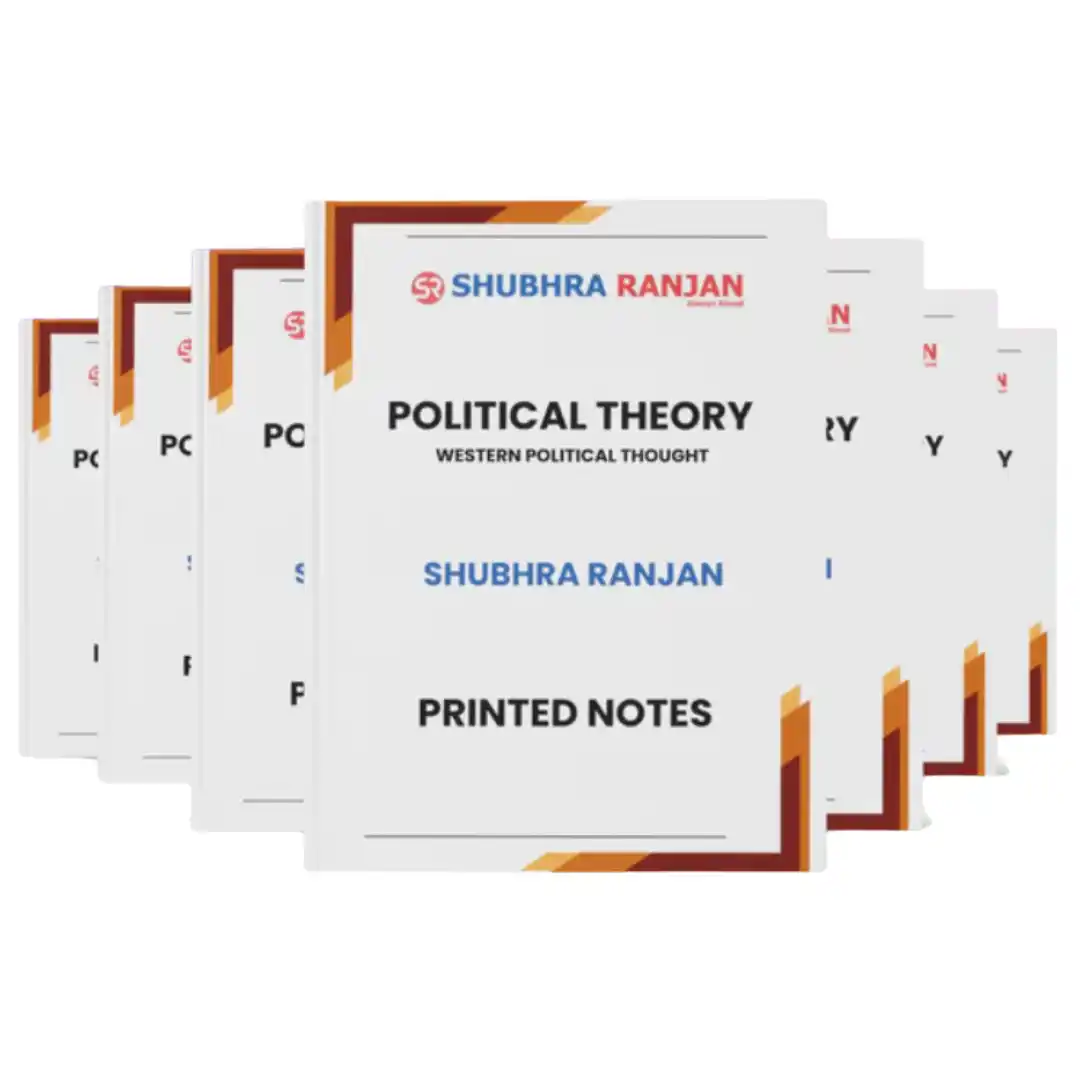
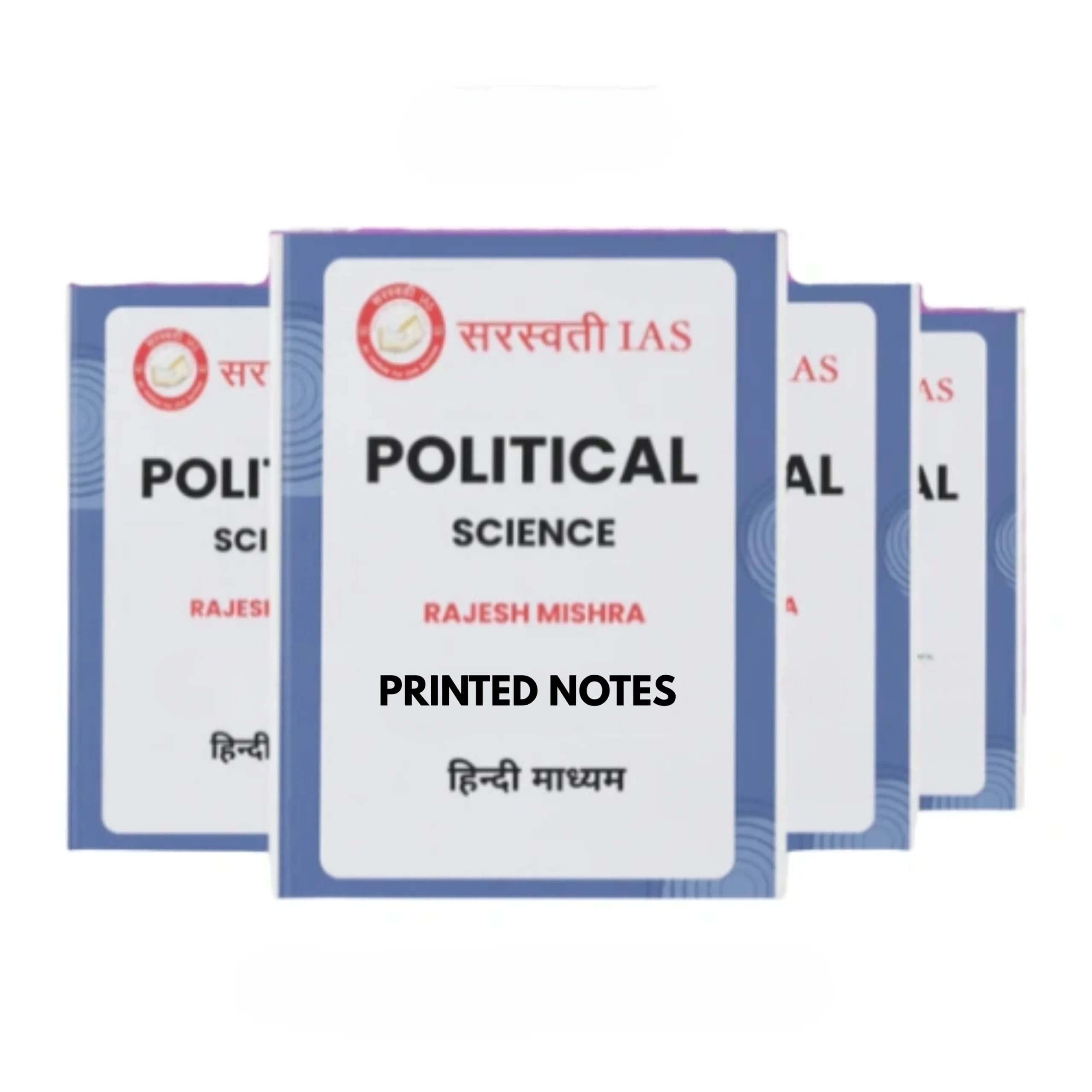
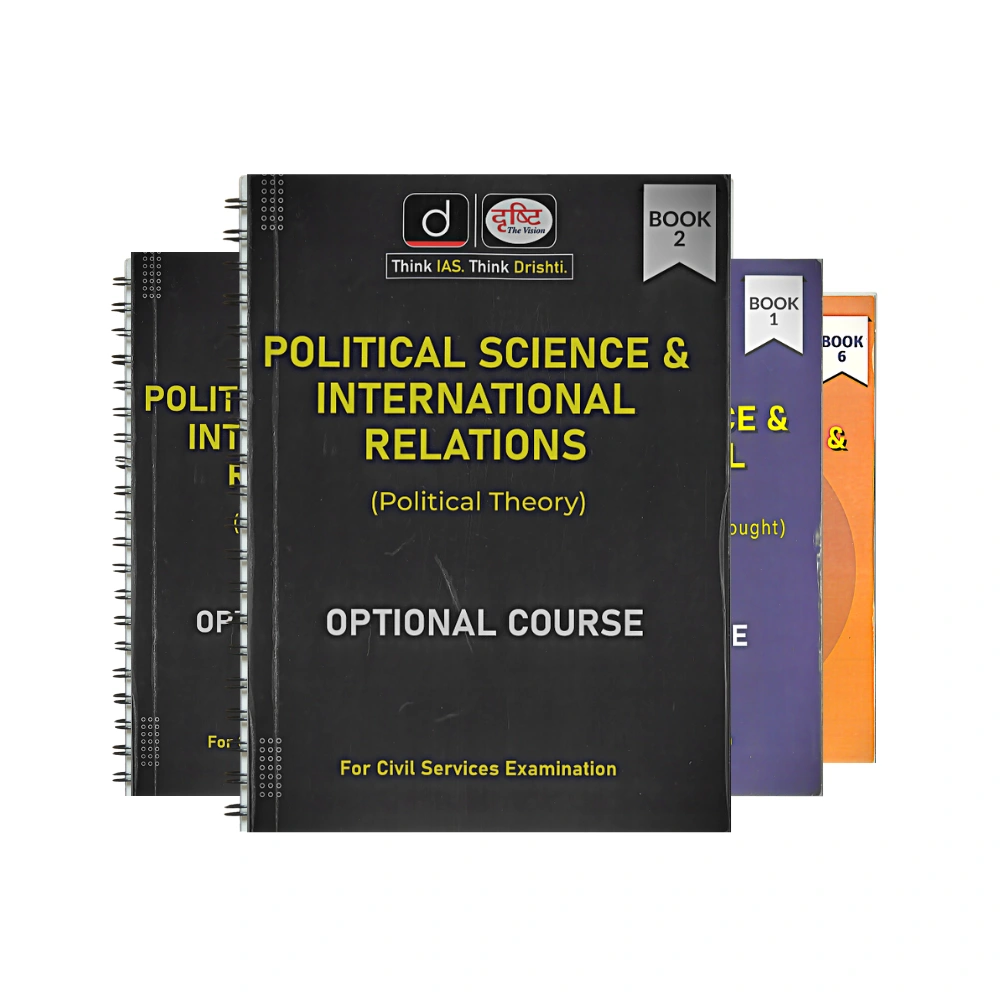
Books alone rarely build exam-ready answers, which is why most selected candidates pair them with structured coaching notes. The Shubhra Ranjan PSIR Notes 2026 (English, Set of 4) are the most widely used resource for English-medium aspirants, while Shubhra Ranjan PSIR Optional Material (4 printed booklets) covers the full course. Drishti’s Drishti IAS PSIR Notes (Set of 6) are a good value alternative, and Hindi-medium aspirants are well served by Rajesh Mishra PSIR Notes (6-booklet Hindi set) or the Shubhra Ranjan PSIR Notes Hindi Edition (7 booklets).
PSIR PYQ Trend Analysis and Section-Wise Weightage
Top pages list previous year papers (2018-2025) but rarely analyse them. Studying UPSC PSIR PYQs reveals that certain areas are asked almost every year, letting you prioritise ruthlessly. The approximate weightage pattern below is based on recent Mains trends and is indicative, not official.
| Section | High-frequency topics | Approx. weightage |
|---|---|---|
| P1-A Political Theory | Justice, democracy, rights, Marxism, feminism | ~25% of Paper 1 |
| P1-A Thinkers | Gandhi, Ambedkar, Marx, Gramsci, Aristotle | ~20% of Paper 1 |
| P1-B Indian Politics | Federalism, party system, pressure groups, movements | ~55% of Paper 1 |
| P2-A Comparative & IR theory | Realism, globalisation, UN reform, security | ~45% of Paper 2 |
| P2-B India & the World | India-China/US/Russia, neighbourhood, NAM, nuclear | ~55% of Paper 2 |
The clear takeaway: Section B of both papers (Indian politics and India’s foreign policy) carries slightly more direct, scoring questions than the theory sections, and benefits most from current-affairs integration. Thinkers like Gandhi, Ambedkar and Marx recur so often that preparing them deeply is non-negotiable.
PSIR Preparation Strategy, 3-4 Month Timeline & Common Mistakes
Can I complete the PSIR optional syllabus in 3 months? It is tight but feasible for full-time aspirants who already have polity and IR exposure; 4-5 months is more comfortable and allows for answer-writing practice. Here is a realistic phased plan.
| Phase | Duration | Focus |
|---|---|---|
| Phase 1 | Weeks 1-5 | Paper 1 — theory, thinkers, Indian politics; make one-page notes per thinker |
| Phase 2 | Weeks 6-10 | Paper 2 — comparative politics, IR theory, India’s foreign policy |
| Phase 3 | Weeks 11-14 | PYQ practice, answer writing, current-affairs linkage |
| Phase 4 | Ongoing | Weekly revision + full-length test series + topper-copy study |
Why Are PSIR Scores Falling and How to Adapt
In recent cycles, average PSIR marks have softened because the subject became crowded and many candidates write generic, bookish answers. The fix is differentiation: quote thinkers precisely, use diagrams and flowcharts, cite recent examples (bilateral summits, Supreme Court judgments, UN developments), and present multiple perspectives rather than a single narrative. Examiners reward analytical, multi-dimensional answers over reproduced notes.
Common Mistakes to Avoid
- Reading too many books instead of revising a few sources multiple times.
- Neglecting answer writing until the last month — start by week 6.
- Ignoring Paper 2 current affairs; IR questions date quickly.
- Mugging thinkers without understanding their core argument and critiques.
- Skipping topper copies — study AIR-1 Ishita Kishore and other PSIR toppers’ structure.
Supplement optional prep with strong current affairs; a monthly magazine such as the Vision IAS Current Affairs Magazine (January 2026) keeps your Paper 2 and GS examples fresh and interlinked.
Sociology vs PSIR: Which Optional Is Better?
This is the most common dilemma for arts-background aspirants. Both are static, scoring and GS-friendly; the right pick depends on your interest and writing style.
| Parameter | PSIR | Sociology |
|---|---|---|
| Syllabus length | Moderate, concept-heavy | Shorter, more compact |
| GS overlap | GS2 (Polity, IR), Essay | GS1 (Society), Essay, Ethics |
| Current affairs load | High (Paper 2 IR) | Moderate |
| Best for | Those who enjoy politics & world affairs | Those who enjoy society & theory |
| Scoring potential | High with analytical answers | High and arguably more predictable |
Choose PSIR if current affairs, governance and international relations excite you; choose Sociology if you prefer a slightly shorter, more self-contained syllabus. If you lean Sociology, resources like the SS Pandey Sociology Notes (25 modules) are a solid starting point. Neither optional is inherently easier — selection rates depend far more on answer quality than on subject choice.
Frequently Asked Questions
What is the PSIR optional syllabus for Paper 1 and Paper 2?
Paper 1 covers Political Theory and Indian Political Thought (Section A) plus Indian Government and Politics (Section B). Paper 2 covers Comparative Politics and International Relations (Section A) plus India and the World (Section B). Each paper is 250 marks, for a total of 500 marks.
Is PSIR a good optional for UPSC?
Yes, for generalist aspirants who enjoy politics, governance and international affairs. Its 30-40% overlap with GS Paper 2, the Essay paper and the Interview makes it an efficient choice, and a strong track record of toppers shows it can fetch high marks with analytical, well-illustrated answers.
Is PSIR optional scoring in UPSC?
Yes, PSIR is a scoring optional when answers are analytical, well-structured and backed by thinkers and current examples. Toppers like AIR-1 Ishita Kishore scored well with PSIR, though recent trends reward differentiation over bookish reproduction.
Can I complete the PSIR optional syllabus in 3 months?
It is possible for full-time aspirants with prior polity and IR exposure, but 4-5 months is more realistic to also cover answer writing, PYQs and revision. A phased plan of roughly five weeks per paper plus a practice phase works best.
Which books are best for PSIR optional?
Core books include O.P. Gauba (Political Theory), Subrata Mukherjee & Sushila Ramaswamy (Western Thought), Andrew Heywood (Global Politics), M. Laxmikanth (Indian Polity) and Rajiv Sikri (foreign policy), supplemented by structured coaching notes such as Shubhra Ranjan or Drishti PSIR notes.
How much does the PSIR syllabus overlap with GS?
PSIR overlaps roughly 30-40% with GS Mains — chiefly GS Paper 2 (polity, governance and international relations), plus useful material for the Essay paper and the Personality Test, making it an efficient optional for generalists.
What is the full form of PSIR in UPSC?
PSIR stands for Political Science and International Relations, one of the optional subjects in the UPSC Civil Services Mains Examination, examined through two papers of 250 marks each.
Sociology vs PSIR — which optional is better?
Neither is universally better. PSIR suits aspirants drawn to polity, governance and international relations and overlaps with GS Paper 2; Sociology has a shorter syllabus and overlaps with GS Paper 1 (Society), Essay and Ethics. Pick the one whose content you enjoy writing about, since answer quality drives selection more than subject choice.
Recommended Study Material
Continue Reading
SSC CGL Preparation 2026: Plan, Books, Books & Strategy (Self-Study)
SSC CGL preparation in 2026 is entirely doable through disciplined self-study at home without coaching. In short: give…
UPSC Mains Syllabus 2026: All 9 Papers + PDF Download
The upsc mains syllabus for the Civil Services Examination 2026 consists of 9 descriptive papers — one Essay…
UPPCS Syllabus 2026: Prelims, Mains (8 Papers) + PDF Download
Quick answer: The UPPCS syllabus for 2026 spans three stages run by the Uttar Pradesh Public Service Commission…