Super TET Syllabus 2025: Subject-Wise Marks + PDF
Complete Super TET syllabus 2025 in Hindi & English: 150-mark exam pattern, subject-wise marks, primary & junior topics, qualifying marks + PDF download.

The Super TET syllabus is a single 150-mark objective paper covering 10 subject heads — Language (40 marks), General Knowledge & Current Affairs (30), Mathematics (20), Science (10), Social Studies/Environment (10), Teaching Methodology (10), Child Development & Psychology (10), Life Skills/Management (10), Reasoning (5) and Information Technology (5). There are 150 multiple-choice questions of 1 mark each, no negative marking, to be completed in 2.5 hours (150 minutes). It is conducted by the Uttar Pradesh authorities (UPESSC/UPBEB) to recruit Assistant Teachers at the Primary level (Classes 1–5) and the Junior/Upper-Primary level (Classes 6–8) in state basic-education schools.
This guide gives you the complete, subject-wise super tet syllabus with the latest exam pattern, marks distribution, a Hindi and English PDF download route, minimum qualifying marks, the final merit formula, and — the part most pages skip — a weightage-based 30/45/60-day study plan, a UP-specific GK topic list, a primary-vs-junior comparison, and a clear overlap map with CTET and UPTET so you don’t re-study what you already know.
Last reviewed: July 2025 by the Competer editorial team. Marks distribution and pattern below reflect the standard 150-mark Super TET structure; always confirm final numbers against the current official notification before your exam.
Super TET 2025 — Quick Overview Table
Super TET (Uttar Pradesh Teacher Eligibility Test for Assistant Teachers) is the qualifying-cum-selection test that CTET/UPTET-qualified candidates must clear to become government Assistant Teachers in UP Basic Shiksha Parishad schools. Here is the at-a-glance overview for 2025–2026.
| Particular | Detail |
|---|---|
| Exam name | Super TET (UP Assistant Teacher Recruitment Exam) |
| Conducting body | UPESSC / UP Basic Education Board (UPBEB) |
| Levels | Primary (Class 1–5) & Junior / Upper-Primary (Class 6–8) |
| Exam mode | Offline (OMR-based, pen-and-paper) |
| Total questions | 150 objective MCQs |
| Total marks | 150 |
| Marks per question | 1 |
| Duration | 2.5 hours (150 minutes) |
| Negative marking | No |
| Medium | Hindi & English |
| Qualifying marks | General 45% (67.5) · OBC/SC/ST 40% (60) |
| Eligibility | CTET or UPTET qualified + relevant qualification |
What Is Super TET and How Is It Different from UPTET?
Aspirants routinely confuse the three teaching exams — TET, UPTET and Super TET — because the topics overlap. The simplest way to understand it: UPTET/CTET is only an eligibility test (a gateway certificate), while Super TET is the actual recruitment exam that decides your posting. You cannot appear for Super TET unless you have already cleared UPTET or CTET.
| Feature | UPTET / CTET | Super TET |
|---|---|---|
| Purpose | Eligibility certificate only | Actual recruitment & posting |
| Result | Pass/fail certificate | Merit list & appointment |
| Total marks | 150 | 150 |
| Difficulty | Moderate | Higher (more GK, current affairs, reasoning) |
| GK & current affairs | Minimal | High — 30 marks |
| Reasoning & IT | Not tested separately | Tested (5 + 5 marks) |
| Prerequisite | Graduation/D.El.Ed/B.Ed | UPTET or CTET pass |
Because you have already prepared Child Development & Pedagogy and the language sections for CTET/UPTET, roughly 40–45% of the Super TET syllabus is revision for you. The new load is General Knowledge, Current Affairs, Reasoning and Information Technology — plan your time around those.
Super TET 2025 Eligibility Criteria
Before the syllabus, confirm you are eligible. Super TET has two eligibility gates — a teacher-eligibility gate and an educational-qualification gate.
- Teacher eligibility: Must have qualified UPTET or CTET (valid certificate).
- Primary level (Class 1–5): Graduation + D.El.Ed / BTC / B.Ed (as per NCTE norms).
- Junior level (Class 6–8): Graduation + B.Ed or relevant D.El.Ed, plus subject eligibility.
- Age: Generally 21–40 years (with category relaxation as per UP norms).
- Domicile: Preference/rules as notified for UP recruitment.
Always cross-check the exact cut-offs in the latest official Super TET notification, as age relaxation and B.Ed/D.El.Ed conditions are revised periodically.
Super TET Exam Pattern 2025
The super tet exam pattern is a single objective paper with no sectional timing. All 150 questions carry equal weight, and there is no negative marking — so attempting every question is strategically correct.
| Component | Detail |
|---|---|
| Type of questions | Objective (MCQ, 4 options) |
| Number of questions | 150 |
| Total marks | 150 |
| Marks per correct answer | +1 |
| Negative marking | None |
| Time allotted | 2 hours 30 minutes |
| Mode | Offline, OMR sheet |
| Language of paper | Bilingual (Hindi & English) |
Latest Revised Pattern — What Actually Changed
Pages often label the pattern “revised” without saying what changed. In practice, the revision consolidated the earlier lengthy list into clearly weighted heads and increased emphasis on General Knowledge and Current Affairs (now 30 marks) and dedicated Reasoning and Information Technology sections. The total (150) and the no-negative-marking rule are unchanged. If a fresh notification tweaks weightage, the head-wise logic below still holds — Language and GK remain the two biggest scoring blocks.
Super TET Syllabus 2025 — Subject-Wise Marks Distribution
This is the single most important table on the page. The super tet syllabus subject wise marks breakdown tells you exactly where the 150 marks sit — and therefore what to study first. Language (40) and GK/Current Affairs (30) together are 70 of 150 marks, nearly half the paper.
| Subject | Marks | Priority |
|---|---|---|
| Language (Hindi / English / Sanskrit) | 40 | Highest |
| General Knowledge & Current Affairs | 30 | Highest |
| Mathematics | 20 | High |
| Science | 10 | Medium |
| Social Studies / Environment (EVS) | 10 | Medium |
| Teaching Methodology (Pedagogy) | 10 | Medium |
| Child Development & Psychology (CDP) | 10 | Medium |
| Life Skills / Management & Aptitude | 10 | Medium |
| Reasoning Ability | 5 | Quick-win |
| Information Technology (ICT) | 5 | Quick-win |
| Total | 150 | — |
Strategy takeaway: master Language + GK first (70 marks), lock the two 5-mark quick-wins (Reasoning + IT = 10 easy marks), then layer in Maths and the 10-mark blocks.
UP Super TET Syllabus: Primary and Junior Level Compared
A common query is the up super tet syllabus primary and junior level difference. The good news: the subject heads and marks distribution are the same for both levels — you sit the same 150-mark paper. What changes is the depth of subject content expected and the eligibility route.
| Aspect | Primary Level (Class 1–5) | Junior Level (Class 6–8) |
|---|---|---|
| Subject heads & marks | Same 10 heads, 150 marks | Same 10 heads, 150 marks |
| Content depth | Foundational (up to NCERT Class 8) | Slightly higher (NCERT Class 8–10 level) |
| Subject specialisation | General teaching | Subject-linked eligibility matters more |
| Core qualification | Graduation + D.El.Ed/BTC/B.Ed | Graduation + B.Ed / relevant D.El.Ed |
| Prep overlap | Heavy overlap with UPTET Paper 1 | Heavy overlap with UPTET Paper 2 |
Practical takeaway: prepare one common syllabus, but if you are targeting the Junior level, revise Science, Maths and Social Studies at NCERT Class 9–10 depth rather than stopping at Class 8.
Detailed Subject-Wise Super TET Syllabus (All 10 Subjects)
Below is the complete topic-wise super tet ka syllabus 2025 for both Primary and Junior levels. The syllabus is common; only the depth of subject knowledge expected at Junior level is slightly higher.
1. Language — Hindi (सुपर टीईटी सामान्य हिंदी सिलेबस)
- संधि, समास, उपसर्ग, प्रत्यय (Sandhi, Samas, Upsarg, Pratyay)
- पर्यायवाची, विलोम, अनेकार्थी शब्द, तत्सम-तद्भव
- मुहावरे एवं लोकोक्तियाँ (idioms & proverbs)
- वाक्य शुद्धि, वर्तनी शुद्धि, अलंकार, रस, छंद, समास
- वाच्य, कारक, संज्ञा, सर्वनाम, विशेषण, क्रिया
- हिंदी साहित्य के प्रमुख कवि, लेखक एवं रचनाएँ
- अपठित गद्यांश एवं पद्यांश (unseen passages)
2. Language — English
- Tenses, Articles, Prepositions, Conjunctions, Modals
- Active/Passive Voice, Direct/Indirect Speech
- Synonyms, Antonyms, One-word substitution, Idioms & Phrases
- Spotting errors, Sentence improvement, Fill in the blanks
- Comprehension (unseen passage), Vocabulary
3. Language — Sanskrit (संस्कृत सिलेबस)
- संधि, समास, कारक, विभक्ति, धातु रूप, शब्द रूप
- संख्या, लिंग, वचन, उपसर्ग, प्रत्यय
- अव्यय, वाच्य, अनुवाद (Sanskrit ↔ Hindi)
- संस्कृत व्याकरण एवं छंद
4. General Knowledge & Current Affairs (30 marks — UP-focused)
This 30-mark block is where most aspirants lose marks because generic prep ignores the strong UP-state weightage. Cover both national and UP-specific topics:
- UP-specific GK: UP geography, rivers, districts, national parks, folk dances (Nautanki, Raslila), festivals, tourism, schemes (e.g., Kanya Sumangala), UP CM/Governor, UP budget highlights, famous personalities of UP.
- Static GK: Indian history (freedom struggle, ancient/medieval landmarks), Indian polity & Constitution basics, geography of India, economy fundamentals.
- Current affairs (last 6–12 months): national schemes, awards & honours, sports, books & authors, science & tech, appointments, summits, defence.
- General science of everyday life, important days, abbreviations.
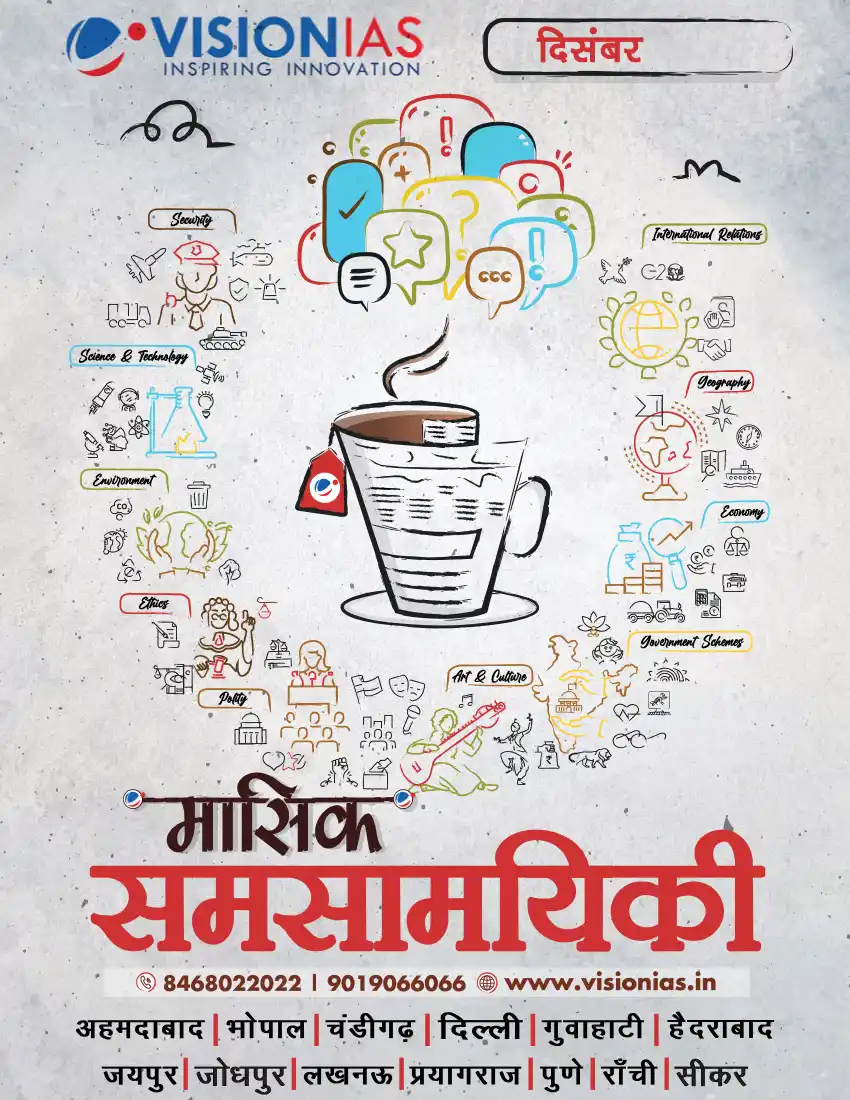
For the current-affairs half, a dependable monthly compilation matters more than random news scrolling. A structured Hindi-medium current-affairs digest such as the Vision IAS Current Affairs Magazine (Hindi Medium) keeps national events organised month-by-month so you can revise the whole year quickly before the exam.
5. Mathematics (20 marks)
- Number system, LCM/HCF, simplification, average
- Percentage, ratio & proportion, profit & loss
- Simple & compound interest, time & work, time-speed-distance
- Mensuration, geometry, algebra basics
- Data interpretation, statistics (mean, median, mode)
- Pedagogy of Mathematics (teaching methods, evaluation)
6. Science (10 marks)
- Physics: motion, force, light, sound, electricity, energy
- Chemistry: matter, elements, acids-bases, everyday chemistry
- Biology: human body, plants, nutrition, diseases, environment
- Science pedagogy & teaching aids
7. Social Studies / Environment (EVS) (10 marks)
- History: Indian freedom movement, key events
- Geography: India & world, physical features, resources
- Civics: Constitution, fundamental rights & duties, governance
- Environmental studies, pollution, conservation, EVS pedagogy
8. Teaching Methodology / Pedagogy (10 marks)
- Teaching-learning methods, lesson planning, teaching aids
- Micro-teaching, evaluation & assessment, CCE
- Classroom management, inclusive education
- Models of teaching, motivation techniques
9. Child Development & Psychology (CDP) (10 marks)
- Growth & development, stages of development
- Learning theories (Piaget, Vygotsky, Skinner, Kohlberg)
- Intelligence, personality, individual differences
- Learning disabilities, special & inclusive education
- Motivation, heredity vs environment, guidance & counselling
10. Life Skills, Management & Aptitude (10 marks)
- Communication skills, decision-making, problem-solving
- Emotional intelligence, leadership, time management
- Teacher aptitude & interpersonal skills
- School management, administration basics
11. Reasoning Ability (5 marks — quick win)
- Analogy, series, coding-decoding, blood relations
- Direction sense, syllogism, ranking, calendar & clock
- Non-verbal reasoning, mirror images, classification
12. Information Technology / ICT (5 marks — quick win)
- Computer fundamentals, hardware/software, input-output devices
- MS Office (Word, Excel, PowerPoint), operating systems
- Internet, email, e-learning, digital classroom tools
- Abbreviations & shortcuts, ICT in education
How to Download the Super TET Syllabus PDF (Hindi & English)
You can save the full super tet syllabus pdf download in either medium so you can revise offline — this is also the fastest way to get the super tet syllabus 2025 in hindi. Follow these steps for the official version:
- Visit the official UP Basic Education Board / UPESSC website when the notification is live.
- Open the latest Super TET / Assistant Teacher recruitment notification.
- Scroll to the “Syllabus & Exam Pattern” annexure.
- Click the syllabus PDF link and choose Hindi or English medium.
- Download and save; take a printout for daily reference.
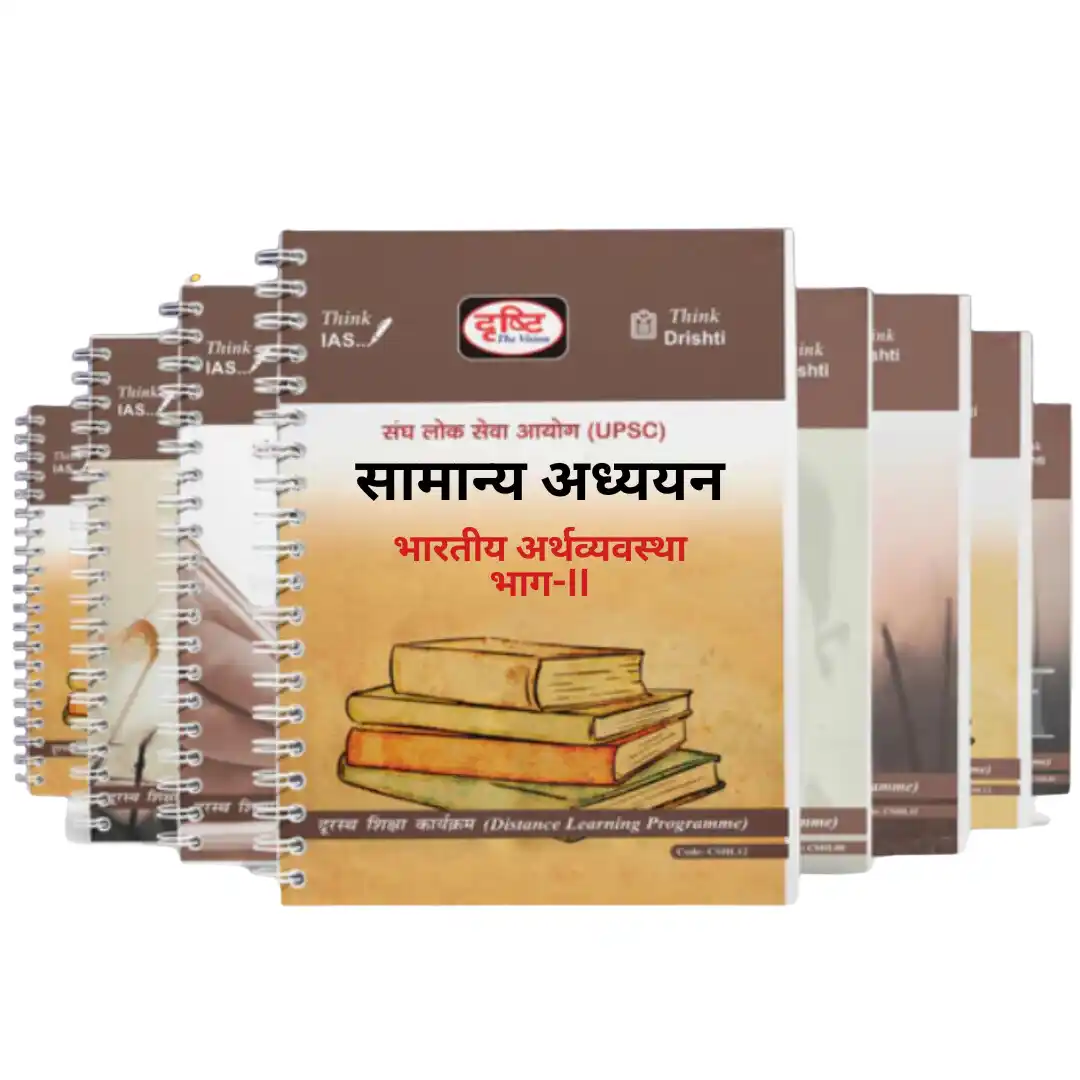
Until the official PDF is released, use the subject-wise breakdown on this page — it mirrors the standard 150-mark structure and lets you start preparation immediately. A printed syllabus + notes set keeps everything in one place; many aspirants pair the syllabus with a structured Hindi GS resource like the Drishti IAS Hindi Study Material to cover static GK, polity and geography in one go.
Super TET Qualifying Marks 2025
Clearing the paper needs category-wise minimum marks. Merely qualifying does not guarantee selection — you must rank high in the merit list — but you cannot be considered without crossing these cut-offs.
| Category | Minimum Qualifying % | Marks (out of 150) |
|---|---|---|
| General / Unreserved | 45% | 67.5 (≈68) |
| OBC | 40% | 60 |
| SC | 40% | 60 |
| ST | 40% | 60 |
Given the competition, a safe target is 100+ marks for General candidates — the qualifying figure is just the floor, not the selection cut-off.
Super TET Selection Process & Final Merit Formula
Super TET selection is not based on the written exam alone. The final merit list combines your exam performance with your academic record on a 60:40 weighting. Understanding this formula tells you whether you need a very high exam score or can rely partly on strong academics.
| Stage | Weightage | Basis |
|---|---|---|
| Super TET written exam | 60% | Marks scored out of 150 |
| Academic / qualification record | 40% | High school, intermediate, graduation, D.El.Ed/B.Ed, TET |
| Document verification | Qualifying | Eligibility & certificate check |
| Final merit & counselling | — | Combined score → posting |
The academic 40% is typically distributed across your qualifying marks in Class 10, Class 12, graduation, the training qualification and the TET score. Because the written exam carries 60% and academics are fixed, your Super TET score is the biggest lever you can still pull.
Weightage-Based Study Plan: 30, 45 & 60 Days
Most syllabus pages dump topics but never tell you the order. Here is a marks-driven plan that studies the highest-weightage blocks first. Follow the 60-day version if you are starting fresh; compress to 45 or 30 days if you are already CTET/UPTET-qualified.
| Phase | Focus (in priority order) | 60-Day | 45-Day | 30-Day |
|---|---|---|---|---|
| Phase 1 | Language (40) + Reasoning & IT quick-wins (10) | Days 1–15 | Days 1–11 | Days 1–8 |
| Phase 2 | GK + Current Affairs (30) incl. UP GK | Days 16–30 | Days 12–22 | Days 9–15 |
| Phase 3 | Maths (20) + Science & Social Studies (20) | Days 31–42 | Days 23–32 | Days 16–21 |
| Phase 4 | Pedagogy + CDP + Life Skills (30) | Days 43–52 | Days 33–39 | Days 22–26 |
| Phase 5 | Full mocks + PYQ + revision | Days 53–60 | Days 40–45 | Days 27–30 |
Rule of thumb: spend the most hours where the marks are. Language + GK = 70 marks, so nearly half your study time should sit in Phases 1–2.
Previous-Year Question Analysis — What Actually Gets Asked
Instead of a generic topic dump, here is where questions concentrate based on recurring Super TET patterns:
- Language (40): Hindi grammar (Sandhi, Samas, Alankar) and vocabulary dominate; expect 8–10 pure grammar questions.
- GK/Current Affairs (30): UP-specific static GK + last-year current affairs are the highest-yield; national schemes and awards recur.
- Maths (20): Arithmetic (percentage, ratio, average, profit-loss) outweighs advanced topics.
- CDP & Pedagogy (20): Learning theories (Piaget/Vygotsky) and assessment (CCE) are repeat favourites.
- Reasoning & IT (10): Direct, formula-based — high accuracy is expected, so treat these as guaranteed marks.
Practising previous-year questions the same way UPSC aspirants use topic-wise PYQ compilations sharpens your pattern sense. If you want to see how disciplined PYQ practice is structured, the format of the Forum IAS Topic-Wise PYQ Toolkit is a useful model for organising your own Super TET question bank by topic.
Best Books for Super TET Preparation 2025
Alongside your syllabus, build a compact, high-yield bookshelf rather than piling up dozens of guides. Recommended coverage:
| Subject | Recommended Study Source |
|---|---|
| Language (Hindi) | Standard Hindi Vyakaran (e.g., Lucent/Arihant Samanya Hindi) |
| Language (English) | Wren & Martin, objective English guide |
| General Knowledge | Lucent’s Samanya Gyan + a UP GK booklet |
| Current Affairs | Monthly current-affairs magazine (last 12 months) |
| Mathematics | R.S. Aggarwal Quantitative Aptitude / NCERT Class 6–8 |
| Science & Social Studies | NCERT Class 6–10 |
| CDP & Pedagogy | Any standard CTET/TET pedagogy book |
| Reasoning | R.S. Aggarwal / Arihant reasoning |
NCERT tip: Class 6–10 NCERT textbooks are the backbone for Science, Social Studies and Maths at the Junior level — they explain concepts in exactly the depth Super TET tests.
Super TET Preparation Tips 2025
- Follow the marks map: give Language and GK the most hours — they are 70 of 150 marks.
- Bank the quick-wins: Reasoning and IT (10 marks) are formula-based and fully scorable — never skip them.
- Attempt everything: no negative marking means you should leave zero questions blank.
- Prioritise UP GK: state-specific static GK gives an edge most candidates miss.
- Revise current affairs monthly: maintain one-page notes per month for fast revision.
- Take full-length mocks: practise the full 150-question, 150-minute paper to build stamina.
- Reuse CTET/UPTET prep: your pedagogy and language base already covers ~40% — revise, don’t restart.
How Super TET Differs from CTET/UPTET — Study Overlap Map
To avoid wasting time re-studying, use this overlap map to see what carries over and what is new.
| Section | Already covered in CTET/UPTET? | Extra effort for Super TET |
|---|---|---|
| Child Development & Pedagogy | Yes | Light revision only |
| Language (Hindi/English) | Mostly | Add advanced grammar & literature |
| Maths & Science | Partly | Add arithmetic speed practice |
| General Knowledge | No | Full new prep (static + UP GK) |
| Current Affairs | No | Full new prep (12 months) |
| Reasoning | No | New — but quick to master |
| Information Technology | No | New — basic computer awareness |
Frequently Asked Questions
What is the syllabus of Super TET?
The Super TET syllabus covers 10 subject heads across a single 150-mark paper: Language (40), General Knowledge & Current Affairs (30), Mathematics (20), Science (10), Social Studies/Environment (10), Teaching Methodology (10), Child Development & Psychology (10), Life Skills/Management (10), Reasoning (5) and Information Technology (5). The syllabus is common for both Primary (Class 1–5) and Junior (Class 6–8) levels.
Is Super TET tougher than CTET or UPTET?
Yes, Super TET is generally considered tougher because it is a recruitment exam, not just an eligibility test. It adds substantial General Knowledge, Current Affairs, Reasoning and Information Technology sections that CTET/UPTET do not test in depth, and the competition for final selection is higher.
How many questions and marks are there in Super TET?
Super TET has 150 objective multiple-choice questions carrying 150 marks in total — 1 mark for each correct answer. The paper is offline (OMR-based) and must be completed in 2 hours 30 minutes.
Is there negative marking in Super TET?
No, there is no negative marking in Super TET. Since wrong answers are not penalised, you should attempt all 150 questions, making an educated guess wherever you are unsure.
What are the minimum qualifying marks for Super TET?
General/unreserved candidates must score at least 45% (about 67.5 marks out of 150), while OBC, SC and ST candidates need 40% (60 marks). However, because selection is merit-based, aiming for 100+ marks is advisable to stay competitive.
How is the final Super TET merit list prepared?
The final Super TET merit list is prepared on a 60:40 weighting — 60% from your written exam score (out of 150) and 40% from your academic record across Class 10, Class 12, graduation, your training qualification (D.El.Ed/B.Ed) and the TET score. Document verification is qualifying, and the combined score decides your posting through counselling.
Which books are best for Super TET preparation?
A compact set works best: Lucent/Arihant Samanya Hindi for Hindi, Wren & Martin for English, Lucent’s Samanya Gyan plus a UP GK booklet for GK, a monthly current-affairs magazine, R.S. Aggarwal for Maths and Reasoning, NCERT Class 6–10 for Science and Social Studies, and any standard CTET/TET pedagogy book for CDP. Prefer a few high-yield books plus previous-year questions over piling up many guides.
Can I download the Super TET syllabus PDF in Hindi?
Yes. The official Super TET syllabus PDF is released in both Hindi and English mediums on the UP Basic Education Board / UPESSC website with the recruitment notification. You can open the notification, go to the syllabus annexure, and download the Hindi-medium PDF for offline revision.
Recommended Study Material

Continue Reading
OJAS GPSC Syllabus 2026: Class 1-2 Pattern + PDF Download
The OJAS GPSC syllabus for the Class 1-2 (Gujarat Administrative Service / Gujarat Civil Service) exam covers a…
UGC NET History Syllabus 2026: Unit-Wise + PDF Download
The ugc net history syllabus has two papers set by the NTA: Paper 1 (Teaching & Research Aptitude…
IBPS RRB Syllabus 2026: PO, Clerk & Officer Pattern + PDF
The IBPS RRB syllabus covers Reasoning, Quantitative Aptitude/Numerical Ability, General Awareness, English/Hindi Language and Computer Knowledge, split across…