JEE Main Syllabus 2026: Subject-Wise PDF + Weightage
Complete JEE Main syllabus 2026 — subject-wise Physics, Chemistry & Maths topics, chapter weightage, deleted topics and a free PDF download route to plan your prep.

The JEE Main syllabus for 2026 is set by the National Testing Agency (NTA) and is drawn entirely from the NCERT Class 11 and Class 12 books for Physics, Chemistry and Mathematics. Paper 1 (B.E./B.Tech) covers roughly 20 Physics chapters, about 28 Chemistry chapters (Physical, Organic and Inorganic) and 14 Mathematics units, tested through 75 questions worth 300 marks. No new topics have been added for 2026, and the topics deleted in 2024 — such as States of Matter, Surface Chemistry, Communication Systems and Mathematical Reasoning — remain out of the syllabus. In short: if you prepared for JEE Main 2025, your 2026 syllabus is the same.
This page is a single, dated, NTA-aligned reference: the full subject-wise topic list, chapter-wise weightage from the last five years, the exact list of deleted topics, the Paper 2A (B.Arch) and Paper 2B (B.Planning) syllabus, and a free PDF download route — so an aspirant, parent or teacher can plan preparation without hunting across ten different portals. Use the quick-summary table first, then jump to the subject you want.
JEE Main Syllabus 2026 at a Glance (Quick Summary Table)
For skimmers, here is the whole JEE Main 2026 structure in one mobile-friendly table before we go deep into each subject. The three subjects carry exactly equal weight, so no subject can be treated as optional.
| Subject | Class 11 + 12 Chapters | Questions (Section A + B) | Marks |
|---|---|---|---|
| Physics | ~20 chapters + Experimental Skills | 20 + 5 | 100 |
| Chemistry | ~28 chapters (Physical / Organic / Inorganic) | 20 + 5 | 100 |
| Mathematics | 14 units | 20 + 5 | 100 |
| Total (Paper 1) | ~62 chapters | 75 questions | 300 |
Key takeaways from the table: all 75 questions are compulsory from 2025 onwards, the paper is three hours long, and marks are split evenly at 100 per subject. Everything below expands each row into a full topic list with weightage.
What Is the Syllabus of JEE Main 2026?
The JEE Main syllabus 2026 spans three subjects — Physics, Chemistry and Mathematics — each built on the CBSE NCERT curriculum for Classes 11 and 12. Physics ranges from Mechanics and Thermodynamics to Electrodynamics, Optics and Modern Physics, plus a dedicated Experimental Skills unit. Chemistry is divided into Physical, Organic and Inorganic branches. Mathematics is organised into 14 units led by Calculus, Coordinate Geometry and Algebra. There is no separate “extra” reading list beyond NCERT topics; coaching modules simply reorganise the same content into exam-oriented theory and graded practice. The sections that follow give you the exact chapter list for each subject.
JEE Main 2026 Exam Pattern (Paper 1 — B.Tech)
Before studying the syllabus, understand how it is tested. JEE Main 2026 Paper 1 is a Computer-Based Test (CBT) of three hours with three subjects carrying equal weight. Each subject has two sections: Section A (20 multiple-choice questions) and Section B (numerical-value questions). From 2025 onwards, the earlier choice in Section B was removed — now all 5 numerical questions are compulsory in every subject.
| Component | Detail |
|---|---|
| Mode | Online (Computer-Based Test) |
| Duration | 3 hours (4 hours for PwD candidates) |
| Subjects | Physics, Chemistry, Mathematics |
| Section A | 20 MCQs per subject (all compulsory) |
| Section B | 5 numerical questions per subject (all compulsory) |
| Total questions | 75 (25 per subject) |
| Total marks | 300 |
| Marking scheme | +4 correct, -1 incorrect (both sections) |
| Unattempted | 0 marks (no negative for skipped) |
| Language | 13 languages including English & Hindi |
Note the marking parity: a wrong numerical answer now also costs -1, so guesswork in Section B is riskier than it used to be. Building accuracy with topic-wise practice through NCERT-aligned modules such as the eSaral IIT JEE Modules 2026 pays off directly in Section B, where careless numerical errors quietly drain rank.
JEE Main Physics Syllabus 2026 (Class 11 + 12)
The JEE Main physics syllabus is grouped into mechanics, thermal physics, electrodynamics, optics, modern physics and a dedicated Experimental Skills unit. Physics is where accuracy and concept clarity matter most, because the numerical questions here are heavily formula-driven and reward clean derivations over rote recall.
| Class 11 Topics | Class 12 Topics |
|---|---|
| Physics and Measurement (Units & Dimensions) | Electrostatics |
| Kinematics | Current Electricity |
| Laws of Motion | Magnetic Effects of Current & Magnetism |
| Work, Energy and Power | Electromagnetic Induction & Alternating Current |
| Rotational Motion | Electromagnetic Waves |
| Gravitation | Optics (Ray & Wave Optics) |
| Properties of Solids and Liquids | Dual Nature of Matter and Radiation |
| Thermodynamics | Atoms and Nuclei |
| Kinetic Theory of Gases | Electronic Devices (Semiconductors) |
| Oscillations and Waves | Experimental Skills |
Physics Experimental / Practical Skills Section
Many aspirants ignore the Experimental Skills unit, but NTA regularly asks 1–2 questions from it. It covers vernier callipers, screw gauge, simple pendulum, metre scale, Young’s modulus, surface tension, viscosity, speed of sound (resonance tube), specific heat, potentiometer, metre bridge, Ohm’s law, focal length of mirrors/lenses, and identifying diodes/transistors. These are direct, scoring questions tied to error analysis and least count — do not skip them.
JEE Main Chemistry Syllabus 2026 (28 Chapters — Physical, Organic, Inorganic)
The JEE Main chemistry syllabus is traditionally split into three branches — Physical Chemistry, Organic Chemistry and Inorganic Chemistry. After the 2024 pruning, the effective count sits around 28 chapters. Chemistry is the highest-ROI subject: concepts are NCERT-line-by-line, and Inorganic in particular rewards memory over derivation, making it the fastest section to convert into marks.
| Physical Chemistry | Organic Chemistry | Inorganic Chemistry |
|---|---|---|
| Some Basic Concepts in Chemistry | Purification & Characterisation of Organic Compounds | Classification of Elements & Periodicity |
| Atomic Structure | Basic Principles of Organic Chemistry (GOC) | Chemical Bonding & Molecular Structure |
| Chemical Bonding | Hydrocarbons | P-Block Elements |
| Chemical Thermodynamics | Organic Compounds Containing Halogens | D- and F-Block Elements |
| Solutions | Organic Compounds Containing Oxygen | Coordination Compounds |
| Equilibrium | Organic Compounds Containing Nitrogen | Environmental Chemistry (limited) |
| Redox Reactions & Electrochemistry | Biomolecules | Principles of Practical Chemistry |
| Chemical Kinetics | Aldehydes, Ketones & Carboxylic Acids | Hydrogen (limited) |
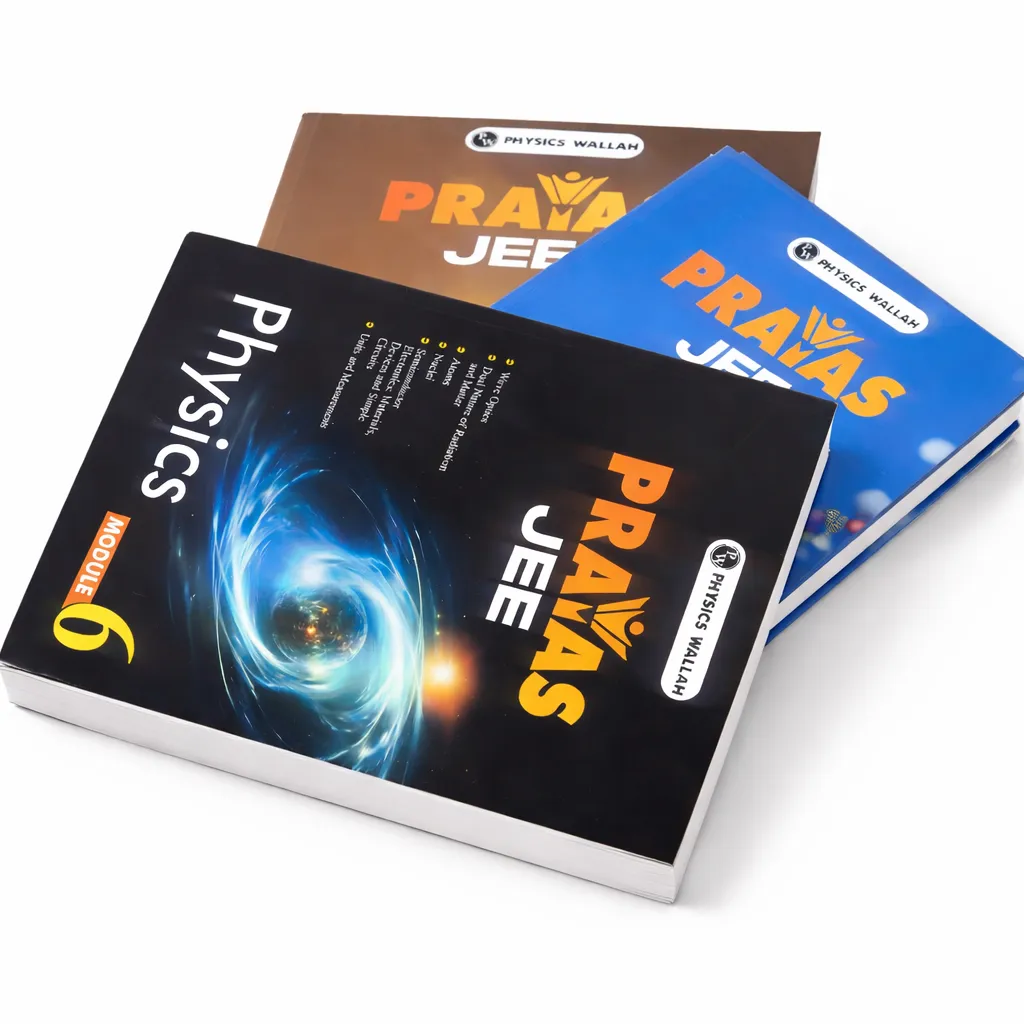
A printed, module-wise set that mirrors this Physical/Organic/Inorganic split — like the PW Prayas JEE Modules for 2026 (18 books) — makes it easy to tick off chapters branch-by-branch rather than jumping randomly between unrelated topics.
JEE Main Maths Syllabus 2026 (14 Units)
The JEE Main maths syllabus is organised into 14 units. Mathematics has no “theory” cushion — every question is problem-solving — so speed and practice volume decide your score. Calculus and Coordinate Geometry together dominate the paper, so they deserve the largest share of your practice hours.
| Unit | Key Topics |
|---|---|
| Sets, Relations & Functions | Types of relations, functions, composition |
| Complex Numbers & Quadratic Equations | Argand plane, roots, nature of roots |
| Matrices & Determinants | Operations, inverse, system of equations |
| Permutations & Combinations | Arrangements, selections |
| Binomial Theorem | General term, applications |
| Sequences & Series | AP, GP, sums of special series |
| Limits, Continuity & Differentiability | Limits, derivatives, applications |
| Integral Calculus | Definite/indefinite integrals, area under curves |
| Differential Equations | Order, degree, solving methods |
| Coordinate Geometry | Straight lines, circles, conic sections |
| Three Dimensional Geometry | Lines, planes, distance |
| Vector Algebra | Dot & cross products, applications |
| Statistics & Probability | Mean, variance, probability, Bayes |
| Trigonometry | Identities, equations, inverse, heights & distances |
JEE Main Syllabus with Weightage (Chapter-Wise, Last 5 Years)
The single biggest differentiator for planning is combining the syllabus with weightage in one place. Below are the approximate marks-share trends from the last five years of JEE Main — use them to sequence chapters by return on effort. Actual weightage varies by shift and session, but these ranges are reliable for prioritisation and match the pattern most coaching analyses report.
Physics — High-Weightage Chapters
| Chapter / Area | Approx. Weightage |
|---|---|
| Mechanics (Kinematics, Laws, Rotation) | 18–22% |
| Modern Physics (Atoms, Nuclei, Dual Nature) | 12–16% |
| Electrostatics & Current Electricity | 10–14% |
| Magnetism, EMI & AC | 10–12% |
| Optics (Ray + Wave) | 8–10% |
| Heat & Thermodynamics | 8–10% |
| Oscillations & Waves | 6–8% |
Chemistry — High-Weightage Chapters
| Chapter / Area | Approx. Weightage |
|---|---|
| P-Block, D & F-Block Elements | 10–12% |
| Chemical Bonding & Periodicity | 8–10% |
| General Organic Chemistry & Isomerism | 8–10% |
| Coordination Compounds | 7–9% |
| Thermodynamics & Electrochemistry | 7–9% |
| Aldehydes, Ketones, Carboxylic Acids | 6–8% |
| Chemical & Ionic Equilibrium | 6–8% |
| Biomolecules & Polymers | 4–6% |
Mathematics — High-Weightage Chapters
| Chapter / Area | Approx. Weightage |
|---|---|
| Calculus (Limits, Differentiation, Integration, Diff. Eqns) | 25–30% |
| Coordinate Geometry (Lines, Circle, Conics) | 15–18% |
| Algebra (Complex Nos., Quadratics, Matrices, Determinants) | 15–18% |
| Vectors & 3D Geometry | 10–12% |
| Sequences, Series, Binomial, P&C | 10–12% |
| Probability & Statistics | 6–8% |
| Trigonometry | 6–8% |
Which Is the Most Important / High-Weightage Chapter in JEE Main?
Across all three subjects, Calculus in Mathematics carries the single largest share (about 25–30%), followed by Mechanics in Physics and the combined P/D/F-Block chapters in Chemistry. If you have limited time, securing Calculus, Coordinate Geometry, Modern Physics, Electrodynamics, Coordination Compounds and Organic Chemistry basics can lock in the majority of marks. These “anchor” chapters are also the most stable year to year, so effort spent here rarely goes to waste.
JEE Main Deleted Syllabus 2026 (Removed Topics)
NTA trimmed the syllabus in 2024 to align it with the reduced NCERT/CBSE content, and those deletions continue for 2026 — the JEE Main deleted syllabus 2026 is the same reduced list, not a fresh cut. Do not waste time on the topics below unless they overlap with your school boards or NEET preparation.
| Subject | Deleted / Removed Topics |
|---|---|
| Physics | Communication Systems (entire chapter); parts of Experimental Skills; some semiconductor sub-topics |
| Chemistry | States of Matter; Surface Chemistry; General Principles & Processes of Isolation of Metals (Metallurgy); s-Block Elements (as a standalone unit); Hydrogen (largely); Environmental Chemistry (reduced); Polymers & Chemistry in Everyday Life (reduced) |
| Mathematics | Mathematical Reasoning; parts of Sets, Relations & Functions; Trigonometry (Heights & Distances reduced) |
Because portals disagree on exactly what is “reduced” versus “fully deleted,” always cross-check any borderline topic against the official information bulletin before dropping it. When in doubt, a quick skim of a borderline chapter costs little; assuming it is gone can cost marks.
Is the JEE Main 2026 Syllabus Reduced Compared to Previous Years?
Yes — relative to the pre-2024 syllabus, the current syllabus is noticeably lighter after the removal of chapters like Communication Systems, States of Matter, Surface Chemistry and Mathematical Reasoning. However, compared with 2024 and 2025, the 2026 syllabus is essentially unchanged: no new chapters have been added and no previously deleted chapters have been restored. In short, if you prepared for 2025, your 2026 syllabus is the same, and any 2024/2025 study material is still valid.
Paper 2A (B.Arch) & Paper 2B (B.Planning) Syllabus
JEE Main is not only about B.Tech. Paper 2A is for B.Arch admissions and Paper 2B for B.Planning. Both share a common Mathematics and Aptitude section but differ in their third section.
| Paper | Sections | Focus |
|---|---|---|
| Paper 2A (B.Arch) | Mathematics + Aptitude + Drawing Test | Maths (Section A syllabus), aptitude for architecture, 3D perception, freehand & geometric drawing, sketching |
| Paper 2B (B.Planning) | Mathematics + Aptitude + Planning | Maths, aptitude, general awareness, planning, development issues, comprehension & analytical reasoning |
The Aptitude section (common to both) covers awareness of places, persons, buildings and materials; visualising 3D objects from 2D drawings; analytical reasoning; and mental ability. The Drawing Test in Paper 2A assesses sense of scale, proportion, colour and composition. B.Planning’s Planning section adds topics on government schemes, urban development and simple statistics. Candidates can appear for Paper 1, Paper 2, or both.
Is JEE Main Based on NCERT (Class 11 and 12)?
Yes — the entire JEE Main syllabus is built on the CBSE NCERT Class 11 and Class 12 curriculum. Every chapter listed above maps directly to an NCERT chapter, which is why toppers advise mastering NCERT first (especially in Chemistry, where Inorganic questions are frequently lifted almost verbatim from NCERT lines) and then moving to advanced problem sets. Coaching modules simply reorganise NCERT content into exam-oriented theory plus graded practice.
| Subject | NCERT Reliance | Beyond-NCERT Practice Needed |
|---|---|---|
| Chemistry | Very high (esp. Inorganic & Organic basics) | Numericals in Physical Chemistry |
| Physics | Moderate (concepts from NCERT) | High — problem practice essential |
| Mathematics | Low–Moderate (topics from NCERT) | Very high — volume of solved problems |
Is the JEE Main and JEE Advanced Syllabus the Same?
No. JEE Main and JEE Advanced overlap heavily in topics, but they are not identical. JEE Advanced has a few topics not in Main (and vice versa) and tests concepts at a far greater depth with multi-concept, tougher problems. JEE Main sticks close to NCERT-level application, while Advanced demands deeper analysis and longer, multi-step reasoning. If you are targeting the IITs, clear the Main syllabus first, then layer Advanced-specific rigour on top. The concept-plus-practice format of the eSaral IIT JEE modules helps bridge both levels.
How Many Chapters Are There in the JEE Main Syllabus?
Counting the current, reduced syllabus, Paper 1 has roughly 62 chapters in total: about 20 in Physics (including Experimental Skills), around 28 in Chemistry across Physical/Organic/Inorganic, and 14 units in Mathematics. The exact number depends on how sub-topics are grouped, but 60–65 chapters is the practical figure to plan around. Spread across roughly 10–11 months of serious preparation, that is about six chapters a month, or roughly a chapter every five days including revision.
How to Download the JEE Main Syllabus 2026 PDF (Free)
Looking for the jee main syllabus 2026 pdf download? The official source is the NTA information bulletin. Here is the one-click, no-sign-up route:
- Visit the official website: jeemain.nta.nic.in
- Open the latest “Information Bulletin” or “Syllabus” link on the homepage.
- The syllabus is included as an appendix inside the bulletin PDF (overall + subject-wise).
- Click download and save the PDF — it is free and needs no login.
- For a quick per-subject copy, save this page and use the subject tables above as a printable checklist.
Because official PDFs are bundled inside a long bulletin, many aspirants prefer a clean, subject-segregated printed set they can annotate. That is where NCERT-aligned printed modules earn their keep during revision, when you want the syllabus in your hands rather than on a screen.
Printable JEE Main Syllabus Checklist (Tick-Off Tracker)
Use this completion tracker to monitor progress. Print it or copy it into a notebook and tick each stage per subject.
| Subject | 1st Reading | Practice Done | PYQs Solved | Revision 1 |
|---|---|---|---|---|
| Physics | □ | □ | □ | □ |
| Chemistry | □ | □ | □ | □ |
| Mathematics | □ | □ | □ | □ |
Smart Preparation Strategy Using the Syllabus
A syllabus is only useful if it drives your timetable. Here is how to convert the tables above into a plan:
- Start with high-ROI, low-effort chapters: in Chemistry begin with Coordination Compounds, Chemical Bonding, P/D/F-Block and Aldehydes-Ketones — all high weightage and quick to master from NCERT.
- Anchor Maths around Calculus and Coordinate Geometry since together they are nearly half the paper.
- In Physics, front-load Mechanics and Electrodynamics, then Modern Physics for a reliable scoring block.
- Don’t skip Experimental Skills — it is 1–2 near-guaranteed marks each year.
- Practice numericals relentlessly because Section B now has negative marking and no optional choice.
- Revise deleted topics out of your notes so you never spend time on removed content.
A structured 11+12 module set such as the PW Prayas JEE Modules lets you move through this sequence chapter-by-chapter with graded problems, instead of assembling material from scattered PDFs.
Common Mistakes JEE Aspirants Make With the Syllabus
- Studying deleted chapters from old material and wasting weeks.
- Ignoring weightage and giving equal time to low-yield chapters.
- Skipping NCERT for Chemistry and losing easy Inorganic marks.
- Neglecting Section B numericals until the last month.
- Confusing JEE Advanced-only topics with the Main syllabus.
- Relying on a single portal’s list instead of the official NTA bulletin.
Frequently Asked Questions
What is the syllabus of JEE Main 2026?
The JEE Main 2026 syllabus covers Physics, Chemistry and Mathematics based on NCERT Class 11 and Class 12. Paper 1 includes about 20 Physics chapters (plus Experimental Skills), roughly 28 Chemistry chapters across Physical, Organic and Inorganic, and 14 Mathematics units, tested via 75 questions worth 300 marks.
Is JEE Main syllabus based on NCERT (Class 11 and 12)?
Yes. The entire JEE Main syllabus is drawn from the NCERT Class 11 and Class 12 curriculum for Physics, Chemistry and Mathematics. Every listed chapter maps to an NCERT chapter, so NCERT should be your primary source — especially for Chemistry — before advanced problem practice.
Which topics were deleted from the JEE Main syllabus?
Topics removed in 2024 and still out for 2026 include Communication Systems (Physics); States of Matter, Surface Chemistry, Metallurgy, s-Block and much of Hydrogen (Chemistry); and Mathematical Reasoning along with parts of Sets and Heights & Distances (Mathematics).
Is the JEE Main and JEE Advanced syllabus the same?
No. They overlap in most topics but are not identical. JEE Advanced includes a few extra topics and tests concepts at a much greater depth with harder, multi-concept problems, while JEE Main stays closer to NCERT-level application.
Which is the most important chapter in JEE Main?
Calculus in Mathematics carries the highest single share (about 25–30%). Other high-weightage areas are Mechanics and Modern Physics in Physics, and Coordination Compounds plus the P/D/F-Block chapters in Chemistry.
How many chapters are there in the JEE Main syllabus?
The current reduced syllabus has roughly 62 chapters in Paper 1 — about 20 in Physics (including Experimental Skills), around 28 in Chemistry, and 14 units in Mathematics. Depending on how sub-topics are grouped, plan around 60–65 chapters.
Is the JEE Main 2026 syllabus reduced compared to previous years?
Yes compared to pre-2024, since several chapters were removed. But compared to 2024 and 2025 it is unchanged — no new chapters were added and no deleted ones were restored, so 2025 preparation fully applies to 2026.
How can I download the JEE Main syllabus PDF for free?
Go to the official NTA website jeemain.nta.nic.in, open the latest Information Bulletin or Syllabus link, and download the PDF — the full subject-wise syllabus is included as an appendix. It is free and requires no sign-up.
Recommended Study Material

Continue Reading
JPSC Syllabus 2026: Prelims & Mains + PDF (Hindi)
The JPSC syllabus for the Jharkhand Combined Civil Services Examination is divided across three stages: a Preliminary exam…
Super TET Syllabus 2026: Subject-Wise Marks, Pattern + PDF
The Super TET syllabus covers 10 subjects across 150 objective questions worth 150 marks, with Language (40 marks)…
Best Current Affairs Magazine for UPSC 2026: Ranked & Compared
The best current affairs magazine for UPSC in 2026 is the Vision IAS Monthly Current Affairs Magazine —…